COOPERATIVE LEARNING
INSIDE THE CLASSROOM
SESSION 5
When 4 heads are better
than one
WHAT IS
COOPERATIVE
LEARNING?
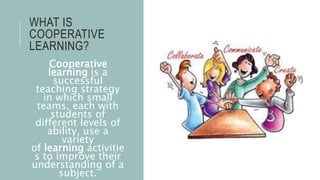
Cooperative
learning is a
successful
teaching strategy
in which small
teams, each with
students of
different levels of
ability, use a
variety
of learning activitie
s to improve their
understanding of a
subject.
LET’S LOOK AT THE DIFFERENCE
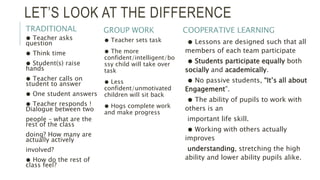
TRADITIONAL
● Teacher asks
question
● Think time
● Student(s) raise
hands
● Teacher calls on
student to answer
● One student answers
● Teacher responds !
Dialogue between two
people – what are the
rest of the class
doing? How many are
actually actively
involved?
● How do the rest of
class feel?
GROUP WORK
● Teacher sets task
● The more
confident/intelligent/bo
ssy child will take over
task
● Less
confident/unmotivated
children will sit back
● Hogs complete work
and make progress
COOPERATIVE LEARNING
● Lessons are designed such that all
members of each team participate
● Students participate equally both
socially and academically.
● No passive students, “It’s all about
Engagement”.
● The ability of pupils to work with
others is an
important life skill.
● Working with others actually
improves
understanding, stretching the high
ability and lower ability pupils alike.
TOOLS
1 2
3 4
NUMBERED CARD / PAPER
TIMER
NOW YOU ARE READY FOR
TO WORK!
RECORD
A piece of paper
Worksheets
Notebook
LET’S TRY AN ACTIVITY
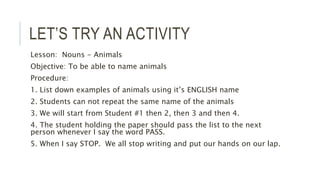
Lesson: Nouns - Animals
Objective: To be able to name animals
Procedure:
1. List down examples of animals using it’s ENGLISH name
2. Students can not repeat the same name of the animals
3. We will start from Student #1 then 2, then 3 and then 4.
4. The student holding the paper should pass the list to the next
person whenever I say the word PASS.
5. When I say STOP. We all stop writing and put our hands on our lap.
1SPELLING CHECKER
2REPEAT CHECKER
3LITTLE TEACHER
4REPORTER
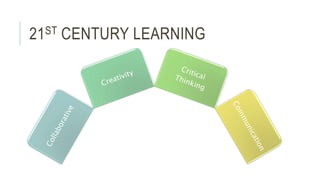
21ST CENTURY LEARNING
ACTIVITIES
Think-Pair-Share
WHAT DO YOU NEED TO DO?
Ask them to listen first to the instruction.
 Include a signal when they will start the activity
 Use transition words when giving instruction
Set time limit
 Use visual signal of the time lapsed
 Give them a signal when to go to the next part of the activity
Rotate the roles
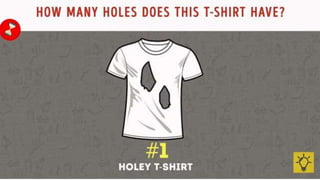
HOLEY SHIRT
Pairs
1 and 2
3 and 4
Instructions:
1. Look at the picture carefully.
2. Read the question
3. Think about your answer for 30 seconds
4. After 30 seconds, I will ask you to share your answer with your
partner and explain how you got your answer in 30 seconds.
5. Partners 1 and 3 will share first, then 2 and 4
SOCIAL STUDIES
THINK
Who are the
members of your
family?
PAIR
1 and 2
3 and 4
SHARE
Today all number
2 will share what
they learned
STAND - PAIR - SHARE
●Stand up
●Walk around room
●On teacher’s indication – find a partner (Pair)
 Person A talks first – Person B listens
 Person B summarizes what person A has said
●Swap roles
●Teacher asks for feedback
WORLD’S FAMILY
Video: The World Family
Questions to think about
What did you SEE in the video?
How did you FEEL while watching the video?
What did you LEARN from the video?
INSTANT STAR
(STUDENTS ARE RANDOMLY CALLED TO STAND AND SHARE WITH THEIR
TEAMMATES.)
1. Teacher asks a question.
2. Teacher calls for think time.
3. Teacher randomly calls a number.
4. The student on each team with that number stands and shares
her/his thought or answer with teammates.
5. For high consensus questions, teammates praise or coach, if
needed. For low consensus question, teammates praise the thinking
that went into the answer.
NUMBERED HEADS
•Each student in the team has a number
•Students work individually to solve a problem / answer a question.
(Use white boards or paper)
•They work individually to begin with and then share their answer
with the group and agree a group response
•Teacher selects a student to feedback to the rest of the class (e.g. –
all number 3s stand up and tell me….)
•This student stands up and shares with the whole class
FAN N PICK
● Students are given a set of prepared cards on a topic (these can be
prepared by the teacher or the students). On each card is a question
and an answer
● Partner A fans the cards
● Partner B chooses a card
● Partner B reads the card to Partner A
● If Partner A does not know the answer, Partner B coaches them to
reach the answer.
● Partner B praises Partner A and then roles are reversed
Cooperative learning inside the classroom

Cooperative learning inside the classroom

  • 1.
    COOPERATIVE LEARNING INSIDE THECLASSROOM SESSION 5 When 4 heads are better than one
  • 2.
    WHAT IS COOPERATIVE LEARNING? Cooperative learning isa successful teaching strategy in which small teams, each with students of different levels of ability, use a variety of learning activitie s to improve their understanding of a subject.
  • 4.
    LET’S LOOK ATTHE DIFFERENCE TRADITIONAL ● Teacher asks question ● Think time ● Student(s) raise hands ● Teacher calls on student to answer ● One student answers ● Teacher responds ! Dialogue between two people – what are the rest of the class doing? How many are actually actively involved? ● How do the rest of class feel? GROUP WORK ● Teacher sets task ● The more confident/intelligent/bo ssy child will take over task ● Less confident/unmotivated children will sit back ● Hogs complete work and make progress COOPERATIVE LEARNING ● Lessons are designed such that all members of each team participate ● Students participate equally both socially and academically. ● No passive students, “It’s all about Engagement”. ● The ability of pupils to work with others is an important life skill. ● Working with others actually improves understanding, stretching the high ability and lower ability pupils alike.
  • 6.
  • 7.
    1 2 3 4 NUMBEREDCARD / PAPER
  • 8.
  • 9.
    NOW YOU AREREADY FOR TO WORK!
  • 10.
    RECORD A piece ofpaper Worksheets Notebook
  • 11.
    LET’S TRY ANACTIVITY Lesson: Nouns - Animals Objective: To be able to name animals Procedure: 1. List down examples of animals using it’s ENGLISH name 2. Students can not repeat the same name of the animals 3. We will start from Student #1 then 2, then 3 and then 4. 4. The student holding the paper should pass the list to the next person whenever I say the word PASS. 5. When I say STOP. We all stop writing and put our hands on our lap.
  • 12.
  • 13.
  • 14.
  • 15.
    WHAT DO YOUNEED TO DO? Ask them to listen first to the instruction.  Include a signal when they will start the activity  Use transition words when giving instruction Set time limit  Use visual signal of the time lapsed  Give them a signal when to go to the next part of the activity Rotate the roles
  • 16.
    HOLEY SHIRT Pairs 1 and2 3 and 4 Instructions: 1. Look at the picture carefully. 2. Read the question 3. Think about your answer for 30 seconds 4. After 30 seconds, I will ask you to share your answer with your partner and explain how you got your answer in 30 seconds. 5. Partners 1 and 3 will share first, then 2 and 4
  • 19.
    SOCIAL STUDIES THINK Who arethe members of your family? PAIR 1 and 2 3 and 4 SHARE Today all number 2 will share what they learned
  • 20.
    STAND - PAIR- SHARE ●Stand up ●Walk around room ●On teacher’s indication – find a partner (Pair)  Person A talks first – Person B listens  Person B summarizes what person A has said ●Swap roles ●Teacher asks for feedback
  • 21.
    WORLD’S FAMILY Video: TheWorld Family Questions to think about What did you SEE in the video? How did you FEEL while watching the video? What did you LEARN from the video?
  • 22.
    INSTANT STAR (STUDENTS ARERANDOMLY CALLED TO STAND AND SHARE WITH THEIR TEAMMATES.) 1. Teacher asks a question. 2. Teacher calls for think time. 3. Teacher randomly calls a number. 4. The student on each team with that number stands and shares her/his thought or answer with teammates. 5. For high consensus questions, teammates praise or coach, if needed. For low consensus question, teammates praise the thinking that went into the answer.
  • 23.
    NUMBERED HEADS •Each studentin the team has a number •Students work individually to solve a problem / answer a question. (Use white boards or paper) •They work individually to begin with and then share their answer with the group and agree a group response •Teacher selects a student to feedback to the rest of the class (e.g. – all number 3s stand up and tell me….) •This student stands up and shares with the whole class
  • 24.
    FAN N PICK ●Students are given a set of prepared cards on a topic (these can be prepared by the teacher or the students). On each card is a question and an answer ● Partner A fans the cards ● Partner B chooses a card ● Partner B reads the card to Partner A ● If Partner A does not know the answer, Partner B coaches them to reach the answer. ● Partner B praises Partner A and then roles are reversed