Whitten Middle School
Eagle Ridge Conference Center
Cecilia Lemon Rice, Presenter
Victor Ellis, Principal
August 14, 2014
Every Child!Every Child!
Every Day!Every Day!
InclusionInclusion is theis the
Key toKey to
“Leave No Child Behind”“Leave No Child Behind”
 RITA PIERSON
 Inclusion is the process of meshingInclusion is the process of meshing
general and special education reformgeneral and special education reform
initiatives and strategies in order toinitiatives and strategies in order to
achieve aachieve a unifiedunified system of publicsystem of public
education that incorporateseducation that incorporates allall childrenchildren
and youth as active,and youth as active, fullyfully participatingparticipating
members of the school community; thatmembers of the school community; that
views diversity as theviews diversity as the normnorm; and that; and that
ensures a high quality of education forensures a high quality of education for
eacheach student by providing meaningfulstudent by providing meaningful
curriculum, effective teaching, andcurriculum, effective teaching, and
necessary supports fornecessary supports for eacheach student.student.
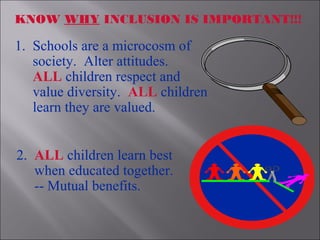
1. Schools are a microcosm of
society. Alter attitudes.
ALL children respect and
value diversity. ALL children
learn they are valued.
KNOW WHY INCLUSION IS IMPORTANT!!!
2. ALL children learn best
when educated together.
-- Mutual benefits.
It’s the law.It’s the law.
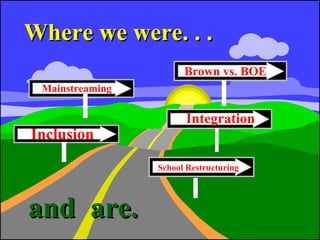
Brown vs. BOE
Mainstreaming
Integration
Inclusion
School Restructuring
Where we were. . .Where we were. . .
and are.and are.
It’s the rightIt’s the right
thing to do.thing to do.
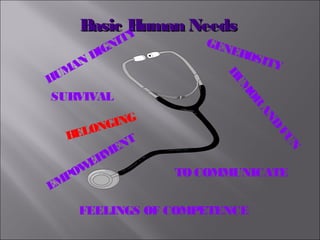
Basic Human NeedsBasic Human Needs
HUMAN DIGNITY
SURVIVAL
EMPOWERMENTBELONGING
GENEROSITY
HUM
OR
AND
FUN
FEELINGS OF COMPETENCE
TOCOMMUNICATE
Attitudes & PerceptionsAttitudes & Perceptions
About Classroom Climate:
 I feel accepted by teachers and
peers
 I experience a sense of comfort
and order
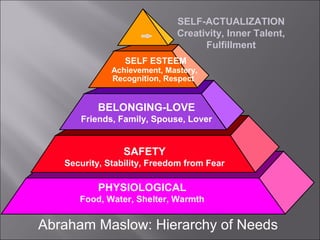
Abraham Maslow: Hierarchy of Needs
PHYSIOLOGICAL
Food, Water, Shelter, Warmth
SAFETY
Security, Stability, Freedom from Fear
BELONGING-LOVE
Friends, Family, Spouse, Lover
SELF ESTEEM
Achievement, Mastery,
Recognition, Respect
SELF-ACTUALIZATION
Creativity, Inner Talent,
Fulfillment
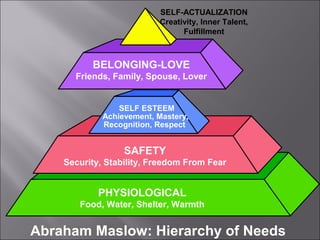
Abraham Maslow: Hierarchy of Needs
PHYSIOLOGICAL
Food, Water, Shelter, Warmth
SAFETY
Security, Stability, Freedom From Fear
BELONGING-LOVE
Friends, Family, Spouse, Lover
SELF ESTEEM
Achievement, Mastery,
Recognition, Respect
SELF-ACTUALIZATION
Creativity, Inner Talent,
Fulfillment
More accepting attitudes toward people with
disabilities. (Voeltz, 1980, 1982; Kishi, 1988; Evans et
al., 1992). Participation in integrated activities and
settings linked to positive attitudes toward peers
with disabilities. (CRI, 1992).
Increased achievement through cooperative learning
and peer tutoring activities (c.f., Johnson & Johnson,
1989; Kagan, 1992).
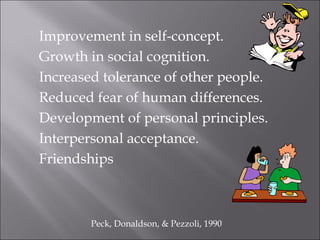
Benefits to StudentsBenefits to Students WithoutWithout DisabilitiesDisabilities
Improvement in self-concept.
Growth in social cognition.
Increased tolerance of other people.
Reduced fear of human differences.
Development of personal principles.
Interpersonal acceptance.
Friendships
Peck, Donaldson, & Pezzoli, 1990
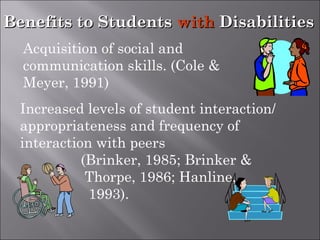
Benefits to StudentsBenefits to Students withwith DisabilitiesDisabilities
Increased levels of student interaction/
appropriateness and frequency of
interaction with peers
(Brinker, 1985; Brinker &
Thorpe, 1986; Hanline,
1993).
Acquisition of social and
communication skills. (Cole &
Meyer, 1991)
Benefits to StudentsBenefits to Students withwith DisabilitiesDisabilities
(con’t)(con’t)
Positive post-school adjustment and
employment after graduation
(Brown et al., 1987; Hasazi,
Gordon, & Roe, 1985).
Increased achievement of IEP
objectives (Brinker & Thorpe,
1984).
Benefits to StudentsBenefits to Students withwith DisabilitiesDisabilities
(cont)(cont)
Research on negative impact
of tracking and ability
grouping.
IEP
Higher quality IEPs developed for
students in general education
placements and integrated place-
ments (Hunt & Ferron-Davis, 1993;
Hunt, Goetz, & Anderson, 1986).
Children with disabilities achieve
just as well or better in general
education than special education
classes (ASCD, Jan. ’95).
Benefits to StudentsBenefits to Students withwith DisabilitiesDisabilities
(cont)(cont)
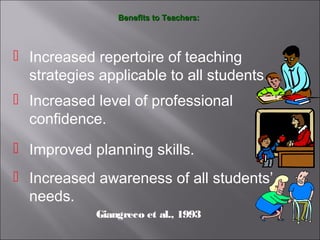
 Increased repertoire of teaching
strategies applicable to all students.
 Increased level of professional
confidence.
 Improved planning skills.
 Increased awareness of all students’
needs.
Giangreco et al., 1993
Benefits to Teachers:Benefits to Teachers:
Benefits to Teachers (con’t):
 Infusion of expertise: Two or more
trained professionals.
 Two or more approaches or styles of
teaching.
 Sharing ideas, responsibilities,
materials, resources.
 More than one person deciding on
supplemental, complementary, or
adapted instruction.
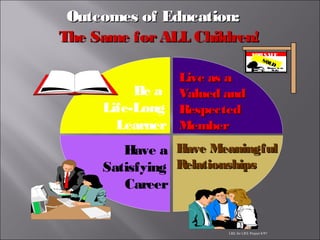
Have a
Satisfying
Career
LRE for LIFE Project 8/97
Outcomes of Education:Outcomes of Education:
FORSALE
Houses 'R' us
Realty
SOLD
Live as aLive as a
Valued andValued and
RespectedRespected
MemberMember
Have MeaningfulHave Meaningful
RelationshipsRelationships
Be a
Life-Long
Learner
The Same forALL Children!The Same forALL Children!
 On-going collaboration between co-teachers on
a regular/daily basis.
 Multiple teachers in a classroom to facilitate
instruction.
 A team-teaching approach that allows
flexibility in meeting the needs of all learners.
 A format that provides opportunities for
individual intern instruction delivery and
planning for small and large groups, and short
and long-term lessons that may incorporate a
variety of teaching strategies.
 On-going collaboration between co-teachers on
a regular/daily basis.
 Multiple teachers in a classroom to facilitate
instruction.
 A team-teaching approach that allows
flexibility in meeting the needs of all learners.
 A format that provides opportunities for
individual intern instruction delivery and
planning for small and large groups, and short
and long-term lessons that may incorporate a
variety of teaching strategies.
 One teacher teaching and one teacher sitting.
 One teacher planning and the other teacher
not.
 One teacher easily identified as primary
instructional leader and the other as an
assistant.
 One teacher that implements classroom
management responsibilities and the other that
only provides support.
 Co-teaching is one way to deliver services
to students with disabilities or other
special needs as part of a philosophy of
inclusive practices.
 WHAT ARE THEY?
 one teach, one support
 parallel teaching
 alternative teaching
 station teaching
 team teaching
 WHAT DO THEY LOOK LIKE?
 https://www.youtube.com/watch?v=gY9GeuCwW
 As a result, it shares many benefits with other
inclusion strategies, including a reduction in
stigma for students with special needs, an
increased understanding and respect for
students with special needs on the part of other
students, and the development of a sense of
heterogeneously-based classroom community.
 In co-taught classrooms, ALL students can
receive improved instruction. This includes
students who are academically gifted or
talented, students who have average ability,
students who are at risk for school failure as
well as students with identified special needs.
Teaching is one way to deliver services to
students with disabilities or other special needs
as part of a philosophy of inclusive practices.
 Although co-teaching is integral to the inclusive
practices in many schools, it is not a requirement
for inclusion to occur.
 Inclusion refers to a broad belief system or
philosophy embracing the notion that all
students should be welcomed members of a
learning community, and that all students are
part of their classrooms even if their abilities
differ.
 ONE TEACH, ONE SUPPORT
 ONE TEACH ONE SUPPORT
 SHARED PLANNING
 PHYSICAL CONFIGURATION OF
CLASSROOM
 SEAMLESS INSTRUCTION AND FLOW
FROM ONE ACTIVITY TO THE NEXT
 SHARED CLASSROOM INSTRUCTION
 SHARED CLASSROOM MANAGEMENT
 PROFESSIONALISM AND RESPECT
WHITTEN INCLUSION PD WITH COTEACHING

WHITTEN INCLUSION PD WITH COTEACHING

  • 1.
    Whitten Middle School EagleRidge Conference Center Cecilia Lemon Rice, Presenter Victor Ellis, Principal August 14, 2014
  • 2.
    Every Child!Every Child! EveryDay!Every Day! InclusionInclusion is theis the Key toKey to “Leave No Child Behind”“Leave No Child Behind”
  • 3.
  • 5.
     Inclusion isthe process of meshingInclusion is the process of meshing general and special education reformgeneral and special education reform initiatives and strategies in order toinitiatives and strategies in order to achieve aachieve a unifiedunified system of publicsystem of public education that incorporateseducation that incorporates allall childrenchildren and youth as active,and youth as active, fullyfully participatingparticipating members of the school community; thatmembers of the school community; that views diversity as theviews diversity as the normnorm; and that; and that ensures a high quality of education forensures a high quality of education for eacheach student by providing meaningfulstudent by providing meaningful curriculum, effective teaching, andcurriculum, effective teaching, and necessary supports fornecessary supports for eacheach student.student.
  • 7.
    1. Schools area microcosm of society. Alter attitudes. ALL children respect and value diversity. ALL children learn they are valued. KNOW WHY INCLUSION IS IMPORTANT!!! 2. ALL children learn best when educated together. -- Mutual benefits.
  • 8.
  • 9.
    Brown vs. BOE Mainstreaming Integration Inclusion SchoolRestructuring Where we were. . .Where we were. . . and are.and are.
  • 10.
    It’s the rightIt’sthe right thing to do.thing to do.
  • 11.
    Basic Human NeedsBasicHuman Needs HUMAN DIGNITY SURVIVAL EMPOWERMENTBELONGING GENEROSITY HUM OR AND FUN FEELINGS OF COMPETENCE TOCOMMUNICATE
  • 12.
    Attitudes & PerceptionsAttitudes& Perceptions About Classroom Climate:  I feel accepted by teachers and peers  I experience a sense of comfort and order
  • 13.
    Abraham Maslow: Hierarchyof Needs PHYSIOLOGICAL Food, Water, Shelter, Warmth SAFETY Security, Stability, Freedom from Fear BELONGING-LOVE Friends, Family, Spouse, Lover SELF ESTEEM Achievement, Mastery, Recognition, Respect SELF-ACTUALIZATION Creativity, Inner Talent, Fulfillment
  • 14.
    Abraham Maslow: Hierarchyof Needs PHYSIOLOGICAL Food, Water, Shelter, Warmth SAFETY Security, Stability, Freedom From Fear BELONGING-LOVE Friends, Family, Spouse, Lover SELF ESTEEM Achievement, Mastery, Recognition, Respect SELF-ACTUALIZATION Creativity, Inner Talent, Fulfillment
  • 15.
    More accepting attitudestoward people with disabilities. (Voeltz, 1980, 1982; Kishi, 1988; Evans et al., 1992). Participation in integrated activities and settings linked to positive attitudes toward peers with disabilities. (CRI, 1992). Increased achievement through cooperative learning and peer tutoring activities (c.f., Johnson & Johnson, 1989; Kagan, 1992). Benefits to StudentsBenefits to Students WithoutWithout DisabilitiesDisabilities
  • 16.
    Improvement in self-concept. Growthin social cognition. Increased tolerance of other people. Reduced fear of human differences. Development of personal principles. Interpersonal acceptance. Friendships Peck, Donaldson, & Pezzoli, 1990
  • 17.
    Benefits to StudentsBenefitsto Students withwith DisabilitiesDisabilities Increased levels of student interaction/ appropriateness and frequency of interaction with peers (Brinker, 1985; Brinker & Thorpe, 1986; Hanline, 1993). Acquisition of social and communication skills. (Cole & Meyer, 1991)
  • 18.
    Benefits to StudentsBenefitsto Students withwith DisabilitiesDisabilities (con’t)(con’t) Positive post-school adjustment and employment after graduation (Brown et al., 1987; Hasazi, Gordon, & Roe, 1985). Increased achievement of IEP objectives (Brinker & Thorpe, 1984).
  • 19.
    Benefits to StudentsBenefitsto Students withwith DisabilitiesDisabilities (cont)(cont) Research on negative impact of tracking and ability grouping. IEP Higher quality IEPs developed for students in general education placements and integrated place- ments (Hunt & Ferron-Davis, 1993; Hunt, Goetz, & Anderson, 1986).
  • 20.
    Children with disabilitiesachieve just as well or better in general education than special education classes (ASCD, Jan. ’95). Benefits to StudentsBenefits to Students withwith DisabilitiesDisabilities (cont)(cont)
  • 21.
     Increased repertoireof teaching strategies applicable to all students.  Increased level of professional confidence.  Improved planning skills.  Increased awareness of all students’ needs. Giangreco et al., 1993 Benefits to Teachers:Benefits to Teachers:
  • 22.
    Benefits to Teachers(con’t):  Infusion of expertise: Two or more trained professionals.  Two or more approaches or styles of teaching.  Sharing ideas, responsibilities, materials, resources.  More than one person deciding on supplemental, complementary, or adapted instruction.
  • 23.
    Have a Satisfying Career LRE forLIFE Project 8/97 Outcomes of Education:Outcomes of Education: FORSALE Houses 'R' us Realty SOLD Live as aLive as a Valued andValued and RespectedRespected MemberMember Have MeaningfulHave Meaningful RelationshipsRelationships Be a Life-Long Learner The Same forALL Children!The Same forALL Children!
  • 24.
     On-going collaborationbetween co-teachers on a regular/daily basis.  Multiple teachers in a classroom to facilitate instruction.  A team-teaching approach that allows flexibility in meeting the needs of all learners.  A format that provides opportunities for individual intern instruction delivery and planning for small and large groups, and short and long-term lessons that may incorporate a variety of teaching strategies.
  • 26.
     On-going collaborationbetween co-teachers on a regular/daily basis.  Multiple teachers in a classroom to facilitate instruction.  A team-teaching approach that allows flexibility in meeting the needs of all learners.  A format that provides opportunities for individual intern instruction delivery and planning for small and large groups, and short and long-term lessons that may incorporate a variety of teaching strategies.
  • 27.
     One teacherteaching and one teacher sitting.  One teacher planning and the other teacher not.  One teacher easily identified as primary instructional leader and the other as an assistant.  One teacher that implements classroom management responsibilities and the other that only provides support.

  • 28.
     Co-teaching isone way to deliver services to students with disabilities or other special needs as part of a philosophy of inclusive practices.
  • 29.
     WHAT ARETHEY?  one teach, one support  parallel teaching  alternative teaching  station teaching  team teaching  WHAT DO THEY LOOK LIKE?  https://www.youtube.com/watch?v=gY9GeuCwW
  • 30.
     As aresult, it shares many benefits with other inclusion strategies, including a reduction in stigma for students with special needs, an increased understanding and respect for students with special needs on the part of other students, and the development of a sense of heterogeneously-based classroom community.
  • 31.
     In co-taughtclassrooms, ALL students can receive improved instruction. This includes students who are academically gifted or talented, students who have average ability, students who are at risk for school failure as well as students with identified special needs. Teaching is one way to deliver services to students with disabilities or other special needs as part of a philosophy of inclusive practices.
  • 32.
     Although co-teachingis integral to the inclusive practices in many schools, it is not a requirement for inclusion to occur.  Inclusion refers to a broad belief system or philosophy embracing the notion that all students should be welcomed members of a learning community, and that all students are part of their classrooms even if their abilities differ.
  • 33.
     ONE TEACH,ONE SUPPORT  ONE TEACH ONE SUPPORT
  • 36.
     SHARED PLANNING PHYSICAL CONFIGURATION OF CLASSROOM  SEAMLESS INSTRUCTION AND FLOW FROM ONE ACTIVITY TO THE NEXT  SHARED CLASSROOM INSTRUCTION  SHARED CLASSROOM MANAGEMENT  PROFESSIONALISM AND RESPECT