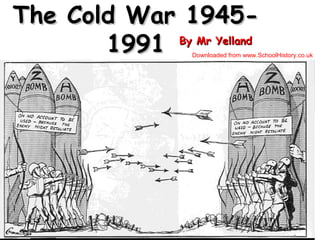
The Cold War 1945-
       1991 By Mr Yelland
                  Downloaded from www.SchoolHistory.co.uk
Improve your knowledge
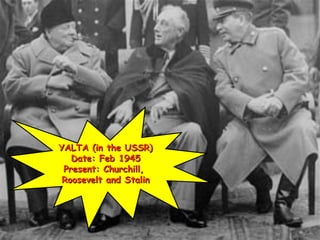
• Yalta was the the penultimate of the
  wartime allied conferences. It dealt mainly
  with the settlement of post-war Europe.

  Allegedly FD Roosevelt was too ill to
  withstand Stalin’s demands, and his
  successor, Harry S Truman, took a tougher
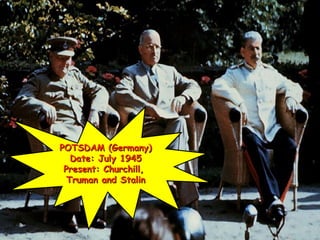
  line. By by the time of the Potsdam
  Conference in July 1945, the West had the
  bomb and were anxious to restrict Russia.
YALTA (in the USSR)
   Date: Feb 1945
 Present: Churchill,
 Roosevelt and Stalin
POTSDAM (Germany)
   Date: July 1945
 Present: Churchill,
  Truman and Stalin
Improve your knowledge
• The Russians took very high casualties to
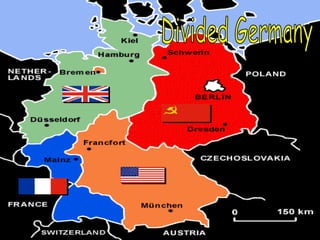
  capture Berlin in May 1945. They spent the
  early occupation trying to take over all
  zones of the city but were stopped by
  German democrats such as Willy Brandt
  and Konrad Adenauer. Reluctantly the
  Russians had to admit the Americans,
  French and British to their respective
  zones.
Iron Curtain –
A term used by
Winston Churchill
to describe the
separating of
Those communist
lands of East
Europe from the
West.
Improve your knowledge
• The nuclear bomb gave America a lead
  which was expected to last at least 5
  years. The rapid Russian development of
  nuclear technology, helped by the work of
  the “atom spies” was a shock.

  Significantly, Russia hurriedly declared
  war against Japan at the beginning of
  August 1945 and rushed to advance into
  Asia to stake out a position for the post-
  war settlement. This helped make both the
  Korean and Vietnamese conflicts more
  likely.
Improve your knowledge
      • Truman had been horrified at the pre-war
        Allied policy of appeasement and was
        determined to stand upto any Soviet
        intimidation.
        The Truman Doctrine in March 1947
        promised that the USA “would support
        free peoples who are resisting
        subjugation by armed minorities or by
        outside pressures”. Triggered by British
        inability to hold the line in Greece, it was
        followed by aid to Greece and Turkey, and
        also money to secure upcoming elections
        in Italy and the advance of Communist
        trade unions in France.
        It signalled the end of “isolationst”
        policies.
Improve your knowledge
• The Marshall Plan reflected the strength of the
  US economy and offered huge sums to enable the
  war shattered economies of Europe to rebuild and,
  by generating prosperity, to reject the appeal of
  Communism, Czechoslovakia showed interest in
  receiving Marshall Aid but was blocked by Russia.

  The Soviet system was as much dependent upon
  creating a self-contained economic bloc as it was
  in maintaining a repressive political system.
Improve your knowledge
• West Berlin, as an outpost of Western democracy
  and economic success deep within the Communist
  zone, was both a nest of spies for both sides and a
  constant challenge to the Soviets.
  The Berlin Blockade was an attempt to starve the
  city into submission and the Allied airlift signalled
  the West’s determination to use all resources to
  defend Berlin.
  Thereafter, it was accepted by both sides that
  Berlin would act as the trigger for general war. Any
  Russian invasion would be followed by conflict with
  the considerable Allied forces camped permanently
  on the plain of West Germany. Both sides finding
  Europe too dangerous a site for confrontation,
  looked elsewhere to compete.
Improve your knowledge
• The “Red Scare”, launched by Senator Joe
  McCarthy, dominated US politics for
  several years 1948-53 and helped pressure
  Truman into the Korean War, a costly and
  ultimately stalemated conflict. Given the
  suddeness of the fall of China, the
  development of the Soviet bomb, and the
  shocking performance of the Western
  secret services, the level of panic is
  understandable.
Improve your knowledge
• Truman restricted his ant-Soviet policy to one of “containment”,
  resisting the advance of Communism into South Korea. After some
  hesitation he resisted his Commander, Gen Douglas MacArthur’s
  attempt to “roll-back” Communism by invading North Korea and
  China.
  MacArthur was dismissed but Truman’s successors continued to
  be drawn into conflicts of containment for the rest of the cold
  war. The beginning of the Korean War also highlighted the failings
  of the United Nations.
  Up to 1950, Russia and America had respectively blocked each
  other’s iniatives by using their veto powers in the Security
  Council. Because the Russian delegates were boycotting the UN in
  1950, Truman was able to condemn the Communist invasion of S
  Korea and to set up a counter-attack under the banner of the UN.
  In contrast to the pre-War League of Nations, at least this
  ensured that the UN would, in future, be able to deploy force in
  international disputes.

Cold War

  • 1.
    The Cold War1945- 1991 By Mr Yelland Downloaded from www.SchoolHistory.co.uk
  • 3.
    Improve your knowledge •Yalta was the the penultimate of the wartime allied conferences. It dealt mainly with the settlement of post-war Europe. Allegedly FD Roosevelt was too ill to withstand Stalin’s demands, and his successor, Harry S Truman, took a tougher line. By by the time of the Potsdam Conference in July 1945, the West had the bomb and were anxious to restrict Russia.
  • 4.
    YALTA (in theUSSR) Date: Feb 1945 Present: Churchill, Roosevelt and Stalin
  • 5.
    POTSDAM (Germany) Date: July 1945 Present: Churchill, Truman and Stalin
  • 6.
    Improve your knowledge •The Russians took very high casualties to capture Berlin in May 1945. They spent the early occupation trying to take over all zones of the city but were stopped by German democrats such as Willy Brandt and Konrad Adenauer. Reluctantly the Russians had to admit the Americans, French and British to their respective zones.
  • 7.
    Iron Curtain – Aterm used by Winston Churchill to describe the separating of Those communist lands of East Europe from the West.
  • 8.
    Improve your knowledge •The nuclear bomb gave America a lead which was expected to last at least 5 years. The rapid Russian development of nuclear technology, helped by the work of the “atom spies” was a shock. Significantly, Russia hurriedly declared war against Japan at the beginning of August 1945 and rushed to advance into Asia to stake out a position for the post- war settlement. This helped make both the Korean and Vietnamese conflicts more likely.
  • 9.
    Improve your knowledge • Truman had been horrified at the pre-war Allied policy of appeasement and was determined to stand upto any Soviet intimidation. The Truman Doctrine in March 1947 promised that the USA “would support free peoples who are resisting subjugation by armed minorities or by outside pressures”. Triggered by British inability to hold the line in Greece, it was followed by aid to Greece and Turkey, and also money to secure upcoming elections in Italy and the advance of Communist trade unions in France. It signalled the end of “isolationst” policies.
  • 10.
    Improve your knowledge •The Marshall Plan reflected the strength of the US economy and offered huge sums to enable the war shattered economies of Europe to rebuild and, by generating prosperity, to reject the appeal of Communism, Czechoslovakia showed interest in receiving Marshall Aid but was blocked by Russia. The Soviet system was as much dependent upon creating a self-contained economic bloc as it was in maintaining a repressive political system.
  • 11.
    Improve your knowledge •West Berlin, as an outpost of Western democracy and economic success deep within the Communist zone, was both a nest of spies for both sides and a constant challenge to the Soviets. The Berlin Blockade was an attempt to starve the city into submission and the Allied airlift signalled the West’s determination to use all resources to defend Berlin. Thereafter, it was accepted by both sides that Berlin would act as the trigger for general war. Any Russian invasion would be followed by conflict with the considerable Allied forces camped permanently on the plain of West Germany. Both sides finding Europe too dangerous a site for confrontation, looked elsewhere to compete.
  • 12.
    Improve your knowledge •The “Red Scare”, launched by Senator Joe McCarthy, dominated US politics for several years 1948-53 and helped pressure Truman into the Korean War, a costly and ultimately stalemated conflict. Given the suddeness of the fall of China, the development of the Soviet bomb, and the shocking performance of the Western secret services, the level of panic is understandable.
  • 13.
    Improve your knowledge •Truman restricted his ant-Soviet policy to one of “containment”, resisting the advance of Communism into South Korea. After some hesitation he resisted his Commander, Gen Douglas MacArthur’s attempt to “roll-back” Communism by invading North Korea and China. MacArthur was dismissed but Truman’s successors continued to be drawn into conflicts of containment for the rest of the cold war. The beginning of the Korean War also highlighted the failings of the United Nations. Up to 1950, Russia and America had respectively blocked each other’s iniatives by using their veto powers in the Security Council. Because the Russian delegates were boycotting the UN in 1950, Truman was able to condemn the Communist invasion of S Korea and to set up a counter-attack under the banner of the UN. In contrast to the pre-War League of Nations, at least this ensured that the UN would, in future, be able to deploy force in international disputes.