What is Green Tourism?
• IS DEFINED AS ENVIRONMENTALLY
FRIENDLY TOURISM ACTIVITIES WITH VARIOUS
FOCUSES AND MEANINGS.
• IN A BROAD TERM, GREEN TOURISM IS ABOUT
BEING AN ENVIRONMENTALLY
FRIENDLY TOURIST OR PROVIDING
ENVIRONMENTALLY FRIENDLY TOURIST SERVICES.
What is Green Tourism?
• GREEN TOURISM IS THE TERM USED TO DESCRIBE
BEST ENVIRONMENTAL PRACTICE WITHIN THE
TOURISM SECTOR.
• IT COVERS ISSUES SUCH AS BUSINESS EFFICIENCY,
ENVIRONMENTAL MANAGEMENT, WASTE,
TRANSPORT, AS WELL AS TOPICS LIKE SOCIAL
RESPONSIBILITY AND BIODIVERSITY.
WHAT IS GTBS?
 The Green Tourism Business Scheme (GTBS) is an accreditation scheme for
tourism and tourism related businesses relating to environmental good practice.
The GTBS is increasingly recognised as the most appropriate UK scheme for
green accreditation for tourism businesses.
SOUTH AMERICA
Sustainable Travel & Ecotourism
• South America is one of the planet's prime ecotourism destinations. Many of
the isolated nature lodges and tour operators around the country are
and dedicated professionals in the ecotourism and sustainable tourism field.
• Many other hotels, lodges, and tour operators are simply "green-washing,"
the terms "eco" and "sustainable" in their promo materials, but doing little
good in their daily operations.
• Deforestation is the main threat to South America's fragile ecosystem. Farming
has virtually wiped out most of the region's rainforests, and logging is a major
threat. Such destruction has been devastating to many species, including man
himself, in the form of displaced indigenous tribes, and has led to drinking-water
shortages, flash flooding, and mud slides.
• Though environmental awareness is growing, solving the region's huge
environmental problems, including not just deforestation but the effects of
overpopulation and industrial pollution, clearly remains an uphill struggle. Your
hotel will often be your best bet for finding a place to deposit recyclable waste,
especially if you choose a hotel that has instituted sustainable practices.
• Hotel Cala Mia is Certified GTA Green Leader Status for Sustainable Tourism Management.
• The eleven private bungalows each have water views and come with spacious outdoor
living area, king or double beds with luxurious linens, full baths with walk-in showers
offering unlimited hot water. The Hotel is completely solar powered, with a supporting
farm providing organic cheeses, cream and butter, as well as rice, vegetables and fruit.
CASA CALMA WELLNESS HOTEL – BUENOS AIRES – ARGENTINA
• Casa Calma is Certified GTA Green Champion for Sustainable Tourism
Management.
• Personality and technology combined with innovative design, light woods
and soft colours are joined in a warm style.
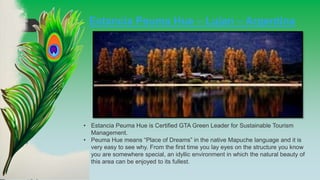
Estancia Peuma Hue – Lujan – Argentina
• Estancia Peuma Hue is Certified GTA Green Leader for Sustainable Tourism
Management.
• Peuma Hue means “Place of Dreams” in the native Mapuche language and it is
very easy to see why. From the first time you lay eyes on the structure you know
you are somewhere special, an idyllic environment in which the natural beauty of
this area can be enjoyed to its fullest.
Inkaterra Machu Picchu Hotel – Cusco – Peru
• Inkaterra Machu Picchu Hotel is Awarded GTA Green Leader Status for Sustainable
Tourism Management.
• At Inkaterra Machu Picchu you also may enjoy the benefits of a de-stress massage at
the mystical UNU Spa, and have the opportunity to participate in group eco-activities,
such as bird watching or a guided orchid walk, offered on the 12-acre grounds.
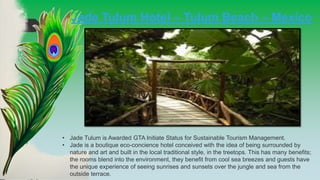
Jade Tulum Hotel – Tulum Beach – Mexico
• Jade Tulum is Awarded GTA Initiate Status for Sustainable Tourism Management.
• Jade is a boutique eco-concience hotel conceived with the idea of being surrounded by
nature and art and built in the local traditional style, in the treetops. This has many benefits;
the rooms blend into the environment, they benefit from cool sea breezes and guests have
the unique experience of seeing sunrises and sunsets over the jungle and sea from the
outside terrace.
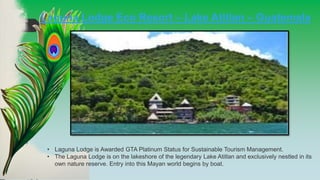
• Laguna Lodge is Awarded GTA Platinum Status for Sustainable Tourism Management.
• The Laguna Lodge is on the lakeshore of the legendary Lake Atitlan and exclusively nestled in its
own nature reserve. Entry into this Mayan world begins by boat.
Laguna Lodge Eco Resort – Lake Atitlan – Guatemala
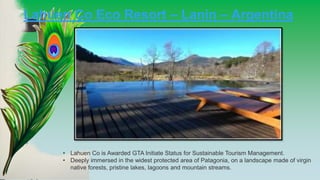
Lahuen Co Eco Resort – Lanin – Argentina
• Lahuen Co is Awarded GTA Initiate Status for Sustainable Tourism Management.
• Deeply immersed in the widest protected area of Patagonia, on a landscape made of virgin
native forests, pristine lakes, lagoons and mountain streams.
Zimbali Retreats – Little London – Jamaica
• Zimbali Retreat is Awarded GTA Gold Status for Sustainable Tourism Management.
• Experience an ancient way of life and discover a truly unique culture whose blend of love
and nature is famous throughout the world. Drink from natural springs, swim in rivers and
get a massage from the waterfall. Zimbali Mountain Retreat is a fusion of modern
technology with an ancient way of life; a place to Retreat in complete comfort, while you
reconnect with Mother Nature and yourself.
ARGENTINA
 Gold mining in San Juan, soya planting in El Chaco, global warming in South
Patagonia, and pulp milling on the River Plate are all hot environmental issues in
Argentina at the moment. Despite having one of the best national park systems
in the region, the country's protected areas are under threat from encroaching
development.
 On the bright side is a growing awareness amongst the populace that they are in
danger of losing what they have. A forest preservation law was introduced in
2007 prohibiting deforestation, and Mendoza's provincial congress issued a
blanket ban on mining, though it was later overturned by the governor.
Argentina's main weapon against environmental damage is its utter vastness and
under population, yet lax government control, little tradition for conservation,
and rampant development are all cause for concern.
BOLIVIA
 Bolivia, one of the world's most biodiverse countries on earth, is home to 60
protected areas, including 22 national parks, which covers an impressive 15% of
its total territory. Many of the protected areas, however, are in constant threat
from oil companies and loggers, who seemingly avoid any crackdowns from the
government. The extraction of the significant lithium reserves in southwest Bolivia
had led to frequent protests around Uyuni, but thus far they remain untapped.
Natural gas reserves, once a significant source of revenue for Bolivia, have lost
their value; as buyers in neighboring countries turn elsewhere, new explorations
have come to a halt.
 Only a few hotels have jumped on the green train in Bolivia thus far, including La
Posada del Inca on Isla del Sol and Chalalan Ecolodge in Madidi National Park.
BRAZIL
 Brazilian resorts and tour operators do advertise "ecotourism," but in Brazil this means
anything that takes place in the outdoors, be it leave-only-footprints nature hikes or
churn-up-the-wildlife ATV expeditions. It does not signify lodges or hotels with solar
heating or clever ways of dealing with waste water, or even outdoor operators that
take particular care of their local ecosystems.
 In Brazil's two most vulnerable remaining ecosystems -- the Pantanal and the Amazon
-- there are tourism operators who strive to protect their local ecosystems. In the
Pantanal the Araras Eco Lodge and the Jaguar Ecological Reserve have helped to
popularize the private ecological reserve, a Brazilian program through which the
government provides tax breaks in return for a landowner committing to preserving a
portion of his in perpetuity. The presence of ecotourism operators in the Pantanal has
also provided a lobby to counter certain ill-advised development schemes, including
the paving of the Transpantaneira highway, and the widening, straightening, and
deepening of the Rio Paraguay, the better to transport soybeans to the coast.
 In the Amazon, the Pousada Uakarí serves as an integral part of the Mamiraua
Sustainable Development Institute (www.mamiraua.org.br), a project designed to
preserve the habitat of the Uakarí monkey while improving the living standards of
local human populations living in and around the Uakarí reserve. Other Amazon
lodges come nowhere near this standard, though they do provide some local
employment for guides and other lodge staff. Unfortunately, the miniscule scale of
ecotourism operations in comparison with the employment and revenues
generated by the timber and cattle industries has rendered ecotourism a nonplayer
in the debate over preserving the Amazon.
 However, one could argue that those who experience the Amazon become more
likely to lobby to save it. Certainly, awareness of the importance of the Amazon,
both globally and in Brazil, has led to the passage in Brazil of a range of reasonably
stringent preservation measures, including parks, reserves, Indian reservations,
national forest lands, and restrictions on deforestation on private landholdings. The
problem in Brazil is that these regulations are often not respected, while
enforcement on the ground remains weak. Still, rates of deforestation in the
Brazilian Amazon have declined, from a 2004 peak of 27,400 sq. km (16,686 sq.
miles, an area somewhat larger than Vermont) to 12,911 sq. km (5,035 sq. miles, an
area somewhat smaller than Connecticut) in 2008.
CHILE
 The principal environmental problems that confront Chile are deforestation and
air, water, and land pollution. Santiago is one of Latin America's most polluted
cities, and air pollution there has become an acute problem; children and the
elderly and infirm are frequently advised to stay indoors for days on end due to
dangerous levels of toxic pollutants that enshroud the capital. Rapid urban
expansion, industrial emissions from the copper mining sector, and the increased
volume of car traffic are cited as the main causes of Santiago's air pollution.
Mining is responsible for releasing the chief air and water pollutants, including
sulfur dioxide and arsenic. In 2000, the city faced an unprecedented pollution
emergency when over 200,000 vehicles were prohibited from driving on the
roads and offending industries were shut down. Fortunately, in the last few years,
environmental issues have taken a more prominent role in domestic politics and,
while the pace is slow, government initiatives have gone a long way to improving
the situation.
 The indiscriminate logging of Chile's temperate forests has resulted in the tragic
disappearance of thousand-year-old forests. The most publicized case of illegal
logging, which has been taken up by environmental agencies, including
Greenpeace, is that of the rare alerce tree, which is found in the Andes and can live
for up to 3,500 years. Many animals are in serious risk of extinction throughout the
country, as well. As of 2001, of the 91 listed mammals in Chile, some 16 species
were registered as endangered. Almost 5% of Chile's 298 breeding bird species are
threatened with extinction, most notably the tundra peregrine falcon, the Chilean
woodstar, and the ruddy-headed goose. Also threatened are four types of
freshwater fish and over 250 plant species.
 Chile hasn't made great strides in the sustainable accommodations arena, although
eco-conscious lodges are popping up in Patagonia and the Lake District.
COLOMBIA
 Colombia is facing significant environmental risks. At the current rate of
deforestation, experts estimate that Colombia's jungles will completely disappear
by the year 2050. The logging, mining, gold, and emerald trade, as well as the
illicit coca trade, has caused massive deforestation at a rate of 1.5 to 2 million
acres a year. Mountain scraping for farming has caused previously forested and
vegetated areas to turn into semi-arid desert zones, and road and home
construction in rural areas is threatening the country's biodiversity. In addition,
improperly disposed sewage, pesticides, and herbicides have contaminated many
of the country's rivers and lakes, making the water undrinkable. Factory and car
pollution continues to be a major problem in cities.
ECUADOR
 Oil exploration and mining operations continue to be the biggest environmental
threats in Ecuador. In addition to impacting the environment, these activities also
impact a variety of indigenous groups, whose way of life, culture, and ancestral
homelands are severely threatened. This has led to numerous protests, and
sometimes violent clashes between indigenous groups and the government. The
Galápagos Islands present their own special set of challenges in terms of
environmental protection and sustainable development issues. Isolated, unique,
and delicate, the Galápagos are threatened by overexposure to tourists, over
fishing, and the introduction of non-native species.
PARAGUAY
 Deforestation is the main concern in Paraguay, as big agro-businesses come from
Brazil and Argentina to clear forests and plant genetically modified plants. On
paper the country has an impressive list of parks and reserves, but because of
poor public access, underfunded government bodies, and corrupt local officials,
it seems the only people that get to enter these biologically diverse areas are
ranchers and lumber companies.
PERU
 Peru has 72 million hectares (178 million acres) of natural-growth forests -- 70% in the
Amazon jungle region -- that comprise nearly 60% of the national territory. Peru has
done a slightly better job of setting aside tracts of rainforest as national park reserves
and regulating industry than have some other Latin American and Asian countries.
The Manu Biosphere Reserve, the Tambopata National Reserve, and the Pacaya-
Samiria National Reserve are three of the largest protected rainforest areas in the
world, and the government regulates entry of tour groups. Peru augmented the
Bahuaja-Sonene National Park, which was created in 1996, by 809,000 hectares (nearly
2 million acres) in 2001. INRENA, Peru's Institute for Natural Resource Management,
enforces logging regulations and reseeds Peru's Amazon forests, and in 2008,
President Alan García created the country's first Ministry of the Environment. A
handful of Peruvian and international environmental and conservation groups, such as
ProNaturaleza and Conservation International, are active in Peru, working on
sustainable forestry projects.
 Yet Peru is losing nearly 300,000 hectares (740,000 acres) of rainforest annually. The
primary threats to Peru's tropical forests are deforestation caused by agricultural
expansion, cattle ranching, logging, oil extraction and spills, mining, illegal coca
farming, and colonization initiatives. Deforestation has shrunk territories belonging
to indigenous peoples and wiped out more than 90% of the population. (There
were once some six million people, 2,000 tribes and/or ethnic groups, and
innumerable languages in the Amazon basin; today the indigenous population is
less than two million.) Jungle ecotourism has exploded in Peru, and rainforest
regions are now much more accessible than they once were, with more lodges and
eco-options than ever. Many are taking leading roles in sustainable tourism even as
they introduce protected regions to more travelers.
URUGUAY
 Uruguay is often called the most European country in South America, not least
because most of its natural forests have been cleared for agriculture and there is
little or nothing left of large wildlife indigenous to the region. The few nature
reserves that exist offer little out of the ordinary, though there are some seal
colonies worth visiting along the coast. The hot environmental issue at the
moment is a dispute with Argentina over two massive pulp mills built on the
Uruguayan side of the River Plate, which are badly polluting the riverway. The
Uruguayans have denied this claim.
VENEZUELA
 Since over 90% of Venezuela's population lives in a narrow urban belt along the
northern coast, much of the interior is seldom visited and oft forgotten. Still,
Venezuela has the third-highest rate of deforestation in South America, and the
country's oil industry has caused massive environmental destruction in the Lake
Maracaibo area, and to a lesser extent in Los Llanos. Gold, iron, bauxite and coal
mining operations have also had a negative impact on the environment. That
said, Venezuela has the largest percentage of protected land, with some 55% of
its total territory protected in some form or another.
10 Latin America Ecotourism
Adventures
 ROCK CLIMBING IN PATAGONIA
 Discovered by Ferdinand Magellan in 1520, Patagonia is a pristine expanse of dry,
desolate land occupying 260,000 square miles in southern Argentina and Chile.
region is equally well known for its abundant wildlife (including condors, pumas
and guanacos) and dramatic mountain peaks, which attract trekkers from all
around the world. The area around the Northern Patagonia city of Bariloche
a variety of well-bolted rock-climbing routes to challenge enthusiasts of all skill
levels, with favorite spots such as Virgen de las Nieves and Piedras Blancos rated
from 5.6 to 5.14 for their degree of difficulty. Whichever route you choose, you’re
assured stunning vistas of the remote land that National Geographic has called
“Eden at the End of the World.”
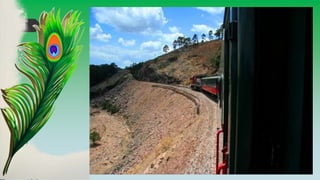
 EXPLORING MEXICO’S COPPER CANYON
 Located in northern Mexico just a few hundred miles south of El Paso, buried in
the heart of the Sierra Madre Mountains, the remote and rugged Copper
one of the continent’s largest canyon systems. “Hike and Bike” tours offer a
way for hardy travelers to experience the area’s natural wonders. You can board
Chihuahua al Pacifico train for the 180-mile jaunt from El Fuerte to Divisadero,
soaking in desert scenery and towering canyon walls that seem like something
straight out of a John Wayne western along the way. From there, you can take a
short trek on foot before mountain biking past unique rock formations, waterfalls,
pueblos and cave dwellings, gradually journeying from the historical mining
of Batopilas to the Lost Cathedral of Satevo and walking the ancient trails of the
Tarahumara Indians.
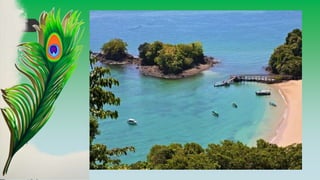
 GETTING IN TOUCH WITH NATURE IN PANAMA
 Referred to by some as “the new Galapagos,” Panama’s 1,053 sq. mile Coiba
Island National Park remains largely unspoiled thanks to the fact that the island
was home to a penal colony from 1919 to 2004 and requires permission from the
National Environment Authority (ANAM) to visit. The largest island in all of
America, about 75% of Coiba is virgin tropical forest, while 80% of the park is
oceanic, filled with myriad whales, bottle-nosed dolphins, marine turtles and rare
tropical fish that make it a haven for avid divers. Located 50 minutes by plane or
hours by car from Panama City, this eco-tourist haven is definitely a bit off the
beaten path, but well worth the visit.
 HANG GLIDING & PARAGLIDING IN ECUADOR
 Located on the northwest coast of Ecuador near Bahia, Canoa is an extremely
back beach town popular among surfers and expats, but not so much with
It’s small and sleepy, without a single ATM to be found. But the steady winds and
the gentle cliffs that surround Canoa create perfect conditions for hang gliding
paragliding over the picturesque beach, and the town has played host to the
Open Hang Gliding Championship since 2010. You don’t necessarily need any
experience to fly, as tandem flights are available for beginners starting at $45. But
those seeking serious air time can get more intensive training, with operators
as the Surf Shak offering more in-depth courses.
 HIKING THE INCA TRAIL TO MACHU PICCHU
 Peru’s most popular tourist attraction, built by the Incas around 1440 AD, draws
more than 500,000 visitors each year. It’s easy to see why, as the glorious
architecture of the ancient city perched high above the clouds remains largely
intact, with giant stone walls, old temples and luscious green terraces overlooking
canyon on the Urubamba River and the surrounding Andes mountains. Various
tour companies offer guided expeditions to this UNESCO World Heritage site,
hiking 25 to 33 miles (depending on your starting point) through semi-arid
verdant tropical rainforest and breathtaking mountain passes to the stunning pre-
Columbian ruins. At altitudes of up to 13,700 feet it’s no easy trek, but the jaw-
dropping views along this 500-year-old trail are certain to provide a lifetime of
memories.
 KITESURFING IN BRAZIL
 With hundreds of miles of practically empty beaches, warm tropical climate and
average of nine months of wind every year, Brazil’s Ceara coast has emerged as a
haven for kite-surfers looking to catch major ocean air. Cumbuco Beach is the
hottest of the area’s hotspots, offering a variety of flat-water lagoons with slight
swells, with numerous sand bars off the point that produce great waves
approximately 300-400 meters from the shore. With a variety of schools offering
their services, even novice surfers can learn to execute awesome moves such as
jump, grab, spin and invert in no time flat, while the village at the center of the
beach provides a place to immerse yourself in the burgeoning sport’s colorful
culture.
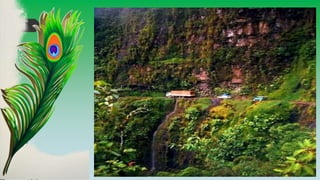
 MOUNTAIN BIKING ON BOLIVIA’S MOST DANGEROUS ROAD
 Heading north from Bolivia‘s capitol city of La Paz to Coroico, a cloud forest town
on the rim of the Amazon basin, El Camino de la Muerte is considered the
most dangerous road. Carved into the sides of a canyon, with steep vertical
of up to 1,600 feet and no guardrails, “Death Road” claims more than 100 lives a
year. Most Bolivians take the time to pray before beginning their descent in
vehicles, so it takes a special breed of daredevil to make the journey on mountain
bike, passing frigid mountaintops, misty cloud forests, enormous waterfalls and
myriad tropical birds in the midst of heavy road traffic. After the 6-hour ride
there’s a 1.8-mile climb to Coroico, so only the hardiest and most fearless (a.k.a.
CRAZY) cyclists need apply.
 SANDBOARDING IN CHILE’S “DEATH VALLEY”
 Covering 966km on Chile’s Pacific Coast, the Atacama Desert is considered one
the world’s driest places, and has been used as a backdrop in films such
as Quantum of Solace for its otherworldly appearance. The area known as the
Valley of the Moon (a.k.a. “Death Valley”) has become a haven for enthusiasts of
sandboarding, a relatively new extreme sport that combines elements of
snowboarding and surfing. With the help of experienced guides, you’ll learn how
wax your board, strap your feet in, lean back and hurl yourself down the dunes,
hopefully avoiding a mouthful of sand in the process. For those craving pure
adrenaline, it’s one heck of a rush.
 SNORKELING CENOTES IN MEXICO’S RIVIERA MAYA
 The Sac-Actun underground river system stretches over a hundred miles
across Mexico‘s Riviera Maya, and its cenotes (or sinkholes) were believed by
ancient Mayans to be gateways to the afterlife. Their crystal-clear waters are now
haven for snorkelers and scuba divers, exploring underground caves surrounded
spectacular stalactites and stalagmites. You’ll likely see tiny freshwater fish and
colonies of bats, as well as hear stories of amazing archeological finds such as
30,000-year-old remains of mammoths, turtles and humans. The swim can get a
dark and claustrophobic for some (particularly when going through gaps so small
you have to duck underwater to avoid hitting a rock), but the scenery along the
way is positively otherworldly.
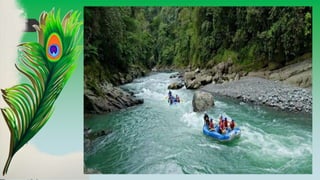
 WHITEWATER RAFTING IN COSTA RICA
 Feel like taking a wild jungle adventure, but don’t want to go all the way to the
Amazon to do so? Head to San Jose, Costa Rica, where guides will pick you up
take you on a heartpounding ride down the picturesque Pacuare River. Winding
through rock canyon walls and past cascading waterfalls, the raging rapids (which
range from Class II-IV in difficulty) take you on an hour-long journey deep into
rainforest to the eco-friendly lodge, which is situated on a 740-acre private
reserve and features surprisingly luxurious accommodations. While there you can
soak up the serene beauty of your surroundings, visit the neighboring Cabecar
Indian village and zip through a 2-hour tour of the rainforest canopy in this
unspoiled tropical paradise. –Bret Love

GREEN TOURISM

GREEN TOURISM

  • 1.
    What is GreenTourism? • IS DEFINED AS ENVIRONMENTALLY FRIENDLY TOURISM ACTIVITIES WITH VARIOUS FOCUSES AND MEANINGS. • IN A BROAD TERM, GREEN TOURISM IS ABOUT BEING AN ENVIRONMENTALLY FRIENDLY TOURIST OR PROVIDING ENVIRONMENTALLY FRIENDLY TOURIST SERVICES.
  • 2.
    What is GreenTourism? • GREEN TOURISM IS THE TERM USED TO DESCRIBE BEST ENVIRONMENTAL PRACTICE WITHIN THE TOURISM SECTOR. • IT COVERS ISSUES SUCH AS BUSINESS EFFICIENCY, ENVIRONMENTAL MANAGEMENT, WASTE, TRANSPORT, AS WELL AS TOPICS LIKE SOCIAL RESPONSIBILITY AND BIODIVERSITY.
  • 3.
    WHAT IS GTBS? The Green Tourism Business Scheme (GTBS) is an accreditation scheme for tourism and tourism related businesses relating to environmental good practice. The GTBS is increasingly recognised as the most appropriate UK scheme for green accreditation for tourism businesses.
  • 4.
  • 5.
    • South Americais one of the planet's prime ecotourism destinations. Many of the isolated nature lodges and tour operators around the country are and dedicated professionals in the ecotourism and sustainable tourism field. • Many other hotels, lodges, and tour operators are simply "green-washing," the terms "eco" and "sustainable" in their promo materials, but doing little good in their daily operations.
  • 6.
    • Deforestation isthe main threat to South America's fragile ecosystem. Farming has virtually wiped out most of the region's rainforests, and logging is a major threat. Such destruction has been devastating to many species, including man himself, in the form of displaced indigenous tribes, and has led to drinking-water shortages, flash flooding, and mud slides. • Though environmental awareness is growing, solving the region's huge environmental problems, including not just deforestation but the effects of overpopulation and industrial pollution, clearly remains an uphill struggle. Your hotel will often be your best bet for finding a place to deposit recyclable waste, especially if you choose a hotel that has instituted sustainable practices.
  • 7.
    • Hotel CalaMia is Certified GTA Green Leader Status for Sustainable Tourism Management. • The eleven private bungalows each have water views and come with spacious outdoor living area, king or double beds with luxurious linens, full baths with walk-in showers offering unlimited hot water. The Hotel is completely solar powered, with a supporting farm providing organic cheeses, cream and butter, as well as rice, vegetables and fruit.
  • 8.
    CASA CALMA WELLNESSHOTEL – BUENOS AIRES – ARGENTINA • Casa Calma is Certified GTA Green Champion for Sustainable Tourism Management. • Personality and technology combined with innovative design, light woods and soft colours are joined in a warm style.
  • 9.
    Estancia Peuma Hue– Lujan – Argentina • Estancia Peuma Hue is Certified GTA Green Leader for Sustainable Tourism Management. • Peuma Hue means “Place of Dreams” in the native Mapuche language and it is very easy to see why. From the first time you lay eyes on the structure you know you are somewhere special, an idyllic environment in which the natural beauty of this area can be enjoyed to its fullest.
  • 10.
    Inkaterra Machu PicchuHotel – Cusco – Peru • Inkaterra Machu Picchu Hotel is Awarded GTA Green Leader Status for Sustainable Tourism Management. • At Inkaterra Machu Picchu you also may enjoy the benefits of a de-stress massage at the mystical UNU Spa, and have the opportunity to participate in group eco-activities, such as bird watching or a guided orchid walk, offered on the 12-acre grounds.
  • 11.
    Jade Tulum Hotel– Tulum Beach – Mexico • Jade Tulum is Awarded GTA Initiate Status for Sustainable Tourism Management. • Jade is a boutique eco-concience hotel conceived with the idea of being surrounded by nature and art and built in the local traditional style, in the treetops. This has many benefits; the rooms blend into the environment, they benefit from cool sea breezes and guests have the unique experience of seeing sunrises and sunsets over the jungle and sea from the outside terrace.
  • 12.
    • Laguna Lodgeis Awarded GTA Platinum Status for Sustainable Tourism Management. • The Laguna Lodge is on the lakeshore of the legendary Lake Atitlan and exclusively nestled in its own nature reserve. Entry into this Mayan world begins by boat. Laguna Lodge Eco Resort – Lake Atitlan – Guatemala
  • 13.
    Lahuen Co EcoResort – Lanin – Argentina • Lahuen Co is Awarded GTA Initiate Status for Sustainable Tourism Management. • Deeply immersed in the widest protected area of Patagonia, on a landscape made of virgin native forests, pristine lakes, lagoons and mountain streams.
  • 14.
    Zimbali Retreats –Little London – Jamaica • Zimbali Retreat is Awarded GTA Gold Status for Sustainable Tourism Management. • Experience an ancient way of life and discover a truly unique culture whose blend of love and nature is famous throughout the world. Drink from natural springs, swim in rivers and get a massage from the waterfall. Zimbali Mountain Retreat is a fusion of modern technology with an ancient way of life; a place to Retreat in complete comfort, while you reconnect with Mother Nature and yourself.
  • 19.
    ARGENTINA  Gold miningin San Juan, soya planting in El Chaco, global warming in South Patagonia, and pulp milling on the River Plate are all hot environmental issues in Argentina at the moment. Despite having one of the best national park systems in the region, the country's protected areas are under threat from encroaching development.  On the bright side is a growing awareness amongst the populace that they are in danger of losing what they have. A forest preservation law was introduced in 2007 prohibiting deforestation, and Mendoza's provincial congress issued a blanket ban on mining, though it was later overturned by the governor. Argentina's main weapon against environmental damage is its utter vastness and under population, yet lax government control, little tradition for conservation, and rampant development are all cause for concern.
  • 20.
    BOLIVIA  Bolivia, oneof the world's most biodiverse countries on earth, is home to 60 protected areas, including 22 national parks, which covers an impressive 15% of its total territory. Many of the protected areas, however, are in constant threat from oil companies and loggers, who seemingly avoid any crackdowns from the government. The extraction of the significant lithium reserves in southwest Bolivia had led to frequent protests around Uyuni, but thus far they remain untapped. Natural gas reserves, once a significant source of revenue for Bolivia, have lost their value; as buyers in neighboring countries turn elsewhere, new explorations have come to a halt.  Only a few hotels have jumped on the green train in Bolivia thus far, including La Posada del Inca on Isla del Sol and Chalalan Ecolodge in Madidi National Park.
  • 21.
    BRAZIL  Brazilian resortsand tour operators do advertise "ecotourism," but in Brazil this means anything that takes place in the outdoors, be it leave-only-footprints nature hikes or churn-up-the-wildlife ATV expeditions. It does not signify lodges or hotels with solar heating or clever ways of dealing with waste water, or even outdoor operators that take particular care of their local ecosystems.  In Brazil's two most vulnerable remaining ecosystems -- the Pantanal and the Amazon -- there are tourism operators who strive to protect their local ecosystems. In the Pantanal the Araras Eco Lodge and the Jaguar Ecological Reserve have helped to popularize the private ecological reserve, a Brazilian program through which the government provides tax breaks in return for a landowner committing to preserving a portion of his in perpetuity. The presence of ecotourism operators in the Pantanal has also provided a lobby to counter certain ill-advised development schemes, including the paving of the Transpantaneira highway, and the widening, straightening, and deepening of the Rio Paraguay, the better to transport soybeans to the coast.
  • 22.
     In theAmazon, the Pousada Uakarí serves as an integral part of the Mamiraua Sustainable Development Institute (www.mamiraua.org.br), a project designed to preserve the habitat of the Uakarí monkey while improving the living standards of local human populations living in and around the Uakarí reserve. Other Amazon lodges come nowhere near this standard, though they do provide some local employment for guides and other lodge staff. Unfortunately, the miniscule scale of ecotourism operations in comparison with the employment and revenues generated by the timber and cattle industries has rendered ecotourism a nonplayer in the debate over preserving the Amazon.  However, one could argue that those who experience the Amazon become more likely to lobby to save it. Certainly, awareness of the importance of the Amazon, both globally and in Brazil, has led to the passage in Brazil of a range of reasonably stringent preservation measures, including parks, reserves, Indian reservations, national forest lands, and restrictions on deforestation on private landholdings. The problem in Brazil is that these regulations are often not respected, while enforcement on the ground remains weak. Still, rates of deforestation in the Brazilian Amazon have declined, from a 2004 peak of 27,400 sq. km (16,686 sq. miles, an area somewhat larger than Vermont) to 12,911 sq. km (5,035 sq. miles, an area somewhat smaller than Connecticut) in 2008.
  • 23.
    CHILE  The principalenvironmental problems that confront Chile are deforestation and air, water, and land pollution. Santiago is one of Latin America's most polluted cities, and air pollution there has become an acute problem; children and the elderly and infirm are frequently advised to stay indoors for days on end due to dangerous levels of toxic pollutants that enshroud the capital. Rapid urban expansion, industrial emissions from the copper mining sector, and the increased volume of car traffic are cited as the main causes of Santiago's air pollution. Mining is responsible for releasing the chief air and water pollutants, including sulfur dioxide and arsenic. In 2000, the city faced an unprecedented pollution emergency when over 200,000 vehicles were prohibited from driving on the roads and offending industries were shut down. Fortunately, in the last few years, environmental issues have taken a more prominent role in domestic politics and, while the pace is slow, government initiatives have gone a long way to improving the situation.
  • 24.
     The indiscriminatelogging of Chile's temperate forests has resulted in the tragic disappearance of thousand-year-old forests. The most publicized case of illegal logging, which has been taken up by environmental agencies, including Greenpeace, is that of the rare alerce tree, which is found in the Andes and can live for up to 3,500 years. Many animals are in serious risk of extinction throughout the country, as well. As of 2001, of the 91 listed mammals in Chile, some 16 species were registered as endangered. Almost 5% of Chile's 298 breeding bird species are threatened with extinction, most notably the tundra peregrine falcon, the Chilean woodstar, and the ruddy-headed goose. Also threatened are four types of freshwater fish and over 250 plant species.  Chile hasn't made great strides in the sustainable accommodations arena, although eco-conscious lodges are popping up in Patagonia and the Lake District.
  • 25.
    COLOMBIA  Colombia isfacing significant environmental risks. At the current rate of deforestation, experts estimate that Colombia's jungles will completely disappear by the year 2050. The logging, mining, gold, and emerald trade, as well as the illicit coca trade, has caused massive deforestation at a rate of 1.5 to 2 million acres a year. Mountain scraping for farming has caused previously forested and vegetated areas to turn into semi-arid desert zones, and road and home construction in rural areas is threatening the country's biodiversity. In addition, improperly disposed sewage, pesticides, and herbicides have contaminated many of the country's rivers and lakes, making the water undrinkable. Factory and car pollution continues to be a major problem in cities.
  • 26.
    ECUADOR  Oil explorationand mining operations continue to be the biggest environmental threats in Ecuador. In addition to impacting the environment, these activities also impact a variety of indigenous groups, whose way of life, culture, and ancestral homelands are severely threatened. This has led to numerous protests, and sometimes violent clashes between indigenous groups and the government. The Galápagos Islands present their own special set of challenges in terms of environmental protection and sustainable development issues. Isolated, unique, and delicate, the Galápagos are threatened by overexposure to tourists, over fishing, and the introduction of non-native species.
  • 27.
    PARAGUAY  Deforestation isthe main concern in Paraguay, as big agro-businesses come from Brazil and Argentina to clear forests and plant genetically modified plants. On paper the country has an impressive list of parks and reserves, but because of poor public access, underfunded government bodies, and corrupt local officials, it seems the only people that get to enter these biologically diverse areas are ranchers and lumber companies.
  • 28.
    PERU  Peru has72 million hectares (178 million acres) of natural-growth forests -- 70% in the Amazon jungle region -- that comprise nearly 60% of the national territory. Peru has done a slightly better job of setting aside tracts of rainforest as national park reserves and regulating industry than have some other Latin American and Asian countries. The Manu Biosphere Reserve, the Tambopata National Reserve, and the Pacaya- Samiria National Reserve are three of the largest protected rainforest areas in the world, and the government regulates entry of tour groups. Peru augmented the Bahuaja-Sonene National Park, which was created in 1996, by 809,000 hectares (nearly 2 million acres) in 2001. INRENA, Peru's Institute for Natural Resource Management, enforces logging regulations and reseeds Peru's Amazon forests, and in 2008, President Alan García created the country's first Ministry of the Environment. A handful of Peruvian and international environmental and conservation groups, such as ProNaturaleza and Conservation International, are active in Peru, working on sustainable forestry projects.
  • 29.
     Yet Peruis losing nearly 300,000 hectares (740,000 acres) of rainforest annually. The primary threats to Peru's tropical forests are deforestation caused by agricultural expansion, cattle ranching, logging, oil extraction and spills, mining, illegal coca farming, and colonization initiatives. Deforestation has shrunk territories belonging to indigenous peoples and wiped out more than 90% of the population. (There were once some six million people, 2,000 tribes and/or ethnic groups, and innumerable languages in the Amazon basin; today the indigenous population is less than two million.) Jungle ecotourism has exploded in Peru, and rainforest regions are now much more accessible than they once were, with more lodges and eco-options than ever. Many are taking leading roles in sustainable tourism even as they introduce protected regions to more travelers.
  • 30.
    URUGUAY  Uruguay isoften called the most European country in South America, not least because most of its natural forests have been cleared for agriculture and there is little or nothing left of large wildlife indigenous to the region. The few nature reserves that exist offer little out of the ordinary, though there are some seal colonies worth visiting along the coast. The hot environmental issue at the moment is a dispute with Argentina over two massive pulp mills built on the Uruguayan side of the River Plate, which are badly polluting the riverway. The Uruguayans have denied this claim.
  • 31.
    VENEZUELA  Since over90% of Venezuela's population lives in a narrow urban belt along the northern coast, much of the interior is seldom visited and oft forgotten. Still, Venezuela has the third-highest rate of deforestation in South America, and the country's oil industry has caused massive environmental destruction in the Lake Maracaibo area, and to a lesser extent in Los Llanos. Gold, iron, bauxite and coal mining operations have also had a negative impact on the environment. That said, Venezuela has the largest percentage of protected land, with some 55% of its total territory protected in some form or another.
  • 32.
    10 Latin AmericaEcotourism Adventures
  • 34.
     ROCK CLIMBINGIN PATAGONIA  Discovered by Ferdinand Magellan in 1520, Patagonia is a pristine expanse of dry, desolate land occupying 260,000 square miles in southern Argentina and Chile. region is equally well known for its abundant wildlife (including condors, pumas and guanacos) and dramatic mountain peaks, which attract trekkers from all around the world. The area around the Northern Patagonia city of Bariloche a variety of well-bolted rock-climbing routes to challenge enthusiasts of all skill levels, with favorite spots such as Virgen de las Nieves and Piedras Blancos rated from 5.6 to 5.14 for their degree of difficulty. Whichever route you choose, you’re assured stunning vistas of the remote land that National Geographic has called “Eden at the End of the World.”
  • 35.
     EXPLORING MEXICO’SCOPPER CANYON  Located in northern Mexico just a few hundred miles south of El Paso, buried in the heart of the Sierra Madre Mountains, the remote and rugged Copper one of the continent’s largest canyon systems. “Hike and Bike” tours offer a way for hardy travelers to experience the area’s natural wonders. You can board Chihuahua al Pacifico train for the 180-mile jaunt from El Fuerte to Divisadero, soaking in desert scenery and towering canyon walls that seem like something straight out of a John Wayne western along the way. From there, you can take a short trek on foot before mountain biking past unique rock formations, waterfalls, pueblos and cave dwellings, gradually journeying from the historical mining of Batopilas to the Lost Cathedral of Satevo and walking the ancient trails of the Tarahumara Indians.
  • 37.
     GETTING INTOUCH WITH NATURE IN PANAMA  Referred to by some as “the new Galapagos,” Panama’s 1,053 sq. mile Coiba Island National Park remains largely unspoiled thanks to the fact that the island was home to a penal colony from 1919 to 2004 and requires permission from the National Environment Authority (ANAM) to visit. The largest island in all of America, about 75% of Coiba is virgin tropical forest, while 80% of the park is oceanic, filled with myriad whales, bottle-nosed dolphins, marine turtles and rare tropical fish that make it a haven for avid divers. Located 50 minutes by plane or hours by car from Panama City, this eco-tourist haven is definitely a bit off the beaten path, but well worth the visit.
  • 39.
     HANG GLIDING& PARAGLIDING IN ECUADOR  Located on the northwest coast of Ecuador near Bahia, Canoa is an extremely back beach town popular among surfers and expats, but not so much with It’s small and sleepy, without a single ATM to be found. But the steady winds and the gentle cliffs that surround Canoa create perfect conditions for hang gliding paragliding over the picturesque beach, and the town has played host to the Open Hang Gliding Championship since 2010. You don’t necessarily need any experience to fly, as tandem flights are available for beginners starting at $45. But those seeking serious air time can get more intensive training, with operators as the Surf Shak offering more in-depth courses.
  • 41.
     HIKING THEINCA TRAIL TO MACHU PICCHU  Peru’s most popular tourist attraction, built by the Incas around 1440 AD, draws more than 500,000 visitors each year. It’s easy to see why, as the glorious architecture of the ancient city perched high above the clouds remains largely intact, with giant stone walls, old temples and luscious green terraces overlooking canyon on the Urubamba River and the surrounding Andes mountains. Various tour companies offer guided expeditions to this UNESCO World Heritage site, hiking 25 to 33 miles (depending on your starting point) through semi-arid verdant tropical rainforest and breathtaking mountain passes to the stunning pre- Columbian ruins. At altitudes of up to 13,700 feet it’s no easy trek, but the jaw- dropping views along this 500-year-old trail are certain to provide a lifetime of memories.
  • 43.
     KITESURFING INBRAZIL  With hundreds of miles of practically empty beaches, warm tropical climate and average of nine months of wind every year, Brazil’s Ceara coast has emerged as a haven for kite-surfers looking to catch major ocean air. Cumbuco Beach is the hottest of the area’s hotspots, offering a variety of flat-water lagoons with slight swells, with numerous sand bars off the point that produce great waves approximately 300-400 meters from the shore. With a variety of schools offering their services, even novice surfers can learn to execute awesome moves such as jump, grab, spin and invert in no time flat, while the village at the center of the beach provides a place to immerse yourself in the burgeoning sport’s colorful culture.
  • 45.
     MOUNTAIN BIKINGON BOLIVIA’S MOST DANGEROUS ROAD  Heading north from Bolivia‘s capitol city of La Paz to Coroico, a cloud forest town on the rim of the Amazon basin, El Camino de la Muerte is considered the most dangerous road. Carved into the sides of a canyon, with steep vertical of up to 1,600 feet and no guardrails, “Death Road” claims more than 100 lives a year. Most Bolivians take the time to pray before beginning their descent in vehicles, so it takes a special breed of daredevil to make the journey on mountain bike, passing frigid mountaintops, misty cloud forests, enormous waterfalls and myriad tropical birds in the midst of heavy road traffic. After the 6-hour ride there’s a 1.8-mile climb to Coroico, so only the hardiest and most fearless (a.k.a. CRAZY) cyclists need apply.
  • 47.
     SANDBOARDING INCHILE’S “DEATH VALLEY”  Covering 966km on Chile’s Pacific Coast, the Atacama Desert is considered one the world’s driest places, and has been used as a backdrop in films such as Quantum of Solace for its otherworldly appearance. The area known as the Valley of the Moon (a.k.a. “Death Valley”) has become a haven for enthusiasts of sandboarding, a relatively new extreme sport that combines elements of snowboarding and surfing. With the help of experienced guides, you’ll learn how wax your board, strap your feet in, lean back and hurl yourself down the dunes, hopefully avoiding a mouthful of sand in the process. For those craving pure adrenaline, it’s one heck of a rush.
  • 49.
     SNORKELING CENOTESIN MEXICO’S RIVIERA MAYA  The Sac-Actun underground river system stretches over a hundred miles across Mexico‘s Riviera Maya, and its cenotes (or sinkholes) were believed by ancient Mayans to be gateways to the afterlife. Their crystal-clear waters are now haven for snorkelers and scuba divers, exploring underground caves surrounded spectacular stalactites and stalagmites. You’ll likely see tiny freshwater fish and colonies of bats, as well as hear stories of amazing archeological finds such as 30,000-year-old remains of mammoths, turtles and humans. The swim can get a dark and claustrophobic for some (particularly when going through gaps so small you have to duck underwater to avoid hitting a rock), but the scenery along the way is positively otherworldly.
  • 51.
     WHITEWATER RAFTINGIN COSTA RICA  Feel like taking a wild jungle adventure, but don’t want to go all the way to the Amazon to do so? Head to San Jose, Costa Rica, where guides will pick you up take you on a heartpounding ride down the picturesque Pacuare River. Winding through rock canyon walls and past cascading waterfalls, the raging rapids (which range from Class II-IV in difficulty) take you on an hour-long journey deep into rainforest to the eco-friendly lodge, which is situated on a 740-acre private reserve and features surprisingly luxurious accommodations. While there you can soak up the serene beauty of your surroundings, visit the neighboring Cabecar Indian village and zip through a 2-hour tour of the rainforest canopy in this unspoiled tropical paradise. –Bret Love 