Presented by
Pinki Deb
Assistant Professor
SITCOE, Yadrav
INTRODUCTION TO COLD MIX
ASPHALT
COLD MIX CONCRETE
5-Dec-23
2
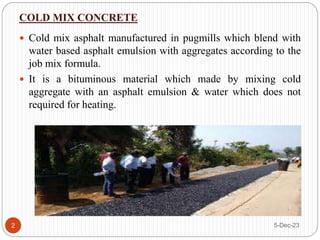
 Cold mix asphalt manufactured in pugmills which blend with
water based asphalt emulsion with aggregates according to the
job mix formula.
 It is a bituminous material which made by mixing cold
aggregate with an asphalt emulsion & water which does not
required for heating.
GREEN COLD MIX CONCRETE BENIFITS
5-Dec-23
3
 Flexible but strong to withstand temperature fluctuation ,
resistance to rutting, cracking and moisture damage.
 No heating is required, strict quality control ,smooth and quite
riding surface and ideal for upgrading and strengthening thin
pavement.
 They have a tendency of self healing.
 It can be designed with high percentage of recycled material,
saving valuable mineral aggregate.
 Low cost construction, minimizes transportational and material
cost, easily recycled and maintained.
 Water based emulsion mixed easily with aggregate.
DISADVANTAGES OF COLD MIX CONCRETE
5-Dec-23
4
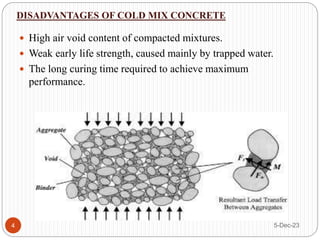
 High air void content of compacted mixtures.
 Weak early life strength, caused mainly by trapped water.
 The long curing time required to achieve maximum
performance.
1. BITUMEN EMULSION
5-Dec-23
5
 Bitumen emulsion in which a substantial amount of bitumen is
suspended in a finely divided form of size 0.5 to 50 micron in
water in presence of emulsion.
MAJOR COMPONENTS OF COLD MIX ASPHALT
TYPES OF EMULSION
5-Dec-23
6
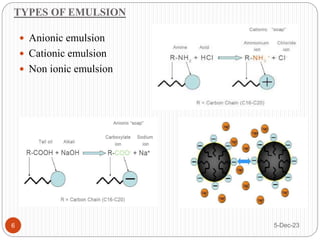
 Anionic emulsion
 Cationic emulsion
 Non ionic emulsion
ACCORDING TO SP 100:2004
SPECIFICATIONS FIVE GRADES OF
EMULSION CLASSIFICATION
5-Dec-23
7
 RS1
 RS2
 MS
 SS1
 SS2
5-Dec-23
8
 Mostly oxide rocks such as igneous rock, slag fall and
some of the metamorphic rocks are preferred in CMA for
the presence of silicon oxide or metal oxide in them.
 This silicate based aggregate (negatively charged
aggregate) can easily bond with cationic bitumen emulsion
and help to improve the performance of final mix.
Carbonate based rocks like dolomite and lime stone provide
better performance with anionic bitumen emulsion.
 Portable water is mostly preferrable for the CMA.
2. AGGREGATE AND WATER
5-Dec-23
9
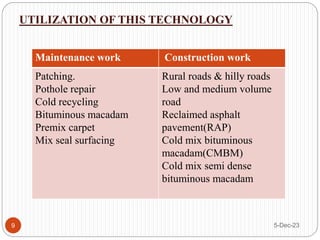
UTILIZATION OF THIS TECHNOLOGY
Maintenance work Construction work
Patching.
Pothole repair
Cold recycling
Bituminous macadam
Premix carpet
Mix seal surfacing
Rural roads & hilly roads
Low and medium volume
road
Reclaimed asphalt
pavement(RAP)
Cold mix bituminous
macadam(CMBM)
Cold mix semi dense
bituminous macadam
5-Dec-23
10
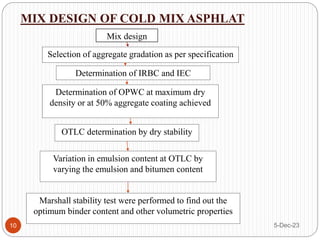
MIX DESIGN OF COLD MIX ASPHLAT
Mix design
Selection of aggregate gradation as per specification
Determination of IRBC and IEC
Determination of OPWC at maximum dry
density or at 50% aggregate coating achieved
OTLC determination by dry stability
Variation in emulsion content at OTLC by
varying the emulsion and bitumen content
Marshall stability test were performed to find out the
optimum binder content and other volumetric properties
5-Dec-23
11
 The curing of CMA is a very complex and time-consuming
process. It went through several stages before attaining the final
stage.
 The water present in mix evaporates during the curing time.
Bitumen emulsion acquires its original properties and achieve
moisture resistance after evaporation of water
 Mostly accelerated curing is preferred due to its low initial
strength to simulated better field conditions.
 Several researchers and agencies developed different curing
methods of CMA for the speedy development of strength
properties
CURING OF COLD MIX ASPHLAT
5-Dec-23
12
 These curing regimes are ambient curing at 15-25℃ and
accelerated curing at 35-60℃.
 Ambient curing is cheaper and convenient method
compared to accelerated curing .
 Compared to the ambient curing, mixtures went to their
final state quickly when subjected to accelerated curing. In
accelerated curing, the CMA samples were placed in a
temperature control cabinet or oven. Field curing is mainly
related to accelerated curing.
REASONS FOR DURABLE ROAD
5-Dec-23
13
•Chemical interaction between emulsion
and aggregate
•The cationic emulsion is positively
charged & aggregate is negatively
charged.
•Emulsion contain anti stripping agent
which reduces water damage.
•Strength offered by filler material
5-Dec-23
14
 The countries lacking in using CMA for pavement construction
due to the improper knowledge of mix design, strength and
curing mechanism.
 The strength of CMA is highly dependent upon the ambient
temperature, emulsion properties, use of additive, residual
bitumen, mixing procedure and curing mechanism, which
required to explore properly by researcher and field engineers.
 Concerning the global warming associated with HMA and
WMA, CMA is the most sustainable technology which requires
more innovative and economical solution by the researchers
that can boost up the field implementation and accepted by
different countries.
Conclusion
5-Dec-23
15
THANK YOU

COLD MIX ASPHALT.pptx

  • 1.
    Presented by Pinki Deb AssistantProfessor SITCOE, Yadrav INTRODUCTION TO COLD MIX ASPHALT
  • 2.
    COLD MIX CONCRETE 5-Dec-23 2 Cold mix asphalt manufactured in pugmills which blend with water based asphalt emulsion with aggregates according to the job mix formula.  It is a bituminous material which made by mixing cold aggregate with an asphalt emulsion & water which does not required for heating.
  • 3.
    GREEN COLD MIXCONCRETE BENIFITS 5-Dec-23 3  Flexible but strong to withstand temperature fluctuation , resistance to rutting, cracking and moisture damage.  No heating is required, strict quality control ,smooth and quite riding surface and ideal for upgrading and strengthening thin pavement.  They have a tendency of self healing.  It can be designed with high percentage of recycled material, saving valuable mineral aggregate.  Low cost construction, minimizes transportational and material cost, easily recycled and maintained.  Water based emulsion mixed easily with aggregate.
  • 4.
    DISADVANTAGES OF COLDMIX CONCRETE 5-Dec-23 4  High air void content of compacted mixtures.  Weak early life strength, caused mainly by trapped water.  The long curing time required to achieve maximum performance.
  • 5.
    1. BITUMEN EMULSION 5-Dec-23 5 Bitumen emulsion in which a substantial amount of bitumen is suspended in a finely divided form of size 0.5 to 50 micron in water in presence of emulsion. MAJOR COMPONENTS OF COLD MIX ASPHALT
  • 6.
    TYPES OF EMULSION 5-Dec-23 6 Anionic emulsion  Cationic emulsion  Non ionic emulsion
  • 7.
    ACCORDING TO SP100:2004 SPECIFICATIONS FIVE GRADES OF EMULSION CLASSIFICATION 5-Dec-23 7  RS1  RS2  MS  SS1  SS2
  • 8.
    5-Dec-23 8  Mostly oxiderocks such as igneous rock, slag fall and some of the metamorphic rocks are preferred in CMA for the presence of silicon oxide or metal oxide in them.  This silicate based aggregate (negatively charged aggregate) can easily bond with cationic bitumen emulsion and help to improve the performance of final mix. Carbonate based rocks like dolomite and lime stone provide better performance with anionic bitumen emulsion.  Portable water is mostly preferrable for the CMA. 2. AGGREGATE AND WATER
  • 9.
    5-Dec-23 9 UTILIZATION OF THISTECHNOLOGY Maintenance work Construction work Patching. Pothole repair Cold recycling Bituminous macadam Premix carpet Mix seal surfacing Rural roads & hilly roads Low and medium volume road Reclaimed asphalt pavement(RAP) Cold mix bituminous macadam(CMBM) Cold mix semi dense bituminous macadam
  • 10.
    5-Dec-23 10 MIX DESIGN OFCOLD MIX ASPHLAT Mix design Selection of aggregate gradation as per specification Determination of IRBC and IEC Determination of OPWC at maximum dry density or at 50% aggregate coating achieved OTLC determination by dry stability Variation in emulsion content at OTLC by varying the emulsion and bitumen content Marshall stability test were performed to find out the optimum binder content and other volumetric properties
  • 11.
    5-Dec-23 11  The curingof CMA is a very complex and time-consuming process. It went through several stages before attaining the final stage.  The water present in mix evaporates during the curing time. Bitumen emulsion acquires its original properties and achieve moisture resistance after evaporation of water  Mostly accelerated curing is preferred due to its low initial strength to simulated better field conditions.  Several researchers and agencies developed different curing methods of CMA for the speedy development of strength properties CURING OF COLD MIX ASPHLAT
  • 12.
    5-Dec-23 12  These curingregimes are ambient curing at 15-25℃ and accelerated curing at 35-60℃.  Ambient curing is cheaper and convenient method compared to accelerated curing .  Compared to the ambient curing, mixtures went to their final state quickly when subjected to accelerated curing. In accelerated curing, the CMA samples were placed in a temperature control cabinet or oven. Field curing is mainly related to accelerated curing.
  • 13.
    REASONS FOR DURABLEROAD 5-Dec-23 13 •Chemical interaction between emulsion and aggregate •The cationic emulsion is positively charged & aggregate is negatively charged. •Emulsion contain anti stripping agent which reduces water damage. •Strength offered by filler material
  • 14.
    5-Dec-23 14  The countrieslacking in using CMA for pavement construction due to the improper knowledge of mix design, strength and curing mechanism.  The strength of CMA is highly dependent upon the ambient temperature, emulsion properties, use of additive, residual bitumen, mixing procedure and curing mechanism, which required to explore properly by researcher and field engineers.  Concerning the global warming associated with HMA and WMA, CMA is the most sustainable technology which requires more innovative and economical solution by the researchers that can boost up the field implementation and accepted by different countries. Conclusion
  • 15.