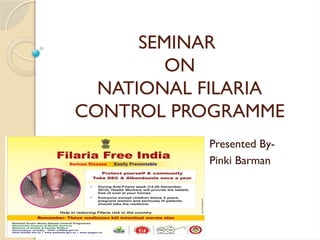
SEMINAR
ON
NATIONAL FILARIA
CONTROL PROGRAMME
Presented By-
Pinki Barman
INTRODUCTION
 Lymphatic Filariasis is distributed in
economically challenged countries. Bancroftian
filariasis caused by Wuchereria banccrofti which
is transmitted to man by the bites of infected
mosquitoes- Culex, Anopheles, Mansonia and
Ades.
 National Filaria Control Programme (NFCP) was
launched in the country in 1955 with the
objective of delimiting the problem, to undertake
control measures in endemic areas and to train
personnel.
FILARIASIS
 Filariasis is caused by several round, coiled
and thread-like parasitic worms belonging to
the family filaridea
 The disease is caused by the nematode
worm, either Wuchereria bancrofti or Brugia
malayi and transmitted by Culex
quinquefasciatus and Mansonia
annulifera/M.uniformis respectively.
 The disease manifests often in bizarre
swelling of legs, and hydrocele
LYMPHATIC FILARIASIS (LF)
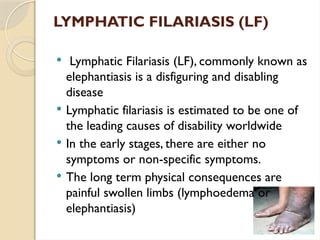
 Lymphatic Filariasis (LF), commonly known as
elephantiasis is a disfiguring and disabling
disease
 Lymphatic filariasis is estimated to be one of
the leading causes of disability worldwide
 In the early stages, there are either no
symptoms or non-specific symptoms.
 The long term physical consequences are
painful swollen limbs (lymphoedema or
elephantiasis)
EPIDEMIOLOGY
 The WHO has estimated that 600 million people are
at risk of infection in South-East Asia and 60 million
are actually infected in the region.
 There are about 553 million people at the risk of
infection with 48 million (80% i.e., 48 out of 60
million) infected with parasite in India.
 Lymphatic filaria is prevalent in 250 districts in 20
states and union territories. Bancroftian filariasis is
widely distributed while brugian filariasis caused by
Brugia malayi is restricted to states-UP, Bihar,Andhra
Pradesh, Orissa,Tamil Nadu, Kerala, and Gujarat.
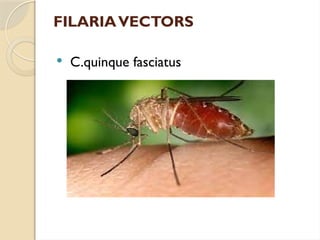
FILARIAVECTORS
 C.quinque fasciatus
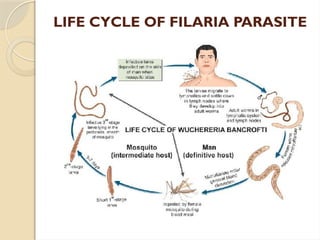
LIFE CYCLE OF FILARIA PARASITE
CLINICAL PRESENTATION OF LF
 There are bouts of fever accompanied by
pain, tenderness and erythema.
 Inflammation of the spermatic cord,
epididymitis and orchitis.
 Progressive enlargement, coarsening
corrugation and fissuring of skin and
subcutaneous tissue with warty superficial
excrescences develop gradually causing
elephantiasis.
DIFFERENCE BETWEEN
BANCROFTIAN
FILARIASIS AND
BRUGIA FILARIASIS
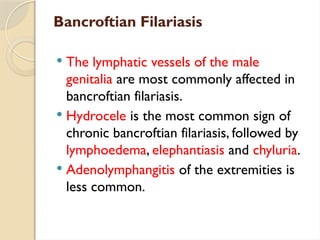
Bancroftian Filariasis
 The lymphatic vessels of the male
genitalia are most commonly affected in
bancroftian filariasis.
 Hydrocele is the most common sign of
chronic bancroftian filariasis, followed by
lymphoedema, elephantiasis and chyluria.
 Adenolymphangitis of the extremities is
less common.
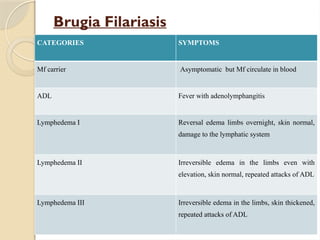
Brugia Filariasis
CATEGORIES SYMPTOMS
Mf carrier Asymptomatic but Mf circulate in blood
ADL Fever with adenolymphangitis
Lymphedema I Reversal edema limbs overnight, skin normal,
damage to the lymphatic system
Lymphedema II Irreversible edema in the limbs even with
elevation, skin normal, repeated attacks of ADL
Lymphedema III Irreversible edema in the limbs, skin thickened,
repeated attacks of ADL
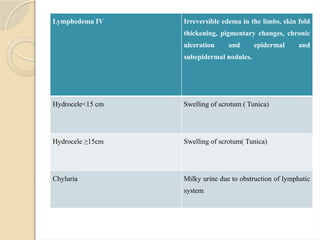
Lymphedema IV Irreversible edema in the limbs, skin fold
thickening, pigmentary changes, chronic
ulceration and epidermal and
subepidermal nodules.
Hydrocele<15 cm Swelling of scrotum ( Tunica)
Hydrocele ≥15cm Swelling of scrotum( Tunica)
Chyluria Milky urine due to obstruction of lymphatic
system
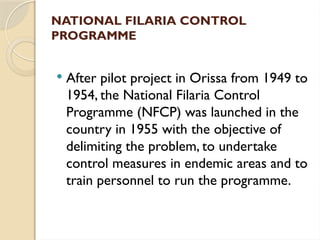
NATIONAL FILARIA CONTROL
PROGRAMME
 After pilot project in Orissa from 1949 to
1954, the National Filaria Control
Programme (NFCP) was launched in the
country in 1955 with the objective of
delimiting the problem, to undertake
control measures in endemic areas and to
train personnel to run the programme.
OBJECTIVES
 Reduction of the problem in un-surveyed
areas.
 Control in urban areas through recurrent
anti larval and anti-parasitic measures.
NFCP STRATEGY
 Recurrent anti-larval measures at weekly intervals.
 Environmental methods including source
reduction by filling ditches, pits, low lying areas
etc.
 Biological control of mosquito breeding through
larvivorous fish.
 Anti-parasitic measures through 'detection' and
'treatment' of microfilaria carriers and disease
person with DEC by Filaria Clinics in towns
covered under the programme
INDICATORS
 Percentage of population actually consumed Drug.
 Microfilaria rate in sentinel sites of the districts
Member Hospitals/CHCs equipped for
hydrocelectomy.
 Number of hydrocele operations conducted out
of total enlisted .
 Number of complications after hydrocelectomy to
assess quality of service per 1000 operations
 Percentage of Lymphedema cases practicing
Home based management
CONTROL STRATEGY
 Vector Control Anti-Mosquito and Anti-larval Measures
 Biological Control through larvivorous fishes.
 Environmental engineering through source reduction
and water management;
 Antiparasitic measures
1. For the individual case treatment: Diethyl
Carbamazine (DEC) is given for Bancroftifilariasis in
the dose of 6 mg/kg body weight orally daily for 12
days in divided doses after meal (a total of 72 mg per
kg of DEC). For the Brugianfilariasis, DEC is given 3-6
mg/kg body weight per day up to total dose of 18-72
mg per kg.
 DEC tablets should be taken once in a year on
the identified day of MDA (National Filaria Day).
 The tablets should be taken after food. If the
tablets are taken on empty stomach, it may
cause stomach discomfort.
 There is a report of successful treatment of
elephantiasis with doxycycline given for 14 days
 Mass treatment
 Revised Strategy- Single dose mass treatment of
Diethylcarbamazine (DEC) alone or combined
with Albendazole repeated at six months or one
year
 Pre MDA activities-
First visit: (Household enumeration)
 Visit every house in assigned area within 15
days prior to the day of MDA .
 Enquire about the details of the household
and record
 Inform the family members about the
MDA programme and clarify their doubts
 Second visit: (Interpersonal contact)
 Make house to house visit
 Meet all the available members
 Select the correct dose of DEC based on the
age of the person
 Co-administer DEC with albendazole
 Ensure that the individual is consuming the drugs
in your presence (supervised administration)
 Record the absentees and their time of
availability
 Advise to approach the Subcentre/PHC if any
inconvenience is faced
 Mopping-up:
 Make daily visits to your assigned area for
two days following MDA to cover the
absentees
 If any case with side effects are come
across, provide them with symptomatic
treatment
 If any case requires hospital admission,
report to theVHN/rapid response team
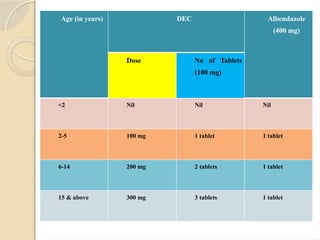
Age (in years) DEC Albendazole
(400 mg)
Dose No of Tablets
(100 mg)
<2 Nil Nil Nil
2-5 100 mg 1 tablet 1 tablet
6-14 200 mg 2 tablets 1 tablet
15 & above 300 mg 3 tablets 1 tablet
 Single dose of Ivermectin (20-400 ug/kg of
body weight) has been found to be effective,
but it is associated with high recurrence
rates (5-40%) after 6 months of treatment in
bancroftian infections.
 Triple drug therapy: Ivermectin, DEC and
Albedazole to eliminate Lf by 2020
(coverage endemic districts of Maharashtra,
1 district each in Bihar, UP, Jharkhand.
 Behavior Change Communication
 Capacity building for home based
management.
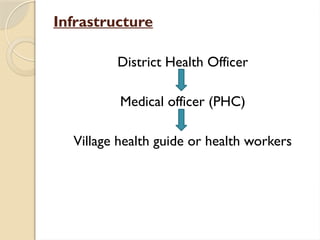
Infrastructure
District Health Officer
Medical officer (PHC)
Village health guide or health workers
ELIMINATION OF LYMPHATIC FILARIASIS
 In 1997,WHO and its Member States made a
commitment to eliminate Lymphatic Filariasis
(LF) as public health problem by 2020 through
World Health Assembly Resolution WHA 50.29.
 The National Health Policy (2002) has set the
goal of Elimination of Lymphatic Filariasis in India
by 2015. Later extended to 2021.
 Subsequent to that Global Alliance to Eliminate
Lymphatic Filariasis (GAELF) has been formed in
2000.
Twin Pillar Strategy for
Elimination of Lymphatic Filariasis
 Annual Mass Drug Administration (MDA) of single
dose of DEC (Diethylcarbamazine citrate) and
Albendazole for 5 years or more to the eligible
population (except pregnant women, children
below 2 years of age and seriously ill persons) to
interrupt transmission of the disease.
 Home based management of lymphoedema cases
and up-scaling of hydrocele operations in identified
CHCs/ District hospitals /medical colleges
Milestones of ELF
 In 1997-Elimination of Lymphatic Filariasis
as a global public health problem
 In 2002- National Health Policy set a goal
for ELF in India by 2015
 In 2004-Elimination of Lymphatic Filariasis
(ELF) programme
 In 2013- validation started through
Transmission Assessment Survey (TAS)
 On 13th June, 2018-Accelerated Plan for
Elimination of Lymphatic Filariasis 2018
 Triple DrugTherapy (IDA) has been
successfully implemented in 5 districts
namely Arwal (Bihar) and Simdega
(Jharkhand), Nagpur (Maharashtra),Varanasi
(Uttar Pradesh),Yadgiri (Karnataka) on
20th
December 2018, 10th
January 2019,
20th
January, 2019, 20th
February, 2019 and
13th
November, 2019 respectively.
 Government of India has revised the
financial norms for Morbidity Management
Kits from Rs. 150/- to Rs. 500/- per kit in
February 2019.
Mass Drug Administration (MDA)
 MDA started as mass campaign from
2004.
 Initially with single dose of DEC only.
 In the year of 2007 with DEC +
Albendazole co-administration
 Form 2018 Triple Drug Therapy (IDA) i.e.
DEC + Albendazole + Ivermectin is
launched initially in five selected districts.
ACCELERATED PLANTO ELIMINATE LF 2018
 Starting from 2018, the national programme plans to
implement an accelerated plan to give a new impetus
to the ongoing activities and achieve the goal of LF
elimination by 2020, in accordance with the World
Health Organization (WHO) regional strategic frame
work for control/elimination of Neglected Tropical
Diseases (NTDs) and WHO NTD goals and timeline.
 The plan is built upon the national guidelines for
elimination of LF (2009) and seeks to introduce
newer intervention strategies and improve
implementation of MDA and Monitoring& Evaluation
and surveillance strategies
Goal
 Elimination of lymphatic filariasis (LF) as a public
health problem by 2020, as envisaged by WHO-
SEAR’s strategic framework.
General objectives
 To accelerate interruption of transmission in all
endemic districts using enhanced and innovative
preventive chemotherapy strategies
 To provide a minimum package of care to all
people affected with chronic disease to alleviate
suffering
 To augment the programme activities towards
preparation of LF elimination validation dossier
Specific objectives
 To strengthen advocacy and ownership of the
program at all levels
 To implement confirmatory mapping of uncertain
areas
 To strengthen communication and social
mobilization
 To ensure enhanced MDA in all endemic districts
 To introduce new and innovative preventive
chemotherapy strategies and strengthen
supplementary intervention measures
 To strengthen monitoring and surveillance system
 To assess burden of chronic disease
 To strengthen the health system capacity to
provide quality care for people affected with
chronic disease
 To ensure quality data management at all
levelsTo address the gender equity and
disability related issues (no one should be
left behind as per the theme of SDGs)
 To build stronger and sustainable
partnerships
 To support operational research
 To initiate steps for preparation of dossier
for validation of elimination of LF
Action
 Action 1:To enhance advocacy and ownership of the
programme at all levels
 Action 2:To implement confirmatory mapping in uncertain
areas
 Action 3:To strengthen communication and social
mobilization
 Action 4: Ensure enhanced MDA in all districts
 Action 5:To introduce innovative preventive chemotherapy
strategies and strengthen supplementary measures.
 Action 6:To strengthen monitoring and surveillance system
 Action 7:To identify all people affected with chronic
disease to facilitate treatment
 Action 8:To strengthen the health system
capacity to provide quality care for people
affected with chronic disease
 Action 9:To ensure quality data
management at all levels
 Action 10:To build stronger and sustainable
partnerships
 Action 11:To support operational research
 12: Preparation of dossier for validation of
elimination of LF
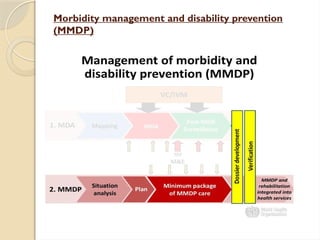
Morbidity management and disability prevention
(MMDP)
Goal
 To alleviate suffering in people with
ADLA, lymphedema, and hydrocele.
 To provide access to the recommended
basic care for every person with these
manifestations in areas endemic for
lymphatic filariasis.
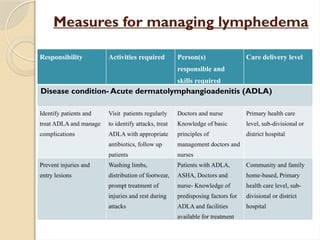
Measures for managing lymphedema
Responsibility Activities required Person(s)
responsible and
skills required
Care delivery level
Disease condition- Acute dermatolymphangioadenitis (ADLA)
Identify patients and
treat ADLA and manage
complications
Visit patients regularly
to identify attacks, treat
ADLA with appropriate
antibiotics, follow up
patients
Doctors and nurse
Knowledge of basic
principles of
management doctors and
nurses
Primary health care
level, sub-divisional or
district hospital
Prevent injuries and
entry lesions
Washing limbs,
distribution of footwear,
prompt treatment of
injuries and rest during
attacks
Patients with ADLA,
ASHA, Doctors and
nurse- Knowledge of
predisposing factors for
ADLA and facilities
available for treatment
Community and family
home-based, Primary
health care level, sub-
divisional or district
hospital
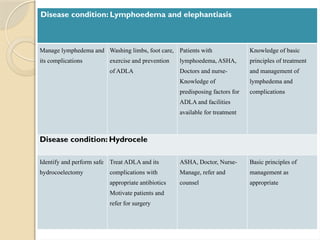
Disease condition: Lymphoedema and elephantiasis
Manage lymphedema and
its complications
Washing limbs, foot care,
exercise and prevention
of ADLA
Patients with
lymphoedema, ASHA,
Doctors and nurse-
Knowledge of
predisposing factors for
ADLA and facilities
available for treatment
Knowledge of basic
principles of treatment
and management of
lymphedema and
complications
Disease condition: Hydrocele
Identify and perform safe
hydrocoelectomy
Treat ADLA and its
complications with
appropriate antibiotics
Motivate patients and
refer for surgery
ASHA, Doctor, Nurse-
Manage, refer and
counsel
Basic principles of
management as
appropriate
ROLE OF COMMUNITY HEALTH
NURSE
 Administration
 Communication
 Nursing
 Teaching
Summary
And
Conclusion

national filariasis control programme ppt

  • 1.
  • 2.
    INTRODUCTION  Lymphatic Filariasisis distributed in economically challenged countries. Bancroftian filariasis caused by Wuchereria banccrofti which is transmitted to man by the bites of infected mosquitoes- Culex, Anopheles, Mansonia and Ades.  National Filaria Control Programme (NFCP) was launched in the country in 1955 with the objective of delimiting the problem, to undertake control measures in endemic areas and to train personnel.
  • 3.
    FILARIASIS  Filariasis iscaused by several round, coiled and thread-like parasitic worms belonging to the family filaridea  The disease is caused by the nematode worm, either Wuchereria bancrofti or Brugia malayi and transmitted by Culex quinquefasciatus and Mansonia annulifera/M.uniformis respectively.  The disease manifests often in bizarre swelling of legs, and hydrocele
  • 4.
    LYMPHATIC FILARIASIS (LF) Lymphatic Filariasis (LF), commonly known as elephantiasis is a disfiguring and disabling disease  Lymphatic filariasis is estimated to be one of the leading causes of disability worldwide  In the early stages, there are either no symptoms or non-specific symptoms.  The long term physical consequences are painful swollen limbs (lymphoedema or elephantiasis)
  • 5.
    EPIDEMIOLOGY  The WHOhas estimated that 600 million people are at risk of infection in South-East Asia and 60 million are actually infected in the region.  There are about 553 million people at the risk of infection with 48 million (80% i.e., 48 out of 60 million) infected with parasite in India.  Lymphatic filaria is prevalent in 250 districts in 20 states and union territories. Bancroftian filariasis is widely distributed while brugian filariasis caused by Brugia malayi is restricted to states-UP, Bihar,Andhra Pradesh, Orissa,Tamil Nadu, Kerala, and Gujarat.
  • 6.
  • 7.
    LIFE CYCLE OFFILARIA PARASITE
  • 8.
    CLINICAL PRESENTATION OFLF  There are bouts of fever accompanied by pain, tenderness and erythema.  Inflammation of the spermatic cord, epididymitis and orchitis.  Progressive enlargement, coarsening corrugation and fissuring of skin and subcutaneous tissue with warty superficial excrescences develop gradually causing elephantiasis.
  • 9.
  • 10.
    Bancroftian Filariasis  Thelymphatic vessels of the male genitalia are most commonly affected in bancroftian filariasis.  Hydrocele is the most common sign of chronic bancroftian filariasis, followed by lymphoedema, elephantiasis and chyluria.  Adenolymphangitis of the extremities is less common.
  • 11.
    Brugia Filariasis CATEGORIES SYMPTOMS Mfcarrier Asymptomatic but Mf circulate in blood ADL Fever with adenolymphangitis Lymphedema I Reversal edema limbs overnight, skin normal, damage to the lymphatic system Lymphedema II Irreversible edema in the limbs even with elevation, skin normal, repeated attacks of ADL Lymphedema III Irreversible edema in the limbs, skin thickened, repeated attacks of ADL
  • 12.
    Lymphedema IV Irreversibleedema in the limbs, skin fold thickening, pigmentary changes, chronic ulceration and epidermal and subepidermal nodules. Hydrocele<15 cm Swelling of scrotum ( Tunica) Hydrocele ≥15cm Swelling of scrotum( Tunica) Chyluria Milky urine due to obstruction of lymphatic system
  • 13.
    NATIONAL FILARIA CONTROL PROGRAMME After pilot project in Orissa from 1949 to 1954, the National Filaria Control Programme (NFCP) was launched in the country in 1955 with the objective of delimiting the problem, to undertake control measures in endemic areas and to train personnel to run the programme.
  • 14.
    OBJECTIVES  Reduction ofthe problem in un-surveyed areas.  Control in urban areas through recurrent anti larval and anti-parasitic measures.
  • 15.
    NFCP STRATEGY  Recurrentanti-larval measures at weekly intervals.  Environmental methods including source reduction by filling ditches, pits, low lying areas etc.  Biological control of mosquito breeding through larvivorous fish.  Anti-parasitic measures through 'detection' and 'treatment' of microfilaria carriers and disease person with DEC by Filaria Clinics in towns covered under the programme
  • 16.
    INDICATORS  Percentage ofpopulation actually consumed Drug.  Microfilaria rate in sentinel sites of the districts Member Hospitals/CHCs equipped for hydrocelectomy.  Number of hydrocele operations conducted out of total enlisted .  Number of complications after hydrocelectomy to assess quality of service per 1000 operations  Percentage of Lymphedema cases practicing Home based management
  • 17.
    CONTROL STRATEGY  VectorControl Anti-Mosquito and Anti-larval Measures  Biological Control through larvivorous fishes.  Environmental engineering through source reduction and water management;  Antiparasitic measures 1. For the individual case treatment: Diethyl Carbamazine (DEC) is given for Bancroftifilariasis in the dose of 6 mg/kg body weight orally daily for 12 days in divided doses after meal (a total of 72 mg per kg of DEC). For the Brugianfilariasis, DEC is given 3-6 mg/kg body weight per day up to total dose of 18-72 mg per kg.
  • 18.
     DEC tabletsshould be taken once in a year on the identified day of MDA (National Filaria Day).  The tablets should be taken after food. If the tablets are taken on empty stomach, it may cause stomach discomfort.  There is a report of successful treatment of elephantiasis with doxycycline given for 14 days  Mass treatment  Revised Strategy- Single dose mass treatment of Diethylcarbamazine (DEC) alone or combined with Albendazole repeated at six months or one year
  • 19.
     Pre MDAactivities- First visit: (Household enumeration)  Visit every house in assigned area within 15 days prior to the day of MDA .  Enquire about the details of the household and record  Inform the family members about the MDA programme and clarify their doubts
  • 20.
     Second visit:(Interpersonal contact)  Make house to house visit  Meet all the available members  Select the correct dose of DEC based on the age of the person  Co-administer DEC with albendazole  Ensure that the individual is consuming the drugs in your presence (supervised administration)  Record the absentees and their time of availability  Advise to approach the Subcentre/PHC if any inconvenience is faced
  • 21.
     Mopping-up:  Makedaily visits to your assigned area for two days following MDA to cover the absentees  If any case with side effects are come across, provide them with symptomatic treatment  If any case requires hospital admission, report to theVHN/rapid response team
  • 22.
    Age (in years)DEC Albendazole (400 mg) Dose No of Tablets (100 mg) <2 Nil Nil Nil 2-5 100 mg 1 tablet 1 tablet 6-14 200 mg 2 tablets 1 tablet 15 & above 300 mg 3 tablets 1 tablet
  • 23.
     Single doseof Ivermectin (20-400 ug/kg of body weight) has been found to be effective, but it is associated with high recurrence rates (5-40%) after 6 months of treatment in bancroftian infections.  Triple drug therapy: Ivermectin, DEC and Albedazole to eliminate Lf by 2020 (coverage endemic districts of Maharashtra, 1 district each in Bihar, UP, Jharkhand.  Behavior Change Communication  Capacity building for home based management.
  • 24.
    Infrastructure District Health Officer Medicalofficer (PHC) Village health guide or health workers
  • 25.
    ELIMINATION OF LYMPHATICFILARIASIS  In 1997,WHO and its Member States made a commitment to eliminate Lymphatic Filariasis (LF) as public health problem by 2020 through World Health Assembly Resolution WHA 50.29.  The National Health Policy (2002) has set the goal of Elimination of Lymphatic Filariasis in India by 2015. Later extended to 2021.  Subsequent to that Global Alliance to Eliminate Lymphatic Filariasis (GAELF) has been formed in 2000.
  • 26.
    Twin Pillar Strategyfor Elimination of Lymphatic Filariasis  Annual Mass Drug Administration (MDA) of single dose of DEC (Diethylcarbamazine citrate) and Albendazole for 5 years or more to the eligible population (except pregnant women, children below 2 years of age and seriously ill persons) to interrupt transmission of the disease.  Home based management of lymphoedema cases and up-scaling of hydrocele operations in identified CHCs/ District hospitals /medical colleges
  • 27.
    Milestones of ELF In 1997-Elimination of Lymphatic Filariasis as a global public health problem  In 2002- National Health Policy set a goal for ELF in India by 2015  In 2004-Elimination of Lymphatic Filariasis (ELF) programme  In 2013- validation started through Transmission Assessment Survey (TAS)  On 13th June, 2018-Accelerated Plan for Elimination of Lymphatic Filariasis 2018
  • 28.
     Triple DrugTherapy(IDA) has been successfully implemented in 5 districts namely Arwal (Bihar) and Simdega (Jharkhand), Nagpur (Maharashtra),Varanasi (Uttar Pradesh),Yadgiri (Karnataka) on 20th December 2018, 10th January 2019, 20th January, 2019, 20th February, 2019 and 13th November, 2019 respectively.  Government of India has revised the financial norms for Morbidity Management Kits from Rs. 150/- to Rs. 500/- per kit in February 2019.
  • 29.
    Mass Drug Administration(MDA)  MDA started as mass campaign from 2004.  Initially with single dose of DEC only.  In the year of 2007 with DEC + Albendazole co-administration  Form 2018 Triple Drug Therapy (IDA) i.e. DEC + Albendazole + Ivermectin is launched initially in five selected districts.
  • 30.
    ACCELERATED PLANTO ELIMINATELF 2018  Starting from 2018, the national programme plans to implement an accelerated plan to give a new impetus to the ongoing activities and achieve the goal of LF elimination by 2020, in accordance with the World Health Organization (WHO) regional strategic frame work for control/elimination of Neglected Tropical Diseases (NTDs) and WHO NTD goals and timeline.  The plan is built upon the national guidelines for elimination of LF (2009) and seeks to introduce newer intervention strategies and improve implementation of MDA and Monitoring& Evaluation and surveillance strategies
  • 31.
    Goal  Elimination oflymphatic filariasis (LF) as a public health problem by 2020, as envisaged by WHO- SEAR’s strategic framework. General objectives  To accelerate interruption of transmission in all endemic districts using enhanced and innovative preventive chemotherapy strategies  To provide a minimum package of care to all people affected with chronic disease to alleviate suffering  To augment the programme activities towards preparation of LF elimination validation dossier
  • 32.
    Specific objectives  Tostrengthen advocacy and ownership of the program at all levels  To implement confirmatory mapping of uncertain areas  To strengthen communication and social mobilization  To ensure enhanced MDA in all endemic districts  To introduce new and innovative preventive chemotherapy strategies and strengthen supplementary intervention measures  To strengthen monitoring and surveillance system  To assess burden of chronic disease
  • 33.
     To strengthenthe health system capacity to provide quality care for people affected with chronic disease  To ensure quality data management at all levelsTo address the gender equity and disability related issues (no one should be left behind as per the theme of SDGs)  To build stronger and sustainable partnerships  To support operational research  To initiate steps for preparation of dossier for validation of elimination of LF
  • 34.
    Action  Action 1:Toenhance advocacy and ownership of the programme at all levels  Action 2:To implement confirmatory mapping in uncertain areas  Action 3:To strengthen communication and social mobilization  Action 4: Ensure enhanced MDA in all districts  Action 5:To introduce innovative preventive chemotherapy strategies and strengthen supplementary measures.  Action 6:To strengthen monitoring and surveillance system  Action 7:To identify all people affected with chronic disease to facilitate treatment
  • 35.
     Action 8:Tostrengthen the health system capacity to provide quality care for people affected with chronic disease  Action 9:To ensure quality data management at all levels  Action 10:To build stronger and sustainable partnerships  Action 11:To support operational research  12: Preparation of dossier for validation of elimination of LF
  • 36.
    Morbidity management anddisability prevention (MMDP)
  • 37.
    Goal  To alleviatesuffering in people with ADLA, lymphedema, and hydrocele.  To provide access to the recommended basic care for every person with these manifestations in areas endemic for lymphatic filariasis.
  • 38.
    Measures for managinglymphedema Responsibility Activities required Person(s) responsible and skills required Care delivery level Disease condition- Acute dermatolymphangioadenitis (ADLA) Identify patients and treat ADLA and manage complications Visit patients regularly to identify attacks, treat ADLA with appropriate antibiotics, follow up patients Doctors and nurse Knowledge of basic principles of management doctors and nurses Primary health care level, sub-divisional or district hospital Prevent injuries and entry lesions Washing limbs, distribution of footwear, prompt treatment of injuries and rest during attacks Patients with ADLA, ASHA, Doctors and nurse- Knowledge of predisposing factors for ADLA and facilities available for treatment Community and family home-based, Primary health care level, sub- divisional or district hospital
  • 39.
    Disease condition: Lymphoedemaand elephantiasis Manage lymphedema and its complications Washing limbs, foot care, exercise and prevention of ADLA Patients with lymphoedema, ASHA, Doctors and nurse- Knowledge of predisposing factors for ADLA and facilities available for treatment Knowledge of basic principles of treatment and management of lymphedema and complications Disease condition: Hydrocele Identify and perform safe hydrocoelectomy Treat ADLA and its complications with appropriate antibiotics Motivate patients and refer for surgery ASHA, Doctor, Nurse- Manage, refer and counsel Basic principles of management as appropriate
  • 40.
    ROLE OF COMMUNITYHEALTH NURSE  Administration  Communication  Nursing  Teaching
  • 41.