


MICRO TEACHING
ON
EXCLUSIVE BREASTFEEDING
GENERAL OBJECTIVE:
After completion of the topic, the students will be able to
gain knowledge about exclusive breastfeeding and they can apply
their knowledge in clinical area also.
SPECIFIC OBJECTIVES: After the completion of the
lesson plan the students will be able to-
-Introduce exclusive breastfeeding.
-Define exclusive breastfeeding.
-Discuss why exclusive breastfeeding is public health concern.
-Factors influencing breast feeding.
-PROS of breastfeeding.
-CONS of breastfeeding.
-Conclusion
-Bibliography
INTRODUCTION
DEFINITION OF BREASTFEEDING
 WHO has defined breastfeeding as the normal method
to provide infants with the nutrients they need for
healthy growth and development.(WHO,2013)
 Breastfeeding: the method of feeding a baby with milk
directly from the mother’s breast (Bristow, 2012)
 Breastfeeding is the normal way of providing young
infants with nutrients they need for healthy growth
and development (WHO, 2013)
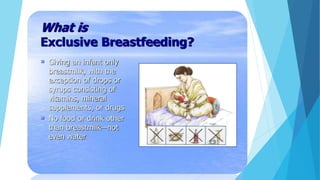
DEFINITION OF EXCLUSIVE BREASTFEEDING
 Exclusive breastfeeding: breast milk only, excluding
water, other liquids, and solid foods (WHO, 2013).
 Exclusive breastfeeding means that the infant receives
only breast milk. No other liquids or solids are given –
not even water – with the exception of oral
rehydration solution, or drops/syrups of vitamins,
minerals or medicines. (WHO, 2013).
WHY EXCLUSIVE BREASTFEEDING IS PUBLIC
HEALTH CONCERN
 For infants to survive, grow and develop properly they require the
right proportion of nutrients, Breast milk rich in nutrients and anti
– bodies and contains the right quantities of fat, sugar, water and
protein. These nutrients are major pre – requisites to health and
survival of the baby.
 When a child is exclusively breast fed, their immune system is
strengthened, enabling it to life – threatening illnesses like
pneumonia and diarrhea amongst other infections.
 Reports indicate the babies who are not breast fed for the
first six months of life are 15 times more likely to die from
pneumonia compared to newborns that are breast fed
exclusively for six months after birth. (Healthy Newborn
Network)
 Infant who contained to be exclusively breastfed tended to
be those who are remained healthy and on an accepted
growth trajectory.
 The World health organization estimates that around
220,000 children could be saved every year with
exclusive breastfeeding.
Breastfeeding is a healthier than formula feeding; it
contains all necessary nutrients for a baby and protects
against several infections and disease.
 The availability of information about formula
feeding, for example, was found to be negatively
correlated with the duration of breastfeeding. In this
experimental study , comparing women who received
promotion materials related to formula feeding and a
control group, a larger proportion of women in the
experimental group stopped breastfeeding during the
first two weeks.
 FACTORS INFLUENCING BREASTFEEDING
-PSYCHOSOCIAL
-DEMOGRAPHIC CHARACTERSTICS
-HOSPITAL PRACTICES
-BIOMEDICAL FACTORS
-SOURCES OF SUPPORT
PORS OF BREASTFEEDING
FOR THE BABY
 Breast milk is the most complete form of nutrition for infants
 Increase survival
 Decreased morbidity
 Adequacy
 Reduce cardiac risk factor
 Improve growth parameters
 Breastfed infants grow exactly the way they should
 Breast milk test good to your child
 Breast milk is easy for your new born to digest
 Breast milk is the healthiest food for the baby
FOR THE MOTHERS
 Helping in uterine involution
 Work as contraception
 Reduce the risk of breast and ovarian cancer
 Hormonal balance
 Provide immediate satisfaction
FOR THE SOCIETY
 Cost effective
 Productive work force
 Purity
 Naturally availability
CONS FOR BREASTFEEDING
 Less freedom to mother
 Continuous
 Can be painful if not having proper positioning or steps
 Other can’t breastfeed
 Can be stressful
 Need more effort towards mother
SUMMARY
After the completion of the class the student teacher
summaries the topic.
 Define exclusive breastfeeding.
 Discuss why exclusive breastfeeding is public health
concern.
 Factors influencing breast feeding.
 PROS of breastfeeding.
 CONS of breastfeeding.
CONCLUSION
 Breast milk remain the best and most secure form of nutrition for
infants. The health benefits of exclusive breastfeeding to infants
especially in developing countries should not be underrated.
Breastfeeding is well recognized as the best food source for
infants. It has been advocated as a cost effective means of
improving the child’s health and mother bonding.
 Breast feeding is the safest, less allergic and best infant feeding
method. It has nutritional , immunological, behavioral and
economic benefits of breastfeeding, breastfeeding prevalence and
duration in many countries, states and local government are still
lower then the international recommendation of exclusive
breastfeeding for the first 6 months of life.
BIBLIOGRAPHY
 Annama Jacab, a comprehensive textbook of midwifery
and gynecological nursing, 5th edition, 2019, jaypee
brother medical publisher pvt., p/p 185-186
 Dc Dutta, textbook of obstetrics, 9th edition2018, jaypee
brother medical publication, p/p 421-450
 Rimple Sharma, textbook of pediatrics, 3rd edition, jaypee
brother medical publication, p/p 223
 Panchali pal, textbook of pediatric nursing, 2nd edition,
CBS Publisher and distributors pvt. Ltd, p/p 97-103
EXCLUSIVE BREASTFEEDING PPT.pptx

EXCLUSIVE BREASTFEEDING PPT.pptx

  • 1.
  • 3.
    GENERAL OBJECTIVE: After completionof the topic, the students will be able to gain knowledge about exclusive breastfeeding and they can apply their knowledge in clinical area also. SPECIFIC OBJECTIVES: After the completion of the lesson plan the students will be able to- -Introduce exclusive breastfeeding. -Define exclusive breastfeeding. -Discuss why exclusive breastfeeding is public health concern.
  • 4.
    -Factors influencing breastfeeding. -PROS of breastfeeding. -CONS of breastfeeding. -Conclusion -Bibliography
  • 5.
  • 6.
    DEFINITION OF BREASTFEEDING WHO has defined breastfeeding as the normal method to provide infants with the nutrients they need for healthy growth and development.(WHO,2013)  Breastfeeding: the method of feeding a baby with milk directly from the mother’s breast (Bristow, 2012)  Breastfeeding is the normal way of providing young infants with nutrients they need for healthy growth and development (WHO, 2013)
  • 7.
    DEFINITION OF EXCLUSIVEBREASTFEEDING  Exclusive breastfeeding: breast milk only, excluding water, other liquids, and solid foods (WHO, 2013).  Exclusive breastfeeding means that the infant receives only breast milk. No other liquids or solids are given – not even water – with the exception of oral rehydration solution, or drops/syrups of vitamins, minerals or medicines. (WHO, 2013).
  • 8.
    WHY EXCLUSIVE BREASTFEEDINGIS PUBLIC HEALTH CONCERN  For infants to survive, grow and develop properly they require the right proportion of nutrients, Breast milk rich in nutrients and anti – bodies and contains the right quantities of fat, sugar, water and protein. These nutrients are major pre – requisites to health and survival of the baby.  When a child is exclusively breast fed, their immune system is strengthened, enabling it to life – threatening illnesses like pneumonia and diarrhea amongst other infections.
  • 9.
     Reports indicatethe babies who are not breast fed for the first six months of life are 15 times more likely to die from pneumonia compared to newborns that are breast fed exclusively for six months after birth. (Healthy Newborn Network)  Infant who contained to be exclusively breastfed tended to be those who are remained healthy and on an accepted growth trajectory.
  • 10.
     The Worldhealth organization estimates that around 220,000 children could be saved every year with exclusive breastfeeding. Breastfeeding is a healthier than formula feeding; it contains all necessary nutrients for a baby and protects against several infections and disease.
  • 11.
     The availabilityof information about formula feeding, for example, was found to be negatively correlated with the duration of breastfeeding. In this experimental study , comparing women who received promotion materials related to formula feeding and a control group, a larger proportion of women in the experimental group stopped breastfeeding during the first two weeks.
  • 12.
     FACTORS INFLUENCINGBREASTFEEDING -PSYCHOSOCIAL -DEMOGRAPHIC CHARACTERSTICS -HOSPITAL PRACTICES -BIOMEDICAL FACTORS -SOURCES OF SUPPORT
  • 13.
    PORS OF BREASTFEEDING FORTHE BABY  Breast milk is the most complete form of nutrition for infants  Increase survival  Decreased morbidity  Adequacy  Reduce cardiac risk factor  Improve growth parameters  Breastfed infants grow exactly the way they should  Breast milk test good to your child  Breast milk is easy for your new born to digest  Breast milk is the healthiest food for the baby
  • 14.
    FOR THE MOTHERS Helping in uterine involution  Work as contraception  Reduce the risk of breast and ovarian cancer  Hormonal balance  Provide immediate satisfaction
  • 15.
    FOR THE SOCIETY Cost effective  Productive work force  Purity  Naturally availability
  • 16.
    CONS FOR BREASTFEEDING Less freedom to mother  Continuous  Can be painful if not having proper positioning or steps  Other can’t breastfeed  Can be stressful  Need more effort towards mother
  • 17.
    SUMMARY After the completionof the class the student teacher summaries the topic.  Define exclusive breastfeeding.  Discuss why exclusive breastfeeding is public health concern.  Factors influencing breast feeding.  PROS of breastfeeding.  CONS of breastfeeding.
  • 18.
    CONCLUSION  Breast milkremain the best and most secure form of nutrition for infants. The health benefits of exclusive breastfeeding to infants especially in developing countries should not be underrated. Breastfeeding is well recognized as the best food source for infants. It has been advocated as a cost effective means of improving the child’s health and mother bonding.  Breast feeding is the safest, less allergic and best infant feeding method. It has nutritional , immunological, behavioral and economic benefits of breastfeeding, breastfeeding prevalence and duration in many countries, states and local government are still lower then the international recommendation of exclusive breastfeeding for the first 6 months of life.
  • 19.
    BIBLIOGRAPHY  Annama Jacab,a comprehensive textbook of midwifery and gynecological nursing, 5th edition, 2019, jaypee brother medical publisher pvt., p/p 185-186  Dc Dutta, textbook of obstetrics, 9th edition2018, jaypee brother medical publication, p/p 421-450  Rimple Sharma, textbook of pediatrics, 3rd edition, jaypee brother medical publication, p/p 223  Panchali pal, textbook of pediatric nursing, 2nd edition, CBS Publisher and distributors pvt. Ltd, p/p 97-103