for Curriculum Mapping
The CenterCurriculum Mapping Implementation:
Student
Learning
Pre mapping
curricular process
Aligned to
standards
No direct or formal attention to
aligning curriculum to either
state; national; or organization
standards.
Faculty loosely follows tradi-
tional curricular documents that
are difficult to keep updated.
Therefore, most teach to their
own strengths and preferences
because there is no K-12 plan
for students.
At times, students experience
unlinked learning episodes.
Learning experiences may re-
peat or contain learning gaps.
In general, traditional methods
of evaluation define the grading
process.
Selection to align to standards
is random approaching “cherry-
picking” by each isolated
teacher.
Faculty and administrators
agree upon goals for student
achievement and agree to fo-
cus instruction so that each stu-
dent will meet the academic
goals and standards.These are
postedbutnotmappedformally.
Awareness of the opportunity to
link learning experiences is
developed with the mapping
process.
Rubrics and other means of
authentic assessment are intro-
duced and used to determine
student achievement according
to each teacher.
Standards are identified by
school or group with delibera-
tion but are formally integrated
into curriculum. They are a
separate list of targets.
Using the help of computer soft-
ware,yearlybenchmarksbased
on academic standards are
designated for student learning.
These are formally mapped.
Subject strands collaborate to
eliminate gaps and repetitions
within the curriculum Pre-12th
grade.
Faculty and administrators
collaborate to determine au-
thentic assessments that dem-
onstrate students’ yearly
progress with benchmarks.
Standards are thoughtfully
identified and directly matched
with specific grade levels and
departmentstoassistinimprov-
ing student learning.
Instruction is designed to sup-
port student achievement of
academic standards. Regular
assessments and review of cur-
riculum occur throughout each
year, so teachers, parents and
students are aware of progress
towards benchmarks based on
school-wide standards.
Learning experiences are ver-
tically linked, sequential and
spiralwithineachsubjectstrand
Pre-12th grade.
Assessments are aligned within
strands and grade levels. Fac-
ulty and administrators use stu-
dent assessment data to inform
curricular decisions.
Power standards are identified as most pertinent
and necessary by faculty and leadership and each
school based on needs of specific student popula-
tion. These are formally entered on each teacher’s
map and are reviewed on an ongoing basis.
The faculty and administration collaboratively set
forth a pre-12th grade concensus map (master map
or essential map) that contains designated yearly
benchmarks and assessments linked to District/
School Standards and Intended Outcome state-
ment.
Power standards are identified as most pertinent
and necessary by faculty and leadership and each
school based on needs of specific student popula-
tion. These are formally entered on each teacher’s
map and are reviewed on an ongoing basis.
The faculty and administration collaboratively set
forth a pre-12th grade concensus map (master map
or essential map) that contains designated yearly
benchmarks and assessments linked to District/
School Standards and Intended Outcome state-
ment.
1 2 3 4 5
Fully operational mapping process
Integrated
Instruction
Linked
Learning
Integrated
Assessment
Developed by Dr. Heidi Hayes Jacobs with source material from PBS Teacherline course, Dr. Bena Kallick and Dr. Laura Fisher, Principia School, St. Louis, Maryland
for Curriculum Mapping
The CenterCurriculum Mapping Implementation:
Faculty and
Administrative
Planning
Pre mapping
curricular process
Collaboration
Little or no curricular collabora-
tion or consultation exists
between faculty members.
Teachers may have only an
occasional awareness of what
is taught in other classes.
Faculty members engage in
solo professional development
experiences. Reports to col-
leagues are brief if at all.
Teacher planning occurs in iso-
lation and does not inform other
faculty members or other de-
partments of the school (i.e.
Admissions, Development).
Faculty gain an awareness of
what is being taught in “like”
areas of the school across a
grade level on elementary and
within department on the sec-
ondary level. Awareness in
middle schools is within teams.
Groups of teachers experience
professional development with
the expectation and opportunity
to share with other faculty.
The Office of Curriculum Coor-
dinator is created to coordinate
anddisplaythecurriculum.Fac-
ulty begins work on computer
curriculum maps.
1 2 3 4 5
Fully operational mapping process
Professional
Development
An Accessible
Curriculum
Developed by Dr. Heidi Hayes Jacobs with source material from PBS Teacherline course, Dr. Bena Kallick and Dr. Laura Fisher, Principia School, St. Louis, Maryland
All faculty members align es-
sential questions, content, skills
to academic standards verti-
cally within subject strands and
horizontally across grade divi-
sion levels.
Faculty members work with ad-
ministrators to designate and
planfacultydevelopmentbased
on data they have gathered.
Faculty works with a computer
mapping process to coordinate
and develop a sequential and
spiraledessentialcurriculumfor
students pre-12th grade.
Faculty members continually
review and adjust student
benchmarks within subject
strands and across grade divi-
sion levels based on data they
collect and on research that
they conduct or read.
Faculty and administration
gather data to measure how
professional development has
affected student achievement.
Faculty is ready to make public
an abridged, core essential cur-
riculum that will inform the work
of the admissions office as well
as other departments and con-
stituents of the school.
Teachers and administrators collaboratively
adjust what is taught based on the best interest
of the students; related to student performance
needs. TARGETED work sessions develop
between the professionals who are best suited
to solve a problem. An essential curriculum is
put forth on the school’s website that is periodi-
cally updated according to faculty research.
Resources spent on Professional Development
can be directly assessed and aligned to student
achievement.
The public, essential curriculum is periodically
updatedonwebsite.In-house,facultymembers
use computer software to share their maps and
lesson plans as needed to expedite coordina-
tion and planning for students.
for Curriculum Mapping
The CenterCurriculum Mapping Implementation:
Curriculum
Development Pre mapping
curricular process
Joint
Decision
Making
Process
Faculty members make curricu-
lar decisions, independently.
Some decisions are mandated
by administration.
Working independently from
one another, teachers adapt,
adjust, or discard ideas from
outdated curricular documents.
The Faculty Curriculum Coun-
cil is formed that works in tan-
dem with administrators. The
Curriculum Coordinator facili-
tates and coordinates the work
of these two groups.
Teachers and administrators
read data that has been gath-
ered from mixed reviews of
maps and ISACS reports and
then consult various academic
standard documents.
1 2 3 4 5
Fully operational mapping process
Decisions
Based on
Data
Developed by Dr. Heidi Hayes Jacobs with source material from PBS Teacherline course, Dr. Bena Kallick and Dr. Laura Fisher, Principia School, St. Louis, Maryland
Teachers work in subject area
strands under the leadership of
an appointed coordinator. Rep-
resentatives from each grade
level and department compose
the site based curriculum coun-
cil with an administrator
present.
As a school, faculty and admin-
istration explore what data is
available and how and when to
use it.
Teachers and administrators
gather data from a variety of
sources to inform curricular de-
cisions.
Task Forces address curricular
issues that go across subject
strands and grade levels.
Groups may include other
constituents of the school as
well.
Teachers and administrators
generate data from student as-
sessments to inform curricular
decisions. Action research is
explored as a way of collecting
data as well.
Site based decision making is institutionalized.
Excess and unneeded committees are
eliminated. Faculty and administration make
curricular decisions jointly. A fluid curriculum
review and change process is in place with
regular meeting times.
Teachers and administrators make curricular
decisions based on external data they have
consulted or internal data they have generated,
including action research conducted in
classrooms. New breakthroughs from the
larger world will be thoughtfully entered in the
curriculum.
for Curriculum Mapping
The CenterCurriculum Mapping Implementation:
Curriculum
Mapping
Entries
Detail on
Content
Vague, general description.
No essential questions are
entered.
Missing, or inaccurate.
Absent, incomplete, or
unfocused.
No attention to developmental
considerations.
Inaccurate information is
entered.
*Understanding is not evident.
No alignment, elements are
missing.
Listing of topic and a few gen-
eral topics.
Simplistic, uneven in quality,
lacking in relevance.
Generic verb; broad process.
Generic product or perfor-
mance is listed.
Uneven reflection of develop-
mental appropriateness.
Attempt at accuracy is
inconsistent.
*Shows some understanding
with some support.
Elements are all entered but not
aligned.
Essential
Questions
Precise skills
Targeted
Assessment
Developmental
Focus
Accuracy of
response
Conceptual
understanding
of the design
process
Internal
Alignment
Developed by Dr. Heidi Hayes Jacobs with source material from PBS Teacherline course, Dr. Bena Kallick and Dr. Laura Fisher, Principia School, St. Louis, Maryland
Concept with supporting sub-
components.
Clear focus question that are
accessible to learners.
Action verbs are listed indis-
criminately; too many.
Generic products only; teacher
role is noted but not students
(i.e. ...teacher observation).
Limited attention to develop-
mental appropriateness in cer-
tain elements.
*General representation of cur-
riculum with little attention to
timeframes.
Displays understanding of ma-
terial and design principles con-
sistently.
Minimal attention is evident to
alignment.
Deliberate choice of topic, prob-
lem, theme, issue, or work de-
scribes main concepts, and
subject matter with a focus.
Questions are conceptual and
targeted; open for inquiry.
Action verbs are used
consistently; skills sets in the
“foreground.”
Specific product and perfor-
mance is noted and aligns with
skills.
Age, stage of development is
reflected in all entries.
Reasonable representation of
operational curriculum.
Conveys a depth of under-
standing of curriculum sup-
ported by salient details.
Demonstrates alignment be-
tween some of the key ele-
ments internally but not all.
Details succinct, clear, specific references to
key concepts, facts, materials.
Engaging, targeted, insightful question; frames
and aligns content, skills, and assessment that
work developmentally.
Commenceswithactionverb;reflectsstandards
and desired proficiencies.
Specific and engaging product and perfor-
mance providing evidence of student learning;
aligns with other elements.
Age, stage of development is reviewed and
considered among faculty regularly.
Consistent and accurate reflection of opera-
tional curriculum anchored in real time.
Creates engaging imaginative, rigorous curricu-
lum with deep understanding.
Demonstrates a clear, coherent, complete cor-
respondence between content, assessment,
skills, and essential questions and standards.
1 2 3 4 5
Pre mapping
curricular process Fully operational mapping process

Curriculum mapping implementation rubric

  • 1.
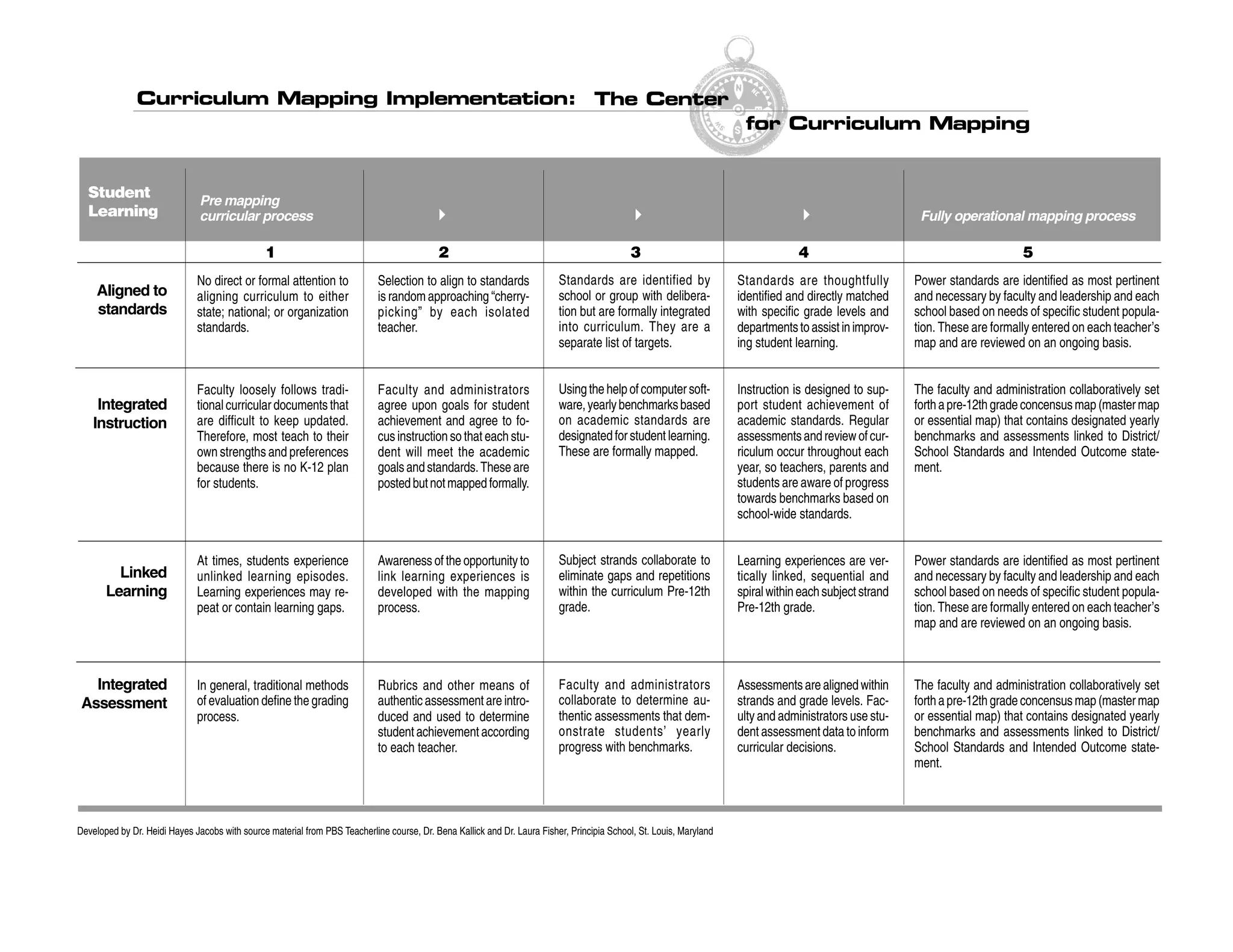
    for Curriculum Mapping TheCenterCurriculum Mapping Implementation: Student Learning Pre mapping curricular process Aligned to standards No direct or formal attention to aligning curriculum to either state; national; or organization standards. Faculty loosely follows tradi- tional curricular documents that are difficult to keep updated. Therefore, most teach to their own strengths and preferences because there is no K-12 plan for students. At times, students experience unlinked learning episodes. Learning experiences may re- peat or contain learning gaps. In general, traditional methods of evaluation define the grading process. Selection to align to standards is random approaching “cherry- picking” by each isolated teacher. Faculty and administrators agree upon goals for student achievement and agree to fo- cus instruction so that each stu- dent will meet the academic goals and standards.These are postedbutnotmappedformally. Awareness of the opportunity to link learning experiences is developed with the mapping process. Rubrics and other means of authentic assessment are intro- duced and used to determine student achievement according to each teacher. Standards are identified by school or group with delibera- tion but are formally integrated into curriculum. They are a separate list of targets. Using the help of computer soft- ware,yearlybenchmarksbased on academic standards are designated for student learning. These are formally mapped. Subject strands collaborate to eliminate gaps and repetitions within the curriculum Pre-12th grade. Faculty and administrators collaborate to determine au- thentic assessments that dem- onstrate students’ yearly progress with benchmarks. Standards are thoughtfully identified and directly matched with specific grade levels and departmentstoassistinimprov- ing student learning. Instruction is designed to sup- port student achievement of academic standards. Regular assessments and review of cur- riculum occur throughout each year, so teachers, parents and students are aware of progress towards benchmarks based on school-wide standards. Learning experiences are ver- tically linked, sequential and spiralwithineachsubjectstrand Pre-12th grade. Assessments are aligned within strands and grade levels. Fac- ulty and administrators use stu- dent assessment data to inform curricular decisions. Power standards are identified as most pertinent and necessary by faculty and leadership and each school based on needs of specific student popula- tion. These are formally entered on each teacher’s map and are reviewed on an ongoing basis. The faculty and administration collaboratively set forth a pre-12th grade concensus map (master map or essential map) that contains designated yearly benchmarks and assessments linked to District/ School Standards and Intended Outcome state- ment. Power standards are identified as most pertinent and necessary by faculty and leadership and each school based on needs of specific student popula- tion. These are formally entered on each teacher’s map and are reviewed on an ongoing basis. The faculty and administration collaboratively set forth a pre-12th grade concensus map (master map or essential map) that contains designated yearly benchmarks and assessments linked to District/ School Standards and Intended Outcome state- ment. 1 2 3 4 5 Fully operational mapping process Integrated Instruction Linked Learning Integrated Assessment Developed by Dr. Heidi Hayes Jacobs with source material from PBS Teacherline course, Dr. Bena Kallick and Dr. Laura Fisher, Principia School, St. Louis, Maryland
  • 2.
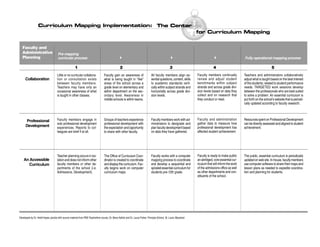
    for Curriculum Mapping TheCenterCurriculum Mapping Implementation: Faculty and Administrative Planning Pre mapping curricular process Collaboration Little or no curricular collabora- tion or consultation exists between faculty members. Teachers may have only an occasional awareness of what is taught in other classes. Faculty members engage in solo professional development experiences. Reports to col- leagues are brief if at all. Teacher planning occurs in iso- lation and does not inform other faculty members or other de- partments of the school (i.e. Admissions, Development). Faculty gain an awareness of what is being taught in “like” areas of the school across a grade level on elementary and within department on the sec- ondary level. Awareness in middle schools is within teams. Groups of teachers experience professional development with the expectation and opportunity to share with other faculty. The Office of Curriculum Coor- dinator is created to coordinate anddisplaythecurriculum.Fac- ulty begins work on computer curriculum maps. 1 2 3 4 5 Fully operational mapping process Professional Development An Accessible Curriculum Developed by Dr. Heidi Hayes Jacobs with source material from PBS Teacherline course, Dr. Bena Kallick and Dr. Laura Fisher, Principia School, St. Louis, Maryland All faculty members align es- sential questions, content, skills to academic standards verti- cally within subject strands and horizontally across grade divi- sion levels. Faculty members work with ad- ministrators to designate and planfacultydevelopmentbased on data they have gathered. Faculty works with a computer mapping process to coordinate and develop a sequential and spiraledessentialcurriculumfor students pre-12th grade. Faculty members continually review and adjust student benchmarks within subject strands and across grade divi- sion levels based on data they collect and on research that they conduct or read. Faculty and administration gather data to measure how professional development has affected student achievement. Faculty is ready to make public an abridged, core essential cur- riculum that will inform the work of the admissions office as well as other departments and con- stituents of the school. Teachers and administrators collaboratively adjust what is taught based on the best interest of the students; related to student performance needs. TARGETED work sessions develop between the professionals who are best suited to solve a problem. An essential curriculum is put forth on the school’s website that is periodi- cally updated according to faculty research. Resources spent on Professional Development can be directly assessed and aligned to student achievement. The public, essential curriculum is periodically updatedonwebsite.In-house,facultymembers use computer software to share their maps and lesson plans as needed to expedite coordina- tion and planning for students.
  • 3.
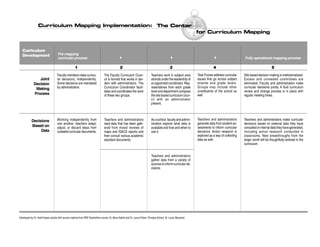
    for Curriculum Mapping TheCenterCurriculum Mapping Implementation: Curriculum Development Pre mapping curricular process Joint Decision Making Process Faculty members make curricu- lar decisions, independently. Some decisions are mandated by administration. Working independently from one another, teachers adapt, adjust, or discard ideas from outdated curricular documents. The Faculty Curriculum Coun- cil is formed that works in tan- dem with administrators. The Curriculum Coordinator facili- tates and coordinates the work of these two groups. Teachers and administrators read data that has been gath- ered from mixed reviews of maps and ISACS reports and then consult various academic standard documents. 1 2 3 4 5 Fully operational mapping process Decisions Based on Data Developed by Dr. Heidi Hayes Jacobs with source material from PBS Teacherline course, Dr. Bena Kallick and Dr. Laura Fisher, Principia School, St. Louis, Maryland Teachers work in subject area strands under the leadership of an appointed coordinator. Rep- resentatives from each grade level and department compose the site based curriculum coun- cil with an administrator present. As a school, faculty and admin- istration explore what data is available and how and when to use it. Teachers and administrators gather data from a variety of sources to inform curricular de- cisions. Task Forces address curricular issues that go across subject strands and grade levels. Groups may include other constituents of the school as well. Teachers and administrators generate data from student as- sessments to inform curricular decisions. Action research is explored as a way of collecting data as well. Site based decision making is institutionalized. Excess and unneeded committees are eliminated. Faculty and administration make curricular decisions jointly. A fluid curriculum review and change process is in place with regular meeting times. Teachers and administrators make curricular decisions based on external data they have consulted or internal data they have generated, including action research conducted in classrooms. New breakthroughs from the larger world will be thoughtfully entered in the curriculum.
  • 4.
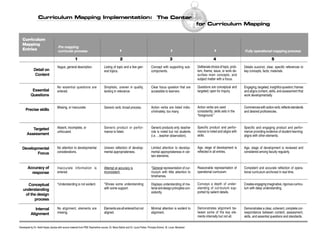
    for Curriculum Mapping TheCenterCurriculum Mapping Implementation: Curriculum Mapping Entries Detail on Content Vague, general description. No essential questions are entered. Missing, or inaccurate. Absent, incomplete, or unfocused. No attention to developmental considerations. Inaccurate information is entered. *Understanding is not evident. No alignment, elements are missing. Listing of topic and a few gen- eral topics. Simplistic, uneven in quality, lacking in relevance. Generic verb; broad process. Generic product or perfor- mance is listed. Uneven reflection of develop- mental appropriateness. Attempt at accuracy is inconsistent. *Shows some understanding with some support. Elements are all entered but not aligned. Essential Questions Precise skills Targeted Assessment Developmental Focus Accuracy of response Conceptual understanding of the design process Internal Alignment Developed by Dr. Heidi Hayes Jacobs with source material from PBS Teacherline course, Dr. Bena Kallick and Dr. Laura Fisher, Principia School, St. Louis, Maryland Concept with supporting sub- components. Clear focus question that are accessible to learners. Action verbs are listed indis- criminately; too many. Generic products only; teacher role is noted but not students (i.e. ...teacher observation). Limited attention to develop- mental appropriateness in cer- tain elements. *General representation of cur- riculum with little attention to timeframes. Displays understanding of ma- terial and design principles con- sistently. Minimal attention is evident to alignment. Deliberate choice of topic, prob- lem, theme, issue, or work de- scribes main concepts, and subject matter with a focus. Questions are conceptual and targeted; open for inquiry. Action verbs are used consistently; skills sets in the “foreground.” Specific product and perfor- mance is noted and aligns with skills. Age, stage of development is reflected in all entries. Reasonable representation of operational curriculum. Conveys a depth of under- standing of curriculum sup- ported by salient details. Demonstrates alignment be- tween some of the key ele- ments internally but not all. Details succinct, clear, specific references to key concepts, facts, materials. Engaging, targeted, insightful question; frames and aligns content, skills, and assessment that work developmentally. Commenceswithactionverb;reflectsstandards and desired proficiencies. Specific and engaging product and perfor- mance providing evidence of student learning; aligns with other elements. Age, stage of development is reviewed and considered among faculty regularly. Consistent and accurate reflection of opera- tional curriculum anchored in real time. Creates engaging imaginative, rigorous curricu- lum with deep understanding. Demonstrates a clear, coherent, complete cor- respondence between content, assessment, skills, and essential questions and standards. 1 2 3 4 5 Pre mapping curricular process Fully operational mapping process