Rooney - English 101
What & How
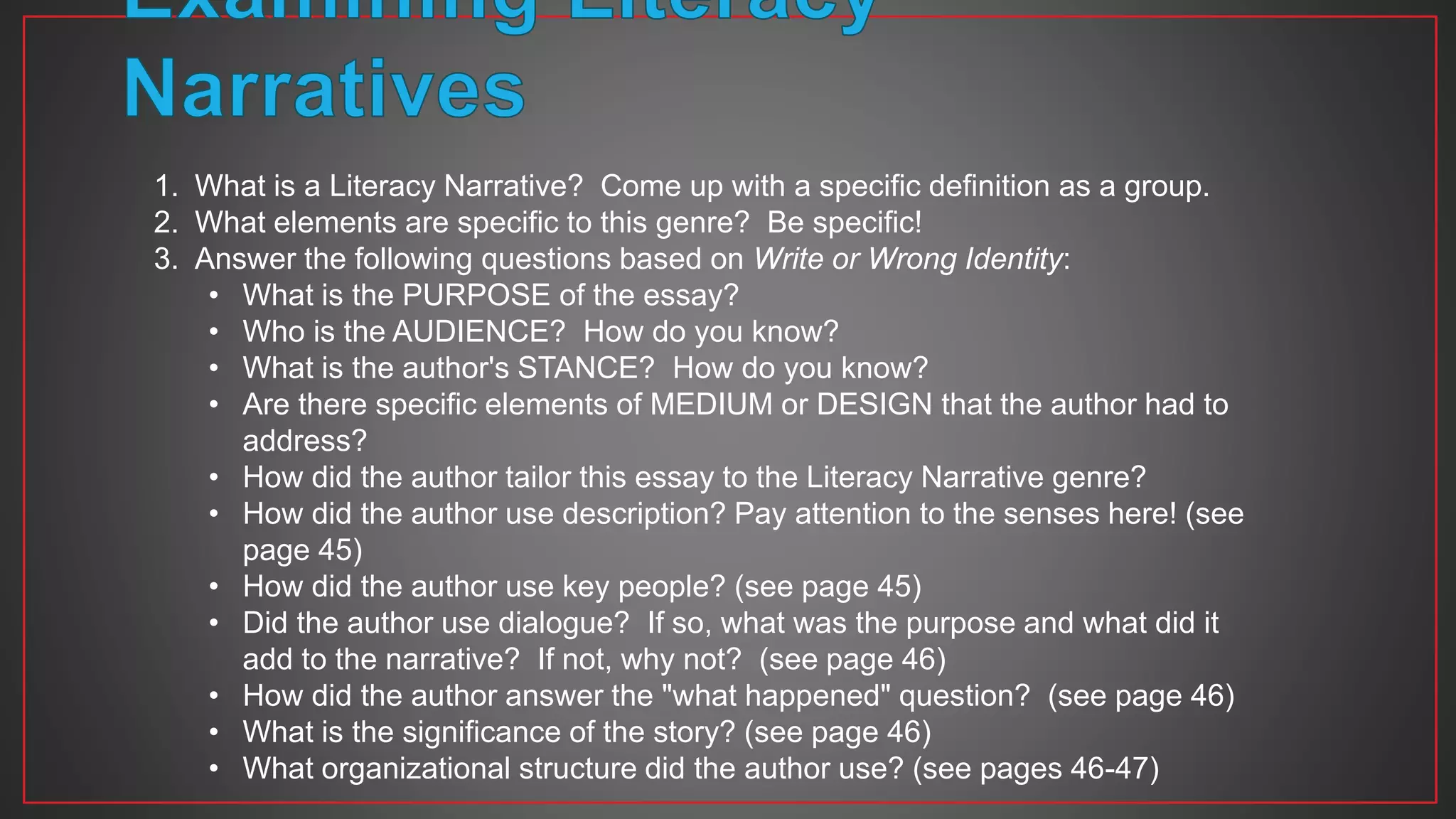
1. What is a Literacy Narrative? Come up with a specific definition as a group.
2. What elements are specific to this genre? Be specific!
3. Answer the following questions based on Write or Wrong Identity:
• What is the PURPOSE of the essay?
• Who is the AUDIENCE? How do you know?
• What is the author's STANCE? How do you know?
• Are there specific elements of MEDIUM or DESIGN that the author had to
address?
• How did the author tailor this essay to the Literacy Narrative genre?
• How did the author use description? Pay attention to the senses here! (see
page 45)
• How did the author use key people? (see page 45)
• Did the author use dialogue? If so, what was the purpose and what did it
add to the narrative? If not, why not? (see page 46)
• How did the author answer the "what happened" question? (see page 46)
• What is the significance of the story? (see page 46)
• What organizational structure did the author use? (see pages 46-47)
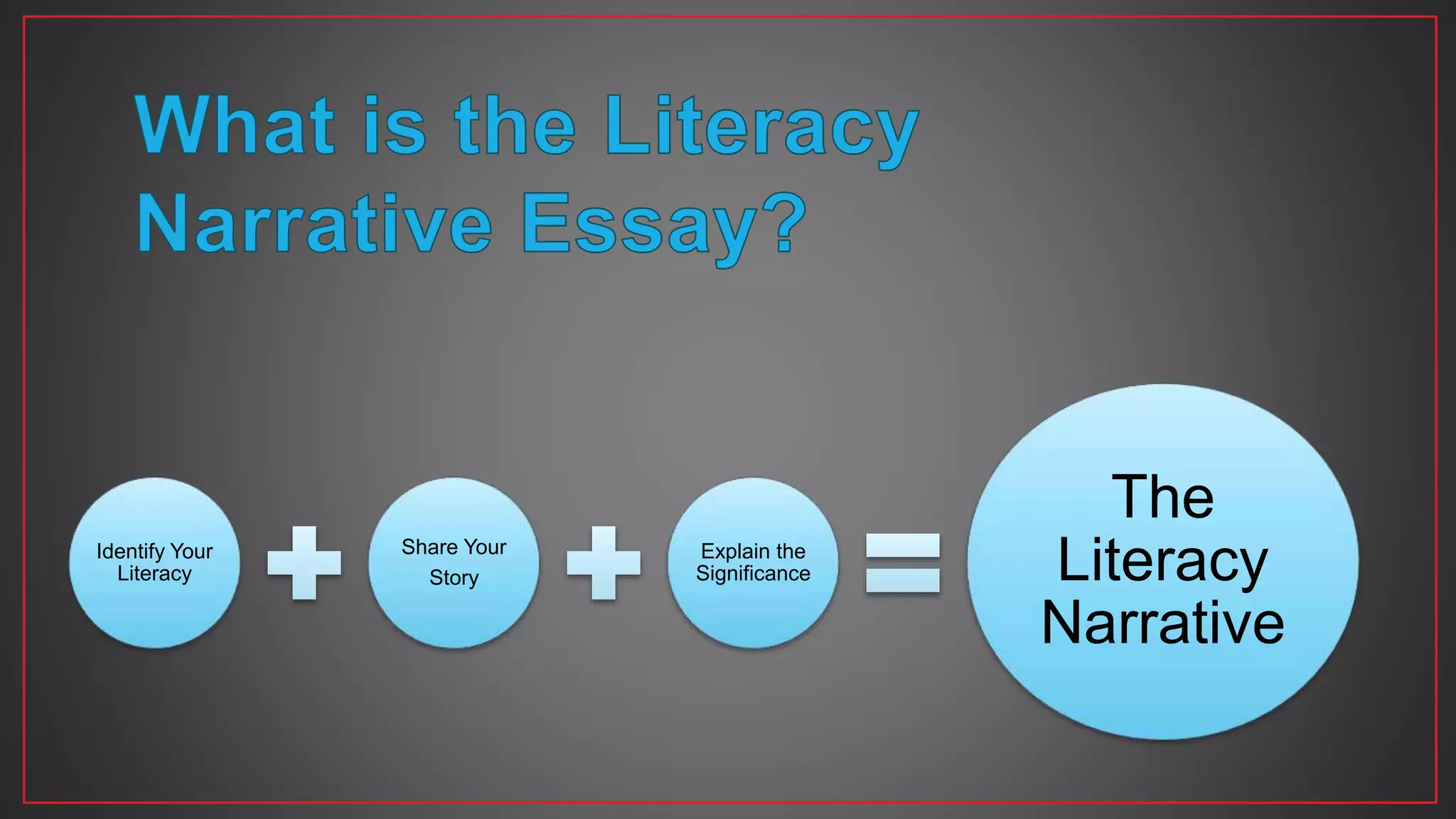
Identify Your
Literacy
Share Your
Story
Explain the
Significance
The
Literacy
Narrative
• This project asks you to share one major event in your development of a literacy in a
detailed and engaging way. Remember that, for our purposes, literacy can encompass
many things - but it is something at which you have a certain skill.
• While this project asks you to share your story, you must also reflect on the importance of
the event to your current ability in the area you discuss. By doing so, you will be learning
more about genre and practicing different modes of composition, which are essential to our
course. Additionally, you will be practicing writing rhetorically with a specific purpose and
audience in mind.
• You MUST choose a literacy that will cross over to your first speech in Ms. Reiser's class -
so you must focus on a literacy that has something you can demonstrate to the class. For
example, if you write about baking as a literacy and focus on the impact it has had on your
life, you may choose to show the class how to frost cookies.
To Inform
• Yourself
• Your
audience
To Identify
• Your own
literacies
and their
significance
To Explore &
Show
• The reasons
it matters
• How it
works
Parts of the Paper
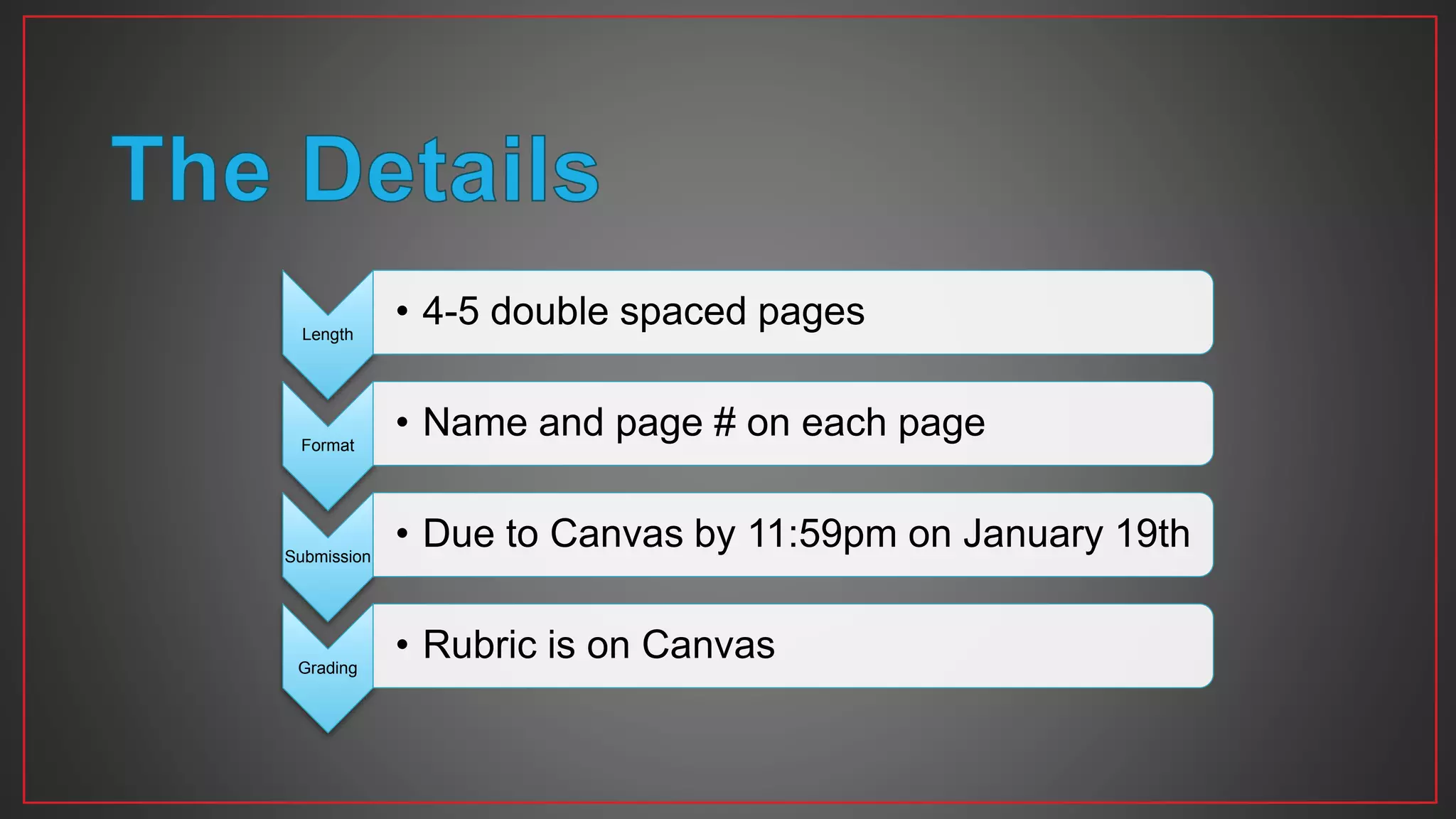
Length
• 4-5 double spaced pages
Format
• Name and page # on each page
Submission
• Due to Canvas by 11:59pm on January 19th
Grading
• Rubric is on Canvas
Fantastic & Compelling
Introduction
Sets up a well-told story
as a situation that needs
to be resolved
Body Paragraphs
Use vivid detail to bring
the narrative to life (sight,
sounds, smell, etc)
Conclusion
Relays an indication of the
narrative’s significance
and gives a resolution
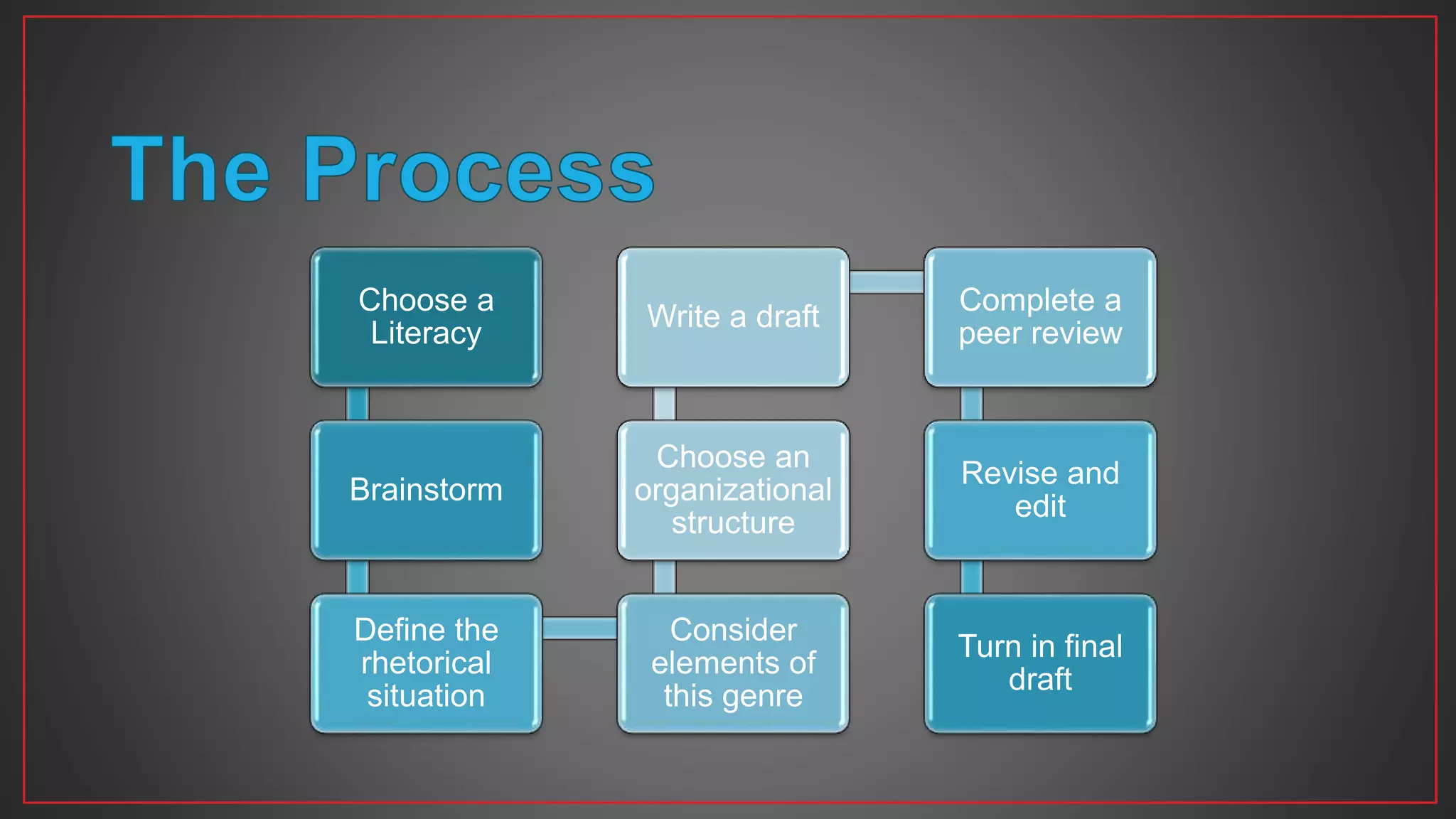
Choose a
Literacy
Brainstorm
Define the
rhetorical
situation
Consider
elements of
this genre
Choose an
organizational
structure
Write a draft
Complete a
peer review
Revise and
edit
Turn in final
draft
1/10: Introduction to paper, brainstorming
1/11: Rhetorical situation and elements due at the beginning
of class
1/12: Outline due at 11:59pm on Canvas
1/16: First draft due at at 11:59pm on Canvas
1/18: Second Draft due in class, Peer Review Workshop
1/19: Final draft due on Canvas at 11:59pm.
• What are some ways to brainstorm?
• What is it that you are brainstorming?
• Homework:
1. Read the entire prompt & rubric on Canvas
2. Brainstorm a list of your own literacies, and come up with at
least three different ways you could demonstrate this
literacy. Bring this to class tomorrow! You’ll be actively
working on writing your paper.

Literacy Narrative Paper Overview

  • 1.
  • 2.
  • 3.
    1. What isa Literacy Narrative? Come up with a specific definition as a group. 2. What elements are specific to this genre? Be specific! 3. Answer the following questions based on Write or Wrong Identity: • What is the PURPOSE of the essay? • Who is the AUDIENCE? How do you know? • What is the author's STANCE? How do you know? • Are there specific elements of MEDIUM or DESIGN that the author had to address? • How did the author tailor this essay to the Literacy Narrative genre? • How did the author use description? Pay attention to the senses here! (see page 45) • How did the author use key people? (see page 45) • Did the author use dialogue? If so, what was the purpose and what did it add to the narrative? If not, why not? (see page 46) • How did the author answer the "what happened" question? (see page 46) • What is the significance of the story? (see page 46) • What organizational structure did the author use? (see pages 46-47)
  • 4.
    Identify Your Literacy Share Your Story Explainthe Significance The Literacy Narrative
  • 5.
    • This projectasks you to share one major event in your development of a literacy in a detailed and engaging way. Remember that, for our purposes, literacy can encompass many things - but it is something at which you have a certain skill. • While this project asks you to share your story, you must also reflect on the importance of the event to your current ability in the area you discuss. By doing so, you will be learning more about genre and practicing different modes of composition, which are essential to our course. Additionally, you will be practicing writing rhetorically with a specific purpose and audience in mind. • You MUST choose a literacy that will cross over to your first speech in Ms. Reiser's class - so you must focus on a literacy that has something you can demonstrate to the class. For example, if you write about baking as a literacy and focus on the impact it has had on your life, you may choose to show the class how to frost cookies.
  • 6.
    To Inform • Yourself •Your audience To Identify • Your own literacies and their significance To Explore & Show • The reasons it matters • How it works
  • 7.
  • 8.
    Length • 4-5 doublespaced pages Format • Name and page # on each page Submission • Due to Canvas by 11:59pm on January 19th Grading • Rubric is on Canvas
  • 9.
    Fantastic & Compelling Introduction Setsup a well-told story as a situation that needs to be resolved Body Paragraphs Use vivid detail to bring the narrative to life (sight, sounds, smell, etc) Conclusion Relays an indication of the narrative’s significance and gives a resolution
  • 10.
    Choose a Literacy Brainstorm Define the rhetorical situation Consider elementsof this genre Choose an organizational structure Write a draft Complete a peer review Revise and edit Turn in final draft
  • 11.
    1/10: Introduction topaper, brainstorming 1/11: Rhetorical situation and elements due at the beginning of class 1/12: Outline due at 11:59pm on Canvas 1/16: First draft due at at 11:59pm on Canvas 1/18: Second Draft due in class, Peer Review Workshop 1/19: Final draft due on Canvas at 11:59pm.
  • 13.
    • What aresome ways to brainstorm? • What is it that you are brainstorming?
  • 14.
    • Homework: 1. Readthe entire prompt & rubric on Canvas 2. Brainstorm a list of your own literacies, and come up with at least three different ways you could demonstrate this literacy. Bring this to class tomorrow! You’ll be actively working on writing your paper.