Writing Thesis and
Project Proposals
A presentation by
Sajadin Sembiring, S.Si., M.Sc. Comp.
Outcomes of this workshop
• To introduce strategies for bridging the gap between
coursework/beginning research and thesis/project
writing.
• To help you understand the symbolic situation of the
thesis/project proposal and common elements of such
proposals.
• To introduce practical symbolic and grammatical
principles of writing effective proposals.
• To provide you with tips for drafting and revising
individual sections of the proposal.
Writing Thesis/project Proposals:
The Big Picture
Your proposal describes your proposed plan of
work:
• What you intend to study (scope and research
questions).
• How you intend to study your topic (methodology).
• Why this topic needs to be studied (significance).
• When you will complete this work (timeline).
• (Occasionally) Where you will conduct this work.
Writing Thesis/Project Proposals
Purpose:
• Justify and plan (or contract for) a research
project.
• Show how your project contributes to existing
research.
• Demonstrate that you understand how to conduct
discipline-specific research in an acceptable time-
frame.
Audience:
• your academic advisor and committee
Proposal Writing and Anxiety:
Proposal-specific Advice
• Understand that the proposal will be negotiated--be
prepared to revise!
• Think of the proposal as an introduction to your thesis or
project.
• Remember that the proposal is not a compulsory contract.
• Remember that your proposal is not intended to limit
ideas, but to help you think practically.
• Ask classmates to form a writing group.
• Talk to your Supervisor/Academic advisor!
Parts of a Proposal
• Title
• Abstract
• Introduction/Background
• Problem Statement
• Purpose/Aims/
Rationale/Research
Questions
• Review of Literature
• Methodology
• Significance/
Implications
• Overview of
Chapters
• Plan of Work
• Bibliography
Creating a Working Title
• Orient your readers to your
research topic.
• Indicate the type of study you
will conduct.
Abstract
• Provide a brief (100-150 word) overview of
the proposal
• Summarize important elements
(Introduction, Statement of the Problem,
Background of the Study, Research
Questions, and Methods and Procedures).
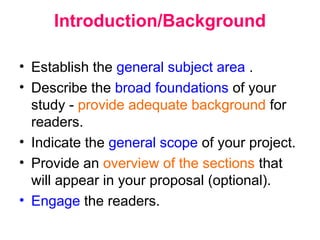
Introduction/Background
• Establish the general subject area .
• Describe the broad foundations of your
study - provide adequate background for
readers.
• Indicate the general scope of your project.
• Provide an overview of the sections that
will appear in your proposal (optional).
• Engage the readers.
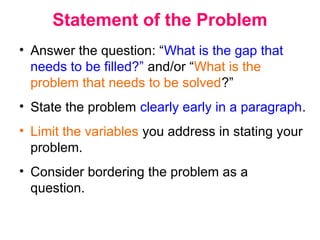
Statement of the Problem
• Answer the question: “What is the gap that
needs to be filled?” and/or “What is the
problem that needs to be solved?”
• State the problem clearly early in a paragraph.
• Limit the variables you address in stating your
problem.
• Consider bordering the problem as a
question.
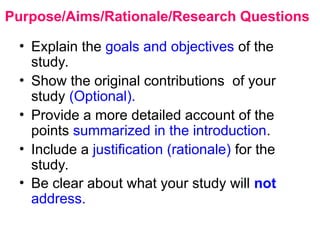
Purpose/Aims/Rationale/Research Questions
• Explain the goals and objectives of the
study.
• Show the original contributions of your
study (Optional).
• Provide a more detailed account of the
points summarized in the introduction.
• Include a justification (rationale) for the
study.
• Be clear about what your study will not
address.
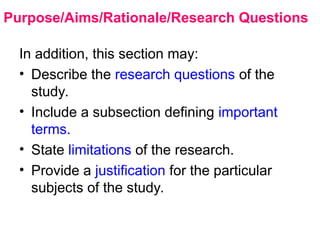
Purpose/Aims/Rationale/Research Questions
In addition, this section may:
• Describe the research questions of the
study.
• Include a subsection defining important
terms.
• State limitations of the research.
• Provide a justification for the particular
subjects of the study.
Review of Literature
• How other scholars have written about your topic.
• The range of theories used to analyze materials
or data
• How other scholars connect their specific
research topics to larger issues, questions, or
practices within the field.
• The best methodologies and research techniques
for your particular topic.
Writing the literature review allows you
to understand:
Review of Literature:
symbolic Functions
• Situates the current study within a wider
disciplinary conversation.
• Illustrates the uniqueness, importance of
and need for your particular project.
• Justifies methodological choices.
• Demonstrates familiarity with the topic and
appropriate approaches to studying it.
An Effective Literature Review should
• Flesh out the background of your
study.
• Critically assess important research
trends or areas of interest.
• Identify potential gaps in knowledge.
• Establish a need for current and/or
future research projects.
Tips on drafting a literature review
• Categorize the literature into recognizable topic
clusters:
– stake out the various positions that are relevant to
your project,
– build on conclusions that lead to your project, or
– demonstrate the places where the literature is lacking.
• Avoid “Smith says X, Jones says Y” literature
reviews.
• Avoid including all the studies on the subject.
• Avoid polemics, praise, and blame.
Writing Literature Reviews: Key Point
• You are entering a scholarly conversation already in
progress. The literature review shows that you’ve been
listening and that you have something valuable to say.
• After assessing the literature in your field, you should
be able to answer the following questions:
– Why should we study (further) this research topic/problem?
– What contributions will my study make to the existing
literature?
Methodology
• Introduce the overall methodological approach.
• Indicate how the approach fits the overall
research design.
• Describe the specific methods of data
collection.
• Explain how you intend to analyze and
interpret your results.
• If necessary, provide background and
justification for unfamiliar methodologies.
• Address possible limitations.
Tips on Drafting Methodology
• Break down your methodology into
subsections.
– In the Engineering, may include subjects, design,
apparatus, instrumentation, process, analysis, etc.
• Remember that your methods section may also
require supporting literature.
• Anticipate and prevent the audience’s
methodological concerns.
– Acknowledge major problems.
– Justify your approach by showing how benefits
balance potential problems.
Significance/Implications
• Discuss the methodological, substantive, and/or
theoretical contribution.
• State the practical and/or theoretical importance
of the problem and/or objectives of your study.
• Explain the usefulness or benefits of the study to
both the outside world and the research
community.
Overview of Chapters
• Some proposals include a sentence
length description of each chapter
(i.e. chapter two reviews relevant
literature; chapter three discusses the
methodology).
Timeline/Plan of Work
Some things to keep in mind:
• Consult your supervisor.
• Be aware of important dates for submitting.
• Do not be overly ambitious.
• Remember that your proposed timeline
demonstrates your awareness of the various
elements of the study (approval, design,
testing, and length of experiments; purchase
of necessary materials; drafting; redrafting).
Bibliography & Appendices
• Include a working bibliography of key texts
that inform your study and methodology.
• Your appendices may include Experiment
Diagrams, table, computer program etc.
• Both bibliographies and required
appendices tend to be discipline specific:
know what the requirements are.
More Proposal “Nuts and Bolts”
• Length
– Most are roughly 5 to 6 pages, but
they can be much longer.
• Style Considerations
– Tone
– Coherence
• Voice
• Visual Aids
Style Considerations: Coherence
• Move from “old” information to “new” information.
• Put the most important information at the end of
the sentence.
• Keep the subject and verb together.
• Start sentences with short, easily understood
phrases.
• Use “stock” transitional phrases.
• Use pronouns and/or recycling.
Voice and Visual Aids
Voice
• Active: I will conduct the bulk of the research during the six-
month fieldwork period.
• Passive: The bulk of the research will be conducted during
fieldwork.
Reasons to use Passive Voice:
• Your field may prefer its use, especially in describing
research design and experimental activities.
• You need to defend consistency from sentence to sentence.
Visual Aids
• Incorporate charts, graphs, diagrams,
illustrations, etc., wherever possible,
permissible, or practical.

Research_Methodology_1_Writing_Research.ppt

  • 1.
    Writing Thesis and ProjectProposals A presentation by Sajadin Sembiring, S.Si., M.Sc. Comp.
  • 2.
    Outcomes of thisworkshop • To introduce strategies for bridging the gap between coursework/beginning research and thesis/project writing. • To help you understand the symbolic situation of the thesis/project proposal and common elements of such proposals. • To introduce practical symbolic and grammatical principles of writing effective proposals. • To provide you with tips for drafting and revising individual sections of the proposal.
  • 3.
    Writing Thesis/project Proposals: TheBig Picture Your proposal describes your proposed plan of work: • What you intend to study (scope and research questions). • How you intend to study your topic (methodology). • Why this topic needs to be studied (significance). • When you will complete this work (timeline). • (Occasionally) Where you will conduct this work.
  • 4.
    Writing Thesis/Project Proposals Purpose: •Justify and plan (or contract for) a research project. • Show how your project contributes to existing research. • Demonstrate that you understand how to conduct discipline-specific research in an acceptable time- frame. Audience: • your academic advisor and committee
  • 5.
    Proposal Writing andAnxiety: Proposal-specific Advice • Understand that the proposal will be negotiated--be prepared to revise! • Think of the proposal as an introduction to your thesis or project. • Remember that the proposal is not a compulsory contract. • Remember that your proposal is not intended to limit ideas, but to help you think practically. • Ask classmates to form a writing group. • Talk to your Supervisor/Academic advisor!
  • 6.
    Parts of aProposal • Title • Abstract • Introduction/Background • Problem Statement • Purpose/Aims/ Rationale/Research Questions • Review of Literature • Methodology • Significance/ Implications • Overview of Chapters • Plan of Work • Bibliography
  • 7.
    Creating a WorkingTitle • Orient your readers to your research topic. • Indicate the type of study you will conduct.
  • 8.
    Abstract • Provide abrief (100-150 word) overview of the proposal • Summarize important elements (Introduction, Statement of the Problem, Background of the Study, Research Questions, and Methods and Procedures).
  • 9.
    Introduction/Background • Establish thegeneral subject area . • Describe the broad foundations of your study - provide adequate background for readers. • Indicate the general scope of your project. • Provide an overview of the sections that will appear in your proposal (optional). • Engage the readers.
  • 10.
    Statement of theProblem • Answer the question: “What is the gap that needs to be filled?” and/or “What is the problem that needs to be solved?” • State the problem clearly early in a paragraph. • Limit the variables you address in stating your problem. • Consider bordering the problem as a question.
  • 11.
    Purpose/Aims/Rationale/Research Questions • Explainthe goals and objectives of the study. • Show the original contributions of your study (Optional). • Provide a more detailed account of the points summarized in the introduction. • Include a justification (rationale) for the study. • Be clear about what your study will not address.
  • 12.
    Purpose/Aims/Rationale/Research Questions In addition,this section may: • Describe the research questions of the study. • Include a subsection defining important terms. • State limitations of the research. • Provide a justification for the particular subjects of the study.
  • 13.
    Review of Literature •How other scholars have written about your topic. • The range of theories used to analyze materials or data • How other scholars connect their specific research topics to larger issues, questions, or practices within the field. • The best methodologies and research techniques for your particular topic. Writing the literature review allows you to understand:
  • 14.
    Review of Literature: symbolicFunctions • Situates the current study within a wider disciplinary conversation. • Illustrates the uniqueness, importance of and need for your particular project. • Justifies methodological choices. • Demonstrates familiarity with the topic and appropriate approaches to studying it.
  • 15.
    An Effective LiteratureReview should • Flesh out the background of your study. • Critically assess important research trends or areas of interest. • Identify potential gaps in knowledge. • Establish a need for current and/or future research projects.
  • 16.
    Tips on draftinga literature review • Categorize the literature into recognizable topic clusters: – stake out the various positions that are relevant to your project, – build on conclusions that lead to your project, or – demonstrate the places where the literature is lacking. • Avoid “Smith says X, Jones says Y” literature reviews. • Avoid including all the studies on the subject. • Avoid polemics, praise, and blame.
  • 17.
    Writing Literature Reviews:Key Point • You are entering a scholarly conversation already in progress. The literature review shows that you’ve been listening and that you have something valuable to say. • After assessing the literature in your field, you should be able to answer the following questions: – Why should we study (further) this research topic/problem? – What contributions will my study make to the existing literature?
  • 18.
    Methodology • Introduce theoverall methodological approach. • Indicate how the approach fits the overall research design. • Describe the specific methods of data collection. • Explain how you intend to analyze and interpret your results. • If necessary, provide background and justification for unfamiliar methodologies. • Address possible limitations.
  • 19.
    Tips on DraftingMethodology • Break down your methodology into subsections. – In the Engineering, may include subjects, design, apparatus, instrumentation, process, analysis, etc. • Remember that your methods section may also require supporting literature. • Anticipate and prevent the audience’s methodological concerns. – Acknowledge major problems. – Justify your approach by showing how benefits balance potential problems.
  • 20.
    Significance/Implications • Discuss themethodological, substantive, and/or theoretical contribution. • State the practical and/or theoretical importance of the problem and/or objectives of your study. • Explain the usefulness or benefits of the study to both the outside world and the research community.
  • 21.
    Overview of Chapters •Some proposals include a sentence length description of each chapter (i.e. chapter two reviews relevant literature; chapter three discusses the methodology).
  • 22.
    Timeline/Plan of Work Somethings to keep in mind: • Consult your supervisor. • Be aware of important dates for submitting. • Do not be overly ambitious. • Remember that your proposed timeline demonstrates your awareness of the various elements of the study (approval, design, testing, and length of experiments; purchase of necessary materials; drafting; redrafting).
  • 23.
    Bibliography & Appendices •Include a working bibliography of key texts that inform your study and methodology. • Your appendices may include Experiment Diagrams, table, computer program etc. • Both bibliographies and required appendices tend to be discipline specific: know what the requirements are.
  • 24.
    More Proposal “Nutsand Bolts” • Length – Most are roughly 5 to 6 pages, but they can be much longer. • Style Considerations – Tone – Coherence • Voice • Visual Aids
  • 25.
    Style Considerations: Coherence •Move from “old” information to “new” information. • Put the most important information at the end of the sentence. • Keep the subject and verb together. • Start sentences with short, easily understood phrases. • Use “stock” transitional phrases. • Use pronouns and/or recycling.
  • 26.
    Voice and VisualAids Voice • Active: I will conduct the bulk of the research during the six- month fieldwork period. • Passive: The bulk of the research will be conducted during fieldwork. Reasons to use Passive Voice: • Your field may prefer its use, especially in describing research design and experimental activities. • You need to defend consistency from sentence to sentence.
  • 27.
    Visual Aids • Incorporatecharts, graphs, diagrams, illustrations, etc., wherever possible, permissible, or practical.

Editor's Notes

  • #3 These points are variations on the journalist’s basic questions: who, what, when, where, how, and why.