Motivation and Goal Setting Unit 1
Review of Last Week You reviewed your Addicted vs. Sober worksheet and circled each characteristic you want to change  Pick one characteristic and identify the 3 things you can do to change it. Have group members who identified the same characteristic share their ideas on how to change it
Objectives Define motivation Explain how motivation is related to goal setting and change Learn how to identify goals Understand the process for setting (and achieving) goals List the different levels or stages of motivation Discuss ways to increase motivation Define the FRAMES approach
What is Motivation Motivation is a key to change. Motivation can be modified.
Aspects of Motivation Commitment (Energy) Control (Ability) Challenge (Perception)
Motivation is Multidimensional Emotional expression of concern about the perceived problem (e.g., "I'm really worried about what is happening to me.") Cognitive (Thoughts and Beliefs: Recognition of the problem (e.g., "I guess this is more serious than I thought.") Physical (Energy/Control) Optimism about one's ability to change (e.g., "I know that if I try, I can really do it.") Social (Peer Pressure, Social Support)
Change Causes Crisis &  Crisis Causes Change Emotional How you feel about the current behaviors How excited/hopeful you are for change Fear of failure, rejection and the unknown Mental Reasons for changing Reasons for staying the same Belief that you can change
Physical Amount of energy available for change Plan for dealing with discomfort Social Peer pressure to change Peer pressure to remain the same Potential changes in peer group when you change Desire to keep current friends Influence of family
Activity For the following goals, identify the motivation Commitment Control Challenge Emotional Motivation (Feelings about the issue) Mental Motivation (Thoughts/Rationales) Social Motivation (Supporters, Peer pressure) Physical Motivation Weight loss or getting in shape Depression Addiction
Motivation is Dynamic & Fluctuating Different issues can have different levels of motivation Reasons (Motivations ) for behaviors can change Motivation levels will wax and wane Stages/Levels of Motivation Precontemplation Contemplation Preparation Action
Activity Review the list of changes you identified from the Addicted vs. Sober self activity. Pick 3 that you feel most motivated to work on Identify the following reasons for change Emotional Mental Physical Social
FRAMES Feedback Responsibility Advice Menu of options Empathy/Support Self-Efficacy (Can-Do Attitude)
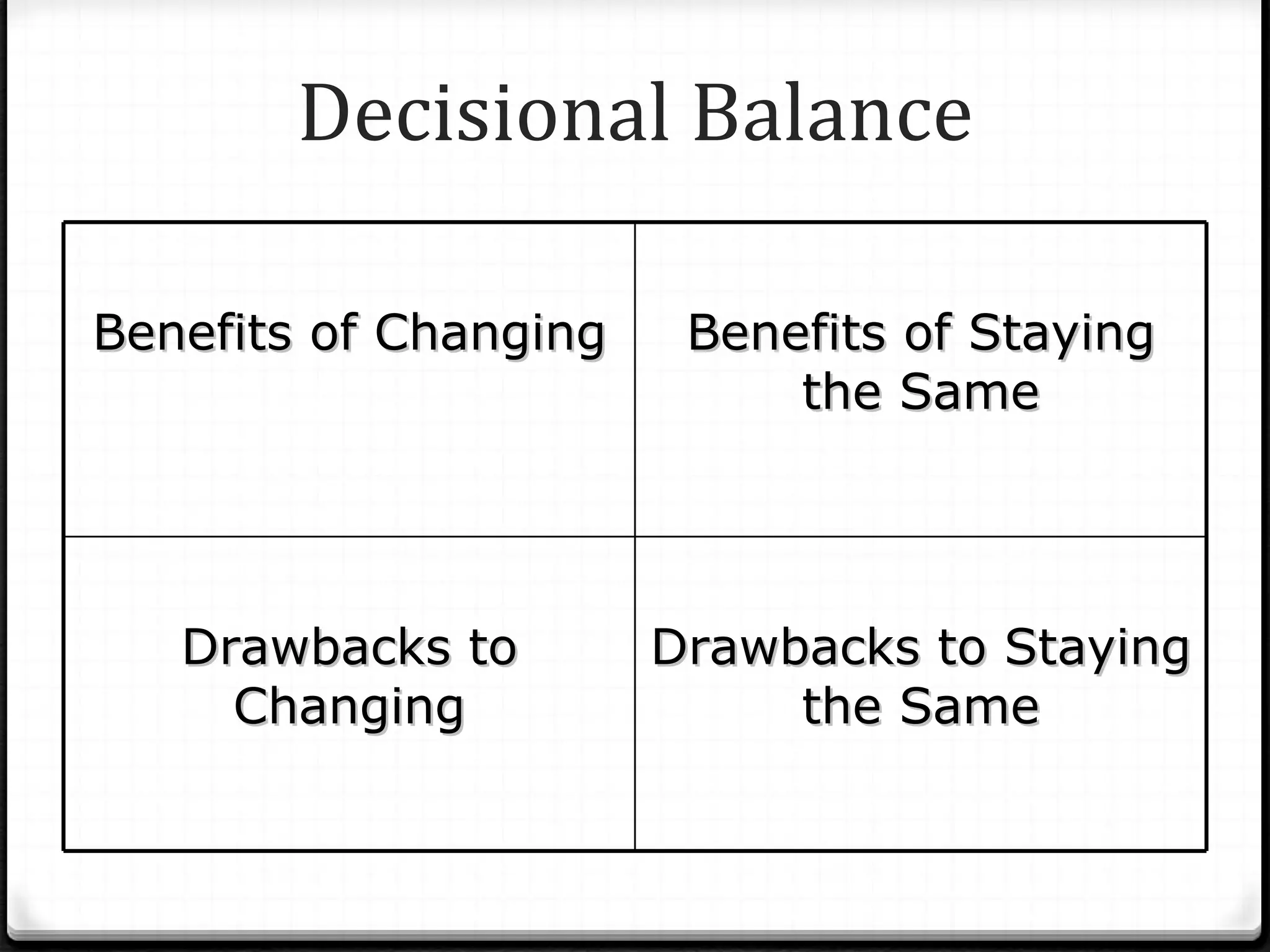
Decisional Balance Benefits of Changing Benefits of Staying the Same Drawbacks to Changing Drawbacks to Staying the Same
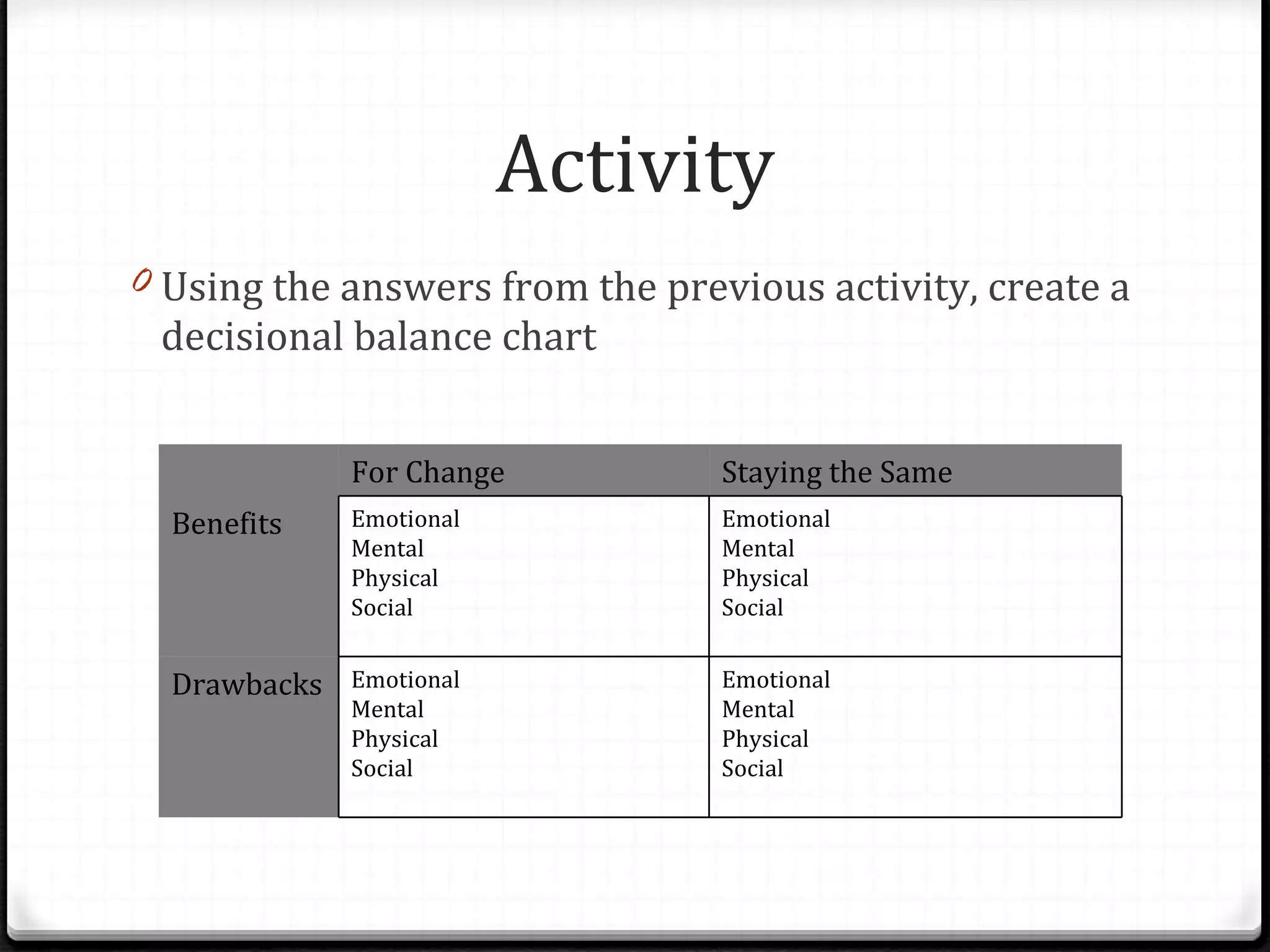
Activity Using the answers from the previous activity, create a decisional balance chart For Change Staying the Same Benefits Emotional Mental Physical Social Emotional Mental Physical Social Drawbacks Emotional Mental Physical Social Emotional Mental Physical Social
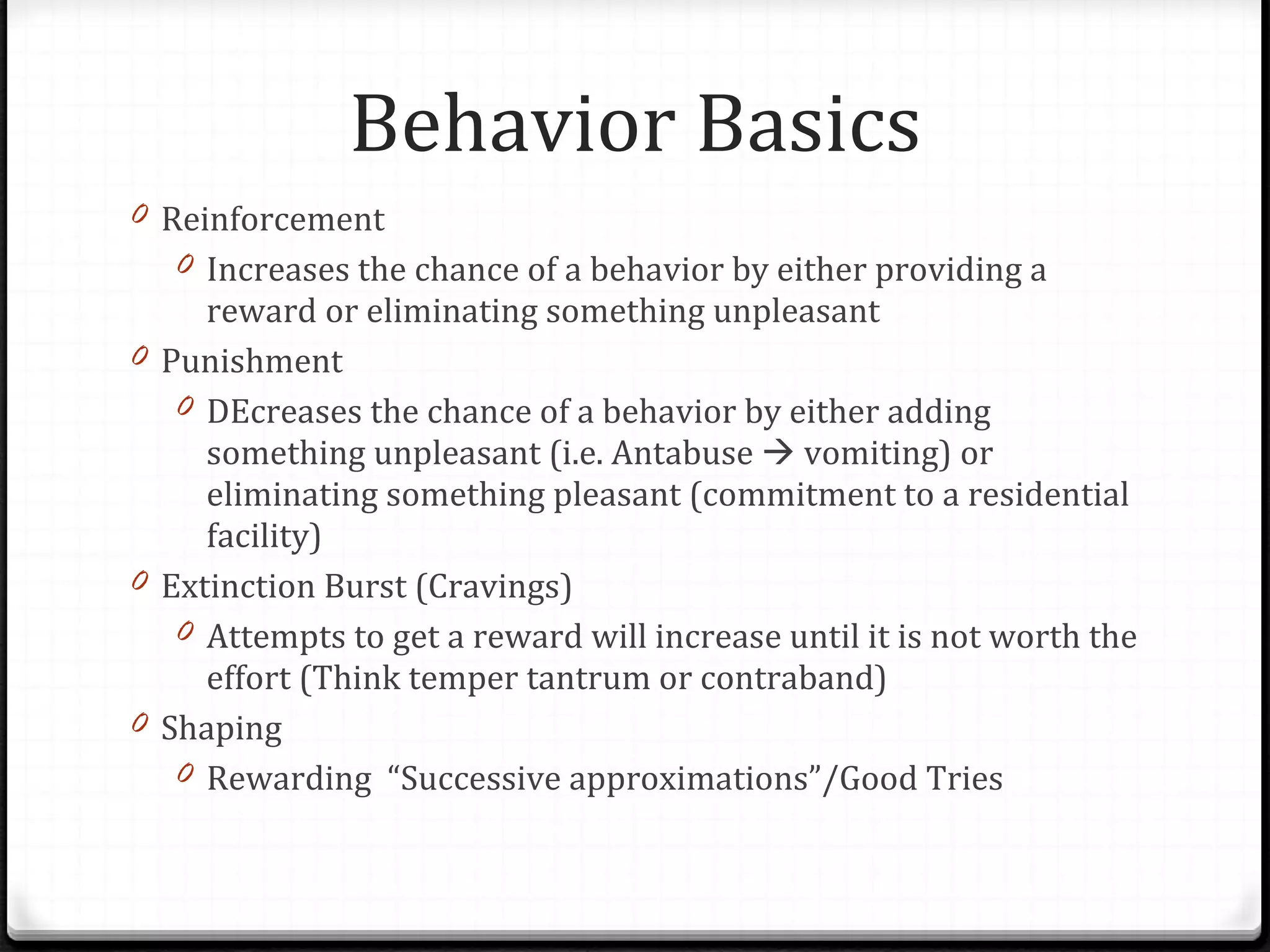
Behavior Basics Reinforcement Increases the chance of a behavior by either providing a reward or eliminating something unpleasant Punishment DEcreases the chance of a behavior by either adding something unpleasant (i.e. Antabuse    vomiting) or eliminating something pleasant (commitment to a residential facility) Extinction Burst (Cravings) Attempts to get a reward will increase until it is not worth the effort (Think temper tantrum or contraband) Shaping Rewarding  “Successive approximations”/Good Tries
Activity For the three behaviors you want to change identify Rewards for doing the next right thing Punishments/consequences of doing the wrong thing How you are going to deal with cravings
Increasing Motivation Consciousness raising  is increasing information about the problem.  Self-reevaluation  involves assessing how one feels and thinks about oneself with respect to problem behaviors.  Hardiness  means committing to act, believing that it is within your control and seeing it as a challenge.
Competing Responses  means developing alternative, healthy coping behaviors to deal with distress and discomfort.  Creating Safety  means avoiding or addressing things that trigger problem behaviors.  Reinforcement  means identifying and ensuring rewards for good choices.  Helping relationships  are created by being open and trusting with people who care.
Activity For each of the goals identify What information/knowledge you need about the causes/consequences and alternatives to the problem ( Consciousness raising) How you feel and think about yourself with respect to problem behaviors. ( Self-reevaluation )  Review the decisional balance exercise to identify how  change will affect you What parts are within your control and worth the effort  (Hardiness) Alternative, healthy coping behaviors to deal with distress and discomfort.  (Competing Responses) Triggers and ways to avoid, eliminate or cope with them  (Creating Safety) Rewards to keep you motivated  (Reinforcement) Supportive people who can help you stay motivated  (Helping Relationships)
Assess bio-psycho-social needs Biological Emotional and Physical Safety Supportive Relationships Self-Esteem Identify areas in which you are motivated to work Write the Goal Statement Answers the question “How will I know when I have accomplished this?” States what new behaviors, feelings will be present Review: Process and Format
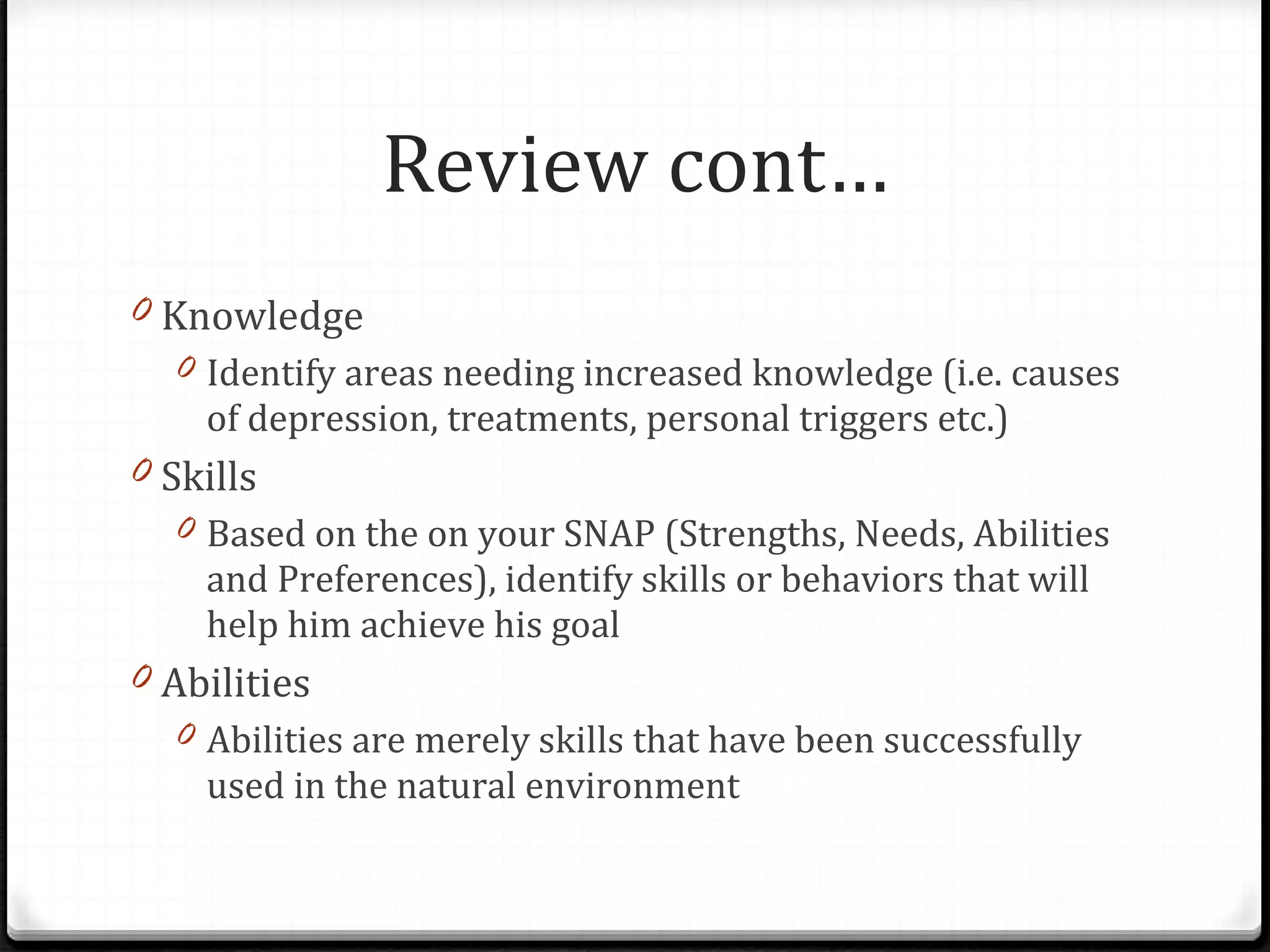
Knowledge Identify areas needing increased knowledge (i.e. causes of depression, treatments, personal triggers etc.) Skills Based on the on your SNAP (Strengths, Needs, Abilities and Preferences), identify skills or behaviors that will help him achieve his goal Abilities Abilities are merely skills that have been successfully used in the natural environment  Review cont…
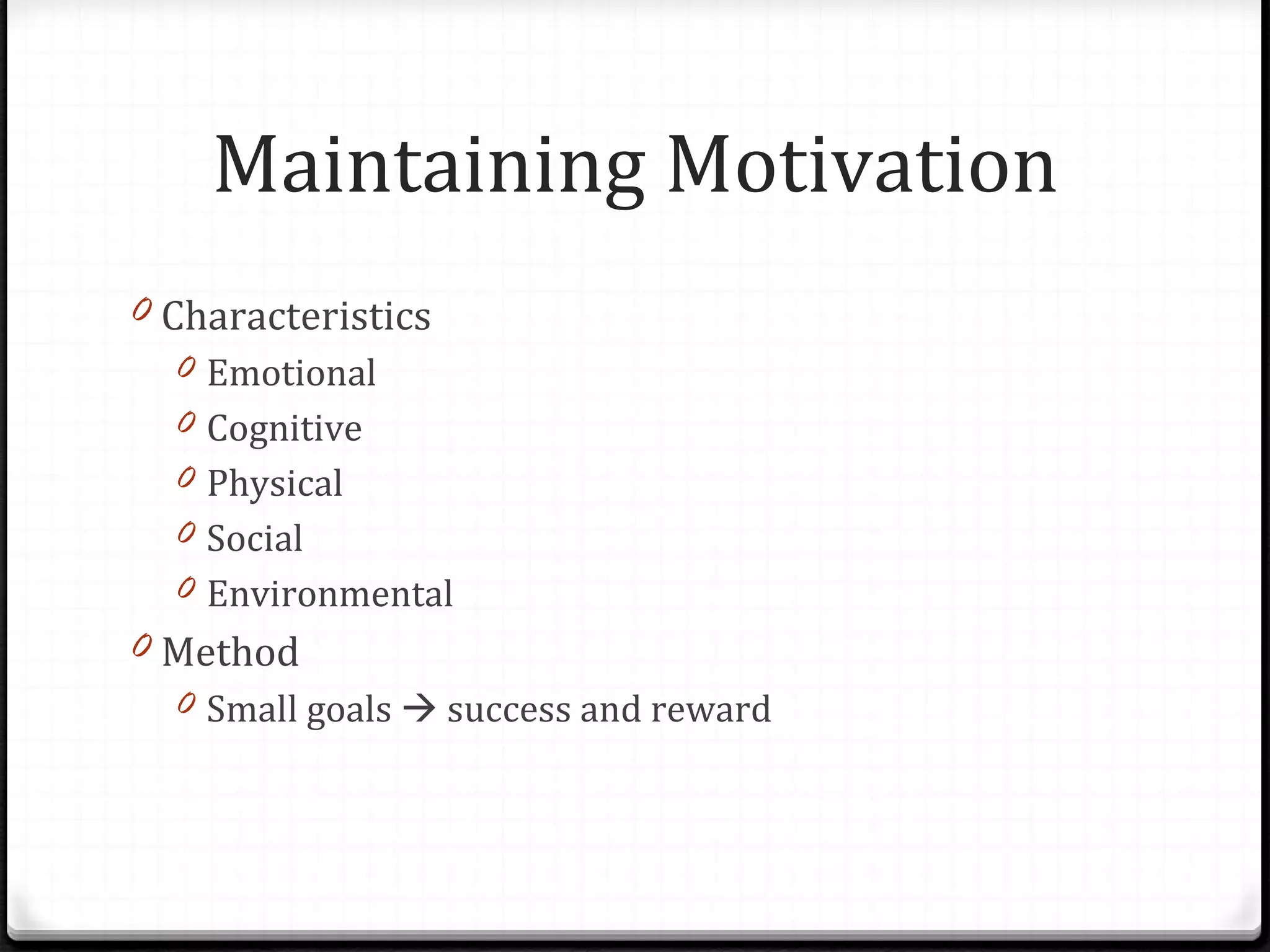
Characteristics Emotional  Cognitive Physical Social Environmental Method Small goals    success and reward Maintaining Motivation
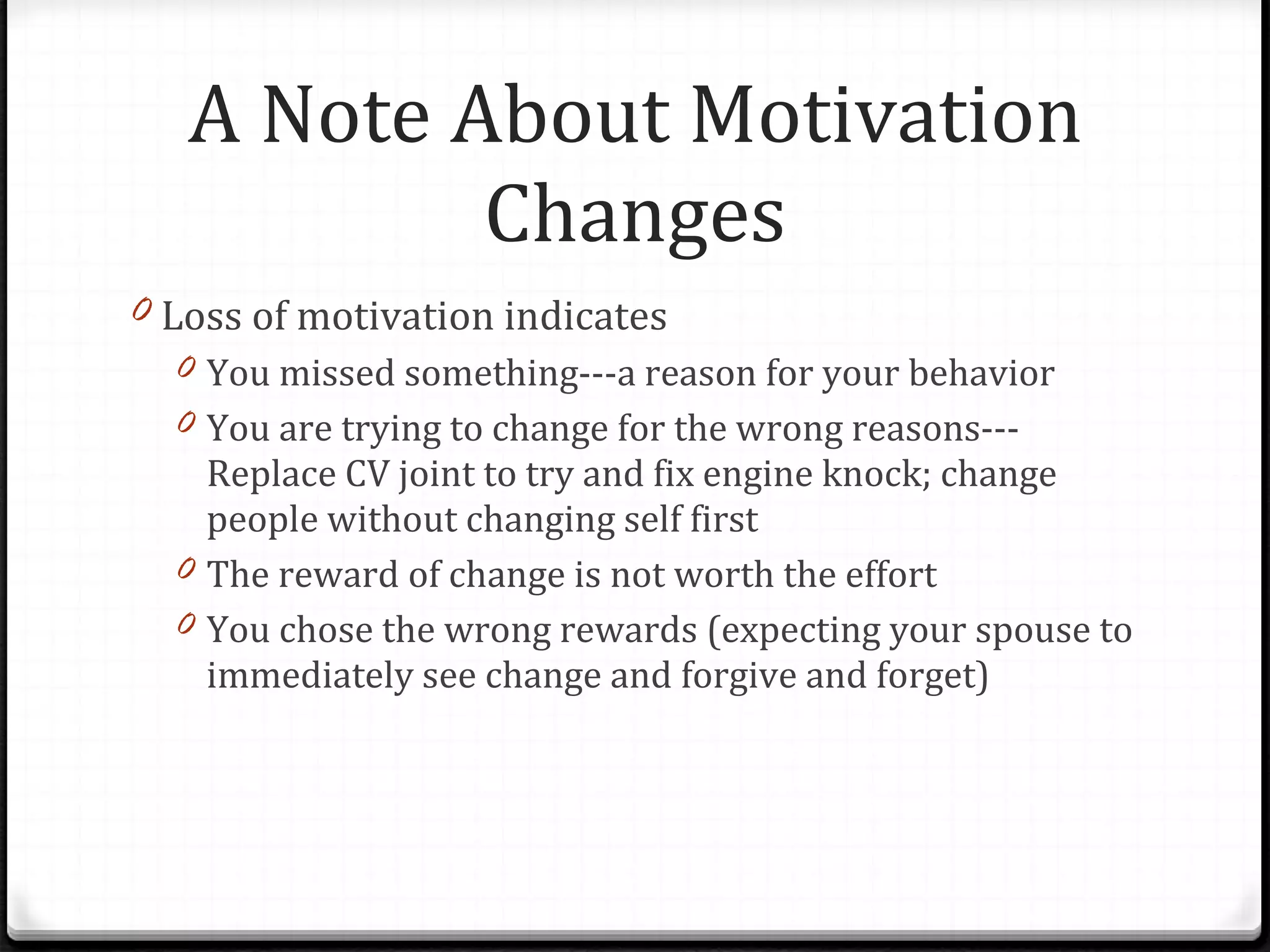
A Note About Motivation Changes Loss of motivation indicates You missed something---a reason for your behavior You are trying to change for the wrong reasons---Replace CV joint to try and fix engine knock; change people without changing self first The reward of change is not worth the effort You chose the wrong rewards (expecting your spouse to immediately see change and forgive and forget)
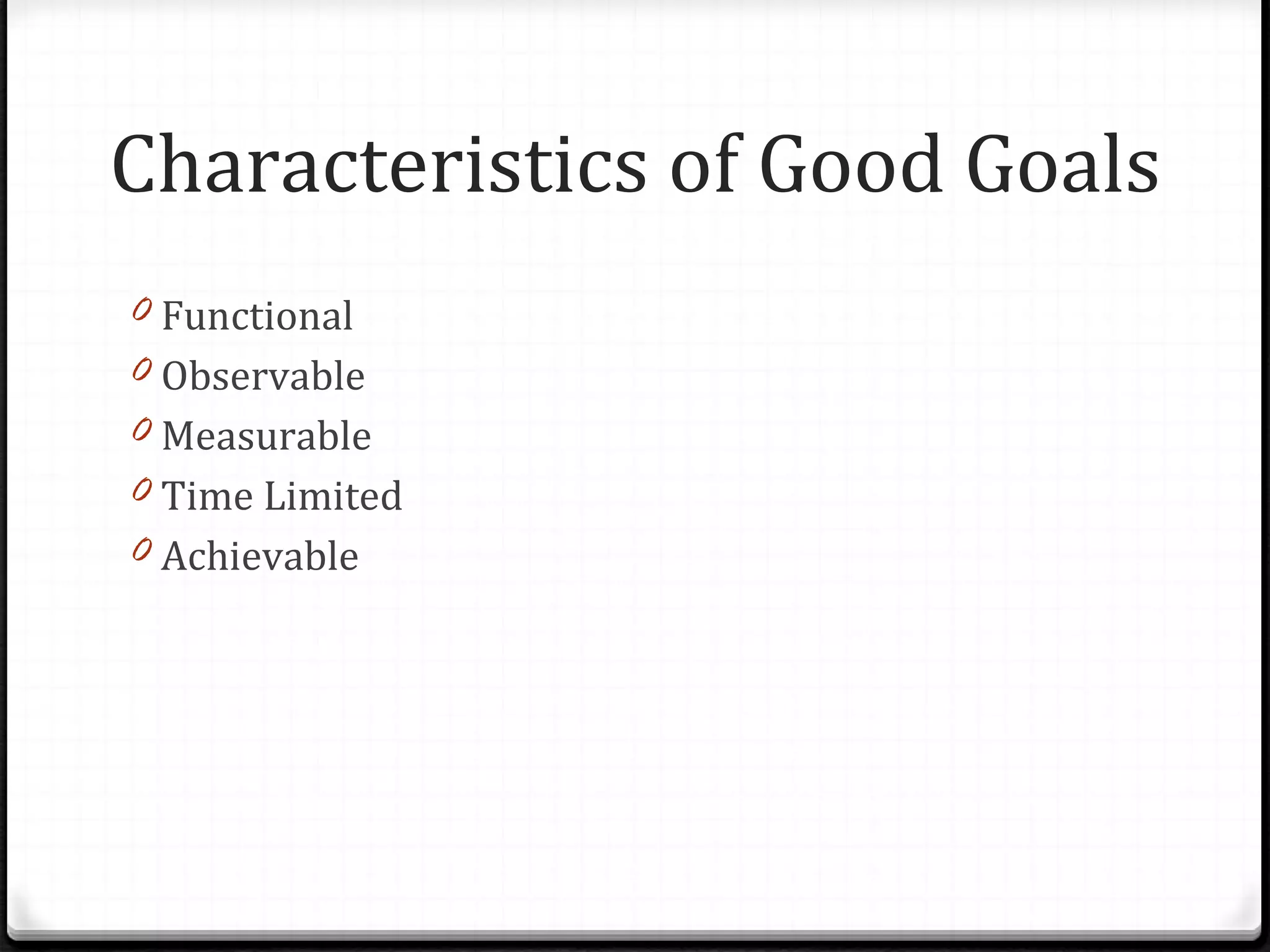
Functional Observable Measurable Time Limited Achievable Characteristics of Good Goals
The old behavior served a purpose The new behavior must accomplish the same goal in a healthier way Assess how the old behavior impacted the person emotionally, mentally, physically, socially, spiritually and environmentally. Add three new behaviors for every one you are trying to eliminate Replace Chocolate with…
Sights, sounds, smells, times of day, activities associated with the old behavior Will trigger cravings/urges Need to be  Eliminated Addressed Changed to elicit a different behavior A note about Triggers
Develop and Enhance Coping Skills Objectives Knowledge:  Identify 5 to 10 ways you deal with stress Learn about 3 different coping methods including Radical Acceptance, REBT and Reality Therapy/Choice Theory by reading handouts, participating in coping skills group and discussing with primary therapist Evaluate the effectiveness of your existing coping skills and eliminate those that do not work Skills Add at least 1 new coping skill to your list Practice using those skills in group and session with scenarios and as you discuss your current issues Abilities Keep a log each week of stressors, how you coped, how effective it was, anything you might need to do differently and discuss in group Fundamental Goals
Self-Esteem Knowledge Learn what self esteem is and how self esteem is created in children and maintained in adults by attending educational group List the traits you envision in your ideal self, and list the traits in your real self.  Discuss in group the differences and your goals for change Skills Use Cognitive Behavioral approaches to identify those “ideal traits” that help you achieve your goals Use behavior modification and goal setting to develop 3 goals Abilities Report back to the group/therapist each week your progress in achieving your goals and the impact on your self esteem. Fundamental Goals Cont…
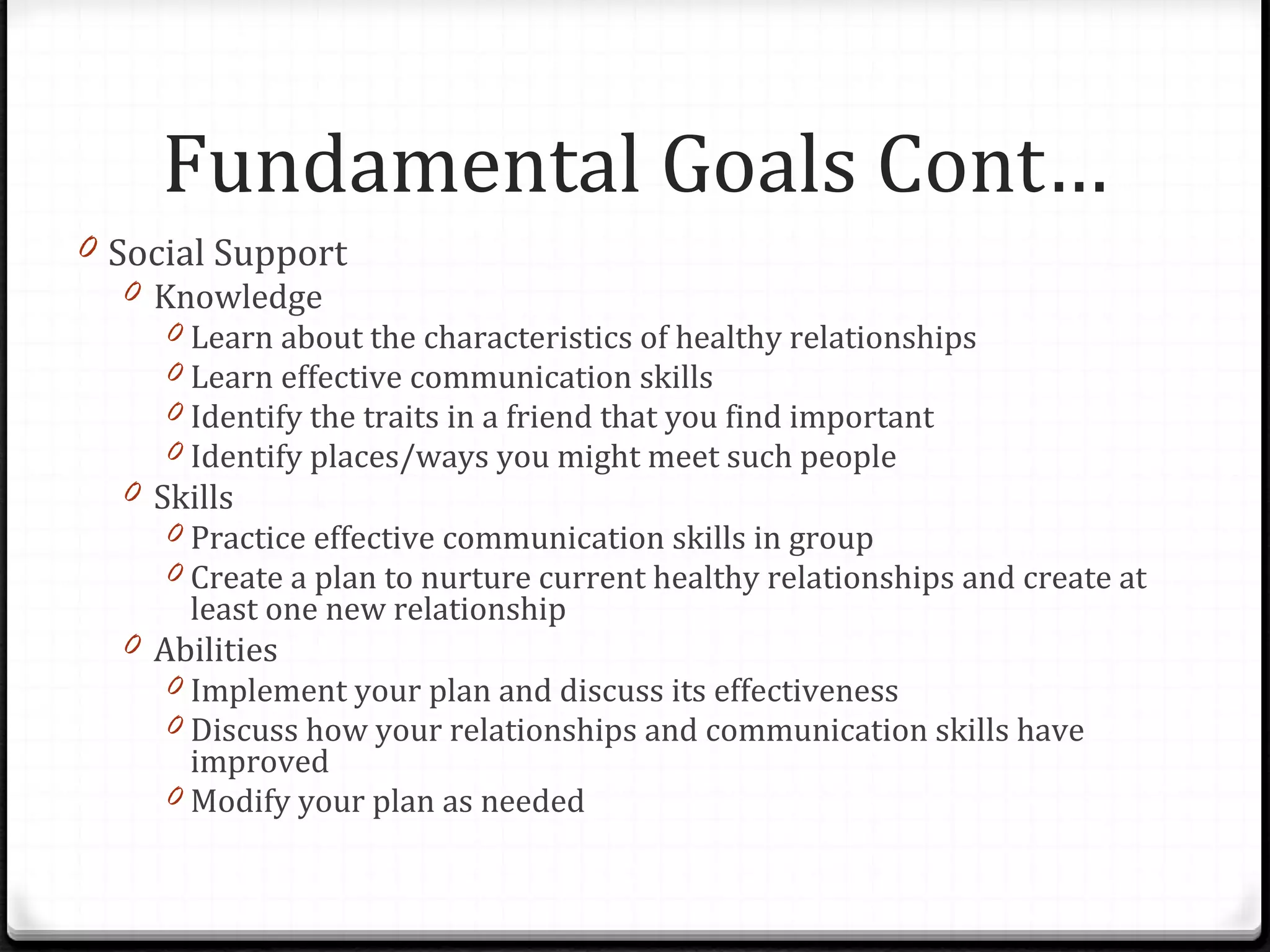
Social Support Knowledge Learn about the characteristics of healthy relationships Learn effective communication skills Identify the traits in a friend that you find important Identify places/ways you might meet such people Skills Practice effective communication skills in group Create a plan to nurture current healthy relationships and create at least one new relationship Abilities Implement your plan and discuss its effectiveness Discuss how your relationships and communication skills have improved Modify your plan as needed Fundamental Goals Cont…
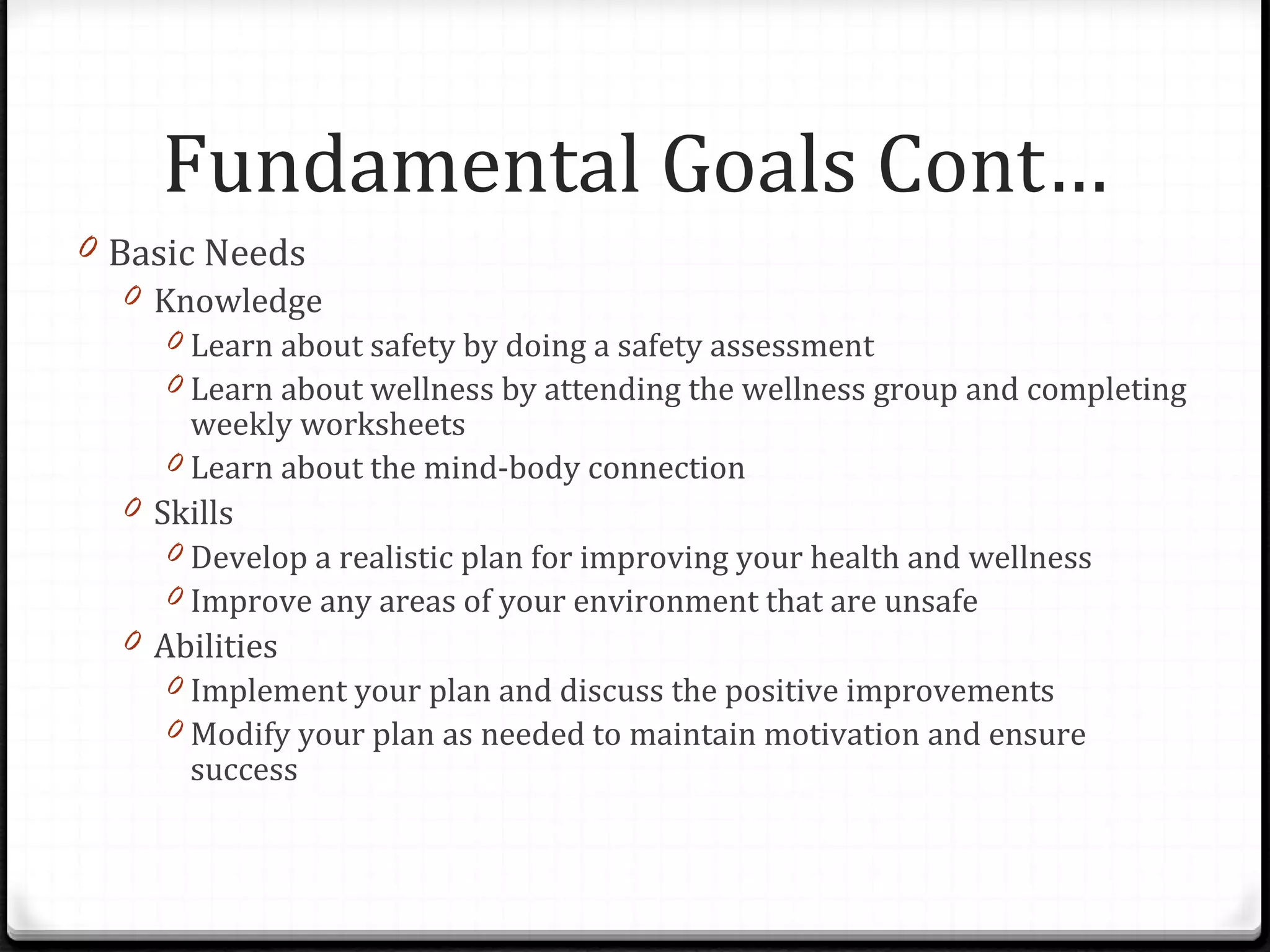
Basic Needs Knowledge Learn about safety by doing a safety assessment Learn about wellness by attending the wellness group and completing weekly worksheets Learn about the mind-body connection Skills Develop a realistic plan for improving your health and wellness Improve any areas of your environment that are unsafe Abilities Implement your plan and discuss the positive improvements Modify your plan as needed to maintain motivation and ensure success Fundamental Goals Cont…
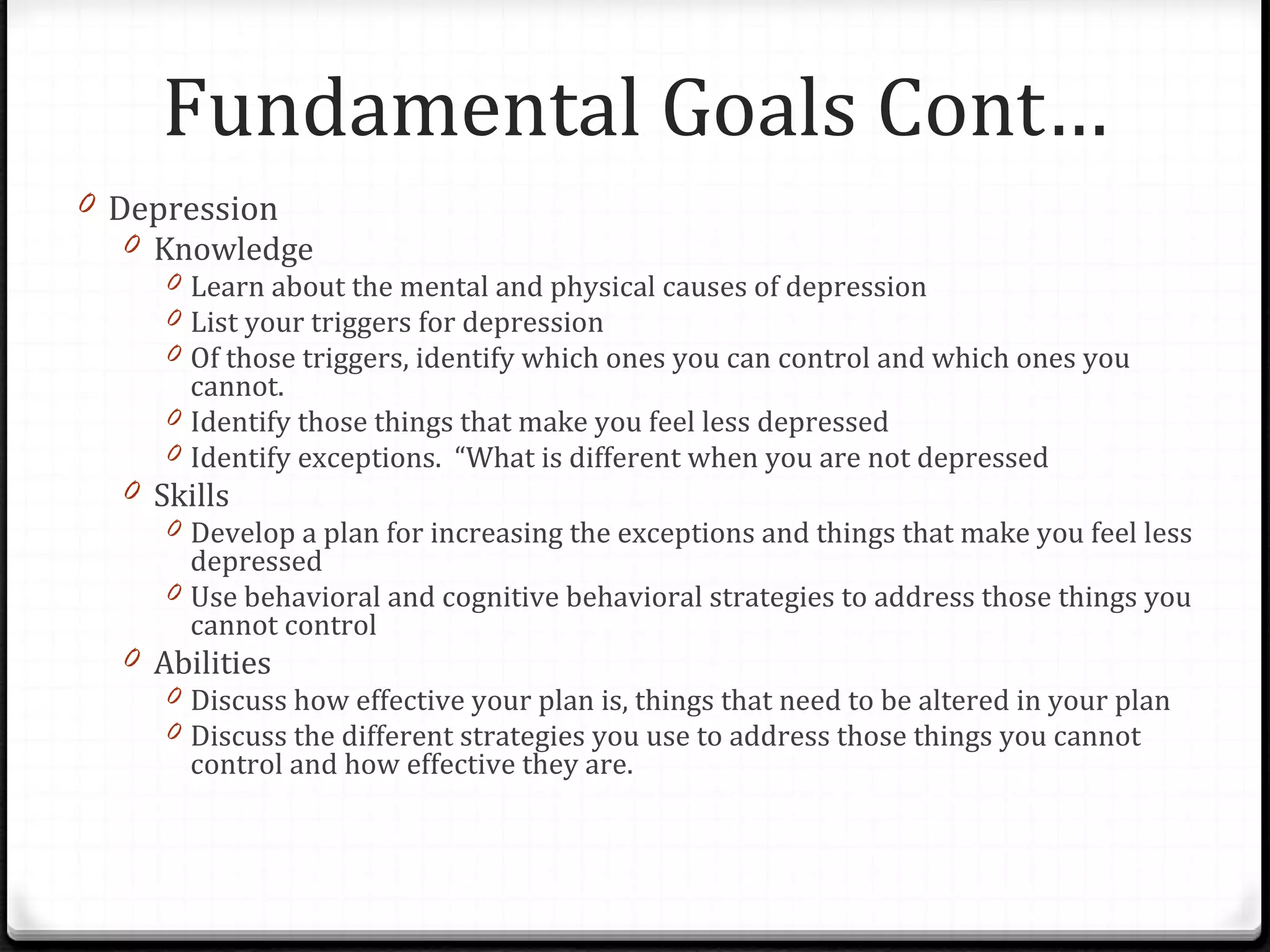
Depression Knowledge Learn about the mental and physical causes of depression List your triggers for depression Of those triggers, identify which ones you can control and which ones you cannot. Identify those things that make you feel less depressed Identify exceptions.  “What is different when you are not depressed Skills Develop a plan for increasing the exceptions and things that make you feel less depressed Use behavioral and cognitive behavioral strategies to address those things you cannot control Abilities Discuss how effective your plan is, things that need to be altered in your plan Discuss the different strategies you use to address those things you cannot control and how effective they are. Fundamental Goals Cont…
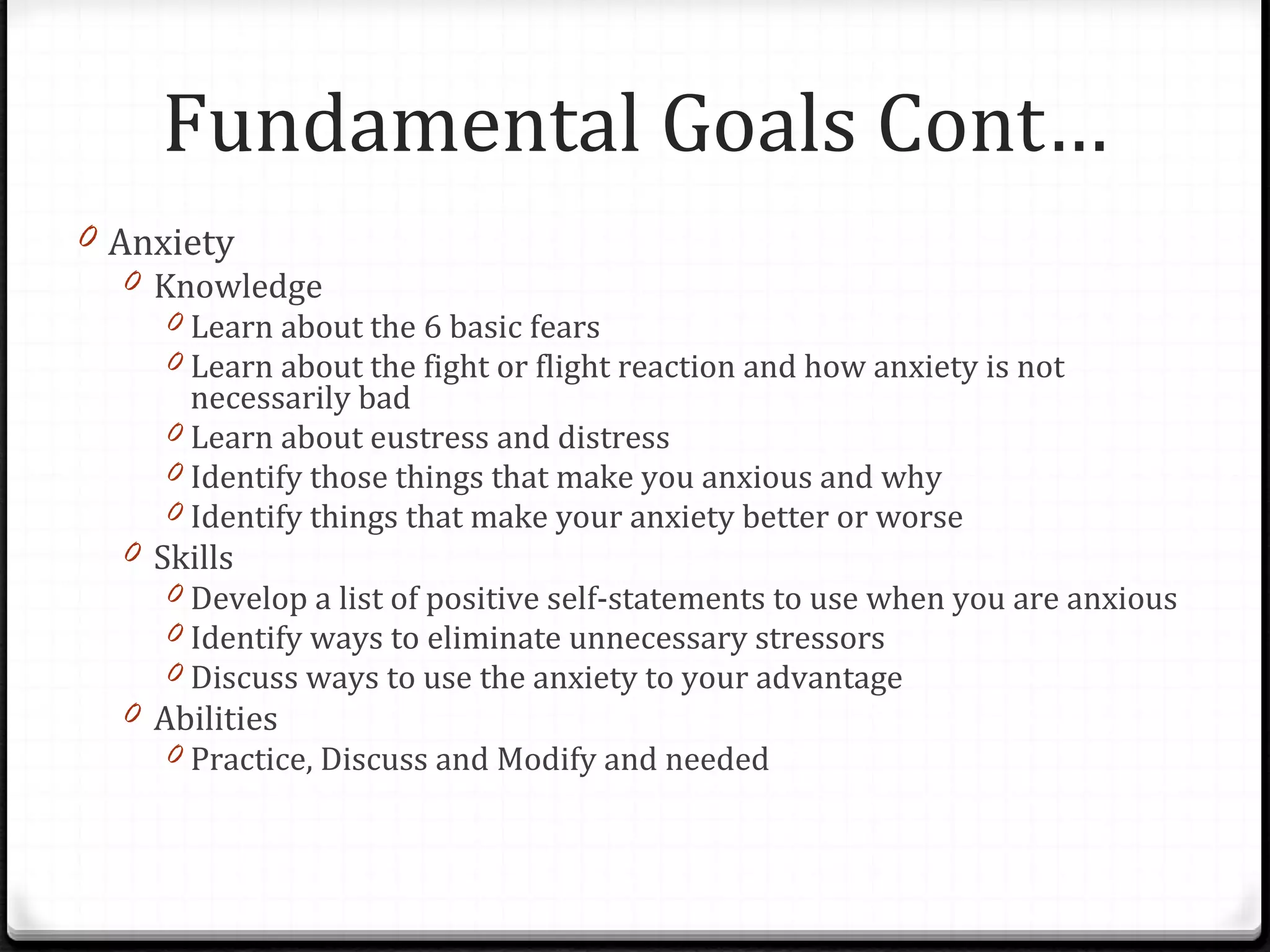
Anxiety Knowledge Learn about the 6 basic fears Learn about the fight or flight reaction and how anxiety is not necessarily bad Learn about eustress and distress Identify those things that make you anxious and why Identify things that make your anxiety better or worse Skills Develop a list of positive self-statements to use when you are anxious Identify ways to eliminate unnecessary stressors Discuss ways to use the anxiety to your advantage Abilities Practice, Discuss and Modify and needed Fundamental Goals Cont…
Goal Setting serves to Help you learn to problem solve Develop a roadmap for treatment Communicate with supportive others/team members Goal Setting needs to focus on KSAs—Learn, practice, rehearse/apply Trying to change is most effective when  the you only focus on a couple goals at once You receive frequent rewards Summary
Homework Using the Addicted vs. Sober worksheet, pick one characteristic you want to change and  Do a decisional balance exercise Identify ways to keep your motivation up to do what you need to do

Iop part 4 motivation and goal setting

  • 1.
    Motivation and GoalSetting Unit 1
  • 2.
    Review of LastWeek You reviewed your Addicted vs. Sober worksheet and circled each characteristic you want to change Pick one characteristic and identify the 3 things you can do to change it. Have group members who identified the same characteristic share their ideas on how to change it
  • 3.
    Objectives Define motivationExplain how motivation is related to goal setting and change Learn how to identify goals Understand the process for setting (and achieving) goals List the different levels or stages of motivation Discuss ways to increase motivation Define the FRAMES approach
  • 4.
    What is MotivationMotivation is a key to change. Motivation can be modified.
  • 5.
    Aspects of MotivationCommitment (Energy) Control (Ability) Challenge (Perception)
  • 6.
    Motivation is MultidimensionalEmotional expression of concern about the perceived problem (e.g., "I'm really worried about what is happening to me.") Cognitive (Thoughts and Beliefs: Recognition of the problem (e.g., "I guess this is more serious than I thought.") Physical (Energy/Control) Optimism about one's ability to change (e.g., "I know that if I try, I can really do it.") Social (Peer Pressure, Social Support)
  • 7.
    Change Causes Crisis& Crisis Causes Change Emotional How you feel about the current behaviors How excited/hopeful you are for change Fear of failure, rejection and the unknown Mental Reasons for changing Reasons for staying the same Belief that you can change
  • 8.
    Physical Amount ofenergy available for change Plan for dealing with discomfort Social Peer pressure to change Peer pressure to remain the same Potential changes in peer group when you change Desire to keep current friends Influence of family
  • 9.
    Activity For thefollowing goals, identify the motivation Commitment Control Challenge Emotional Motivation (Feelings about the issue) Mental Motivation (Thoughts/Rationales) Social Motivation (Supporters, Peer pressure) Physical Motivation Weight loss or getting in shape Depression Addiction
  • 10.
    Motivation is Dynamic& Fluctuating Different issues can have different levels of motivation Reasons (Motivations ) for behaviors can change Motivation levels will wax and wane Stages/Levels of Motivation Precontemplation Contemplation Preparation Action
  • 11.
    Activity Review thelist of changes you identified from the Addicted vs. Sober self activity. Pick 3 that you feel most motivated to work on Identify the following reasons for change Emotional Mental Physical Social
  • 12.
    FRAMES Feedback ResponsibilityAdvice Menu of options Empathy/Support Self-Efficacy (Can-Do Attitude)
  • 13.
    Decisional Balance Benefitsof Changing Benefits of Staying the Same Drawbacks to Changing Drawbacks to Staying the Same
  • 14.
    Activity Using theanswers from the previous activity, create a decisional balance chart For Change Staying the Same Benefits Emotional Mental Physical Social Emotional Mental Physical Social Drawbacks Emotional Mental Physical Social Emotional Mental Physical Social
  • 15.
    Behavior Basics ReinforcementIncreases the chance of a behavior by either providing a reward or eliminating something unpleasant Punishment DEcreases the chance of a behavior by either adding something unpleasant (i.e. Antabuse  vomiting) or eliminating something pleasant (commitment to a residential facility) Extinction Burst (Cravings) Attempts to get a reward will increase until it is not worth the effort (Think temper tantrum or contraband) Shaping Rewarding “Successive approximations”/Good Tries
  • 16.
    Activity For thethree behaviors you want to change identify Rewards for doing the next right thing Punishments/consequences of doing the wrong thing How you are going to deal with cravings
  • 17.
    Increasing Motivation Consciousnessraising is increasing information about the problem. Self-reevaluation involves assessing how one feels and thinks about oneself with respect to problem behaviors. Hardiness means committing to act, believing that it is within your control and seeing it as a challenge.
  • 18.
    Competing Responses means developing alternative, healthy coping behaviors to deal with distress and discomfort. Creating Safety means avoiding or addressing things that trigger problem behaviors. Reinforcement means identifying and ensuring rewards for good choices. Helping relationships are created by being open and trusting with people who care.
  • 19.
    Activity For eachof the goals identify What information/knowledge you need about the causes/consequences and alternatives to the problem ( Consciousness raising) How you feel and think about yourself with respect to problem behaviors. ( Self-reevaluation ) Review the decisional balance exercise to identify how change will affect you What parts are within your control and worth the effort (Hardiness) Alternative, healthy coping behaviors to deal with distress and discomfort. (Competing Responses) Triggers and ways to avoid, eliminate or cope with them (Creating Safety) Rewards to keep you motivated (Reinforcement) Supportive people who can help you stay motivated (Helping Relationships)
  • 20.
    Assess bio-psycho-social needsBiological Emotional and Physical Safety Supportive Relationships Self-Esteem Identify areas in which you are motivated to work Write the Goal Statement Answers the question “How will I know when I have accomplished this?” States what new behaviors, feelings will be present Review: Process and Format
  • 21.
    Knowledge Identify areasneeding increased knowledge (i.e. causes of depression, treatments, personal triggers etc.) Skills Based on the on your SNAP (Strengths, Needs, Abilities and Preferences), identify skills or behaviors that will help him achieve his goal Abilities Abilities are merely skills that have been successfully used in the natural environment Review cont…
  • 22.
    Characteristics Emotional Cognitive Physical Social Environmental Method Small goals  success and reward Maintaining Motivation
  • 23.
    A Note AboutMotivation Changes Loss of motivation indicates You missed something---a reason for your behavior You are trying to change for the wrong reasons---Replace CV joint to try and fix engine knock; change people without changing self first The reward of change is not worth the effort You chose the wrong rewards (expecting your spouse to immediately see change and forgive and forget)
  • 24.
    Functional Observable MeasurableTime Limited Achievable Characteristics of Good Goals
  • 25.
    The old behaviorserved a purpose The new behavior must accomplish the same goal in a healthier way Assess how the old behavior impacted the person emotionally, mentally, physically, socially, spiritually and environmentally. Add three new behaviors for every one you are trying to eliminate Replace Chocolate with…
  • 26.
    Sights, sounds, smells,times of day, activities associated with the old behavior Will trigger cravings/urges Need to be Eliminated Addressed Changed to elicit a different behavior A note about Triggers
  • 27.
    Develop and EnhanceCoping Skills Objectives Knowledge: Identify 5 to 10 ways you deal with stress Learn about 3 different coping methods including Radical Acceptance, REBT and Reality Therapy/Choice Theory by reading handouts, participating in coping skills group and discussing with primary therapist Evaluate the effectiveness of your existing coping skills and eliminate those that do not work Skills Add at least 1 new coping skill to your list Practice using those skills in group and session with scenarios and as you discuss your current issues Abilities Keep a log each week of stressors, how you coped, how effective it was, anything you might need to do differently and discuss in group Fundamental Goals
  • 28.
    Self-Esteem Knowledge Learnwhat self esteem is and how self esteem is created in children and maintained in adults by attending educational group List the traits you envision in your ideal self, and list the traits in your real self. Discuss in group the differences and your goals for change Skills Use Cognitive Behavioral approaches to identify those “ideal traits” that help you achieve your goals Use behavior modification and goal setting to develop 3 goals Abilities Report back to the group/therapist each week your progress in achieving your goals and the impact on your self esteem. Fundamental Goals Cont…
  • 29.
    Social Support KnowledgeLearn about the characteristics of healthy relationships Learn effective communication skills Identify the traits in a friend that you find important Identify places/ways you might meet such people Skills Practice effective communication skills in group Create a plan to nurture current healthy relationships and create at least one new relationship Abilities Implement your plan and discuss its effectiveness Discuss how your relationships and communication skills have improved Modify your plan as needed Fundamental Goals Cont…
  • 30.
    Basic Needs KnowledgeLearn about safety by doing a safety assessment Learn about wellness by attending the wellness group and completing weekly worksheets Learn about the mind-body connection Skills Develop a realistic plan for improving your health and wellness Improve any areas of your environment that are unsafe Abilities Implement your plan and discuss the positive improvements Modify your plan as needed to maintain motivation and ensure success Fundamental Goals Cont…
  • 31.
    Depression Knowledge Learnabout the mental and physical causes of depression List your triggers for depression Of those triggers, identify which ones you can control and which ones you cannot. Identify those things that make you feel less depressed Identify exceptions. “What is different when you are not depressed Skills Develop a plan for increasing the exceptions and things that make you feel less depressed Use behavioral and cognitive behavioral strategies to address those things you cannot control Abilities Discuss how effective your plan is, things that need to be altered in your plan Discuss the different strategies you use to address those things you cannot control and how effective they are. Fundamental Goals Cont…
  • 32.
    Anxiety Knowledge Learnabout the 6 basic fears Learn about the fight or flight reaction and how anxiety is not necessarily bad Learn about eustress and distress Identify those things that make you anxious and why Identify things that make your anxiety better or worse Skills Develop a list of positive self-statements to use when you are anxious Identify ways to eliminate unnecessary stressors Discuss ways to use the anxiety to your advantage Abilities Practice, Discuss and Modify and needed Fundamental Goals Cont…
  • 33.
    Goal Setting servesto Help you learn to problem solve Develop a roadmap for treatment Communicate with supportive others/team members Goal Setting needs to focus on KSAs—Learn, practice, rehearse/apply Trying to change is most effective when the you only focus on a couple goals at once You receive frequent rewards Summary
  • 34.
    Homework Using theAddicted vs. Sober worksheet, pick one characteristic you want to change and Do a decisional balance exercise Identify ways to keep your motivation up to do what you need to do

Editor's Notes

  • #34 Please skim chapters 2-5 of the following text in Google Books: Case Conceptualization and Treatment Planning: Exercises for Integrating Theory with Clinical Practice