Emotional
First Aid Kit
Linda Flores
Career Counselor
Myths
● There is a right and wrong way to feel in every situation
● It’s not good or healthy to feel angry
● Happy or emotionally healthy people don’t experience painful emotions
● Feeling sad/bad is weak
● Painful emotions are destructive
Basis
Dialectical Behavior Therapy (DBT)
- Mindfulness: the practice of being fully aware and present in this
one moment
- Cognitive Behavior Therapy (CBT): a time-sensitive, structured,
present-oriented psychotherapy directed toward solving current
problems and teaching clients skills to modify dysfunctional
thinking and behavior.
Please note
- This is meant to treat everyday flux of emotions; if you have more
severe distressful symptoms - please seek professional counseling
Otherwise -
- Think of difficult emotions you want to resolve through this workshop
- PARTICIPATE :)
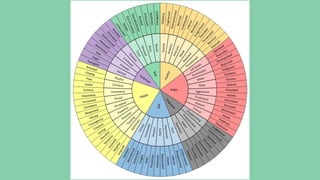
Got feelings?
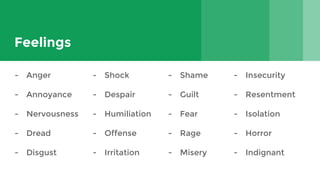
Feelings
- Anger
- Annoyance
- Nervousness
- Dread
- Disgust
- Shock
- Despair
- Humiliation
- Offense
- Irritation
- Shame
- Guilt
- Fear
- Rage
- Misery
- Insecurity
- Resentment
- Isolation
- Horror
- Indignant
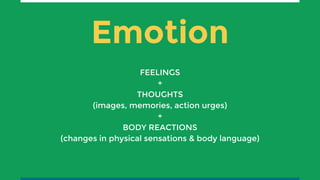
Emotion
FEELINGS
+
THOUGHTS
(images, memories, action urges)
+
BODY REACTIONS
(changes in physical sensations & body language)
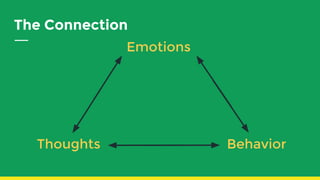
The Connection
Emotions
BehaviorThoughts
How does your body
respond to feelings?
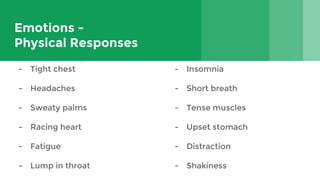
Emotions -
Physical Responses
- Tight chest
- Headaches
- Sweaty palms
- Racing heart
- Fatigue
- Lump in throat
- Insomnia
- Short breath
- Tense muscles
- Upset stomach
- Distraction
- Shakiness
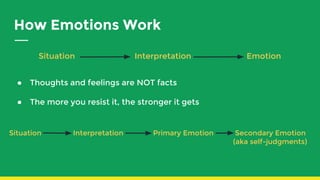
How Emotions Work
● Thoughts and feelings are NOT facts
● The more you resist it, the stronger it gets
Situation Interpretation Emotion
Situation Interpretation Primary Emotion Secondary Emotion
(aka self-judgments)
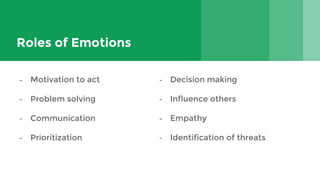
Roles of Emotions
- Motivation to act
- Problem solving
- Communication
- Prioritization
- Decision making
- Influence others
- Empathy
- Identification of threats
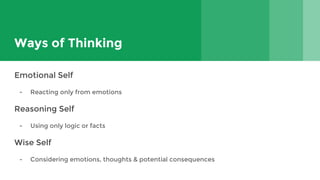
Ways of Thinking
Emotional Self
- Reacting only from emotions
Reasoning Self
- Using only logic or facts
Wise Self
- Considering emotions, thoughts & potential consequences
Being Effective
- Doing what works
- Doing what moves you closer to your long-term goals
- Getting your needs met
How to be Effective
- Know what you want
- Respond to reality (what has actually already happened)
- Focus on the long term
Change Acceptance
Emotional Self Treatment
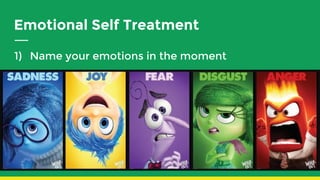
1) Name your emotions in the moment
Emotional Self Treatment
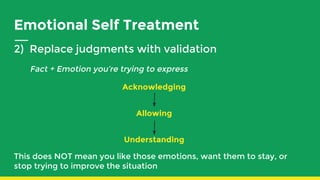
2) Replace judgments with validation
Fact + Emotion you’re trying to express
Acknowledging
Allowing
Understanding
This does NOT mean you like those emotions, want them to stay, or
stop trying to improve the situation
Emotional Self Treatment Summary
3) Change feelings
a. Change feelings by changing PHYSICAL SYMPTOMS
b. Change feelings by changing THOUGHTS
c. Change feelings by changing ACTIONS
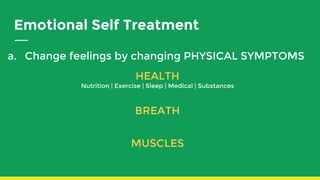
Emotional Self Treatment
a. Change feelings by changing PHYSICAL SYMPTOMS
HEALTH
Nutrition | Exercise | Sleep | Medical | Substances
BREATH
MUSCLES
Emotional Self Treatment
b. Change feelings by changing THOUGHTS
Find challenging evidence for:
- Exaggerated irrational thinking patterns
- Problematic core beliefs
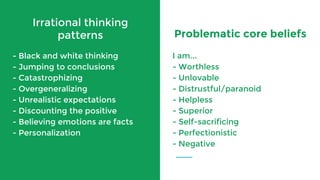
Irrational thinking
patterns
- Black and white thinking
- Jumping to conclusions
- Catastrophizing
- Overgeneralizing
- Unrealistic expectations
- Discounting the positive
- Believing emotions are facts
- Personalization
Problematic core beliefs
I am...
- Worthless
- Unlovable
- Distrustful/paranoid
- Helpless
- Superior
- Self-sacrificing
- Perfectionistic
- Negative
Emotional Self Treatment
c. Change feelings by changing ACTIONS
Do the opposite of your natural urge
100%
Emotional Self Treatment
4) Acceptance & coping when you CANNOT
change how you feel
a. Get through the moment without making things worse
b. Sit with the emotion
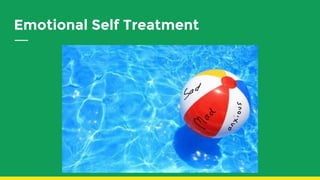
Pain
(inevitable)
Suffering
(optional)
Not accepting the pain >>>
more pain
Emotional Self Treatment
4) Acceptance & coping when you CANNOT
change how you feel
a. Get through the moment without making things worse
Acceptance
recognize the situation | acknowledge emotions | allow it to be
NOT - ignore the situation | suppress emotions | give up trying to change things
Distraction Inaction Visualization Self-Soothing
Emotional Self Treatment
4) Acceptance & coping when you CANNOT
change how you feel
b. Sit with the emotion
- You are not your emotions
- There were times you didn’t feel like this
- Experiencing the emotion provides freedom from avoiding it
- Prove to yourself you can survive it
- No need to worry about confronting it when you already have
Emotional Self Treatment
Emotional Self Treatment Summary
1. Name the emotion
2. Replace judgments with validation
3. Change feelings
a. Change feelings by changing PHYSICAL SYMPTOMS
b. Change feelings by changing THOUGHTS
c. Change feelings by changing ACTIONS
4. Acceptance & coping
a. Get through the emotion without making it worse
b. Sit with the emotion
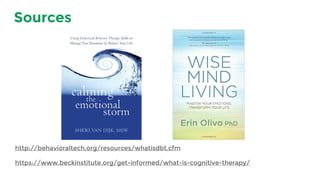
Sources
http://behavioraltech.org/resources/whatisdbt.cfm
https://www.beckinstitute.org/get-informed/what-is-cognitive-therapy/

Workshop - Emotional First Aid Kit

  • 1.
    Emotional First Aid Kit LindaFlores Career Counselor
  • 2.
    Myths ● There isa right and wrong way to feel in every situation ● It’s not good or healthy to feel angry ● Happy or emotionally healthy people don’t experience painful emotions ● Feeling sad/bad is weak ● Painful emotions are destructive
  • 3.
    Basis Dialectical Behavior Therapy(DBT) - Mindfulness: the practice of being fully aware and present in this one moment - Cognitive Behavior Therapy (CBT): a time-sensitive, structured, present-oriented psychotherapy directed toward solving current problems and teaching clients skills to modify dysfunctional thinking and behavior.
  • 4.
    Please note - Thisis meant to treat everyday flux of emotions; if you have more severe distressful symptoms - please seek professional counseling Otherwise - - Think of difficult emotions you want to resolve through this workshop - PARTICIPATE :)
  • 5.
  • 6.
    Feelings - Anger - Annoyance -Nervousness - Dread - Disgust - Shock - Despair - Humiliation - Offense - Irritation - Shame - Guilt - Fear - Rage - Misery - Insecurity - Resentment - Isolation - Horror - Indignant
  • 7.
    Emotion FEELINGS + THOUGHTS (images, memories, actionurges) + BODY REACTIONS (changes in physical sensations & body language)
  • 8.
  • 9.
    How does yourbody respond to feelings?
  • 10.
    Emotions - Physical Responses -Tight chest - Headaches - Sweaty palms - Racing heart - Fatigue - Lump in throat - Insomnia - Short breath - Tense muscles - Upset stomach - Distraction - Shakiness
  • 11.
    How Emotions Work ●Thoughts and feelings are NOT facts ● The more you resist it, the stronger it gets Situation Interpretation Emotion Situation Interpretation Primary Emotion Secondary Emotion (aka self-judgments)
  • 12.
    Roles of Emotions -Motivation to act - Problem solving - Communication - Prioritization - Decision making - Influence others - Empathy - Identification of threats
  • 13.
    Ways of Thinking EmotionalSelf - Reacting only from emotions Reasoning Self - Using only logic or facts Wise Self - Considering emotions, thoughts & potential consequences
  • 14.
    Being Effective - Doingwhat works - Doing what moves you closer to your long-term goals - Getting your needs met
  • 15.
    How to beEffective - Know what you want - Respond to reality (what has actually already happened) - Focus on the long term
  • 16.
  • 17.
    Emotional Self Treatment 1)Name your emotions in the moment
  • 19.
    Emotional Self Treatment 2)Replace judgments with validation Fact + Emotion you’re trying to express Acknowledging Allowing Understanding This does NOT mean you like those emotions, want them to stay, or stop trying to improve the situation
  • 20.
    Emotional Self TreatmentSummary 3) Change feelings a. Change feelings by changing PHYSICAL SYMPTOMS b. Change feelings by changing THOUGHTS c. Change feelings by changing ACTIONS
  • 21.
    Emotional Self Treatment a.Change feelings by changing PHYSICAL SYMPTOMS HEALTH Nutrition | Exercise | Sleep | Medical | Substances BREATH MUSCLES
  • 22.
    Emotional Self Treatment b.Change feelings by changing THOUGHTS Find challenging evidence for: - Exaggerated irrational thinking patterns - Problematic core beliefs
  • 23.
    Irrational thinking patterns - Blackand white thinking - Jumping to conclusions - Catastrophizing - Overgeneralizing - Unrealistic expectations - Discounting the positive - Believing emotions are facts - Personalization Problematic core beliefs I am... - Worthless - Unlovable - Distrustful/paranoid - Helpless - Superior - Self-sacrificing - Perfectionistic - Negative
  • 24.
    Emotional Self Treatment c.Change feelings by changing ACTIONS Do the opposite of your natural urge 100%
  • 25.
    Emotional Self Treatment 4)Acceptance & coping when you CANNOT change how you feel a. Get through the moment without making things worse b. Sit with the emotion
  • 26.
  • 27.
    Emotional Self Treatment 4)Acceptance & coping when you CANNOT change how you feel a. Get through the moment without making things worse Acceptance recognize the situation | acknowledge emotions | allow it to be NOT - ignore the situation | suppress emotions | give up trying to change things Distraction Inaction Visualization Self-Soothing
  • 28.
    Emotional Self Treatment 4)Acceptance & coping when you CANNOT change how you feel b. Sit with the emotion - You are not your emotions - There were times you didn’t feel like this - Experiencing the emotion provides freedom from avoiding it - Prove to yourself you can survive it - No need to worry about confronting it when you already have
  • 29.
  • 30.
    Emotional Self TreatmentSummary 1. Name the emotion 2. Replace judgments with validation 3. Change feelings a. Change feelings by changing PHYSICAL SYMPTOMS b. Change feelings by changing THOUGHTS c. Change feelings by changing ACTIONS 4. Acceptance & coping a. Get through the emotion without making it worse b. Sit with the emotion
  • 31.