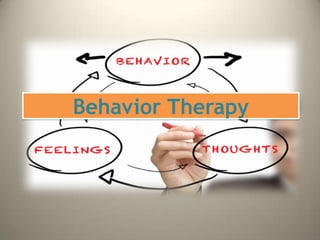
Behavior Therapy
What is psychotherapy?
An emotionally charged disclosing interaction
Between a trained therapist and someone suffers from psychological
problems
Using psychological techniques
Aims:
• change behavior
• Decrease distress
• Increase joy, aspiration, and hope
• Improve resilience
Aim: To answer these
questions
Behavior (Action) Vs Insight Therapy
Elements of behavioral approaches
Behavior therapy & learning
Goals of BT
Various techniques
Role of behavior therapist
Strengths & Weaknesses
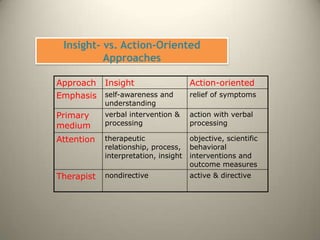
Insight- vs. Action-Oriented
Approaches
Approach Insight Action-oriented
Emphasis self-awareness and
understanding
relief of symptoms
Primary
medium
verbal intervention &
processing
action with verbal
processing
Attention therapeutic
relationship, process,
interpretation, insight
objective, scientific
behavioral
interventions and
outcome measures
Therapist nondirective active & directive
Common elements of behavioral approaches
1. Emphasizes on the present (not past)
2. Gives attention – to change specific dysfunctional behaviors
3. Rely on research - in developing and testing interventions
4. Consider principles of learning – to develop and treat
dysfunctional behaviors
5. Treatment outcomes – carefully measured
6. Matches specific treatments to particular presenting problems
How do psychological problems arise?
• All behaviors are the result of learning
 Behavior is a product of learning
No matter how pathological client’s behavior may be, it is the result of past
learning and conditioning
 What has been learned can be unlearned
Same learning principles that apply to learning maladaptive behavior can be used
to get rid of it
Behavioral Therapy and Learning
Three primary types of behavior problems:
Behavioral Excess- behavior that occur too often
Behavioral Deficits – too little or non-existent
Inappropriate/maladaptive behavior-
Minor (less impairment-nail biting ) to severe(more
impairment-sexual behaviors) interference in ADL
Goals of Behavioural
Therapy
1. Aims to change behavior in order to change emotion and mood.
2. Directed exclusively towards symptomatic improvement, without
addressing psychodynamic causation.
Behavior Modification
Observing and Recording
behavior
Case # 1
A & B were having difficulties in
their marriage, because of
frequent arguments. Their
marriage counselor arranged.
Case # 2

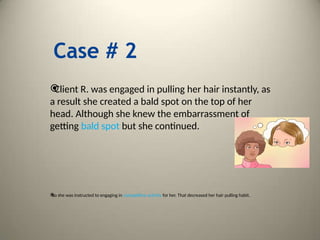
Client R. was engaged in pulling her hair instantly, as
a result she created a bald spot on the top of her
head. Although she knew the embarrassment of
getting bald spot but she continued.

So she was instructed to engaging in competitive activity for her. That decreased her hair pulling habit.
Case # 3

A boy F was putting lot of weight he joined a weight loss
group. At each group meeting he used to deposit money. Set a
goal for daily exercise.
So if he earned specified number of point he used to get back the deposit money otherwise not.
In these 3 cases you can notice that
there is a focused behavior and also
a procedure to change the behavior.
So what do you think
what is Behavior ?
What is behavior
modification?
Behavior
What people do and say.
Examples: running, walking, screaming, slamming the door, head banging etc.
Do you think ?
Anger
Sadness
Confusion is a behavior?
Behavior Have one or more dimensions
 that can be measured.
Physical dimensions :
Frequency
Duration
Intensity
Can be observed and recorded
Have an impact on oneself/environment
Lawful
Systematically influenced by environment events.
May be overt (observed) or covert (private event)
What is that characteristic of behavior?
An autistic child when receives
higher attention from the teacher,
his disruptive behavior decreases.
When he receives low attention ,
disruptive behavior increases.
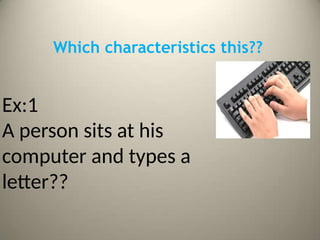
Which characteristics this??
Ex:1
A person sits at his
computer and types a
letter??
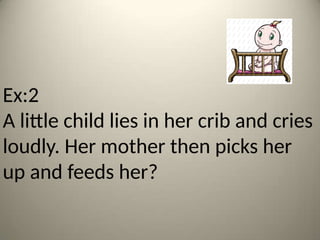
Ex:2
A little child lies in her crib and cries
loudly. Her mother then picks her
up and feeds her?
What does mean by?
Functional relationship between a
disruptive behavior and attention.
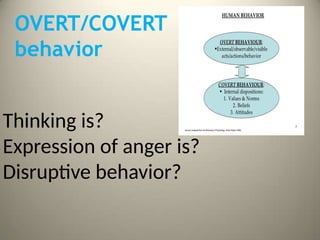
OVERT/COVERT
behavior
Thinking is?
Expression of anger is?
Disruptive behavior?
Areas of Application
Developmental disabilities
Mental illness
Special Education
Rehabilitation
Community psychology
Clinical psychology
Business and human services
Self management
Child management
Prevention
Sports psychology
Health related behaviors
Sports psychology
Gerontology (Nursing homes and other care facilities)
Assessment
Why behavioral
assessment/measureme
nt of behavior is
important?

Measuring the behavior before treatment provides
information that can help you determine whether
treatment is necessary.

Behavioral assessment can provide information that
helps you choose the best treatment.

Measuring the target behavior before and after
treatment allows you to determine whether the behavior
changed after the treatment was implemented.
Direct and Indirect Assessment
Direct involves using interviews, questionnaires, and rating
scales to obtain information on the target behavior from the
person exhibiting the behavior or from others (e.g., parents,
teachers, or staff).
Indirect assessment does not occur when the target behavior
occurs but relies on an individual’s recall of the target behavior.

When a school psychologist observes a socially
withdrawn child on the playground and records each
social interaction with another child, the psychologist is
using direct assessment.

When the psychologist interviews the student’s teacher
and asks the teacher how many times the child usually
interacts with other children on the playground, the
psychologist is using indirect assessment.
Procedures of behavioral analysis
Defining the target behavior
When two people independently observe the same behavior and both
record that the behavior occurred, this is called interobserver agreement(IOA) or
interobserver reliability
Determining the logistics of recording
Choosing a recording method
Choosing a recording instrument
Direct assessment usually
is more accurate than
indirect assessment.
What kind of limitations
The Logistics of
Recording
The Observer

We have defined the target behavior to be
recorded for a client, that is, a person who
exhibits the target behavior and with whom the
behavior modification program will be
implemented.
 The next step is to identify who will observe and record the behavior.
 In a behavior modification program, the target behavior typically is observed and recorded by
a person other than the one exhibiting the target behavior (i.e., an independent observer).
The observer may be a professional,
such as a behavior analyst or a
psychologist, or a person routinely
associated with the client in the
client’s natural environment, such
as a teacher, parent, staff member,
or supervisor.
In some cases, the observer is the
person exhibiting the target
behavior.
When the client observes and
records his or her own target
behavior, it is called self-monitoring.
In addition, the client might be asked
to self-monitor the target behavior
outside the therapy sessions.
If self-monitoring is used in a behavior
modification program, the client must
be trained to record his or her own
behavior in the same way that an
observer would be trained.
When and Where to Record

The observer records the target behavior in a specific
period called the observation period.

It Observation and recording of behavior take place in
natural settings or in analogue settings.

A natural setting consists of the places in which the target
behavior typically occurs.
Observing and recording a target behavior in the classroom is an example of a
natural setting for a student
Observing a target behavior in a clinic playroom is an analogue setting because
being in the clinic is not part of the child’s normal daily routine.

Observation of the target behavior can be structured or unstructured.

When observations are structured, the observer arranges for specific
events or activities to occur during the observation period. For example,
when observing child behavior problems, the observer may ask the
parent to make specific requests of the child during the observation
period.

During unstructured observations, no specific
events or activities are arranged and no instructions are given during the
observation period.
Choosing a Recording Method
continuous recording
product recording
interval recording
and time sample recording.
Continuous Recording
In continuous recording, the
observer observes the client
continuously throughout the
observation period and records
each occurrence of the behavior.
frequency, duration, intensity, and latency.
How does latency differ from
duration?
Latency is the time from some
stimulus or event to the onset of
the behavior,
whereas duration is the time
from the onset of the behavior
to its offset.
a real-time recording method in
which the exact time of each onset
and offset of the target behavior is
recorded
Real time recording can be carried
out after video recording the target
behavior in the observation period

If you were recording a child’s tantrum behavior (screaming,
throwing toys, slamming doors), which dimension of the
behavior would you measure?

The example of a child’s tantrum behavior is less clear. You may
be interested in the number of tantrums per day (frequency),
but you may also be interested in how long each tantrum lasts
(duration). Finally, you may be interested in how loud the child
screams or how forcefully the child throws toys or slams doors
(intensity).
Unless you measure the
right dimension of a
behavior, you may not be
able to judge the
effectiveness of treatment.
Percentage of Opportunities

Percentage of trials or percentage correct is one final way in
which event recording may be conducted.

In this method, the observer records the occurrence of a
behavior in relation to some other event, such as a learning
trial or a response opportunity, and reports the results as the
percentage of opportunities in which the behavior occurred.

If the teacher made 12 requests and the student
complied with the teacher’s requests 11 times, the
percentage of compliance is 11/12, or 92%.

However, if the teachers made 25 requests and
the student complied 11 times, the percentage is
only 44%, a much less acceptable level of the
behavior.

Product Recording

Another aspect of a behavior that may be recorded is its
product. Product recording, also called permanent product
recording (Marholin & Steinman, 1977),

a teacher could record the number of correctly completed
homework problems or workbook pages as a product measure
of students’ academic performance (Noell et al., 2000).

Interval Recording

Another method for recording behavior is to record whether the behavior
occurred during consecutive time periods.
the observer divides the observation period into a number
of smaller time periods or intervals, observes the client throughout each
consecutive
interval, and then records whether the behavior occurred in that interval.
There are two types of interval recording:
 partial interval recording
 and whole interval recording.
With partial interval recording, you are not interested in the number of times
the behavior occurs (frequency) or how long it lasts (duration).
You do not have to identify the onset and offset of the behavior; rather, you simply
record whether the behavior occurred during each interval of time.
Suppose that a teacher is recording whether a child disrupts the class during each
15-minute interval in the class period. The teacher sets a timer to beep every 15
minutes. When the disruptive behavior occurs, the teacher marks the corresponding
nterval on a data sheet.
Once an interval is marked, the teacher does not have to observe the child or record
the behavior until the next interval begins. If the behavior does not occur in an
interval,
presence or absence of the tic behavior.
In some cases, frequency recording and interval
recording can be combined
to produce frequency-within-interval recording. With
this method, the observer
records the frequency of the target behavior but does
so within consecutive intervals
of time in the observation period

Time Sample Recording

When using time sample recording, you divide the observation period into intervals
of time, but you observe and record the behavior during only part of each interval.

The observation periods are separated by periods without observation. For
example, you might record the behavior for only 1 minute during each 15-minute
interval, or you might record the behavior only if it is occurring at the end of the
interval.
Consider an observer who is using time sample recording to record a client’s
poor posture (defined as slouching, bending the back forward). The observer
sets a timer to beep every 10 minutes and records an instance of bad posture only
if the client’s posture is bad when the timer beeps at the end of the interval. Time
sample recording is valuable because the person does not have to observe the
behavior for the entire interval.
Choosing a Recording Instrument

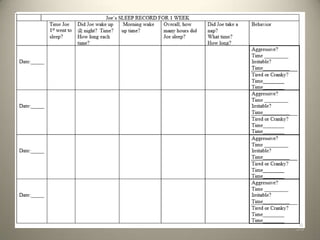
What the observer uses to register or make a permanent product of the occurrence
of the behavior.
 Paper and pencil
 data sheet prepared in advance for the particular behavior.

The data sheet in Figure 2-5 is used to record the duration of a target behavior.
On each day, there are places to record the times the behavior started (onset)
and ended (offset). By recording the onset and offset of each instance of a behavior,
you end up with a recording of how long the behavior occurred (duration), as
well as how often it occurred (frequency).
Reactivity
Sometimes the process of recording a behavior causes the behavior to change, even before any treatment is
implemented. This is called reactivity (Foster, Bell-
Dolan, & Burge, 1988; Hartmann & Wood, 1990; Tryon, 1998). Reactivity may
occur when an observer is recording the behavior of another person or when a
person engages in self-monitoring.
Reactivity may be undesirable, especially for research purposes, because the behavior recorded during the
observation period is
not representative of the level of the behavior occurring .
Usually this change in behavior is only temporary, and the behavior returns to its original level once the child
becomes accustomed to the observer’s presence.
One way to reduce reactivity is to wait until the people who are being observed become accustomed to the
observer.
 Another is to have the observer record the behavior without the people knowing that they are being
observed.
 This may be accomplished with the use of one-way observation windows or with participant observers. A
participant observer is a person who is normally in the setting where the target behavior occurs, such as a
teacher’s aide in a classroom.
Likewise, when a person starts to record his or her own behavior as part of a self-management project, the
behavior often changes in the desired direction as a result of the self-monitoring (Epstein, 1996). For this
reason, self-monitoring sometimes is used as a treatment to change a target behavior.
Interobserver Agreement

You assess IOA to determine whether the target behavior is being recorded
consistently.

To evaluate IOA, two people independently observe and record the same
target behavior of the same subject during the same observation period. The
recordings of the two observers are then compared, and a percentage of agreement
between observers is calculated.
When the percentage of agreement is high, it indicates that there is consistency in
the scoring by the two observers. This suggests that the definition of the target
behavior is clear and objective, and that the observers are using the recording
system correctly. When high IOA is reported in a research study, it suggests that the
observers in the study recorded the target behavior consistently.
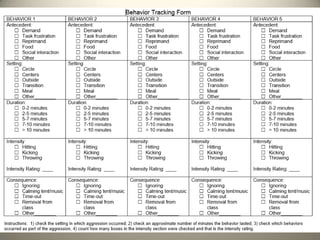
Examples for Data
Collection
52
53
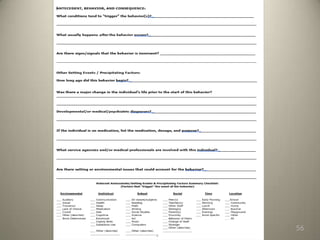
54
55
56
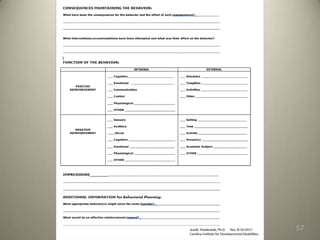
57
JeanB. Mankowski, Ph.D. Rev. 8/10/2017
Carolina Institute for Developmental Disabilities
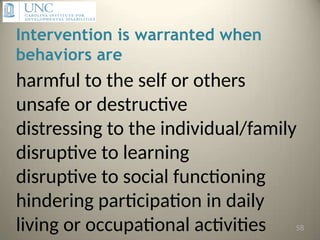
Intervention is warranted when
behaviors are
harmful to the self or others
unsafe or destructive
distressing to the individual/family
disruptive to learning
disruptive to social functioning
hindering participation in daily
living or occupational activities 58
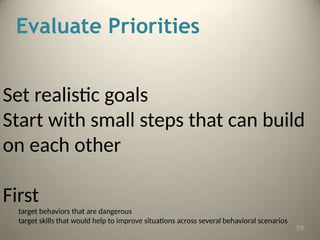
Evaluate Priorities
Set realistic goals
Start with small steps that can build
on each other
First
target behaviors that are dangerous
target skills that would help to improve situations across several behavioral scenarios
59
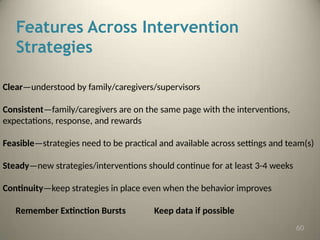
Features Across Intervention
Strategies
Clear—understood by family/caregivers/supervisors
Consistent—family/caregivers are on the same page with the interventions,
expectations, response, and rewards
Feasible—strategies need to be practical and available across settings and team(s)
Steady—new strategies/interventions should continue for at least 3-4 weeks
Continuity—keep strategies in place even when the behavior improves
Remember Extinction Bursts Keep data if possible
60
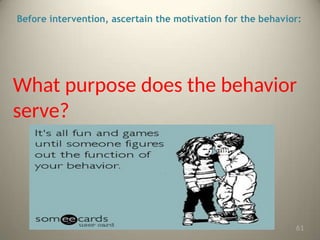
Before intervention, ascertain the motivation for the behavior:
What purpose does the behavior
serve?
61
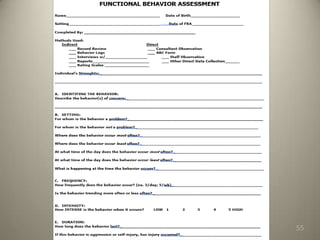
Functional Behavior Analysis
Functional behavior analysis--a
structured, systematic, and objective
method for determining the
communicative function underlying a
maladaptive behavior for
intervention planning purposes
62
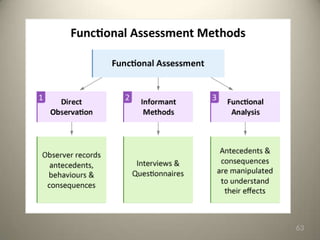
63
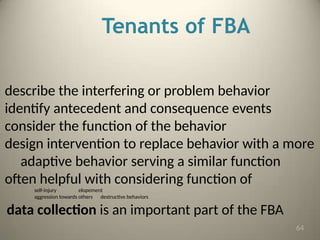
Tenants of FBA
describe the interfering or problem behavior
identify antecedent and consequence events
consider the function of the behavior
design intervention to replace behavior with a more
adaptive behavior serving a similar function
often helpful with considering function of
self-injury elopement
aggression towards others destructive behaviors
data collection is an important part of the FBA
64
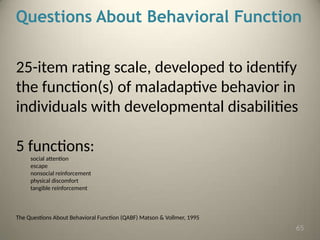
Questions About Behavioral Function
25-item rating scale, developed to identify
the function(s) of maladaptive behavior in
individuals with developmental disabilities
5 functions:
social attention
escape
nonsocial reinforcement
physical discomfort
tangible reinforcement
The Questions About Behavioral Function (QABF) Matson & Vollmer, 1995
65
When Communication is the
Function of the Behavior
Teach a more functional form of
communication
(pointing to, giving a cue card, vocalization, sign)
Replace inappropriate behavior or subtle communicative acts with more
appropriate and effective communicative behaviors
Differential reinforcement of taught behavior
Extinction
66
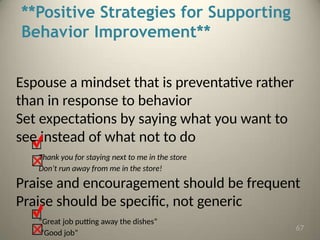
**Positive Strategies for Supporting
Behavior Improvement**
Espouse a mindset that is preventative rather
than in response to behavior
Set expectations by saying what you want to
see instead of what not to do
Thank you for staying next to me in the store
Don’t run away from me in the store!
Praise and encouragement should be frequent
Praise should be specific, not generic
“Great job putting away the dishes”
“Good job”
67
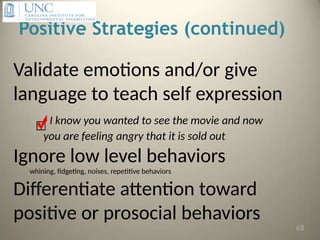
Positive Strategies (continued)
Validate emotions and/or give
language to teach self expression
I know you wanted to see the movie and now
you are feeling angry that it is sold out
Ignore low level behaviors
whining, fidgeting, noises, repetitive behaviors
Differentiate attention toward
positive or prosocial behaviors
68
69
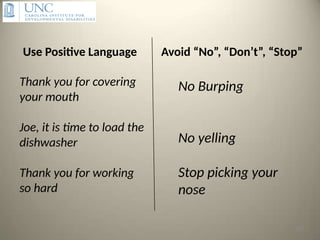
Use Positive Language
Thank you for covering
your mouth
Joe, it is time to load the
dishwasher
Thank you for working
so hard
Avoid “No”, “Don’t”, “Stop”
No Burping
No yelling
Stop picking your
nose
Behaviour Modification
Give a Man a fish and feed him for a
day; Teach a man to fish and feed
him for the life.
What’s
Behaviour?
behavior [bɪˈ heɪvjə]n 1. manner of behaving or conducting oneself
on one's best behaviour behaving with careful good manners
3. (Psychology) Psychol a. the aggregate of all the responses made by
an organism in any situation
b. a specific response of a certain organism to a specific stimulus or
group of stimuli
4. the action, reaction, or functioning of a system, under normal or
specified circumstances [from BEHAVE; influenced in form by Middle
English havior, from Old French havoir, from Latin habēre to have]
What’s Behaviour
Problem?
When the Behaviour
deviates from the normally
expected Pattern
What’s Behaviour
Modification?
Interfere positively in the child’s
activities to influence its
thoughts in order to bring in
desirable changes in the pattern
of behaviour
General
Definition
Systematic application of learning
principles and techniques to assess and
improve individuals covert and
overt behaviours in order to help
them function more fully in society.
Techniques
Techniques are various systematised
tried and tested principles of action
to bring in behavioural changes in the
targeted
population
Behaviour Modification
techniques
Systematic application of learning
principles and techniques to assess and
improve individuals covert and
overt behaviours in order to help
them function more fully in society.
Some Behaviour
Modification
techniques
• Reinforcement
• Punishment
• Systematic De-
sensitisation
• Aversion
• Extinction
• Shaping and Chaining
• Prompting and Fading
• Behaviour Contracting
• T
oken Economy
• Timeout
• Overcorrection
• Stimulus Satiation
• Flooding
• Assertiveness Training
• Bio-feedback
Reinforcemen
t
The process used to help increase the
probability that a specific behaviour
will
occur with the delivery of a
stimulus/item/immediately after a
response/behaviour is exhibited.
Factors influencing the effectiveness
of positive reinforcement
1-Selecting the behavior to be increased.
2-Choosing reinforces.
3-Reinforcer size.
4-Reinforce immediacy.
5- Contingent versus non-contingent Reinforcement
1-Selecting a behavior to be increased :
-Behavior to be reinforced must be identified specifically.
Ex: if you start with general behavior such as(being
friendly) you should then identify specific behavior
such as(smiling)
2- Choosing reinforces..
•Different individuals are frequently turned on by
different things.
•The important thing is to use a reinforce that is
effective with the individual with whom you are
working…
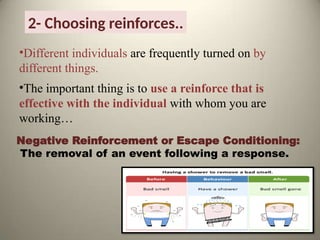
Negative Reinforcement or Escape Conditioning:
The removal of an event following a response.
Positive reinforcement can be classified
under 5 categories:
1-consumable :
Reinforcer that can be
consumed (food or drink)
Ex: cookies, fruits ,Pepsi ?.
2-Activity:
Ex: watching TV.
3-Manipulative:
Ex: play with favorite toy ,color,
paint, surf the internet.
4-Possetional:
Ex: have a private room.
5-Social:
Ex: hugs, smiles, nods.
3- Reinforcer size:
The size(magnitude)of reinforcer is
an important determinant of its
effectiveness.
Ex:
Many of teenagers would likely be
unwilling to eat fruits for 10 SR but
many will eagerly do so for 50SR.
4-Reinforce immediately :
For maximum effectiveness , a
reinforcer should be giver
immediately after the desired
response.
5-Contingent versus non-contingent
Reinforcement :
Contingent reinforcement:
When a behavior must occur before a reinforcer will be present .
Ex: child doing his homework after that the mother reward him
with a chocolate.
Non-contingent reinforcement:
If a reinforcer is presented at a particular time , regardless of
preceding behavior.
Ex: The teacher told the student that he’s smart and he can do the
test ,after that the student confidently take the test.
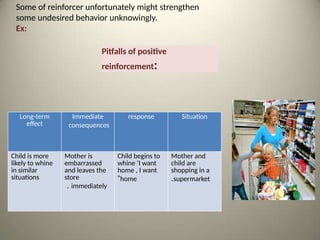
Pitfalls of positive
reinforcement:
Some of reinforcer unfortunately might strengthen
some undesired behavior unknowingly.
Ex:
Long-term
effect
Immediate
consequences
response Situation
Child is more
likely to whine
in similar
situations
Mother is
embarrassed
and leaves the
store
immediately
.
Child begins to
whine ‘I want
home , I want
home
”
Mother and
child are
shopping in a
supermarket
.
Positive and negative
reinforcment
http://www.youtube.com/watch?v=
OxdtMVww2q0
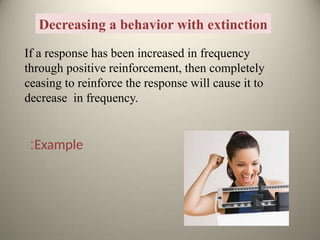
Decreasing a behavior with extinction
If a response has been increased in frequency
through positive reinforcement, then completely
ceasing to reinforce the response will cause it to
decrease in frequency.
Example
:
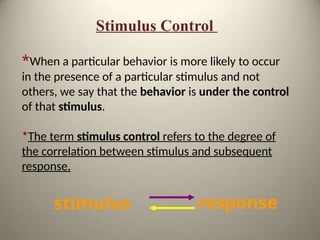
Stimulus Control
*When a particular behavior is more likely to occur
in the presence of a particular stimulus and not
others, we say that the behavior is under the control
of that stimulus.
*The term stimulus control refers to the degree of
the correlation between stimulus and subsequent
response.
stimulus response
*Through experience, we learn to
refrain from performing certain
behaviors in the presence of certain
stimuli because we have learnt that
those behaviors will go
unreinforced.
Reinforcemen
t
Two Types:
• Primary Reinforcement
• Secondary
Reinforcement
Primary
Reinforcement
Also known as
Unconditional
Reinforcement
Occurs naturally
Doesn’t require
learning
Have an evolutionary basis
Secondary
Reinforcement
Also known as
Conditioned
Reinforcement
Involves stimuli that have become
rewarding by being paired with
another
reinforcing stimulus.
Positive
Reinforcement
Positive reinforcement is very
powerful and effective tool to help
shape and
change behaviour
Positive
Reinforcement
Works by presenting a motivating item
to the person after the desired
behavior is exhibited, making the
behaviour more
likely to happen in future.
Adding Something
Pleasant
• Mother giving her son a candy
for cleaning up his toys
• A little girl receives Rs. 5/- for every
A+ she earns
Negative
Reinforcement
Negative
reinforcement is
reinforcement of a
desired behaviour by the removal of a
stimuli/item after a particular
behaviour
Negative
Reinforcement
The likelihood of the particular
behaviour occurring again in the future
is increased
because of removing/avoiding
the negative stimuli.
Removing Something
Unpleasant
Lisa always complains headache when
it’s time to start doing her
homework.
Her parents allow her to go to
bed without doing her
Punishmen
t
Is used to help decrease the probability
that a specific undesired behaviour
will
occur with the delivery of a
consequence immediately after the
response behaviour is exhibited.
Punishmen
t
People think, typically that punishment
produces something wrong or
harmful;
it shouldn’t necessarily be the case.
Punishmen
t
The punishment procedures have been
used with both typical and atypical
developing children, teenagers, elderly
persons, animals and people exhibiting
different psychological disorders.
Positive
Punishment
Works by presenting a negative
consequence after an
undesired
behaviour is being exhibited, making
the behaviour less likely to happen in
the future.
Examples of Positive
Punishment
Achild pricks another’s nose during class
and the teacher reprimands him in
front
of his classmates.
Examples of Positive
Punishment
A child wears his favourite hat to
church or at dinner, parents chides
and ask him
to remove it.
Alternatives to
Punishment
There are harmful effects of physical
or verbal punishment. Yelling,
slapping, hitting and spanking
teach violence,
destroy self esteem, create anger,
interfere with learning and damage
Alternatives to
Punishment
Prevent unwanted behaviour by
meeting your child’s needs when
they are first
expressed.
Alternatives to
Punishment
Provide safe
child friendly
environment
The Golden
Rule
Think about how you would like to
be treated if you were to find
yourself in the same circumstances
as your child.
T
o err is humane.
Empath
y
T
o empathise means placing yourself
in the other man’s place.
Show empathy to your children.
Non-Violent
Communication
Understand and meet the need that led
to the undesired behaviour.
Emotional
Tank
Fill the child’s emotional tank
with:
Eye contact
Gentle
touch
Parental Command
V/s.
Cordial Persuasion
Please “Slow
down” Is often
better than “Stop
Running”
Shaping and
Chaining
This is a behavioural term that refers
to gradually moulding or training
an
organism to perform a specific
response (behaviour) by reinforcing
any response that are similar to the
Shaping
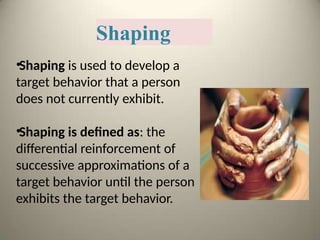
•Shaping is used to develop a
target behavior that a person
does not currently exhibit.
•Shaping is defined as: the
differential reinforcement of
successive approximations of a
target behavior until the person
exhibits the target behavior.
Differential
Reinforcement
A procedure in which a reinforcer follows a
specific desirable behavior but other
undesirable behaviors are not reinforced
The result is an increase in the desirable
behavior and extinction of the other behaviors
(
Miltenberger, 2012
)
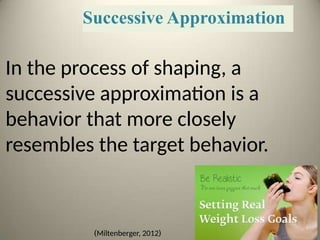
Successive Approximation
In the process of shaping, a
successive approximation is a
behavior that more closely
resembles the target behavior.
(
Miltenberger, 2012
)
Target Behavior
Is the behavior one want to see
demonstrated; the end goal.
Reinforcer
•Is a stimulus or event that increases the future
probability of a behavior when it occurs. It is
contingent on the occurrence of the behavior.
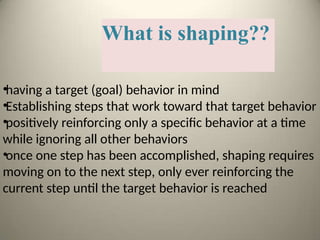
What is shaping??
•having a target (goal) behavior in mind
•Establishing steps that work toward that target behavior
•positively reinforcing only a specific behavior at a time
while ignoring all other behaviors
•once one step has been accomplished, shaping requires
moving on to the next step, only ever reinforcing the
current step until the target behavior is reached
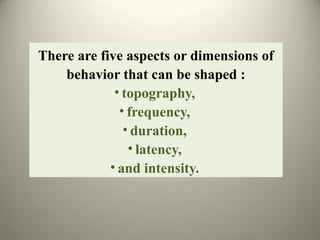
There are five aspects or dimensions of
behavior that can be shaped :
• topography,
• frequency,
• duration,
• latency,
• and intensity.
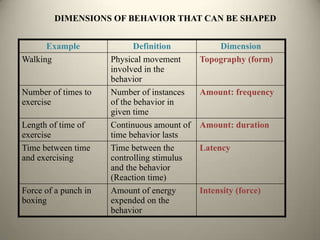
Example Definition Dimension
Walking Physical movement
involved in the
behavior
Topography (form)
Number of times to
exercise
Number of instances
of the behavior in
given time
Amount: frequency
Length of time of
exercise
Continuous amount of
time behavior lasts
Amount: duration
Time between time
and exercising
Time between the
controlling stimulus
and the behavior
(Reaction time)
Latency
Force of a punch in
boxing
Amount of energy
expended on the
behavior
Intensity (force)
DIMENSIONS OF BEHAVIOR THAT CAN BE SHAPED
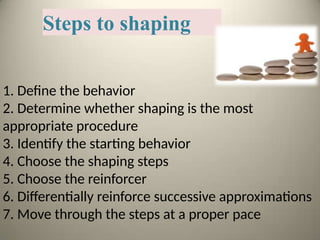
Steps to shaping
1. Define the behavior
2. Determine whether shaping is the most
appropriate procedure
3. Identify the starting behavior
4. Choose the shaping steps
5. Choose the reinforcer
6. Differentially reinforce successive approximations
7. Move through the steps at a proper pace
1
.
Define the behavior
•The first stage in shaping is to identify clearly the final desired
behavior, which is often referred to as the terminal behavior.
• A precise statement of the final desired behavior increases the
chances of consistent reinforcement of successive approximations
of that behavior.
• The final desired behavior should be stated in such a way that all
the relevant characteristics of the behavior (its topography,
amount, latency, and intensity) are identified.
• The conditions under which behavior is or is not to occur
should be stated, and any other guidelines that appear to be
necessary for consistency should be provided.
•If the person already demonstrates the behavior on
occasion you can use other techniques to strengthen
that behavior.
•If you can tell the person to do the target behavior,
if you can physically assist the person in doing the
behavior, or if you can show the person the correct
behavior you do not need to use shaping
2
.
Determine whether shaping is the
most appropriate procedure
3
.
Identify the starting behavior
•Because the final desired or terminal behavior does not occur
initially, and because it is necessary to reinforce some behavior
that approximates it, you must identify a starting point.
• This should be a behavior that occur often enough and it should
approximate the final desired behavior.
•It is helpful to outline the successive approximations through which the
person will be moved, in the attempt to approximate the final desired
behavior.
•There are no specific guidelines for identifying the ideal step size.
•Whatever guidelines or guesses are used, it is important to try to stick
to them and yet be flexible if the trainee does not proceed quickly
enough or is learning more quickly than had been expected.
4
.
Choose the shaping steps
5
.
Choose the reinforcer
•Must be a strong reinforcer for the participant being
shaped.
•Must be able to be delivered immediately following
a behavior (i.e. clicker with animals)
•Reinforce each behavior until they happen on their
own.
•Once the participant masters a stage, you move on to
the next approximation and only reinforce that
behavior, putting the previous approximation on
extinction.
6
.
Differentially reinforce successive
approximations
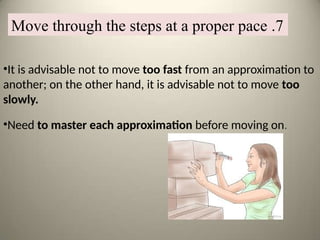
•It is advisable not to move too fast from an approximation to
another; on the other hand, it is advisable not to move too
slowly.
•Need to master each approximation before moving on.
7
.
Move through the steps at a proper pace
Shaping is so common in everyday life
that often people are not even aware of
it. Sometimes the shaping proceeding is
applied systemically, sometimes no
systemically, and sometimes shaping
occurs from consequences in the natural
environment.
Then he decided to try a new procedure.
- Frank’s goal was to jog a quarter of a mile each day.
- Frank decided that, at the very least, he would walk around his home (approximately 30
yards). Although this was along way from a quarter of a mile, it was at least a START.
- Frank decided to use the drinking of beer as a reinforcer. After the first approximation
had occurred on several successive afternoons, Frank increased the requirement to
walk around the home twice(60yards). Then the distance was increased to four
times(120yards), then six times(180yards), then more until the distance became a
quarter of a mile. By reinforcing successive approximations to his goal, Frank reached
the point!
After taking an early retirement at the age of 55, Frank decided to make some changes in his life.
On the advice of his doctor, he resolved to begin a regular exercise program. Frank had been a
“couch potato” all his life. Frank launched his exercise program with a pledge to his wife that he
would jog a quarter of a mile each day. But after a couple of attempts, he returned to his couch-
potato routine.
Examples
In playing “Hot & Cold”, you reinforce any
movement that takes the player closer to the
prize.
Each of those successive movements is a
closer approximation of the desired behavior.
If the prize is under the couch, and the player
is moving toward the couch, every time the
player takes a step toward the couch, you are
yelling “hotter”, and you are reinforcing the
behavior.
If the player moves away from the couch, you
would yell, “colder” (non-reinforcing).
Examples
• Subject: 40 year old woman
•Final Desired Behavior: Workout in the gym 1 hour a day/3 days
per week
•Response that could be used as a starting point in working toward
the final desired behavior: Driving directly to the gym Monday
after work and working out for 20 minutes. Although this was a
long way from her final desired goal, it’s a start.
•Reinforce the starting response; then reinforce closer and closer
approximations until eventually the desired response occurs: She
decided to use a small cup of non-fat yogurt as her reinforcer.
Instead of going home to eat ice cream after work, she is going to
have a lower calorie treat but not until she works out.
Examples
Chaining
Reinforcement of successive elements of a behavior chain
Behavior chain – sequence of related behaviors, each of which
provides the cue for the next and the last produces s reinforcer
E.g.tying shoes, going to school..
Types of
chaining
Forward chaining
Backward chaining
antidisestablishmentarianism
Now try
reading
this
Rules for
chaining
Define the target behavior
As a chain! – you must know in advance what sequence you will be dealing with
Reinforce successive elements of
the chain
Monitor results
Prompting and
Fading
A prompt can be defined as a cue or
hint meant to induce a person to
perform desired behaviour.
Prompting and
Fading
Promptingis an act of helping a
behaviour to occur
Prompting and
Fading
A coach help a small child hold a
baseball bat to teach a proper
swing
Fadin
g
Fading is when the trainer gradually
withdraws the prompt
Eg: Learning to drive a vehicle
Types of
prompting
Verbal
Physical
Gestural
Modeling
Environmental
Rules for prompting and
fading
Define the target behavior
Identify the suitable prompts
Prompt reinforce and fade
Monitor results
Systematic
Desensitisation
Is a behavioural treatment that is used
to treatanxiety causing behaviour
such as
phobias and fears.
3 Steps of Systematic
Desensitisation
Training to relax:
Hierarchy of Anxiety:
Desensitisation
process:
Training to
Relax
Training to relax: Progressive
relaxation, one first tightens and
then relaxes various muscle groups
in the body.
Hierarchy of
Anxiety
Hierarchy of Anxiety: a catalogue of
anxiety provoking situations or stimuli
arranged in order from least to most
distressing.
Desensitisation
Process
Desensitisation process: Direct
confrontation of the
situation.
Systematic
Desensitisation
The patient is taught to relax
through various relaxation
techniques like
learning how to relax the muscles
and applying various deep breathing
relaxation techniques.
Systematic
Desensitisation
The patient is asked to think about
only
red rose.
Of course this may generate the feeling
of anxiety but only in a limited
amount as the object of fear is only
Systematic
Desensitisation
Slowly a picture of rose is presented
to the person in a pleasant
situation. For
instance a picture of a boy offering a
red rose to a girl as a symbol of love
will be shown to the person. This will
Systematic
Desensitisation
Then the person is presented a funny
drawing, representing a person or
scene,
that includes a rose. If this generates
anxiety the person will be asked to
close
his eyes, relax his mind, and once
Systematic
Desensitisation
Now the person has to see a real rose
in a vase, from a distance. This will
be done with a constant reassurance
that it can
possibly cause no harm.
Systematic
Desensitisation
The person will slowly be made to
approach the red rose and look at
it
from a shorter distance.
Systematic
Desensitisation
The person will go close to the rose
placed in a vase and be asked just to
touch the
vase.
Systematic
Desensitisation
The to touch the rose
real.
Systematic
Desensitisation
Holds the red rose in his
hands.
Systematic
Desensitisation
Finally he will be able to hold the
entire bouquet of red roses
without
experiencing any anxiety of
fear
.
Thus works the Systemic
Aversion
Therapy
A behaviour therapy in which an
aversive (causing a strong feeling of
dislike or
disgust) stimuli is paired with an
undesirable behaviour in order to
reduce or eliminate that
Aversion Therapy is used
in
Alcohol abuse, drug abuse, gambling,
sexual deviations, smoking or
behaviour
problems
Examples Aversion
Therapy
Electric Shock, drugs, disturbing media
such as graphic images or loud and
painful noises, unappealing scenes or
sensations,
Drugs used Aversion
Therapy
Pungent smelling chemicals,
strong emetics, noxious and
irritating chemicals, irritating
ophthalmic
applications, capsicum aerosols
etc
Precautions of Aversion
Therapy
The chemicals and medicaments
generate very unpleasant and often
physically
painful responses. This type of aversive
stimulation may be risky for persons
with hear or lung problems.
Precautions of Aversion
Therapy
Beahavioural contract to be
executed.
Precautions of Aversion
Therapy
Worsening of the present
medical
conditions.
Extinctio
n
Extinction is used to stop an
undesirable
behaviour.
Extinctio
n
Like punishment, an extinction
behaviour is used when you need
to get your subject to stop some
behaviours.
Extinctio
n
Parents can create behaviour
“extinction” by carefully observing
their child’s
behavour and noticing what reward the
child receives for that inappropriate
behaviour.
Extinctio
n
High magnitude of reinforcement of
the undesired behaviour makes it
hard to
remove by extinction.
Associative Loss theory in
Extinction
The simplest explanation of extinction is
that as the CS is presented without
the
aversive US, the animal gradually
“unlearns” the CS-US association.
Behaviour
Contracting
It’s a therapeutic approach in
which an agreement is reached
with a client usually in the
form of a written contract.
Behaviour
Contracting
This would make clear the
consequences that would follow
certain identified behaviours.
Behaviour
Contracting
Eg: A contract may be drawn up with a
child specifying their reward for bed-
wetting. These agreement make clear
the schedule of reinforcement being
applied and in signing up to the
agreement it’s understood that this
might motivate the client to cooperate
with the programme
Behaviour
Contracting
Is applied to stopping of smoking,
drinking etc.
Procedure of Behaviour
Contracting
Plan the contract, set up a meeting,
communicate the laid out
conditions, benefits and dead
lines. Schedule follow ups.
T
oken
Economy
Is a system of behaviour
modification based on the
systematic positive reinforcement
of target behaviour.
T
oken
Economy
The reinforcement symbols or
tokens that can be exchanged for
other reinforcers.
It’s based on the conditions of
operant conditioning.
T
oken
Economy
Are applied with children and
adults. Give the reward whenever
the behaviour occur.
Steps of T
oken
Economy
Step 1: Select target behaviour for
change.
Steps of T
oken
Economy
Step 2: Develop a method for
recording or token or points.
Steps of T
oken
Economy
Step 3: Identify powerful rewards.
Steps of T
oken
Economy
Step 4: Establish Goals- number of
tokens or points to be won for
obtaining the rewards.
Steps of T
oken
Economy
Step 5: Detail the programme to the
child.
Steps of T
oken
Economy
Step 6: Provide the feedback.
Steps of T
oken
Economy
Step 7: Finally present the reward.
Steps of T
oken
Economy
Step 8: Change the programme.
When the desired result is
obtained too you should change
the programme ingredients.
Time
Out
Temporarily changing or separating the
child from the environment where
inappropriate behaviour has
occurred.
It’s intended to remove a
positive reinforcement of the
undesired
Time
Out
It’s an educational and parenting
technique recommended by some
paediatricians and developmental
psychologists as an effective
measure to ensure child discipline.
Time
Out
Recommended for younger children. The
purpose is to isolate or separate the child for
a short period of time (usually 5 to 15
minutes) in order to allow the child to calm
down as well as to discourage inappropriate
behaviour.
May on chair, steps, corner or any other
locations where there is no distractions.
Time
Out
Temporarily changing or separating the
child from the environment where
inappropriate behaviour has
occurred.
It’s intended to remove a
positive reinforcement of the
undesired
Time
Out
Type of a behaviour control method
based on removing positive
reinforcements.
Overcorrectio
n
A type of Positive practice which
involves performing an action
repeatedly until it’s
performed
correctly.
Overcorrectio
n
If you have trouble in producing
the exact musical note in a song
you overcorrect it by practicing
singing until you reach the desired
level of performance.
Stimulus
satiation
This response of elimination
procedure involves the repeated
presentation of the desired
stimulus for the purpose of
reducing its attractiveness.
Stimulus
satiation
Excessive presentation of desired
stimulus to reach levels or
satiation (to get cloyed with).
Floodin
g
A form of desensitisation for treating
phobias and anxieties by repeated
exposure to highly distressing stimuli
until the lack of reinforcement of
the
anxiety response causes its
Floodin
g
A form of desensitisation used in
behaviour therapy in which the
person imagines or is actually
exposed to anxiety-producing
stimuli.
Assertiveness
Training
A form of behaviour therapy
designed to help people stand up
for themselves- to empower
themselves.
Assertiveness
Training
Assertiveness is a response that
seeks to maintain an appropriate
balance between passivity and
aggression.
Assertiveness
Training
Assertiveness response that
promotes fairness and equality in
human interaction, based on
positive sense of respect for self
and others.
Assertiveness
Training
The purpose of assertiveness training is
to teach persons appropriate
strategies for identifying and acting
on their desires, needs and opinions
while remaining respectful of others.
Bio-
feedback
Applied Psychological feedback- is a
patient guided treatment that teaches
an individual to control muscle tension,
pain, body temperature, brain waves
and other bodily functions and
processes through relaxation,
visualisation and other cognitive control
techniques.
Bio-
feedback
Temperature Bio-feedback
GSR Galvanic Skin Response
EEG Bio-feedback
Bio-Life
Feedback-
Bio-
feedback
Applied Psychological feedback- is a
patient guided treatment that teaches
an individual to control muscle tension,
pain, body temperature, brain waves
and other bodily functions and
processes through relaxation,
visualisation and other cognitive control
techniques.
Relaxation
Methods
Relaxation is not just zoning our
before a TV at the end of a
stressful day.
Relaxation
Methods
To effectively combat stress, we need
to activate the body’s natural
relaxation response. We can do this
by practicing relaxation techniques
such as deep breathing, mindful
meditation, rhythmic exercises and
YOGA.
Self-Management
Self-management Problems
Self-management problems include behavioral
excesses and behavioral deficits
Self-management problems involve a conflict
between short term contingencies and long
term consequences
Short term contingencies control the behavior
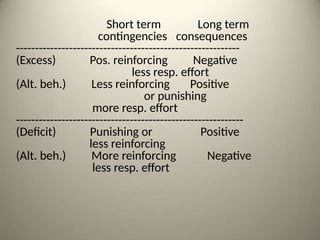
Short term Long term
contingencies consequences
-----------------------------------------------------------
(Excess) Pos. reinforcing Negative
less resp. effort
(Alt. beh.) Less reinforcing Positive
or punishing
more resp. effort
------------------------------------------------------------
(Deficit) Punishing or Positive
less reinforcing
(Alt. beh.) More reinforcing Negative
less resp. effort
Self-management process
Must analyze the target behavior and alternative
behaviors (behavioral excess and deficit) in self-
management
In self-management you engage in a controlling behavior
in the present to influence the controlled behavior in the
future
Controlling behavior = self-management strategy
Controlled behavior = target behavior to be changed in a
self-management program
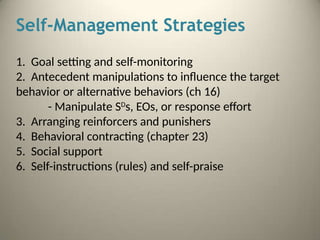
Self-Management Strategies
1. Goal setting and self-monitoring
2. Antecedent manipulations to influence the target
behavior or alternative behaviors (ch 16)
- Manipulate SD
s, EOs, or response effort
3. Arranging reinforcers and punishers
4. Behavioral contracting (chapter 23)
5. Social support
6. Self-instructions (rules) and self-praise
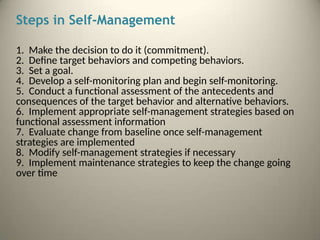
Steps in Self-Management
1. Make the decision to do it (commitment).
2. Define target behaviors and competing behaviors.
3. Set a goal.
4. Develop a self-monitoring plan and begin self-monitoring.
5. Conduct a functional assessment of the antecedents and
consequences of the target behavior and alternative behaviors.
6. Implement appropriate self-management strategies based on
functional assessment information
7. Evaluate change from baseline once self-management
strategies are implemented
8. Modify self-management strategies if necessary
9. Implement maintenance strategies to keep the change going
over time
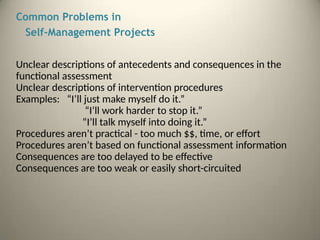
Common Problems in
Self-Management Projects
Unclear descriptions of antecedents and consequences in the
functional assessment
Unclear descriptions of intervention procedures
Examples: “I’ll just make myself do it.”
“I’ll work harder to stop it.”
“I’ll talk myself into doing it.”
Procedures aren’t practical - too much $$, time, or effort
Procedures aren’t based on functional assessment information
Consequences are too delayed to be effective
Consequences are too weak or easily short-circuited
I
think..
I have covered the topic fairly well.
Your suggestions to improve this
effort is welcome.
babuappat@gmail.c
om

Behavior Therapy & techniques new.pptx for child

  • 1.
  • 2.
    What is psychotherapy? Anemotionally charged disclosing interaction Between a trained therapist and someone suffers from psychological problems Using psychological techniques Aims: • change behavior • Decrease distress • Increase joy, aspiration, and hope • Improve resilience
  • 3.
    Aim: To answerthese questions Behavior (Action) Vs Insight Therapy Elements of behavioral approaches Behavior therapy & learning Goals of BT Various techniques Role of behavior therapist Strengths & Weaknesses
  • 4.
    Insight- vs. Action-Oriented Approaches ApproachInsight Action-oriented Emphasis self-awareness and understanding relief of symptoms Primary medium verbal intervention & processing action with verbal processing Attention therapeutic relationship, process, interpretation, insight objective, scientific behavioral interventions and outcome measures Therapist nondirective active & directive
  • 5.
    Common elements ofbehavioral approaches 1. Emphasizes on the present (not past) 2. Gives attention – to change specific dysfunctional behaviors 3. Rely on research - in developing and testing interventions 4. Consider principles of learning – to develop and treat dysfunctional behaviors 5. Treatment outcomes – carefully measured 6. Matches specific treatments to particular presenting problems
  • 6.
    How do psychologicalproblems arise? • All behaviors are the result of learning  Behavior is a product of learning No matter how pathological client’s behavior may be, it is the result of past learning and conditioning  What has been learned can be unlearned Same learning principles that apply to learning maladaptive behavior can be used to get rid of it Behavioral Therapy and Learning
  • 7.
    Three primary typesof behavior problems: Behavioral Excess- behavior that occur too often Behavioral Deficits – too little or non-existent Inappropriate/maladaptive behavior- Minor (less impairment-nail biting ) to severe(more impairment-sexual behaviors) interference in ADL
  • 8.
    Goals of Behavioural Therapy 1.Aims to change behavior in order to change emotion and mood. 2. Directed exclusively towards symptomatic improvement, without addressing psychodynamic causation.
  • 9.
  • 10.
    Case # 1 A& B were having difficulties in their marriage, because of frequent arguments. Their marriage counselor arranged.
  • 11.
    Case # 2  ClientR. was engaged in pulling her hair instantly, as a result she created a bald spot on the top of her head. Although she knew the embarrassment of getting bald spot but she continued.  So she was instructed to engaging in competitive activity for her. That decreased her hair pulling habit.
  • 12.
    Case # 3  Aboy F was putting lot of weight he joined a weight loss group. At each group meeting he used to deposit money. Set a goal for daily exercise. So if he earned specified number of point he used to get back the deposit money otherwise not.
  • 13.
    In these 3cases you can notice that there is a focused behavior and also a procedure to change the behavior.
  • 14.
    So what doyou think what is Behavior ? What is behavior modification?
  • 15.
    Behavior What people doand say. Examples: running, walking, screaming, slamming the door, head banging etc. Do you think ? Anger Sadness Confusion is a behavior?
  • 16.
    Behavior Have oneor more dimensions  that can be measured. Physical dimensions : Frequency Duration Intensity Can be observed and recorded Have an impact on oneself/environment Lawful Systematically influenced by environment events. May be overt (observed) or covert (private event)
  • 17.
    What is thatcharacteristic of behavior? An autistic child when receives higher attention from the teacher, his disruptive behavior decreases. When he receives low attention , disruptive behavior increases.
  • 18.
    Which characteristics this?? Ex:1 Aperson sits at his computer and types a letter??
  • 19.
    Ex:2 A little childlies in her crib and cries loudly. Her mother then picks her up and feeds her?
  • 20.
    What does meanby? Functional relationship between a disruptive behavior and attention.
  • 21.
  • 22.
    Areas of Application Developmentaldisabilities Mental illness Special Education Rehabilitation Community psychology Clinical psychology Business and human services Self management Child management Prevention Sports psychology Health related behaviors Sports psychology Gerontology (Nursing homes and other care facilities)
  • 23.
  • 24.
     Measuring the behaviorbefore treatment provides information that can help you determine whether treatment is necessary.  Behavioral assessment can provide information that helps you choose the best treatment.  Measuring the target behavior before and after treatment allows you to determine whether the behavior changed after the treatment was implemented.
  • 25.
    Direct and IndirectAssessment Direct involves using interviews, questionnaires, and rating scales to obtain information on the target behavior from the person exhibiting the behavior or from others (e.g., parents, teachers, or staff). Indirect assessment does not occur when the target behavior occurs but relies on an individual’s recall of the target behavior.
  • 26.
     When a schoolpsychologist observes a socially withdrawn child on the playground and records each social interaction with another child, the psychologist is using direct assessment.  When the psychologist interviews the student’s teacher and asks the teacher how many times the child usually interacts with other children on the playground, the psychologist is using indirect assessment.
  • 27.
    Procedures of behavioralanalysis Defining the target behavior When two people independently observe the same behavior and both record that the behavior occurred, this is called interobserver agreement(IOA) or interobserver reliability Determining the logistics of recording Choosing a recording method Choosing a recording instrument
  • 28.
    Direct assessment usually ismore accurate than indirect assessment. What kind of limitations
  • 29.
    The Logistics of Recording TheObserver  We have defined the target behavior to be recorded for a client, that is, a person who exhibits the target behavior and with whom the behavior modification program will be implemented.  The next step is to identify who will observe and record the behavior.  In a behavior modification program, the target behavior typically is observed and recorded by a person other than the one exhibiting the target behavior (i.e., an independent observer).
  • 30.
    The observer maybe a professional, such as a behavior analyst or a psychologist, or a person routinely associated with the client in the client’s natural environment, such as a teacher, parent, staff member, or supervisor.
  • 31.
    In some cases,the observer is the person exhibiting the target behavior. When the client observes and records his or her own target behavior, it is called self-monitoring.
  • 32.
    In addition, theclient might be asked to self-monitor the target behavior outside the therapy sessions. If self-monitoring is used in a behavior modification program, the client must be trained to record his or her own behavior in the same way that an observer would be trained.
  • 33.
    When and Whereto Record  The observer records the target behavior in a specific period called the observation period.  It Observation and recording of behavior take place in natural settings or in analogue settings.  A natural setting consists of the places in which the target behavior typically occurs. Observing and recording a target behavior in the classroom is an example of a natural setting for a student Observing a target behavior in a clinic playroom is an analogue setting because being in the clinic is not part of the child’s normal daily routine.
  • 34.
     Observation of thetarget behavior can be structured or unstructured.  When observations are structured, the observer arranges for specific events or activities to occur during the observation period. For example, when observing child behavior problems, the observer may ask the parent to make specific requests of the child during the observation period.  During unstructured observations, no specific events or activities are arranged and no instructions are given during the observation period.
  • 35.
    Choosing a RecordingMethod continuous recording product recording interval recording and time sample recording.
  • 36.
    Continuous Recording In continuousrecording, the observer observes the client continuously throughout the observation period and records each occurrence of the behavior. frequency, duration, intensity, and latency.
  • 37.
    How does latencydiffer from duration? Latency is the time from some stimulus or event to the onset of the behavior, whereas duration is the time from the onset of the behavior to its offset.
  • 38.
    a real-time recordingmethod in which the exact time of each onset and offset of the target behavior is recorded Real time recording can be carried out after video recording the target behavior in the observation period
  • 39.
     If you wererecording a child’s tantrum behavior (screaming, throwing toys, slamming doors), which dimension of the behavior would you measure?  The example of a child’s tantrum behavior is less clear. You may be interested in the number of tantrums per day (frequency), but you may also be interested in how long each tantrum lasts (duration). Finally, you may be interested in how loud the child screams or how forcefully the child throws toys or slams doors (intensity).
  • 40.
    Unless you measurethe right dimension of a behavior, you may not be able to judge the effectiveness of treatment.
  • 41.
    Percentage of Opportunities  Percentageof trials or percentage correct is one final way in which event recording may be conducted.  In this method, the observer records the occurrence of a behavior in relation to some other event, such as a learning trial or a response opportunity, and reports the results as the percentage of opportunities in which the behavior occurred.
  • 42.
     If the teachermade 12 requests and the student complied with the teacher’s requests 11 times, the percentage of compliance is 11/12, or 92%.  However, if the teachers made 25 requests and the student complied 11 times, the percentage is only 44%, a much less acceptable level of the behavior.
  • 43.
     Product Recording  Another aspectof a behavior that may be recorded is its product. Product recording, also called permanent product recording (Marholin & Steinman, 1977),  a teacher could record the number of correctly completed homework problems or workbook pages as a product measure of students’ academic performance (Noell et al., 2000).
  • 44.
     Interval Recording  Another methodfor recording behavior is to record whether the behavior occurred during consecutive time periods. the observer divides the observation period into a number of smaller time periods or intervals, observes the client throughout each consecutive interval, and then records whether the behavior occurred in that interval. There are two types of interval recording:  partial interval recording  and whole interval recording.
  • 45.
    With partial intervalrecording, you are not interested in the number of times the behavior occurs (frequency) or how long it lasts (duration). You do not have to identify the onset and offset of the behavior; rather, you simply record whether the behavior occurred during each interval of time. Suppose that a teacher is recording whether a child disrupts the class during each 15-minute interval in the class period. The teacher sets a timer to beep every 15 minutes. When the disruptive behavior occurs, the teacher marks the corresponding nterval on a data sheet. Once an interval is marked, the teacher does not have to observe the child or record the behavior until the next interval begins. If the behavior does not occur in an interval,
  • 46.
    presence or absenceof the tic behavior. In some cases, frequency recording and interval recording can be combined to produce frequency-within-interval recording. With this method, the observer records the frequency of the target behavior but does so within consecutive intervals of time in the observation period
  • 47.
     Time Sample Recording  Whenusing time sample recording, you divide the observation period into intervals of time, but you observe and record the behavior during only part of each interval.  The observation periods are separated by periods without observation. For example, you might record the behavior for only 1 minute during each 15-minute interval, or you might record the behavior only if it is occurring at the end of the interval. Consider an observer who is using time sample recording to record a client’s poor posture (defined as slouching, bending the back forward). The observer sets a timer to beep every 10 minutes and records an instance of bad posture only if the client’s posture is bad when the timer beeps at the end of the interval. Time sample recording is valuable because the person does not have to observe the behavior for the entire interval.
  • 48.
    Choosing a RecordingInstrument  What the observer uses to register or make a permanent product of the occurrence of the behavior.  Paper and pencil  data sheet prepared in advance for the particular behavior.  The data sheet in Figure 2-5 is used to record the duration of a target behavior. On each day, there are places to record the times the behavior started (onset) and ended (offset). By recording the onset and offset of each instance of a behavior, you end up with a recording of how long the behavior occurred (duration), as well as how often it occurred (frequency).
  • 49.
    Reactivity Sometimes the processof recording a behavior causes the behavior to change, even before any treatment is implemented. This is called reactivity (Foster, Bell- Dolan, & Burge, 1988; Hartmann & Wood, 1990; Tryon, 1998). Reactivity may occur when an observer is recording the behavior of another person or when a person engages in self-monitoring. Reactivity may be undesirable, especially for research purposes, because the behavior recorded during the observation period is not representative of the level of the behavior occurring .
  • 50.
    Usually this changein behavior is only temporary, and the behavior returns to its original level once the child becomes accustomed to the observer’s presence. One way to reduce reactivity is to wait until the people who are being observed become accustomed to the observer.  Another is to have the observer record the behavior without the people knowing that they are being observed.  This may be accomplished with the use of one-way observation windows or with participant observers. A participant observer is a person who is normally in the setting where the target behavior occurs, such as a teacher’s aide in a classroom. Likewise, when a person starts to record his or her own behavior as part of a self-management project, the behavior often changes in the desired direction as a result of the self-monitoring (Epstein, 1996). For this reason, self-monitoring sometimes is used as a treatment to change a target behavior.
  • 51.
    Interobserver Agreement  You assessIOA to determine whether the target behavior is being recorded consistently.  To evaluate IOA, two people independently observe and record the same target behavior of the same subject during the same observation period. The recordings of the two observers are then compared, and a percentage of agreement between observers is calculated. When the percentage of agreement is high, it indicates that there is consistency in the scoring by the two observers. This suggests that the definition of the target behavior is clear and objective, and that the observers are using the recording system correctly. When high IOA is reported in a research study, it suggests that the observers in the study recorded the target behavior consistently.
  • 52.
  • 53.
  • 54.
  • 55.
  • 56.
  • 57.
    57 JeanB. Mankowski, Ph.D.Rev. 8/10/2017 Carolina Institute for Developmental Disabilities
  • 58.
    Intervention is warrantedwhen behaviors are harmful to the self or others unsafe or destructive distressing to the individual/family disruptive to learning disruptive to social functioning hindering participation in daily living or occupational activities 58
  • 59.
    Evaluate Priorities Set realisticgoals Start with small steps that can build on each other First target behaviors that are dangerous target skills that would help to improve situations across several behavioral scenarios 59
  • 60.
    Features Across Intervention Strategies Clear—understoodby family/caregivers/supervisors Consistent—family/caregivers are on the same page with the interventions, expectations, response, and rewards Feasible—strategies need to be practical and available across settings and team(s) Steady—new strategies/interventions should continue for at least 3-4 weeks Continuity—keep strategies in place even when the behavior improves Remember Extinction Bursts Keep data if possible 60
  • 61.
    Before intervention, ascertainthe motivation for the behavior: What purpose does the behavior serve? 61
  • 62.
    Functional Behavior Analysis Functionalbehavior analysis--a structured, systematic, and objective method for determining the communicative function underlying a maladaptive behavior for intervention planning purposes 62
  • 63.
  • 64.
    Tenants of FBA describethe interfering or problem behavior identify antecedent and consequence events consider the function of the behavior design intervention to replace behavior with a more adaptive behavior serving a similar function often helpful with considering function of self-injury elopement aggression towards others destructive behaviors data collection is an important part of the FBA 64
  • 65.
    Questions About BehavioralFunction 25-item rating scale, developed to identify the function(s) of maladaptive behavior in individuals with developmental disabilities 5 functions: social attention escape nonsocial reinforcement physical discomfort tangible reinforcement The Questions About Behavioral Function (QABF) Matson & Vollmer, 1995 65
  • 66.
    When Communication isthe Function of the Behavior Teach a more functional form of communication (pointing to, giving a cue card, vocalization, sign) Replace inappropriate behavior or subtle communicative acts with more appropriate and effective communicative behaviors Differential reinforcement of taught behavior Extinction 66
  • 67.
    **Positive Strategies forSupporting Behavior Improvement** Espouse a mindset that is preventative rather than in response to behavior Set expectations by saying what you want to see instead of what not to do Thank you for staying next to me in the store Don’t run away from me in the store! Praise and encouragement should be frequent Praise should be specific, not generic “Great job putting away the dishes” “Good job” 67
  • 68.
    Positive Strategies (continued) Validateemotions and/or give language to teach self expression I know you wanted to see the movie and now you are feeling angry that it is sold out Ignore low level behaviors whining, fidgeting, noises, repetitive behaviors Differentiate attention toward positive or prosocial behaviors 68
  • 69.
    69 Use Positive Language Thankyou for covering your mouth Joe, it is time to load the dishwasher Thank you for working so hard Avoid “No”, “Don’t”, “Stop” No Burping No yelling Stop picking your nose
  • 70.
    Behaviour Modification Give aMan a fish and feed him for a day; Teach a man to fish and feed him for the life.
  • 71.
    What’s Behaviour? behavior [bɪˈ heɪvjə]n1. manner of behaving or conducting oneself on one's best behaviour behaving with careful good manners 3. (Psychology) Psychol a. the aggregate of all the responses made by an organism in any situation b. a specific response of a certain organism to a specific stimulus or group of stimuli 4. the action, reaction, or functioning of a system, under normal or specified circumstances [from BEHAVE; influenced in form by Middle English havior, from Old French havoir, from Latin habēre to have]
  • 72.
    What’s Behaviour Problem? When theBehaviour deviates from the normally expected Pattern
  • 73.
    What’s Behaviour Modification? Interfere positivelyin the child’s activities to influence its thoughts in order to bring in desirable changes in the pattern of behaviour
  • 74.
    General Definition Systematic application oflearning principles and techniques to assess and improve individuals covert and overt behaviours in order to help them function more fully in society.
  • 75.
    Techniques Techniques are varioussystematised tried and tested principles of action to bring in behavioural changes in the targeted population
  • 76.
    Behaviour Modification techniques Systematic applicationof learning principles and techniques to assess and improve individuals covert and overt behaviours in order to help them function more fully in society.
  • 77.
    Some Behaviour Modification techniques • Reinforcement •Punishment • Systematic De- sensitisation • Aversion • Extinction • Shaping and Chaining • Prompting and Fading • Behaviour Contracting • T oken Economy • Timeout • Overcorrection • Stimulus Satiation • Flooding • Assertiveness Training • Bio-feedback
  • 78.
    Reinforcemen t The process usedto help increase the probability that a specific behaviour will occur with the delivery of a stimulus/item/immediately after a response/behaviour is exhibited.
  • 79.
    Factors influencing theeffectiveness of positive reinforcement 1-Selecting the behavior to be increased. 2-Choosing reinforces. 3-Reinforcer size. 4-Reinforce immediacy. 5- Contingent versus non-contingent Reinforcement
  • 80.
    1-Selecting a behaviorto be increased : -Behavior to be reinforced must be identified specifically. Ex: if you start with general behavior such as(being friendly) you should then identify specific behavior such as(smiling)
  • 81.
    2- Choosing reinforces.. •Differentindividuals are frequently turned on by different things. •The important thing is to use a reinforce that is effective with the individual with whom you are working… Negative Reinforcement or Escape Conditioning: The removal of an event following a response.
  • 82.
    Positive reinforcement canbe classified under 5 categories: 1-consumable : Reinforcer that can be consumed (food or drink) Ex: cookies, fruits ,Pepsi ?. 2-Activity: Ex: watching TV.
  • 83.
    3-Manipulative: Ex: play withfavorite toy ,color, paint, surf the internet. 4-Possetional: Ex: have a private room. 5-Social: Ex: hugs, smiles, nods.
  • 85.
    3- Reinforcer size: Thesize(magnitude)of reinforcer is an important determinant of its effectiveness. Ex: Many of teenagers would likely be unwilling to eat fruits for 10 SR but many will eagerly do so for 50SR.
  • 86.
    4-Reinforce immediately : Formaximum effectiveness , a reinforcer should be giver immediately after the desired response.
  • 87.
    5-Contingent versus non-contingent Reinforcement: Contingent reinforcement: When a behavior must occur before a reinforcer will be present . Ex: child doing his homework after that the mother reward him with a chocolate. Non-contingent reinforcement: If a reinforcer is presented at a particular time , regardless of preceding behavior. Ex: The teacher told the student that he’s smart and he can do the test ,after that the student confidently take the test.
  • 88.
    Pitfalls of positive reinforcement: Someof reinforcer unfortunately might strengthen some undesired behavior unknowingly. Ex: Long-term effect Immediate consequences response Situation Child is more likely to whine in similar situations Mother is embarrassed and leaves the store immediately . Child begins to whine ‘I want home , I want home ” Mother and child are shopping in a supermarket .
  • 89.
  • 90.
    Decreasing a behaviorwith extinction If a response has been increased in frequency through positive reinforcement, then completely ceasing to reinforce the response will cause it to decrease in frequency. Example :
  • 91.
    Stimulus Control *When aparticular behavior is more likely to occur in the presence of a particular stimulus and not others, we say that the behavior is under the control of that stimulus. *The term stimulus control refers to the degree of the correlation between stimulus and subsequent response. stimulus response
  • 93.
    *Through experience, welearn to refrain from performing certain behaviors in the presence of certain stimuli because we have learnt that those behaviors will go unreinforced.
  • 94.
    Reinforcemen t Two Types: • PrimaryReinforcement • Secondary Reinforcement
  • 95.
    Primary Reinforcement Also known as Unconditional Reinforcement Occursnaturally Doesn’t require learning Have an evolutionary basis
  • 96.
    Secondary Reinforcement Also known as Conditioned Reinforcement Involvesstimuli that have become rewarding by being paired with another reinforcing stimulus.
  • 97.
    Positive Reinforcement Positive reinforcement isvery powerful and effective tool to help shape and change behaviour
  • 98.
    Positive Reinforcement Works by presentinga motivating item to the person after the desired behavior is exhibited, making the behaviour more likely to happen in future.
  • 99.
    Adding Something Pleasant • Mothergiving her son a candy for cleaning up his toys • A little girl receives Rs. 5/- for every A+ she earns
  • 100.
    Negative Reinforcement Negative reinforcement is reinforcement ofa desired behaviour by the removal of a stimuli/item after a particular behaviour
  • 101.
    Negative Reinforcement The likelihood ofthe particular behaviour occurring again in the future is increased because of removing/avoiding the negative stimuli.
  • 102.
    Removing Something Unpleasant Lisa alwayscomplains headache when it’s time to start doing her homework. Her parents allow her to go to bed without doing her
  • 103.
    Punishmen t Is used tohelp decrease the probability that a specific undesired behaviour will occur with the delivery of a consequence immediately after the response behaviour is exhibited.
  • 104.
    Punishmen t People think, typicallythat punishment produces something wrong or harmful; it shouldn’t necessarily be the case.
  • 105.
    Punishmen t The punishment procedureshave been used with both typical and atypical developing children, teenagers, elderly persons, animals and people exhibiting different psychological disorders.
  • 106.
    Positive Punishment Works by presentinga negative consequence after an undesired behaviour is being exhibited, making the behaviour less likely to happen in the future.
  • 107.
    Examples of Positive Punishment Achildpricks another’s nose during class and the teacher reprimands him in front of his classmates.
  • 108.
    Examples of Positive Punishment Achild wears his favourite hat to church or at dinner, parents chides and ask him to remove it.
  • 109.
    Alternatives to Punishment There areharmful effects of physical or verbal punishment. Yelling, slapping, hitting and spanking teach violence, destroy self esteem, create anger, interfere with learning and damage
  • 110.
    Alternatives to Punishment Prevent unwantedbehaviour by meeting your child’s needs when they are first expressed.
  • 111.
  • 112.
    The Golden Rule Think abouthow you would like to be treated if you were to find yourself in the same circumstances as your child. T o err is humane.
  • 113.
    Empath y T o empathise meansplacing yourself in the other man’s place. Show empathy to your children.
  • 114.
    Non-Violent Communication Understand and meetthe need that led to the undesired behaviour.
  • 115.
    Emotional Tank Fill the child’semotional tank with: Eye contact Gentle touch
  • 116.
    Parental Command V/s. Cordial Persuasion Please“Slow down” Is often better than “Stop Running”
  • 117.
    Shaping and Chaining This isa behavioural term that refers to gradually moulding or training an organism to perform a specific response (behaviour) by reinforcing any response that are similar to the
  • 118.
    Shaping •Shaping is usedto develop a target behavior that a person does not currently exhibit. •Shaping is defined as: the differential reinforcement of successive approximations of a target behavior until the person exhibits the target behavior.
  • 119.
    Differential Reinforcement A procedure inwhich a reinforcer follows a specific desirable behavior but other undesirable behaviors are not reinforced The result is an increase in the desirable behavior and extinction of the other behaviors ( Miltenberger, 2012 )
  • 120.
    Successive Approximation In theprocess of shaping, a successive approximation is a behavior that more closely resembles the target behavior. ( Miltenberger, 2012 )
  • 121.
    Target Behavior Is thebehavior one want to see demonstrated; the end goal. Reinforcer •Is a stimulus or event that increases the future probability of a behavior when it occurs. It is contingent on the occurrence of the behavior.
  • 122.
    What is shaping?? •havinga target (goal) behavior in mind •Establishing steps that work toward that target behavior •positively reinforcing only a specific behavior at a time while ignoring all other behaviors •once one step has been accomplished, shaping requires moving on to the next step, only ever reinforcing the current step until the target behavior is reached
  • 123.
    There are fiveaspects or dimensions of behavior that can be shaped : • topography, • frequency, • duration, • latency, • and intensity.
  • 124.
    Example Definition Dimension WalkingPhysical movement involved in the behavior Topography (form) Number of times to exercise Number of instances of the behavior in given time Amount: frequency Length of time of exercise Continuous amount of time behavior lasts Amount: duration Time between time and exercising Time between the controlling stimulus and the behavior (Reaction time) Latency Force of a punch in boxing Amount of energy expended on the behavior Intensity (force) DIMENSIONS OF BEHAVIOR THAT CAN BE SHAPED
  • 125.
    Steps to shaping 1.Define the behavior 2. Determine whether shaping is the most appropriate procedure 3. Identify the starting behavior 4. Choose the shaping steps 5. Choose the reinforcer 6. Differentially reinforce successive approximations 7. Move through the steps at a proper pace
  • 126.
    1 . Define the behavior •Thefirst stage in shaping is to identify clearly the final desired behavior, which is often referred to as the terminal behavior. • A precise statement of the final desired behavior increases the chances of consistent reinforcement of successive approximations of that behavior. • The final desired behavior should be stated in such a way that all the relevant characteristics of the behavior (its topography, amount, latency, and intensity) are identified. • The conditions under which behavior is or is not to occur should be stated, and any other guidelines that appear to be necessary for consistency should be provided.
  • 127.
    •If the personalready demonstrates the behavior on occasion you can use other techniques to strengthen that behavior. •If you can tell the person to do the target behavior, if you can physically assist the person in doing the behavior, or if you can show the person the correct behavior you do not need to use shaping 2 . Determine whether shaping is the most appropriate procedure
  • 128.
    3 . Identify the startingbehavior •Because the final desired or terminal behavior does not occur initially, and because it is necessary to reinforce some behavior that approximates it, you must identify a starting point. • This should be a behavior that occur often enough and it should approximate the final desired behavior.
  • 129.
    •It is helpfulto outline the successive approximations through which the person will be moved, in the attempt to approximate the final desired behavior. •There are no specific guidelines for identifying the ideal step size. •Whatever guidelines or guesses are used, it is important to try to stick to them and yet be flexible if the trainee does not proceed quickly enough or is learning more quickly than had been expected. 4 . Choose the shaping steps
  • 130.
    5 . Choose the reinforcer •Mustbe a strong reinforcer for the participant being shaped. •Must be able to be delivered immediately following a behavior (i.e. clicker with animals)
  • 131.
    •Reinforce each behavioruntil they happen on their own. •Once the participant masters a stage, you move on to the next approximation and only reinforce that behavior, putting the previous approximation on extinction. 6 . Differentially reinforce successive approximations
  • 132.
    •It is advisablenot to move too fast from an approximation to another; on the other hand, it is advisable not to move too slowly. •Need to master each approximation before moving on. 7 . Move through the steps at a proper pace
  • 133.
    Shaping is socommon in everyday life that often people are not even aware of it. Sometimes the shaping proceeding is applied systemically, sometimes no systemically, and sometimes shaping occurs from consequences in the natural environment.
  • 134.
    Then he decidedto try a new procedure. - Frank’s goal was to jog a quarter of a mile each day. - Frank decided that, at the very least, he would walk around his home (approximately 30 yards). Although this was along way from a quarter of a mile, it was at least a START. - Frank decided to use the drinking of beer as a reinforcer. After the first approximation had occurred on several successive afternoons, Frank increased the requirement to walk around the home twice(60yards). Then the distance was increased to four times(120yards), then six times(180yards), then more until the distance became a quarter of a mile. By reinforcing successive approximations to his goal, Frank reached the point! After taking an early retirement at the age of 55, Frank decided to make some changes in his life. On the advice of his doctor, he resolved to begin a regular exercise program. Frank had been a “couch potato” all his life. Frank launched his exercise program with a pledge to his wife that he would jog a quarter of a mile each day. But after a couple of attempts, he returned to his couch- potato routine. Examples
  • 135.
    In playing “Hot& Cold”, you reinforce any movement that takes the player closer to the prize. Each of those successive movements is a closer approximation of the desired behavior. If the prize is under the couch, and the player is moving toward the couch, every time the player takes a step toward the couch, you are yelling “hotter”, and you are reinforcing the behavior. If the player moves away from the couch, you would yell, “colder” (non-reinforcing). Examples
  • 136.
    • Subject: 40year old woman •Final Desired Behavior: Workout in the gym 1 hour a day/3 days per week •Response that could be used as a starting point in working toward the final desired behavior: Driving directly to the gym Monday after work and working out for 20 minutes. Although this was a long way from her final desired goal, it’s a start. •Reinforce the starting response; then reinforce closer and closer approximations until eventually the desired response occurs: She decided to use a small cup of non-fat yogurt as her reinforcer. Instead of going home to eat ice cream after work, she is going to have a lower calorie treat but not until she works out. Examples
  • 137.
    Chaining Reinforcement of successiveelements of a behavior chain Behavior chain – sequence of related behaviors, each of which provides the cue for the next and the last produces s reinforcer E.g.tying shoes, going to school..
  • 138.
  • 139.
  • 140.
    Rules for chaining Define thetarget behavior As a chain! – you must know in advance what sequence you will be dealing with Reinforce successive elements of the chain Monitor results
  • 141.
    Prompting and Fading A promptcan be defined as a cue or hint meant to induce a person to perform desired behaviour.
  • 142.
    Prompting and Fading Promptingis anact of helping a behaviour to occur
  • 143.
    Prompting and Fading A coachhelp a small child hold a baseball bat to teach a proper swing
  • 144.
    Fadin g Fading is whenthe trainer gradually withdraws the prompt Eg: Learning to drive a vehicle
  • 145.
  • 146.
    Rules for promptingand fading Define the target behavior Identify the suitable prompts Prompt reinforce and fade Monitor results
  • 147.
    Systematic Desensitisation Is a behaviouraltreatment that is used to treatanxiety causing behaviour such as phobias and fears.
  • 148.
    3 Steps ofSystematic Desensitisation Training to relax: Hierarchy of Anxiety: Desensitisation process:
  • 149.
    Training to Relax Training torelax: Progressive relaxation, one first tightens and then relaxes various muscle groups in the body.
  • 150.
    Hierarchy of Anxiety Hierarchy ofAnxiety: a catalogue of anxiety provoking situations or stimuli arranged in order from least to most distressing.
  • 151.
  • 152.
    Systematic Desensitisation The patient istaught to relax through various relaxation techniques like learning how to relax the muscles and applying various deep breathing relaxation techniques.
  • 153.
    Systematic Desensitisation The patient isasked to think about only red rose. Of course this may generate the feeling of anxiety but only in a limited amount as the object of fear is only
  • 154.
    Systematic Desensitisation Slowly a pictureof rose is presented to the person in a pleasant situation. For instance a picture of a boy offering a red rose to a girl as a symbol of love will be shown to the person. This will
  • 155.
    Systematic Desensitisation Then the personis presented a funny drawing, representing a person or scene, that includes a rose. If this generates anxiety the person will be asked to close his eyes, relax his mind, and once
  • 156.
    Systematic Desensitisation Now the personhas to see a real rose in a vase, from a distance. This will be done with a constant reassurance that it can possibly cause no harm.
  • 157.
    Systematic Desensitisation The person willslowly be made to approach the red rose and look at it from a shorter distance.
  • 158.
    Systematic Desensitisation The person willgo close to the rose placed in a vase and be asked just to touch the vase.
  • 159.
  • 160.
  • 161.
    Systematic Desensitisation Finally he willbe able to hold the entire bouquet of red roses without experiencing any anxiety of fear . Thus works the Systemic
  • 162.
    Aversion Therapy A behaviour therapyin which an aversive (causing a strong feeling of dislike or disgust) stimuli is paired with an undesirable behaviour in order to reduce or eliminate that
  • 163.
    Aversion Therapy isused in Alcohol abuse, drug abuse, gambling, sexual deviations, smoking or behaviour problems
  • 164.
    Examples Aversion Therapy Electric Shock,drugs, disturbing media such as graphic images or loud and painful noises, unappealing scenes or sensations,
  • 165.
    Drugs used Aversion Therapy Pungentsmelling chemicals, strong emetics, noxious and irritating chemicals, irritating ophthalmic applications, capsicum aerosols etc
  • 166.
    Precautions of Aversion Therapy Thechemicals and medicaments generate very unpleasant and often physically painful responses. This type of aversive stimulation may be risky for persons with hear or lung problems.
  • 167.
  • 168.
    Precautions of Aversion Therapy Worseningof the present medical conditions.
  • 169.
    Extinctio n Extinction is usedto stop an undesirable behaviour.
  • 170.
    Extinctio n Like punishment, anextinction behaviour is used when you need to get your subject to stop some behaviours.
  • 171.
    Extinctio n Parents can createbehaviour “extinction” by carefully observing their child’s behavour and noticing what reward the child receives for that inappropriate behaviour.
  • 172.
    Extinctio n High magnitude ofreinforcement of the undesired behaviour makes it hard to remove by extinction.
  • 173.
    Associative Loss theoryin Extinction The simplest explanation of extinction is that as the CS is presented without the aversive US, the animal gradually “unlearns” the CS-US association.
  • 174.
    Behaviour Contracting It’s a therapeuticapproach in which an agreement is reached with a client usually in the form of a written contract.
  • 175.
    Behaviour Contracting This would makeclear the consequences that would follow certain identified behaviours.
  • 176.
    Behaviour Contracting Eg: A contractmay be drawn up with a child specifying their reward for bed- wetting. These agreement make clear the schedule of reinforcement being applied and in signing up to the agreement it’s understood that this might motivate the client to cooperate with the programme
  • 177.
    Behaviour Contracting Is applied tostopping of smoking, drinking etc.
  • 178.
    Procedure of Behaviour Contracting Planthe contract, set up a meeting, communicate the laid out conditions, benefits and dead lines. Schedule follow ups.
  • 179.
    T oken Economy Is a systemof behaviour modification based on the systematic positive reinforcement of target behaviour.
  • 180.
    T oken Economy The reinforcement symbolsor tokens that can be exchanged for other reinforcers. It’s based on the conditions of operant conditioning.
  • 181.
    T oken Economy Are applied withchildren and adults. Give the reward whenever the behaviour occur.
  • 182.
    Steps of T oken Economy Step1: Select target behaviour for change.
  • 183.
    Steps of T oken Economy Step2: Develop a method for recording or token or points.
  • 184.
    Steps of T oken Economy Step3: Identify powerful rewards.
  • 185.
    Steps of T oken Economy Step4: Establish Goals- number of tokens or points to be won for obtaining the rewards.
  • 186.
    Steps of T oken Economy Step5: Detail the programme to the child.
  • 187.
    Steps of T oken Economy Step6: Provide the feedback.
  • 188.
    Steps of T oken Economy Step7: Finally present the reward.
  • 189.
    Steps of T oken Economy Step8: Change the programme. When the desired result is obtained too you should change the programme ingredients.
  • 190.
    Time Out Temporarily changing orseparating the child from the environment where inappropriate behaviour has occurred. It’s intended to remove a positive reinforcement of the undesired
  • 191.
    Time Out It’s an educationaland parenting technique recommended by some paediatricians and developmental psychologists as an effective measure to ensure child discipline.
  • 192.
    Time Out Recommended for youngerchildren. The purpose is to isolate or separate the child for a short period of time (usually 5 to 15 minutes) in order to allow the child to calm down as well as to discourage inappropriate behaviour. May on chair, steps, corner or any other locations where there is no distractions.
  • 193.
    Time Out Temporarily changing orseparating the child from the environment where inappropriate behaviour has occurred. It’s intended to remove a positive reinforcement of the undesired
  • 194.
    Time Out Type of abehaviour control method based on removing positive reinforcements.
  • 195.
    Overcorrectio n A type ofPositive practice which involves performing an action repeatedly until it’s performed correctly.
  • 196.
    Overcorrectio n If you havetrouble in producing the exact musical note in a song you overcorrect it by practicing singing until you reach the desired level of performance.
  • 197.
    Stimulus satiation This response ofelimination procedure involves the repeated presentation of the desired stimulus for the purpose of reducing its attractiveness.
  • 198.
    Stimulus satiation Excessive presentation ofdesired stimulus to reach levels or satiation (to get cloyed with).
  • 199.
    Floodin g A form ofdesensitisation for treating phobias and anxieties by repeated exposure to highly distressing stimuli until the lack of reinforcement of the anxiety response causes its
  • 200.
    Floodin g A form ofdesensitisation used in behaviour therapy in which the person imagines or is actually exposed to anxiety-producing stimuli.
  • 201.
    Assertiveness Training A form ofbehaviour therapy designed to help people stand up for themselves- to empower themselves.
  • 202.
    Assertiveness Training Assertiveness is aresponse that seeks to maintain an appropriate balance between passivity and aggression.
  • 203.
    Assertiveness Training Assertiveness response that promotesfairness and equality in human interaction, based on positive sense of respect for self and others.
  • 204.
    Assertiveness Training The purpose ofassertiveness training is to teach persons appropriate strategies for identifying and acting on their desires, needs and opinions while remaining respectful of others.
  • 205.
    Bio- feedback Applied Psychological feedback-is a patient guided treatment that teaches an individual to control muscle tension, pain, body temperature, brain waves and other bodily functions and processes through relaxation, visualisation and other cognitive control techniques.
  • 206.
    Bio- feedback Temperature Bio-feedback GSR GalvanicSkin Response EEG Bio-feedback Bio-Life Feedback-
  • 207.
    Bio- feedback Applied Psychological feedback-is a patient guided treatment that teaches an individual to control muscle tension, pain, body temperature, brain waves and other bodily functions and processes through relaxation, visualisation and other cognitive control techniques.
  • 208.
    Relaxation Methods Relaxation is notjust zoning our before a TV at the end of a stressful day.
  • 209.
    Relaxation Methods To effectively combatstress, we need to activate the body’s natural relaxation response. We can do this by practicing relaxation techniques such as deep breathing, mindful meditation, rhythmic exercises and YOGA.
  • 210.
  • 211.
    Self-management Problems Self-management problemsinclude behavioral excesses and behavioral deficits Self-management problems involve a conflict between short term contingencies and long term consequences Short term contingencies control the behavior
  • 212.
    Short term Longterm contingencies consequences ----------------------------------------------------------- (Excess) Pos. reinforcing Negative less resp. effort (Alt. beh.) Less reinforcing Positive or punishing more resp. effort ------------------------------------------------------------ (Deficit) Punishing or Positive less reinforcing (Alt. beh.) More reinforcing Negative less resp. effort
  • 213.
    Self-management process Must analyzethe target behavior and alternative behaviors (behavioral excess and deficit) in self- management In self-management you engage in a controlling behavior in the present to influence the controlled behavior in the future Controlling behavior = self-management strategy Controlled behavior = target behavior to be changed in a self-management program
  • 214.
    Self-Management Strategies 1. Goalsetting and self-monitoring 2. Antecedent manipulations to influence the target behavior or alternative behaviors (ch 16) - Manipulate SD s, EOs, or response effort 3. Arranging reinforcers and punishers 4. Behavioral contracting (chapter 23) 5. Social support 6. Self-instructions (rules) and self-praise
  • 215.
    Steps in Self-Management 1.Make the decision to do it (commitment). 2. Define target behaviors and competing behaviors. 3. Set a goal. 4. Develop a self-monitoring plan and begin self-monitoring. 5. Conduct a functional assessment of the antecedents and consequences of the target behavior and alternative behaviors. 6. Implement appropriate self-management strategies based on functional assessment information 7. Evaluate change from baseline once self-management strategies are implemented 8. Modify self-management strategies if necessary 9. Implement maintenance strategies to keep the change going over time
  • 216.
    Common Problems in Self-ManagementProjects Unclear descriptions of antecedents and consequences in the functional assessment Unclear descriptions of intervention procedures Examples: “I’ll just make myself do it.” “I’ll work harder to stop it.” “I’ll talk myself into doing it.” Procedures aren’t practical - too much $$, time, or effort Procedures aren’t based on functional assessment information Consequences are too delayed to be effective Consequences are too weak or easily short-circuited
  • 217.
    I think.. I have coveredthe topic fairly well. Your suggestions to improve this effort is welcome.
  • 218.

Editor's Notes

  • #62 A functional analysis of behavior is completed to define the best approaches to use in a behavior plan/strategy. Systematic behavior programs can be implemented by family members, caregivers, or teachers in the person’s environment. Often the individual who is dually diagnosed may be able participate in the design of the behavioral program. When you have their ‘buy-in’ they might be more likely to participate and/or work toward improvement.
  • #64 Antecedent—an event or ‘trigger’ that happens before an behavior (e.g., loud noise) Consequence –the result or effect of an event (e.g., running away)
  • #66 Specifically with individuals with autism and/or limited language skills, giving them a visual way to communicate is often easy and quickly effective. Re: Differential reinforcement. If one is using an inappropriate manner to communicate (i.e., screaming) the caregiver might ignore the inappropriate behavior. However, as soon as an appropriate overture is made, the caregiver should immediately engage, respond, and praise the communication/communication attempt.