Applied Behavior
Analysis
(Introduction & Areas of Application)
There are two major areas of behavior
analysis: experimental and applied.
Experimental behavior analysis involves basic
research designed to add to the body of
knowledge about behavior.
Applied behavior analysis, on the other hand,
is focused on applying these behavior
principles to real-world situations.
O “Applied behavior analysis is the science in
which procedures derived from the
principles of behavior are systematically
applied to improve socially significant
behavior to a meaningful degree and to
demonstrate experimentally that the
procedures employed were responsible for
the improvement in behavior” (Cooper,
Heron, Heward).
Areas of Application
Parenting and Child
Management
O Behavioral techniques have been applied to help
parents more effectively teach their children to
walk, develop initial language skills, provide
effective toilet training, and influence their
children to do household chores.
O Behavioral strategies can decrease problem
behaviors, such as nail biting, temper tantrums,
aggressive behaviors, ignoring of rules, failure to
comply with parents’ requests, and frequent
arguing.
Education: From Preschool
to University
O Many applications in grade school were designed to
change student behaviors that were disruptive or
incompatible with academic learning. Out of seat
behavior, tantrums, aggressive behavior, excessive
socializing have been successfully dealt within classroom
settings.
O Other application have been concerned with modifying
academic behavior directly including oral reading, reading
comprehension, spelling, handwriting, mathematics,
English composition, creativity and mastering science
concepts.
Personalized System of Instruction (PSI) is a behavior
modification approach to teaching (Keller, 1968). PSI (Keller
Plan):
1. identifies the target behaviors or learning requirements for a
course in the form of study questions
2. requires students to study only a small amount of material
before demonstrating mastery
3. has frequent tests in which students demonstrate their
knowledge of the answers to the study questions
4. has mastery criteria so that students must demonstrate
mastery at a particular level before going on to the next level
5. is nonpunitive, in that students are not penalized for failing to
demonstrate mastery on a test, but simply restudy and try
again
6. uses a number of student assistants (called
proctors) to score tests immediately and provide
feedback to students concerning test
performance
7. incorporates a “go-at-your-own-pace” feature in
which students are allowed to proceed through
the course material at rates that suit their own
particular abilities and time demands
8. uses lectures primarily for motivation and
demonstration, rather than as a major means of
presenting new information
Severe Problems: Intellectual Disabilities,
Childhood Autism, & Schizophrenia
Developmental Disabilities:
O Developmental disabilities has replaced the term mental
retardation among most professionals who treat this type of
problem.
Childhood Autism:
O Children diagnosed with autism often show some behaviors
similar to children diagnosed with developmental
disabilities; however, they are also likely to show some
combination of impaired social behavior, impaired
communication, abnormal play behaviors, and repetitive
self-stimulatory behaviors.
Schizophrenia:
O People with schizophrenia may hear voices other
people don’t hear or they may believe that others
are reading their minds, controlling their thoughts,
or plotting to harm them. They may not make
sense when they talk, may sit for hours without
moving or talking much, or may seem perfectly
fine until they talk about what they are really
thinking.
Clinical Behavior
Therapy
O Behavioral treatment of such clinical problems as anxiety
disorders, obsessive-compulsive disorders, stress-related
problems, depression, obesity, marital problems, sexual
dysfunction, and habit disorders has steadily increased
since the 1970s.
O How effective is behavior therapy with clinical populations?
O Many studies have demonstrated that there are clear
problem areas (e.g., phobias, obsessive-compulsive
disorders) in which specific behavior therapy procedures are
superior to existing psychotherapeutic alternatives.
O In some cases, the treatment of choice may be a
combination of behavior therapy and medical treatments
(such as drugs).
Self-Management
of Personal Problems
O Many people would like to change something about
themselves. How about you?
O A great deal of progress has been made in the area
referred to as self-management, self-control, self-
adjustment, self-modification, or self-direction.
O Successful self-modification requires a set of skills
that can be learned; these skills involve ways of
rearranging your environment to control your behavior.
Medical and Health Care
O Health psychology considers how
psychological factors can influence or cause
illness, and how people can be encouraged
to practice healthy behavior so as to prevent
health problems such as heart disease.
Health psychologists have applied behavioral
principles in five major areas:
1. Direct Treatment of Medical Problems
2. Establishing Treatment Compliance
3. Promotion of Healthy Living
4. Management of Caregivers
5. Stress Management
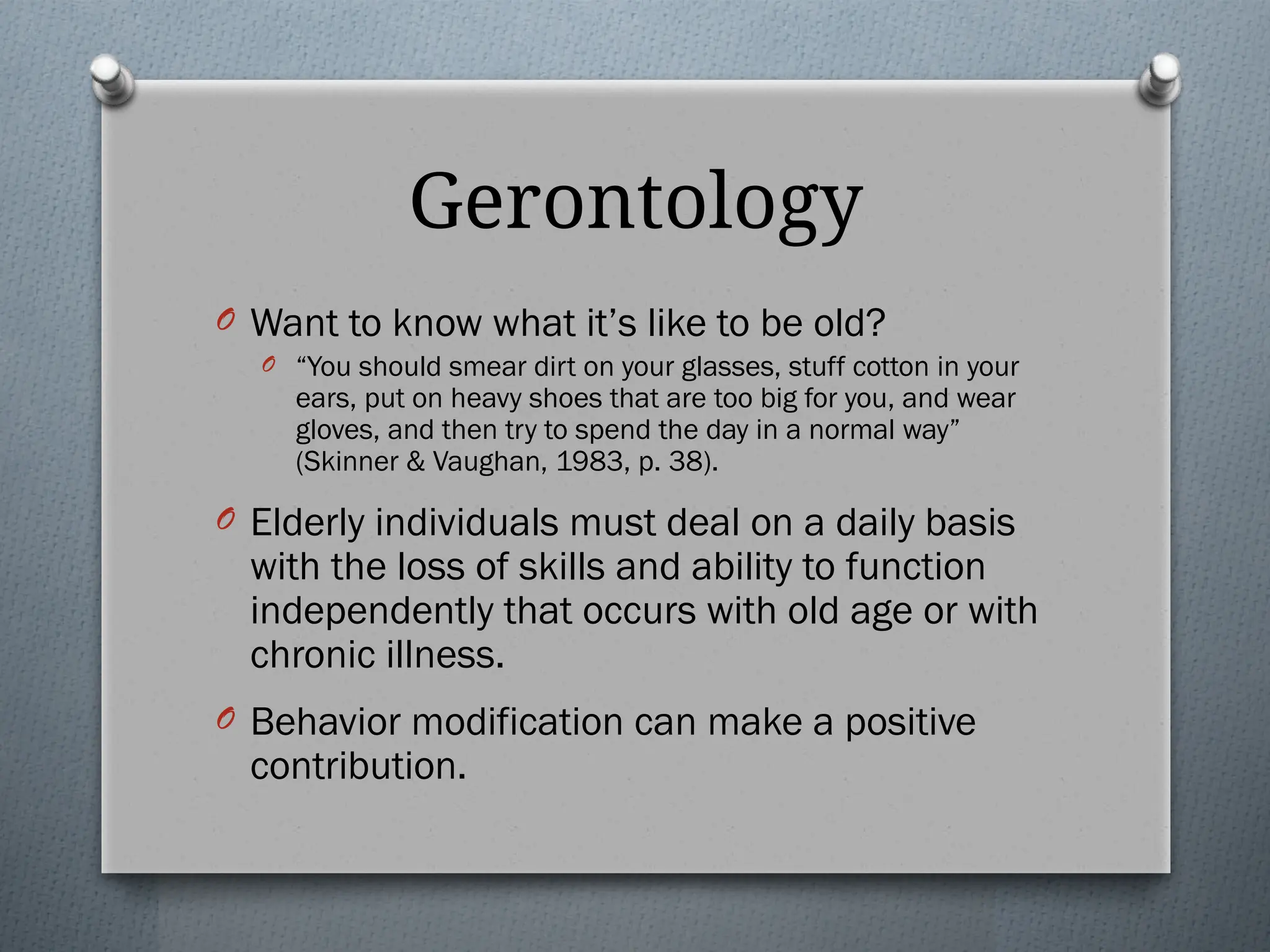
Gerontology
O Want to know what it’s like to be old?
O “You should smear dirt on your glasses, stuff cotton in your
ears, put on heavy shoes that are too big for you, and wear
gloves, and then try to spend the day in a normal way”
(Skinner & Vaughan, 1983, p. 38).
O Elderly individuals must deal on a daily basis
with the loss of skills and ability to function
independently that occurs with old age or with
chronic illness.
O Behavior modification can make a positive
contribution.
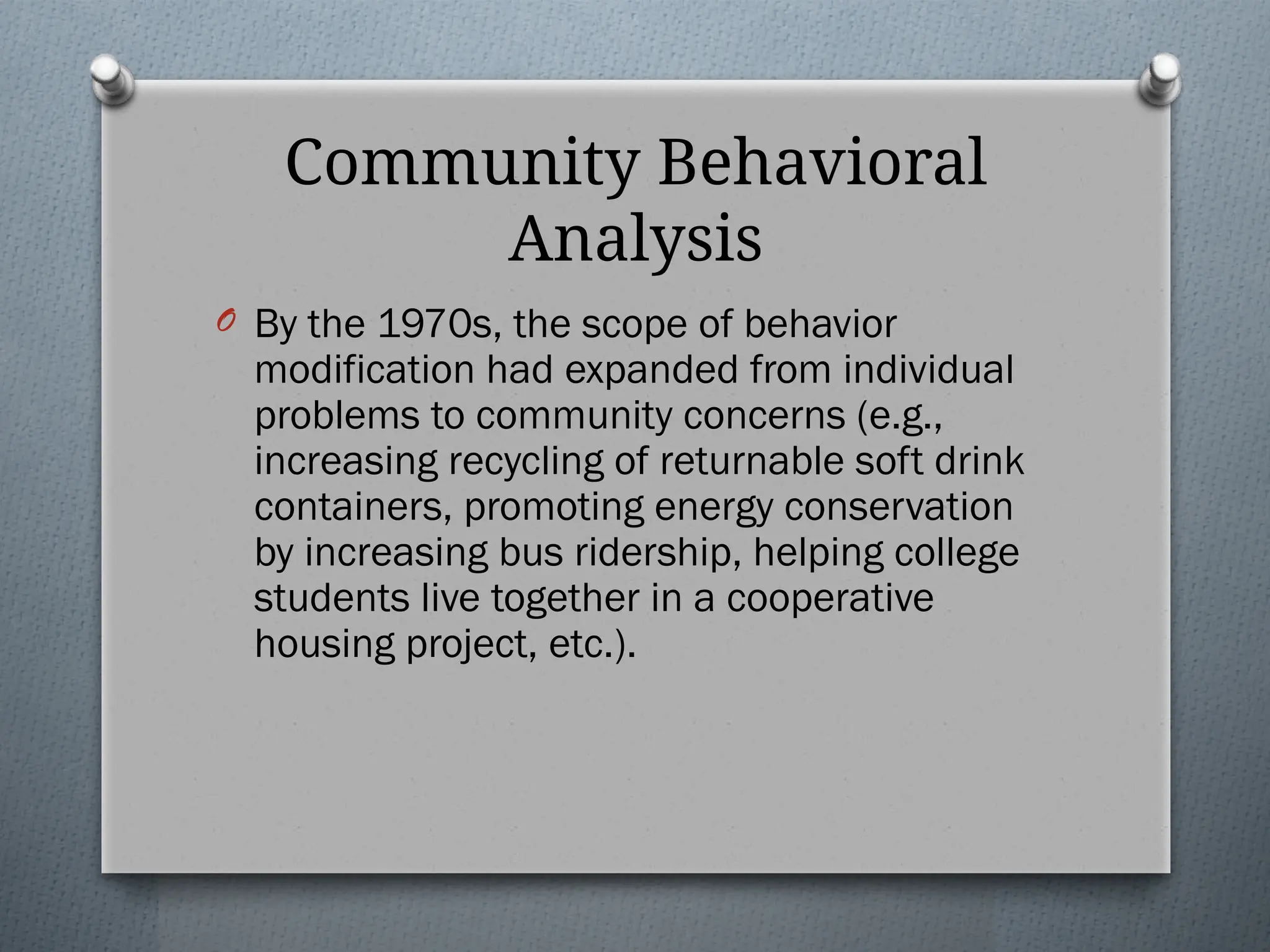
Community Behavioral
Analysis
O By the 1970s, the scope of behavior
modification had expanded from individual
problems to community concerns (e.g.,
increasing recycling of returnable soft drink
containers, promoting energy conservation
by increasing bus ridership, helping college
students live together in a cooperative
housing project, etc.).
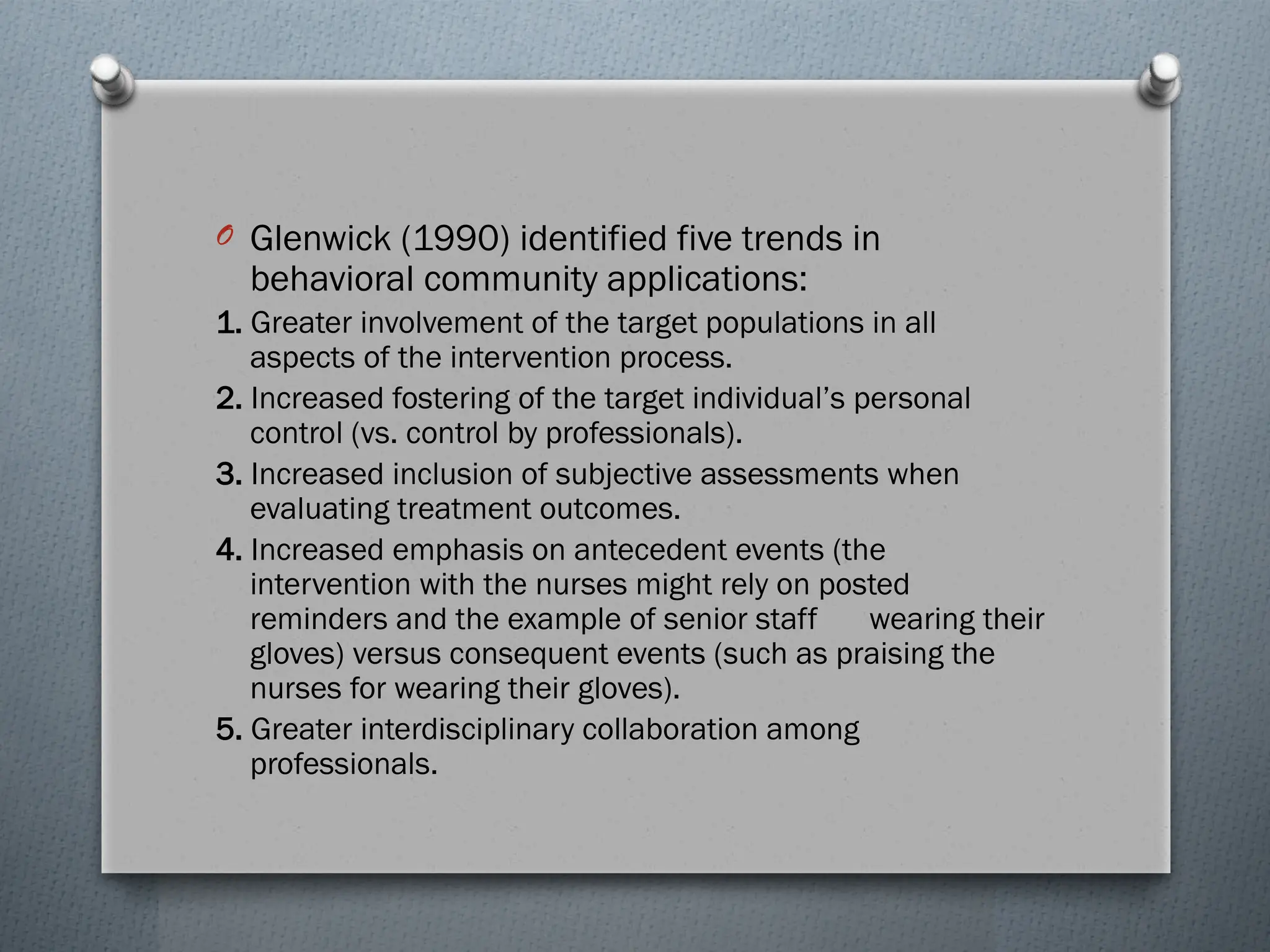
O Glenwick (1990) identified five trends in
behavioral community applications:
1. Greater involvement of the target populations in all
aspects of the intervention process.
2. Increased fostering of the target individual’s personal
control (vs. control by professionals).
3. Increased inclusion of subjective assessments when
evaluating treatment outcomes.
4. Increased emphasis on antecedent events (the
intervention with the nurses might rely on posted
reminders and the example of senior staff wearing their
gloves) versus consequent events (such as praising the
nurses for wearing their gloves).
5. Greater interdisciplinary collaboration among
professionals.
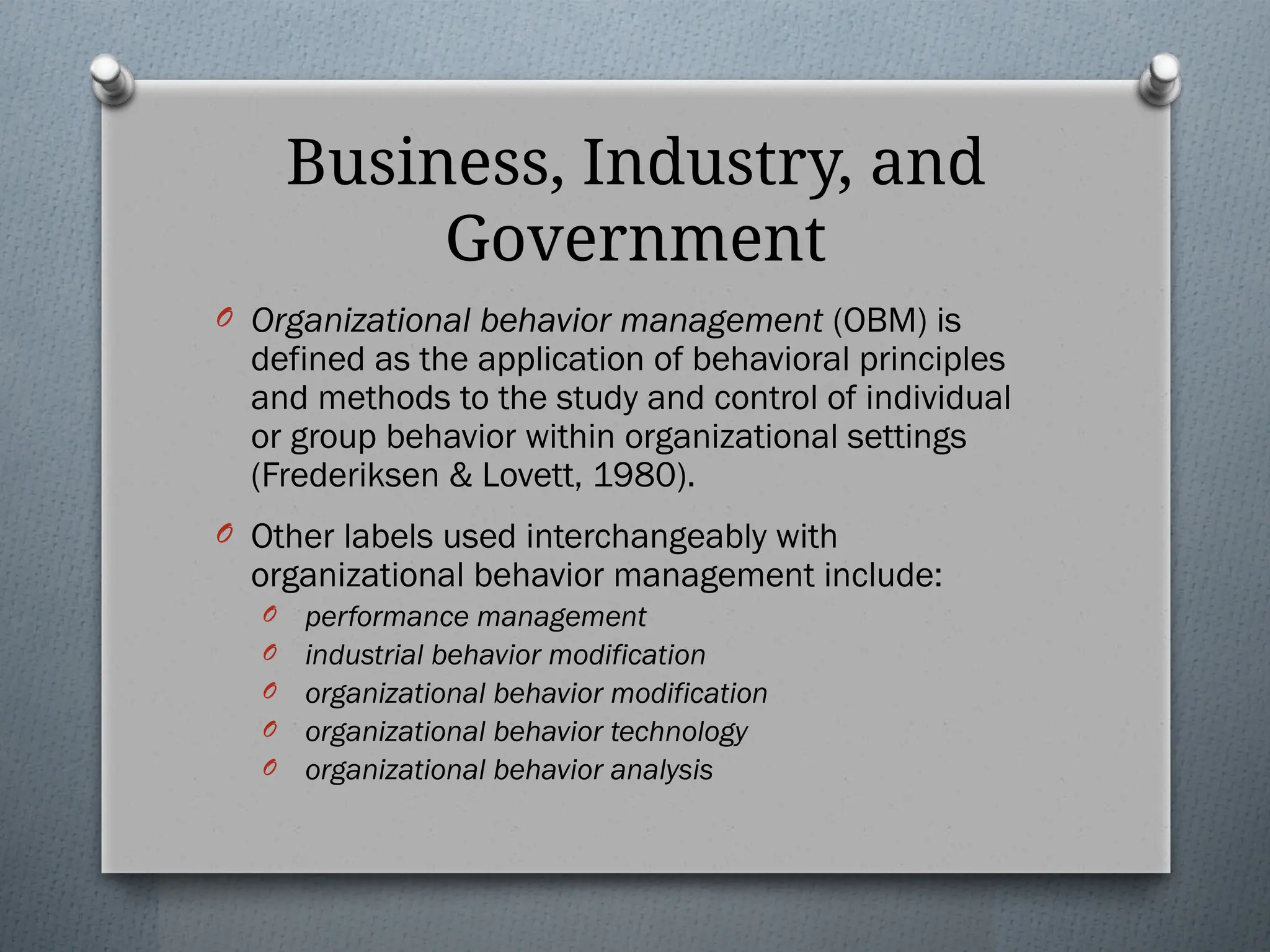
Business, Industry, and
Government
O Organizational behavior management (OBM) is
defined as the application of behavioral principles
and methods to the study and control of individual
or group behavior within organizational settings
(Frederiksen & Lovett, 1980).
O Other labels used interchangeably with
organizational behavior management include:
O performance management
O industrial behavior modification
O organizational behavior modification
O organizational behavior technology
O organizational behavior analysis
Sport Psychology
“Applied sport psychology involves the use of
psychological knowledge to enhance athletic
performance and the satisfaction of athletes and
others associated with sports” (Blimke, Gowan,
Patterson, & Wood, 1984).
O Techniques for Improving Skills of Athletes
O Strategies for Motivating Practice and Endurance
Training
O Changing the Behavior of Coaches
O “Sports Psyching” to Prepare for Competition
Looking Ahead
O Behavioral modification has been used both
with persons with profound handicaps and
with gifted students, for self-improvement,
and to preserve the environment in which
we live.
O Several thousand books have been
published concerning basic, applied, and
theoretical issues in behavior modification.
Thank-you 

Lecture 1- Applied Behavior Analysis.pptx

  • 1.
  • 2.
    There are twomajor areas of behavior analysis: experimental and applied. Experimental behavior analysis involves basic research designed to add to the body of knowledge about behavior. Applied behavior analysis, on the other hand, is focused on applying these behavior principles to real-world situations.
  • 3.
    O “Applied behavioranalysis is the science in which procedures derived from the principles of behavior are systematically applied to improve socially significant behavior to a meaningful degree and to demonstrate experimentally that the procedures employed were responsible for the improvement in behavior” (Cooper, Heron, Heward).
  • 4.
  • 5.
    Parenting and Child Management OBehavioral techniques have been applied to help parents more effectively teach their children to walk, develop initial language skills, provide effective toilet training, and influence their children to do household chores. O Behavioral strategies can decrease problem behaviors, such as nail biting, temper tantrums, aggressive behaviors, ignoring of rules, failure to comply with parents’ requests, and frequent arguing.
  • 6.
    Education: From Preschool toUniversity O Many applications in grade school were designed to change student behaviors that were disruptive or incompatible with academic learning. Out of seat behavior, tantrums, aggressive behavior, excessive socializing have been successfully dealt within classroom settings. O Other application have been concerned with modifying academic behavior directly including oral reading, reading comprehension, spelling, handwriting, mathematics, English composition, creativity and mastering science concepts.
  • 7.
    Personalized System ofInstruction (PSI) is a behavior modification approach to teaching (Keller, 1968). PSI (Keller Plan): 1. identifies the target behaviors or learning requirements for a course in the form of study questions 2. requires students to study only a small amount of material before demonstrating mastery 3. has frequent tests in which students demonstrate their knowledge of the answers to the study questions 4. has mastery criteria so that students must demonstrate mastery at a particular level before going on to the next level 5. is nonpunitive, in that students are not penalized for failing to demonstrate mastery on a test, but simply restudy and try again
  • 8.
    6. uses anumber of student assistants (called proctors) to score tests immediately and provide feedback to students concerning test performance 7. incorporates a “go-at-your-own-pace” feature in which students are allowed to proceed through the course material at rates that suit their own particular abilities and time demands 8. uses lectures primarily for motivation and demonstration, rather than as a major means of presenting new information
  • 9.
    Severe Problems: IntellectualDisabilities, Childhood Autism, & Schizophrenia Developmental Disabilities: O Developmental disabilities has replaced the term mental retardation among most professionals who treat this type of problem. Childhood Autism: O Children diagnosed with autism often show some behaviors similar to children diagnosed with developmental disabilities; however, they are also likely to show some combination of impaired social behavior, impaired communication, abnormal play behaviors, and repetitive self-stimulatory behaviors.
  • 10.
    Schizophrenia: O People withschizophrenia may hear voices other people don’t hear or they may believe that others are reading their minds, controlling their thoughts, or plotting to harm them. They may not make sense when they talk, may sit for hours without moving or talking much, or may seem perfectly fine until they talk about what they are really thinking.
  • 11.
    Clinical Behavior Therapy O Behavioraltreatment of such clinical problems as anxiety disorders, obsessive-compulsive disorders, stress-related problems, depression, obesity, marital problems, sexual dysfunction, and habit disorders has steadily increased since the 1970s. O How effective is behavior therapy with clinical populations? O Many studies have demonstrated that there are clear problem areas (e.g., phobias, obsessive-compulsive disorders) in which specific behavior therapy procedures are superior to existing psychotherapeutic alternatives. O In some cases, the treatment of choice may be a combination of behavior therapy and medical treatments (such as drugs).
  • 12.
    Self-Management of Personal Problems OMany people would like to change something about themselves. How about you? O A great deal of progress has been made in the area referred to as self-management, self-control, self- adjustment, self-modification, or self-direction. O Successful self-modification requires a set of skills that can be learned; these skills involve ways of rearranging your environment to control your behavior.
  • 13.
    Medical and HealthCare O Health psychology considers how psychological factors can influence or cause illness, and how people can be encouraged to practice healthy behavior so as to prevent health problems such as heart disease.
  • 14.
    Health psychologists haveapplied behavioral principles in five major areas: 1. Direct Treatment of Medical Problems 2. Establishing Treatment Compliance 3. Promotion of Healthy Living 4. Management of Caregivers 5. Stress Management
  • 15.
    Gerontology O Want toknow what it’s like to be old? O “You should smear dirt on your glasses, stuff cotton in your ears, put on heavy shoes that are too big for you, and wear gloves, and then try to spend the day in a normal way” (Skinner & Vaughan, 1983, p. 38). O Elderly individuals must deal on a daily basis with the loss of skills and ability to function independently that occurs with old age or with chronic illness. O Behavior modification can make a positive contribution.
  • 16.
    Community Behavioral Analysis O Bythe 1970s, the scope of behavior modification had expanded from individual problems to community concerns (e.g., increasing recycling of returnable soft drink containers, promoting energy conservation by increasing bus ridership, helping college students live together in a cooperative housing project, etc.).
  • 17.
    O Glenwick (1990)identified five trends in behavioral community applications: 1. Greater involvement of the target populations in all aspects of the intervention process. 2. Increased fostering of the target individual’s personal control (vs. control by professionals). 3. Increased inclusion of subjective assessments when evaluating treatment outcomes. 4. Increased emphasis on antecedent events (the intervention with the nurses might rely on posted reminders and the example of senior staff wearing their gloves) versus consequent events (such as praising the nurses for wearing their gloves). 5. Greater interdisciplinary collaboration among professionals.
  • 18.
    Business, Industry, and Government OOrganizational behavior management (OBM) is defined as the application of behavioral principles and methods to the study and control of individual or group behavior within organizational settings (Frederiksen & Lovett, 1980). O Other labels used interchangeably with organizational behavior management include: O performance management O industrial behavior modification O organizational behavior modification O organizational behavior technology O organizational behavior analysis
  • 19.
    Sport Psychology “Applied sportpsychology involves the use of psychological knowledge to enhance athletic performance and the satisfaction of athletes and others associated with sports” (Blimke, Gowan, Patterson, & Wood, 1984). O Techniques for Improving Skills of Athletes O Strategies for Motivating Practice and Endurance Training O Changing the Behavior of Coaches O “Sports Psyching” to Prepare for Competition
  • 20.
    Looking Ahead O Behavioralmodification has been used both with persons with profound handicaps and with gifted students, for self-improvement, and to preserve the environment in which we live. O Several thousand books have been published concerning basic, applied, and theoretical issues in behavior modification.
  • 21.