COGENERATION
Prepared by:
Engr. Marlon D. Mata, RMP
M.Eng’g-ME. Student
• All cycles previously discussed
has sole purpose of converting
a portion of heat to work.
• The remaining portion of heat is
rejected to the sink i.e.
atmosphere, lakes, oceans….
• Wasting a large amount of heat
is a price we have to pay to
produce work.
• Many Systems or devices;
however require energy input in
the form of heat called
PROCESS-HEAT.
INDUSTRIES THAT RELY HEAVILY
ON PROCESS HEAT
• CHEMICAL
• PULP AND PAPER
• OIL PRODUCTION AND
REFINING
• STEEL MAKING
• FOOD PROCESSING
• TEXTILE
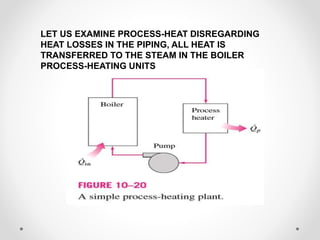
LET US EXAMINE PROCESS-HEAT DISREGARDING
HEAT LOSSES IN THE PIPING, ALL HEAT IS
TRANSFERRED TO THE STEAM IN THE BOILER
PROCESS-HEATING UNITS
• The temperature of the furnace of
fig.10-20 is equal 1400 deg.C. is
transferred to water as steam at
200 deg.C. Associated with
irreversibilities there is a loss of
work potential or destruction of
exergy.
• It is not wise to use high quality
energy if it can be accomplished
by low-quality energy.
• Industries that use a large amount of
process-heat consumes large amount of
electric power if it relies on electricity.
• It is economical to use the already
existing work potential instead of letting
it go to waste.
• The resulting Plant that produce power
and process-heat is called
COGENERATION PLANT.
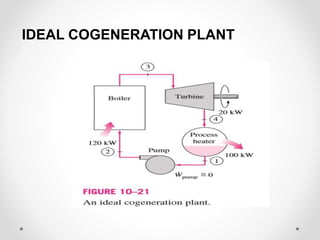
IDEAL COGENERATION PLANT
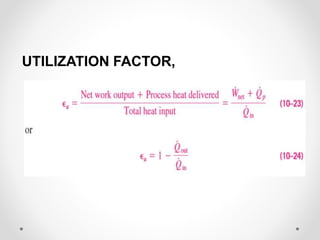
UTILIZATION FACTOR,
• THEN, We can conclude that a
cogeneration power plant is
equivalent to a process-heating
plant with a power plant that has a
thermal efficiency of 100%
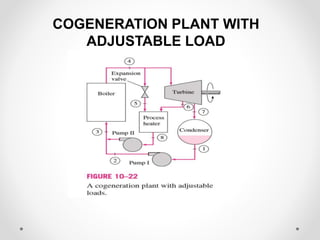
COGENERATION PLANT WITH
ADJUSTABLE LOAD
SAMPLE PROBLEM
Consider a cogeneration plant. Steam enters the
turbine at 7 MPa and 500°C. Some steam is
extracted from the turbine at 500 kPa for
process heating. The remaining steam
continues to expand to 5 kPa. Steam is then
condensed at constant pressure and pumped to
the boiler pressure of 7 MPa. At times of high
demand for process heat, some steam leaving
the boiler is throttled to 500 kPa and is routed to
the process heater. The extraction fractions are
adjusted so that steam leaves the process
heater as a saturated liquid at 500 kPa. It is
subsequently pumped to 7 MPa. The mass flow
rate of steam through the boiler is 15 kg/s.
• Disregarding any pressure drops and heat losses in
the piping and assuming the turbine and the pump to
be isentropic, determine
• (a) the maximum rate at which process heat can be
supplied,
• (b) the power produced and the utilization factor
when no process heat is supplied, and
• (c) the rate of process heat supply when 10 percent
of the steam is extracted before it enters the turbine
and 70 percent of the steam is extracted from the
turbine at 500 kPa for process heating.

Cogeneration

  • 1.
    COGENERATION Prepared by: Engr. MarlonD. Mata, RMP M.Eng’g-ME. Student
  • 2.
    • All cyclespreviously discussed has sole purpose of converting a portion of heat to work. • The remaining portion of heat is rejected to the sink i.e. atmosphere, lakes, oceans….
  • 3.
    • Wasting alarge amount of heat is a price we have to pay to produce work. • Many Systems or devices; however require energy input in the form of heat called PROCESS-HEAT.
  • 4.
    INDUSTRIES THAT RELYHEAVILY ON PROCESS HEAT • CHEMICAL • PULP AND PAPER • OIL PRODUCTION AND REFINING • STEEL MAKING • FOOD PROCESSING • TEXTILE
  • 5.
    LET US EXAMINEPROCESS-HEAT DISREGARDING HEAT LOSSES IN THE PIPING, ALL HEAT IS TRANSFERRED TO THE STEAM IN THE BOILER PROCESS-HEATING UNITS
  • 6.
    • The temperatureof the furnace of fig.10-20 is equal 1400 deg.C. is transferred to water as steam at 200 deg.C. Associated with irreversibilities there is a loss of work potential or destruction of exergy. • It is not wise to use high quality energy if it can be accomplished by low-quality energy.
  • 7.
    • Industries thatuse a large amount of process-heat consumes large amount of electric power if it relies on electricity. • It is economical to use the already existing work potential instead of letting it go to waste. • The resulting Plant that produce power and process-heat is called COGENERATION PLANT.
  • 8.
  • 9.
  • 10.
    • THEN, Wecan conclude that a cogeneration power plant is equivalent to a process-heating plant with a power plant that has a thermal efficiency of 100%
  • 11.
  • 12.
    SAMPLE PROBLEM Consider acogeneration plant. Steam enters the turbine at 7 MPa and 500°C. Some steam is extracted from the turbine at 500 kPa for process heating. The remaining steam continues to expand to 5 kPa. Steam is then condensed at constant pressure and pumped to the boiler pressure of 7 MPa. At times of high demand for process heat, some steam leaving the boiler is throttled to 500 kPa and is routed to the process heater. The extraction fractions are adjusted so that steam leaves the process heater as a saturated liquid at 500 kPa. It is subsequently pumped to 7 MPa. The mass flow rate of steam through the boiler is 15 kg/s.
  • 13.
    • Disregarding anypressure drops and heat losses in the piping and assuming the turbine and the pump to be isentropic, determine • (a) the maximum rate at which process heat can be supplied, • (b) the power produced and the utilization factor when no process heat is supplied, and • (c) the rate of process heat supply when 10 percent of the steam is extracted before it enters the turbine and 70 percent of the steam is extracted from the turbine at 500 kPa for process heating.