Overview of the regulation of
midwifery in Australia
Associate Professor Lynette Cusack
Chair, Nursing and Midwifery Board of Australia
Obstetric Malpractice Conference, Melbourne
9 August 2017
• The NMBA - who we are and what we do
• Midwifery in numbers
• Professional requirements
– National Law obligations
– Registration standards
– Standards for practice, Codes and Guidelines
• Questions
2
Overview
What does that mean?
3
Women place their trust in
midwives
The NMBA exists to make sure standards
and practice meet that trust
What we do
• set evidence-based, contemporary standards,
codes and guidelines for nurses and midwives to
practice safely
• take action on behalf of women, colleagues,
managers who raise a concern about standards
of care
• approve accreditation standards and accredited
programs of study
4
5
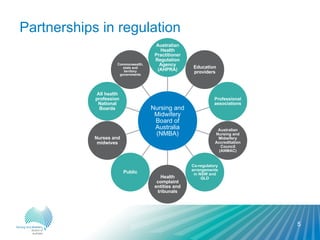
Partnerships in regulation
Nursing and
Midwifery
Board of
Australia
(NMBA)
Australian
Health
Practitioner
Regulation
Agency
(AHPRA)
Education
providers
Professional
associations
Australian
Nursing and
Midwifery
Accreditation
Council
(ANMAC)
Co-regulatory
arrangements
in NSW and
QLDHealth
complaint
entities and
tribunals
Public
Nurses and
midwives
All health
profession
National
Boards
Commonwealth,
state and
territory
governments
Midwifery in numbers
6
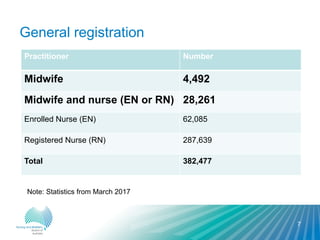
General registration
Practitioner Number
Midwife 4,492
Midwife and nurse (EN or RN) 28,261
Enrolled Nurse (EN) 62,085
Registered Nurse (RN) 287,639
Total 382,477
7
Note: Statistics from March 2017
Change in midwifery numbers
Practitioner March
2013
March
2014
March
2015
March
2016
March
2017
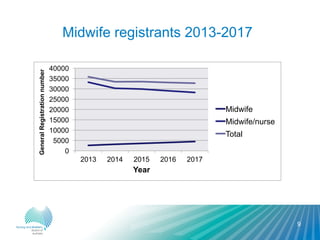
Midwife 2629 3158 3587 4008 4,492
Midwife and nurse
(EN or RN)
33,219 30,278 29,903 29,052 28,261
Total 35,848 33,436 33,490 33,060 32,753
8
Midwife registrants 2013-2017
9
0
5000
10000
15000
20000
25000
30000
35000
40000
2013 2014 2015 2016 2017
GeneralRegistrationnumber
Year
Midwife
Midwife/nurse
Total
Endorsed/notated midwives since 2013
10
0
50
100
150
200
250
300
350
2013 2014 2015 2016 2017
Numberofmidwives
Year
Endorsed
Notated
11
Midwife notifications
Professional requirements
12
Professional requirements under the National
Scheme
13
Professional
practice
Registration
standards
Obligations
under the
National Law
Standards for
Practice,
Codes and
Guidelines
Protection of the
public
Safe and competent
practice
Registration standards
14
Registration standards
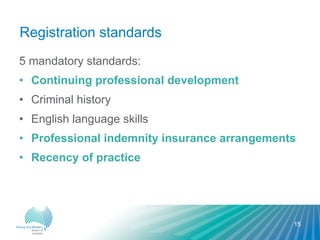
5 mandatory standards:
• Continuing professional development
• Criminal history
• English language skills
• Professional indemnity insurance arrangements
• Recency of practice
15
Continuing professional development
16
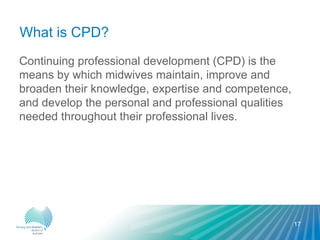
What is CPD?
Continuing professional development (CPD) is the
means by which midwives maintain, improve and
broaden their knowledge, expertise and competence,
and develop the personal and professional qualities
needed throughout their professional lives.
17
Key points
• Applies to ALL generally registered midwives even
those not working
• Required to complete a minimum of 20 hours of
CPD per registration period relevant to your
context of practice as a midwife
• CPD should be ‘new learning’
• Midwife with scheduled medicines endorsement 30
hours
18
Recency of practice
19
What is recency of practice?
Recency of practice means that a midwife has
maintained an adequate connection with, and recent
practice in midwifery since qualifying for, or obtaining
registration.
20
What is practice
• Broad definition
• Remunerated or not
• Skills and knowledge as a nurse and/or midwife
• Not only direct clinical care
• Includes non-clinical - management, administration,
education, research, advisory, regulatory or policy
development roles.
21
Key points
• Midwives must be able to provide evidence that
they have practised for a period equivalent to a
minimum of 450 hours of practice within the past
five years.
• Recency of practice also applies to midwives with
an endorsement.
• Midwives can use non-clinical practice to meet
recency requirements
• Must be able to show adequate connection with,
and recent practice in midwifery
22
Professional indemnity insurance
23
Key points
• Make sure that midwives have PII arrangements in
place which provide adequate and appropriate cover
for all aspects of your practice
• Section 284 exemption applies to home birth
– Informed consent (that PII not in place for home birth)
– Private midwifery defined as attending a home birth
– Compliance with a code or guideline developed by the
NMBA
24
Midwife standards for practice
25
What will the standards be used for?
• communicate to the general public the standards that
can be expected of midwives
• determine the eligibility for registration of people who
have completed a midwifery program of study in
Australia
• determine the eligibility for registration of midwives
who wish to practise in Australia but have completed
courses elsewhere
• assess midwives who wish to return to work after being
out of the workforce for a defined period, and
• assess midwives who need to show that they are
competent to practise
26
Midwife standards for practice (draft)
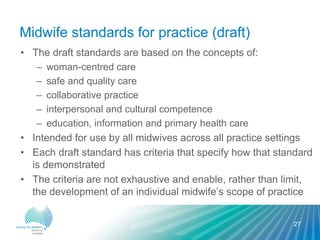
• The draft standards are based on the concepts of:
– woman-centred care
– safe and quality care
– collaborative practice
– interpersonal and cultural competence
– education, information and primary health care
• Intended for use by all midwives across all practice settings
• Each draft standard has criteria that specify how that standard
is demonstrated
• The criteria are not exhaustive and enable, rather than limit,
the development of an individual midwife’s scope of practice
27
Key codes and guidelines
• Codes of ethics
• Decision-making framework
• Safety and quality guidelines for privately practising
midwives
• Codes of conduct
28
Codes of conduct
29
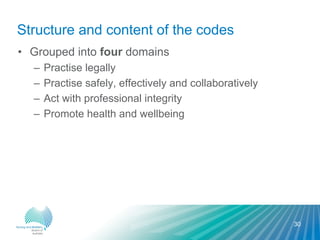
• Grouped into four domains
– Practise legally
– Practise safely, effectively and collaboratively
– Act with professional integrity
– Promote health and wellbeing
30
Structure and content of the codes
• Framed around seven principles of conduct with
explanatory value statements
– Legal compliance
– Women centred practice
– Cultural practice and respectful relationships
– Professional behaviour
– Teaching, supervising and assessing
– Research in health
– Promote health and wellbeing
31
Structure and content of the codes (continued)
32
• a confidential service, independent of the NMBA
and AHPRA
• offers advice and referral on health issues to
nurses, midwives and students
• offers information and support for employers,
education providers and concerned others
• phone support available 24/7 nationally
www.nmsupport.org.au 1800 667 877
Where can I find more information?
33
www.nursingmidwiferyboard.gov.au
• presentations and videos available online
• consultations
• regular NMBA newsletters

Lynette Cusack, Tanya Vogt

  • 1.
    Overview of theregulation of midwifery in Australia Associate Professor Lynette Cusack Chair, Nursing and Midwifery Board of Australia Obstetric Malpractice Conference, Melbourne 9 August 2017
  • 2.
    • The NMBA- who we are and what we do • Midwifery in numbers • Professional requirements – National Law obligations – Registration standards – Standards for practice, Codes and Guidelines • Questions 2 Overview
  • 3.
    What does thatmean? 3 Women place their trust in midwives The NMBA exists to make sure standards and practice meet that trust
  • 4.
    What we do •set evidence-based, contemporary standards, codes and guidelines for nurses and midwives to practice safely • take action on behalf of women, colleagues, managers who raise a concern about standards of care • approve accreditation standards and accredited programs of study 4
  • 5.
    5 Partnerships in regulation Nursingand Midwifery Board of Australia (NMBA) Australian Health Practitioner Regulation Agency (AHPRA) Education providers Professional associations Australian Nursing and Midwifery Accreditation Council (ANMAC) Co-regulatory arrangements in NSW and QLDHealth complaint entities and tribunals Public Nurses and midwives All health profession National Boards Commonwealth, state and territory governments
  • 6.
  • 7.
    General registration Practitioner Number Midwife4,492 Midwife and nurse (EN or RN) 28,261 Enrolled Nurse (EN) 62,085 Registered Nurse (RN) 287,639 Total 382,477 7 Note: Statistics from March 2017
  • 8.
    Change in midwiferynumbers Practitioner March 2013 March 2014 March 2015 March 2016 March 2017 Midwife 2629 3158 3587 4008 4,492 Midwife and nurse (EN or RN) 33,219 30,278 29,903 29,052 28,261 Total 35,848 33,436 33,490 33,060 32,753 8
  • 9.
    Midwife registrants 2013-2017 9 0 5000 10000 15000 20000 25000 30000 35000 40000 20132014 2015 2016 2017 GeneralRegistrationnumber Year Midwife Midwife/nurse Total
  • 10.
    Endorsed/notated midwives since2013 10 0 50 100 150 200 250 300 350 2013 2014 2015 2016 2017 Numberofmidwives Year Endorsed Notated
  • 11.
  • 12.
  • 13.
    Professional requirements underthe National Scheme 13 Professional practice Registration standards Obligations under the National Law Standards for Practice, Codes and Guidelines Protection of the public Safe and competent practice
  • 14.
  • 15.
    Registration standards 5 mandatorystandards: • Continuing professional development • Criminal history • English language skills • Professional indemnity insurance arrangements • Recency of practice 15
  • 16.
  • 17.
    What is CPD? Continuingprofessional development (CPD) is the means by which midwives maintain, improve and broaden their knowledge, expertise and competence, and develop the personal and professional qualities needed throughout their professional lives. 17
  • 18.
    Key points • Appliesto ALL generally registered midwives even those not working • Required to complete a minimum of 20 hours of CPD per registration period relevant to your context of practice as a midwife • CPD should be ‘new learning’ • Midwife with scheduled medicines endorsement 30 hours 18
  • 19.
  • 20.
    What is recencyof practice? Recency of practice means that a midwife has maintained an adequate connection with, and recent practice in midwifery since qualifying for, or obtaining registration. 20
  • 21.
    What is practice •Broad definition • Remunerated or not • Skills and knowledge as a nurse and/or midwife • Not only direct clinical care • Includes non-clinical - management, administration, education, research, advisory, regulatory or policy development roles. 21
  • 22.
    Key points • Midwivesmust be able to provide evidence that they have practised for a period equivalent to a minimum of 450 hours of practice within the past five years. • Recency of practice also applies to midwives with an endorsement. • Midwives can use non-clinical practice to meet recency requirements • Must be able to show adequate connection with, and recent practice in midwifery 22
  • 23.
  • 24.
    Key points • Makesure that midwives have PII arrangements in place which provide adequate and appropriate cover for all aspects of your practice • Section 284 exemption applies to home birth – Informed consent (that PII not in place for home birth) – Private midwifery defined as attending a home birth – Compliance with a code or guideline developed by the NMBA 24
  • 25.
  • 26.
    What will thestandards be used for? • communicate to the general public the standards that can be expected of midwives • determine the eligibility for registration of people who have completed a midwifery program of study in Australia • determine the eligibility for registration of midwives who wish to practise in Australia but have completed courses elsewhere • assess midwives who wish to return to work after being out of the workforce for a defined period, and • assess midwives who need to show that they are competent to practise 26
  • 27.
    Midwife standards forpractice (draft) • The draft standards are based on the concepts of: – woman-centred care – safe and quality care – collaborative practice – interpersonal and cultural competence – education, information and primary health care • Intended for use by all midwives across all practice settings • Each draft standard has criteria that specify how that standard is demonstrated • The criteria are not exhaustive and enable, rather than limit, the development of an individual midwife’s scope of practice 27
  • 28.
    Key codes andguidelines • Codes of ethics • Decision-making framework • Safety and quality guidelines for privately practising midwives • Codes of conduct 28
  • 29.
  • 30.
    • Grouped intofour domains – Practise legally – Practise safely, effectively and collaboratively – Act with professional integrity – Promote health and wellbeing 30 Structure and content of the codes
  • 31.
    • Framed aroundseven principles of conduct with explanatory value statements – Legal compliance – Women centred practice – Cultural practice and respectful relationships – Professional behaviour – Teaching, supervising and assessing – Research in health – Promote health and wellbeing 31 Structure and content of the codes (continued)
  • 32.
    32 • a confidentialservice, independent of the NMBA and AHPRA • offers advice and referral on health issues to nurses, midwives and students • offers information and support for employers, education providers and concerned others • phone support available 24/7 nationally www.nmsupport.org.au 1800 667 877
  • 33.
    Where can Ifind more information? 33 www.nursingmidwiferyboard.gov.au • presentations and videos available online • consultations • regular NMBA newsletters