PRESENTED BY,
RISHAV RAY,
MSc II SEM-3rd,
DEPARTMENT OF
ENVIRONMENTAL STUDIES,
VISVA BHARATI, SANTINIKETAN
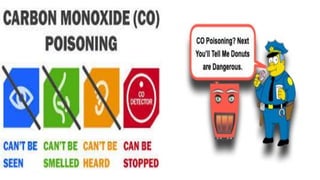
•It is a colorless, odorless, and tasteless flammable gas that is
slightly less dense than air.
• Consists of one carbon atom and one oxygen atom,
connected by a triple bond containing 2 covalent bonds &
1 dative covalent bond
•Along with aldehydes, part of the series of chemical
reactions that form photochemical smog
•It is the second-most common molecule in the interstellar
medium, after hydrogen.
•Primary air pollutant
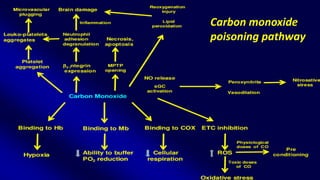
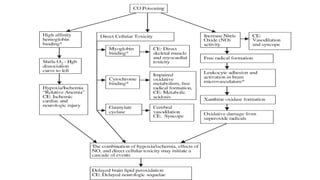
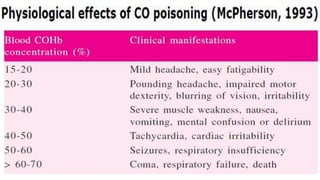
Carbon monoxide
poisoning pathway
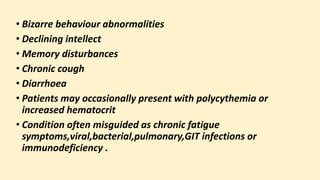
• Bizarre behaviour abnormalities
• Declining intellect
• Memory disturbances
• Chronic cough
• Diarrhoea
• Patients may occasionally present with polycythemia or
increased hematocrit
• Condition often misguided as chronic fatigue
symptoms,viral,bacterial,pulmonary,GIT infections or
immunodeficiency .
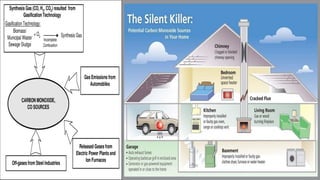
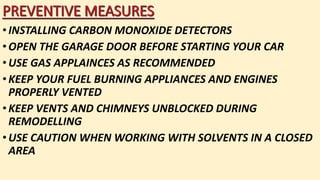
•INSTALLING CARBON MONOXIDE DETECTORS
•OPEN THE GARAGE DOOR BEFORE STARTING YOUR CAR
•USE GAS APPLAINCES AS RECOMMENDED
•KEEP YOUR FUEL BURNING APPLIANCES AND ENGINES
PROPERLY VENTED
•KEEP VENTS AND CHIMNEYS UNBLOCKED DURING
REMODELLING
•USE CAUTION WHEN WORKING WITH SOLVENTS IN A CLOSED
AREA
• Health, National Center for Environmental (30 December 2015). "Carbon
Monoxide Poisoning – Frequently Asked QuestionS". www.cdc.gov.from the
original on 5 July 2017. Retrieved 2 July 2017.
• Penney, David G. (2007). Carbon Monoxide Poisoning. CRC Press.
p. 569. ISBN 978-0849384189. Archived from the original on 10 September
2017. Retrieved 2 July 2017.
• Omaye ST (Nov 2002). "Metabolic modulation of carbon monoxide
toxicity". Toxicology. 180 (2): 139–50.
• Kao LW, Nañagas KA (March 2006). "Toxicity associated with carbon
monoxide". Clinics in Laboratory Medicine. 26 (1): 99–
125. doi:10.1016/j.cll.2006.01.005. PMID 16567227
• Ducasse JL, Celsis P, Marc-Vergnes JP (March 1995). "Non-comatose patients
with acute carbon monoxide poisoning: hyperbaric or normobaric oxygenation
Co toxicity by rishav

Co toxicity by rishav

  • 1.
    PRESENTED BY, RISHAV RAY, MScII SEM-3rd, DEPARTMENT OF ENVIRONMENTAL STUDIES, VISVA BHARATI, SANTINIKETAN
  • 2.
    •It is acolorless, odorless, and tasteless flammable gas that is slightly less dense than air. • Consists of one carbon atom and one oxygen atom, connected by a triple bond containing 2 covalent bonds & 1 dative covalent bond •Along with aldehydes, part of the series of chemical reactions that form photochemical smog •It is the second-most common molecule in the interstellar medium, after hydrogen. •Primary air pollutant
  • 4.
  • 9.
    • Bizarre behaviourabnormalities • Declining intellect • Memory disturbances • Chronic cough • Diarrhoea • Patients may occasionally present with polycythemia or increased hematocrit • Condition often misguided as chronic fatigue symptoms,viral,bacterial,pulmonary,GIT infections or immunodeficiency .
  • 10.
    •INSTALLING CARBON MONOXIDEDETECTORS •OPEN THE GARAGE DOOR BEFORE STARTING YOUR CAR •USE GAS APPLAINCES AS RECOMMENDED •KEEP YOUR FUEL BURNING APPLIANCES AND ENGINES PROPERLY VENTED •KEEP VENTS AND CHIMNEYS UNBLOCKED DURING REMODELLING •USE CAUTION WHEN WORKING WITH SOLVENTS IN A CLOSED AREA
  • 11.
    • Health, NationalCenter for Environmental (30 December 2015). "Carbon Monoxide Poisoning – Frequently Asked QuestionS". www.cdc.gov.from the original on 5 July 2017. Retrieved 2 July 2017. • Penney, David G. (2007). Carbon Monoxide Poisoning. CRC Press. p. 569. ISBN 978-0849384189. Archived from the original on 10 September 2017. Retrieved 2 July 2017. • Omaye ST (Nov 2002). "Metabolic modulation of carbon monoxide toxicity". Toxicology. 180 (2): 139–50. • Kao LW, Nañagas KA (March 2006). "Toxicity associated with carbon monoxide". Clinics in Laboratory Medicine. 26 (1): 99– 125. doi:10.1016/j.cll.2006.01.005. PMID 16567227 • Ducasse JL, Celsis P, Marc-Vergnes JP (March 1995). "Non-comatose patients with acute carbon monoxide poisoning: hyperbaric or normobaric oxygenation