Teaching blended learning through a
blended community of inquiry
A course for faculty in Sweden
M. Cleveland-Innes, Ph.D.
S. Stenbom, PhD candidate
Session Objective
Foster a community of inquiry
to review creating a community of inquiry
about creating a community of inquiry in a
blended higher education environment.
Agenda
Introduction exercise
(SP – open communication and affective expression)
Objectives review
(TP – design and organization)
Presentation
(TP – direct instruction)
Questions to the audience
(CP – trigger event, exploration, integration, resolution)
Questions from the audience
(TP – facilitation)
Door prize draw
(SP – group cohesion)
KTH Royal Institute of Technology, Sweden
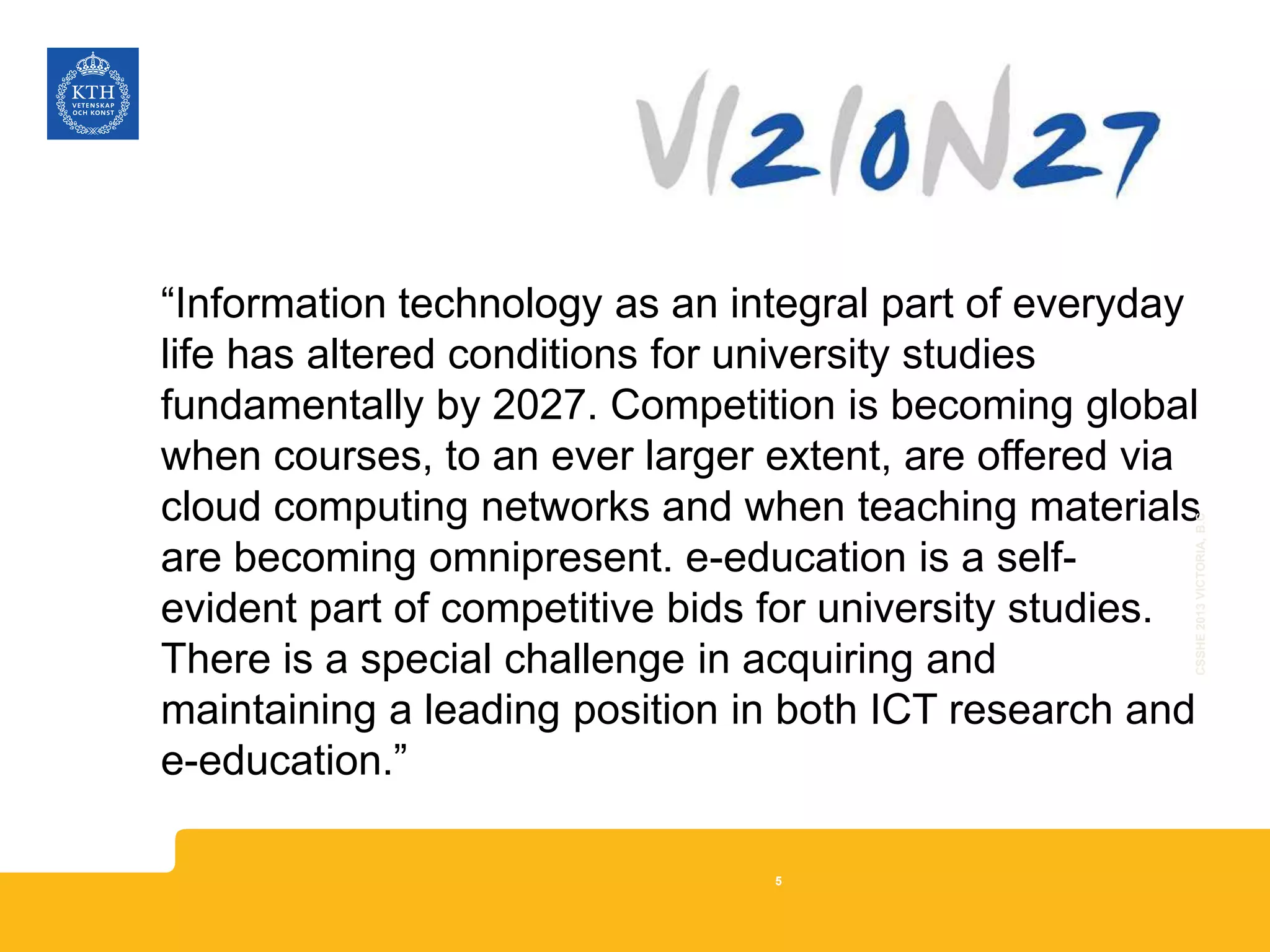
“Information technology as an integral part of everyday
life has altered conditions for university studies
fundamentally by 2027. Competition is becoming global
when courses, to an ever larger extent, are offered via
cloud computing networks and when teaching materials
are becoming omnipresent. e-education is a self-
evident part of competitive bids for university studies.
There is a special challenge in acquiring and
maintaining a leading position in both ICT research and
e-education.”
CSSHE2013VICTORIA,B.C
5
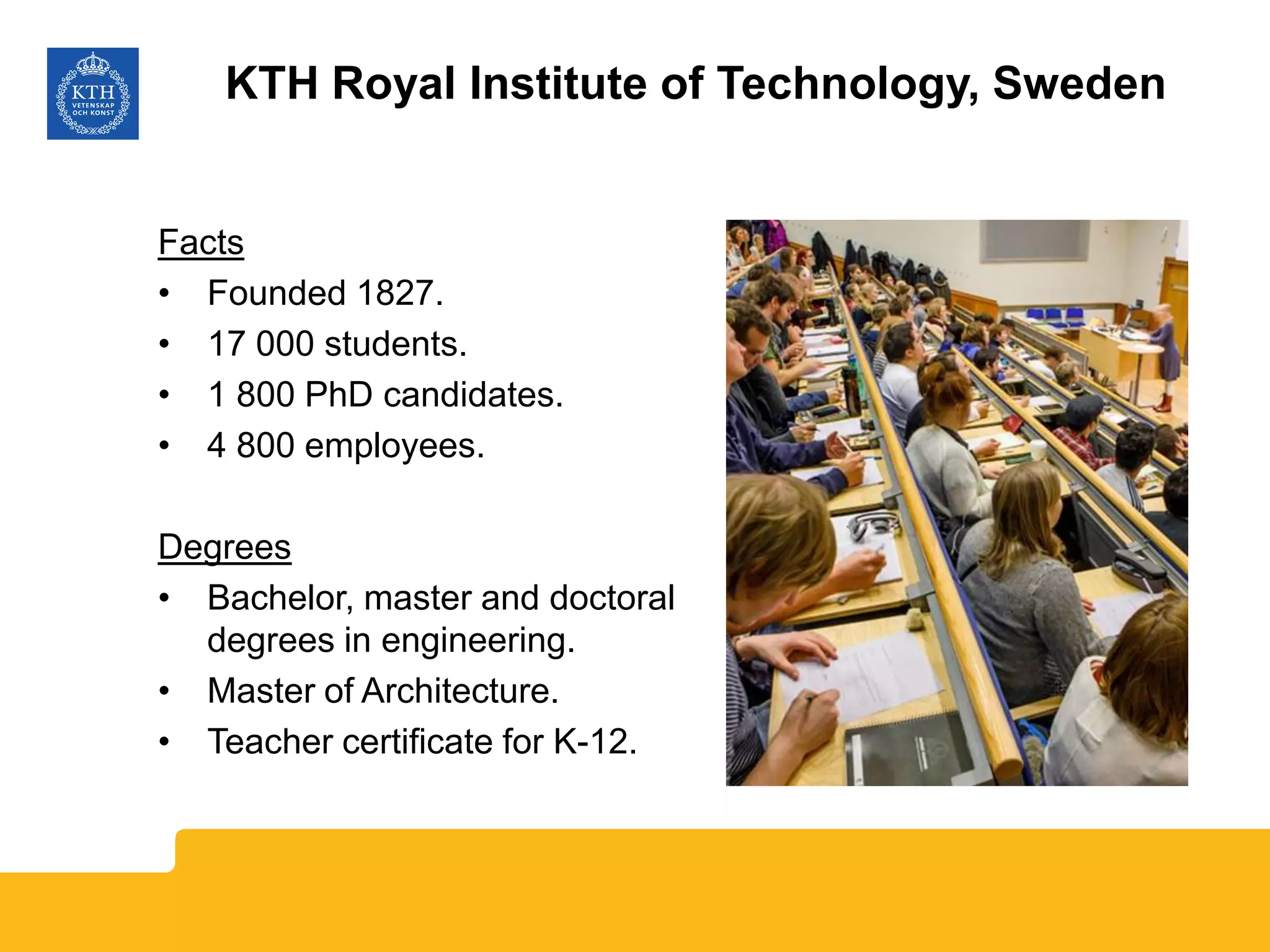
Facts
• Founded 1827.
• 17 000 students.
• 1 800 PhD candidates.
• 4 800 employees.
Degrees
• Bachelor, master and doctoral
degrees in engineering.
• Master of Architecture.
• Teacher certificate for K-12.
KTH Royal Institute of Technology, Sweden
In order to be appointed as associate
professor (or full professor) at KTH
one must have 10 weeks of courses in
Teaching and Learning in Higher
education.
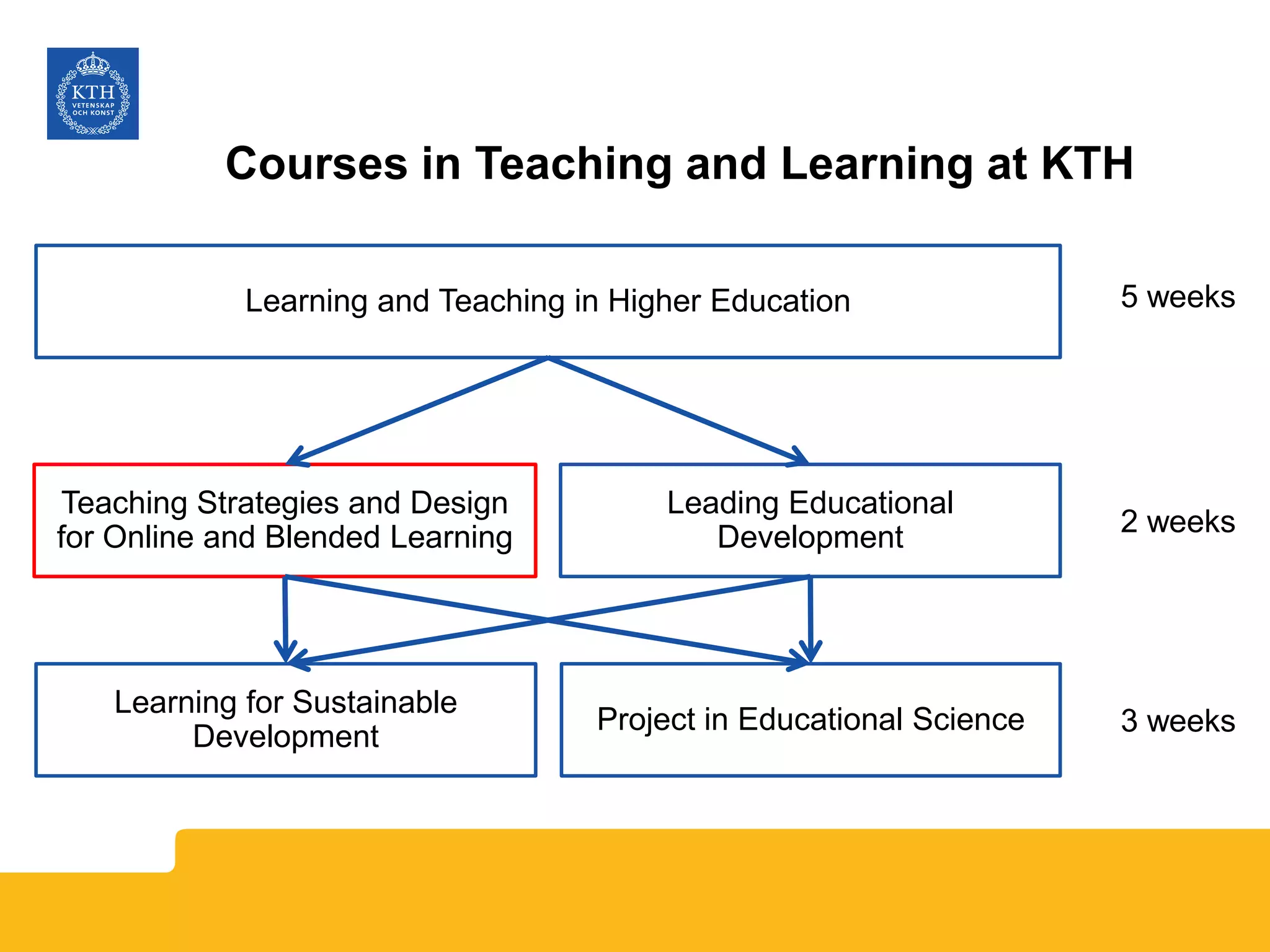
Courses in Teaching and Learning at KTH
Learning and Teaching in Higher Education
Teaching Strategies and Design
for Online and Blended Learning
Leading Educational
Development
Learning for Sustainable
Development
Project in Educational Science
5 weeks
2 weeks
3 weeks
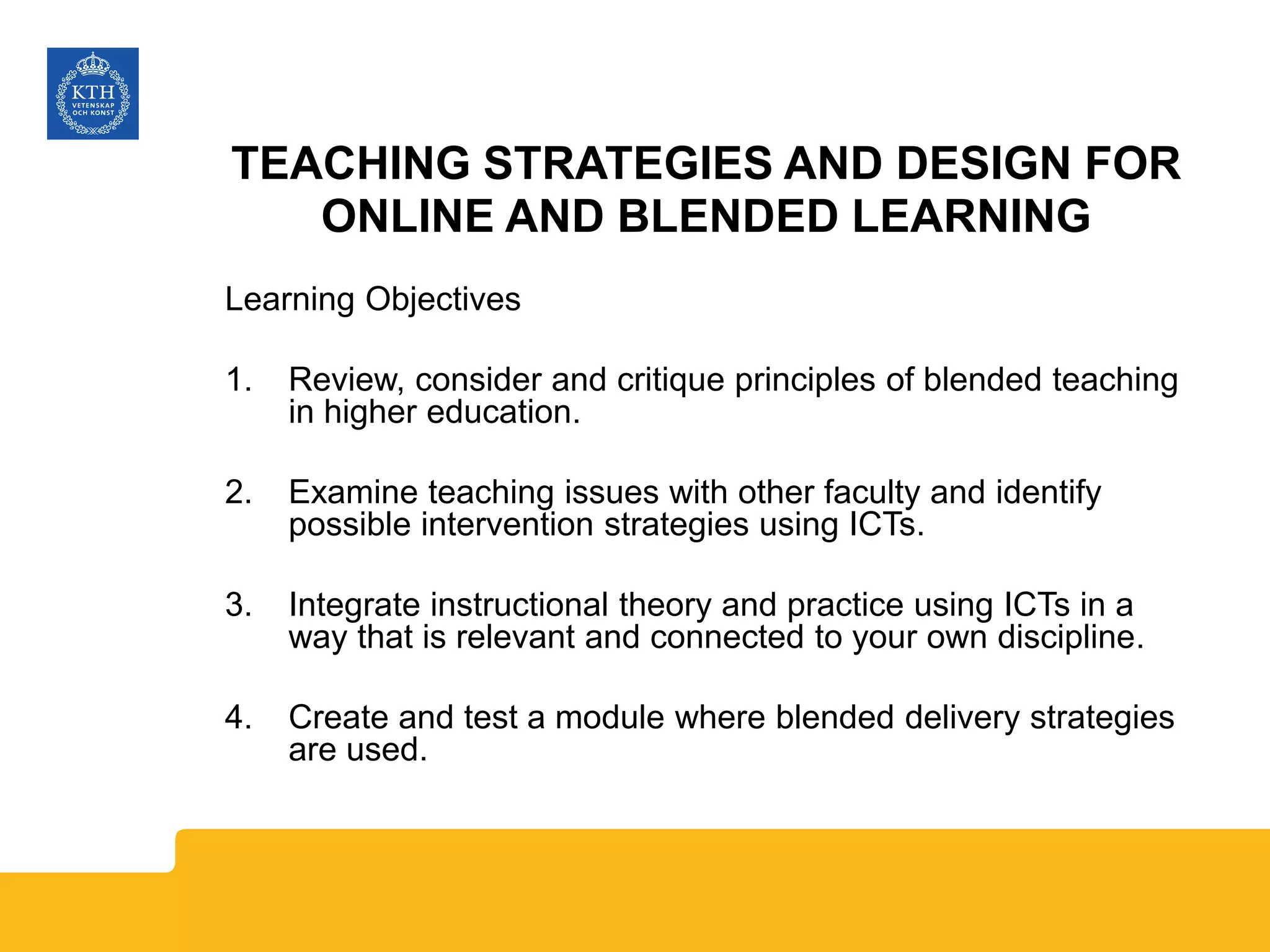
TEACHING STRATEGIES AND DESIGN FOR
ONLINE AND BLENDED LEARNING
Learning Objectives
1. Review, consider and critique principles of blended teaching
in higher education.
2. Examine teaching issues with other faculty and identify
possible intervention strategies using ICTs.
3. Integrate instructional theory and practice using ICTs in a
way that is relevant and connected to your own discipline.
4. Create and test a module where blended delivery strategies
are used.
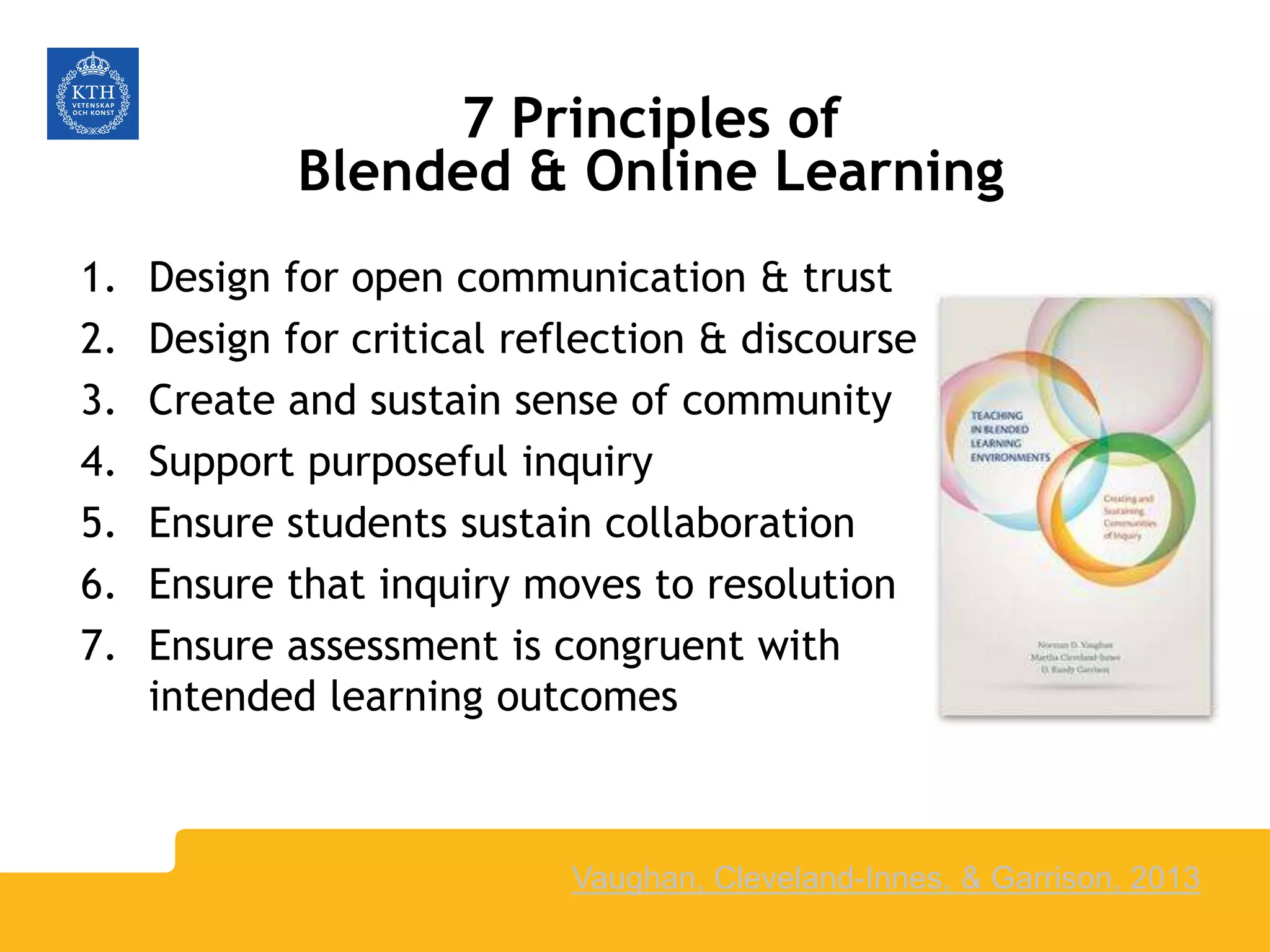
7 Principles of
Blended & Online Learning
1. Design for open communication & trust
2. Design for critical reflection & discourse
3. Create and sustain sense of community
4. Support purposeful inquiry
5. Ensure students sustain collaboration
6. Ensure that inquiry moves to resolution
7. Ensure assessment is congruent with
intended learning outcomes
Vaughan, Cleveland-Innes, & Garrison, 2013
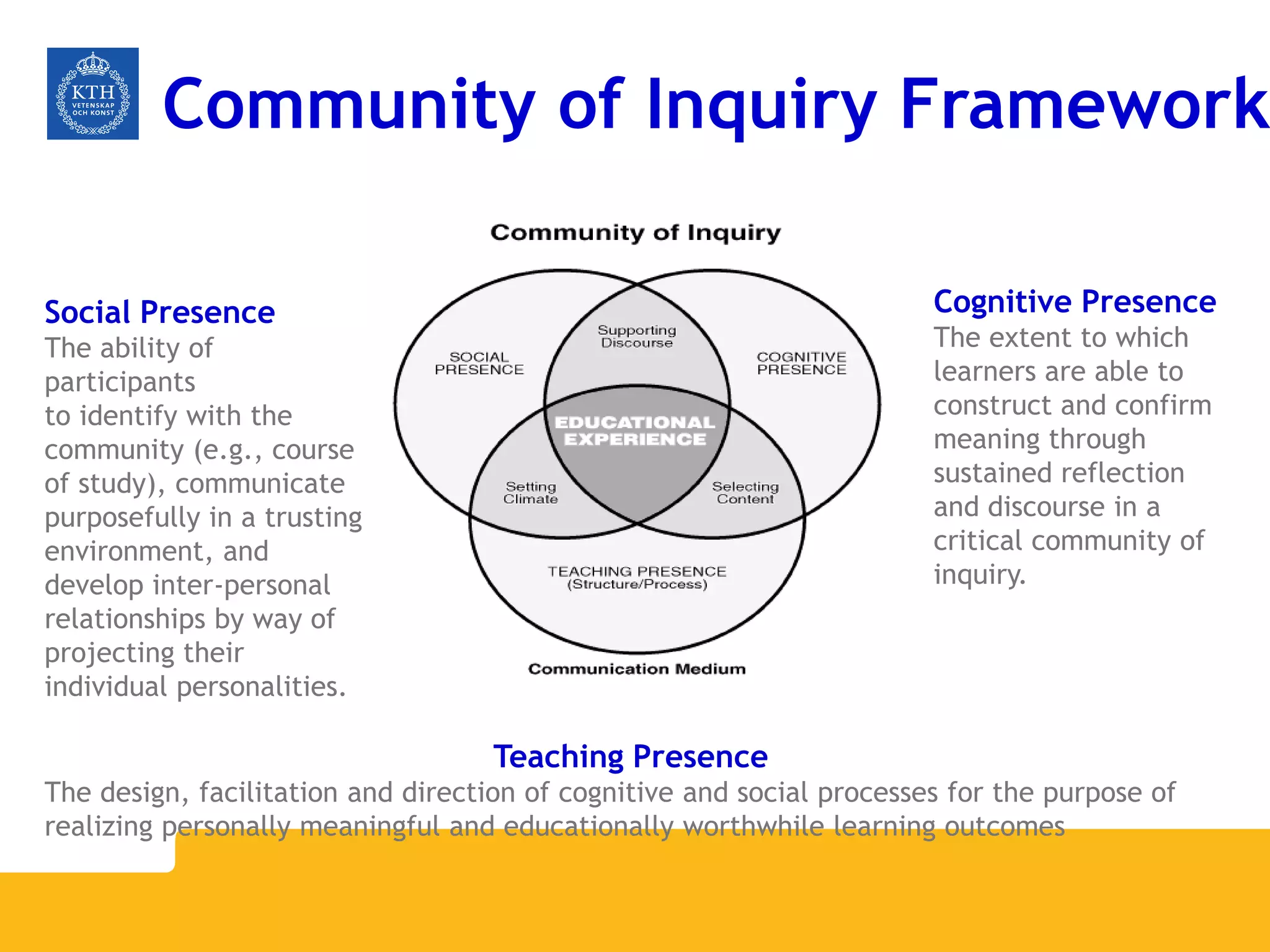
Community of Inquiry Framework
Social Presence
The ability of
participants
to identify with the
community (e.g., course
of study), communicate
purposefully in a trusting
environment, and
develop inter-personal
relationships by way of
projecting their
individual personalities.
Cognitive Presence
The extent to which
learners are able to
construct and confirm
meaning through
sustained reflection
and discourse in a
critical community of
inquiry.
Teaching Presence
The design, facilitation and direction of cognitive and social processes for the purpose of
realizing personally meaningful and educationally worthwhile learning outcomes
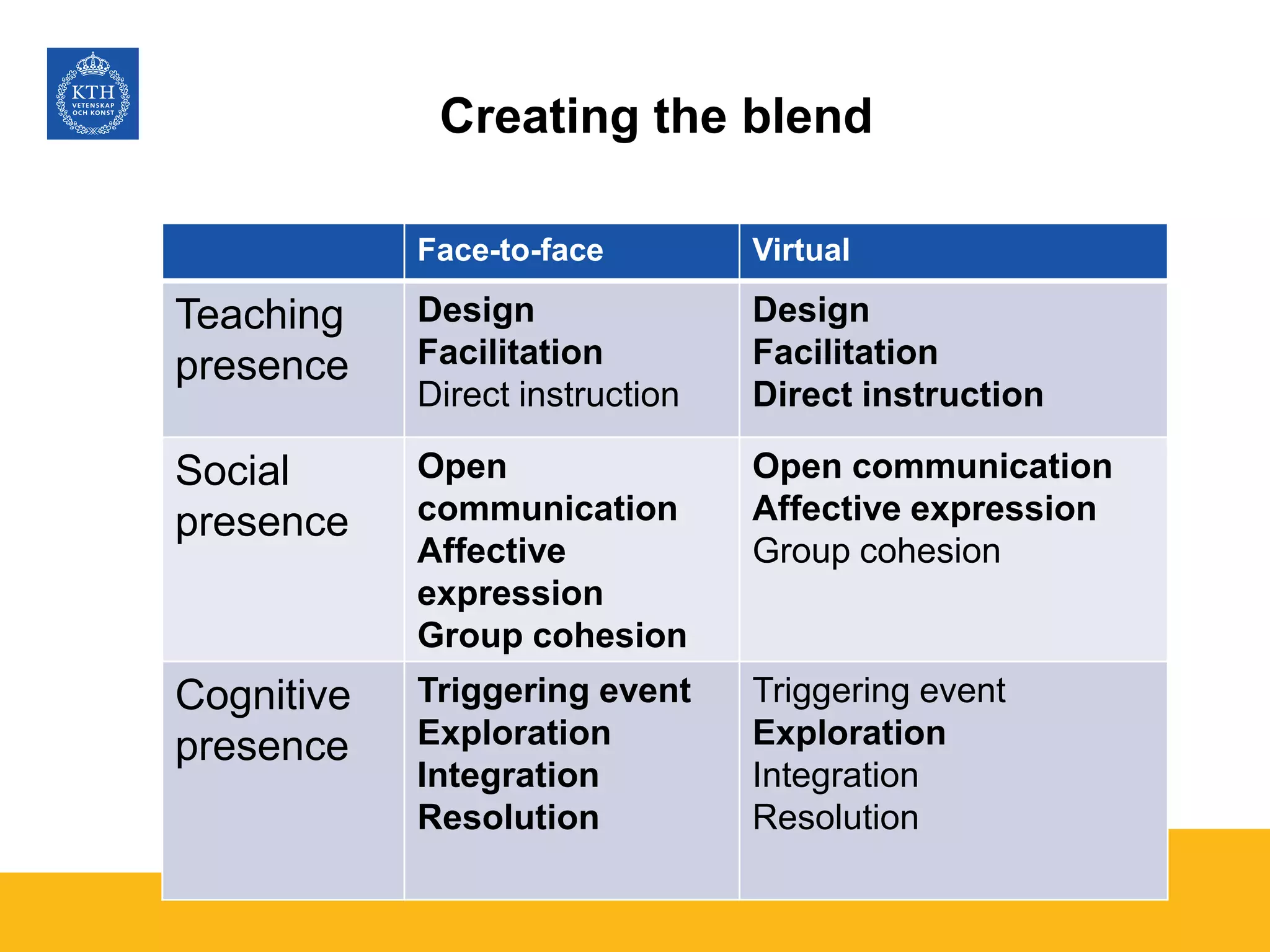
Creating the blend
Face-to-face Virtual
Teaching
presence
Design
Facilitation
Direct instruction
Design
Facilitation
Direct instruction
Social
presence
Open
communication
Affective
expression
Group cohesion
Open communication
Affective expression
Group cohesion
Cognitive
presence
Triggering event
Exploration
Integration
Resolution
Triggering event
Exploration
Integration
Resolution
Outcomes and participant evaluation
• Twenty-nine course evaluation questions Likert scale 0-5
• Average 4.36; sd .73; range 3.64 – 4.91
Bricks
• AdobeConnect poor technically and pace was too slow
• More concrete examples and practical advice
• Train in AdobeConnect in f2f meetings
Bouquets
• Gets you in the seat of the students for blended learning
• Provides theoretical backbone
• Flexibility and engagement
Key learning for instructors
- Disciplinary clusters
- Disciplinary examples
- Balance theory with increased techniques and
tools
- Importance of margin for learning
- Longitudinal implementation
- Change balance and sequence of f2f and online
sessions
Next steps
Revise based on pilot feedback
Consider options for on-going community
Increase disciplinary literature and examples
Integrate with workshops on technology
Which of the three presences is
the leading presence in a blended
learning environment?
Questions and Discussion
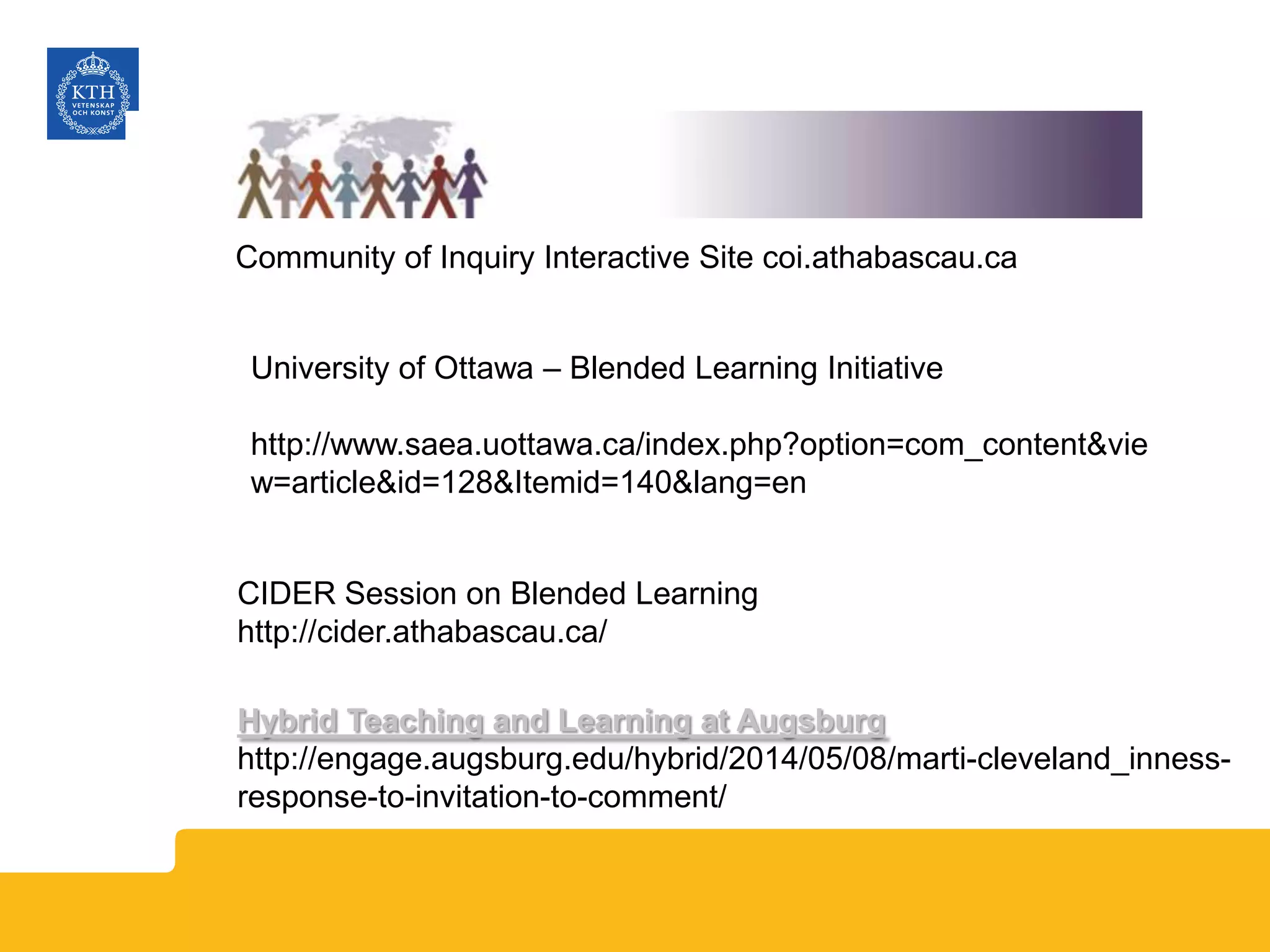
Community of Inquiry Interactive Site coi.athabascau.ca
University of Ottawa – Blended Learning Initiative
http://www.saea.uottawa.ca/index.php?option=com_content&vie
w=article&id=128&Itemid=140&lang=en
CIDER Session on Blended Learning
http://cider.athabascau.ca/
Hybrid Teaching and Learning at Augsburg
http://engage.augsburg.edu/hybrid/2014/05/08/marti-cleveland_inness-
response-to-invitation-to-comment/

Teaching blended learning through a blended community of inquiry

  • 1.
    Teaching blended learningthrough a blended community of inquiry A course for faculty in Sweden M. Cleveland-Innes, Ph.D. S. Stenbom, PhD candidate
  • 2.
    Session Objective Foster acommunity of inquiry to review creating a community of inquiry about creating a community of inquiry in a blended higher education environment.
  • 3.
    Agenda Introduction exercise (SP –open communication and affective expression) Objectives review (TP – design and organization) Presentation (TP – direct instruction) Questions to the audience (CP – trigger event, exploration, integration, resolution) Questions from the audience (TP – facilitation) Door prize draw (SP – group cohesion)
  • 4.
    KTH Royal Instituteof Technology, Sweden
  • 5.
    “Information technology asan integral part of everyday life has altered conditions for university studies fundamentally by 2027. Competition is becoming global when courses, to an ever larger extent, are offered via cloud computing networks and when teaching materials are becoming omnipresent. e-education is a self- evident part of competitive bids for university studies. There is a special challenge in acquiring and maintaining a leading position in both ICT research and e-education.” CSSHE2013VICTORIA,B.C 5
  • 6.
    Facts • Founded 1827. •17 000 students. • 1 800 PhD candidates. • 4 800 employees. Degrees • Bachelor, master and doctoral degrees in engineering. • Master of Architecture. • Teacher certificate for K-12. KTH Royal Institute of Technology, Sweden
  • 7.
    In order tobe appointed as associate professor (or full professor) at KTH one must have 10 weeks of courses in Teaching and Learning in Higher education.
  • 8.
    Courses in Teachingand Learning at KTH Learning and Teaching in Higher Education Teaching Strategies and Design for Online and Blended Learning Leading Educational Development Learning for Sustainable Development Project in Educational Science 5 weeks 2 weeks 3 weeks
  • 9.
    TEACHING STRATEGIES ANDDESIGN FOR ONLINE AND BLENDED LEARNING Learning Objectives 1. Review, consider and critique principles of blended teaching in higher education. 2. Examine teaching issues with other faculty and identify possible intervention strategies using ICTs. 3. Integrate instructional theory and practice using ICTs in a way that is relevant and connected to your own discipline. 4. Create and test a module where blended delivery strategies are used.
  • 10.
    7 Principles of Blended& Online Learning 1. Design for open communication & trust 2. Design for critical reflection & discourse 3. Create and sustain sense of community 4. Support purposeful inquiry 5. Ensure students sustain collaboration 6. Ensure that inquiry moves to resolution 7. Ensure assessment is congruent with intended learning outcomes Vaughan, Cleveland-Innes, & Garrison, 2013
  • 11.
    Community of InquiryFramework Social Presence The ability of participants to identify with the community (e.g., course of study), communicate purposefully in a trusting environment, and develop inter-personal relationships by way of projecting their individual personalities. Cognitive Presence The extent to which learners are able to construct and confirm meaning through sustained reflection and discourse in a critical community of inquiry. Teaching Presence The design, facilitation and direction of cognitive and social processes for the purpose of realizing personally meaningful and educationally worthwhile learning outcomes
  • 12.
    Creating the blend Face-to-faceVirtual Teaching presence Design Facilitation Direct instruction Design Facilitation Direct instruction Social presence Open communication Affective expression Group cohesion Open communication Affective expression Group cohesion Cognitive presence Triggering event Exploration Integration Resolution Triggering event Exploration Integration Resolution
  • 13.
    Outcomes and participantevaluation • Twenty-nine course evaluation questions Likert scale 0-5 • Average 4.36; sd .73; range 3.64 – 4.91 Bricks • AdobeConnect poor technically and pace was too slow • More concrete examples and practical advice • Train in AdobeConnect in f2f meetings Bouquets • Gets you in the seat of the students for blended learning • Provides theoretical backbone • Flexibility and engagement
  • 14.
    Key learning forinstructors - Disciplinary clusters - Disciplinary examples - Balance theory with increased techniques and tools - Importance of margin for learning - Longitudinal implementation - Change balance and sequence of f2f and online sessions
  • 15.
    Next steps Revise basedon pilot feedback Consider options for on-going community Increase disciplinary literature and examples Integrate with workshops on technology
  • 16.
    Which of thethree presences is the leading presence in a blended learning environment?
  • 17.
  • 18.
    Community of InquiryInteractive Site coi.athabascau.ca University of Ottawa – Blended Learning Initiative http://www.saea.uottawa.ca/index.php?option=com_content&vie w=article&id=128&Itemid=140&lang=en CIDER Session on Blended Learning http://cider.athabascau.ca/ Hybrid Teaching and Learning at Augsburg http://engage.augsburg.edu/hybrid/2014/05/08/marti-cleveland_inness- response-to-invitation-to-comment/