Blended Learning In Higher Education Framework
Principles And Guidelines 1st Edition D Randy
Garrison download
https://ebookbell.com/product/blended-learning-in-higher-
education-framework-principles-and-guidelines-1st-edition-d-
randy-garrison-2444856
Explore and download more ebooks at ebookbell.com
Here are some recommended products that we believe you will be
interested in. You can click the link to download.
Adapting To Online And Blended Learning In Higher Education Supporting
The Retention And Success Of The Expanded And Diversified Intake 1st
Ed 2023 David Kember
https://ebookbell.com/product/adapting-to-online-and-blended-learning-
in-higher-education-supporting-the-retention-and-success-of-the-
expanded-and-diversified-intake-1st-ed-2023-david-kember-50279236
Models For Improving And Optimizing Online And Blended Learning In
Higher Education Jared Keengwe
https://ebookbell.com/product/models-for-improving-and-optimizing-
online-and-blended-learning-in-higher-education-jared-keengwe-5137052
Cases On Online And Blended Learning Technologies In Higher Education
Concepts And Practices 1st Edition Yukiko Inoue
https://ebookbell.com/product/cases-on-online-and-blended-learning-
technologies-in-higher-education-concepts-and-practices-1st-edition-
yukiko-inoue-1646668
Blended Learning Designs In Stem Higher Education Putting Learning
First 1st Ed Christopher N Allan
https://ebookbell.com/product/blended-learning-designs-in-stem-higher-
education-putting-learning-first-1st-ed-christopher-n-allan-10493944
Adopting Blended Learning For Collaborative Work In Higher Education
1st Edition Alan Hogarth
https://ebookbell.com/product/adopting-blended-learning-for-
collaborative-work-in-higher-education-1st-edition-alan-
hogarth-51355920
Blended Learning And The Global South Virtual Exchanges In Higher
Education 1st Edition Giovanna Carloni
https://ebookbell.com/product/blended-learning-and-the-global-south-
virtual-exchanges-in-higher-education-1st-edition-giovanna-
carloni-57058180
Blended Learning In Grades 412 Leveraging The Power Of Technology To
Create Studentcentered Classrooms 1st Catlin R Tucker
https://ebookbell.com/product/blended-learning-in-
grades-412-leveraging-the-power-of-technology-to-create-
studentcentered-classrooms-1st-catlin-r-tucker-38437884
Blended Learning In Engineering Education Recent Developments In
Curriculum Assessment And Practice Vojislav Ilic
https://ebookbell.com/product/blended-learning-in-engineering-
education-recent-developments-in-curriculum-assessment-and-practice-
vojislav-ilic-10502238
Blended Learning In Action A Practical Guide Toward Sustainable Change
1st Catlin R Tucker
https://ebookbell.com/product/blended-learning-in-action-a-practical-
guide-toward-sustainable-change-1st-catlin-r-tucker-11820476
P1: OTE/SPH P2: OTE
JWSF011-Garrison-FM August 22, 2007 22:17
ii
P1: OTE/SPH P2: OTE
JWSF011-Garrison-FM August 22, 2007 22:17
Blended Learning in
Higher Education
i
P1: OTE/SPH P2: OTE
JWSF011-Garrison-FM August 22, 2007 22:17
ii
P1: OTE/SPH P2: OTE
JWSF011-Garrison-FM August 22, 2007 22:17
Blended
Learning in
Higher
Education
Framework, Principles,
and Guidelines
D. Randy Garrison
Norman D. Vaughan
JOSSEY-BASS
A Wiley Imprint
www.josseybass.com
iii
P1: OTE/SPH P2: OTE
JWSF011-Garrison-FM August 22, 2007 22:17
Copyright C
 2008 by John Wiley  Sons, Inc. All rights reserved.
Published by Jossey-Bass
A Wiley Imprint
989 Market Street, San Francisco, CA 94103-1741—www.josseybass.com
No part of this publication may be reproduced, stored in a retrieval system, or transmitted in any
form or by any means, electronic, mechanical, photocopying, recording, scanning, or otherwise,
except as permitted under Section 107 or 108 of the 1976 United States Copyright Act, without
either the prior written permission of the Publisher, or authorization through payment of the
appropriate per-copy fee to the Copyright Clearance Center, Inc., 222 Rosewood Drive,
Danvers, MA 01923, 978-750-8400, fax 978-750-4470, or on the web at www.copyright.com.
Requests to the Publisher for permission should be addressed to the Permissions Department,
John Wiley  Sons, Inc., 111 River Street, Hoboken, NJ 07030, 201-748-6011, fax 201-748-
6008, or online at www.wiley.com/go/permissions.
Readers should be aware that Internet Web sites offered as citations and/or sources for further
information may have changed or disappeared between the time this was written and when it is
read.
Limit of Liability/Disclaimer of Warranty:While the publisher and author have used their best
efforts in preparing this book, they make no representations or warranties with respect to the
accuracy or completeness of the contents of this book and specifically disclaim any implied
warranties of merchantability or fitness for a particular purpose. No warranty may be created or
extended by sales representatives or written sales materials. The advice and strategies contained
herein may not be suitable for your situation.You should consult with a professional where
appropriate. Neither the publisher nor the author shall be liable for any loss of profit or any
other commercial damages, including but not limited to special, incidental, consequential, or
other damages.
Jossey-Bass books and products are available through most bookstores. To contact Jossey-Bass
directly call our Customer Care Department within the U.S. at 800-956-7739, outside the U.S.
at 317-572-3986, or fax 317-572-4002.
Jossey-Bass also publishes its books in a variety of electronic formats. Some content that appears
in print may not be available in electronic books.
Library of Congress Cataloging-in-Publication Data
Garrison, D. R. (D. Randy), 1945-
Blended learning in higher education : framework, principles, and guidelines / D. Randy
Garrison, Norman D. Vaughan. – 1st ed.
p. cm.
Includes bibliographical references and index.
ISBN 978-0-7879-8770-1 (cloth)
1. Education, Higher–Computer-assisted instruction. 2. Blended learning. 3. Internet in
higher education. I. Vaughan, Norman D., 1960- II. Title.
LB2395.7.G365 2008
371.3–dc22
2007028790
Printed in the United States of America
first edition
HB Printing 10 9 8 7 6 5 4 3 2 1
iv
P1: OTE/SPH P2: OTE
JWSF011-Garrison-FM August 22, 2007 22:17
The Jossey-Bass Higher and Adult Education Series
v
P1: OTE/SPH P2: OTE
JWSF011-Garrison-FM August 22, 2007 22:17
vi
P1: OTE/SPH P2: OTE
JWSF011-Garrison-FM August 22, 2007 22:17
Contents
Preface ix
The Authors xv
Part One: Community of Inquiry Framework 1
1. Introduction 3
2. Community of Inquiry and Blended Learning 13
3. Designing Blended Learning to Create a
Community of Inquiry 31
4. Community of Inquiry for Faculty Development 49
Part Two: Blended Learning in Practice 69
5. Scenarios 71
6. Guidelines 85
7. Strategies and Tools 105
8. The Future 143
Appendix1. Organizational Change 157
Appendix2. Project Proposal Form 173
Appendix3. Redesign Guide for Blended Learning 177
vii
P1: OTE/SPH P2: OTE
JWSF011-Garrison-FM August 22, 2007 22:17
viii CONTENTS
Appendix4. Blended Faculty Community of Inquiry
Planning Document 181
Appendix5. Student Survey Questionnaire 189
Appendix6. Faculty Interview Questions 195
Appendix7. Student Survey Results 197
Appendix8. Faculty Interview Comments 201
Appendix9. Template for Preparing a Blended
Learning Course Outline 205
Appendix10. Sample Blended Learning Course Outline 207
Appendix11. Sample Assessment Rubric for an
e-Portfolio Assignment 219
References 223
Index 233
P1: OTE/SPH P2: OTE
JWSF011-Garrison-FM August 22, 2007 22:17
Preface
Higher education institutions must address changing expecta-
tions associated with the quality of the learning experience and
the wave of technological innovations. Participants in the higher
education enterprise are questioning traditional approaches and
whether they are achieving the high levels of learning promised.
Deep and meaningful learning experiences are best supported by
actively engaged learners (Kuh and Associates, 2005). Those
who have grown up with interactive technology are not al-
ways comfortable with the information transmission approach of
large lectures. Students expect a relevant and engaging learning
experience.
It is beyond time that higher education institutions recognize
the untenable position of holding onto past practices that are in-
congruent with the needs and demands of a knowledge society.
Higher education leaders have the challenge to position their in-
stitutions for the twenty-first century. They must provide students
with an opportunity to engage their professors and peers in critical
and creative reflection and discourse—the conventional ideals of
higher education. The past is the future if we examine the ideals
of higher education and recognize the need to critically examine
current practices in higher education and the potential of commu-
nications technology to support intense, varied, and continuous
engagement in the learning process. There is the opportunity to
revisit and regain the ideals of higher education with the adoption
of approaches that value dialogue and debate. The premise of this
ix
P1: OTE/SPH P2: OTE
JWSF011-Garrison-FM August 22, 2007 22:17
x PREFACE
book is that the greatest possibility of recapturing the ideals of
higher education is through redesigning blended learning.
Administration, faculty, and students in higher education
know there has to be change in how we design educational ex-
periences. Most recognize that the convergence of the classroom
and communications technology has the potential to transform
highereducationforthebetter.However,blendedlearningismore
than enhancing lectures. It represents the transformation of how
we approach teaching and learning. It is a complete rethinking
and redesign of the educational environment and learning ex-
perience. Blended learning is a coherent design approach that
openly assesses and integrates the strengths of face-to-face and
online learning to address worthwhile educational goals. When
blended learning is well understood and implemented, higher ed-
ucation will be transformed in a way not seen since the expansion
of higher education in the late 1940s. The challenge now is to
gain a deep understanding of the need, potential, and strategies
of blended learning to approach the ideals of higher education.
The purpose here is to explore the concept of blended learn-
ing in a comprehensive yet coherent manner. To borrow from the
European ODL Liaison Committee (2004), the challenge is to
“create order in the confused ‘panacea concept’ of ‘blended learn-
ing’ by distinguishing between innovative and merely substitu-
tive use of ICT [information and communication technology].”
Several key points are recognized in this statement. The first is
the need for order. The second point is the recognition of the
complexity of a deceivingly simple concept. And third, blended
learning is fundamentally different and is not simply an add-on
to the dominant approach. These particular challenges shape the
content of this book.
This book provides an organizing framework to guide the
exploration and understanding of the principles and practices
needed to effect the much needed transformational change in
higher education. Moreover, the book provides practical exam-
ples and organizational support structures required to fuse a range
P1: OTE/SPH P2: OTE
JWSF011-Garrison-FM August 22, 2007 22:17
Preface xi
of face-to-face and online learning to meet the quality challenges
and serve disciplinary goals effectively and efficiently.
The primary audience for this book is faculty in higher edu-
cation who are struggling to find the time and means to engage
their students in meaningful learning activities. In addition, fac-
ulty who are trying to integrate the Internet and communications
technology into their courses will find the book of considerable
value. Certainly faculty developers and instructional designers
will find here a coherent approach and specific techniques for de-
signing blended learning courses. Finally, graduate students and
administrators will find this book useful to gain an understanding
and appreciation for the potential of blended learning designs.
Overview of Contents
Blended Learning in Higher Education provides a vision and a
roadmap for higher education faculty to understand the possi-
bilities of organically blending face-to-face and online learning
for engaging and meaningful learning experiences. The first part
provides the theoretical framework. The second part focuses on
the practice of designing a blended learning experience.
Chapter One explores the broader context that has spawned
the interest in and development of blended learning in higher
education. The chapter describes blended learning, along with
changing expectations and challenges in higher education. It
then discusses how blended learning can address these challenges
through its potential to merge the best of face-to-face and online
approaches.
Part One: Community of Inquiry Framework
Chapter Two introduces the community of inquiry framework as
the ideal and heart of a higher education experience. The frame-
work provides the roadmap for the integration of face-to-face and
online learning activities. The chapter describes the conceptual
P1: OTE/SPH P2: OTE
JWSF011-Garrison-FM August 22, 2007 22:17
xii PREFACE
foundation in terms of purposeful, open, and disciplined critical
discourse and reflection. It also discusses the core elements of the
framework—social, cognitive, and teaching presence.
Chapter Three outlines seven blended learning redesign
principles. The chapter spans the three categories of teaching
presence—design, facilitation, and direct instruction—and de-
scribes and identifies the principles of social and cognitive pres-
ence in each of these categories, as well as assessment.
Chapter Four uses the community of inquiry framework to
explore professional development issues essential to the imple-
mentation of blended learning designs. It also describes faculty
learning communities, organizational strategies for support, and
blended approaches to professional development.
Part Two: Blended Learning in Practice
Chapter Five presents six scenarios of blended learning design
organized under three ideal types. Each of the scenarios reflects
successful blended learning designs associated with courses com-
mon in higher education. They cut across disciplines and are an
amalgam of the best features and examples of course redesigns
based upon the authors’ experiences and those found in the lit-
erature. They serve as the touchstone for further discussions in
designing blended approaches to learning in higher education.
Chapter Six explores more practical guidelines to blended
learning redesign. It begins with a discussion of new approaches
congruent with higher education goals. The discussion then
moves into specific guidelines with regard to applying the pre-
viously identified principles.
Chapter Seven describes specific techniques and tools to en-
gage students in a collaborative and reflective blended learning
experience. It gives detailed examples such as an online syllabus,
a lesson plan for the first week, discussion forums, assessment
rubrics, and other practical ideas and tips. These techniques and
tools can be readily adapted to a range of disciplinary contexts.
P1: OTE/SPH P2: OTE
JWSF011-Garrison-FM August 22, 2007 22:17
Preface xiii
Chapter Eight describes the era of engagement and looks into
the near future with a discussion of the evolutionary transforma-
tion of teaching and learning in higher education. Finally, the
Appendixes provide a wide range of documents, practical tools,
and resources.
Although chapters may be read in any order, the chapters do
build on particular themes and concepts, and in many cases they
follow a similar structure. For this reason, the most benefit from
the book can be gained by reading the chapters in sequence.
Acknowledgments
We would like to recognize the blended learning resources that
B. J. Eib, Patti Dyjur, Julie Weible, and Rosalie Pedersen have de-
veloped at the University of Calgary, which we have incorporated
into this book. In addition, we would like to thank the Univer-
sity of Calgary professors who shared with us their experiences
and insights in designing blended learning courses. We would be
remiss not to acknowledge and thank David Brightman at Jossey-
Bass for his insightful suggestions to improve the first draft of the
manuscript.
We would also like to acknowledge that Chapter Three grew
out of a previously published article: Garrison, D. R. (2006).
Online collaboration principles. Journal of Asynchronous Learning
Networks, 10(1), 25–34.
P1: OTE/SPH P2: OTE
JWSF011-Garrison-FM August 22, 2007 22:17
xiv
P1: OTE/SPH P2: OTE
JWSF011-Garrison-FM August 22, 2007 22:17
The Authors
D. Randy Garrison is the director of the Teaching  Learning
Centre and a full professor in the Faculty of Education at the
University of Calgary. He served as dean, faculty of extension at
the University of Alberta from 1996 to 2001. He has published
extensivelyonteachingandlearninginhigher,distance,andadult
education contexts. This is his sixth book, and he has published
well in excess of 100 refereed articles. Randy Garrison has won
several research awards.
Norman D. Vaughan is the coordinator for the inquiry and
blended learning program in the Teaching  Learning Centre at
the University of Calgary. In this position he coordinates course
redesign projects and provides support for the faculty and graduate
student teaching certificate programs. Norm is also a member of
the editorial boards for the Journal on Excellence in College Teaching
and the Canadian Journal of Learning and Technology. His teaching
background includes graduate and undergraduate courses in edu-
cational technology, K–12 education in northern Canada, tech-
nical training in the petroleum industry, and English as a second
language in Japan. In addition, he has been involved in several
consulting projects with book publishers and higher education in-
stitutions to develop online courses and resources. Norm received
his Ph.D. in Educational Technology from the University of
Calgary. His current research focuses on blended learning and
faculty development.
xv
P1: OTE/SPH P2: OTE
JWSF011-Garrison-FM August 22, 2007 22:17
xvi
P1: OTE/SPH P2: OTE
JWSF011-Garrison-FM August 22, 2007 22:17
Blended Learning in
Higher Education
xvii
P1: OTE/SPH P2: OTE
JWSF011-Garrison-FM August 22, 2007 22:17
xviii
JWSF011-Garrison August 13, 2007 9:26
Part One
COMMUNITY OF INQUIRY
FRAMEWORK
1
JWSF011-Garrison August 13, 2007 9:26
2
JWSF011-Garrison August 13, 2007 9:26
1
INTRODUCTION
In this chapter we document the growing interest in blended
learning and describe the essence of this emerging approach to
course design. We also make the case for a framework that has
practical value in guiding blended learning design and describe
the challenges in understanding and implementing this poten-
tially significant change in higher education. We encourage edu-
cators in higher education to reexamine current practices and to
actively engage students in their learning to achieve the higher-
order learning outcomes that are so needed in higher education
(Boyer Commission, 2001). New ways of thinking about course
design are required to reconcile traditional values and practices
with evolving expectations and technological possibilities.
Interest in Blended Learning
Curtis Bonk and his colleagues have documented the strong and
growing interest in blended learning (Bonk  Graham, 2006).
They concluded in a recent survey of higher education that re-
spondents clearly expected a dramatic rise in their use of blended
learning approaches in the coming years (Bonk, Kim  Zeng,
2006, p. 553). In another survey, Arabasz and Baker (2003) re-
vealed that 80 percent of all higher education institutions offer
blended learning courses.
Underlying these data is the increasing awareness that
blended learning approaches and designs can significantly
enhance the learning experience. Albrecht (2006) reports high
3
JWSF011-Garrison August 13, 2007 9:26
4 BLENDED LEARNING IN HIGHER EDUCATION
student satisfaction with blended learning, and others have
reported faculty satisfaction (Vaughan  Garrison, 2006a). This
is confirmed by Marquis (2004) in a survey that found that
94 percent of lecturers believed that blended learning “is more
effective than classroom-based teaching alone.” This is also
consistent with a study by Bourne and Seaman (2005), who
found that the primary interest in blended learning is to benefit
the educational process. They report that blended learning is
perceived to be a means to combine the best of face-to-face and
online learning.
The need to provide more engaged learning experiences is at
the core of the interest in blended learning. Many faculty have
begun to question passive teaching and learning approaches such
as the lecture. The lecture is a method of disseminating informa-
tion that emerged before the advent of the printing press. The
lecture is not particularly effective in engaging learners in criti-
cally filtering and making sense of the glut of information that we
now face. Complex topics require more in-depth engagement for
students to construct meaning than what is possible in a typical
lecture. In this regard, Palloff and Pratt (2005) argue that interac-
tive and collaborative learning experiences are more congruent
with achieving higher-order learning outcomes.
Concurrent with the recognition of the importance of inter-
active and engaged learning experiences is the growing under-
standing of the potential of the Internet and communications
technology to connect learners. The interest in blended learning
can also be attributed to the advances and proliferation of com-
munications technology in most segments of society—advances
that have not seen the same degree of uptake in the higher edu-
cation classroom. Although this is changing, there is still a lack
of understanding of how best to use technology to advance the
goals of higher education in terms of engaging students in critical
thinking and discourse.
We argue that the time has come to reject the dualistic
thinking that seems to demand choosing between conventional
face-to-face and online learning, a dualism that is no longer
JWSF011-Garrison August 13, 2007 9:26
INTRODUCTION 5
tenable, theoretically or practically. There is a better approach.
With the increasing awareness and adoption of the Internet and
communications technology to connect learners, a more sensible
way forward would be to better understand the potential of these
technologies and how they might be integrated with the best of
the face-to-face learning environment.
We explore in this book a new educational paradigm that in-
tegrates the strengths of face-to-face and online learning. Blended
learning—a design approach whereby both face-to-face and on-
line learning are made better by the presence of the other—offers
the possibility of recapturing the traditional values of higher ed-
ucation while meeting the demands and needs of the twenty-
first century.
Blended Learning Described
Recognizing true blended learning is not obvious. Blended learn-
ing is the thoughtful fusion of face-to-face and online learning
experiences. The basic principle is that face-to-face oral commu-
nication and online written communication are optimally inte-
grated such that the strengths of each are blended into a unique
learning experience congruent with the context and intended
educational purpose. Although the concept of blended learning
may be intuitively apparent and simple, the practical application
is more complex. Blended learning is not an addition that simply
builds another expensive educational layer. It represents a restruc-
turing of class contact hours with the goal to enhance engagement
and to extend access to Internet-based learning opportunities.
Most important, blended learning is a fundamental redesign that
transforms the structure of, and approach to, teaching and learn-
ing. The key assumptions of a blended learning design are
r Thoughtfully integrating face-to-face and online learning
r Fundamentally rethinking the course design to optimize
student engagement
r Restructuring and replacing traditional class contact hours
JWSF011-Garrison August 13, 2007 9:26
6 BLENDED LEARNING IN HIGHER EDUCATION
Blended learning emerges from an understanding of the
relative strengths of face-to-face and online learning. This
opens a wide range of possibilities for redesign that goes be-
yond enhancing the traditional classroom lecture. Attaining the
threshold of blended learning means replacing aspects of face-
to-face learning with appropriate online learning experiences,
such as labs, simulations, tutorials, and assessment. Blended
learning represents a new approach and mix of classroom and
online activities consistent with the goals of specific courses
or programs.
Blended learning must be approached with the awareness of
the broad range of flexible design possibilities and the challenge
of doing things differently. It must be based upon a sound under-
standing of higher-order learning environments, communication
characteristics, requirements of various disciplines, and resources.
Blended learning redesign is a catalyst; it means to fundamentally
reconceptualize and restructure the teaching and learning trans-
action. Its basic assumption is to open the educational mind to a
full range of possibilities. Blended learning brings into considera-
tion a range of options that require revisiting how students learn
in deep and meaningful ways.
Blended learning is no more about reshaping and enhancing
the traditional classroom than it is about making e-learning more
acceptable. In both contexts one is left with essentially either
face-to-face or online learning. Blended learning combines the
properties and possibilities of both to go beyond the capabilities of
each separately. It recognizes the strengths of integrating verbal
and text-based communication and creates a unique fusion of
synchronous and asynchronous, direct and mediated modes of
communication in that the proportion of face-to-face and online
learning activities may vary considerably.
Blended learning necessitates that educators question what is
important and consider how much time should be spent in the
classroom. We approach the possibilities of blended learning only
when we step back and allow our minds to escape the paradigmatic
JWSF011-Garrison August 13, 2007 9:26
INTRODUCTION 7
trap of either the traditional lecture or Web-based learning.
Blended learning is an approach to educational redesign that can
enhance and extend learning and offer designs that efficiently
manage large classes. It represents a distinct design methodology
that transcends the conventional classroom paradigm. The pro-
portion of face-to-face and online learning activities may vary
considerably, but blended learning is distinguishable by way of
the integration of face-to-face and online learning that is multi-
plicative, not additive.
Change
Higher education must start delivering on its promise of providing
learning experiences that engage and address the needs of society
in the twenty-first century. As Swail (2002) states, the “rules are
changing, and there is increased pressure on institutions of higher
education to evolve, adapt, or desist” (p. 16). To paraphrase Peter
Drucker (1999), we must ask ourselves: would we, knowing what
we now know, design learning experiences as we do with 200 and
300 students in a lecture hall? With what we know about the
potential of blended learning, the need to create communities of
inquiry, and the vast array of accessible and affordable commu-
nications technology, the answer has to be that there must be a
better way.
Levy (2005) has stated that the field of e-learning “is
marked by a juxtaposition of new technology and old pedagogy.”
Higher education is only just beginning to grasp the significance
and educational potential of asynchronous communication net-
works. The mistake of most traditional campus-based institutions
was to see the potential of online learning in terms of access
and serving more students instead of serving current students
better. However, serving students better from a learning perspec-
tive would necessitate the adoption of a new pedagogy. For the
traditional campus-based higher education institution, the break-
through came when online learning was no longer regarded as a
JWSF011-Garrison August 13, 2007 9:26
8 BLENDED LEARNING IN HIGHER EDUCATION
substitute but as an integral and valued component to address the
need for a new pedagogy. This was the watershed moment for
higher education.
The transformation of teaching and learning in higher edu-
cation is inevitable with the use of Web-based communications
technology (Newman, Couturier  Scurry, 2004). Fundamental
redesign based on blended approaches to teaching and learning
represent the means to address the challenges associated with
providing a quality learning experience. Although the catalyst
for change in teaching and learning has been technology, it is the
need to enhance quality standards that is drawing attention to
the potential of blended approaches. Technology is an enabling
tool. Because blended learning is an approach and design that
merges the best of traditional and Web-based learning experi-
ences to create and sustain vital communities of inquiry, many
higher education institutions are quietly positioning themselves
to harness its transformational potential.
The Framework
Blended learning is at the center of an evolutionary transfor-
mation of teaching and learning in higher education. However,
transformational growth can only be sustained with a clear
understanding of the nature of the educational process and
intended learning outcomes. In higher education there is
an expressed focus on opportunities for learners to construct
meaning and confirm understanding through discourse. At the
core of this process is a community of inquiry that supports
connection and collaboration among learners and creates a
learning environment that integrates social, cognitive, and
teaching elements in a way that will precipitate and sustain
critical reflection and discourse. Blended learning opens the pos-
sibility of creating and sustaining a community of inquiry beyond
the classroom.
JWSF011-Garrison August 13, 2007 9:26
INTRODUCTION 9
We approach the understanding of blended learning designs
through the framework of a community of inquiry. The commu-
nity of inquiry (CoI) framework was created by Garrison and his
colleagues (2000) to guide the research and practice of online
learning. The CoI framework was generated from the literature
and experiences of the authors grounded in the larger field of
education. In particular, the framework was grounded in a crit-
ical, collaborative learning community consistent with the ide-
als of higher education. The generic nature of the framework
and its resonance with both face-to-face and online education
make it a useful guide to understand and design blended learning
environments.
Arbaugh (2006) states that the CoI framework has shown
considerable promise and has been widely cited in the litera-
ture. One reason for this is that it is a comprehensive yet par-
simonious and intuitively understandable framework. Another
reason is that it builds upon two ideas that are essential to
higher education—community and inquiry. Community, on the
one hand, recognizes the social nature of education and the role
that interaction, collaboration, and discourse play in construct-
ing knowledge. Inquiry, on the other hand, reflects the process of
constructing meaning through personal responsibility and choice.
A community of inquiry is a cohesive and interactive community
of learners whose purpose is to critically analyze, construct, and
confirm worthwhile knowledge. The three key elements for a
viable community of inquiry are social presence, teaching pres-
ence, and cognitive presence. A community of inquiry appropri-
ately integrates these elements and provides a means to guide the
design of deep and meaningful educational experiences.
We use the CoI framework to shape this book. The first part
of the book focuses on understanding this perspective and de-
scribing how it can influence practice and professional devel-
opment. The design scenarios, guidelines, strategies, and tools
discussed in the second part of this book all emerge from the CoI
JWSF011-Garrison August 13, 2007 9:26
10 BLENDED LEARNING IN HIGHER EDUCATION
framework. The next chapter describes the CoI framework in
greater detail.
Conclusion
There has been little fundamental change with regard to how we
approach teaching and learning in higher education, yet there
is increasing dissatisfaction among faculty, students, and society
with the quality of the learning experience. Although techno-
logical advancements in society have been unrelenting (the In-
ternet, pocket-sized computers, wireless web, cell phones, and
satellite radio, television, games, and simulations), technological
innovation in higher education has been largely restricted to
administration and research. The significant technological inno-
vations in teaching and learning have been confined to address-
ing issues of access and convenience. However, addressing the
relevance and quality of the learning experience demands that
higher education take a fresh look at how it approaches teaching
and learning and utilizes technology.
For all of these reasons, as well as because of the successes of
individual blended learning designs, there is a convergence of in-
terest (intuitive appeal), need (educational demands) and oppor-
tunity (potential of communications technology) with regard to
blended learning. The reality of engaging students across time and
place makes possible the educational ideal of an engaged commu-
nity of inquiry. Blended learning designs remove the constraints
to create and sustain communities of inquiry in higher education.
The concept of a community of inquiry that frames this book
provides a much needed roadmap for blended learning approaches
and designs. The CoI framework provides the order and rational-
ity to understand the nature, purpose, and principles of blended
learning. It provides the context for the practical examples and
the selection of strategies and tools presented in this book. It also
generates the rationale for the templates and rubrics found in the
Appendix.
JWSF011-Garrison August 13, 2007 9:26
INTRODUCTION 11
Blended learning is not new. What is new is the recognition
of its potential to help fundamentally redesign the learning expe-
rience in ways that can enhance the traditional values of higher
education. Blended learning can address the ideals and core values
of higher education in terms of creating and sustaining commu-
nities of inquiry. The challenge higher education faces is how
to merge the distinct approaches and properties of face-to-face
and online learning. This challenge is the focus of the remaining
chapters of this book.
JWSF011-Garrison August 13, 2007 9:26
12
JWSF011-Garrison August 22, 2007 21:19
2
COMMUNITY OF INQUIRY AND
BLENDED LEARNING
The rationale and guidelines for blended learning provided here
are embedded within the community of inquiry (CoI) framework.
A framework avoids the distortion that may arise from the sep-
aration of theory and practice. Without order and a means to
construct the rationale for adopting a particular technique, we
are condemned to thrash about and to randomly search for what
may work with little understanding of why something was success-
ful or not. A coherent framework avoids the tyranny of adopting
clever techniques. Moreover, a theoretical framework not only
provides a means to shape practice but also to reflect upon and
make sense of outcomes. The openness of blended learning re-
designs, in terms of the range of possibilities, demands a strong
theoretical foundation and framework.
A blended learning framework must organically integrate
thought and action and provide an understanding for the im-
portance of sustained critical discourse and private reflection.
A unified framework will merge the public and private worlds.
Finally, a useful blended learning framework must be coherent
and inform the integration of face-to-face and online learning.
Conceptual Foundation
In recent years, innovative approaches to teaching and learning
in higher education were inevitably framed from a constructivist
perspective. Constructivist learning theory is essentially about in-
dividuals making sense of their experiences. However, meaning
13
JWSF011-Garrison August 22, 2007 21:19
14 BLENDED LEARNING IN HIGHER EDUCATION
is not constructed in isolation. Consistent with Garrison and
Archer (2000), we believe the ideal educational transaction is a
collaborative constructivist process that has inquiry at its core.
Social interaction and collaboration shapes and tests meaning,
thus enriching understanding and knowledge sharing. It is im-
portant to note that collaborative constructivist learning experi-
ences are not conducive to “covering” a large amount of subject
matter. Instead, the emphasis is on inquiry processes that en-
sure core concepts are constructed and assimilated in a deep and
meaningful manner.
The theoretical foundation for blended learning as outlined
here is predicated on the recognition of the unity of the public
and private worlds, information and knowledge, discourse and
reflection, control and responsibility, and process with learning
outcomes. John Dewey strongly rejected dualism and argued that
the value of the educative experience is in unifying the internal
and external worlds. Dewey stated, “the educational process has
two sides—one psychological and one sociological; and that nei-
ther can be subordinated to the other or neglected without evil
results following” (1959, p. 20). It is essential that students be ac-
tively engaged in the process of inquiry. When action is divorced
from thought, teaching becomes information “transmission by a
kind of scholastic pipeline into the minds of pupils whose busi-
ness is to absorb what is transmitted” (Dewey  Childs, 1981,
pp. 88–89). For this reason, higher education experiences are
best conceived as communities of inquiry.
A community of inquiry is inevitably described as the ideal
and heart of a higher education experience. A community of
inquiry is shaped by purposeful, open, and disciplined critical
discourse and reflection.
Purposeful
According to Dewey, educational inquiry is a process to inves-
tigate problems and issues—not to memorize solutions. Inquiry
JWSF011-Garrison August 22, 2007 21:19
COMMUNITY OF INQUIRY AND BLENDED LEARNING 15
within the educational community focuses on intended goals and
learning outcomes. It is a systematic process to define relevant
questions, search for relevant information, formulate solutions,
and apply those solutions. Discourse engages curriculum through
reflection. A community of inquiry depends on sustained commu-
nication and collaboration wherein participants share experience
and insights. Participants are expected to be self-directed and
focused on the task at hand.
Education defined as a process of inquiry goes beyond access-
ing or even assimilating information. Inquiry joins process and
outcomes (means-end) in a unified, iterative cycle. It links re-
flection and content by encouraging students to collaboratively
explore and reasonably question the organization and meaning
of subject matter. Inquiry is both a reflective and collaborative
experience. Inquiry must be purposeful, but flexible, to explore
unintended paths of interest. Personal relationships may be an
artifact of a successful community of inquiry, but they are not the
primary goal. Sustained communities of inquiry are dependent
upon purposeful and respectful relations that encourage free and
open communication.
Open
The individual must have the freedom to explore ideas, ques-
tion, and construct meaning. If learning is to be a process of
inquiry, then it must focus on questions, not just on answers.
Learners must be free to follow new leads and to question public
knowledge. They must have an opportunity to explore questions,
as well as to construct and confirm resolutions collaboratively.
Paavola and colleagues argue that constructing individual mean-
ing and “knowledge creation is a matter of individual initiative
embedded in fertile group . . . activities” (Paavola, Lipponen, 
Hakkarainen, 2004, p. 568). Schrire (2004) found a relation-
ship between interaction and cognition. We believe that under-
standing is precipitated and enhanced through interaction in the
JWSF011-Garrison August 22, 2007 21:19
16 BLENDED LEARNING IN HIGHER EDUCATION
community. Education does not easily advance to higher levels
of inquiry when reflection and discourse are artificially severed.
The inquiry method is dependent upon interaction. Inter-
action is essential for both a community of inquiry and the
higher educational experience. The educational process within
this community is a process of inquiry that integrates both the
public and private worlds. Participants must feel secure to re-
veal their private thoughts and open them to scrutiny and cri-
tique. Engagement in a community of inquiry is the intersec-
tion of public and private worlds. An educational experience
has both an interactive (social) and a reflective (private) ele-
ment. To inquire is to be awakened, informed, and engaged to
explore the controversies of a discipline rather than simply adopt
the obvious and accepted truths. Worthwhile educational expe-
riences fully engage learners to question ideas—even accepted
truths—and hone the critical and creative thinking abilities of
students.
Disciplined
The foreground of the educational experience is engagement—
interaction, collaboration, and reflection. The educational ex-
perience requires focusing on ideas and conceptual frameworks,
challenging and creating ideas, and diagnosing misconceptions
and constructing mutual understanding. It demands the disci-
pline to interact academically and respectfully with members of
the community as they engage in the pursuit of common goals. It
is learning to listen, explain, and defend positions and ideas. In
short, the educational experience is a commitment to scholarship.
By focusing on the process of inquiry, higher-order thinking and
learning emerge. Lipman (1991) defined higher-order thinking as
being “conceptually rich, coherently organized, and persistently
exploratory” (p. 19). The process of inquiry requires considerable
intellectual discipline. In a discipline of inquiry, participants ac-
quire the attitudes and skills to become critical thinkers and to
JWSF011-Garrison August 22, 2007 21:19
COMMUNITY OF INQUIRY AND BLENDED LEARNING 17
continue their learning beyond the narrow scope and time limit
of a formal educational experience.
Discipline is essential for deep and meaningful learning. Dis-
cipline provides the mindset to engage in critical discourse and
reflection. For tacit knowledge and individual insights to be ex-
ternalized and made explicit, participants must have the disci-
pline to engage in critical reflection and discourse. A community
of inquiry requires discipline if it is to provide a sense of con-
nection and support in the systematic and purposeful pursuit of
shared educational goals and knowledge. Through purposeful,
open, and disciplined interaction and discourse, a community
supports inquiry and development of both the individual and the
community. Disciplined collaboration to test and confirm person-
ally constructed meaning is essential and integral to a community
of inquiry.
The following CoI framework provides a broad orientation
to the educational process. This framework will provide order
and guide our exploration of blended learning designs by present-
ing a coherent and accurate account of what shapes educational
processes and outcomes.
Community of Inquiry
An educational community is a formally constituted group of
individuals whose connection is that of academic purpose and
interest who work collaboratively toward intended learning goals
and outcomes. The purpose of the community should determine
how it is defined and developed. From an educational perspective,
the academic interest should be the primary focus. Community
must be developed to support the learning processes that progress
systematically from identifying a problem to resolving it. Partic-
ipant knowledge and expertise is shared and developed through
discourse and collaborative activities. Although social dynamics
are important to create the climate that will support the learning
process, it is the academic interests that give purpose and shape
JWSF011-Garrison August 22, 2007 21:19
18 BLENDED LEARNING IN HIGHER EDUCATION
to the inquiry process. Roles and expectations are defined by the
educational community.
As noted, the CoI framework provides much of the conceptual
order for this book and has shown strong empirical validation
(Arbaugh, 2007; Garrison, Cleveland-Innes,  Fung, 2004). The
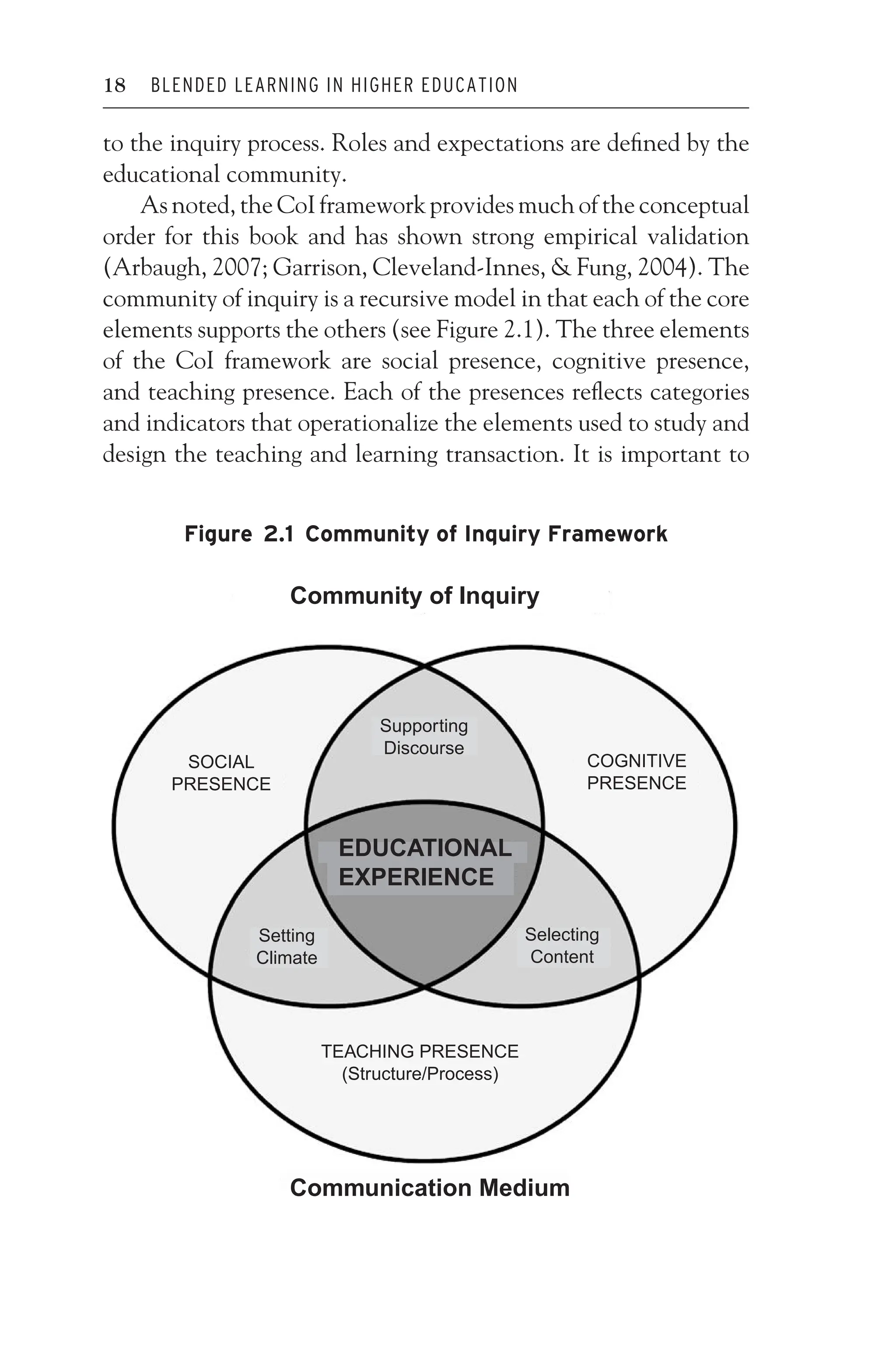
community of inquiry is a recursive model in that each of the core
elements supports the others (see Figure 2.1). The three elements
of the CoI framework are social presence, cognitive presence,
and teaching presence. Each of the presences reflects categories
and indicators that operationalize the elements used to study and
design the teaching and learning transaction. It is important to
Figure 2.1 Community of Inquiry Framework
Community of Inquiry
EDUCATIONAL
EXPERIENCE
SOCIAL
PRESENCE
COGNITIVE
PRESENCE
TEACHING PRESENCE
(Structure/Process)
Communication Medium
Supporting
Discourse
Setting
Climate
Selecting
Content
JWSF011-Garrison August 22, 2007 21:19
COMMUNITY OF INQUIRY AND BLENDED LEARNING 19
note the interdependence across and within the presences. For
example, teaching presence will have a significant influence on
cognitive presence, and social presence will influence cognitive
presence. Overlap does not have to be symmetrical. Emphasis can
be on any one of the presences.
We next describe the presences crucial for the design of a
blended educational experience.
Social Presence
Students in a community of inquiry must feel free to express
themselves openly in a risk-free manner. They must be able to
develop the personal relationships necessary to commit to, and
pursue, intended academic goals and gain a sense of belonging
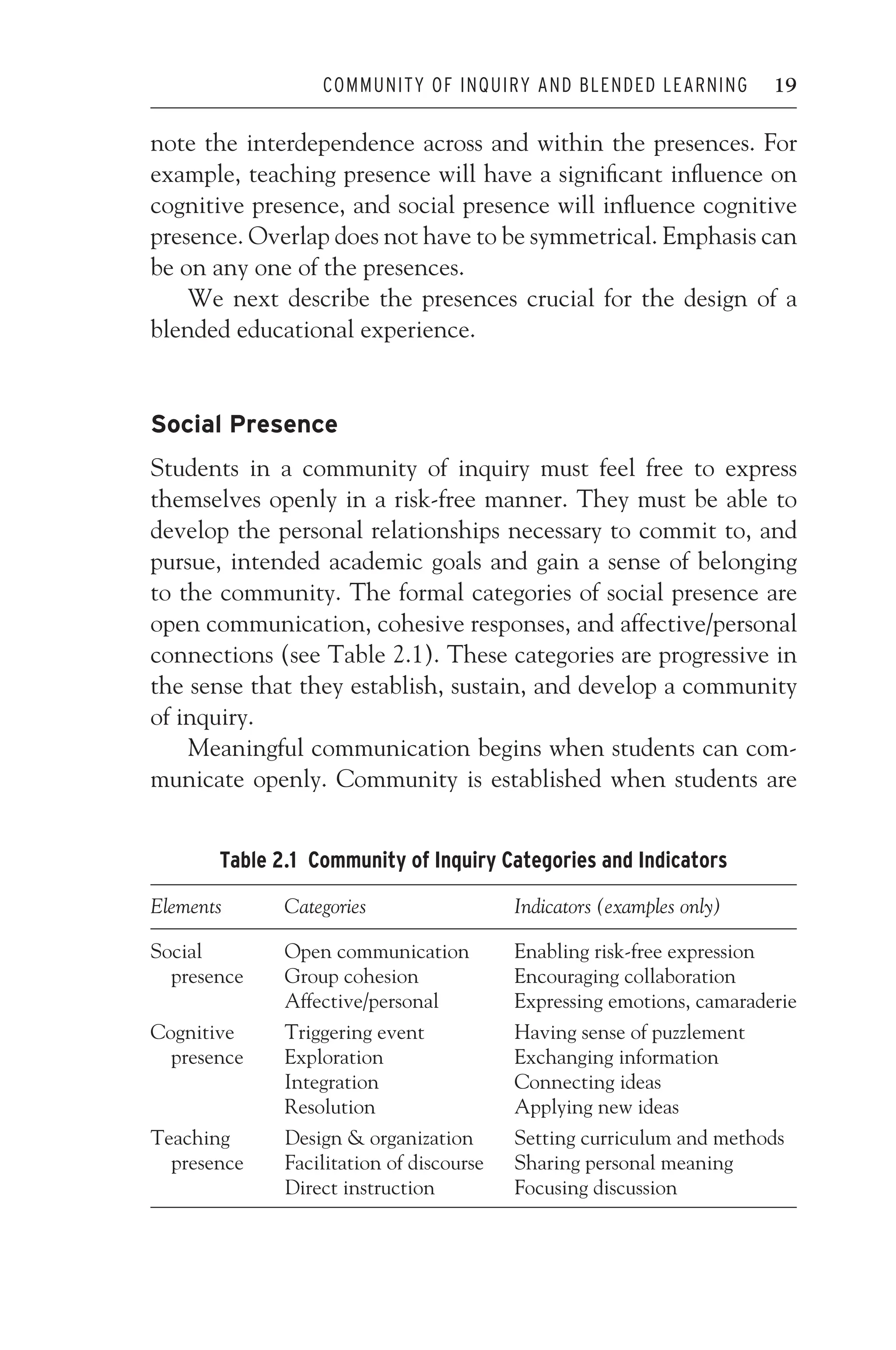
to the community. The formal categories of social presence are
open communication, cohesive responses, and affective/personal
connections (see Table 2.1). These categories are progressive in
the sense that they establish, sustain, and develop a community
of inquiry.
Meaningful communication begins when students can com-
municate openly. Community is established when students are
Table 2.1 Community of Inquiry Categories and Indicators
Elements Categories Indicators (examples only)
Social
presence
Open communication Enabling risk-free expression
Group cohesion Encouraging collaboration
Affective/personal Expressing emotions, camaraderie
Cognitive
presence
Triggering event Having sense of puzzlement
Exploration Exchanging information
Integration Connecting ideas
Resolution Applying new ideas
Teaching
presence
Design  organization Setting curriculum and methods
Facilitation of discourse Sharing personal meaning
Direct instruction Focusing discussion
JWSF011-Garrison August 22, 2007 21:19
20 BLENDED LEARNING IN HIGHER EDUCATION
encouraged to project themselves personally and academically.
Interpersonal interaction is a very important means of connect-
ing with others and creating trust. A community of inquiry must
foster personal but purposeful relationships. Students must feel
emotionally secure to engage in open, purposeful discourse. Stu-
dents may well feel secure and feel free to comment but may
still need to establish the cohesiveness for the community to
begin to work collaboratively. A community is inherently col-
laborative. Therefore, social presence must provide the cohesive
tension to sustain participation and focus. Although participants
must be respected as individuals, they must also feel a sense of re-
sponsibility and commitment to the community of inquiry. Open
communication establishes a community of inquiry, but social
cohesion sustains it. Finally, according to Ruth Brown (2001),
“after long-term and/or intense association with others involv-
ing personal communication” (p. 24), personal relationships de-
velop and camaraderie may emerge. In a community of inquiry,
it takes time for students to find a level of comfort and trust,
develop personal relationships, and evolve into a state of ca-
maraderie. Emotional bonding and camaraderie constitute the
ultimate stage of establishing social presence in an educational
community.
Considerable research has focused on the issue of social pres-
ence in computer conferencing. There was great concern in the
early research that the lack of visual cues and body language
would seriously inhibit the effectiveness of asynchronous text
communication. Put simply, the communication theorists argued
that the lack of social cues would severely limit interpersonal
communication. However, researchers began to understand the
complexities of this supposedly “lean” communication medium.
It became clear that participants could communicate a wide range
of socio-emotional messages, such as personal greetings, feelings,
and humor. Written communication, in fact, had great power and
flexibility and participants could project themselves socially and
emotionally and create interpersonal relationships.
JWSF011-Garrison August 22, 2007 21:19
COMMUNITY OF INQUIRY AND BLENDED LEARNING 21
Establishing social presence is a primary concern at the outset
of creating a community of inquiry. Social relationships create a
sense of belonging, support freedom of expression, and sustain co-
hesiveness, but they do not structure and focus academic interests
among the students. Social interaction is insufficient to sustain
a community of inquiry and achieve educational goals. Commu-
nities of inquiry are more than online chat rooms. Higher levels
of learning inevitably require purposeful discourse to collabo-
ratively construct, critically reflect, and confirm understanding.
This is what is referred to as cognitive presence. With the under-
standing that social presence could be established in a community
of inquiry, we next turn our attention to issues of cognitive and
teaching presence.
Cognitive Presence
Cognitive presence is basic to the inquiry process. Inquiry includes
the integration of reflective and interactive processes. Cognitive
presence maps the cyclical inquiry pattern of learning from ex-
perience through reflection and conceptualization to action and
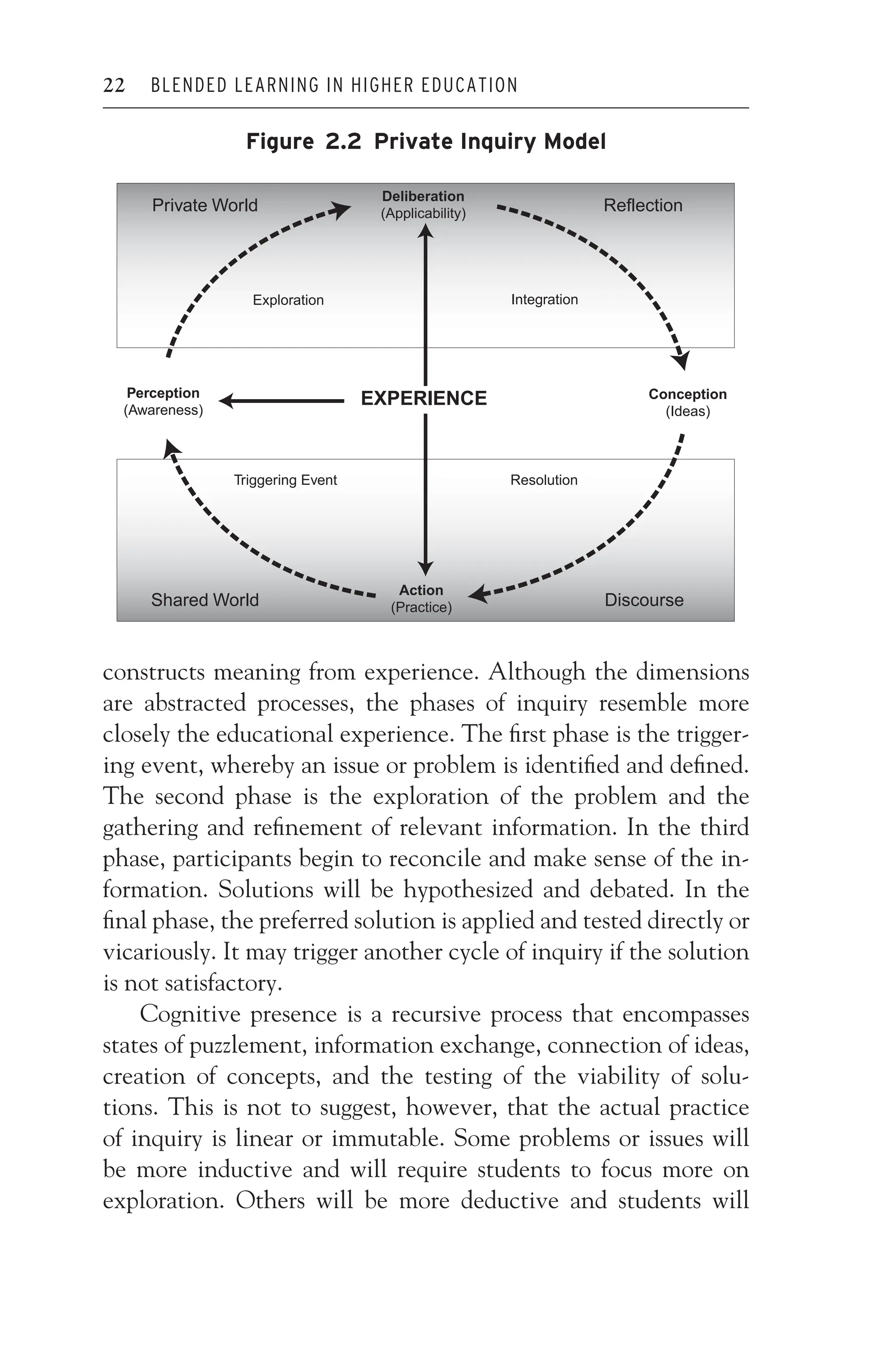
on to further experience (see Figure 2.2). We see the progres-
sive nature of cognitive presence moving from a triggering event
through to resolution. Dewey based his concept of inquiry on the
scientific process writ large. This is the core of cognitive presence
and a key element of the CoI framework.
Cognitive presence is defined by the practical inquiry model
(see Figure 2.2). In comparison to other cognitive taxonomies,
Schrire (2004) found the practical inquiry model “to be the most
relevant to the analysis of the cognitive dimension and presents a
clear picture of the knowledge-building processes” (p. 491). Prac-
tical inquiry has two dimensions and four phases. The vertical
axis defines the deliberation–action dimension. This dimension
represents the recursive nature of inquiry as representing both
constructive and collaborative activities. The horizontal axis
represents the perception–conception dimension. This process
JWSF011-Garrison August 22, 2007 21:19
22 BLENDED LEARNING IN HIGHER EDUCATION
Figure 2.2 Private Inquiry Model
Private World Reflection
Shared World Discourse
Resolution
Integration
Exploration
Triggering Event
Perception
(Awareness)
Conception
(Ideas)
Deliberation
(Applicability)
EXPERIENCE
Action
(Practice)
constructs meaning from experience. Although the dimensions
are abstracted processes, the phases of inquiry resemble more
closely the educational experience. The first phase is the trigger-
ing event, whereby an issue or problem is identified and defined.
The second phase is the exploration of the problem and the
gathering and refinement of relevant information. In the third
phase, participants begin to reconcile and make sense of the in-
formation. Solutions will be hypothesized and debated. In the
final phase, the preferred solution is applied and tested directly or
vicariously. It may trigger another cycle of inquiry if the solution
is not satisfactory.
Cognitive presence is a recursive process that encompasses
states of puzzlement, information exchange, connection of ideas,
creation of concepts, and the testing of the viability of solu-
tions. This is not to suggest, however, that the actual practice
of inquiry is linear or immutable. Some problems or issues will
be more inductive and will require students to focus more on
exploration. Others will be more deductive and students will
JWSF011-Garrison August 22, 2007 21:19
COMMUNITY OF INQUIRY AND BLENDED LEARNING 23
focus on the application of ideas or solutions. Leaps of insight
and intuition reflect what appears to be radical phase shifts
such as a student moving from exploration spontaneously to
a solution. Regardless, practical inquiry must be a logical pro-
cess and hypothesized solutions rationally justified and defended.
A community of inquiry is essential to establish and sustain
cognitive presence.
Higher educational outcomes are very difficult to define
and measure. Moreover, outcomes change as students engage
in the educational process and activities are modified. As Bur-
bules (2004) states, “Outcomes are constituted and reconstituted
in active processes of inquiry, not taken as static endpoints”
(p. 7). Unfortunately, an obsession with educational outcomes
has created a focus on assimilating measurable, although trivial,
information. Unintended learning outcomes can be most edu-
cational. True inquiry is exploratory and often unpredictable.
Burbules (2004) goes on to say that the “question of educational
quality should be sought . . . in the reflexively critical and liber-
ating activities of the classroom itself ” (p. 9). For this reason,
practical inquiry is very much process oriented.
Establishing and maintaining cognitive presence in blended
communities is the area that is in greatest need of research. Cog-
nitive presence goes to the heart of a community of interest. It
has been argued that community supports the cognitive devel-
opment of individuals. Garrison and Archer (2007) point out
that only recently has research focused on the nature of formal,
purposive online educational communities and their ability to
support cognitive presence. Heckman and Annabi (2005) found
written communication to be cognitively rich. Not only was writ-
ten communication precise and permanent, but it was open to
all participants in a way not always possible in a face-to-face
context. Working in an asynchronous text-based environment
reduces student cognitive load and the need to rely on memory
to process large numbers of facts and ideas. Cognition and learn-
ing, above a very limited number of facts and ideas, is inversely
JWSF011-Garrison August 22, 2007 21:19
24 BLENDED LEARNING IN HIGHER EDUCATION
proportional to the cognitive load. Online inquiry would appear
to offer students a considerable advantage in processing informa-
tion and constructing meaning.
Online communities of inquiry were also shown to be more
inclusive and less threatening. Other researchers have shown
that a sense of community is positively related to the perception
of learning in an online environment (Rovai, 2002; Shea et al.,
2006). However, little cognitive presence research has focused on
blended learning environments and the strengths of integrating
verbal and written communication.
The final element necessary to create and sustain a community
of inquiry is teaching presence. Teaching presence is essential to
provide structure, facilitation, and direction for the cohesion,
balance, and progression of the inquiry process.
Teaching Presence
In an educational context, teaching presence is essential to bring
all the elements together and ensure that the community of in-
terest is productive. It is a significant educational challenge to
create and sustain a community of inquiry. Teaching presence
provides the design, facilitation, and direction for a worthwhile
educational experience (see Figure 2.2). There is evidence of con-
struct validity for teaching presence (Arbaugh, 2007; LaPointe 
Gunawardena, 2004). Consistent with the categories of social
and cognitive presence, these are progressive; they do not reflect
static categories. Although the categories are always present (for
example, planning occurs throughout the educational process),
the different categories take precedence as the inquiry process
moves from planning to establishing and sustaining reflection
and discourse. Teaching presence establishes the curriculum, ap-
proaches, and methods; it also moderates, guides, and focuses
discourse and tasks. It is the means by which to bring together so-
cial and cognitive presence in an effective and efficient manner.
Teaching presence is an essential and challenging responsibility,
JWSF011-Garrison August 22, 2007 21:19
COMMUNITY OF INQUIRY AND BLENDED LEARNING 25
especially in a blended learning environment where students are
not always in direct contact.
The focus of recent research has shifted to teaching presence.
In a review of the CoI literature, Garrison (2006b) has shown
that students in an online CoI expect strong teaching presence.
Perry and Edwards (2005) state that “exemplary online teachers
create a community of inquiry that is comprised of a strong so-
cial, cognitive and teaching presence.” From an online teaching-
effectiveness perspective, Conrad (2005) reports in her research
that students stated simply that “Good instructors created com-
munity; poor instructors didn’t” (p. 12). She also states that
opportunity for face-to-face experiences can enhance connected-
ness and satisfaction. Similarly, Garrison and Cleveland-Innes,
(2005) found that students value their time and expect struc-
ture and leadership. Arbaugh (2007) found teaching presence
to be a strong predictor of perceived learning and satisfaction
with the delivery medium. Finally, Dixson and associates (2006)
found that leadership was linked to student success. Students
clearly attribute a successful learning experience with teaching
presence. The unifying force of teaching presence is essential to
create and sustain a community of inquiry in a blended environ-
ment when students are shifting between direct and mediated
communication.
Blended learning is about fully engaging students in the edu-
cational process; that is, providing students with a highly interac-
tive succession of learning experiences that lead to the resolution
of an issue or problem. Interaction is to life in the classroom what
carbon is to DNA. However, just as other elements (hydrogen,
oxygen, and nitrogen) are essential to the formation of DNA,
cognitive and social presence in the classroom also require the
components of design, facilitation, and direction to form a vital
community of inquiry that will ensure organic academic growth
and development.
The provision of teaching presence is challenged to shape
cognitive and metacognitive processes and learning. Student
JWSF011-Garrison August 22, 2007 21:19
26 BLENDED LEARNING IN HIGHER EDUCATION
awareness of the inquiry process is crucial to complete the inquiry
cycle and to prevent stalling in the early phases. Metacognitive
awareness must be a goal of higher education for students to mon-
itor and manage their learning. Metacognition is the regulation
of cognition, which includes self-appraisal (assessing what needs
to be done) and self-management (successfully carrying out the
learning task). Engaging in a higher-order learning experience
requires that students have some metacognitive understanding of
the inquiry process if students are to learn how to learn.
The CoI framework provides an understanding of the essential
elements of a higher educational experience. The goal is to use
this framework to explore the synergies of face-to-face and online
learning.
Real and Virtual Communities
Blended learning is a significant presence in higher education that
offers contact and convenience for the professor and students.
The strength of blended learning goes beyond the complemen-
tary educational experiences of face-to-face and online learning.
Blended learning represents a fundamental redesign and the con-
sideration of new approaches to learning. The premise is that
education is best experienced in a community of inquiry. How we
integrate real and virtual communities will be informed by the
community of inquiry model and related research.
Dewey (1981) believed in the “experience of genuine commu-
nity” and continuous inquiry “in the sense of being connected as
well as persistent” (p. 620). Being connected and persistent gives
participants the means to shape the discourse and be fully en-
gaged. Empirically, Rovai and Jordan (2004) found that “blended
courses produce a stronger sense of community among students
than either traditional or fully online courses.” In turn, Rovai
(2002) and others have found that community is associated
with higher levels of perceived learning (Schrire, 2004; Shea
et al., 2006).
JWSF011-Garrison August 22, 2007 21:19
COMMUNITY OF INQUIRY AND BLENDED LEARNING 27
Community is not defined by physical presence. Network
supported and facilitated communities have the great advantage
of being accessible virtually anywhere and at any time. Shumar
and Renninger (2002) argue that online or virtual communi-
ties can be simultaneously expanded and compressed in space
and time. Although it may be clear how communities can be
sustained over time, the written form of communication can also
compress time with succinct and more rapid forms of communica-
tion compared to spontaneous and ephemeral verbal exchanges.
Face-to-face verbal and online text communication are distinct
and have enormous potential to complement each other. Conrad
(2005) found that when online learners had an opportunity to
meet face-to-face, they reported “an enormous surge in connect-
edness and satisfaction with the program design” (p. 9). She also
reported that face-to-face and online communication “facilitated
a greater ease in the other medium” (p. 9). Reciprocity benefited
teacher-student and student-student relationships and learning
in both face-to-face and online environments.
Blended learning has enormous potential to transform the
nature of the educational experience with the use of direct and
mediated communication and the rethinking of the educational
approach. Shumar and Renninger (2002) state that the “boundary
between the physical and virtual communities is permeable, . . .
making it difficult to conceptualize either form of community as
a completely separate entity” (p. 8). The community of partici-
pants may be well defined, but the network is virtually infinite.
Blended learning is a complex weaving of the face-to-face and
online communities so that participants move between them in a
seamless manner—each with its complementary strengths. Com-
munication in such a community is multidimensional, both aca-
demically and personally. Blended learning communities open up
new learning relationships that can extend beyond the limited
time of the class and course.
It is a challenge to create and sustain an online commu-
nity of inquiry. An educational community is a specialized and
JWSF011-Garrison August 22, 2007 21:19
28 BLENDED LEARNING IN HIGHER EDUCATION
purposeful community that must come together quickly but lasts
for a relatively short period. Fully online communities take time
to develop social and cognitive presence to support the neces-
sary commitment and collaboration. Face-to-face communica-
tion provides an opportunity to create a sense of community and
connectedness more quickly. Although a face-to-face classroom
dynamic may provide the best opportunity to begin the formation
of a community, online communities can extend the opportunity
for both sustained and flexible communication and provide con-
venient links to other resources.
However, other personal and collaborative properties and
capacities of face-to-face and online learning need to be con-
sidered. Garrison and colleagues have shown that “students do
perceive face-to-face and online learning differently” (Garrison,
Cleveland-Innes,  Fung, 2004, p. 70). Furthermore, they sug-
gest that the face-to-face learning experience is more teacher
oriented, whereas the online learning experience is more cogni-
tive or internally focused. They also observe that the face-to-face
educational experience involves the teacher transmitting infor-
mation, in “contrast to online learning which is concurrent with
and integral to the learning process” (p. 70).
How we integrate face-to-face and online learning experi-
ences is best approached with an understanding of reflective and
collaborative processes. The face-to-face classroom is collabo-
rative before it is reflective. Its strength is in its spontaneity,
which reinforces education as a social activity. It is a challenge
to provide the time for students to reflect and offer a considered
opinion. In fact, Abrams (2005) has found that students preferred
a face-to-face environment but were more willing to critique par-
ticipants’ work in an online context because of the asynchronous
nature of online learning. It is equally important that online
learning be reflective before it is collaborative. The strength of
online learning is the opportunity for reflection and rigor. It takes
longer to compose a written message and communicate in a clear
and concise manner that others will read and respond to. A
JWSF011-Garrison August 22, 2007 21:19
COMMUNITY OF INQUIRY AND BLENDED LEARNING 29
community of inquiry would benefit from the integrated strengths
of blending face-to-face and online learning and capitalizing on
their inherent strengths.
Pedagogically, the CoI framework identifies the core elements
and provides direction for the design of authentic and engaging
higher-order learning experiences. For there to be a high cogni-
tive presence, both reflection and collaboration must be present.
Attention needs to be given to the opportunity for students to
reflect on and monitor the construction of meaning, as well as to
collaborate and manage the learning process. Students must be
prepared and willing to recast their role. To benefit from a com-
munity of inquiry, students must be engaged both collaboratively
and reflectively. Song and colleagues (2005) have shown that
reflective thinking is perceived to be enhanced through collab-
oration. Blended learning offers the opportunity for all students
to be cognitively engaged and feel that they are learning indi-
vidually by participating in, and contributing to, a community
of inquiry.
Conclusion
This chapter has provided an organizational framework to guide
the exploration and understanding of blended learning. We be-
gan by identifying the characteristics of a learning community
as being purposeful, open, and disciplined inquiry. To under-
stand and shape the practice of blended learning, we described
the CoI framework with its constituent elements—social pres-
ence, cognitive presence, and teaching presence. We argued that
a community of inquiry is a unifying process that integrates the
essential processes of personal reflection and collaboration in or-
der to construct meaning, confirm understanding, and achieve
higher-order learning outcomes.
Higher-order learning outcomes are the natural result of a
purposeful, open, and disciplined learning process. Meaning can-
not be imposed or “swallowed whole” (memorized), as Dewey
JWSF011-Garrison August 22, 2007 21:19
30 BLENDED LEARNING IN HIGHER EDUCATION
(1933) argues. It is the struggle of the individual making sense
(constructing meaning) of the educational experience that is of
lasting value. An educational experience is the transaction be-
tween teacher as pedagogue and subject expert and the engaged
community of learners. The ultimate goal is not to acquire frag-
ments of information but to collaboratively construct core con-
cepts and schema based on important ideas and information. It is
the understanding of the process of inquiry that will stay with the
student and be of subsequent value in future learning endeavors.
The best guarantee of quality learning outcomes is to focus on
the foreground of the inquiry process with community and com-
munication as the contextual background.
As noted in the introduction, blended learning is a simple
concept but it is challenging in practice. In application it be-
comes a complex phenomenon and presents challenges in terms
of disciplinary content, levels of instruction, and course goals.
The complementary and reciprocal relationship of face-to-face
and online learning offers the potential to rethink the educa-
tional experience. Blended learning is a fundamental redesign
in which the combination of face-to-face and online learning
represents a new approach and a qualitative shift in process and
outcome. The fusion of real and virtual experiences creates unique
communities of inquiry that are accessible regardless of time and
location. If we did not already know that this was possible, it
could be dismissed as simply an imaginative creation. We explore
the practical realities of integrating the strengths of the real and
the virtual experiences in subsequent chapters.
Other documents randomly have
different content
This professional allusion, together with a moment’s reflection, enabled
Letrames, the turnkey, to call to mind the ancien vivandier; and showering
upon him a thousand harsh epithets for his interference, he called upon him
to stand aside, and let him secure his prisoner; still, however, standing aloof
from the point of the weapon,—for Jacques Chatpilleur, while vivandier to
the army, had shown that he could gather laurels with his sword, as well as
with his knife; and had as often, to use Sancho’s expression, given his
enemies a bellyfull of dry blows, as he had filled his friends with more
dainty fare; with this difference, however, that the drubbings he bestowed
gratis.
In the present instance, he either did not, or would not, know the
Turnkey; and continued vociferating to him to hold off, and tell who he
was, with such reiteration, that for some time the other had no opportunity
of replying. At length, however, he roared, rather than said, “Jacques
Diable! you know me well enough; I am Letrames, Géolier au château.”
The aubergiste looked over his shoulder, and seeing that Pauline was no
longer visible, he very quietly put up his rapier, saying, “Mais mon Dieu!
mon ami, why did you not tell me that before? Je vous en demande mille
pardons;” and seizing the Turnkey in his arms, he embraced him, making a
thousand excuses for having mistaken him, and hugging him with a sort of
malicious affection, which quite put a stop to his pursuit of Pauline.
The only benediction that the gaoler thought proper to bestow on the
little aubergiste, was a thousand curses, struggling all the time to free
himself from the serpent folds of Chatpilleur’s embrace. But it was not till
the aubergiste had completely satisfied himself, that he suffered Letrames
to escape, and then very composedly offered to assist him in the pursuit,
which he well knew would now be ineffectual.
The darkness of the night had prevented this scene from being visible
from the gates of the Bastille, and Letrames, on his return to the prison, was
too wise to complain of the conduct of our friend Chatpilleur; a vivandier at
the gates of the Bastille being much too convenient an acquaintance to be
quarrelled with upon trifles.
During his absence, the wrath of the Governor turned upon Philip the
woodman. “What is the meaning of this? Villain!” exclaimed he, “this is
none of your daughter! Fouchard! La Heuterie!” he called aloud to some of
his satellites—“quick! bring me a set of irons! we shall soon hear who this
is, Monsieur Philip Grissoles!”
“You will never hear any thing from me more than you know already,”
replied Philip; “so put what irons on me you like. But you had better
beware, Sir Governor; those that meddle with pitch will stick their fingers.
You do not know what you may bring upon your head.”
“Silence, fool!” cried the Governor, in a voice that made the archway
ring; “you know not what you have brought upon your own head.—
Fouchard! La Heuterie! I say, why are you so long? Oh, here you come at
last. Now secure that fellow, and down with him to one of the black
dungeons!—Porter, turn that young viper out,” he continued, pointing to
Charles, who stood trembling and weeping by his father’s side; “Turn him
out, I say!—we will have no more of these traitors than we have occasion
for.”
At the word the dark dungeon, Philip’s courage had almost failed him,
and it was not without an effort that he kept his sturdy limbs from betraying
his emotion, while the gaolers began to place the irons on his wrists and
ancles: but when he heard the order to drive forth his son, he made a strong
effort and caught the boy in his arms: “God bless you, Charles! God bless
you, my boy! and fear not for me,” he exclaimed, “while there is a Power
above.”
It was a momentary solace to embrace his child, but the Porter soon tore
the boy from his arms, and pushing him through the gate closed it after him,
rejoicing that he should no more have to turn the key for any of the
Woodman’s family. “Now,” said he, “now we shall have no more trouble; I
hate to see all our good old rules and regulations broken through. I dare say
if his Eminence the Cardinal—God protect him!—were to follow this
Monsieur Chavigni’s advice, we should have every thing out of order; and
all the good store of chains and irons here in the lodge would get rusty for
want of use.”
“Peace, peace!” cried the Governor: “La Heuterie, take that fellow down,
as I told you. He shall have the question to-morrow, and we shall see if he
finds that so easy to bear. Away with him, quick!—A fool I was to be so
deceived!—I suspected something when she stammered so about her
father’s name.” So saying, he turned to hear the report of Letrames, who at
that moment returned from his unsuccessful pursuit of Pauline.
In the mean while, the gaolers led Philip, who moved with difficulty in
his heavy irons, across the first and second court, and opening a low door in
the western tower displayed to his sight a flight of steps leading down to the
lower dungeons. At this spot La Heuterie, who seemed superior in rank to
his fellow-turnkey, lighted a torch that he had brought with him at his
companion’s lantern, and descending to the bottom of the steps, held it up
on high to let Philip see his way down. The Woodman shuddered as he
gazed at the deep gloomy chasm which presented itself but half seen by the
glare of the torch, the light of which glancing upon the wall in different
places, showed its green damp and ropy slime, without offering any definite
limit to the dark and fearful vacuity. But he had no time to make any
particular remark, for the second gaoler, who stood at his side, rudely forced
him on; and descending the slippy stone steps, he found himself in a large
long vault, paved with round stones, and filled with heavy subterranean air,
which at first made the torch burn dim, and took away the Woodman’s
breath. As the light, however, spread slowly through the thick darkness, he
could perceive three doors on either hand, which he conceived to give
entrance to some of those under-ground dungeons, whose intrinsic horror,
as well as the fearful uses to which they were often applied, had given a
terrific fame to the name of the Bastille, and rendered it more dreaded than
any other prison in France.
During this time they had paused a moment, moving the torch slowly
about, as if afraid that it would be extinguished by the damp, but when the
flame began to rise again, La Heuterie desired his companion to bring the
prisoner to number six, and proceeding to the extremity of the vault, they
opened the farthest door on the left, which led into a low damp cell, cold,
narrow, and unfurnished, the very abode of horror and despair. Into this they
pushed the unfortunate Woodman, following themselves, to see, as they
said, if there was any straw.
“Have you brought some oil with you?” demanded La Heuterie,
examining a rusty iron lamp that hung against the wall: “This is quite out.”
“No, indeed,” replied Fouchard, “and we cannot get any to-night: but he
does not want it till day. It is time for him to go to sleep.”
“No, no,” rejoined the other, who seemed at least to have some human
feeling; “do not leave the poor devil without light. Give him your lantern,
man; you can fetch it to-morrow, when you come round to trim the lamps.”
The man grumbled, but did as La Heuterie bade him; and having
fastened the lantern on the hook where the lamp hung, they went away,
leaving Philip to meditate over his fate in solitude.
“I have brought it on myself at last,” thought the Woodman, as looking
round him he found all the horrors he had dreamed of the Bastille more than
realized; and his spirit sank within him. Cut off from all communication
with any human being, he had now no means of making his situation
known; and the horrible idea of the torture shook all his resolution and
unmanned his heart.
It would hardly be fair to pursue the course of his reflections any farther;
for if, when he remembered his happy cottage in the wood of Mantes, and
his wife, and his little ones, a momentary thought of disclosing all he knew
crossed the Woodman’s mind, the next instant, the ruin of the Queen, the
death of the good Count de Blenau, and a train of endless ills and horrors to
those who confided in him, flashed across his imagination, and nerved his
heart to better things. He called to mind every generous principle of his
nature; and though but a humble peasant, he struggled nobly against the
dishonouring power of fear.
Sleep, however, was out of the question; and he sat mournfully on the
straw that had been placed for his bed, watching the light in the lantern, as
inch by inch it burned away, till at last it gleamed for a moment in the
socket—sank—rose again with a bright flash, and then became totally
extinguished. He now remained in utter darkness, and a thousand vague and
horrible fancies crowded upon his imagination while he sat there,
calculating how near it was to day, when he fancied that even the
momentary presence of the gaoler would prove some relief to the blank
solitude of his situation. Hour after hour, however, passed away, and no
glimpse of light told him it was morning. At length the door opened and the
gaoler appeared, bringing with him a fresh lighted lamp, thus offering a
frightful confirmation of Philip’s fears that the beams of day never
penetrated to the place of his confinement.
The gaoler took down the lantern, and having fastened the lamp in its
place, gave to the unfortunate Woodman a loaf of bread and a pitcher of
water. “Come!” exclaimed Fouchard, in a tone which spoke no great
pleasure in the task; “get up; I am to take off your irons for you: and truly,
there is no great use of them, for if you were the Devil himself, you could
not get out here.”
“I suppose so,” answered Philip. “But I trust that it will not be long
before I am released altogether.”
“Why, I should guess that it would not,” answered the gaoler, in
somewhat of a sarcastic tone, still continuing to unlock the irons; “People
do not in general stay here very long.”
“How so?” demanded Philip anxiously, misdoubting the tone in which
the other spoke.
“Why,” replied he, “you must know there are three ways, by one of
which prisoners are generally released, as you say, altogether; and one way
is as common as another, so far as my experience goes. Sometimes they die
under the torture; at other times they are turned out to have their head struck
off; or else they die of the damp: which last we call being Home sick.” And
with this very consolatory speech he bundled up the irons under his arm,
and quitted the cell, taking care to fasten the door behind him.
CHAPTER X.
Showing what it is to be a day after the Fair; with sundry other matters,
which the reader cannot fully comprehend without reading them.
HAVING now left the Woodman as unhappy as we could wish, and De
Blenau very little better off than he was before; we must proceed with
Pauline, and see what we can do for her in the same way.
It has been already said that, in the hurry of her flight, she struck her foot
against a stone, and fell. This is an unpleasant accident at all times, and
more especially when one is running away; but Pauline suffered it not to
interrupt her flight one moment longer than necessary. Finding that some
unexpected obstacle had delayed her pursuer as well as herself, she was
upon her feet in a moment; and leaving him to arrange his difference with
Monsieur Chatpilleur in the best way he could, she flew on towards the Rue
Saint Antoine, without stopping to thank her deliverer; and, indeed, without
knowing that the good aubergiste, taking a sincere interest in her fate, had,
at the hour appointed, waited at the door of his auberge till he saw her enter
the Bastille, and then, from some undefined feeling that all would not go
right, had watched anxiously to see her safe out again.
The interest not being reciprocal, Pauline had forgot all about the
aubergiste; and only seeing that some one obstructed her pursuer, she fled,
as I have said before, to the Rue Saint Antoine. She passed Jacques
Chatpilleur’s little auberge, without any exchange of sentiment, even with
the Sanglier Gourmand, and darted by the boutique of a passementier with
the same celerity. The next shop was a marchand de broderie et de dentelle,
with a little passage, or cul de sac, between it and the following house,
which was occupied by a brocanteur, both which trades requiring daylight
in aid of their operations, were at that hour firmly closed with bolt and bar,
nor shed one solitary ray to light the passenger along the streets.
Just as she had come opposite to the first of these, Pauline found some
one seize her robe behind, and the next minute a large Spanish cloak was
thrown over her head, while a gigantic pair of arms embracing her waist,
raised her from the ground, and bore her along the street. Naturally
conceiving that she was in the power of some of her pursuers from the
Bastille, Pauline did not perceive, in the dreadful agitation of the moment,
that she was carried in a different direction; and, giving herself up for lost,
she yielded to her fate without scream or cry. Whoever it was that held her,
carried her like a feather; but after striding along through several turnings,
he paused, placed her on the ground, and still holding the cloak over her
head with one hand, seemed to open a door with the other. The next
moment he raised her again, though in a different position, and carried her
up what was evidently a small winding staircase, at the top of which he
again opened a door, where, even through the cloak, Pauline could perceive
that they had entered some place which contained a powerful light. The
moment the door was open, some one exclaimed, “It is her! Oh Jesu! yes, it
is her!” in a voice which sounded so like that of her maid Louise that
Pauline was more than ever bewildered. The person who had carried her,
now placed her in a chair, and taking the additional security of tying the
cloak over her head, communicated for a few minutes with the other person
in whispers; after which Pauline fancied that some one quitted the room.
The covering was then removed from her eyes, and she found herself in a
small, meanly-furnished apartment, whose only occupant, besides herself,
was a handsome man, of very gigantic proportions, and of that sort of
daring aspect which smacked a little of the bravo. He was well dressed in a
pourpoint of green lustring, braided with gold lace, slightly tarnished; the
haut-de-chausses was of the same, tied down the side with red ribbons; and
the cloak which he removed from Pauline’s head seemed to form a part of
the dress, though he had deprived himself of it for the moment, to answer
the purpose in which we have seen it employed. On the whole, he was a
good-looking cavalier, though there was a certain air of lawlessness in his
countenance and mien which made Pauline shrink.
“Nay, do not be afraid, Mademoiselle,” said he, with a strong Norman
accent: “Point de danger, point de danger;” and he strove to reassure her to
the best of his power. He possessed no great eloquence, however, at least of
the kind calculated to calm a lady’s fears; and the only thing which tended
to give Pauline any relief, was the manifest respect with which he addressed
her, standing cap in hand, and reiterating that no harm was intended or
could happen to her.
She listened without attending, too much frightened to believe his words
to their full extent, and striving to gain from the objects round about some
more precise knowledge of her situation. She was evidently not in the
Bastille; for the door of the room, instead of offering to her view bolts and
bars, of such complicated forms that, like the mousetrap, they would have
puzzled the man that made them, was only fastened by a single wooden
lock, the key of which, like a dog’s tongue in a hot day, kept lolling out with
a negligent inclination towards the ground, very much at ease in its keyhole.
The more Pauline gazed around her, the more she was bewildered; and after
resolving twenty times to speak to the Norman, and as often failing in
courage, she at last produced an articulate sound, which went to inquire
where she was. The Norman, who had been walking up and down the room,
as if waiting the arrival of some one, stopped in the midst, and making a
low inclination, begged to assure Mademoiselle that she was in a place of
safety.
The ice being broken, Pauline demanded, “Did not I hear the voice of
my maid Louise?”
“No; it was my wife, Mademoiselle,” replied her companion drily; and
recommencing his perambulations, the young lady sank back into herself.
At length a tap was heard at the door, and the Norman starting forward went
on the outside, closing it after him, though not completely; and of the
conversation which ensued between him and some other man, Pauline could
catch detached sentences, which, though they served but little to elucidate
her position to herself, may be of service to the reader.
At first all was conducted in a whisper, but the Norman soon broke forth,
“Sachristie! I tell you she got in. I did not catch her till she was coming
out.”
“Monseigneur will be precious angry with us both,” answered the other.
“How I missed you, I cannot imagine; I only went to call upon la petite
Jeanette, and did not stay five minutes.”
“And I just stepped into the Sanglier Gourmand,” rejoined our Norman,
“which is opposite, you know. There I thought I could see all that went on.
But that maraud, Jacques Chatpilleur, was always at his door about
something; so finding that I could not get my second bottle of wine, I went
down to the cave for it myself; and she must have passed while I was
below.”
“How did you find out, then, that she had got into the Bastille?”
demanded the other.
The Norman’s reply was delivered in so low a tone that Pauline could
only distinguish the words—“Heard a scream—saw her running past like
mad—threw the cloak over her, and brought her here.”
“Perhaps she was not in, after all,” rejoined the other; “but at all events,
we must tell Monseigneur so. You swear you caught her just as she was
going in, and I’ll vow that I was there and saw you.”
A new consultation seemed to take place; but the speakers proceeded so
rapidly, that Pauline could not comprehend upon what it turned exactly,
although she was herself evidently the subject of discussion. “Oh, she will
not tell, for her own sake,” said one of the voices. “She would be banished,
to a certainty, if it was known that she got in; and as to the folks at the
Bastille, be sure that they will hold their tongues.”
Something was now said about a letter, and the voice of the Norman
replied, “Monseigneur does not suppose that she had a letter. Oh, no! trust
me, she had none. It was word of mouth work, be you sure. They were too
cunning to send a letter which might be stopped upon her. No, no, they
know something more than that.”
“Well, then, the sooner we take her there, the better,” rejoined the other;
“the carriage is below, but you must blind her eyes, for she may know the
liveries.”
“Ah! your cursed livery betrayed us once before,” answered the Norman.
“Holla! la haut! mon Ange, give me a kerchief; I will tie her eyes with that,
for the cloak almost smothers her, poor little soul!”
A light step was now heard coming down stairs, and a third person was
added to the party without. What they said, Pauline could not make out; but
though speaking in a whisper, she was still confident that she distinguished
the voice of her maid Louise. “Harm!” said the Norman, after a moment,
“we are going to do her no harm, chère amie! She will be down there in
Maine, with the Countess, and as happy as a Princess. Give this gentleman
the trunk-mail, and get yourself ready against I come back; for we have our
journey to take too, you know, ma petite femme.”
The Norman now laid his hand upon the lock; there was a momentary
bustle as of the party separating; and then entering the room, he informed
Pauline that she must allow him to blindfold her eyes. Knowing that
resistance was in vain, Pauline submitted with a good grace; and, her fears
considerably allayed by the conversation she had overheard, attempted to
draw from the Norman some farther information. But here he was
inflexible; and having tied the handkerchief over her eyes, so as completely
to prevent her seeing, he conducted her gently down the stairs, taking care
to keep her from falling; and having arrived in the open air, lifted her lightly
into a carriage, placed himself by her side, and gave orders to drive on.
The vehicle had not proceeded many minutes, when it again stopped;
and Pauline was lifted out, conducted up a flight of stone steps, and then led
into an apartment, where she was placed in a fauteuil, the luxurious softness
of which bespoke a very different sort of furniture from that of the chamber
which she had just left. There was now a little bustle, and a good deal of
whispering, and then every one seemed to leave the room. Fancying herself
alone, Pauline raised her hand, in order to remove the handkerchief from
her eyes, at least for a moment; but a loud “Prenez garde!” from the
Norman, stopped her in her purpose, and the next instant a door opened,
and she heard steps approaching.
“Shut the door,” said a voice she had never heard before. “Marteville,
you have done well. Are you sure that she had no conversation with any one
within the prison?”
“I will swear to it!” answered the Norman, with the stout asseveration of
a determined liar. “Ask your man Chauvelin, Monseigneur; he was by, and
saw me catch hold of her before she was at the gate.”
“So he says,” rejoined the other; “but now leave the room. I must have
some conversation with this demoiselle myself. Wait for me without.”
“Pardie!” muttered the Norman, as he withdrew; “he’ll find it out now,
and then I’m ruined.”
“Mademoiselle de Beaumont,” said the person that remained, “you have
been engaged in a rash and dangerous enterprise—Had you succeeded in it,
the Bastille must have been your doom, and severe judgment according to
the law. By timely information on the subject, I have been enabled to save
you from such a fate; but I am sorry to say that, for the safety of all parties,
you must endure an absence from your friends for some time.”
He paused, as if expecting a reply; and Pauline, after a moment’s
consideration, determined to answer, in order to draw from him, if possible,
some farther information concerning the manner in which he had become
acquainted with her movements, and also in regard to her future destination.
“I perceive, Sir,” said she, “from your conversation, that you belong to the
same rank of society as myself; but I am at a loss to imagine how any
gentleman presumes to attribute dangerous enterprises, and actions
deserving imprisonment, to a lady, of whom he neither does, nor can know
any thing.”
“My dear young lady,” replied her companion, “you make me smile. I
did not think that I should have to put forth my diplomatic powers against
so fair and so youthful an opponent. But allow me to remind you that, when
young ladies of the highest rank are found masquerading in the streets at
night, dressed in their servants’ garments, they subject their conduct,
perhaps, to worse misconstructions than that which I have put upon yours.
But, Mademoiselle de Beaumont, I know you, and I know the spirit of your
family too well to suppose that any thing but some great and powerful
motive could induce you to appear as you do now. Withdraw that bandage
from your eyes, (I have no fear of encountering them,) and look if that be a
dress in which Mademoiselle de Beaumont should be seen.”
Pauline’s quick fingers instantly removed the handkerchief, and raising
her eyes, she found that she was placed exactly before a tall Venetian
mirror, which offered her a complete portrait of herself, sitting in an
immense arm-chair of green velvet, and disguised in the costume of a
Languedoc paysanne. The large capote, or hood, which she had worn, had
been thrust back by the Norman, in order to blindfold her eyes, and her dark
hair, all dishevelled, was hanging about her face in glossy confusion. The
red serge jupe of Louise had acquired in the passages of the Bastille no
inconsiderable portion of dust; and near the knee on which she had fallen at
the foot of the glacis, it was stained with mire, as well as slightly torn. In
addition to all this, appeared a large rent at the side, occasioned by the
efforts of Philip the woodman to disengage it from the staple on which it
had caught; and the black bodice had been broadly marked with green
mould, in pressing against the wall while the guards passed so near to her.
Her face also was deathly pale, with all the alarm, agitation, and fatigue
she had undergone; so that no person could be more different from the
elegant and blooming Pauline de Beaumont than the figure which that
mirror reflected. Pauline almost started when she beheld herself; but
quickly recovering from her surprise, she cast her eyes round the room,
which was furnished in the most splendid and costly manner, and filled with
a thousand objects of curiosity or luxury, procured from all the quarters of
the globe.
Her attention, however, rested not upon any of these. Within a few paces
of the chair in which she sat, stood a tall elegant man, near that period of
life called the middle age, but certainly rather below than above the point to
which the term is generally applied. He was splendidly dressed, according
to the custom of the day; and the neat trimming of his beard and mustaches,
the regular arrangement of his dark flowing hair, and the scrupulous
harmony and symmetry of every part of his apparel, contradicted the
thoughtful, dignified expression of his eyes, which seemed occupied with
much higher thoughts. Vandyke has transmitted to us many such a
physiognomy, and many such a dress; but few of his costumes are more
splendid, or his countenances more dignified, than was that of the stranger
who stood beside Mademoiselle de Beaumont.
He paused for a moment, giving her time to make what examination she
liked of every thing in the apartment; and as her eye glanced to himself,
demanded with a smile, “Well, Mademoiselle de Beaumont, do you
recollect me?”
“Not in the least,” replied Pauline: “I think, Sir, that we can never have
seen each other before.”
“Yes, we have,” answered her companion, “but it was at a distance.
However, now look in that glass, and tell me—Do you recollect yourself?”
“Hardly!” replied Pauline, with a blush, “hardly, indeed!”
“Well then, fair lady, I think that you will no longer demand my reasons
for attributing to you dangerous enterprises, and actions, as you say,
deserving imprisonment; but to put an end to your doubts at once, look at
that order, where, I think, you will find yourself somewhat accurately
described.” And he handed to Pauline a small piece of parchment,
beginning with the words of serious import ‘De par le roy,’ and going on to
order the arrest of the Demoiselle Pauline, daughter of the late Marquis de
Beaumont, and of the Dame Anne de la Hautière; with all those good set
terms and particulars, which left no room for mistake or quibble, even if it
had been examined by the eyes of the sharpest lawyer of the Cour des
Aides.
“What say you now, Mademoiselle de Beaumont?” demanded her
companion, seeing her plunged in embarrassment and surprise.
“I have nothing to say, Sir,” replied Pauline, “but that I must submit.
However, I trust that, in common humanity, I shall be allowed to see my
mother, either when I am in prison, or before I am conveyed thither.”
“You mistake me,” said the other; “you are not going to a prison. I only
intend that you should take a little journey into the country; during the
course of which all attention shall be paid to your comfort and convenience.
Of course, young lady, when you undertook the difficult task of conveying a
message from the Queen to a prisoner in the Bastille, you were prepared to
risk the consequences. As you have not succeeded, no great punishment will
fall upon you; but as it is absolutely necessary to the Government to prevent
all communication between suspected parties, you must bear a temporary
absence from the Court, till such time as this whole business be terminated;
for neither the Queen, nor any one else, must know how far you have
succeeded or failed.”
Pauline pleaded hard to be allowed to see her mother, but in vain. The
stranger was obdurate, and would listen to neither entreaties, promises, nor
remonstrances. All she could obtain was, the assurance that Madame de
Beaumont should be informed of her safety, and that, perhaps, after a time
she might be permitted to write to her. “Listen to me,” said the stranger,
cutting short the prayers by which she was attempting to influence him. “I
expect the King and Court from Chantilly within an hour; and before that
time you must be out of Paris. For your convenience, a female servant shall
attend you, and you will meet with all the respect due to your rank; but for
your own sake, ask no questions, for I never permit my domestics to
canvass my affairs with any one—nay, they are forbidden ever to mention
my name, except for some express and permitted purpose. I will now leave
you, and send Mathurine to your assistance, who will help you to change
your dress from that coffre. You will then take some refreshment, and set
out as speedily as possible. At the end of your journey, you will meet with
one to whose care I have recommended you, and you will then learn in
whose hands you are placed. At present, I have the honour of bidding you
farewell.”
The uncertainty of her fate, the separation from her mother, the vague
uneasy fear attendant upon want of all knowledge of whither she was going,
and the impossibility of communicating with her friends under any event,
raised up images far more terrifying and horrible to the mind of Pauline,
than almost any specific danger could have done; and, as her companion
turned away, she hid her face in her hands and wept.
Hearing her sob, and perhaps attributing her tears to other motives, he
returned for a moment, and said in a low voice: “Do not weep, my dear
child! I give you my honour, that you will be well and kindly treated. But
one thing I forgot to mention. I know that your object was to visit the Count
de Blenau; and I know, also, that a personal interest had something to do in
the matter. Now, Mademoiselle de Beaumont, I can feel for you; and it may
be some comfort to know, that M. de Blenau has, at least, one person in the
Council, who will strive to give to the proceedings against him as much
leniency as circumstances will admit.”
This said, he quitted the apartment, and in a moment after Pauline was
joined by the female servant of whom he had spoken. She was a staid,
reputable-looking woman, of about fifty, with a little of the primness of
ancient maidenhood, but none of its acerbity. And, aware of Pauline’s rank,
she assisted her to disentangle herself from her uncomfortable disguise with
silent respect, though she could not help murmuring to herself. “Mon Dieu!
Une demoiselle mise comme ça.” She then called the young Lady’s
attention to the contents of the coffre, asking which dress she would choose
to wear; when, to her surprise, Pauline found that it contained a
considerable part of her own wardrobe. Forgetting the prohibition to ask
questions, she could not help demanding of Mathurine how her clothes
could come there; but the servant was either ignorant, or pretended to be so,
and Pauline could obtain no information. As soon as she was dressed, some
refreshments were placed on the table by Mathurine, who received them
from a servant at one of the doors, which she immediately closed again, and
pressed Pauline to eat. Pauline at first refused; but at length, to satisfy her
companion, who continued to insist upon it with a degree of quiet,
persevering civility, that would take no refusal, she took some of the coffee,
which was at that time served up as a rarity. As soon as ever the domestic
perceived that no entreaty would induce her to taste any thing else, she
called in a servant to carry the coffre to the carriage, and then notified to
Pauline that it was time for them to depart.
Pauline felt that all resistance or delay would be vain; and she
accordingly followed Mathurine down a magnificent staircase into a court-
yard, where stood a chaise roulante, the door of which was held open by the
Norman we have already mentioned, while two men-servants appeared
ready mounted to follow the vehicle, as soon as it set out. Mathurine placed
herself by Pauline’s side when she had entered; and the Norman, having
closed the door, opened the porte-cochère of the court, and the carriage
drove out into the street.
We will not take the trouble of following Mademoiselle de Beaumont on
her journey, which occupied that night and the two following days:—suffice
it to say, that on the evening of the second day they arrived in the beautiful
neighbourhood of Château du Loir. The smiling slopes, covered with the
first vines; the rich fruit-trees hanging actually over the road, and dropping
with the latest gifts of liberal Nature; the balmy air of a warm September
evening; the rosy cheeks of the peasantry; and the clear, smooth windings of
the river Loir,[A] all announced that they were approaching the land of
happy Touraine: and after putting her head more than once from the
window, Mathurine, with a smile of pleasure, pointed forward, exclaiming,
“Voilà le Château.”
[A] Not the Loire.
Pauline’s eyes followed to the point where the other’s hand directed
them; and upon a high ground, rising gently above the trees which crowned
a little projecting turn of the river, she beheld a group of towers and
pinnacles, with the conical-slated roofs, multifarious weathercocks, long
narrow windows, one turret upon the back of another, and all the other
distinctive marks of an old French château.
CHAPTER XI.
In which De Blenau finds that he has got the rod in his own hand, and how
he uses it; together with a curious account of a tremendous combat and
glorious victory.
ICAN easily imagine myself, and I dare say the reader will not find much
difficulty in fancying, that the Count de Blenau suffered not a little
inquietude while he remained in uncertainty respecting Pauline’s free exit
from the Bastille.
Take and draw him, as Sterne did his captive. See him walking up and
down the chamber with the anxiety of doubt upon his brow and in his heart,
listening for every sound in the court-yard, catching the footstep of the
sentinel at his door, and fancying it the return of the Governor,—hope
struggling against fear, and fear remaining victor,—conjuring up a thousand
wild, improbable events, and missing the true one; and, in short, making his
bosom a hell wherein to torment his own heart.
Thus did Claude de Blenau, during that lapse of time which the
Governor might reasonably be supposed to be occupied in the duties of his
office. But when a longer time passed, and still no news arrived of Pauline’s
escape, the uncertainty became too great for mortal endurance; and he was
about to risk all, by descending into the court through the turret, when the
challenge of the sentinel announced the approach of some one, and in the
next moment the Governor entered the room, his pale features flushed with
anger, and his lip quivering with ill-subdued rage.
“Monsieur de Blenau!” said he, in a tone that he had never before
presumed to use towards his wealthy prisoner, “here is something wrong.
There has been a woman in the prison to-night, passing for that rascal
Woodman’s daughter: and I am given to understand, that she has brought
either letter or message to you. But I will ascertain the truth—By Heaven! I
will ascertain the truth!”
“Have you detained her, then?” exclaimed De Blenau, losing all caution
in his fears for Pauline.
“Oh, ho! Monsieur le Comte,” said the Governor, fixing on him his keen
and angry eye; “then you do know that she has been here? But do you
know, Sir, that it may cost me my head?”
“Very possibly, if you tell any body,” replied De Blenau; who by this
time had recovered his self-possession, and had, upon reconsideration,
drawn from the Governor’s speech a different conclusion from that which
he had formed at first; feeling sure, that if Pauline had not escaped, his
anger would have taken a calmer form. “Listen to me, Sir Governor,”
continued he firmly, after having determined in his own mind the line of
conduct which he ought to pursue: “let us deal straightforwardly towards
each other, and like friends as we have hitherto done. We are both in some
degree in each other’s power. On your part, do not attempt to entrap me into
any acknowledgment, and I will show you that I will not make use of any
advantage you may have given me——”
“I do not understand your meaning, Sir,” cried the Governor, still
angrily: “I have given you no advantage. By Heaven! I will have the
apartment searched;—ay, Sir, and your person too.”
“Will you so?” replied De Blenau, coolly drawing from his bosom the
Queen’s billet, and approaching the edge to the lamp so that it caught fire.
The Governor started forward to seize it; but the strong arm of the Count
held him at a distance, till the few lines the Queen had written were
irretrievably destroyed; and then freeing him from his grasp, he pointed to a
chair, saying, “Now, Monsieur le Gouverneur, sit down and listen to a few
words of common sense.” The Governor placed himself in the chair with a
look of bitter malignity; but this softened down gradually into an expression
of thoughtful cunning, as De Blenau proceeded—“Thus stands the case,”
said the Count; “I was committed to your charge, I think, with positive
orders not to allow me communication with any person whatsoever—was it
not so?” The Governor assented: “It so happened, however,” continued the
Count with a smile, “that at our very first interview, you conceived a
friendship for me of the most liberal and disinterested nature,” (the
Governor bit his lip,) “a sort of love at first sight; and, for the sake of my
accommodation, you not only broke through the positive commands of the
Cardinal Prime Minister, in suffering me once to have communication with
another person, but allowed such to take place at all times, according to my
pleasure; and also took especial pains to procure the attendance of the
person I wished, paying him with my money, for which, and other excellent
purposes, you have, within the space of six days, received from me upwards
of one thousand crowns.”
The Governor winced most desperately; and fully convinced, that a tale
so told, would readily convey his head under the axe of the executioner, if it
reached the ears of Richelieu, he cursed himself for a fool, De Blenau for a
knave, and Philip the woodman for something between the two; most
devoutly wishing both the others at the Devil, so he could slip his own neck
out of the halter.
De Blenau, without much skill in reading the mind’s construction by the
face, easily divined what was passing in his companion’s bosom; and
perceiving him to be much in the situation of a lame dog, he resolved still to
apply the lash a little, before he helped him over the stile. “Well, Sir
Governor,” continued he; “now we will suppose, as a mere hypothesis to
reason upon, that, through this very liberty which your disinterested
kindness has allowed me, I have received those communications from
without, which it was the Cardinal’s great object to prevent. How ought you
to act under such circumstances? Ought you to go to the stern, unrelenting
Richelieu, and say to him,—‘May it please your Eminence, I have
intentionally and wilfully broken through every order you gave me—I have
taken the utmost pains that they should not be observed; and I have so far
succeeded in thwarting your designs, that Monsieur de Blenau, from whom
I have received one thousand crowns, and from whom I expect a thousand
more the moment he is liberated—I say, that this good friend of mine, and
your enemy, has gained all the information which you wished to prevent,'—
This would be a pretty confession of faith!”
De Blenau paused, and the Governor bit his lip; but after a moment, he
looked the Count full in the face, and replied, “Perhaps it might be the best
way.”
De Blenau, however, was not to be deceived; he saw terror in the deadly
hue of the Governor’s pale cheek, and the anxious rolling of his sunken eye,
and he went on—“Perhaps it might be the best way—to have your head
struck off without delay; for what would your confession avail the Cardinal
now, after the mischief is done?—Would it not be better to say to yourself,
—‘Here is a young nobleman, whom I believe to be innocent—for whom I
have a regard—whom I have served already, and who is both willing and
able to reward any one who does serve him; and who, lastly, will never
betray me, let happen what will. Under these circumstances, should I not be
a fool of the first water, to inquire into a matter, the truth of which I am very
unlikely to discover, and which, if I do, it will be my duty to disclose:
whereas, standing as the affair does now, without my knowledge in the
least, my ignorance makes my innocence, and I betray no one. Even
supposing that the whole be found out, I am no worse than I was before, for
the story can but be told at last; while, if the Count be liberated, which most
likely he will, instead of losing my office, or my head, I shall gain a
thousand crowns to indemnify me for all the trouble I have had, and shall
ensure his friendship for life.’ Now, Monsieur le Gouverneur, this is what
you ought to say to yourself. In my opinion, the strength of argument is all
on one side. Even if there were any thing to know, you would be a fool to
investigate it, where you must of necessity be your own accuser; where all
is to be lost, and nothing can be gained.”
“You argue well, Monsieur de Blenau,” answered the Governor,
thoughtfully; “and your reasoning would be convincing, if it extended to all
the circumstances of the case. But you do not know one half;—you do not
know, that Chavigni, from whose eyes nothing seems hidden, knew of this
girl’s coming, and sent me an order to detain her, which that sottish fool the
Porter never gave me till she had escaped—How am I to get over that,
pray?”
“Then, positively, she has escaped?” demanded De Blenau.
“Yes, yes, she has escaped!” replied the Governor pettishly: “you seem
to consider nothing but her; but, let me tell you, Monsieur de Blenau, that
you are fully as much concerned as I am, for if they discover that she has
got in, you will have a touch of the peine forte et dure, to make you confess
who she is, and what she came for.”
“Truly, I know not what can be done,” answered the Count. “Chavigni
seems to know all about it.”
“No, no! he does not know all,” replied the Governor; “for he says here,
in his note, that if a young lady dressed in a jupe of red serge, with a black
bodice, comes to the gate of the prison, asking any thing concerning the
Count de Blenau, we are to detain her: now she never mentioned your
name, and, God knows, I heeded not what she was dressed in.”
“Then the matter is very simple,” replied the Count; “no such person as
he bade you detain, has been here. This is no matter of honour between man
and man, where you are bound to speak your suspicions as well as your
knowledge. No person has come to the gate of the prison asking any thing
concerning me; and so answer Chavigni.”
“But the Porter, Monsieur de Blenau,” said the officer, anxiously,—“he
may peach. All the other dependents on the prison are my own, placed by
me, and would turn out were I to lose my office; but this porter was named
by the Cardinal himself.—What is to be done with him?”
“Oh! fear not him,” answered De Blenau; “as his negligence was the
cause of your not receiving the order in time to render it effectual, your
silence will be a favour to him.”
“True! true!” cried the Governor, rubbing his hands with all the rapture
of a man suddenly relieved from a mortal embarrassment: “True! true! I’ll
go and bully him directly—I’ll threaten to inform the Cardinal, and
Chavigni, and the whole Council; and then—when he begins to fancy that
he feels the very rope round his neck—I’ll relent, and be charitable, and
agree to conceal his mistake, and to swear that the lady never came.—How
will Chavigni know? She will never confess it herself, and at that hour it
was too dark for any one to watch her up to the gates.—Morbleu! that will
do precisely.”
“I see little or no danger attending upon it,” said the prisoner; “and, at all
events, it is a great deal better than conveying your neck into the noose,
which you would certainly do by confessing to Richelieu the circumstances
as they have occurred.”
“Well, well, we will risk it, at all events,” replied the Governor, who,
though not quite free from apprehension respecting the result, had now
regained his usual sweet complacency of manner. “But one thing, Monsieur
de Blenau, I am sure you will promise me; namely, that this attempt shall
never be repeated, even if occasion should occur: and for the rest—with
regard to your never betraying me, and other promises which your words
imply, I will trust to your honour.”
De Blenau readily agreed to what the Governor required, and repeated
his promises never to disclose any thing that had occurred, and to reward
his assistance with a thousand crowns, upon being liberated. Mindful of all
who served him, he did not forget Philip the woodman; and deeply thankful
for the escape of Pauline, was the more anxious to ascertain the fate of one
who had so greatly contributed to the success of her enterprise.
“Speak not of him! speak not of him!” exclaimed the Governor, breaking
forth into passion at De Blenau’s inquiries. “This same skilful plotter
attends upon you no longer. You will suffer some inconvenience for your
scheme; but it is your fault, not mine, and you must put up with it as best
you may.”
“That I care not about,” replied De Blenau. “But I insist upon it that he
be treated with no severity. Mark me, Monsieur le Gouverneur: if I find that
he is ill used, Chavigni shall hear of the whole business. I will risk any
thing sooner than see a man suffer from his kindness for me.”
“You paid him well, of course,” said the Governor, drawing up his lip,
“and he must take his chance. However, do not alarm yourself for him: he
shall be taken care of—only, with your good leave, Seigneur Comte, you
and he do not meet again within the walls of the Bastille.—But in the name
of Heaven! what clatter is this at the door?” he exclaimed, starting from his
chair, at a most unusual noise which proceeded from the staircase.
The Governor, indeed, had good reason to be astonished; for never was
there a more strange and inconsistent sound heard within the walls of a
prison, than that which saluted their ears. First came the “Qui vive?” of the
sentinel; to which a voice roared out, “Le Diable!” “Qui vive?” cried the
sentinel again, in a still sharper key. The answer to this was nothing but a
clatter, as the Governor had expressed it, such as we might suppose
produced by the blowing up of a steam-kitchen: then followed the discharge
of the sentinel’s firelock; and then sundry blows given and received upon
some hard and sonorous substance, mingled with various oaths, execrations,
and expletives then in use amongst the lower classes of his Christian
Majesty’s lieges, making altogether a most deafening din.
At this sound the Governor, as little able to conceive whence it
originated as De Blenau himself, drew his sword, and throwing open the
door, discovered the redoubtable Jacques Chatpilleur, Cuisinier Aubergiste,
striding in triumph over the prostrate body of the sentinel, and waving over
his head an immense stew-pan, being the weapon with which he had
achieved the victory, and through which appeared a small round hole,
caused by the ball of the soldier’s firelock. In the mean while was to be seen
the sentinel on the ground, his iron morion actually dented by the blows of
his adversary, and his face and garments bedabbled, not with blood, indeed,
but with the Poulet en blanquette and its white sauce, which had erst been
tenant of the stew-pan.
“Victoria! Victoria! Victoria!” shouted the aubergiste, waving his stew-
pan; “Twice have I conquered in one night! Can Mieleraye or Bouillon say
that? Victoria! Victoria!” But here his triumph received a check; for looking
into the unhappy utensil, he suddenly perceived the loss of its contents,
which had flown all over the place, the treacherous lid having detached
itself during his conflict with the sentinel, and sought safety in flight down
the stairs. “Mon Poulet! mon Poulet!” exclaimed he, in a tone of bitter
despair, “le nid y est, mais l’oiseau est parti,—the nest is there, but the bird
is flown. Helas, mon Poulet! mon pauvre Poulet!” and quitting the body of
his prostrate foe, he advanced into the apartment with that sort of zig-zag
motion which showed that the thin sinewy shanks which supported his
woodcock-shaped upper man, were somewhat affected by a more than usual
quantity of the generous grape.
The whole scene was so inexpressibly ludicrous, that De Blenau burst
into an immoderate fit of laughter, in which the Governor could not help
joining, notwithstanding his indignation at the treatment the sentinel had
experienced. Recovering himself, however, he poured forth his wrath upon
the aubergiste in no measured terms, demanding how he dared to conduct
himself so in the Royal Chateau of the Bastille, and what had become of the
Count de Blenau’s supper, adding a few qualificatory epithets, which may
as well be omitted.
“Eh bien, Monsieur! Eh bien!” cried the aubergiste, with very little
respect for the Governor: “as for the gentleman there, lying on his belly, he
ought to have let me in, and not fired his piece at me. He knew me well
enough. He might have cried Qui vive? once,—that was well, as it is the
etiquette.”
“But why did you not answer him, sacré maraud?” cried the Governor.
“I did answer him,” replied the other, stoutly. “He cried Qui vive? and I
answered Le Diable, car le Diable vive toujours. And as for the supper, I
have lost it all. Je l’ai perdu entre deux mâtins. The first was a greedy
Norman vagabond, who feeds at my auberge; and while I was out for a
minute, he whips me up my matelot d’anguille from out of the casserole,
and my dinde piquée from the spit, and when I came back five minutes
after, there was nothing left but bare bones and empty bottles. Pardie! And
now I have bestowed on the head of that varlet a poulet en blanquette that
might have comforted the stomach of a King. Oh Dieu! Dieu! mes malheurs
ne finiront jamais. Oh! but I forgot,” he continued, “there is still a
fricandeau à l’oseille with a cold paté, that will do for want of a better.—
Monseigneur, votre serviteur,” and he bowed five or six times to De Blenau;
“Monsieur le Gouverneur, votre très humble,” and bowing round and round
to every one, even to the sentinel, who by this time was beginning to
recover his feet, the tipsy aubergiste staggered off, escaping the wrath of
the Governor by the promise of the fricandeau, but not, however, without
being threatened with punishment on the morrow.
CHAPTER XII.
The bureau of a Counsellor of State, or how things were managed in 1642.
“MARTEVILLE, you have served me essentially,” said the Count de
Chavigni as soon as he had left Pauline in what was called the ladies’ hall of
the Hotel de Bouthilliers, addressing the tall Norman, whom the reader has
already recognised beyond a doubt. “You know I never suffer any good
service to go without its reward; therefore I will now pay you yours, more
especially as I have fresh demands to make upon your zeal. Let us see how
our accounts stand;” and approaching a small table, which served both for
the purposes of a writing-desk and also to support a strong ebony cabinet
clasped with silver, he drew forth a bunch of keys and opened a drawer
plated with iron, which contained a quantity of gold and silver coin.
Chavigni then seated himself at the table, and the Norman standing on his
right hand, they began regularly to balance accounts, the items of the
Norman’s charge being various services of rather a curious nature.
“For stopping the Archduke’s courier,” said Chavigni, “and taking from
him his despatches—fifty crowns is enough for that.”
“I demand no more,” said Marteville; “any common thief could have
done it.”
“But, by the way, I hope you did not hurt him, for he came with a safe
conduct.”
“Hurt him! no,” replied the Norman: “we are the best friends in the
world. When I met him on the road, I told him civilly that I must have his
despatches; and that I would either cut his throat or drink a bottle with him,
whichever he liked: so he chose the latter, and when we parted, he promised
to give me notice the next time he came on the same errand.”
“The rascal!” said Chavigni, “that is the way we are served. But now we
come to this business of the Count de Blenau—what do you expect for the
whole concern?”
“Nay but, Monseigneur, you forget,” exclaimed the other; “there is one
little item before that. Put down,—for being an Astrologer.”
“Why, I have given you fifty crowns on that account already,” rejoined
the Statesman; “you are exorbitant, Seigneur Marteville.”
“That fifty crowns went for my expenses—all of it,” replied the other.
“There was my long black robe all covered with gimcracks; there was my
leathern belt, painted with all the signs under heaven; there was my white
beard, and wig, which cost me ten good crowns at the shop of Jansen the
Peruquier: besides the harness of my horse, which was made to suit, and my
Astrologer’s bonnet, which kept all fast upon my head. Now, Monseigneur,
you cannot give me less than fifty crowns, for being out two nights, and
running the risk of being burnt alive.”
“I think not,” said Chavigni, “so let that pass. But to come to the other
business.”
“Why, first and foremost,” replied the Norman, marking each article as
he named it, by laying the index of his right hand upon one of the immense
fingers of his left,—“For making love to Mademoiselle’s maid.”
“Nay, nay, nay!” cried Chavigni, “this is too much. That must be part of
the dower I have promised with her, of which we will talk presently. But
have you married her?”
“No,” answered the Norman, “not yet. We will see about that hereafter.”
Chavigni’s cheek reddened, and his brow knit into a heavy frown. “No
evasions, Sir. I commanded you, when you took her away last night from
Chantilly, to marry her directly, and you agreed to do so. Why is it not
done?”
“If the truth must be told, Monseigneur, it is not done, because it goes
against a Norman gentleman’s stomach to take up with any body’s cast-
offs.”
“Do not be insolent, Sir,” cried the Statesman. “Did I not give you my
honour that your suspicion was false? Know, Sir, that though Chavigni may
sometimes condescend to converse with you, or may appear to trifle for a
moment with a girl like this Louise, it is merely to gain some greater object
that he does so; and that unless it be for some State purpose, he never
honours such beings with his thoughts.”
“Well, well, Monseigneur,” replied the other, seeing the fire that flashed
in his Lord’s eye, “I will marry her: Foy de Normand! Don’t be angry; I will
marry her.”
“Foy de Normand! will not do,” said Chavigni. “It must be this very
night.”
“Eh bien! Eh bien! Soit,” cried the Norman, and then muttered to himself
with a grin, “I’ve four wives now living; a fifth won’t make much
difference.”
“What murmur you, Sir?” demanded the Statesman. “Mark me! in one
hour from hence you will find a priest and two witnesses in the Cardinal’s
chapel! When you are married, the priest will give you a certificate of the
ceremony, carry it to my intendant, and upon the sight of it he will pay you
the sum we agree upon. Now, proceed with your demands.”
“Well then, Monseigneur,” continued Marteville, “what is the
information concerning Mademoiselle’s coming to Paris worth?”
“It is worth a good deal,” replied Chavigni, “and I will always pay more
for knowledge of that kind than any acts of brute force. Set that down for a
hundred crowns, and fifty more for catching the young lady, and bringing
her here; making altogether two hundred and fifty.”
“Yes, Sir, yes; but the dot—the dowry you mentioned,” cried the
Norman. “You have forgot that.”
“No, I have not,” replied Chavigni. “In favour of Louise, I will make the
sum up one thousand crowns, which you will receive the moment you have
married her.”
“Oh! I’ll marry her directly, if that be the case,” cried the Norman.
“Morbleu! that makes all the difference.”
“But treat her kindly,” said Chavigni. “With the stipend of a thousand
crowns, which I allow you yearly, and what you can gain by particular
services, you may live very well; and perhaps I may add some little
gratification, if you please me in your conduct towards your wife.”
“Oh! I’ll be the tenderest husband living,” cried the Norman, “since my
gratification depends upon her’s. But I’ll run and fetch her to be married
directly, if you will send the Priest, Monseigneur.”
“Nay, stop a moment,” said the Statesman. “You forget that I told you I
had other journeys for you to take, and other services for you to perform.”
“No, Sir,” answered the Norman, “all is prepared to set out this very
night, if you will tell me my errand.”
Chavigni paused for a moment, and remained in deep thought, gnawing
his lip as if embarrassed by doubts as to the best manner of proceeding.
“Mark me, Marteville,” said he at length: “there are two or three sorts of
scoundrels in the world, amongst whom I do not look upon you as the
least.” The Norman bowed with the utmost composure, very well aware of
the place he held in Chavigni’s opinion. “There are, however, some good
points about you,” continued the Statesman; at which Marteville bowed
again. “You would rob, kill, and plunder, I believe, without remorse, any
one you hated or did not care about; but I do not think you would forget a
kindness or betray a trust.”
“Never!” said the Norman: “red-hot pincers will not tear from me what
is intrusted to my honour.”
“So be it, then, in the present instance,” said Chavigni; “for I am obliged
to give you the knowledge of some things, and to enter into explanations
with you, which I do not often do with any one. You must know, then, I
have information that on the same day that Monsieur de Cinq Mars set out
from Chantilly with Monsieur de Thou, the Duke of Orleans, with
Montressor and St. Ibal, took their departure from Moulins, and the Count
de Fontrailles from Paris. They all journeyed towards the same point in
Champagne. I can trace Fontrailles to Troyes, the Duke and his companions
to Villeneuve, and Cinq Mars and De Thou to Nogent, but no farther. All
this might be accidental, but there are circumstances that create suspicion in
my mind. Cinq Mars, when he set forth, gave out that he went to his estate
near Troyes, in which I find he never set his foot; and when he returned, his
conference with Louis was somewhat long. It might have been of hawks
and hounds, it is true; but after it, the King’s manner both to the Cardinal
and myself was cold and haughty, and he suddenly took this resolution of
coming to Paris himself to examine into the case of the young Count de
Blenau:—in short, I suspect that some plot is on foot. What I require of you
then is, to hasten down to Champagne; try to trace each of these persons,
and discover if they had a conference, and where; find out the business that
brought each of them so far, examine their track as you would the slot of a
deer, and give me whatever information you collect; employ every means to
gain a thorough knowledge of all their proceedings—force, should it be
required—but let that be the last thing used. Here is this signet, upon the
sight of which all the agents of Government in the different towns and
villages will communicate with you.” And he drew from his finger a small
seal ring, which the Norman consigned to his pocket, his hands being
somewhat too large to admit of his wearing it in the usual manner.
“The Duke of Orleans and his pack I know well,” answered Marteville,
“and also Cinq Mars and De Thou; but this Count de Fontrailles—what like
is he, Monseigneur?”
“He is a little ugly mean-looking man,” replied Chavigni; “he frequently
dresses himself in grey, and looks like a sorcerer. Make him your first
object; for if ever there was a devil of cunning upon earth, it is Fontrailles,
and he is at the bottom of the plot if there be one.”
“You traced him to Troyes, you say, Monseigneur? Had he any pretence
of business there?”
“None,” answered Chavigni; “my account says that he had no attendants
with him, lodged at the Auberge du Grand Soleil, and was poorly dressed.”
“I will trace him if he were the Devil himself,” said the Norman; “and
before I see you again, Monseigneur, I shall be able to account for each of
these gentry.”
“If you do,” said Chavigni, “a thousand crowns is your reward; and if
you discover any plot or treasonable enterprise, so that by your means they
may be foiled and brought to justice, the thousand shall grow into ten
thousand, and you shall have a place that will give you a life of luxury.”
The Norman’s eyes sparkled at the anticipation, and his imagination
pourtrayed himself and his five wives living together in celestial harmony,
drinking the best vintages of Burgundy and Epernay, eating of the fat of the
land, and singing like mad. These blissful ideas were first interrupted by the
sound of horses’ feet in the court. “Hark!” cried Chavigni, “they are putting
the horses to the carriage; go down, and see that all be prepared for the
young lady’s journey.”
“Instantly,” answered the Norman, “and after that I will carry Louise to
the Priest, finger your Lordship’s cash, and we will set off for Troyes.”
“Do you intend to take her with you?” demanded Chavigni, in some
surprise.
“Nay, my Lord, you would not wish me to leave my bride on our
wedding night, surely,” replied the Norman, in a mock sentimental tone.
“But the truth is, I think she may be useful. Woman’s wit will often find a
way where man’s wisdom looks in vain; and as I have now, thanks to your
bounty, two good horses, I shall e’en set Louise upon one of them, and with
the bridle rein over my arm lead her to Brie, where, with your good leave,
we will sleep, and thence on upon our journey. Travelling with a woman, no
one will suspect my real object, and I shall come sooner at my purpose.”
“Well, so be it then,” answered the Statesman. “You are now, as you
wished to be, intrusted with an affair of more importance than stopping a
courier, or carrying off a weak girl; and as the reward is greater, so would
be the punishment in case you were to betray your trust. I rely on your
honour; but let me hint at the same time, that there is such a thing as the
rack, which has more than once been applied to persons who reveal State
secrets. Keep good account of your expenses, and such as are truly incurred
for the Government, the Government wall pay.”
Thus ended the conference between Chavigni and the Norman, neither of
whom we shall follow much farther in this volume. Of Chavigni it is only
necessary to say, that immediately after the departure of Pauline he
proceeded to the Louvre to wait the arrival of Louis the Thirteenth, who
soon after entered Paris, accompanied by the Queen, Cinq Mars, and all the
usual attendants of the court, and followed by the Cardinal and those
members of the Council who had not previously arrived along with
Chavigni.
In regard to the Norman, inspired by the agreeable prospect of a
thousand crowns, he was not long in visiting the Chapel of the Palais
Cardinal, where the Priest speedily united him to a black-eyed damsel that
he brought in his hand. Who this was, it does not suit me to discover to the
reader. If he have found it out already, I cannot help it; but if he have not, I
vow and protest that in the whole course of this true history I will afford
him no farther explanation; no, not even in the last sentence of the last page
of the last volume.
Immediately after their marriage the Norman put his bride upon
horseback and proceeded to Brie, each carrying behind them a valise,
containing a variety of articles which would doubtless greatly edify the
reader to learn, but which unfortunately cannot now be detailed at full
length, the schedule having been lost some years after by one of their
collateral descendants in the great fire of London, where it had found its
way in consequence of the revocation of the edict of Nantes. All that can be
affirmed with certainty is, that in the valise of the Norman were three shirts
and a half with falling collars, according to the fashion of that day; a
pourpoint or doublet of blue velvet, (which was his best,) and a cloak to
match; also (of the same stuff) a haut-de-chausses, which was a machine
then used for the same purpose as a pair of breeches now-a-days; and over
and above all the rest was his Astrologer’s robe and grey beard, folded
round a supernumerary brace of pistols, and a small stiletto. Into the Lady’s
wardrobe we shall not inquire: suffice it to say, that it accompanied its
mistress safe from Brie to Troyes, where, putting up at the Grand Soleil, the
Norman began his perquisitions concerning Fontrailles.
Now having left all my friends and acquaintances at sixes and sevens, I
shall close this volume; and if the reader be interested in their fate, he may
go on to the next, in which I mean utterly to annihilate them all, leaving
nothing behind but the sole of the Count de Blenau’s shoe, with FINIS at the
bottom of the page.
END OF THE SECOND VOLUME.
LONDON:
PRINTED BY S. AND R. BENTLEY,
Dorset Street, Fleet Street.
Typographical error corrected by the etext transcriber:
aud the servant again= and the servant again {pg 118}
*** END OF THE PROJECT GUTENBERG EBOOK RICHELIEU: A TALE
OF FRANCE, V. 2/3 ***
Updated editions will replace the previous one—the old editions will
be renamed.
Creating the works from print editions not protected by U.S.
copyright law means that no one owns a United States copyright in
these works, so the Foundation (and you!) can copy and distribute it
in the United States without permission and without paying
copyright royalties. Special rules, set forth in the General Terms of
Use part of this license, apply to copying and distributing Project
Gutenberg™ electronic works to protect the PROJECT GUTENBERG™
concept and trademark. Project Gutenberg is a registered trademark,
and may not be used if you charge for an eBook, except by following
the terms of the trademark license, including paying royalties for use
of the Project Gutenberg trademark. If you do not charge anything
for copies of this eBook, complying with the trademark license is
very easy. You may use this eBook for nearly any purpose such as
creation of derivative works, reports, performances and research.
Project Gutenberg eBooks may be modified and printed and given
away—you may do practically ANYTHING in the United States with
eBooks not protected by U.S. copyright law. Redistribution is subject
to the trademark license, especially commercial redistribution.
START: FULL LICENSE
THE FULL PROJECT GUTENBERG LICENSE
PLEASE READ THIS BEFORE YOU DISTRIBUTE OR USE THIS WORK
To protect the Project Gutenberg™ mission of promoting the free
distribution of electronic works, by using or distributing this work (or
any other work associated in any way with the phrase “Project
Gutenberg”), you agree to comply with all the terms of the Full
Project Gutenberg™ License available with this file or online at
www.gutenberg.org/license.
Section 1. General Terms of Use and
Redistributing Project Gutenberg™
electronic works
1.A. By reading or using any part of this Project Gutenberg™
electronic work, you indicate that you have read, understand, agree
to and accept all the terms of this license and intellectual property
(trademark/copyright) agreement. If you do not agree to abide by all
the terms of this agreement, you must cease using and return or
destroy all copies of Project Gutenberg™ electronic works in your
possession. If you paid a fee for obtaining a copy of or access to a
Project Gutenberg™ electronic work and you do not agree to be
bound by the terms of this agreement, you may obtain a refund
from the person or entity to whom you paid the fee as set forth in
paragraph 1.E.8.
1.B. “Project Gutenberg” is a registered trademark. It may only be
used on or associated in any way with an electronic work by people
who agree to be bound by the terms of this agreement. There are a
few things that you can do with most Project Gutenberg™ electronic
works even without complying with the full terms of this agreement.
See paragraph 1.C below. There are a lot of things you can do with
Project Gutenberg™ electronic works if you follow the terms of this
agreement and help preserve free future access to Project
Gutenberg™ electronic works. See paragraph 1.E below.
1.C. The Project Gutenberg Literary Archive Foundation (“the
Foundation” or PGLAF), owns a compilation copyright in the
collection of Project Gutenberg™ electronic works. Nearly all the
individual works in the collection are in the public domain in the
United States. If an individual work is unprotected by copyright law
in the United States and you are located in the United States, we do
not claim a right to prevent you from copying, distributing,
performing, displaying or creating derivative works based on the
work as long as all references to Project Gutenberg are removed. Of
course, we hope that you will support the Project Gutenberg™
mission of promoting free access to electronic works by freely
sharing Project Gutenberg™ works in compliance with the terms of
this agreement for keeping the Project Gutenberg™ name associated
with the work. You can easily comply with the terms of this
agreement by keeping this work in the same format with its attached
full Project Gutenberg™ License when you share it without charge
with others.
1.D. The copyright laws of the place where you are located also
govern what you can do with this work. Copyright laws in most
countries are in a constant state of change. If you are outside the
United States, check the laws of your country in addition to the
terms of this agreement before downloading, copying, displaying,
performing, distributing or creating derivative works based on this
work or any other Project Gutenberg™ work. The Foundation makes
no representations concerning the copyright status of any work in
any country other than the United States.
1.E. Unless you have removed all references to Project Gutenberg:
1.E.1. The following sentence, with active links to, or other
immediate access to, the full Project Gutenberg™ License must
appear prominently whenever any copy of a Project Gutenberg™
work (any work on which the phrase “Project Gutenberg” appears,
or with which the phrase “Project Gutenberg” is associated) is
accessed, displayed, performed, viewed, copied or distributed:
Welcome to our website – the perfect destination for book lovers and
knowledge seekers. We believe that every book holds a new world,
offering opportunities for learning, discovery, and personal growth.
That’s why we are dedicated to bringing you a diverse collection of
books, ranging from classic literature and specialized publications to
self-development guides and children's books.
More than just a book-buying platform, we strive to be a bridge
connecting you with timeless cultural and intellectual values. With an
elegant, user-friendly interface and a smart search system, you can
quickly find the books that best suit your interests. Additionally,
our special promotions and home delivery services help you save time
and fully enjoy the joy of reading.
Join us on a journey of knowledge exploration, passion nurturing, and
personal growth every day!
ebookbell.com

Blended Learning In Higher Education Framework Principles And Guidelines 1st Edition D Randy Garrison


  • 1.
    Blended Learning InHigher Education Framework Principles And Guidelines 1st Edition D Randy Garrison download https://ebookbell.com/product/blended-learning-in-higher- education-framework-principles-and-guidelines-1st-edition-d- randy-garrison-2444856 Explore and download more ebooks at ebookbell.com

  • 2.
    Here are somerecommended products that we believe you will be interested in. You can click the link to download. Adapting To Online And Blended Learning In Higher Education Supporting The Retention And Success Of The Expanded And Diversified Intake 1st Ed 2023 David Kember https://ebookbell.com/product/adapting-to-online-and-blended-learning- in-higher-education-supporting-the-retention-and-success-of-the- expanded-and-diversified-intake-1st-ed-2023-david-kember-50279236 Models For Improving And Optimizing Online And Blended Learning In Higher Education Jared Keengwe https://ebookbell.com/product/models-for-improving-and-optimizing- online-and-blended-learning-in-higher-education-jared-keengwe-5137052 Cases On Online And Blended Learning Technologies In Higher Education Concepts And Practices 1st Edition Yukiko Inoue https://ebookbell.com/product/cases-on-online-and-blended-learning- technologies-in-higher-education-concepts-and-practices-1st-edition- yukiko-inoue-1646668 Blended Learning Designs In Stem Higher Education Putting Learning First 1st Ed Christopher N Allan https://ebookbell.com/product/blended-learning-designs-in-stem-higher- education-putting-learning-first-1st-ed-christopher-n-allan-10493944
  • 3.
    Adopting Blended LearningFor Collaborative Work In Higher Education 1st Edition Alan Hogarth https://ebookbell.com/product/adopting-blended-learning-for- collaborative-work-in-higher-education-1st-edition-alan- hogarth-51355920 Blended Learning And The Global South Virtual Exchanges In Higher Education 1st Edition Giovanna Carloni https://ebookbell.com/product/blended-learning-and-the-global-south- virtual-exchanges-in-higher-education-1st-edition-giovanna- carloni-57058180 Blended Learning In Grades 412 Leveraging The Power Of Technology To Create Studentcentered Classrooms 1st Catlin R Tucker https://ebookbell.com/product/blended-learning-in- grades-412-leveraging-the-power-of-technology-to-create- studentcentered-classrooms-1st-catlin-r-tucker-38437884 Blended Learning In Engineering Education Recent Developments In Curriculum Assessment And Practice Vojislav Ilic https://ebookbell.com/product/blended-learning-in-engineering- education-recent-developments-in-curriculum-assessment-and-practice- vojislav-ilic-10502238 Blended Learning In Action A Practical Guide Toward Sustainable Change 1st Catlin R Tucker https://ebookbell.com/product/blended-learning-in-action-a-practical- guide-toward-sustainable-change-1st-catlin-r-tucker-11820476
  • 6.
    P1: OTE/SPH P2:OTE JWSF011-Garrison-FM August 22, 2007 22:17 ii
  • 7.
    P1: OTE/SPH P2:OTE JWSF011-Garrison-FM August 22, 2007 22:17 Blended Learning in Higher Education i
  • 8.
    P1: OTE/SPH P2:OTE JWSF011-Garrison-FM August 22, 2007 22:17 ii
  • 9.
    P1: OTE/SPH P2:OTE JWSF011-Garrison-FM August 22, 2007 22:17 Blended Learning in Higher Education Framework, Principles, and Guidelines D. Randy Garrison Norman D. Vaughan JOSSEY-BASS A Wiley Imprint www.josseybass.com iii
  • 10.
    P1: OTE/SPH P2:OTE JWSF011-Garrison-FM August 22, 2007 22:17 Copyright C 2008 by John Wiley Sons, Inc. All rights reserved. Published by Jossey-Bass A Wiley Imprint 989 Market Street, San Francisco, CA 94103-1741—www.josseybass.com No part of this publication may be reproduced, stored in a retrieval system, or transmitted in any form or by any means, electronic, mechanical, photocopying, recording, scanning, or otherwise, except as permitted under Section 107 or 108 of the 1976 United States Copyright Act, without either the prior written permission of the Publisher, or authorization through payment of the appropriate per-copy fee to the Copyright Clearance Center, Inc., 222 Rosewood Drive, Danvers, MA 01923, 978-750-8400, fax 978-750-4470, or on the web at www.copyright.com. Requests to the Publisher for permission should be addressed to the Permissions Department, John Wiley Sons, Inc., 111 River Street, Hoboken, NJ 07030, 201-748-6011, fax 201-748- 6008, or online at www.wiley.com/go/permissions. Readers should be aware that Internet Web sites offered as citations and/or sources for further information may have changed or disappeared between the time this was written and when it is read. Limit of Liability/Disclaimer of Warranty:While the publisher and author have used their best efforts in preparing this book, they make no representations or warranties with respect to the accuracy or completeness of the contents of this book and specifically disclaim any implied warranties of merchantability or fitness for a particular purpose. No warranty may be created or extended by sales representatives or written sales materials. The advice and strategies contained herein may not be suitable for your situation.You should consult with a professional where appropriate. Neither the publisher nor the author shall be liable for any loss of profit or any other commercial damages, including but not limited to special, incidental, consequential, or other damages. Jossey-Bass books and products are available through most bookstores. To contact Jossey-Bass directly call our Customer Care Department within the U.S. at 800-956-7739, outside the U.S. at 317-572-3986, or fax 317-572-4002. Jossey-Bass also publishes its books in a variety of electronic formats. Some content that appears in print may not be available in electronic books. Library of Congress Cataloging-in-Publication Data Garrison, D. R. (D. Randy), 1945- Blended learning in higher education : framework, principles, and guidelines / D. Randy Garrison, Norman D. Vaughan. – 1st ed. p. cm. Includes bibliographical references and index. ISBN 978-0-7879-8770-1 (cloth) 1. Education, Higher–Computer-assisted instruction. 2. Blended learning. 3. Internet in higher education. I. Vaughan, Norman D., 1960- II. Title. LB2395.7.G365 2008 371.3–dc22 2007028790 Printed in the United States of America first edition HB Printing 10 9 8 7 6 5 4 3 2 1 iv
  • 11.
    P1: OTE/SPH P2:OTE JWSF011-Garrison-FM August 22, 2007 22:17 The Jossey-Bass Higher and Adult Education Series v
  • 12.
    P1: OTE/SPH P2:OTE JWSF011-Garrison-FM August 22, 2007 22:17 vi
  • 13.
    P1: OTE/SPH P2:OTE JWSF011-Garrison-FM August 22, 2007 22:17 Contents Preface ix The Authors xv Part One: Community of Inquiry Framework 1 1. Introduction 3 2. Community of Inquiry and Blended Learning 13 3. Designing Blended Learning to Create a Community of Inquiry 31 4. Community of Inquiry for Faculty Development 49 Part Two: Blended Learning in Practice 69 5. Scenarios 71 6. Guidelines 85 7. Strategies and Tools 105 8. The Future 143 Appendix1. Organizational Change 157 Appendix2. Project Proposal Form 173 Appendix3. Redesign Guide for Blended Learning 177 vii
  • 14.
    P1: OTE/SPH P2:OTE JWSF011-Garrison-FM August 22, 2007 22:17 viii CONTENTS Appendix4. Blended Faculty Community of Inquiry Planning Document 181 Appendix5. Student Survey Questionnaire 189 Appendix6. Faculty Interview Questions 195 Appendix7. Student Survey Results 197 Appendix8. Faculty Interview Comments 201 Appendix9. Template for Preparing a Blended Learning Course Outline 205 Appendix10. Sample Blended Learning Course Outline 207 Appendix11. Sample Assessment Rubric for an e-Portfolio Assignment 219 References 223 Index 233
  • 15.
    P1: OTE/SPH P2:OTE JWSF011-Garrison-FM August 22, 2007 22:17 Preface Higher education institutions must address changing expecta- tions associated with the quality of the learning experience and the wave of technological innovations. Participants in the higher education enterprise are questioning traditional approaches and whether they are achieving the high levels of learning promised. Deep and meaningful learning experiences are best supported by actively engaged learners (Kuh and Associates, 2005). Those who have grown up with interactive technology are not al- ways comfortable with the information transmission approach of large lectures. Students expect a relevant and engaging learning experience. It is beyond time that higher education institutions recognize the untenable position of holding onto past practices that are in- congruent with the needs and demands of a knowledge society. Higher education leaders have the challenge to position their in- stitutions for the twenty-first century. They must provide students with an opportunity to engage their professors and peers in critical and creative reflection and discourse—the conventional ideals of higher education. The past is the future if we examine the ideals of higher education and recognize the need to critically examine current practices in higher education and the potential of commu- nications technology to support intense, varied, and continuous engagement in the learning process. There is the opportunity to revisit and regain the ideals of higher education with the adoption of approaches that value dialogue and debate. The premise of this ix
  • 16.
    P1: OTE/SPH P2:OTE JWSF011-Garrison-FM August 22, 2007 22:17 x PREFACE book is that the greatest possibility of recapturing the ideals of higher education is through redesigning blended learning. Administration, faculty, and students in higher education know there has to be change in how we design educational ex- periences. Most recognize that the convergence of the classroom and communications technology has the potential to transform highereducationforthebetter.However,blendedlearningismore than enhancing lectures. It represents the transformation of how we approach teaching and learning. It is a complete rethinking and redesign of the educational environment and learning ex- perience. Blended learning is a coherent design approach that openly assesses and integrates the strengths of face-to-face and online learning to address worthwhile educational goals. When blended learning is well understood and implemented, higher ed- ucation will be transformed in a way not seen since the expansion of higher education in the late 1940s. The challenge now is to gain a deep understanding of the need, potential, and strategies of blended learning to approach the ideals of higher education. The purpose here is to explore the concept of blended learn- ing in a comprehensive yet coherent manner. To borrow from the European ODL Liaison Committee (2004), the challenge is to “create order in the confused ‘panacea concept’ of ‘blended learn- ing’ by distinguishing between innovative and merely substitu- tive use of ICT [information and communication technology].” Several key points are recognized in this statement. The first is the need for order. The second point is the recognition of the complexity of a deceivingly simple concept. And third, blended learning is fundamentally different and is not simply an add-on to the dominant approach. These particular challenges shape the content of this book. This book provides an organizing framework to guide the exploration and understanding of the principles and practices needed to effect the much needed transformational change in higher education. Moreover, the book provides practical exam- ples and organizational support structures required to fuse a range
  • 17.
    P1: OTE/SPH P2:OTE JWSF011-Garrison-FM August 22, 2007 22:17 Preface xi of face-to-face and online learning to meet the quality challenges and serve disciplinary goals effectively and efficiently. The primary audience for this book is faculty in higher edu- cation who are struggling to find the time and means to engage their students in meaningful learning activities. In addition, fac- ulty who are trying to integrate the Internet and communications technology into their courses will find the book of considerable value. Certainly faculty developers and instructional designers will find here a coherent approach and specific techniques for de- signing blended learning courses. Finally, graduate students and administrators will find this book useful to gain an understanding and appreciation for the potential of blended learning designs. Overview of Contents Blended Learning in Higher Education provides a vision and a roadmap for higher education faculty to understand the possi- bilities of organically blending face-to-face and online learning for engaging and meaningful learning experiences. The first part provides the theoretical framework. The second part focuses on the practice of designing a blended learning experience. Chapter One explores the broader context that has spawned the interest in and development of blended learning in higher education. The chapter describes blended learning, along with changing expectations and challenges in higher education. It then discusses how blended learning can address these challenges through its potential to merge the best of face-to-face and online approaches. Part One: Community of Inquiry Framework Chapter Two introduces the community of inquiry framework as the ideal and heart of a higher education experience. The frame- work provides the roadmap for the integration of face-to-face and online learning activities. The chapter describes the conceptual
  • 18.
    P1: OTE/SPH P2:OTE JWSF011-Garrison-FM August 22, 2007 22:17 xii PREFACE foundation in terms of purposeful, open, and disciplined critical discourse and reflection. It also discusses the core elements of the framework—social, cognitive, and teaching presence. Chapter Three outlines seven blended learning redesign principles. The chapter spans the three categories of teaching presence—design, facilitation, and direct instruction—and de- scribes and identifies the principles of social and cognitive pres- ence in each of these categories, as well as assessment. Chapter Four uses the community of inquiry framework to explore professional development issues essential to the imple- mentation of blended learning designs. It also describes faculty learning communities, organizational strategies for support, and blended approaches to professional development. Part Two: Blended Learning in Practice Chapter Five presents six scenarios of blended learning design organized under three ideal types. Each of the scenarios reflects successful blended learning designs associated with courses com- mon in higher education. They cut across disciplines and are an amalgam of the best features and examples of course redesigns based upon the authors’ experiences and those found in the lit- erature. They serve as the touchstone for further discussions in designing blended approaches to learning in higher education. Chapter Six explores more practical guidelines to blended learning redesign. It begins with a discussion of new approaches congruent with higher education goals. The discussion then moves into specific guidelines with regard to applying the pre- viously identified principles. Chapter Seven describes specific techniques and tools to en- gage students in a collaborative and reflective blended learning experience. It gives detailed examples such as an online syllabus, a lesson plan for the first week, discussion forums, assessment rubrics, and other practical ideas and tips. These techniques and tools can be readily adapted to a range of disciplinary contexts.
  • 19.
    P1: OTE/SPH P2:OTE JWSF011-Garrison-FM August 22, 2007 22:17 Preface xiii Chapter Eight describes the era of engagement and looks into the near future with a discussion of the evolutionary transforma- tion of teaching and learning in higher education. Finally, the Appendixes provide a wide range of documents, practical tools, and resources. Although chapters may be read in any order, the chapters do build on particular themes and concepts, and in many cases they follow a similar structure. For this reason, the most benefit from the book can be gained by reading the chapters in sequence. Acknowledgments We would like to recognize the blended learning resources that B. J. Eib, Patti Dyjur, Julie Weible, and Rosalie Pedersen have de- veloped at the University of Calgary, which we have incorporated into this book. In addition, we would like to thank the Univer- sity of Calgary professors who shared with us their experiences and insights in designing blended learning courses. We would be remiss not to acknowledge and thank David Brightman at Jossey- Bass for his insightful suggestions to improve the first draft of the manuscript. We would also like to acknowledge that Chapter Three grew out of a previously published article: Garrison, D. R. (2006). Online collaboration principles. Journal of Asynchronous Learning Networks, 10(1), 25–34.
  • 20.
    P1: OTE/SPH P2:OTE JWSF011-Garrison-FM August 22, 2007 22:17 xiv
  • 21.
    P1: OTE/SPH P2:OTE JWSF011-Garrison-FM August 22, 2007 22:17 The Authors D. Randy Garrison is the director of the Teaching Learning Centre and a full professor in the Faculty of Education at the University of Calgary. He served as dean, faculty of extension at the University of Alberta from 1996 to 2001. He has published extensivelyonteachingandlearninginhigher,distance,andadult education contexts. This is his sixth book, and he has published well in excess of 100 refereed articles. Randy Garrison has won several research awards. Norman D. Vaughan is the coordinator for the inquiry and blended learning program in the Teaching Learning Centre at the University of Calgary. In this position he coordinates course redesign projects and provides support for the faculty and graduate student teaching certificate programs. Norm is also a member of the editorial boards for the Journal on Excellence in College Teaching and the Canadian Journal of Learning and Technology. His teaching background includes graduate and undergraduate courses in edu- cational technology, K–12 education in northern Canada, tech- nical training in the petroleum industry, and English as a second language in Japan. In addition, he has been involved in several consulting projects with book publishers and higher education in- stitutions to develop online courses and resources. Norm received his Ph.D. in Educational Technology from the University of Calgary. His current research focuses on blended learning and faculty development. xv
  • 22.
    P1: OTE/SPH P2:OTE JWSF011-Garrison-FM August 22, 2007 22:17 xvi
  • 23.
    P1: OTE/SPH P2:OTE JWSF011-Garrison-FM August 22, 2007 22:17 Blended Learning in Higher Education xvii
  • 24.
    P1: OTE/SPH P2:OTE JWSF011-Garrison-FM August 22, 2007 22:17 xviii
  • 25.
    JWSF011-Garrison August 13,2007 9:26 Part One COMMUNITY OF INQUIRY FRAMEWORK 1
  • 26.
  • 27.
    JWSF011-Garrison August 13,2007 9:26 1 INTRODUCTION In this chapter we document the growing interest in blended learning and describe the essence of this emerging approach to course design. We also make the case for a framework that has practical value in guiding blended learning design and describe the challenges in understanding and implementing this poten- tially significant change in higher education. We encourage edu- cators in higher education to reexamine current practices and to actively engage students in their learning to achieve the higher- order learning outcomes that are so needed in higher education (Boyer Commission, 2001). New ways of thinking about course design are required to reconcile traditional values and practices with evolving expectations and technological possibilities. Interest in Blended Learning Curtis Bonk and his colleagues have documented the strong and growing interest in blended learning (Bonk Graham, 2006). They concluded in a recent survey of higher education that re- spondents clearly expected a dramatic rise in their use of blended learning approaches in the coming years (Bonk, Kim Zeng, 2006, p. 553). In another survey, Arabasz and Baker (2003) re- vealed that 80 percent of all higher education institutions offer blended learning courses. Underlying these data is the increasing awareness that blended learning approaches and designs can significantly enhance the learning experience. Albrecht (2006) reports high 3
  • 28.
    JWSF011-Garrison August 13,2007 9:26 4 BLENDED LEARNING IN HIGHER EDUCATION student satisfaction with blended learning, and others have reported faculty satisfaction (Vaughan Garrison, 2006a). This is confirmed by Marquis (2004) in a survey that found that 94 percent of lecturers believed that blended learning “is more effective than classroom-based teaching alone.” This is also consistent with a study by Bourne and Seaman (2005), who found that the primary interest in blended learning is to benefit the educational process. They report that blended learning is perceived to be a means to combine the best of face-to-face and online learning. The need to provide more engaged learning experiences is at the core of the interest in blended learning. Many faculty have begun to question passive teaching and learning approaches such as the lecture. The lecture is a method of disseminating informa- tion that emerged before the advent of the printing press. The lecture is not particularly effective in engaging learners in criti- cally filtering and making sense of the glut of information that we now face. Complex topics require more in-depth engagement for students to construct meaning than what is possible in a typical lecture. In this regard, Palloff and Pratt (2005) argue that interac- tive and collaborative learning experiences are more congruent with achieving higher-order learning outcomes. Concurrent with the recognition of the importance of inter- active and engaged learning experiences is the growing under- standing of the potential of the Internet and communications technology to connect learners. The interest in blended learning can also be attributed to the advances and proliferation of com- munications technology in most segments of society—advances that have not seen the same degree of uptake in the higher edu- cation classroom. Although this is changing, there is still a lack of understanding of how best to use technology to advance the goals of higher education in terms of engaging students in critical thinking and discourse. We argue that the time has come to reject the dualistic thinking that seems to demand choosing between conventional face-to-face and online learning, a dualism that is no longer
  • 29.
    JWSF011-Garrison August 13,2007 9:26 INTRODUCTION 5 tenable, theoretically or practically. There is a better approach. With the increasing awareness and adoption of the Internet and communications technology to connect learners, a more sensible way forward would be to better understand the potential of these technologies and how they might be integrated with the best of the face-to-face learning environment. We explore in this book a new educational paradigm that in- tegrates the strengths of face-to-face and online learning. Blended learning—a design approach whereby both face-to-face and on- line learning are made better by the presence of the other—offers the possibility of recapturing the traditional values of higher ed- ucation while meeting the demands and needs of the twenty- first century. Blended Learning Described Recognizing true blended learning is not obvious. Blended learn- ing is the thoughtful fusion of face-to-face and online learning experiences. The basic principle is that face-to-face oral commu- nication and online written communication are optimally inte- grated such that the strengths of each are blended into a unique learning experience congruent with the context and intended educational purpose. Although the concept of blended learning may be intuitively apparent and simple, the practical application is more complex. Blended learning is not an addition that simply builds another expensive educational layer. It represents a restruc- turing of class contact hours with the goal to enhance engagement and to extend access to Internet-based learning opportunities. Most important, blended learning is a fundamental redesign that transforms the structure of, and approach to, teaching and learn- ing. The key assumptions of a blended learning design are r Thoughtfully integrating face-to-face and online learning r Fundamentally rethinking the course design to optimize student engagement r Restructuring and replacing traditional class contact hours
  • 30.
    JWSF011-Garrison August 13,2007 9:26 6 BLENDED LEARNING IN HIGHER EDUCATION Blended learning emerges from an understanding of the relative strengths of face-to-face and online learning. This opens a wide range of possibilities for redesign that goes be- yond enhancing the traditional classroom lecture. Attaining the threshold of blended learning means replacing aspects of face- to-face learning with appropriate online learning experiences, such as labs, simulations, tutorials, and assessment. Blended learning represents a new approach and mix of classroom and online activities consistent with the goals of specific courses or programs. Blended learning must be approached with the awareness of the broad range of flexible design possibilities and the challenge of doing things differently. It must be based upon a sound under- standing of higher-order learning environments, communication characteristics, requirements of various disciplines, and resources. Blended learning redesign is a catalyst; it means to fundamentally reconceptualize and restructure the teaching and learning trans- action. Its basic assumption is to open the educational mind to a full range of possibilities. Blended learning brings into considera- tion a range of options that require revisiting how students learn in deep and meaningful ways. Blended learning is no more about reshaping and enhancing the traditional classroom than it is about making e-learning more acceptable. In both contexts one is left with essentially either face-to-face or online learning. Blended learning combines the properties and possibilities of both to go beyond the capabilities of each separately. It recognizes the strengths of integrating verbal and text-based communication and creates a unique fusion of synchronous and asynchronous, direct and mediated modes of communication in that the proportion of face-to-face and online learning activities may vary considerably. Blended learning necessitates that educators question what is important and consider how much time should be spent in the classroom. We approach the possibilities of blended learning only when we step back and allow our minds to escape the paradigmatic
  • 31.
    JWSF011-Garrison August 13,2007 9:26 INTRODUCTION 7 trap of either the traditional lecture or Web-based learning. Blended learning is an approach to educational redesign that can enhance and extend learning and offer designs that efficiently manage large classes. It represents a distinct design methodology that transcends the conventional classroom paradigm. The pro- portion of face-to-face and online learning activities may vary considerably, but blended learning is distinguishable by way of the integration of face-to-face and online learning that is multi- plicative, not additive. Change Higher education must start delivering on its promise of providing learning experiences that engage and address the needs of society in the twenty-first century. As Swail (2002) states, the “rules are changing, and there is increased pressure on institutions of higher education to evolve, adapt, or desist” (p. 16). To paraphrase Peter Drucker (1999), we must ask ourselves: would we, knowing what we now know, design learning experiences as we do with 200 and 300 students in a lecture hall? With what we know about the potential of blended learning, the need to create communities of inquiry, and the vast array of accessible and affordable commu- nications technology, the answer has to be that there must be a better way. Levy (2005) has stated that the field of e-learning “is marked by a juxtaposition of new technology and old pedagogy.” Higher education is only just beginning to grasp the significance and educational potential of asynchronous communication net- works. The mistake of most traditional campus-based institutions was to see the potential of online learning in terms of access and serving more students instead of serving current students better. However, serving students better from a learning perspec- tive would necessitate the adoption of a new pedagogy. For the traditional campus-based higher education institution, the break- through came when online learning was no longer regarded as a
  • 32.
    JWSF011-Garrison August 13,2007 9:26 8 BLENDED LEARNING IN HIGHER EDUCATION substitute but as an integral and valued component to address the need for a new pedagogy. This was the watershed moment for higher education. The transformation of teaching and learning in higher edu- cation is inevitable with the use of Web-based communications technology (Newman, Couturier Scurry, 2004). Fundamental redesign based on blended approaches to teaching and learning represent the means to address the challenges associated with providing a quality learning experience. Although the catalyst for change in teaching and learning has been technology, it is the need to enhance quality standards that is drawing attention to the potential of blended approaches. Technology is an enabling tool. Because blended learning is an approach and design that merges the best of traditional and Web-based learning experi- ences to create and sustain vital communities of inquiry, many higher education institutions are quietly positioning themselves to harness its transformational potential. The Framework Blended learning is at the center of an evolutionary transfor- mation of teaching and learning in higher education. However, transformational growth can only be sustained with a clear understanding of the nature of the educational process and intended learning outcomes. In higher education there is an expressed focus on opportunities for learners to construct meaning and confirm understanding through discourse. At the core of this process is a community of inquiry that supports connection and collaboration among learners and creates a learning environment that integrates social, cognitive, and teaching elements in a way that will precipitate and sustain critical reflection and discourse. Blended learning opens the pos- sibility of creating and sustaining a community of inquiry beyond the classroom.
  • 33.
    JWSF011-Garrison August 13,2007 9:26 INTRODUCTION 9 We approach the understanding of blended learning designs through the framework of a community of inquiry. The commu- nity of inquiry (CoI) framework was created by Garrison and his colleagues (2000) to guide the research and practice of online learning. The CoI framework was generated from the literature and experiences of the authors grounded in the larger field of education. In particular, the framework was grounded in a crit- ical, collaborative learning community consistent with the ide- als of higher education. The generic nature of the framework and its resonance with both face-to-face and online education make it a useful guide to understand and design blended learning environments. Arbaugh (2006) states that the CoI framework has shown considerable promise and has been widely cited in the litera- ture. One reason for this is that it is a comprehensive yet par- simonious and intuitively understandable framework. Another reason is that it builds upon two ideas that are essential to higher education—community and inquiry. Community, on the one hand, recognizes the social nature of education and the role that interaction, collaboration, and discourse play in construct- ing knowledge. Inquiry, on the other hand, reflects the process of constructing meaning through personal responsibility and choice. A community of inquiry is a cohesive and interactive community of learners whose purpose is to critically analyze, construct, and confirm worthwhile knowledge. The three key elements for a viable community of inquiry are social presence, teaching pres- ence, and cognitive presence. A community of inquiry appropri- ately integrates these elements and provides a means to guide the design of deep and meaningful educational experiences. We use the CoI framework to shape this book. The first part of the book focuses on understanding this perspective and de- scribing how it can influence practice and professional devel- opment. The design scenarios, guidelines, strategies, and tools discussed in the second part of this book all emerge from the CoI
  • 34.
    JWSF011-Garrison August 13,2007 9:26 10 BLENDED LEARNING IN HIGHER EDUCATION framework. The next chapter describes the CoI framework in greater detail. Conclusion There has been little fundamental change with regard to how we approach teaching and learning in higher education, yet there is increasing dissatisfaction among faculty, students, and society with the quality of the learning experience. Although techno- logical advancements in society have been unrelenting (the In- ternet, pocket-sized computers, wireless web, cell phones, and satellite radio, television, games, and simulations), technological innovation in higher education has been largely restricted to administration and research. The significant technological inno- vations in teaching and learning have been confined to address- ing issues of access and convenience. However, addressing the relevance and quality of the learning experience demands that higher education take a fresh look at how it approaches teaching and learning and utilizes technology. For all of these reasons, as well as because of the successes of individual blended learning designs, there is a convergence of in- terest (intuitive appeal), need (educational demands) and oppor- tunity (potential of communications technology) with regard to blended learning. The reality of engaging students across time and place makes possible the educational ideal of an engaged commu- nity of inquiry. Blended learning designs remove the constraints to create and sustain communities of inquiry in higher education. The concept of a community of inquiry that frames this book provides a much needed roadmap for blended learning approaches and designs. The CoI framework provides the order and rational- ity to understand the nature, purpose, and principles of blended learning. It provides the context for the practical examples and the selection of strategies and tools presented in this book. It also generates the rationale for the templates and rubrics found in the Appendix.
  • 35.
    JWSF011-Garrison August 13,2007 9:26 INTRODUCTION 11 Blended learning is not new. What is new is the recognition of its potential to help fundamentally redesign the learning expe- rience in ways that can enhance the traditional values of higher education. Blended learning can address the ideals and core values of higher education in terms of creating and sustaining commu- nities of inquiry. The challenge higher education faces is how to merge the distinct approaches and properties of face-to-face and online learning. This challenge is the focus of the remaining chapters of this book.
  • 36.
  • 37.
    JWSF011-Garrison August 22,2007 21:19 2 COMMUNITY OF INQUIRY AND BLENDED LEARNING The rationale and guidelines for blended learning provided here are embedded within the community of inquiry (CoI) framework. A framework avoids the distortion that may arise from the sep- aration of theory and practice. Without order and a means to construct the rationale for adopting a particular technique, we are condemned to thrash about and to randomly search for what may work with little understanding of why something was success- ful or not. A coherent framework avoids the tyranny of adopting clever techniques. Moreover, a theoretical framework not only provides a means to shape practice but also to reflect upon and make sense of outcomes. The openness of blended learning re- designs, in terms of the range of possibilities, demands a strong theoretical foundation and framework. A blended learning framework must organically integrate thought and action and provide an understanding for the im- portance of sustained critical discourse and private reflection. A unified framework will merge the public and private worlds. Finally, a useful blended learning framework must be coherent and inform the integration of face-to-face and online learning. Conceptual Foundation In recent years, innovative approaches to teaching and learning in higher education were inevitably framed from a constructivist perspective. Constructivist learning theory is essentially about in- dividuals making sense of their experiences. However, meaning 13
  • 38.
    JWSF011-Garrison August 22,2007 21:19 14 BLENDED LEARNING IN HIGHER EDUCATION is not constructed in isolation. Consistent with Garrison and Archer (2000), we believe the ideal educational transaction is a collaborative constructivist process that has inquiry at its core. Social interaction and collaboration shapes and tests meaning, thus enriching understanding and knowledge sharing. It is im- portant to note that collaborative constructivist learning experi- ences are not conducive to “covering” a large amount of subject matter. Instead, the emphasis is on inquiry processes that en- sure core concepts are constructed and assimilated in a deep and meaningful manner. The theoretical foundation for blended learning as outlined here is predicated on the recognition of the unity of the public and private worlds, information and knowledge, discourse and reflection, control and responsibility, and process with learning outcomes. John Dewey strongly rejected dualism and argued that the value of the educative experience is in unifying the internal and external worlds. Dewey stated, “the educational process has two sides—one psychological and one sociological; and that nei- ther can be subordinated to the other or neglected without evil results following” (1959, p. 20). It is essential that students be ac- tively engaged in the process of inquiry. When action is divorced from thought, teaching becomes information “transmission by a kind of scholastic pipeline into the minds of pupils whose busi- ness is to absorb what is transmitted” (Dewey Childs, 1981, pp. 88–89). For this reason, higher education experiences are best conceived as communities of inquiry. A community of inquiry is inevitably described as the ideal and heart of a higher education experience. A community of inquiry is shaped by purposeful, open, and disciplined critical discourse and reflection. Purposeful According to Dewey, educational inquiry is a process to inves- tigate problems and issues—not to memorize solutions. Inquiry
  • 39.
    JWSF011-Garrison August 22,2007 21:19 COMMUNITY OF INQUIRY AND BLENDED LEARNING 15 within the educational community focuses on intended goals and learning outcomes. It is a systematic process to define relevant questions, search for relevant information, formulate solutions, and apply those solutions. Discourse engages curriculum through reflection. A community of inquiry depends on sustained commu- nication and collaboration wherein participants share experience and insights. Participants are expected to be self-directed and focused on the task at hand. Education defined as a process of inquiry goes beyond access- ing or even assimilating information. Inquiry joins process and outcomes (means-end) in a unified, iterative cycle. It links re- flection and content by encouraging students to collaboratively explore and reasonably question the organization and meaning of subject matter. Inquiry is both a reflective and collaborative experience. Inquiry must be purposeful, but flexible, to explore unintended paths of interest. Personal relationships may be an artifact of a successful community of inquiry, but they are not the primary goal. Sustained communities of inquiry are dependent upon purposeful and respectful relations that encourage free and open communication. Open The individual must have the freedom to explore ideas, ques- tion, and construct meaning. If learning is to be a process of inquiry, then it must focus on questions, not just on answers. Learners must be free to follow new leads and to question public knowledge. They must have an opportunity to explore questions, as well as to construct and confirm resolutions collaboratively. Paavola and colleagues argue that constructing individual mean- ing and “knowledge creation is a matter of individual initiative embedded in fertile group . . . activities” (Paavola, Lipponen, Hakkarainen, 2004, p. 568). Schrire (2004) found a relation- ship between interaction and cognition. We believe that under- standing is precipitated and enhanced through interaction in the
  • 40.
    JWSF011-Garrison August 22,2007 21:19 16 BLENDED LEARNING IN HIGHER EDUCATION community. Education does not easily advance to higher levels of inquiry when reflection and discourse are artificially severed. The inquiry method is dependent upon interaction. Inter- action is essential for both a community of inquiry and the higher educational experience. The educational process within this community is a process of inquiry that integrates both the public and private worlds. Participants must feel secure to re- veal their private thoughts and open them to scrutiny and cri- tique. Engagement in a community of inquiry is the intersec- tion of public and private worlds. An educational experience has both an interactive (social) and a reflective (private) ele- ment. To inquire is to be awakened, informed, and engaged to explore the controversies of a discipline rather than simply adopt the obvious and accepted truths. Worthwhile educational expe- riences fully engage learners to question ideas—even accepted truths—and hone the critical and creative thinking abilities of students. Disciplined The foreground of the educational experience is engagement— interaction, collaboration, and reflection. The educational ex- perience requires focusing on ideas and conceptual frameworks, challenging and creating ideas, and diagnosing misconceptions and constructing mutual understanding. It demands the disci- pline to interact academically and respectfully with members of the community as they engage in the pursuit of common goals. It is learning to listen, explain, and defend positions and ideas. In short, the educational experience is a commitment to scholarship. By focusing on the process of inquiry, higher-order thinking and learning emerge. Lipman (1991) defined higher-order thinking as being “conceptually rich, coherently organized, and persistently exploratory” (p. 19). The process of inquiry requires considerable intellectual discipline. In a discipline of inquiry, participants ac- quire the attitudes and skills to become critical thinkers and to
  • 41.
    JWSF011-Garrison August 22,2007 21:19 COMMUNITY OF INQUIRY AND BLENDED LEARNING 17 continue their learning beyond the narrow scope and time limit of a formal educational experience. Discipline is essential for deep and meaningful learning. Dis- cipline provides the mindset to engage in critical discourse and reflection. For tacit knowledge and individual insights to be ex- ternalized and made explicit, participants must have the disci- pline to engage in critical reflection and discourse. A community of inquiry requires discipline if it is to provide a sense of con- nection and support in the systematic and purposeful pursuit of shared educational goals and knowledge. Through purposeful, open, and disciplined interaction and discourse, a community supports inquiry and development of both the individual and the community. Disciplined collaboration to test and confirm person- ally constructed meaning is essential and integral to a community of inquiry. The following CoI framework provides a broad orientation to the educational process. This framework will provide order and guide our exploration of blended learning designs by present- ing a coherent and accurate account of what shapes educational processes and outcomes. Community of Inquiry An educational community is a formally constituted group of individuals whose connection is that of academic purpose and interest who work collaboratively toward intended learning goals and outcomes. The purpose of the community should determine how it is defined and developed. From an educational perspective, the academic interest should be the primary focus. Community must be developed to support the learning processes that progress systematically from identifying a problem to resolving it. Partic- ipant knowledge and expertise is shared and developed through discourse and collaborative activities. Although social dynamics are important to create the climate that will support the learning process, it is the academic interests that give purpose and shape
  • 42.
    JWSF011-Garrison August 22,2007 21:19 18 BLENDED LEARNING IN HIGHER EDUCATION to the inquiry process. Roles and expectations are defined by the educational community. As noted, the CoI framework provides much of the conceptual order for this book and has shown strong empirical validation (Arbaugh, 2007; Garrison, Cleveland-Innes, Fung, 2004). The community of inquiry is a recursive model in that each of the core elements supports the others (see Figure 2.1). The three elements of the CoI framework are social presence, cognitive presence, and teaching presence. Each of the presences reflects categories and indicators that operationalize the elements used to study and design the teaching and learning transaction. It is important to Figure 2.1 Community of Inquiry Framework Community of Inquiry EDUCATIONAL EXPERIENCE SOCIAL PRESENCE COGNITIVE PRESENCE TEACHING PRESENCE (Structure/Process) Communication Medium Supporting Discourse Setting Climate Selecting Content
  • 43.
    JWSF011-Garrison August 22,2007 21:19 COMMUNITY OF INQUIRY AND BLENDED LEARNING 19 note the interdependence across and within the presences. For example, teaching presence will have a significant influence on cognitive presence, and social presence will influence cognitive presence. Overlap does not have to be symmetrical. Emphasis can be on any one of the presences. We next describe the presences crucial for the design of a blended educational experience. Social Presence Students in a community of inquiry must feel free to express themselves openly in a risk-free manner. They must be able to develop the personal relationships necessary to commit to, and pursue, intended academic goals and gain a sense of belonging to the community. The formal categories of social presence are open communication, cohesive responses, and affective/personal connections (see Table 2.1). These categories are progressive in the sense that they establish, sustain, and develop a community of inquiry. Meaningful communication begins when students can com- municate openly. Community is established when students are Table 2.1 Community of Inquiry Categories and Indicators Elements Categories Indicators (examples only) Social presence Open communication Enabling risk-free expression Group cohesion Encouraging collaboration Affective/personal Expressing emotions, camaraderie Cognitive presence Triggering event Having sense of puzzlement Exploration Exchanging information Integration Connecting ideas Resolution Applying new ideas Teaching presence Design organization Setting curriculum and methods Facilitation of discourse Sharing personal meaning Direct instruction Focusing discussion
  • 44.
    JWSF011-Garrison August 22,2007 21:19 20 BLENDED LEARNING IN HIGHER EDUCATION encouraged to project themselves personally and academically. Interpersonal interaction is a very important means of connect- ing with others and creating trust. A community of inquiry must foster personal but purposeful relationships. Students must feel emotionally secure to engage in open, purposeful discourse. Stu- dents may well feel secure and feel free to comment but may still need to establish the cohesiveness for the community to begin to work collaboratively. A community is inherently col- laborative. Therefore, social presence must provide the cohesive tension to sustain participation and focus. Although participants must be respected as individuals, they must also feel a sense of re- sponsibility and commitment to the community of inquiry. Open communication establishes a community of inquiry, but social cohesion sustains it. Finally, according to Ruth Brown (2001), “after long-term and/or intense association with others involv- ing personal communication” (p. 24), personal relationships de- velop and camaraderie may emerge. In a community of inquiry, it takes time for students to find a level of comfort and trust, develop personal relationships, and evolve into a state of ca- maraderie. Emotional bonding and camaraderie constitute the ultimate stage of establishing social presence in an educational community. Considerable research has focused on the issue of social pres- ence in computer conferencing. There was great concern in the early research that the lack of visual cues and body language would seriously inhibit the effectiveness of asynchronous text communication. Put simply, the communication theorists argued that the lack of social cues would severely limit interpersonal communication. However, researchers began to understand the complexities of this supposedly “lean” communication medium. It became clear that participants could communicate a wide range of socio-emotional messages, such as personal greetings, feelings, and humor. Written communication, in fact, had great power and flexibility and participants could project themselves socially and emotionally and create interpersonal relationships.
  • 45.
    JWSF011-Garrison August 22,2007 21:19 COMMUNITY OF INQUIRY AND BLENDED LEARNING 21 Establishing social presence is a primary concern at the outset of creating a community of inquiry. Social relationships create a sense of belonging, support freedom of expression, and sustain co- hesiveness, but they do not structure and focus academic interests among the students. Social interaction is insufficient to sustain a community of inquiry and achieve educational goals. Commu- nities of inquiry are more than online chat rooms. Higher levels of learning inevitably require purposeful discourse to collabo- ratively construct, critically reflect, and confirm understanding. This is what is referred to as cognitive presence. With the under- standing that social presence could be established in a community of inquiry, we next turn our attention to issues of cognitive and teaching presence. Cognitive Presence Cognitive presence is basic to the inquiry process. Inquiry includes the integration of reflective and interactive processes. Cognitive presence maps the cyclical inquiry pattern of learning from ex- perience through reflection and conceptualization to action and on to further experience (see Figure 2.2). We see the progres- sive nature of cognitive presence moving from a triggering event through to resolution. Dewey based his concept of inquiry on the scientific process writ large. This is the core of cognitive presence and a key element of the CoI framework. Cognitive presence is defined by the practical inquiry model (see Figure 2.2). In comparison to other cognitive taxonomies, Schrire (2004) found the practical inquiry model “to be the most relevant to the analysis of the cognitive dimension and presents a clear picture of the knowledge-building processes” (p. 491). Prac- tical inquiry has two dimensions and four phases. The vertical axis defines the deliberation–action dimension. This dimension represents the recursive nature of inquiry as representing both constructive and collaborative activities. The horizontal axis represents the perception–conception dimension. This process
  • 46.
    JWSF011-Garrison August 22,2007 21:19 22 BLENDED LEARNING IN HIGHER EDUCATION Figure 2.2 Private Inquiry Model Private World Reflection Shared World Discourse Resolution Integration Exploration Triggering Event Perception (Awareness) Conception (Ideas) Deliberation (Applicability) EXPERIENCE Action (Practice) constructs meaning from experience. Although the dimensions are abstracted processes, the phases of inquiry resemble more closely the educational experience. The first phase is the trigger- ing event, whereby an issue or problem is identified and defined. The second phase is the exploration of the problem and the gathering and refinement of relevant information. In the third phase, participants begin to reconcile and make sense of the in- formation. Solutions will be hypothesized and debated. In the final phase, the preferred solution is applied and tested directly or vicariously. It may trigger another cycle of inquiry if the solution is not satisfactory. Cognitive presence is a recursive process that encompasses states of puzzlement, information exchange, connection of ideas, creation of concepts, and the testing of the viability of solu- tions. This is not to suggest, however, that the actual practice of inquiry is linear or immutable. Some problems or issues will be more inductive and will require students to focus more on exploration. Others will be more deductive and students will
  • 47.
    JWSF011-Garrison August 22,2007 21:19 COMMUNITY OF INQUIRY AND BLENDED LEARNING 23 focus on the application of ideas or solutions. Leaps of insight and intuition reflect what appears to be radical phase shifts such as a student moving from exploration spontaneously to a solution. Regardless, practical inquiry must be a logical pro- cess and hypothesized solutions rationally justified and defended. A community of inquiry is essential to establish and sustain cognitive presence. Higher educational outcomes are very difficult to define and measure. Moreover, outcomes change as students engage in the educational process and activities are modified. As Bur- bules (2004) states, “Outcomes are constituted and reconstituted in active processes of inquiry, not taken as static endpoints” (p. 7). Unfortunately, an obsession with educational outcomes has created a focus on assimilating measurable, although trivial, information. Unintended learning outcomes can be most edu- cational. True inquiry is exploratory and often unpredictable. Burbules (2004) goes on to say that the “question of educational quality should be sought . . . in the reflexively critical and liber- ating activities of the classroom itself ” (p. 9). For this reason, practical inquiry is very much process oriented. Establishing and maintaining cognitive presence in blended communities is the area that is in greatest need of research. Cog- nitive presence goes to the heart of a community of interest. It has been argued that community supports the cognitive devel- opment of individuals. Garrison and Archer (2007) point out that only recently has research focused on the nature of formal, purposive online educational communities and their ability to support cognitive presence. Heckman and Annabi (2005) found written communication to be cognitively rich. Not only was writ- ten communication precise and permanent, but it was open to all participants in a way not always possible in a face-to-face context. Working in an asynchronous text-based environment reduces student cognitive load and the need to rely on memory to process large numbers of facts and ideas. Cognition and learn- ing, above a very limited number of facts and ideas, is inversely
  • 48.
    JWSF011-Garrison August 22,2007 21:19 24 BLENDED LEARNING IN HIGHER EDUCATION proportional to the cognitive load. Online inquiry would appear to offer students a considerable advantage in processing informa- tion and constructing meaning. Online communities of inquiry were also shown to be more inclusive and less threatening. Other researchers have shown that a sense of community is positively related to the perception of learning in an online environment (Rovai, 2002; Shea et al., 2006). However, little cognitive presence research has focused on blended learning environments and the strengths of integrating verbal and written communication. The final element necessary to create and sustain a community of inquiry is teaching presence. Teaching presence is essential to provide structure, facilitation, and direction for the cohesion, balance, and progression of the inquiry process. Teaching Presence In an educational context, teaching presence is essential to bring all the elements together and ensure that the community of in- terest is productive. It is a significant educational challenge to create and sustain a community of inquiry. Teaching presence provides the design, facilitation, and direction for a worthwhile educational experience (see Figure 2.2). There is evidence of con- struct validity for teaching presence (Arbaugh, 2007; LaPointe Gunawardena, 2004). Consistent with the categories of social and cognitive presence, these are progressive; they do not reflect static categories. Although the categories are always present (for example, planning occurs throughout the educational process), the different categories take precedence as the inquiry process moves from planning to establishing and sustaining reflection and discourse. Teaching presence establishes the curriculum, ap- proaches, and methods; it also moderates, guides, and focuses discourse and tasks. It is the means by which to bring together so- cial and cognitive presence in an effective and efficient manner. Teaching presence is an essential and challenging responsibility,
  • 49.
    JWSF011-Garrison August 22,2007 21:19 COMMUNITY OF INQUIRY AND BLENDED LEARNING 25 especially in a blended learning environment where students are not always in direct contact. The focus of recent research has shifted to teaching presence. In a review of the CoI literature, Garrison (2006b) has shown that students in an online CoI expect strong teaching presence. Perry and Edwards (2005) state that “exemplary online teachers create a community of inquiry that is comprised of a strong so- cial, cognitive and teaching presence.” From an online teaching- effectiveness perspective, Conrad (2005) reports in her research that students stated simply that “Good instructors created com- munity; poor instructors didn’t” (p. 12). She also states that opportunity for face-to-face experiences can enhance connected- ness and satisfaction. Similarly, Garrison and Cleveland-Innes, (2005) found that students value their time and expect struc- ture and leadership. Arbaugh (2007) found teaching presence to be a strong predictor of perceived learning and satisfaction with the delivery medium. Finally, Dixson and associates (2006) found that leadership was linked to student success. Students clearly attribute a successful learning experience with teaching presence. The unifying force of teaching presence is essential to create and sustain a community of inquiry in a blended environ- ment when students are shifting between direct and mediated communication. Blended learning is about fully engaging students in the edu- cational process; that is, providing students with a highly interac- tive succession of learning experiences that lead to the resolution of an issue or problem. Interaction is to life in the classroom what carbon is to DNA. However, just as other elements (hydrogen, oxygen, and nitrogen) are essential to the formation of DNA, cognitive and social presence in the classroom also require the components of design, facilitation, and direction to form a vital community of inquiry that will ensure organic academic growth and development. The provision of teaching presence is challenged to shape cognitive and metacognitive processes and learning. Student
  • 50.
    JWSF011-Garrison August 22,2007 21:19 26 BLENDED LEARNING IN HIGHER EDUCATION awareness of the inquiry process is crucial to complete the inquiry cycle and to prevent stalling in the early phases. Metacognitive awareness must be a goal of higher education for students to mon- itor and manage their learning. Metacognition is the regulation of cognition, which includes self-appraisal (assessing what needs to be done) and self-management (successfully carrying out the learning task). Engaging in a higher-order learning experience requires that students have some metacognitive understanding of the inquiry process if students are to learn how to learn. The CoI framework provides an understanding of the essential elements of a higher educational experience. The goal is to use this framework to explore the synergies of face-to-face and online learning. Real and Virtual Communities Blended learning is a significant presence in higher education that offers contact and convenience for the professor and students. The strength of blended learning goes beyond the complemen- tary educational experiences of face-to-face and online learning. Blended learning represents a fundamental redesign and the con- sideration of new approaches to learning. The premise is that education is best experienced in a community of inquiry. How we integrate real and virtual communities will be informed by the community of inquiry model and related research. Dewey (1981) believed in the “experience of genuine commu- nity” and continuous inquiry “in the sense of being connected as well as persistent” (p. 620). Being connected and persistent gives participants the means to shape the discourse and be fully en- gaged. Empirically, Rovai and Jordan (2004) found that “blended courses produce a stronger sense of community among students than either traditional or fully online courses.” In turn, Rovai (2002) and others have found that community is associated with higher levels of perceived learning (Schrire, 2004; Shea et al., 2006).
  • 51.
    JWSF011-Garrison August 22,2007 21:19 COMMUNITY OF INQUIRY AND BLENDED LEARNING 27 Community is not defined by physical presence. Network supported and facilitated communities have the great advantage of being accessible virtually anywhere and at any time. Shumar and Renninger (2002) argue that online or virtual communi- ties can be simultaneously expanded and compressed in space and time. Although it may be clear how communities can be sustained over time, the written form of communication can also compress time with succinct and more rapid forms of communica- tion compared to spontaneous and ephemeral verbal exchanges. Face-to-face verbal and online text communication are distinct and have enormous potential to complement each other. Conrad (2005) found that when online learners had an opportunity to meet face-to-face, they reported “an enormous surge in connect- edness and satisfaction with the program design” (p. 9). She also reported that face-to-face and online communication “facilitated a greater ease in the other medium” (p. 9). Reciprocity benefited teacher-student and student-student relationships and learning in both face-to-face and online environments. Blended learning has enormous potential to transform the nature of the educational experience with the use of direct and mediated communication and the rethinking of the educational approach. Shumar and Renninger (2002) state that the “boundary between the physical and virtual communities is permeable, . . . making it difficult to conceptualize either form of community as a completely separate entity” (p. 8). The community of partici- pants may be well defined, but the network is virtually infinite. Blended learning is a complex weaving of the face-to-face and online communities so that participants move between them in a seamless manner—each with its complementary strengths. Com- munication in such a community is multidimensional, both aca- demically and personally. Blended learning communities open up new learning relationships that can extend beyond the limited time of the class and course. It is a challenge to create and sustain an online commu- nity of inquiry. An educational community is a specialized and
  • 52.
    JWSF011-Garrison August 22,2007 21:19 28 BLENDED LEARNING IN HIGHER EDUCATION purposeful community that must come together quickly but lasts for a relatively short period. Fully online communities take time to develop social and cognitive presence to support the neces- sary commitment and collaboration. Face-to-face communica- tion provides an opportunity to create a sense of community and connectedness more quickly. Although a face-to-face classroom dynamic may provide the best opportunity to begin the formation of a community, online communities can extend the opportunity for both sustained and flexible communication and provide con- venient links to other resources. However, other personal and collaborative properties and capacities of face-to-face and online learning need to be con- sidered. Garrison and colleagues have shown that “students do perceive face-to-face and online learning differently” (Garrison, Cleveland-Innes, Fung, 2004, p. 70). Furthermore, they sug- gest that the face-to-face learning experience is more teacher oriented, whereas the online learning experience is more cogni- tive or internally focused. They also observe that the face-to-face educational experience involves the teacher transmitting infor- mation, in “contrast to online learning which is concurrent with and integral to the learning process” (p. 70). How we integrate face-to-face and online learning experi- ences is best approached with an understanding of reflective and collaborative processes. The face-to-face classroom is collabo- rative before it is reflective. Its strength is in its spontaneity, which reinforces education as a social activity. It is a challenge to provide the time for students to reflect and offer a considered opinion. In fact, Abrams (2005) has found that students preferred a face-to-face environment but were more willing to critique par- ticipants’ work in an online context because of the asynchronous nature of online learning. It is equally important that online learning be reflective before it is collaborative. The strength of online learning is the opportunity for reflection and rigor. It takes longer to compose a written message and communicate in a clear and concise manner that others will read and respond to. A
  • 53.
    JWSF011-Garrison August 22,2007 21:19 COMMUNITY OF INQUIRY AND BLENDED LEARNING 29 community of inquiry would benefit from the integrated strengths of blending face-to-face and online learning and capitalizing on their inherent strengths. Pedagogically, the CoI framework identifies the core elements and provides direction for the design of authentic and engaging higher-order learning experiences. For there to be a high cogni- tive presence, both reflection and collaboration must be present. Attention needs to be given to the opportunity for students to reflect on and monitor the construction of meaning, as well as to collaborate and manage the learning process. Students must be prepared and willing to recast their role. To benefit from a com- munity of inquiry, students must be engaged both collaboratively and reflectively. Song and colleagues (2005) have shown that reflective thinking is perceived to be enhanced through collab- oration. Blended learning offers the opportunity for all students to be cognitively engaged and feel that they are learning indi- vidually by participating in, and contributing to, a community of inquiry. Conclusion This chapter has provided an organizational framework to guide the exploration and understanding of blended learning. We be- gan by identifying the characteristics of a learning community as being purposeful, open, and disciplined inquiry. To under- stand and shape the practice of blended learning, we described the CoI framework with its constituent elements—social pres- ence, cognitive presence, and teaching presence. We argued that a community of inquiry is a unifying process that integrates the essential processes of personal reflection and collaboration in or- der to construct meaning, confirm understanding, and achieve higher-order learning outcomes. Higher-order learning outcomes are the natural result of a purposeful, open, and disciplined learning process. Meaning can- not be imposed or “swallowed whole” (memorized), as Dewey
  • 54.
    JWSF011-Garrison August 22,2007 21:19 30 BLENDED LEARNING IN HIGHER EDUCATION (1933) argues. It is the struggle of the individual making sense (constructing meaning) of the educational experience that is of lasting value. An educational experience is the transaction be- tween teacher as pedagogue and subject expert and the engaged community of learners. The ultimate goal is not to acquire frag- ments of information but to collaboratively construct core con- cepts and schema based on important ideas and information. It is the understanding of the process of inquiry that will stay with the student and be of subsequent value in future learning endeavors. The best guarantee of quality learning outcomes is to focus on the foreground of the inquiry process with community and com- munication as the contextual background. As noted in the introduction, blended learning is a simple concept but it is challenging in practice. In application it be- comes a complex phenomenon and presents challenges in terms of disciplinary content, levels of instruction, and course goals. The complementary and reciprocal relationship of face-to-face and online learning offers the potential to rethink the educa- tional experience. Blended learning is a fundamental redesign in which the combination of face-to-face and online learning represents a new approach and a qualitative shift in process and outcome. The fusion of real and virtual experiences creates unique communities of inquiry that are accessible regardless of time and location. If we did not already know that this was possible, it could be dismissed as simply an imaginative creation. We explore the practical realities of integrating the strengths of the real and the virtual experiences in subsequent chapters.
  • 55.
    Other documents randomlyhave different content
  • 56.
    This professional allusion,together with a moment’s reflection, enabled Letrames, the turnkey, to call to mind the ancien vivandier; and showering upon him a thousand harsh epithets for his interference, he called upon him to stand aside, and let him secure his prisoner; still, however, standing aloof from the point of the weapon,—for Jacques Chatpilleur, while vivandier to the army, had shown that he could gather laurels with his sword, as well as with his knife; and had as often, to use Sancho’s expression, given his enemies a bellyfull of dry blows, as he had filled his friends with more dainty fare; with this difference, however, that the drubbings he bestowed gratis. In the present instance, he either did not, or would not, know the Turnkey; and continued vociferating to him to hold off, and tell who he was, with such reiteration, that for some time the other had no opportunity of replying. At length, however, he roared, rather than said, “Jacques Diable! you know me well enough; I am Letrames, Géolier au château.” The aubergiste looked over his shoulder, and seeing that Pauline was no longer visible, he very quietly put up his rapier, saying, “Mais mon Dieu! mon ami, why did you not tell me that before? Je vous en demande mille pardons;” and seizing the Turnkey in his arms, he embraced him, making a thousand excuses for having mistaken him, and hugging him with a sort of malicious affection, which quite put a stop to his pursuit of Pauline. The only benediction that the gaoler thought proper to bestow on the little aubergiste, was a thousand curses, struggling all the time to free himself from the serpent folds of Chatpilleur’s embrace. But it was not till the aubergiste had completely satisfied himself, that he suffered Letrames to escape, and then very composedly offered to assist him in the pursuit, which he well knew would now be ineffectual. The darkness of the night had prevented this scene from being visible from the gates of the Bastille, and Letrames, on his return to the prison, was too wise to complain of the conduct of our friend Chatpilleur; a vivandier at the gates of the Bastille being much too convenient an acquaintance to be quarrelled with upon trifles. During his absence, the wrath of the Governor turned upon Philip the woodman. “What is the meaning of this? Villain!” exclaimed he, “this is none of your daughter! Fouchard! La Heuterie!” he called aloud to some of
  • 57.
    his satellites—“quick! bringme a set of irons! we shall soon hear who this is, Monsieur Philip Grissoles!” “You will never hear any thing from me more than you know already,” replied Philip; “so put what irons on me you like. But you had better beware, Sir Governor; those that meddle with pitch will stick their fingers. You do not know what you may bring upon your head.” “Silence, fool!” cried the Governor, in a voice that made the archway ring; “you know not what you have brought upon your own head.— Fouchard! La Heuterie! I say, why are you so long? Oh, here you come at last. Now secure that fellow, and down with him to one of the black dungeons!—Porter, turn that young viper out,” he continued, pointing to Charles, who stood trembling and weeping by his father’s side; “Turn him out, I say!—we will have no more of these traitors than we have occasion for.” At the word the dark dungeon, Philip’s courage had almost failed him, and it was not without an effort that he kept his sturdy limbs from betraying his emotion, while the gaolers began to place the irons on his wrists and ancles: but when he heard the order to drive forth his son, he made a strong effort and caught the boy in his arms: “God bless you, Charles! God bless you, my boy! and fear not for me,” he exclaimed, “while there is a Power above.” It was a momentary solace to embrace his child, but the Porter soon tore the boy from his arms, and pushing him through the gate closed it after him, rejoicing that he should no more have to turn the key for any of the Woodman’s family. “Now,” said he, “now we shall have no more trouble; I hate to see all our good old rules and regulations broken through. I dare say if his Eminence the Cardinal—God protect him!—were to follow this Monsieur Chavigni’s advice, we should have every thing out of order; and all the good store of chains and irons here in the lodge would get rusty for want of use.” “Peace, peace!” cried the Governor: “La Heuterie, take that fellow down, as I told you. He shall have the question to-morrow, and we shall see if he finds that so easy to bear. Away with him, quick!—A fool I was to be so deceived!—I suspected something when she stammered so about her father’s name.” So saying, he turned to hear the report of Letrames, who at that moment returned from his unsuccessful pursuit of Pauline.
  • 58.
    In the meanwhile, the gaolers led Philip, who moved with difficulty in his heavy irons, across the first and second court, and opening a low door in the western tower displayed to his sight a flight of steps leading down to the lower dungeons. At this spot La Heuterie, who seemed superior in rank to his fellow-turnkey, lighted a torch that he had brought with him at his companion’s lantern, and descending to the bottom of the steps, held it up on high to let Philip see his way down. The Woodman shuddered as he gazed at the deep gloomy chasm which presented itself but half seen by the glare of the torch, the light of which glancing upon the wall in different places, showed its green damp and ropy slime, without offering any definite limit to the dark and fearful vacuity. But he had no time to make any particular remark, for the second gaoler, who stood at his side, rudely forced him on; and descending the slippy stone steps, he found himself in a large long vault, paved with round stones, and filled with heavy subterranean air, which at first made the torch burn dim, and took away the Woodman’s breath. As the light, however, spread slowly through the thick darkness, he could perceive three doors on either hand, which he conceived to give entrance to some of those under-ground dungeons, whose intrinsic horror, as well as the fearful uses to which they were often applied, had given a terrific fame to the name of the Bastille, and rendered it more dreaded than any other prison in France. During this time they had paused a moment, moving the torch slowly about, as if afraid that it would be extinguished by the damp, but when the flame began to rise again, La Heuterie desired his companion to bring the prisoner to number six, and proceeding to the extremity of the vault, they opened the farthest door on the left, which led into a low damp cell, cold, narrow, and unfurnished, the very abode of horror and despair. Into this they pushed the unfortunate Woodman, following themselves, to see, as they said, if there was any straw. “Have you brought some oil with you?” demanded La Heuterie, examining a rusty iron lamp that hung against the wall: “This is quite out.” “No, indeed,” replied Fouchard, “and we cannot get any to-night: but he does not want it till day. It is time for him to go to sleep.” “No, no,” rejoined the other, who seemed at least to have some human feeling; “do not leave the poor devil without light. Give him your lantern, man; you can fetch it to-morrow, when you come round to trim the lamps.”
  • 59.
    The man grumbled,but did as La Heuterie bade him; and having fastened the lantern on the hook where the lamp hung, they went away, leaving Philip to meditate over his fate in solitude. “I have brought it on myself at last,” thought the Woodman, as looking round him he found all the horrors he had dreamed of the Bastille more than realized; and his spirit sank within him. Cut off from all communication with any human being, he had now no means of making his situation known; and the horrible idea of the torture shook all his resolution and unmanned his heart. It would hardly be fair to pursue the course of his reflections any farther; for if, when he remembered his happy cottage in the wood of Mantes, and his wife, and his little ones, a momentary thought of disclosing all he knew crossed the Woodman’s mind, the next instant, the ruin of the Queen, the death of the good Count de Blenau, and a train of endless ills and horrors to those who confided in him, flashed across his imagination, and nerved his heart to better things. He called to mind every generous principle of his nature; and though but a humble peasant, he struggled nobly against the dishonouring power of fear. Sleep, however, was out of the question; and he sat mournfully on the straw that had been placed for his bed, watching the light in the lantern, as inch by inch it burned away, till at last it gleamed for a moment in the socket—sank—rose again with a bright flash, and then became totally extinguished. He now remained in utter darkness, and a thousand vague and horrible fancies crowded upon his imagination while he sat there, calculating how near it was to day, when he fancied that even the momentary presence of the gaoler would prove some relief to the blank solitude of his situation. Hour after hour, however, passed away, and no glimpse of light told him it was morning. At length the door opened and the gaoler appeared, bringing with him a fresh lighted lamp, thus offering a frightful confirmation of Philip’s fears that the beams of day never penetrated to the place of his confinement. The gaoler took down the lantern, and having fastened the lamp in its place, gave to the unfortunate Woodman a loaf of bread and a pitcher of water. “Come!” exclaimed Fouchard, in a tone which spoke no great pleasure in the task; “get up; I am to take off your irons for you: and truly,
  • 60.
    there is nogreat use of them, for if you were the Devil himself, you could not get out here.” “I suppose so,” answered Philip. “But I trust that it will not be long before I am released altogether.” “Why, I should guess that it would not,” answered the gaoler, in somewhat of a sarcastic tone, still continuing to unlock the irons; “People do not in general stay here very long.” “How so?” demanded Philip anxiously, misdoubting the tone in which the other spoke. “Why,” replied he, “you must know there are three ways, by one of which prisoners are generally released, as you say, altogether; and one way is as common as another, so far as my experience goes. Sometimes they die under the torture; at other times they are turned out to have their head struck off; or else they die of the damp: which last we call being Home sick.” And with this very consolatory speech he bundled up the irons under his arm, and quitted the cell, taking care to fasten the door behind him.
  • 61.
    CHAPTER X. Showing whatit is to be a day after the Fair; with sundry other matters, which the reader cannot fully comprehend without reading them. HAVING now left the Woodman as unhappy as we could wish, and De Blenau very little better off than he was before; we must proceed with Pauline, and see what we can do for her in the same way. It has been already said that, in the hurry of her flight, she struck her foot against a stone, and fell. This is an unpleasant accident at all times, and more especially when one is running away; but Pauline suffered it not to interrupt her flight one moment longer than necessary. Finding that some unexpected obstacle had delayed her pursuer as well as herself, she was upon her feet in a moment; and leaving him to arrange his difference with Monsieur Chatpilleur in the best way he could, she flew on towards the Rue Saint Antoine, without stopping to thank her deliverer; and, indeed, without knowing that the good aubergiste, taking a sincere interest in her fate, had, at the hour appointed, waited at the door of his auberge till he saw her enter the Bastille, and then, from some undefined feeling that all would not go right, had watched anxiously to see her safe out again. The interest not being reciprocal, Pauline had forgot all about the aubergiste; and only seeing that some one obstructed her pursuer, she fled, as I have said before, to the Rue Saint Antoine. She passed Jacques Chatpilleur’s little auberge, without any exchange of sentiment, even with the Sanglier Gourmand, and darted by the boutique of a passementier with the same celerity. The next shop was a marchand de broderie et de dentelle, with a little passage, or cul de sac, between it and the following house, which was occupied by a brocanteur, both which trades requiring daylight in aid of their operations, were at that hour firmly closed with bolt and bar, nor shed one solitary ray to light the passenger along the streets. Just as she had come opposite to the first of these, Pauline found some one seize her robe behind, and the next minute a large Spanish cloak was thrown over her head, while a gigantic pair of arms embracing her waist, raised her from the ground, and bore her along the street. Naturally conceiving that she was in the power of some of her pursuers from the
  • 62.
    Bastille, Pauline didnot perceive, in the dreadful agitation of the moment, that she was carried in a different direction; and, giving herself up for lost, she yielded to her fate without scream or cry. Whoever it was that held her, carried her like a feather; but after striding along through several turnings, he paused, placed her on the ground, and still holding the cloak over her head with one hand, seemed to open a door with the other. The next moment he raised her again, though in a different position, and carried her up what was evidently a small winding staircase, at the top of which he again opened a door, where, even through the cloak, Pauline could perceive that they had entered some place which contained a powerful light. The moment the door was open, some one exclaimed, “It is her! Oh Jesu! yes, it is her!” in a voice which sounded so like that of her maid Louise that Pauline was more than ever bewildered. The person who had carried her, now placed her in a chair, and taking the additional security of tying the cloak over her head, communicated for a few minutes with the other person in whispers; after which Pauline fancied that some one quitted the room. The covering was then removed from her eyes, and she found herself in a small, meanly-furnished apartment, whose only occupant, besides herself, was a handsome man, of very gigantic proportions, and of that sort of daring aspect which smacked a little of the bravo. He was well dressed in a pourpoint of green lustring, braided with gold lace, slightly tarnished; the haut-de-chausses was of the same, tied down the side with red ribbons; and the cloak which he removed from Pauline’s head seemed to form a part of the dress, though he had deprived himself of it for the moment, to answer the purpose in which we have seen it employed. On the whole, he was a good-looking cavalier, though there was a certain air of lawlessness in his countenance and mien which made Pauline shrink. “Nay, do not be afraid, Mademoiselle,” said he, with a strong Norman accent: “Point de danger, point de danger;” and he strove to reassure her to the best of his power. He possessed no great eloquence, however, at least of the kind calculated to calm a lady’s fears; and the only thing which tended to give Pauline any relief, was the manifest respect with which he addressed her, standing cap in hand, and reiterating that no harm was intended or could happen to her. She listened without attending, too much frightened to believe his words to their full extent, and striving to gain from the objects round about some more precise knowledge of her situation. She was evidently not in the
  • 63.
    Bastille; for thedoor of the room, instead of offering to her view bolts and bars, of such complicated forms that, like the mousetrap, they would have puzzled the man that made them, was only fastened by a single wooden lock, the key of which, like a dog’s tongue in a hot day, kept lolling out with a negligent inclination towards the ground, very much at ease in its keyhole. The more Pauline gazed around her, the more she was bewildered; and after resolving twenty times to speak to the Norman, and as often failing in courage, she at last produced an articulate sound, which went to inquire where she was. The Norman, who had been walking up and down the room, as if waiting the arrival of some one, stopped in the midst, and making a low inclination, begged to assure Mademoiselle that she was in a place of safety. The ice being broken, Pauline demanded, “Did not I hear the voice of my maid Louise?” “No; it was my wife, Mademoiselle,” replied her companion drily; and recommencing his perambulations, the young lady sank back into herself. At length a tap was heard at the door, and the Norman starting forward went on the outside, closing it after him, though not completely; and of the conversation which ensued between him and some other man, Pauline could catch detached sentences, which, though they served but little to elucidate her position to herself, may be of service to the reader. At first all was conducted in a whisper, but the Norman soon broke forth, “Sachristie! I tell you she got in. I did not catch her till she was coming out.” “Monseigneur will be precious angry with us both,” answered the other. “How I missed you, I cannot imagine; I only went to call upon la petite Jeanette, and did not stay five minutes.” “And I just stepped into the Sanglier Gourmand,” rejoined our Norman, “which is opposite, you know. There I thought I could see all that went on. But that maraud, Jacques Chatpilleur, was always at his door about something; so finding that I could not get my second bottle of wine, I went down to the cave for it myself; and she must have passed while I was below.” “How did you find out, then, that she had got into the Bastille?” demanded the other.
  • 64.
    The Norman’s replywas delivered in so low a tone that Pauline could only distinguish the words—“Heard a scream—saw her running past like mad—threw the cloak over her, and brought her here.” “Perhaps she was not in, after all,” rejoined the other; “but at all events, we must tell Monseigneur so. You swear you caught her just as she was going in, and I’ll vow that I was there and saw you.” A new consultation seemed to take place; but the speakers proceeded so rapidly, that Pauline could not comprehend upon what it turned exactly, although she was herself evidently the subject of discussion. “Oh, she will not tell, for her own sake,” said one of the voices. “She would be banished, to a certainty, if it was known that she got in; and as to the folks at the Bastille, be sure that they will hold their tongues.” Something was now said about a letter, and the voice of the Norman replied, “Monseigneur does not suppose that she had a letter. Oh, no! trust me, she had none. It was word of mouth work, be you sure. They were too cunning to send a letter which might be stopped upon her. No, no, they know something more than that.” “Well, then, the sooner we take her there, the better,” rejoined the other; “the carriage is below, but you must blind her eyes, for she may know the liveries.” “Ah! your cursed livery betrayed us once before,” answered the Norman. “Holla! la haut! mon Ange, give me a kerchief; I will tie her eyes with that, for the cloak almost smothers her, poor little soul!” A light step was now heard coming down stairs, and a third person was added to the party without. What they said, Pauline could not make out; but though speaking in a whisper, she was still confident that she distinguished the voice of her maid Louise. “Harm!” said the Norman, after a moment, “we are going to do her no harm, chère amie! She will be down there in Maine, with the Countess, and as happy as a Princess. Give this gentleman the trunk-mail, and get yourself ready against I come back; for we have our journey to take too, you know, ma petite femme.” The Norman now laid his hand upon the lock; there was a momentary bustle as of the party separating; and then entering the room, he informed Pauline that she must allow him to blindfold her eyes. Knowing that resistance was in vain, Pauline submitted with a good grace; and, her fears considerably allayed by the conversation she had overheard, attempted to
  • 65.
    draw from theNorman some farther information. But here he was inflexible; and having tied the handkerchief over her eyes, so as completely to prevent her seeing, he conducted her gently down the stairs, taking care to keep her from falling; and having arrived in the open air, lifted her lightly into a carriage, placed himself by her side, and gave orders to drive on. The vehicle had not proceeded many minutes, when it again stopped; and Pauline was lifted out, conducted up a flight of stone steps, and then led into an apartment, where she was placed in a fauteuil, the luxurious softness of which bespoke a very different sort of furniture from that of the chamber which she had just left. There was now a little bustle, and a good deal of whispering, and then every one seemed to leave the room. Fancying herself alone, Pauline raised her hand, in order to remove the handkerchief from her eyes, at least for a moment; but a loud “Prenez garde!” from the Norman, stopped her in her purpose, and the next instant a door opened, and she heard steps approaching. “Shut the door,” said a voice she had never heard before. “Marteville, you have done well. Are you sure that she had no conversation with any one within the prison?” “I will swear to it!” answered the Norman, with the stout asseveration of a determined liar. “Ask your man Chauvelin, Monseigneur; he was by, and saw me catch hold of her before she was at the gate.” “So he says,” rejoined the other; “but now leave the room. I must have some conversation with this demoiselle myself. Wait for me without.” “Pardie!” muttered the Norman, as he withdrew; “he’ll find it out now, and then I’m ruined.” “Mademoiselle de Beaumont,” said the person that remained, “you have been engaged in a rash and dangerous enterprise—Had you succeeded in it, the Bastille must have been your doom, and severe judgment according to the law. By timely information on the subject, I have been enabled to save you from such a fate; but I am sorry to say that, for the safety of all parties, you must endure an absence from your friends for some time.” He paused, as if expecting a reply; and Pauline, after a moment’s consideration, determined to answer, in order to draw from him, if possible, some farther information concerning the manner in which he had become acquainted with her movements, and also in regard to her future destination. “I perceive, Sir,” said she, “from your conversation, that you belong to the
  • 66.
    same rank ofsociety as myself; but I am at a loss to imagine how any gentleman presumes to attribute dangerous enterprises, and actions deserving imprisonment, to a lady, of whom he neither does, nor can know any thing.” “My dear young lady,” replied her companion, “you make me smile. I did not think that I should have to put forth my diplomatic powers against so fair and so youthful an opponent. But allow me to remind you that, when young ladies of the highest rank are found masquerading in the streets at night, dressed in their servants’ garments, they subject their conduct, perhaps, to worse misconstructions than that which I have put upon yours. But, Mademoiselle de Beaumont, I know you, and I know the spirit of your family too well to suppose that any thing but some great and powerful motive could induce you to appear as you do now. Withdraw that bandage from your eyes, (I have no fear of encountering them,) and look if that be a dress in which Mademoiselle de Beaumont should be seen.” Pauline’s quick fingers instantly removed the handkerchief, and raising her eyes, she found that she was placed exactly before a tall Venetian mirror, which offered her a complete portrait of herself, sitting in an immense arm-chair of green velvet, and disguised in the costume of a Languedoc paysanne. The large capote, or hood, which she had worn, had been thrust back by the Norman, in order to blindfold her eyes, and her dark hair, all dishevelled, was hanging about her face in glossy confusion. The red serge jupe of Louise had acquired in the passages of the Bastille no inconsiderable portion of dust; and near the knee on which she had fallen at the foot of the glacis, it was stained with mire, as well as slightly torn. In addition to all this, appeared a large rent at the side, occasioned by the efforts of Philip the woodman to disengage it from the staple on which it had caught; and the black bodice had been broadly marked with green mould, in pressing against the wall while the guards passed so near to her. Her face also was deathly pale, with all the alarm, agitation, and fatigue she had undergone; so that no person could be more different from the elegant and blooming Pauline de Beaumont than the figure which that mirror reflected. Pauline almost started when she beheld herself; but quickly recovering from her surprise, she cast her eyes round the room, which was furnished in the most splendid and costly manner, and filled with a thousand objects of curiosity or luxury, procured from all the quarters of the globe.

  • 67.
    Her attention, however,rested not upon any of these. Within a few paces of the chair in which she sat, stood a tall elegant man, near that period of life called the middle age, but certainly rather below than above the point to which the term is generally applied. He was splendidly dressed, according to the custom of the day; and the neat trimming of his beard and mustaches, the regular arrangement of his dark flowing hair, and the scrupulous harmony and symmetry of every part of his apparel, contradicted the thoughtful, dignified expression of his eyes, which seemed occupied with much higher thoughts. Vandyke has transmitted to us many such a physiognomy, and many such a dress; but few of his costumes are more splendid, or his countenances more dignified, than was that of the stranger who stood beside Mademoiselle de Beaumont. He paused for a moment, giving her time to make what examination she liked of every thing in the apartment; and as her eye glanced to himself, demanded with a smile, “Well, Mademoiselle de Beaumont, do you recollect me?” “Not in the least,” replied Pauline: “I think, Sir, that we can never have seen each other before.” “Yes, we have,” answered her companion, “but it was at a distance. However, now look in that glass, and tell me—Do you recollect yourself?” “Hardly!” replied Pauline, with a blush, “hardly, indeed!” “Well then, fair lady, I think that you will no longer demand my reasons for attributing to you dangerous enterprises, and actions, as you say, deserving imprisonment; but to put an end to your doubts at once, look at that order, where, I think, you will find yourself somewhat accurately described.” And he handed to Pauline a small piece of parchment, beginning with the words of serious import ‘De par le roy,’ and going on to order the arrest of the Demoiselle Pauline, daughter of the late Marquis de Beaumont, and of the Dame Anne de la Hautière; with all those good set terms and particulars, which left no room for mistake or quibble, even if it had been examined by the eyes of the sharpest lawyer of the Cour des Aides. “What say you now, Mademoiselle de Beaumont?” demanded her companion, seeing her plunged in embarrassment and surprise. “I have nothing to say, Sir,” replied Pauline, “but that I must submit. However, I trust that, in common humanity, I shall be allowed to see my
  • 68.
    mother, either whenI am in prison, or before I am conveyed thither.” “You mistake me,” said the other; “you are not going to a prison. I only intend that you should take a little journey into the country; during the course of which all attention shall be paid to your comfort and convenience. Of course, young lady, when you undertook the difficult task of conveying a message from the Queen to a prisoner in the Bastille, you were prepared to risk the consequences. As you have not succeeded, no great punishment will fall upon you; but as it is absolutely necessary to the Government to prevent all communication between suspected parties, you must bear a temporary absence from the Court, till such time as this whole business be terminated; for neither the Queen, nor any one else, must know how far you have succeeded or failed.” Pauline pleaded hard to be allowed to see her mother, but in vain. The stranger was obdurate, and would listen to neither entreaties, promises, nor remonstrances. All she could obtain was, the assurance that Madame de Beaumont should be informed of her safety, and that, perhaps, after a time she might be permitted to write to her. “Listen to me,” said the stranger, cutting short the prayers by which she was attempting to influence him. “I expect the King and Court from Chantilly within an hour; and before that time you must be out of Paris. For your convenience, a female servant shall attend you, and you will meet with all the respect due to your rank; but for your own sake, ask no questions, for I never permit my domestics to canvass my affairs with any one—nay, they are forbidden ever to mention my name, except for some express and permitted purpose. I will now leave you, and send Mathurine to your assistance, who will help you to change your dress from that coffre. You will then take some refreshment, and set out as speedily as possible. At the end of your journey, you will meet with one to whose care I have recommended you, and you will then learn in whose hands you are placed. At present, I have the honour of bidding you farewell.” The uncertainty of her fate, the separation from her mother, the vague uneasy fear attendant upon want of all knowledge of whither she was going, and the impossibility of communicating with her friends under any event, raised up images far more terrifying and horrible to the mind of Pauline, than almost any specific danger could have done; and, as her companion turned away, she hid her face in her hands and wept.
  • 69.
    Hearing her sob,and perhaps attributing her tears to other motives, he returned for a moment, and said in a low voice: “Do not weep, my dear child! I give you my honour, that you will be well and kindly treated. But one thing I forgot to mention. I know that your object was to visit the Count de Blenau; and I know, also, that a personal interest had something to do in the matter. Now, Mademoiselle de Beaumont, I can feel for you; and it may be some comfort to know, that M. de Blenau has, at least, one person in the Council, who will strive to give to the proceedings against him as much leniency as circumstances will admit.” This said, he quitted the apartment, and in a moment after Pauline was joined by the female servant of whom he had spoken. She was a staid, reputable-looking woman, of about fifty, with a little of the primness of ancient maidenhood, but none of its acerbity. And, aware of Pauline’s rank, she assisted her to disentangle herself from her uncomfortable disguise with silent respect, though she could not help murmuring to herself. “Mon Dieu! Une demoiselle mise comme ça.” She then called the young Lady’s attention to the contents of the coffre, asking which dress she would choose to wear; when, to her surprise, Pauline found that it contained a considerable part of her own wardrobe. Forgetting the prohibition to ask questions, she could not help demanding of Mathurine how her clothes could come there; but the servant was either ignorant, or pretended to be so, and Pauline could obtain no information. As soon as she was dressed, some refreshments were placed on the table by Mathurine, who received them from a servant at one of the doors, which she immediately closed again, and pressed Pauline to eat. Pauline at first refused; but at length, to satisfy her companion, who continued to insist upon it with a degree of quiet, persevering civility, that would take no refusal, she took some of the coffee, which was at that time served up as a rarity. As soon as ever the domestic perceived that no entreaty would induce her to taste any thing else, she called in a servant to carry the coffre to the carriage, and then notified to Pauline that it was time for them to depart. Pauline felt that all resistance or delay would be vain; and she accordingly followed Mathurine down a magnificent staircase into a court- yard, where stood a chaise roulante, the door of which was held open by the Norman we have already mentioned, while two men-servants appeared ready mounted to follow the vehicle, as soon as it set out. Mathurine placed herself by Pauline’s side when she had entered; and the Norman, having
  • 70.
    closed the door,opened the porte-cochère of the court, and the carriage drove out into the street. We will not take the trouble of following Mademoiselle de Beaumont on her journey, which occupied that night and the two following days:—suffice it to say, that on the evening of the second day they arrived in the beautiful neighbourhood of Château du Loir. The smiling slopes, covered with the first vines; the rich fruit-trees hanging actually over the road, and dropping with the latest gifts of liberal Nature; the balmy air of a warm September evening; the rosy cheeks of the peasantry; and the clear, smooth windings of the river Loir,[A] all announced that they were approaching the land of happy Touraine: and after putting her head more than once from the window, Mathurine, with a smile of pleasure, pointed forward, exclaiming, “Voilà le Château.” [A] Not the Loire. Pauline’s eyes followed to the point where the other’s hand directed them; and upon a high ground, rising gently above the trees which crowned a little projecting turn of the river, she beheld a group of towers and pinnacles, with the conical-slated roofs, multifarious weathercocks, long narrow windows, one turret upon the back of another, and all the other distinctive marks of an old French château.
  • 71.
    CHAPTER XI. In whichDe Blenau finds that he has got the rod in his own hand, and how he uses it; together with a curious account of a tremendous combat and glorious victory. ICAN easily imagine myself, and I dare say the reader will not find much difficulty in fancying, that the Count de Blenau suffered not a little inquietude while he remained in uncertainty respecting Pauline’s free exit from the Bastille. Take and draw him, as Sterne did his captive. See him walking up and down the chamber with the anxiety of doubt upon his brow and in his heart, listening for every sound in the court-yard, catching the footstep of the sentinel at his door, and fancying it the return of the Governor,—hope struggling against fear, and fear remaining victor,—conjuring up a thousand wild, improbable events, and missing the true one; and, in short, making his bosom a hell wherein to torment his own heart. Thus did Claude de Blenau, during that lapse of time which the Governor might reasonably be supposed to be occupied in the duties of his office. But when a longer time passed, and still no news arrived of Pauline’s escape, the uncertainty became too great for mortal endurance; and he was about to risk all, by descending into the court through the turret, when the challenge of the sentinel announced the approach of some one, and in the next moment the Governor entered the room, his pale features flushed with anger, and his lip quivering with ill-subdued rage. “Monsieur de Blenau!” said he, in a tone that he had never before presumed to use towards his wealthy prisoner, “here is something wrong. There has been a woman in the prison to-night, passing for that rascal Woodman’s daughter: and I am given to understand, that she has brought either letter or message to you. But I will ascertain the truth—By Heaven! I will ascertain the truth!” “Have you detained her, then?” exclaimed De Blenau, losing all caution in his fears for Pauline. “Oh, ho! Monsieur le Comte,” said the Governor, fixing on him his keen and angry eye; “then you do know that she has been here? But do you
  • 72.
    know, Sir, thatit may cost me my head?” “Very possibly, if you tell any body,” replied De Blenau; who by this time had recovered his self-possession, and had, upon reconsideration, drawn from the Governor’s speech a different conclusion from that which he had formed at first; feeling sure, that if Pauline had not escaped, his anger would have taken a calmer form. “Listen to me, Sir Governor,” continued he firmly, after having determined in his own mind the line of conduct which he ought to pursue: “let us deal straightforwardly towards each other, and like friends as we have hitherto done. We are both in some degree in each other’s power. On your part, do not attempt to entrap me into any acknowledgment, and I will show you that I will not make use of any advantage you may have given me——” “I do not understand your meaning, Sir,” cried the Governor, still angrily: “I have given you no advantage. By Heaven! I will have the apartment searched;—ay, Sir, and your person too.” “Will you so?” replied De Blenau, coolly drawing from his bosom the Queen’s billet, and approaching the edge to the lamp so that it caught fire. The Governor started forward to seize it; but the strong arm of the Count held him at a distance, till the few lines the Queen had written were irretrievably destroyed; and then freeing him from his grasp, he pointed to a chair, saying, “Now, Monsieur le Gouverneur, sit down and listen to a few words of common sense.” The Governor placed himself in the chair with a look of bitter malignity; but this softened down gradually into an expression of thoughtful cunning, as De Blenau proceeded—“Thus stands the case,” said the Count; “I was committed to your charge, I think, with positive orders not to allow me communication with any person whatsoever—was it not so?” The Governor assented: “It so happened, however,” continued the Count with a smile, “that at our very first interview, you conceived a friendship for me of the most liberal and disinterested nature,” (the Governor bit his lip,) “a sort of love at first sight; and, for the sake of my accommodation, you not only broke through the positive commands of the Cardinal Prime Minister, in suffering me once to have communication with another person, but allowed such to take place at all times, according to my pleasure; and also took especial pains to procure the attendance of the person I wished, paying him with my money, for which, and other excellent purposes, you have, within the space of six days, received from me upwards of one thousand crowns.”
  • 73.
    The Governor wincedmost desperately; and fully convinced, that a tale so told, would readily convey his head under the axe of the executioner, if it reached the ears of Richelieu, he cursed himself for a fool, De Blenau for a knave, and Philip the woodman for something between the two; most devoutly wishing both the others at the Devil, so he could slip his own neck out of the halter. De Blenau, without much skill in reading the mind’s construction by the face, easily divined what was passing in his companion’s bosom; and perceiving him to be much in the situation of a lame dog, he resolved still to apply the lash a little, before he helped him over the stile. “Well, Sir Governor,” continued he; “now we will suppose, as a mere hypothesis to reason upon, that, through this very liberty which your disinterested kindness has allowed me, I have received those communications from without, which it was the Cardinal’s great object to prevent. How ought you to act under such circumstances? Ought you to go to the stern, unrelenting Richelieu, and say to him,—‘May it please your Eminence, I have intentionally and wilfully broken through every order you gave me—I have taken the utmost pains that they should not be observed; and I have so far succeeded in thwarting your designs, that Monsieur de Blenau, from whom I have received one thousand crowns, and from whom I expect a thousand more the moment he is liberated—I say, that this good friend of mine, and your enemy, has gained all the information which you wished to prevent,'— This would be a pretty confession of faith!” De Blenau paused, and the Governor bit his lip; but after a moment, he looked the Count full in the face, and replied, “Perhaps it might be the best way.” De Blenau, however, was not to be deceived; he saw terror in the deadly hue of the Governor’s pale cheek, and the anxious rolling of his sunken eye, and he went on—“Perhaps it might be the best way—to have your head struck off without delay; for what would your confession avail the Cardinal now, after the mischief is done?—Would it not be better to say to yourself, —‘Here is a young nobleman, whom I believe to be innocent—for whom I have a regard—whom I have served already, and who is both willing and able to reward any one who does serve him; and who, lastly, will never betray me, let happen what will. Under these circumstances, should I not be a fool of the first water, to inquire into a matter, the truth of which I am very unlikely to discover, and which, if I do, it will be my duty to disclose:
  • 74.
    whereas, standing asthe affair does now, without my knowledge in the least, my ignorance makes my innocence, and I betray no one. Even supposing that the whole be found out, I am no worse than I was before, for the story can but be told at last; while, if the Count be liberated, which most likely he will, instead of losing my office, or my head, I shall gain a thousand crowns to indemnify me for all the trouble I have had, and shall ensure his friendship for life.’ Now, Monsieur le Gouverneur, this is what you ought to say to yourself. In my opinion, the strength of argument is all on one side. Even if there were any thing to know, you would be a fool to investigate it, where you must of necessity be your own accuser; where all is to be lost, and nothing can be gained.” “You argue well, Monsieur de Blenau,” answered the Governor, thoughtfully; “and your reasoning would be convincing, if it extended to all the circumstances of the case. But you do not know one half;—you do not know, that Chavigni, from whose eyes nothing seems hidden, knew of this girl’s coming, and sent me an order to detain her, which that sottish fool the Porter never gave me till she had escaped—How am I to get over that, pray?” “Then, positively, she has escaped?” demanded De Blenau. “Yes, yes, she has escaped!” replied the Governor pettishly: “you seem to consider nothing but her; but, let me tell you, Monsieur de Blenau, that you are fully as much concerned as I am, for if they discover that she has got in, you will have a touch of the peine forte et dure, to make you confess who she is, and what she came for.” “Truly, I know not what can be done,” answered the Count. “Chavigni seems to know all about it.” “No, no! he does not know all,” replied the Governor; “for he says here, in his note, that if a young lady dressed in a jupe of red serge, with a black bodice, comes to the gate of the prison, asking any thing concerning the Count de Blenau, we are to detain her: now she never mentioned your name, and, God knows, I heeded not what she was dressed in.” “Then the matter is very simple,” replied the Count; “no such person as he bade you detain, has been here. This is no matter of honour between man and man, where you are bound to speak your suspicions as well as your knowledge. No person has come to the gate of the prison asking any thing concerning me; and so answer Chavigni.”
  • 75.
    “But the Porter,Monsieur de Blenau,” said the officer, anxiously,—“he may peach. All the other dependents on the prison are my own, placed by me, and would turn out were I to lose my office; but this porter was named by the Cardinal himself.—What is to be done with him?” “Oh! fear not him,” answered De Blenau; “as his negligence was the cause of your not receiving the order in time to render it effectual, your silence will be a favour to him.” “True! true!” cried the Governor, rubbing his hands with all the rapture of a man suddenly relieved from a mortal embarrassment: “True! true! I’ll go and bully him directly—I’ll threaten to inform the Cardinal, and Chavigni, and the whole Council; and then—when he begins to fancy that he feels the very rope round his neck—I’ll relent, and be charitable, and agree to conceal his mistake, and to swear that the lady never came.—How will Chavigni know? She will never confess it herself, and at that hour it was too dark for any one to watch her up to the gates.—Morbleu! that will do precisely.” “I see little or no danger attending upon it,” said the prisoner; “and, at all events, it is a great deal better than conveying your neck into the noose, which you would certainly do by confessing to Richelieu the circumstances as they have occurred.” “Well, well, we will risk it, at all events,” replied the Governor, who, though not quite free from apprehension respecting the result, had now regained his usual sweet complacency of manner. “But one thing, Monsieur de Blenau, I am sure you will promise me; namely, that this attempt shall never be repeated, even if occasion should occur: and for the rest—with regard to your never betraying me, and other promises which your words imply, I will trust to your honour.” De Blenau readily agreed to what the Governor required, and repeated his promises never to disclose any thing that had occurred, and to reward his assistance with a thousand crowns, upon being liberated. Mindful of all who served him, he did not forget Philip the woodman; and deeply thankful for the escape of Pauline, was the more anxious to ascertain the fate of one who had so greatly contributed to the success of her enterprise. “Speak not of him! speak not of him!” exclaimed the Governor, breaking forth into passion at De Blenau’s inquiries. “This same skilful plotter attends upon you no longer. You will suffer some inconvenience for your
  • 76.
    scheme; but itis your fault, not mine, and you must put up with it as best you may.” “That I care not about,” replied De Blenau. “But I insist upon it that he be treated with no severity. Mark me, Monsieur le Gouverneur: if I find that he is ill used, Chavigni shall hear of the whole business. I will risk any thing sooner than see a man suffer from his kindness for me.” “You paid him well, of course,” said the Governor, drawing up his lip, “and he must take his chance. However, do not alarm yourself for him: he shall be taken care of—only, with your good leave, Seigneur Comte, you and he do not meet again within the walls of the Bastille.—But in the name of Heaven! what clatter is this at the door?” he exclaimed, starting from his chair, at a most unusual noise which proceeded from the staircase. The Governor, indeed, had good reason to be astonished; for never was there a more strange and inconsistent sound heard within the walls of a prison, than that which saluted their ears. First came the “Qui vive?” of the sentinel; to which a voice roared out, “Le Diable!” “Qui vive?” cried the sentinel again, in a still sharper key. The answer to this was nothing but a clatter, as the Governor had expressed it, such as we might suppose produced by the blowing up of a steam-kitchen: then followed the discharge of the sentinel’s firelock; and then sundry blows given and received upon some hard and sonorous substance, mingled with various oaths, execrations, and expletives then in use amongst the lower classes of his Christian Majesty’s lieges, making altogether a most deafening din. At this sound the Governor, as little able to conceive whence it originated as De Blenau himself, drew his sword, and throwing open the door, discovered the redoubtable Jacques Chatpilleur, Cuisinier Aubergiste, striding in triumph over the prostrate body of the sentinel, and waving over his head an immense stew-pan, being the weapon with which he had achieved the victory, and through which appeared a small round hole, caused by the ball of the soldier’s firelock. In the mean while was to be seen the sentinel on the ground, his iron morion actually dented by the blows of his adversary, and his face and garments bedabbled, not with blood, indeed, but with the Poulet en blanquette and its white sauce, which had erst been tenant of the stew-pan. “Victoria! Victoria! Victoria!” shouted the aubergiste, waving his stew- pan; “Twice have I conquered in one night! Can Mieleraye or Bouillon say
  • 77.
    that? Victoria! Victoria!”But here his triumph received a check; for looking into the unhappy utensil, he suddenly perceived the loss of its contents, which had flown all over the place, the treacherous lid having detached itself during his conflict with the sentinel, and sought safety in flight down the stairs. “Mon Poulet! mon Poulet!” exclaimed he, in a tone of bitter despair, “le nid y est, mais l’oiseau est parti,—the nest is there, but the bird is flown. Helas, mon Poulet! mon pauvre Poulet!” and quitting the body of his prostrate foe, he advanced into the apartment with that sort of zig-zag motion which showed that the thin sinewy shanks which supported his woodcock-shaped upper man, were somewhat affected by a more than usual quantity of the generous grape. The whole scene was so inexpressibly ludicrous, that De Blenau burst into an immoderate fit of laughter, in which the Governor could not help joining, notwithstanding his indignation at the treatment the sentinel had experienced. Recovering himself, however, he poured forth his wrath upon the aubergiste in no measured terms, demanding how he dared to conduct himself so in the Royal Chateau of the Bastille, and what had become of the Count de Blenau’s supper, adding a few qualificatory epithets, which may as well be omitted. “Eh bien, Monsieur! Eh bien!” cried the aubergiste, with very little respect for the Governor: “as for the gentleman there, lying on his belly, he ought to have let me in, and not fired his piece at me. He knew me well enough. He might have cried Qui vive? once,—that was well, as it is the etiquette.” “But why did you not answer him, sacré maraud?” cried the Governor. “I did answer him,” replied the other, stoutly. “He cried Qui vive? and I answered Le Diable, car le Diable vive toujours. And as for the supper, I have lost it all. Je l’ai perdu entre deux mâtins. The first was a greedy Norman vagabond, who feeds at my auberge; and while I was out for a minute, he whips me up my matelot d’anguille from out of the casserole, and my dinde piquée from the spit, and when I came back five minutes after, there was nothing left but bare bones and empty bottles. Pardie! And now I have bestowed on the head of that varlet a poulet en blanquette that might have comforted the stomach of a King. Oh Dieu! Dieu! mes malheurs ne finiront jamais. Oh! but I forgot,” he continued, “there is still a fricandeau à l’oseille with a cold paté, that will do for want of a better.—
  • 78.
    Monseigneur, votre serviteur,”and he bowed five or six times to De Blenau; “Monsieur le Gouverneur, votre très humble,” and bowing round and round to every one, even to the sentinel, who by this time was beginning to recover his feet, the tipsy aubergiste staggered off, escaping the wrath of the Governor by the promise of the fricandeau, but not, however, without being threatened with punishment on the morrow.
  • 79.
    CHAPTER XII. The bureauof a Counsellor of State, or how things were managed in 1642. “MARTEVILLE, you have served me essentially,” said the Count de Chavigni as soon as he had left Pauline in what was called the ladies’ hall of the Hotel de Bouthilliers, addressing the tall Norman, whom the reader has already recognised beyond a doubt. “You know I never suffer any good service to go without its reward; therefore I will now pay you yours, more especially as I have fresh demands to make upon your zeal. Let us see how our accounts stand;” and approaching a small table, which served both for the purposes of a writing-desk and also to support a strong ebony cabinet clasped with silver, he drew forth a bunch of keys and opened a drawer plated with iron, which contained a quantity of gold and silver coin. Chavigni then seated himself at the table, and the Norman standing on his right hand, they began regularly to balance accounts, the items of the Norman’s charge being various services of rather a curious nature. “For stopping the Archduke’s courier,” said Chavigni, “and taking from him his despatches—fifty crowns is enough for that.” “I demand no more,” said Marteville; “any common thief could have done it.” “But, by the way, I hope you did not hurt him, for he came with a safe conduct.” “Hurt him! no,” replied the Norman: “we are the best friends in the world. When I met him on the road, I told him civilly that I must have his despatches; and that I would either cut his throat or drink a bottle with him, whichever he liked: so he chose the latter, and when we parted, he promised to give me notice the next time he came on the same errand.” “The rascal!” said Chavigni, “that is the way we are served. But now we come to this business of the Count de Blenau—what do you expect for the whole concern?” “Nay but, Monseigneur, you forget,” exclaimed the other; “there is one little item before that. Put down,—for being an Astrologer.”
  • 80.
    “Why, I havegiven you fifty crowns on that account already,” rejoined the Statesman; “you are exorbitant, Seigneur Marteville.” “That fifty crowns went for my expenses—all of it,” replied the other. “There was my long black robe all covered with gimcracks; there was my leathern belt, painted with all the signs under heaven; there was my white beard, and wig, which cost me ten good crowns at the shop of Jansen the Peruquier: besides the harness of my horse, which was made to suit, and my Astrologer’s bonnet, which kept all fast upon my head. Now, Monseigneur, you cannot give me less than fifty crowns, for being out two nights, and running the risk of being burnt alive.” “I think not,” said Chavigni, “so let that pass. But to come to the other business.” “Why, first and foremost,” replied the Norman, marking each article as he named it, by laying the index of his right hand upon one of the immense fingers of his left,—“For making love to Mademoiselle’s maid.” “Nay, nay, nay!” cried Chavigni, “this is too much. That must be part of the dower I have promised with her, of which we will talk presently. But have you married her?” “No,” answered the Norman, “not yet. We will see about that hereafter.” Chavigni’s cheek reddened, and his brow knit into a heavy frown. “No evasions, Sir. I commanded you, when you took her away last night from Chantilly, to marry her directly, and you agreed to do so. Why is it not done?” “If the truth must be told, Monseigneur, it is not done, because it goes against a Norman gentleman’s stomach to take up with any body’s cast- offs.” “Do not be insolent, Sir,” cried the Statesman. “Did I not give you my honour that your suspicion was false? Know, Sir, that though Chavigni may sometimes condescend to converse with you, or may appear to trifle for a moment with a girl like this Louise, it is merely to gain some greater object that he does so; and that unless it be for some State purpose, he never honours such beings with his thoughts.” “Well, well, Monseigneur,” replied the other, seeing the fire that flashed in his Lord’s eye, “I will marry her: Foy de Normand! Don’t be angry; I will marry her.”
  • 81.
    “Foy de Normand!will not do,” said Chavigni. “It must be this very night.” “Eh bien! Eh bien! Soit,” cried the Norman, and then muttered to himself with a grin, “I’ve four wives now living; a fifth won’t make much difference.” “What murmur you, Sir?” demanded the Statesman. “Mark me! in one hour from hence you will find a priest and two witnesses in the Cardinal’s chapel! When you are married, the priest will give you a certificate of the ceremony, carry it to my intendant, and upon the sight of it he will pay you the sum we agree upon. Now, proceed with your demands.” “Well then, Monseigneur,” continued Marteville, “what is the information concerning Mademoiselle’s coming to Paris worth?” “It is worth a good deal,” replied Chavigni, “and I will always pay more for knowledge of that kind than any acts of brute force. Set that down for a hundred crowns, and fifty more for catching the young lady, and bringing her here; making altogether two hundred and fifty.” “Yes, Sir, yes; but the dot—the dowry you mentioned,” cried the Norman. “You have forgot that.” “No, I have not,” replied Chavigni. “In favour of Louise, I will make the sum up one thousand crowns, which you will receive the moment you have married her.” “Oh! I’ll marry her directly, if that be the case,” cried the Norman. “Morbleu! that makes all the difference.” “But treat her kindly,” said Chavigni. “With the stipend of a thousand crowns, which I allow you yearly, and what you can gain by particular services, you may live very well; and perhaps I may add some little gratification, if you please me in your conduct towards your wife.” “Oh! I’ll be the tenderest husband living,” cried the Norman, “since my gratification depends upon her’s. But I’ll run and fetch her to be married directly, if you will send the Priest, Monseigneur.” “Nay, stop a moment,” said the Statesman. “You forget that I told you I had other journeys for you to take, and other services for you to perform.” “No, Sir,” answered the Norman, “all is prepared to set out this very night, if you will tell me my errand.”
  • 82.
    Chavigni paused fora moment, and remained in deep thought, gnawing his lip as if embarrassed by doubts as to the best manner of proceeding. “Mark me, Marteville,” said he at length: “there are two or three sorts of scoundrels in the world, amongst whom I do not look upon you as the least.” The Norman bowed with the utmost composure, very well aware of the place he held in Chavigni’s opinion. “There are, however, some good points about you,” continued the Statesman; at which Marteville bowed again. “You would rob, kill, and plunder, I believe, without remorse, any one you hated or did not care about; but I do not think you would forget a kindness or betray a trust.” “Never!” said the Norman: “red-hot pincers will not tear from me what is intrusted to my honour.” “So be it, then, in the present instance,” said Chavigni; “for I am obliged to give you the knowledge of some things, and to enter into explanations with you, which I do not often do with any one. You must know, then, I have information that on the same day that Monsieur de Cinq Mars set out from Chantilly with Monsieur de Thou, the Duke of Orleans, with Montressor and St. Ibal, took their departure from Moulins, and the Count de Fontrailles from Paris. They all journeyed towards the same point in Champagne. I can trace Fontrailles to Troyes, the Duke and his companions to Villeneuve, and Cinq Mars and De Thou to Nogent, but no farther. All this might be accidental, but there are circumstances that create suspicion in my mind. Cinq Mars, when he set forth, gave out that he went to his estate near Troyes, in which I find he never set his foot; and when he returned, his conference with Louis was somewhat long. It might have been of hawks and hounds, it is true; but after it, the King’s manner both to the Cardinal and myself was cold and haughty, and he suddenly took this resolution of coming to Paris himself to examine into the case of the young Count de Blenau:—in short, I suspect that some plot is on foot. What I require of you then is, to hasten down to Champagne; try to trace each of these persons, and discover if they had a conference, and where; find out the business that brought each of them so far, examine their track as you would the slot of a deer, and give me whatever information you collect; employ every means to gain a thorough knowledge of all their proceedings—force, should it be required—but let that be the last thing used. Here is this signet, upon the sight of which all the agents of Government in the different towns and villages will communicate with you.” And he drew from his finger a small
  • 83.
    seal ring, whichthe Norman consigned to his pocket, his hands being somewhat too large to admit of his wearing it in the usual manner. “The Duke of Orleans and his pack I know well,” answered Marteville, “and also Cinq Mars and De Thou; but this Count de Fontrailles—what like is he, Monseigneur?” “He is a little ugly mean-looking man,” replied Chavigni; “he frequently dresses himself in grey, and looks like a sorcerer. Make him your first object; for if ever there was a devil of cunning upon earth, it is Fontrailles, and he is at the bottom of the plot if there be one.” “You traced him to Troyes, you say, Monseigneur? Had he any pretence of business there?” “None,” answered Chavigni; “my account says that he had no attendants with him, lodged at the Auberge du Grand Soleil, and was poorly dressed.” “I will trace him if he were the Devil himself,” said the Norman; “and before I see you again, Monseigneur, I shall be able to account for each of these gentry.” “If you do,” said Chavigni, “a thousand crowns is your reward; and if you discover any plot or treasonable enterprise, so that by your means they may be foiled and brought to justice, the thousand shall grow into ten thousand, and you shall have a place that will give you a life of luxury.” The Norman’s eyes sparkled at the anticipation, and his imagination pourtrayed himself and his five wives living together in celestial harmony, drinking the best vintages of Burgundy and Epernay, eating of the fat of the land, and singing like mad. These blissful ideas were first interrupted by the sound of horses’ feet in the court. “Hark!” cried Chavigni, “they are putting the horses to the carriage; go down, and see that all be prepared for the young lady’s journey.” “Instantly,” answered the Norman, “and after that I will carry Louise to the Priest, finger your Lordship’s cash, and we will set off for Troyes.” “Do you intend to take her with you?” demanded Chavigni, in some surprise. “Nay, my Lord, you would not wish me to leave my bride on our wedding night, surely,” replied the Norman, in a mock sentimental tone. “But the truth is, I think she may be useful. Woman’s wit will often find a way where man’s wisdom looks in vain; and as I have now, thanks to your
  • 84.
    bounty, two goodhorses, I shall e’en set Louise upon one of them, and with the bridle rein over my arm lead her to Brie, where, with your good leave, we will sleep, and thence on upon our journey. Travelling with a woman, no one will suspect my real object, and I shall come sooner at my purpose.” “Well, so be it then,” answered the Statesman. “You are now, as you wished to be, intrusted with an affair of more importance than stopping a courier, or carrying off a weak girl; and as the reward is greater, so would be the punishment in case you were to betray your trust. I rely on your honour; but let me hint at the same time, that there is such a thing as the rack, which has more than once been applied to persons who reveal State secrets. Keep good account of your expenses, and such as are truly incurred for the Government, the Government wall pay.” Thus ended the conference between Chavigni and the Norman, neither of whom we shall follow much farther in this volume. Of Chavigni it is only necessary to say, that immediately after the departure of Pauline he proceeded to the Louvre to wait the arrival of Louis the Thirteenth, who soon after entered Paris, accompanied by the Queen, Cinq Mars, and all the usual attendants of the court, and followed by the Cardinal and those members of the Council who had not previously arrived along with Chavigni. In regard to the Norman, inspired by the agreeable prospect of a thousand crowns, he was not long in visiting the Chapel of the Palais Cardinal, where the Priest speedily united him to a black-eyed damsel that he brought in his hand. Who this was, it does not suit me to discover to the reader. If he have found it out already, I cannot help it; but if he have not, I vow and protest that in the whole course of this true history I will afford him no farther explanation; no, not even in the last sentence of the last page of the last volume. Immediately after their marriage the Norman put his bride upon horseback and proceeded to Brie, each carrying behind them a valise, containing a variety of articles which would doubtless greatly edify the reader to learn, but which unfortunately cannot now be detailed at full length, the schedule having been lost some years after by one of their collateral descendants in the great fire of London, where it had found its way in consequence of the revocation of the edict of Nantes. All that can be affirmed with certainty is, that in the valise of the Norman were three shirts
  • 85.
    and a halfwith falling collars, according to the fashion of that day; a pourpoint or doublet of blue velvet, (which was his best,) and a cloak to match; also (of the same stuff) a haut-de-chausses, which was a machine then used for the same purpose as a pair of breeches now-a-days; and over and above all the rest was his Astrologer’s robe and grey beard, folded round a supernumerary brace of pistols, and a small stiletto. Into the Lady’s wardrobe we shall not inquire: suffice it to say, that it accompanied its mistress safe from Brie to Troyes, where, putting up at the Grand Soleil, the Norman began his perquisitions concerning Fontrailles. Now having left all my friends and acquaintances at sixes and sevens, I shall close this volume; and if the reader be interested in their fate, he may go on to the next, in which I mean utterly to annihilate them all, leaving nothing behind but the sole of the Count de Blenau’s shoe, with FINIS at the bottom of the page. END OF THE SECOND VOLUME. LONDON: PRINTED BY S. AND R. BENTLEY, Dorset Street, Fleet Street. Typographical error corrected by the etext transcriber: aud the servant again= and the servant again {pg 118}
  • 86.
    *** END OFTHE PROJECT GUTENBERG EBOOK RICHELIEU: A TALE OF FRANCE, V. 2/3 *** Updated editions will replace the previous one—the old editions will be renamed. Creating the works from print editions not protected by U.S. copyright law means that no one owns a United States copyright in these works, so the Foundation (and you!) can copy and distribute it in the United States without permission and without paying copyright royalties. Special rules, set forth in the General Terms of Use part of this license, apply to copying and distributing Project Gutenberg™ electronic works to protect the PROJECT GUTENBERG™ concept and trademark. Project Gutenberg is a registered trademark, and may not be used if you charge for an eBook, except by following the terms of the trademark license, including paying royalties for use of the Project Gutenberg trademark. If you do not charge anything for copies of this eBook, complying with the trademark license is very easy. You may use this eBook for nearly any purpose such as creation of derivative works, reports, performances and research. Project Gutenberg eBooks may be modified and printed and given away—you may do practically ANYTHING in the United States with eBooks not protected by U.S. copyright law. Redistribution is subject to the trademark license, especially commercial redistribution. START: FULL LICENSE
  • 87.
    THE FULL PROJECTGUTENBERG LICENSE
  • 88.
    PLEASE READ THISBEFORE YOU DISTRIBUTE OR USE THIS WORK To protect the Project Gutenberg™ mission of promoting the free distribution of electronic works, by using or distributing this work (or any other work associated in any way with the phrase “Project Gutenberg”), you agree to comply with all the terms of the Full Project Gutenberg™ License available with this file or online at www.gutenberg.org/license. Section 1. General Terms of Use and Redistributing Project Gutenberg™ electronic works 1.A. By reading or using any part of this Project Gutenberg™ electronic work, you indicate that you have read, understand, agree to and accept all the terms of this license and intellectual property (trademark/copyright) agreement. If you do not agree to abide by all the terms of this agreement, you must cease using and return or destroy all copies of Project Gutenberg™ electronic works in your possession. If you paid a fee for obtaining a copy of or access to a Project Gutenberg™ electronic work and you do not agree to be bound by the terms of this agreement, you may obtain a refund from the person or entity to whom you paid the fee as set forth in paragraph 1.E.8. 1.B. “Project Gutenberg” is a registered trademark. It may only be used on or associated in any way with an electronic work by people who agree to be bound by the terms of this agreement. There are a few things that you can do with most Project Gutenberg™ electronic works even without complying with the full terms of this agreement. See paragraph 1.C below. There are a lot of things you can do with Project Gutenberg™ electronic works if you follow the terms of this agreement and help preserve free future access to Project Gutenberg™ electronic works. See paragraph 1.E below.
  • 89.
    1.C. The ProjectGutenberg Literary Archive Foundation (“the Foundation” or PGLAF), owns a compilation copyright in the collection of Project Gutenberg™ electronic works. Nearly all the individual works in the collection are in the public domain in the United States. If an individual work is unprotected by copyright law in the United States and you are located in the United States, we do not claim a right to prevent you from copying, distributing, performing, displaying or creating derivative works based on the work as long as all references to Project Gutenberg are removed. Of course, we hope that you will support the Project Gutenberg™ mission of promoting free access to electronic works by freely sharing Project Gutenberg™ works in compliance with the terms of this agreement for keeping the Project Gutenberg™ name associated with the work. You can easily comply with the terms of this agreement by keeping this work in the same format with its attached full Project Gutenberg™ License when you share it without charge with others. 1.D. The copyright laws of the place where you are located also govern what you can do with this work. Copyright laws in most countries are in a constant state of change. If you are outside the United States, check the laws of your country in addition to the terms of this agreement before downloading, copying, displaying, performing, distributing or creating derivative works based on this work or any other Project Gutenberg™ work. The Foundation makes no representations concerning the copyright status of any work in any country other than the United States. 1.E. Unless you have removed all references to Project Gutenberg: 1.E.1. The following sentence, with active links to, or other immediate access to, the full Project Gutenberg™ License must appear prominently whenever any copy of a Project Gutenberg™ work (any work on which the phrase “Project Gutenberg” appears, or with which the phrase “Project Gutenberg” is associated) is accessed, displayed, performed, viewed, copied or distributed:
  • 90.
    Welcome to ourwebsite – the perfect destination for book lovers and knowledge seekers. We believe that every book holds a new world, offering opportunities for learning, discovery, and personal growth. That’s why we are dedicated to bringing you a diverse collection of books, ranging from classic literature and specialized publications to self-development guides and children's books. More than just a book-buying platform, we strive to be a bridge connecting you with timeless cultural and intellectual values. With an elegant, user-friendly interface and a smart search system, you can quickly find the books that best suit your interests. Additionally, our special promotions and home delivery services help you save time and fully enjoy the joy of reading. Join us on a journey of knowledge exploration, passion nurturing, and personal growth every day! ebookbell.com