


Physician Asthma Care Education
Background Excellence in medical treatment is worthless if the patient doesn’t take the medicine Compliance is closely linked to clinician communication and patient education  Most clinicians believe they are good communicators, but most patients feel clinician communication and education is inadequate
Background (cont) Studies consistently show that less than 50% of patients adhere to daily medication regimens Clinicians cannot predict better than chance which patients will be compliant Therefore,  all  patients need to be educated to ensure compliance Communicating well and providing education are as important as prescribing the right medicine
Aims To provide a theoretical framework - a way to think about clinician-patient communication To demonstrate strategies that clinicians can use to improve communication and help patients be responsive to recommendations
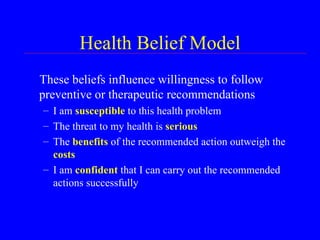
Health Belief Model These beliefs influence willingness to follow preventive or therapeutic recommendations I am  susceptible  to this health problem The threat to my health is  serious The  benefits  of the recommended action outweigh the  costs I am  confident  that I can carry out the recommended actions successfully
Beliefs About Susceptibility Some families resist accepting the diagnosis because they believe that: Because an older relative was crippled by asthma, their child will also be crippled Asthma is psychologically caused or feigned by the child Resisting the diagnosis reduces the likelihood that the family will follow the treatment plan
Beliefs About Seriousness If the family thinks asthma is not serious, they are less likely to follow the treatment plan If the family overestimates the seriousness of asthma, they may follow the plan, but prevent the child from taking part in normal physical activities
Beliefs About Benefits And Costs The benefits of therapy, obvious to the clinician, are often unclear to patients or irrelevant to their personal goals Perceived costs of therapy include: Financial burden of care Fear that medicines will harm the child Regimen seen as time-consuming and hard to carry out
Beliefs About Ability To Carry Out Recommendations Research in psychology shows that when you are confident you can do something successfully: You do it more often You are more persistent in the face of difficulty.  Many families lack confidence that they can manage an asthma attack at home
Because asthma symptoms are variable, families need to recognize symptoms and adjust medications at home according to the clinician’s written plan
Key Features of an Asthma Action Plan Written plan should be keyed to symptoms and severity and should include: Daily management as well as management for exacerbations Medication names (trade and generic) How much to take and when to take it For some patients, focusing on long-term treatment goals may improve adherence
Implications Therefore, the clinician must establish open communications that permit these health beliefs to be identified and discussed.
Barriers To Effective Communications Feel they are wasting the clinician’s valuable time Omit details they deem unimportant Are embarrassed to mention things they think will make them look bad Don’t understand medical terms May believe the clinician has not really listened and therefore doesn’t have the information needed to make a good treatment decision Studies show that patients often:
Specific communication techniques have been shown to enhance physician communication and asthma outcomes for patients
Strategies Non-verbal attentiveness Addressing immediate concerns Reassuring messages GOAL/PURPOSE Relaxing and reassuring patients so they pay attention to what is being said.
Strategies Interactive conversation Eliciting underlying fears GOAL/PURPOSE Improving the exchange of ideas and feelings and gathering information needed for diagnosis and treatment decisions
Strategies Tailoring messages Planning for decision making Goal setting GOAL/PURPOSE Preparing patients to carry out the treatment at home
Strategies Non-verbal encouragement Verbal praise GOAL/PURPOSE Building self confidence needed to carry out the plan.
Several basic asthma concepts must be understood by patients if they are to use therapies successfully and control asthma triggers
Messages What happens during an asthma attack How medicines work How to take the medicines How to respond to changes in asthma severity
Messages (2) Safety of medicines Goals of therapy Criteria for successful treatment
Messages (3) Managing asthma at school Identifying and avoiding triggers Referral to further education
Summary

CME slideshow (PACE)

  • 1.
  • 2.
    Background Excellence inmedical treatment is worthless if the patient doesn’t take the medicine Compliance is closely linked to clinician communication and patient education Most clinicians believe they are good communicators, but most patients feel clinician communication and education is inadequate
  • 3.
    Background (cont) Studiesconsistently show that less than 50% of patients adhere to daily medication regimens Clinicians cannot predict better than chance which patients will be compliant Therefore, all patients need to be educated to ensure compliance Communicating well and providing education are as important as prescribing the right medicine
  • 4.
    Aims To providea theoretical framework - a way to think about clinician-patient communication To demonstrate strategies that clinicians can use to improve communication and help patients be responsive to recommendations
  • 5.
    Health Belief ModelThese beliefs influence willingness to follow preventive or therapeutic recommendations I am susceptible to this health problem The threat to my health is serious The benefits of the recommended action outweigh the costs I am confident that I can carry out the recommended actions successfully
  • 6.
    Beliefs About SusceptibilitySome families resist accepting the diagnosis because they believe that: Because an older relative was crippled by asthma, their child will also be crippled Asthma is psychologically caused or feigned by the child Resisting the diagnosis reduces the likelihood that the family will follow the treatment plan
  • 7.
    Beliefs About SeriousnessIf the family thinks asthma is not serious, they are less likely to follow the treatment plan If the family overestimates the seriousness of asthma, they may follow the plan, but prevent the child from taking part in normal physical activities
  • 8.
    Beliefs About BenefitsAnd Costs The benefits of therapy, obvious to the clinician, are often unclear to patients or irrelevant to their personal goals Perceived costs of therapy include: Financial burden of care Fear that medicines will harm the child Regimen seen as time-consuming and hard to carry out
  • 9.
    Beliefs About AbilityTo Carry Out Recommendations Research in psychology shows that when you are confident you can do something successfully: You do it more often You are more persistent in the face of difficulty. Many families lack confidence that they can manage an asthma attack at home
  • 10.
    Because asthma symptomsare variable, families need to recognize symptoms and adjust medications at home according to the clinician’s written plan
  • 11.
    Key Features ofan Asthma Action Plan Written plan should be keyed to symptoms and severity and should include: Daily management as well as management for exacerbations Medication names (trade and generic) How much to take and when to take it For some patients, focusing on long-term treatment goals may improve adherence
  • 12.
    Implications Therefore, theclinician must establish open communications that permit these health beliefs to be identified and discussed.
  • 13.
    Barriers To EffectiveCommunications Feel they are wasting the clinician’s valuable time Omit details they deem unimportant Are embarrassed to mention things they think will make them look bad Don’t understand medical terms May believe the clinician has not really listened and therefore doesn’t have the information needed to make a good treatment decision Studies show that patients often:
  • 14.
    Specific communication techniqueshave been shown to enhance physician communication and asthma outcomes for patients
  • 15.
    Strategies Non-verbal attentivenessAddressing immediate concerns Reassuring messages GOAL/PURPOSE Relaxing and reassuring patients so they pay attention to what is being said.
  • 16.
    Strategies Interactive conversationEliciting underlying fears GOAL/PURPOSE Improving the exchange of ideas and feelings and gathering information needed for diagnosis and treatment decisions
  • 17.
    Strategies Tailoring messagesPlanning for decision making Goal setting GOAL/PURPOSE Preparing patients to carry out the treatment at home
  • 18.
    Strategies Non-verbal encouragementVerbal praise GOAL/PURPOSE Building self confidence needed to carry out the plan.
  • 19.
    Several basic asthmaconcepts must be understood by patients if they are to use therapies successfully and control asthma triggers
  • 20.
    Messages What happensduring an asthma attack How medicines work How to take the medicines How to respond to changes in asthma severity
  • 21.
    Messages (2) Safetyof medicines Goals of therapy Criteria for successful treatment
  • 22.
    Messages (3) Managingasthma at school Identifying and avoiding triggers Referral to further education
  • 23.

Editor's Notes

  • #3 First, a little background....... Clinician communication and patient education is central to a patient’s compliance with the clinician’s recommendations.
  • #4 * Studies have shown that physicians think they can predict who will comply, but studies show that they cannot. * Assume that every patient is at risk for noncompliance and needs help to adhere to the long-term treatment plan
  • #5 Here are the objectives for the next few slides.
  • #6 Research in psychology has demonstrated that this model can be used to predict and explain health behavior, and that action is strongly related to the four beliefs presented. When the clinician focuses communications on these points, patients have been shown to follow therapeutic advice more closely. * A recent study showed that parents who believed more strongly that their children with asthma were vulnerable were more likely to seek care from a general pediatrician during any acute episode and keep their children home from school regardless of the actual severity of the episode Reference:
  • #7 * These susceptibility beliefs are sometimes the main concern when patients come to see the clinicians, and advice from the clinician can help dispel them.
  • #8 Families need to learn to use objective indicators of asthma’s seriousness. These can include frequency and severity of symptoms, peak flow monitoring, etc. The physician can provide criteria as listed in the asthma action plan so the family can gain a better perspective on the severity of disease.
  • #9 The benefits of the therapy can be explicitly tied to the patient’s personal goals, e.g. to play basketball, to sleep through the night, etc. In this way the “costs” of following the therapeutic plan are reduced and the physician’s recommendations are seen as a way to reach one’s personal goals.
  • #10 You have probably experienced this yourselves, for example when learning a new sport or a musical instrument For example, many families go immediately to the emergency department even for mild asthma episodes instead of beginning appropriate treatment at home Explicit efforts to build patient confidence for self management are central to asthma control
  • #13 Families are often reluctant to bring up their beliefs or concerns; it is important to identify them so they can be dealt with and they do not act as “background noise” distracting the patient from hearing what the clinician is communicating
  • #16 Now let’s review the purpose of each strategy shown in the videotape. Let me emphasize these have been evaluated as part of a clinical trial with pediatricians. References: