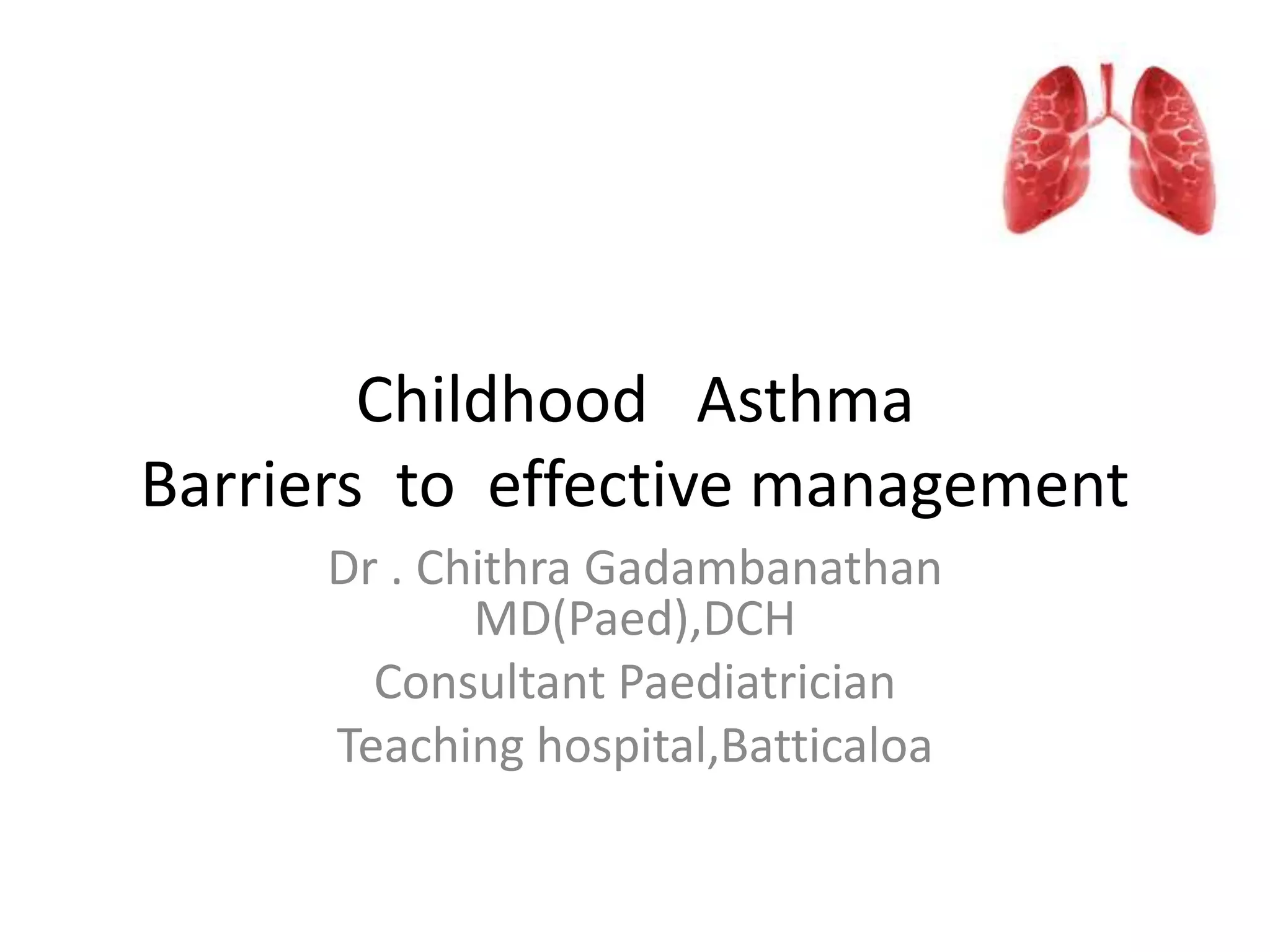
Childhood Asthma
Barriers to effective management
Dr . Chithra Gadambanathan
MD(Paed),DCH
Consultant Paediatrician
Teaching hospital,Batticaloa
• Basics of Asthma
• Impact of Asthma
• Management of asthma
• Defining “Asthma Control”
• Barriers to management
• What are the ways out?
What is Asthma?
• Chronic inflammatory disorder / Airway
• Completely / partially reversible
obstruction.
• With / without specific Rx.
• Inflammation : Hyper reactivity / hyper
responsiveness.
How common is Asthma?
• Most common chronic respiratory disorder
• M:F - 2:1
• Wheezing – commonest cause of admission /
SL children
• Prevalence rate : 15-20% some areas :
35-40%.(SL)
• Common cause - school absenteeism
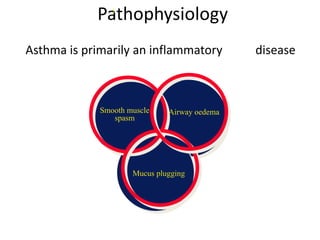
Pathophysiology
Asthma is primarily an inflammatory disease
Mucus plugging
Smooth muscle
spasm
Airway oedema
:
What happens in asthma?
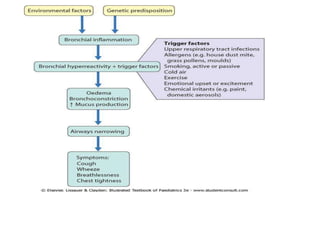
• Airway inflammation – Environmental & genetic
factors.
• Bronchospasm, Mucosal oedema & mucus plugs
• Increased resistance & decreased expiratory flow
• Hyperinflation & hypoventilation
• Hypoxaemia & hypercapnea
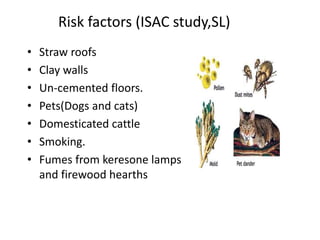
Risk factors (ISAC study,SL)
• Straw roofs
• Clay walls
• Un-cemented floors.
• Pets(Dogs and cats)
• Domesticated cattle
• Smoking.
• Fumes from keresone lamps
and firewood hearths
Diagnosis
• Clinical – Typical symptoms, trigger
factors, F/H , H/O atopy

• Improvement with bronchodilators
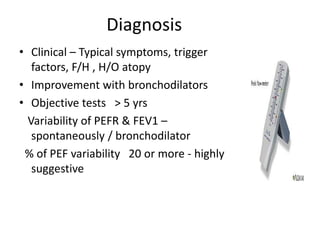
• Objective tests > 5 yrs
Variability of PEFR & FEV1 –
spontaneously / bronchodilator
% of PEF variability 20 or more - highly
suggestive
IMPACT
• PHYSICAL
• SOCIAL
• EMOTIONAL
SE Impact – Child and Family
• Social and leisure pursuits
• Schooling
• Practical aspects of daily life
• Emotional effects
Social and Leisure Pursuits
• Affect the ability to take part in sport.-Limitations or
avoidance
• Avoid coming into contact with animals
• Need to avoid pollen and smoke may similarly restrict
children's play and leisure activities.
• Holiday arrangements can be affected
• Siblings may be affected because of restrictions on the
asthmatic child.
• Parents may be prevented from going out in the evenings or
enjoying a life of their own.
Schooling
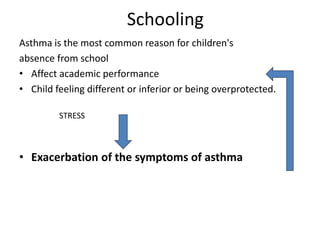
Asthma is the most common reason for children's
absence from school
• Affect academic performance
• Child feeling different or inferior or being overprotected.
STRESS
• Exacerbation of the symptoms of asthma
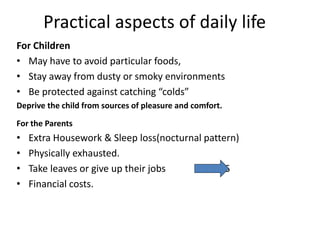
Practical aspects of daily life
For Children
• May have to avoid particular foods,
• Stay away from dusty or smoky environments
• Be protected against catching “colds”
Deprive the child from sources of pleasure and comfort.
For the Parents
• Extra Housework & Sleep loss(nocturnal pattern)
• Physically exhausted.
• Take leaves or give up their jobs STRESS
• Financial costs.
Emotional effects
• Any chronic illness can cause stigma, a loss of self esteem,
and family strain.
• In one study, 41% of parents of asthmatic children said that
asthma caused their children to feel self pity; 21% reported
that their children had a poor self opinion, and 23% felt their
children had poor relationships with their peers.
Restrictions on social activities can increase a child's
sense of isolation and create further difficulties in
establishing social contacts.
Emotional impact on family life
• ‘A constant worry‘ -'red alert' and unable to relax, even
when the asthma is essentially under control.
• Sense of guilt – “We are responsible”
• Over protectiveness and/or a failure to exercise adequate
discipline.
• 34% of parents in one study felt that their had an adverse
effect on their own (parental) relationship.
• Other children receive less than their fair share of
parental attention
Parent-Child Relationship
• Children may seek attention or avoid unpleasant activities-
able to play football at school while claiming to need a
wheelchair at home.
• Parents deny the existence of the condition and to pretend it
does not exist-become hostile and accuse the sufferer of
manipulation
Both children and parents need support
and guidance
Current situation……..
• Although treatment for asthma has improved considerably
over the past 30 years, many sufferers and carers continue to
experience problems in their everyday lives.
What is the reason?
• This may reflect the difficulty of fully controlling the disease
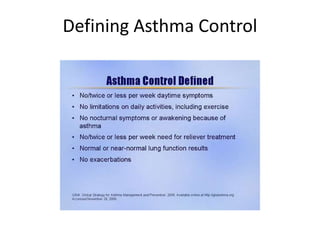
Defining Asthma Control
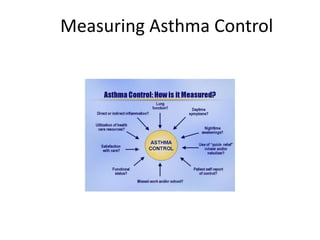
Measuring Asthma Control
Effective Management
• Initial early diagnosis
• Correct assessment.
• Regular Monitoring.
• Clear & ongoing education – Asthma Care
• Control of risk factors & co-morbid
conditions
• Regular use of medications.
Despite improved treatment regimens for
asthma, the prevalence and morbidity from
asthma are increasing among children.
Mona E. Mansour, Bruce P. Lanphear, and Thomas G. DeWitt From
the Children's Hospital Medical Center and the Department of
Pediatrics, University of Cincinnati, Cincinnati, Ohio.
PEDIATRICS Vol. 106 No. 3 September 2000, pp. 512-519
This is true and applicable for us as
well………………..
Current State………….
• Clinicians : Parents are not caring enough – late presentation
and exacerbation
• Parents :Impact of asthma on themselves and their children
is seldom fully recognised.
• School –Denial of opportunities
• Child – Lot of restrictions ??????!
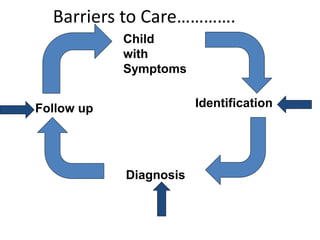
Child
with
Symptoms
Identification
Diagnosis
Follow up
Barriers to Care………….
Barriers- Identification
• Parents - Native management (Symptomatic)
• Primary care staff – Inadequate awareness
• Cultural beliefs and misconceptions
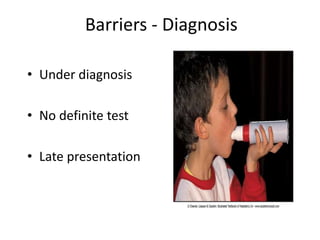
Barriers - Diagnosis
• Under diagnosis
• No definite test
• Late presentation
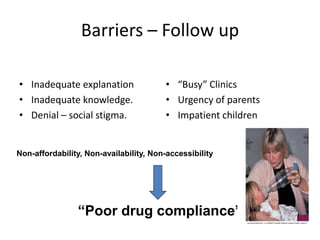
Barriers – Follow up
• Inadequate explanation
• Inadequate knowledge.
• Denial – social stigma.
• “Busy” Clinics
• Urgency of parents
• Impatient children
“Poor drug compliance”
Non-affordability, Non-availability, Non-accessibility
WHAT ARE THE WAYS OUT?
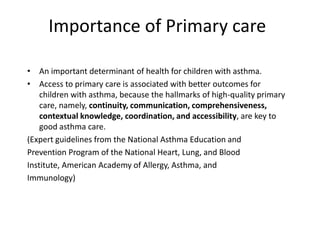
Importance of Primary care
• An important determinant of health for children with asthma.
• Access to primary care is associated with better outcomes for
children with asthma, because the hallmarks of high-quality primary
care, namely, continuity, communication, comprehensiveness,
contextual knowledge, coordination, and accessibility, are key to
good asthma care.
(Expert guidelines from the National Asthma Education and
Prevention Program of the National Heart, Lung, and Blood
Institute, American Academy of Allergy, Asthma, and
Immunology)
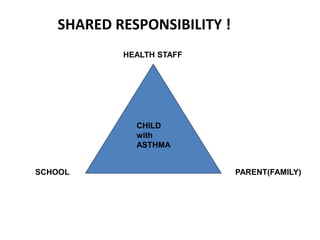
PARENT(FAMILY)
CHILD
with
ASTHMA
HEALTH STAFF
SCHOOL
SHARED RESPONSIBILITY !
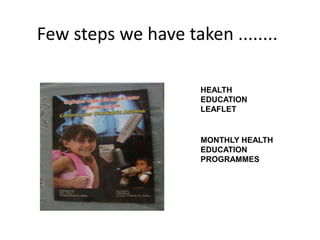
Few steps we have taken ........
HEALTH
EDUCATION
LEAFLET
MONTHLY HEALTH
EDUCATION
PROGRAMMES
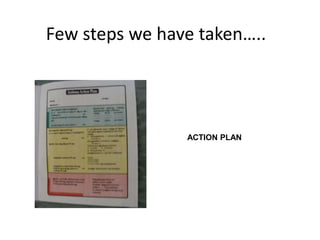
Few steps we have taken…..
ACTION PLAN
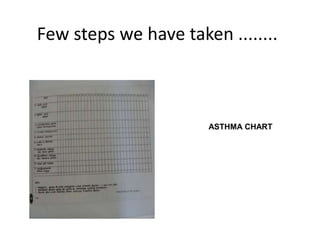
Few steps we have taken ........
ASTHMA CHART
In planning stage………….
• Separate Asthma Clinic
• Continuous educational programmes for
primary care staff
• Awareness raising at school level
Take home messages
• Early diagnosis is the key
• Continuing health education to staff and parents is
essential
• A better appreciation of the social and emotional
impact of asthma is necessary
• Researches on asthma is a need
• “Working together” is mandatory
THANK
YOU!

BMA Child hood Asthma.pptx

  • 1.
    Childhood Asthma Barriers toeffective management Dr . Chithra Gadambanathan MD(Paed),DCH Consultant Paediatrician Teaching hospital,Batticaloa
  • 2.
    • Basics ofAsthma • Impact of Asthma • Management of asthma • Defining “Asthma Control” • Barriers to management • What are the ways out?
  • 3.
    What is Asthma? •Chronic inflammatory disorder / Airway • Completely / partially reversible obstruction. • With / without specific Rx. • Inflammation : Hyper reactivity / hyper responsiveness.
  • 4.
    How common isAsthma? • Most common chronic respiratory disorder • M:F - 2:1 • Wheezing – commonest cause of admission / SL children • Prevalence rate : 15-20% some areas : 35-40%.(SL) • Common cause - school absenteeism
  • 5.
    Pathophysiology Asthma is primarilyan inflammatory disease Mucus plugging Smooth muscle spasm Airway oedema :
  • 6.
    What happens inasthma? • Airway inflammation – Environmental & genetic factors. • Bronchospasm, Mucosal oedema & mucus plugs • Increased resistance & decreased expiratory flow • Hyperinflation & hypoventilation • Hypoxaemia & hypercapnea
  • 8.
    Risk factors (ISACstudy,SL) • Straw roofs • Clay walls • Un-cemented floors. • Pets(Dogs and cats) • Domesticated cattle • Smoking. • Fumes from keresone lamps and firewood hearths
  • 9.
    Diagnosis • Clinical –Typical symptoms, trigger factors, F/H , H/O atopy • Improvement with bronchodilators • Objective tests > 5 yrs Variability of PEFR & FEV1 – spontaneously / bronchodilator % of PEF variability 20 or more - highly suggestive
  • 10.
  • 11.
    SE Impact –Child and Family • Social and leisure pursuits • Schooling • Practical aspects of daily life • Emotional effects
  • 12.
    Social and LeisurePursuits • Affect the ability to take part in sport.-Limitations or avoidance • Avoid coming into contact with animals • Need to avoid pollen and smoke may similarly restrict children's play and leisure activities. • Holiday arrangements can be affected • Siblings may be affected because of restrictions on the asthmatic child. • Parents may be prevented from going out in the evenings or enjoying a life of their own.
  • 13.
    Schooling Asthma is themost common reason for children's absence from school • Affect academic performance • Child feeling different or inferior or being overprotected. STRESS • Exacerbation of the symptoms of asthma
  • 14.
    Practical aspects ofdaily life For Children • May have to avoid particular foods, • Stay away from dusty or smoky environments • Be protected against catching “colds” Deprive the child from sources of pleasure and comfort. For the Parents • Extra Housework & Sleep loss(nocturnal pattern) • Physically exhausted. • Take leaves or give up their jobs STRESS • Financial costs.
  • 15.
    Emotional effects • Anychronic illness can cause stigma, a loss of self esteem, and family strain. • In one study, 41% of parents of asthmatic children said that asthma caused their children to feel self pity; 21% reported that their children had a poor self opinion, and 23% felt their children had poor relationships with their peers. Restrictions on social activities can increase a child's sense of isolation and create further difficulties in establishing social contacts.
  • 16.
    Emotional impact onfamily life • ‘A constant worry‘ -'red alert' and unable to relax, even when the asthma is essentially under control. • Sense of guilt – “We are responsible” • Over protectiveness and/or a failure to exercise adequate discipline. • 34% of parents in one study felt that their had an adverse effect on their own (parental) relationship. • Other children receive less than their fair share of parental attention
  • 17.
    Parent-Child Relationship • Childrenmay seek attention or avoid unpleasant activities- able to play football at school while claiming to need a wheelchair at home. • Parents deny the existence of the condition and to pretend it does not exist-become hostile and accuse the sufferer of manipulation Both children and parents need support and guidance
  • 18.
    Current situation…….. • Althoughtreatment for asthma has improved considerably over the past 30 years, many sufferers and carers continue to experience problems in their everyday lives. What is the reason? • This may reflect the difficulty of fully controlling the disease
  • 19.
  • 20.
  • 21.
    Effective Management • Initialearly diagnosis • Correct assessment. • Regular Monitoring. • Clear & ongoing education – Asthma Care • Control of risk factors & co-morbid conditions • Regular use of medications.
  • 22.
    Despite improved treatmentregimens for asthma, the prevalence and morbidity from asthma are increasing among children. Mona E. Mansour, Bruce P. Lanphear, and Thomas G. DeWitt From the Children's Hospital Medical Center and the Department of Pediatrics, University of Cincinnati, Cincinnati, Ohio. PEDIATRICS Vol. 106 No. 3 September 2000, pp. 512-519 This is true and applicable for us as well………………..
  • 23.
    Current State…………. • Clinicians: Parents are not caring enough – late presentation and exacerbation • Parents :Impact of asthma on themselves and their children is seldom fully recognised. • School –Denial of opportunities • Child – Lot of restrictions ??????!
  • 24.
  • 25.
    Barriers- Identification • Parents- Native management (Symptomatic) • Primary care staff – Inadequate awareness • Cultural beliefs and misconceptions
  • 26.
    Barriers - Diagnosis •Under diagnosis • No definite test • Late presentation
  • 27.
    Barriers – Followup • Inadequate explanation • Inadequate knowledge. • Denial – social stigma. • “Busy” Clinics • Urgency of parents • Impatient children “Poor drug compliance” Non-affordability, Non-availability, Non-accessibility
  • 28.
    WHAT ARE THEWAYS OUT?
  • 29.
    Importance of Primarycare • An important determinant of health for children with asthma. • Access to primary care is associated with better outcomes for children with asthma, because the hallmarks of high-quality primary care, namely, continuity, communication, comprehensiveness, contextual knowledge, coordination, and accessibility, are key to good asthma care. (Expert guidelines from the National Asthma Education and Prevention Program of the National Heart, Lung, and Blood Institute, American Academy of Allergy, Asthma, and Immunology)
  • 30.
  • 31.
    Few steps wehave taken ........ HEALTH EDUCATION LEAFLET MONTHLY HEALTH EDUCATION PROGRAMMES
  • 32.
    Few steps wehave taken….. ACTION PLAN
  • 33.
    Few steps wehave taken ........ ASTHMA CHART
  • 34.
    In planning stage…………. •Separate Asthma Clinic • Continuous educational programmes for primary care staff • Awareness raising at school level
  • 35.
    Take home messages •Early diagnosis is the key • Continuing health education to staff and parents is essential • A better appreciation of the social and emotional impact of asthma is necessary • Researches on asthma is a need • “Working together” is mandatory
  • 36.