
Organizational Policy and Systems Change
Agenda Welcome  (Belinda Nelson) Overview and Examples of Organizational Policy and Systems Change  (Martha Quinn) Systems Change in Dallas: Community Health Workers  (James Walton) Systems Change in Chicago: Clinic Redesign  (Monica Peek and Marshall Chin) Q & A  (Darla Williams)
Presenters Martha Quinn University of Michigan, Center for Managing Chronic Disease
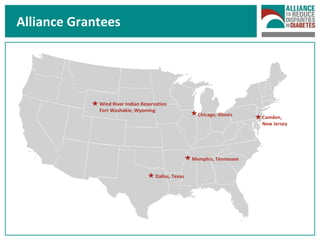
Alliance Grantees Camden,  New Jersey Memphis, Tennessee Dallas, Texas Chicago, Illinois Wind River Indian Reservation Fort Washakie, Wyoming
Objectives Develop a shared understanding of what we mean by โ€œpolicy and systems changeโ€ Highlight current examples of policy and systems change efforts  Facilitate discussion and peer-to- peer learning
Why is this important? An overarching goal of the Alliance is to CHANGE the SYSTEMS and POLICIES that have negative impact on people with diabetes and introduce new policies that will have a positive impact So that, the work of the Alliance  will outlive the funding and be  sustained over the long-term
Policy and Policy Change
What is policy? Public policy Organizational policy
Public policy A set of agreements about how government will address societal needs and spend public funds.  These agreements are: articulated by leaders in all three branches of government, and embedded in many different policy instruments (for example, laws and regulations).
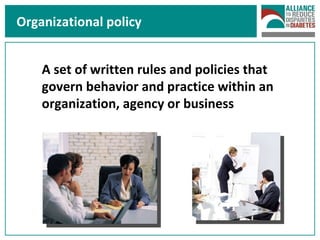
Organizational policy A set of written rules and policies that govern behavior and practice within an organization, agency or business
Custom and Practice Routine practices, cultural norms, customs, and unwritten agreements about behavior are  not policy , but can influence and be influenced by policy
What is organizational policy change? The creation of  new  written policies or rules, or a change in the  current   written policies or rules of an organization
Systems and Systems Change
What is a system? A group of independent but interrelated and interacting elements  (individuals, institutions and infrastructure) that form a unified whole For example: health care delivery system
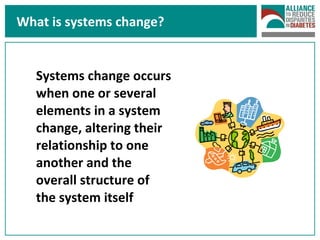
What is systems change? Systems change occurs when one or several elements in a system change, altering their relationship to one another and the overall structure of the system itself
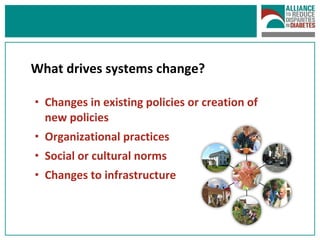
What drives systems change? Changes in existing policies or creation of new policies Organizational practices Social or cultural norms Changes to infrastructure
What is the relationship between policy and systems change? Policy change is an important way to achieve systems change
Examples of Organizational Policy and Systems Change
Health Care Team Approach CareSouth Carolina
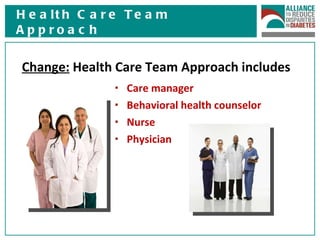
Health Care Team Approach Care manager Behavioral health counselor Nurse Physician Change:  Health Care Team Approach includes
Health Care Team Approach Related Policy Changes: Written job descriptions Board of Directorโ€™s approval Funding allocated Change : Care managers (new position)
Health Care Team Approach Change : Nurses have expanded role Related Policy Changes: Creation of โ€œstanding ordersโ€ Chief Medical Officer approval Clinical Manual of  policies/procedures
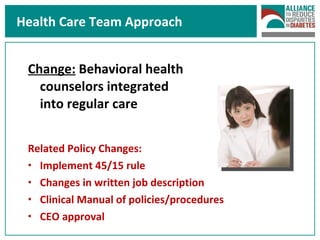
Health Care Team Approach Change:  Behavioral health  counselors integrated  into regular care Related Policy Changes: Implement 45/15 rule Changes in written job description Clinical Manual of policies/procedures CEO approval
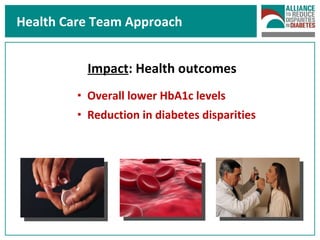
Health Care Team Approach Overall lower HbA1c levels Reduction in diabetes disparities Impact : Health outcomes
Medical Office Visits Providence St. Peter Family Medicine Clinic in  Olympia, Washington
Medical Office Visits Change : patients have a choice to participate in three different types of non-traditional office visits: Planned visits Mini-group medical visits Open office group visits
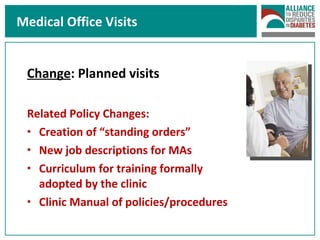
Medical Office Visits Change : Planned visits  Related Policy Changes: Creation of โ€œstanding ordersโ€ New job descriptions for MAs  Curriculum for training formally  adopted by the clinic Clinic Manual of policies/procedures
Medical Office Visits Change : Mini-group visits Related Policy Changes: Patient Confidentiality Forms    required HIPAA compliance required Clinical Manual of    policies/procedures
Medical Office Visits Change : Open office group visits Related Policy Changes: Changes in physician job  descriptions  Creation and adoption of training curriculum Clinical Manual of policies/procedures Chief Medical Officer approval
Medical Office Visits St. Peterโ€™s Approach : policy change came after showing positive outcomes from small pilot First small pilot project Rapid cycle improvements Showed positive outcomes Changed clinic-wide policies  and practices
Medical Office Visits Clinic policies and procedures approved by: Medical Director Organizational Operations Committee (OOC)
Medical Office Visits Impact : Planned and Group medical visits Results of survey data: Patients:  โ€œ..felt well cared for, better supported and more successful and confidentโ€ Medical Assistants:  โ€œ...gained knowledge and confidence in diabetes and self management, and were more satisfied with their jobs.โ€ Physician:  โ€œโ€ฆmodest improvements in comfort with, and perceived effectiveness in providing self management support.โ€
Medical Office Visits Impact : Health Outcomes Patients participating in group visits were more likely to have lower A1C levels than other patients and greater A1C reductions Significant reductions in LDL cholesterol for patients participating in planned visits
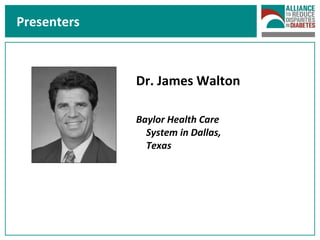
Presenters Dr. James Walton Baylor Health Care System in Dallas, Texas
Grantee Efforts Underway - Dallas Establishment of  Community  Care Coordination Baylor Health Care Systemโ€™s Office of Health Equity established a dedicated โ€œnewโ€ workforce, providing specialized culturally-sensitive care coordination and self-management training   for historically underserved populations with chronic illnesses (i.e. Diabetes)
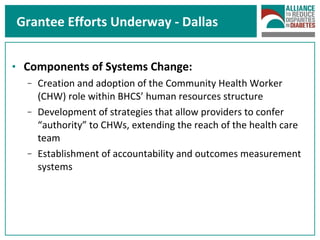
Grantee Efforts Underway - Dallas Components of Systems Change: Creation and adoption of the Community Health Worker (CHW) role within BHCSโ€™ human resources structure Development of strategies that allow providers to confer โ€œauthorityโ€ to CHWs, extending the reach of the health care team Establishment of accountability and outcomes measurement systems
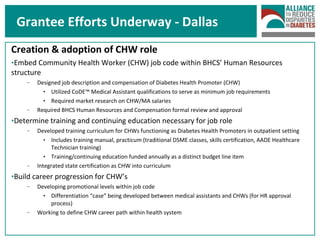
Grantee Efforts Underway - Dallas Creation & adoption of CHW role Embed Community Health Worker (CHW) job code within BHCSโ€™ Human Resources structure Designed job description and compensation of Diabetes Health Promoter (CHW) Utilized CoDE โ„ข Medical Assistant qualifications to serve as minimum job requirements Required market research on CHW/MA salaries Required BHCS Human Resources and Compensation formal review and approval Determine training and continuing education necessary for job role Developed training curriculum for CHWs functioning as Diabetes Health Promoters in outpatient setting Includes training manual, practicum (traditional DSME classes, skills certification, AADE Healthcare Technician training) Training/continuing education funded annually as a distinct budget line item Integrated state certification as CHW into curriculum Build career progression for CHWโ€™s Developing promotional levels within job code Differentiation โ€œcaseโ€ being developed between medical assistants and CHWs (for HR approval process) Working to define CHW career path within health system
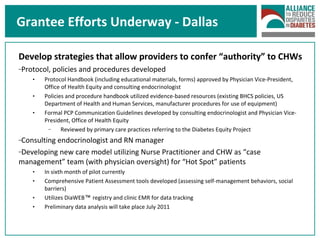
Develop strategies that allow providers to confer โ€œauthorityโ€ to CHWs Protocol, policies and procedures developed Protocol Handbook (including educational materials, forms) approved by Physician Vice-President, Office of Health Equity and consulting endocrinologist Policies and procedure handbook utilized evidence-based resources (existing BHCS policies, US Department of Health and Human Services, manufacturer procedures for use of equipment) Formal PCP Communication Guidelines developed by consulting endocrinologist and Physician Vice-President, Office of Health Equity Reviewed by primary care practices referring to the Diabetes Equity Project Consulting endocrinologist and RN manager Developing new care model utilizing Nurse Practitioner and CHW as โ€œcase managementโ€ team (with physician oversight) for โ€œHot Spotโ€ patients In sixth month of pilot currently Comprehensive Patient Assessment tools developed (assessing self-management behaviors, social barriers) Utilizes DiaWEB โ„ข  registry and clinic EMR for data tracking Preliminary data analysis will take place July 2011 Grantee Efforts Underway - Dallas
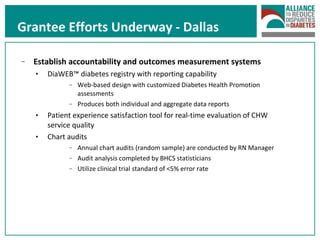
Establish accountability and outcomes measurement systems   DiaWEB โ„ข diabetes registry with reporting capability Web-based design with customized Diabetes Health Promotion assessments Produces both individual and aggregate data reports Patient experience satisfaction tool for real-time evaluation of CHW service quality Chart audits Annual chart audits (random sample) are conducted by RN Manager Audit analysis completed by BHCS statisticians Utilize clinical trial standard of <5% error rate Grantee Efforts Underway - Dallas
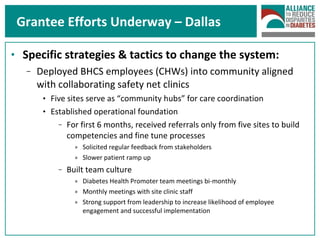
Grantee Efforts Underway โ€“ Dallas  Specific strategies & tactics to change the system: Deployed BHCS employees (CHWs) into community aligned with collaborating safety net clinics Five sites serve as โ€œcommunity hubsโ€ for care coordination Established operational foundation For first 6 months, received referrals only from five sites to build competencies and fine tune processes Solicited regular feedback from stakeholders  Slower patient ramp up Built team culture Diabetes Health Promoter team meetings bi-monthly Monthly meetings with site clinic staff Strong support from leadership to increase likelihood of employee engagement and successful implementation
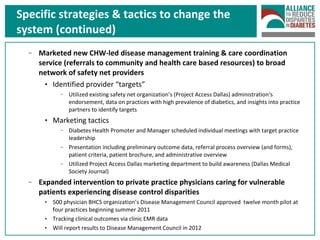
Specific strategies & tactics to change the system (continued) Marketed new CHW-led disease management training & care coordination service (referrals to community and health care based resources) to broad network of safety net providers Identified provider โ€œtargetsโ€ Utilized existing safety net organizationโ€™s (Project Access Dallas) administrationโ€˜s endorsement, data on practices with high prevalence of diabetics, and insights into practice partners to identify targets  Marketing tactics Diabetes Health Promoter and Manager scheduled individual meetings with target practice leadership Presentation including preliminary outcome data, referral process overview (and forms), patient criteria, patient brochure, and administrative overview Utilized Project Access Dallas marketing department to build awareness (Dallas Medical Society Journal) Expanded intervention to private practice physicians caring for vulnerable patients experiencing disease control disparities 500 physician BHCS organizationโ€™s Disease Management Council approved  twelve month pilot at four practices beginning summer 2011 Tracking clinical outcomes via clinic EMR data Will report results to Disease Management Council in 2012
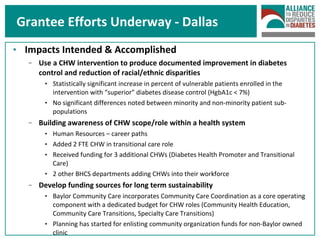
Grantee Efforts Underway - Dallas Impacts Intended & Accomplished Use a CHW intervention to produce documented improvement in diabetes control and reduction of racial/ethnic disparities Statistically significant increase in percent of vulnerable patients enrolled in the intervention with โ€œsuperiorโ€ diabetes disease control (HgbA1c < 7%) No significant differences noted between minority and non-minority patient sub-populations Building awareness of CHW scope/role within a health system Human Resources โ€“ career paths Added 2 FTE CHW in transitional care role Received funding for 3 additional CHWs (Diabetes Health Promoter and Transitional Care) 2 other BHCS departments adding CHWs into their workforce Develop funding sources for long term sustainability  Baylor Community Care incorporates Community Care Coordination as a core operating component with a dedicated budget for CHW roles (Community Health Education, Community Care Transitions, Specialty Care Transitions)  Planning has started for enlisting community organization funds for non-Baylor owned clinic
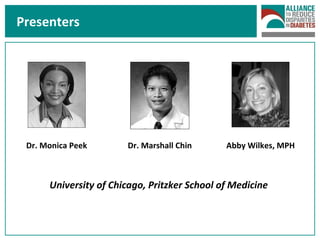
Presenters Dr. Monica Peek Dr. Marshall Chin University of Chicago, Pritzker School of Medicine  Abby Wilkes, MPH
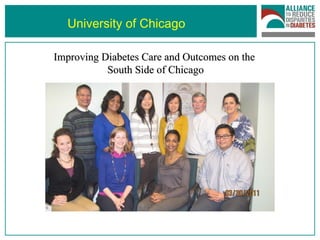
University of Chicago Improving Diabetes Care and Outcomes on the  South Side of Chicago
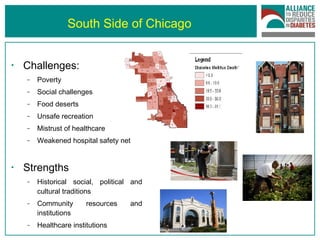
South Side of Chicago Challenges: Poverty Social challenges  Food deserts Unsafe recreation Mistrust of healthcare Weakened hospital safety net Strengths Historical social, political and cultural traditions Community resources and institutions Healthcare institutions
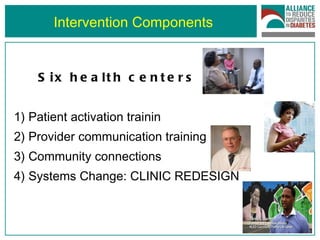
Intervention Components Six health centers 1) Patient activation trainin 2) Provider communication training 3) Community connections 4) Systems Change: CLINIC REDESIGN
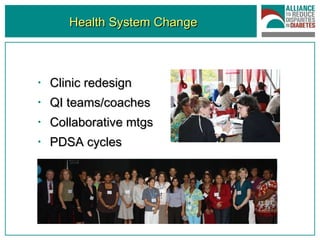
Health System Change Clinic redesign QI teams/coaches Collaborative mtgs PDSA cycles
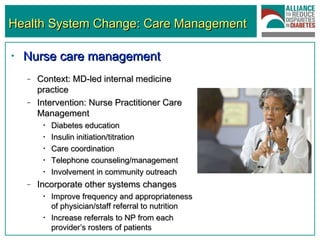
Health System Change: Care Management Nurse care management   Context: MD-led internal medicine practice Intervention: Nurse Practitioner Care Management Diabetes education Insulin initiation/titration Care coordination Telephone counseling/management Involvement in community outreach Incorporate other systems changes Improve frequency and appropriateness of physician/staff referral to nutrition Increase referrals to NP from each providerโ€™s rosters of patients
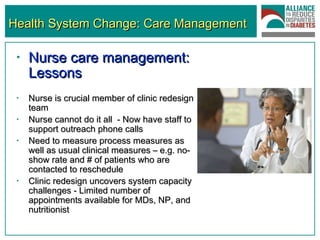
Health System Change: Care Management Nurse care management: Lessons   Nurse is crucial member of clinic redesign team Nurse cannot do it all  - Now have staff to support outreach phone calls Need to measure process measures as well as usual clinical measures โ€“ e.g. no-show rate and # of patients who are contacted to reschedule Clinic redesign uncovers system capacity challenges - Limited number of appointments available for MDs, NP, and nutritionist
Health System Change: Group Visits Diabetes group visits Context: 2 federally-qualified health centers Intervention: Shared medical appts Diabetes education Medication titration/clinical care Support group Some evidence re: reduced costs, hospitalizations, lower blood pressure, Improved patient/provider satisfaction
Health System Change: Group Visits Diabetes group visits: Lessons Pre-plan Identify schedule changes for staff Determine types of providers/staff needed Find out how to bill Work out patient co-pays
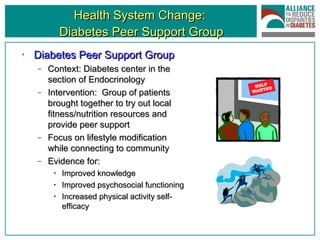
Health System Change:  Diabetes Peer Support Group Diabetes Peer Support Group Context: Diabetes center in the section of Endocrinology Intervention:  Group of patients brought together to try out local fitness/nutrition resources and provide peer support Focus on lifestyle modification while connecting to community Evidence for: Improved knowledge Improved psychosocial functioning Increased physical activity self-efficacy
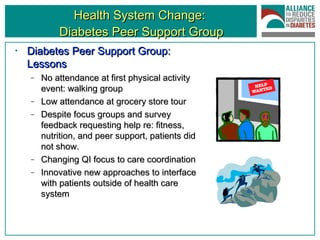
Health System Change:  Diabetes Peer Support Group Diabetes Peer Support Group: Lessons   No attendance at first physical activity event: walking group Low attendance at grocery store tour Despite focus groups and survey feedback requesting help re: fitness, nutrition, and peer support, patients did not show. Changing QI focus to care coordination Innovative new approaches to interface with patients outside of health care system
Lessons Learned from  QI Process Individualize to clinics Whatโ€™s important to clinics vs. more ambitious change Crawl, walk, run  Coaches are vital Learn from peer clinics Collaborative meetings Support network
Lessons Learned from  QI Process Address challenges of health centers Staff turn-over Leadership buy-in Project scope and size Learning curve Perseverance pays off
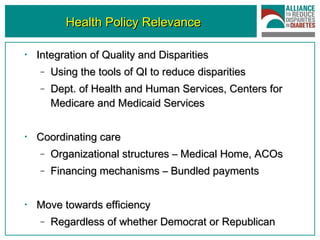
Health Policy Relevance Integration of Quality and Disparities  Using the tools of QI to reduce disparities Dept. of Health and Human Services, Centers for Medicare and Medicaid Services Coordinating care Organizational structures โ€“ Medical Home, ACOs  Financing mechanisms โ€“ Bundled payments Move towards efficiency Regardless of whether Democrat or Republican
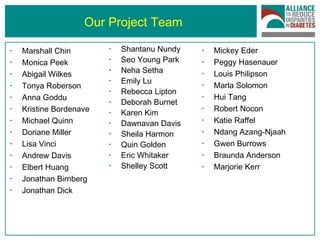
Our Project Team Marshall Chin Monica Peek Abigail Wilkes Tonya Roberson Anna Goddu Kristine Bordenave Michael Quinn Doriane Miller Lisa Vinci Andrew Davis Elbert Huang Jonathan Birnberg Jonathan Dick Mickey Eder Peggy Hasenauer Louis Philipson Marla Solomon Hui Tang Robert Nocon Katie Raffel Ndang Azang-Njaah Gwen Burrows Braunda Anderson Marjorie Kerr Shantanu Nundy Seo Young Park Neha Setha Emily Lu Rebecca Lipton Deborah Burnet Karen Kim Dawnavan Davis Sheila Harmon Quin Golden Eric Whitaker Shelley Scott
Questions? General Questions: Martha Quinn  [email_address]   Questions on Dallas or Chicago Initiatives: Darla Williams  [email_address] Technical Questions: Gillian Mayman  [email_address]
Organizational Policy and Systems Change www.ardd.sph.umich.edu

Organizational Policy and Systems Change

  • 1.
  • 2.
    Agenda Welcome (Belinda Nelson) Overview and Examples of Organizational Policy and Systems Change (Martha Quinn) Systems Change in Dallas: Community Health Workers (James Walton) Systems Change in Chicago: Clinic Redesign (Monica Peek and Marshall Chin) Q & A (Darla Williams)
  • 3.
    Presenters Martha QuinnUniversity of Michigan, Center for Managing Chronic Disease
  • 4.
    Alliance Grantees Camden, New Jersey Memphis, Tennessee Dallas, Texas Chicago, Illinois Wind River Indian Reservation Fort Washakie, Wyoming
  • 5.
    Objectives Develop ashared understanding of what we mean by โ€œpolicy and systems changeโ€ Highlight current examples of policy and systems change efforts Facilitate discussion and peer-to- peer learning
  • 6.
    Why is thisimportant? An overarching goal of the Alliance is to CHANGE the SYSTEMS and POLICIES that have negative impact on people with diabetes and introduce new policies that will have a positive impact So that, the work of the Alliance will outlive the funding and be sustained over the long-term
  • 7.
  • 8.
    What is policy?Public policy Organizational policy
  • 9.
    Public policy Aset of agreements about how government will address societal needs and spend public funds. These agreements are: articulated by leaders in all three branches of government, and embedded in many different policy instruments (for example, laws and regulations).
  • 10.
    Organizational policy Aset of written rules and policies that govern behavior and practice within an organization, agency or business
  • 11.
    Custom and PracticeRoutine practices, cultural norms, customs, and unwritten agreements about behavior are not policy , but can influence and be influenced by policy
  • 12.
    What is organizationalpolicy change? The creation of new written policies or rules, or a change in the current written policies or rules of an organization
  • 13.
  • 14.
    What is asystem? A group of independent but interrelated and interacting elements (individuals, institutions and infrastructure) that form a unified whole For example: health care delivery system
  • 15.
    What is systemschange? Systems change occurs when one or several elements in a system change, altering their relationship to one another and the overall structure of the system itself
  • 16.
    What drives systemschange? Changes in existing policies or creation of new policies Organizational practices Social or cultural norms Changes to infrastructure
  • 17.
    What is therelationship between policy and systems change? Policy change is an important way to achieve systems change
  • 18.
    Examples of OrganizationalPolicy and Systems Change
  • 19.
    Health Care TeamApproach CareSouth Carolina
  • 20.
    Health Care TeamApproach Care manager Behavioral health counselor Nurse Physician Change: Health Care Team Approach includes
  • 21.
    Health Care TeamApproach Related Policy Changes: Written job descriptions Board of Directorโ€™s approval Funding allocated Change : Care managers (new position)
  • 22.
    Health Care TeamApproach Change : Nurses have expanded role Related Policy Changes: Creation of โ€œstanding ordersโ€ Chief Medical Officer approval Clinical Manual of policies/procedures
  • 23.
    Health Care TeamApproach Change: Behavioral health counselors integrated into regular care Related Policy Changes: Implement 45/15 rule Changes in written job description Clinical Manual of policies/procedures CEO approval
  • 24.
    Health Care TeamApproach Overall lower HbA1c levels Reduction in diabetes disparities Impact : Health outcomes
  • 25.
    Medical Office VisitsProvidence St. Peter Family Medicine Clinic in Olympia, Washington
  • 26.
    Medical Office VisitsChange : patients have a choice to participate in three different types of non-traditional office visits: Planned visits Mini-group medical visits Open office group visits
  • 27.
    Medical Office VisitsChange : Planned visits Related Policy Changes: Creation of โ€œstanding ordersโ€ New job descriptions for MAs Curriculum for training formally adopted by the clinic Clinic Manual of policies/procedures
  • 28.
    Medical Office VisitsChange : Mini-group visits Related Policy Changes: Patient Confidentiality Forms required HIPAA compliance required Clinical Manual of policies/procedures
  • 29.
    Medical Office VisitsChange : Open office group visits Related Policy Changes: Changes in physician job descriptions Creation and adoption of training curriculum Clinical Manual of policies/procedures Chief Medical Officer approval
  • 30.
    Medical Office VisitsSt. Peterโ€™s Approach : policy change came after showing positive outcomes from small pilot First small pilot project Rapid cycle improvements Showed positive outcomes Changed clinic-wide policies and practices
  • 31.
    Medical Office VisitsClinic policies and procedures approved by: Medical Director Organizational Operations Committee (OOC)
  • 32.
    Medical Office VisitsImpact : Planned and Group medical visits Results of survey data: Patients: โ€œ..felt well cared for, better supported and more successful and confidentโ€ Medical Assistants: โ€œ...gained knowledge and confidence in diabetes and self management, and were more satisfied with their jobs.โ€ Physician: โ€œโ€ฆmodest improvements in comfort with, and perceived effectiveness in providing self management support.โ€
  • 33.
    Medical Office VisitsImpact : Health Outcomes Patients participating in group visits were more likely to have lower A1C levels than other patients and greater A1C reductions Significant reductions in LDL cholesterol for patients participating in planned visits
  • 34.
    Presenters Dr. JamesWalton Baylor Health Care System in Dallas, Texas
  • 35.
    Grantee Efforts Underway- Dallas Establishment of Community Care Coordination Baylor Health Care Systemโ€™s Office of Health Equity established a dedicated โ€œnewโ€ workforce, providing specialized culturally-sensitive care coordination and self-management training for historically underserved populations with chronic illnesses (i.e. Diabetes)
  • 36.
    Grantee Efforts Underway- Dallas Components of Systems Change: Creation and adoption of the Community Health Worker (CHW) role within BHCSโ€™ human resources structure Development of strategies that allow providers to confer โ€œauthorityโ€ to CHWs, extending the reach of the health care team Establishment of accountability and outcomes measurement systems
  • 37.
    Grantee Efforts Underway- Dallas Creation & adoption of CHW role Embed Community Health Worker (CHW) job code within BHCSโ€™ Human Resources structure Designed job description and compensation of Diabetes Health Promoter (CHW) Utilized CoDE โ„ข Medical Assistant qualifications to serve as minimum job requirements Required market research on CHW/MA salaries Required BHCS Human Resources and Compensation formal review and approval Determine training and continuing education necessary for job role Developed training curriculum for CHWs functioning as Diabetes Health Promoters in outpatient setting Includes training manual, practicum (traditional DSME classes, skills certification, AADE Healthcare Technician training) Training/continuing education funded annually as a distinct budget line item Integrated state certification as CHW into curriculum Build career progression for CHWโ€™s Developing promotional levels within job code Differentiation โ€œcaseโ€ being developed between medical assistants and CHWs (for HR approval process) Working to define CHW career path within health system
  • 38.
    Develop strategies thatallow providers to confer โ€œauthorityโ€ to CHWs Protocol, policies and procedures developed Protocol Handbook (including educational materials, forms) approved by Physician Vice-President, Office of Health Equity and consulting endocrinologist Policies and procedure handbook utilized evidence-based resources (existing BHCS policies, US Department of Health and Human Services, manufacturer procedures for use of equipment) Formal PCP Communication Guidelines developed by consulting endocrinologist and Physician Vice-President, Office of Health Equity Reviewed by primary care practices referring to the Diabetes Equity Project Consulting endocrinologist and RN manager Developing new care model utilizing Nurse Practitioner and CHW as โ€œcase managementโ€ team (with physician oversight) for โ€œHot Spotโ€ patients In sixth month of pilot currently Comprehensive Patient Assessment tools developed (assessing self-management behaviors, social barriers) Utilizes DiaWEB โ„ข registry and clinic EMR for data tracking Preliminary data analysis will take place July 2011 Grantee Efforts Underway - Dallas
  • 39.
    Establish accountability andoutcomes measurement systems DiaWEB โ„ข diabetes registry with reporting capability Web-based design with customized Diabetes Health Promotion assessments Produces both individual and aggregate data reports Patient experience satisfaction tool for real-time evaluation of CHW service quality Chart audits Annual chart audits (random sample) are conducted by RN Manager Audit analysis completed by BHCS statisticians Utilize clinical trial standard of <5% error rate Grantee Efforts Underway - Dallas
  • 40.
    Grantee Efforts Underwayโ€“ Dallas Specific strategies & tactics to change the system: Deployed BHCS employees (CHWs) into community aligned with collaborating safety net clinics Five sites serve as โ€œcommunity hubsโ€ for care coordination Established operational foundation For first 6 months, received referrals only from five sites to build competencies and fine tune processes Solicited regular feedback from stakeholders Slower patient ramp up Built team culture Diabetes Health Promoter team meetings bi-monthly Monthly meetings with site clinic staff Strong support from leadership to increase likelihood of employee engagement and successful implementation
  • 41.
    Specific strategies &tactics to change the system (continued) Marketed new CHW-led disease management training & care coordination service (referrals to community and health care based resources) to broad network of safety net providers Identified provider โ€œtargetsโ€ Utilized existing safety net organizationโ€™s (Project Access Dallas) administrationโ€˜s endorsement, data on practices with high prevalence of diabetics, and insights into practice partners to identify targets Marketing tactics Diabetes Health Promoter and Manager scheduled individual meetings with target practice leadership Presentation including preliminary outcome data, referral process overview (and forms), patient criteria, patient brochure, and administrative overview Utilized Project Access Dallas marketing department to build awareness (Dallas Medical Society Journal) Expanded intervention to private practice physicians caring for vulnerable patients experiencing disease control disparities 500 physician BHCS organizationโ€™s Disease Management Council approved twelve month pilot at four practices beginning summer 2011 Tracking clinical outcomes via clinic EMR data Will report results to Disease Management Council in 2012
  • 42.
    Grantee Efforts Underway- Dallas Impacts Intended & Accomplished Use a CHW intervention to produce documented improvement in diabetes control and reduction of racial/ethnic disparities Statistically significant increase in percent of vulnerable patients enrolled in the intervention with โ€œsuperiorโ€ diabetes disease control (HgbA1c < 7%) No significant differences noted between minority and non-minority patient sub-populations Building awareness of CHW scope/role within a health system Human Resources โ€“ career paths Added 2 FTE CHW in transitional care role Received funding for 3 additional CHWs (Diabetes Health Promoter and Transitional Care) 2 other BHCS departments adding CHWs into their workforce Develop funding sources for long term sustainability Baylor Community Care incorporates Community Care Coordination as a core operating component with a dedicated budget for CHW roles (Community Health Education, Community Care Transitions, Specialty Care Transitions) Planning has started for enlisting community organization funds for non-Baylor owned clinic
  • 43.
    Presenters Dr. MonicaPeek Dr. Marshall Chin University of Chicago, Pritzker School of Medicine Abby Wilkes, MPH
  • 44.
    University of ChicagoImproving Diabetes Care and Outcomes on the South Side of Chicago
  • 45.
    South Side ofChicago Challenges: Poverty Social challenges Food deserts Unsafe recreation Mistrust of healthcare Weakened hospital safety net Strengths Historical social, political and cultural traditions Community resources and institutions Healthcare institutions
  • 46.
    Intervention Components Sixhealth centers 1) Patient activation trainin 2) Provider communication training 3) Community connections 4) Systems Change: CLINIC REDESIGN
  • 47.
    Health System ChangeClinic redesign QI teams/coaches Collaborative mtgs PDSA cycles
  • 48.
    Health System Change:Care Management Nurse care management Context: MD-led internal medicine practice Intervention: Nurse Practitioner Care Management Diabetes education Insulin initiation/titration Care coordination Telephone counseling/management Involvement in community outreach Incorporate other systems changes Improve frequency and appropriateness of physician/staff referral to nutrition Increase referrals to NP from each providerโ€™s rosters of patients
  • 49.
    Health System Change:Care Management Nurse care management: Lessons Nurse is crucial member of clinic redesign team Nurse cannot do it all - Now have staff to support outreach phone calls Need to measure process measures as well as usual clinical measures โ€“ e.g. no-show rate and # of patients who are contacted to reschedule Clinic redesign uncovers system capacity challenges - Limited number of appointments available for MDs, NP, and nutritionist
  • 50.
    Health System Change:Group Visits Diabetes group visits Context: 2 federally-qualified health centers Intervention: Shared medical appts Diabetes education Medication titration/clinical care Support group Some evidence re: reduced costs, hospitalizations, lower blood pressure, Improved patient/provider satisfaction
  • 51.
    Health System Change:Group Visits Diabetes group visits: Lessons Pre-plan Identify schedule changes for staff Determine types of providers/staff needed Find out how to bill Work out patient co-pays
  • 52.
    Health System Change: Diabetes Peer Support Group Diabetes Peer Support Group Context: Diabetes center in the section of Endocrinology Intervention: Group of patients brought together to try out local fitness/nutrition resources and provide peer support Focus on lifestyle modification while connecting to community Evidence for: Improved knowledge Improved psychosocial functioning Increased physical activity self-efficacy
  • 53.
    Health System Change: Diabetes Peer Support Group Diabetes Peer Support Group: Lessons No attendance at first physical activity event: walking group Low attendance at grocery store tour Despite focus groups and survey feedback requesting help re: fitness, nutrition, and peer support, patients did not show. Changing QI focus to care coordination Innovative new approaches to interface with patients outside of health care system
  • 54.
    Lessons Learned from QI Process Individualize to clinics Whatโ€™s important to clinics vs. more ambitious change Crawl, walk, run Coaches are vital Learn from peer clinics Collaborative meetings Support network
  • 55.
    Lessons Learned from QI Process Address challenges of health centers Staff turn-over Leadership buy-in Project scope and size Learning curve Perseverance pays off
  • 56.
    Health Policy RelevanceIntegration of Quality and Disparities Using the tools of QI to reduce disparities Dept. of Health and Human Services, Centers for Medicare and Medicaid Services Coordinating care Organizational structures โ€“ Medical Home, ACOs Financing mechanisms โ€“ Bundled payments Move towards efficiency Regardless of whether Democrat or Republican
  • 57.
    Our Project TeamMarshall Chin Monica Peek Abigail Wilkes Tonya Roberson Anna Goddu Kristine Bordenave Michael Quinn Doriane Miller Lisa Vinci Andrew Davis Elbert Huang Jonathan Birnberg Jonathan Dick Mickey Eder Peggy Hasenauer Louis Philipson Marla Solomon Hui Tang Robert Nocon Katie Raffel Ndang Azang-Njaah Gwen Burrows Braunda Anderson Marjorie Kerr Shantanu Nundy Seo Young Park Neha Setha Emily Lu Rebecca Lipton Deborah Burnet Karen Kim Dawnavan Davis Sheila Harmon Quin Golden Eric Whitaker Shelley Scott
  • 58.
    Questions? General Questions:Martha Quinn [email_address] Questions on Dallas or Chicago Initiatives: Darla Williams [email_address] Technical Questions: Gillian Mayman [email_address]
  • 59.
    Organizational Policy andSystems Change www.ardd.sph.umich.edu

Editor's Notes

  • #2ย Belindaโ€™s Welcome
  • #3ย Belinda
  • #4ย Belinda
  • #5ย The Merck Company Foundation launched the Alliance to Reduce Disparities in Diabetes in 2009 to address the growing problem of health care disparities in Type 2 diabetes in the United States among low-income and underserved adult populations. Through this Alliance, the foundation supports comprehensive, multifaceted, community-based programs to improve health outcomes for people living with diabetes in five grantee communities: Camden, New Jersey; Chicago, Illinois; Dallas, Texas; Wind River Reservation, Wyoming; and Memphis, Tennessee. These sites are working to change the systems and policies related to diabetes management and prevention in their communities.
  • #6ย This presentation has three objectives: To develop a common understanding of what is meant by โ€œpolicy and systems changeโ€ Provide some examples of policy and systems change efforts currently underway around the country ; and Facilitate discussion and peer-to-peer learning.
  • #8ย For the purposes of the Alliance work, what do we mean by policy and policy change?
  • #9ย First, we make the distinction between two kinds of policy: public and organizational.
  • #10ย Public policy is: A set of agreements about how government will address societyโ€™s needs and spend public funds that are articulated by leaders in all three branches of the government and embedded in many different policy instruments (for example, laws and regulations)
  • #11ย Organizational policy is: A set of written rules and policies that govern behavior and practice within an organization, business or agency. ย 
  • #12ย Routine practices, cultural norms, customs, and unwritten agreements about behavior are not policy, but can influence and be influenced by policy Example: It may be a custom or normative practice in a clinic that a receptionist greets and welcomes a patient and refers to him/her by name. โ€œHello Mr. Jones. Good to see you.โ€ This practice is common but its not written down anywhere. ย  For the purpose of this webinar, we will focus on formal policy change (rather than customs and practices) and look specifically at organizational policy examples rather than public policy examples.
  • #13ย What is organizational policy change? Itโ€™s the creation of new written policies or rules or a change in the current policies or rules of an organization. The change is generally agreed upon by a decision-making body or by an individual in a leadership position.
  • #14ย Now, for the purposes of the Alliance work, what do we mean by systems and systems change?
  • #15ย A system is a group of independent but interrelated and interacting elementsโ€“individuals, institutions and infrastructureโ€“that form a unified whole. For instance, the health care delivery system is a large and complex system with many interacting components that affect our health and well-being. There are doctorโ€™s offices, clinics, hospitals, health departments, pharmaceutical companies, insurers etc. that combined comprise the health system. Other systems also affect our health, such as the food system.
  • #16ย Systems are not static entities. They are constantly changing and evolving. So what does it mean to talk about systems change? Systems change occurs when one or several elements in a system, change, altering both their relationship to one another and the overall structure of the system itself. In addition, change in one system can effect change in other systems.
  • #17ย There are a number of ways in which systems can change. Changes in new or existing policies, organizational practices, social and cultural norms and changes to infrastructure all have an impact on systems.
  • #18ย What is the relationship between policy and systems change? Policy change is an important driver of systems change and will help to ensure the sustainability of the changes over the long-term. By setting anew policy the practices and relationships within and between organizations change.
  • #19ย Now Iโ€™d like to talk about some examples of organizational changes going on around the country related to diabetes management, education and prevention. Health care organizations around the country are experimenting with new and innovative approaches to diabetes management.
  • #20ย One such example is in the rural Pee Dee region of South Carolina. CareSouth Carolina is a community health center that has grown from a small, one-physician office to a regional health provider serving more than 35,000 patients at nine different medical centers. Despite this growth, CareSouth has remained committed to itโ€™s community-based approach to health care and has been recognized by the Institute for Healthcare Improvement for its innovative approach to diabetes care. While CareSouth has adopted many changes to their health care delivery system over the last several years, the change that we are going to discuss is their implementation of a โ€œhealth care team approachโ€.
  • #21ย The team approach consists of a care manager, behavioral health counselor, nurse and a physician. While the physician remains a strong partner in the team, CareSouth added care managers to the team and enhanced the roles of nurses and behavioral health counselors in caring for diabetes patients.
  • #22ย CareSouth added a new member to their traditional doctor/nurse team โ€“ a care manager. A written job description was drafted and the health centerโ€™s Board of Directors had to approve the new position. One challenge was that the new position required additional funding, so the Board had to allocate funding for the new position. In order to persuade the Board to make this change, the CEO of CareSouth used a business model plan to show that adding care managers would mean that the Center could increase the number of patients seen and this would offset the additional cost. It worked and the funding was allocated. This change meant that the health care team is now able to spend more time with patients. Care managers meet with patients individually to provide prevention and self-management education and help with individual goal setting. Care managers also hold group classes for diabetes patients and are able to get to know patients.
  • #23ย In this new team approach, nurses have an expanded role that allows them to order lab tests, refill medications and adjust insulin doses. According to the CEO of CareSouth, this has made patient office visits much more efficient. CareSouth implemented this change by creating a series of standard written โ€œstanding ordersโ€ from physicians for things such as drawing blood, ordering lab tests or EKGs, and refilling medications. Creation of the standing orders had to be approved by the chief medical officer at CareSouth, which was not difficult, according to the CEO because the Chief Medical Officer realized that the change would save physicians time and make the process much more efficient. All procedures and guidelines for creating and implementing these new standing orders were documented in the Centerโ€™s Clinical Manual of written policies and procedures.
  • #24ย CareSouth also integrated behavioral health counselors into the regular care of patients. While counselors were available to patients before on a pre-scheduled basis, CareSouth integrated same day, same location behavioral health counseling services for all patients. Having a counselor available to patients when they come in for other appointments and on an as needed basis, has made all the difference according to CareSouth. They did this by adopting a 45/15 appointment scheduling rule that requires all on-site health counselors to keep the first 15 minutes of every hour open and available for patients with immediate counseling needs. The health counselors are licensed, maters-level social workers with experience working with patients on issues related to depression and problem solving. This change took the form of a written appointment rule change and was documented in the Centerโ€™s Clinical Manual. Also, the job description for the behavioral health counselors was revised to include the 45/15 model. The CEO of CareSouth approved this change. Since it was not considered a new formal policy per se, but rather a change in practice and procedure, the Centerโ€™s Board of Directors did not need to approve.
  • #25ย CareSouth clinicians have reported that implementing the โ€œteam approachโ€ has improved health outcomes and helped to reduce disparities among patients. Before the โ€œteam approachโ€ was implemented only 15% of patients had A1c Hemoglobin levels under control with a measurement of 7 or less. Today 54% of diabetes patients at CareSouth have levels of 7 or less. In addition, the โ€œteam approachโ€ has helped them move toward their goal of 0% disparities in hemoglobin A1c levels. Currently, their disparity level measures 6%, indicating that A1c levels are about 6% higher in non-white populations than white populations. Although CareSouth has not yet reached their target, their level of 6% is vastly better than surrounding rural communities which experience disparities at a level of approximately 100%.
  • #26ย The next example we will discuss includes recent changes implemented at St. Peter Family Medicine Clinic in Olympia, Washington. St. Peter is one of 14 family medicine programs affiliated with the University of Washington and is one of the Robert Wood Johnson Foundationโ€™s Diabetes Initiative grantees. With funding from the Foundationโ€™s Diabetes Initiative, St. Peter was able to redesign their diabetes care.
  • #27ย St. Peter now offers three different types of non-traditional medical office visits along with the more traditional 1-on-1 patient/doctor visit. These include: planned visits, mini-group medical visits and open office group visits.
  • #28ย โ€œ Planned visitsโ€ between a medical assistant and patient serve to prepare both the patient and physician for their scheduled visit in the following 1-2 weeks. Medical assistants initiate lab testing, routine measurements, and goal setting at the โ€œplanned visitโ€ in order for the results to be ready for the traditional physician-patient visit. This change required that explicit standing orders be created for the medical assistants to follow during these visits in a sort of โ€œcookbook โ€œ fashion. The creation of โ€œplanned visitsโ€ redefined the role of medical assistants and added new protocols and curriculum to their training. Despite apprehension, the staff at St. Peterโ€™s reports that after a period of adjustment, the medical assistants became comfortable with the new responsibilities and many report higher job satisfaction now.
  • #29ย St. Peter also implemented โ€œmini- groupโ€ medical visits as an option to replace the traditional office visit with a physician. โ€œMini-groupโ€ visits involve 2 or 3 patients meeting at one time with a doctor and a medical assistant for a longer visit, allowing more opportunities for patients to question their health care provider and to share experiences with one another. โ€œ Mini-groupโ€ visits include discussion of medications, hemoglobin levels, blood pressure and other health measures. The cohort of patients are offered the opportunity to schedule follow-up โ€œmini-groupโ€ sessions, and many times patients develop ongoing supportive relationships. Patients participating in the โ€œmini-group โ€œ visits were required to sign HIPAA- compliant patient confidentiality forms agreeing not to share the health information of other patients. According to clinic providers it was very important to make sure it was all HIPAA compliant. And, of course, the clinic manual had to be changed to reflect these new policies and procedures.
  • #30ย An additional option for patients is an โ€œopen office groupโ€ visit which includes 7 to 12 patients at one time in a 2-hour session that is coordinated usually by 1 or 2 physicians, medical assistants, and nurses. This structure provides patients with the opportunity to ask questions and talk openly with each other. An extensive training curriculum was developed by St. Peterโ€™s to prepare their physicians for the counseling role of โ€œopen office groupโ€ visits. Not all physicians at St. Peter are willing to lead these group visits, but they are all willing to refer patients into the group visits . The changes required approval by the Chief Medical Officer.
  • #31ย At St. Peter the policy changes came AFTER they were able to show positive outcomes from a small pilot project undertaken by one physician and one medical assistant. Their aim was to show small, rapid, cycle improvements . These improvements provided convincing evidence for a clinic-wide change to the office visit structure. Given the scope of the project, the clinic-wide change took close to 5 years to fully adopt and implement.
  • #32ย After they were able to show these initial positive outcomes they had to get buy-in from the clinicโ€™s medical director to move forward with larger scale clinic-wide changes. After they had this, they began discussing these changes with their Organizational Operations Committee or OOC committee. This is a leadership committee made up of doctors and nurses that meet weekly and set the policy for the clinic. While there was not a formal process of voting on the policy changes related to office visits, they had to go slowly and could only move forward when they had consensus from this group.
  • #33ย St. Peter found that changing their office visit structure did make a difference. Survey data showed that patients felt well-cared for, better supported and more successful and confident. Medical assistants reported gaining knowledge and confidence and increased job satisfaction. Physicians reported becoming more comfortable with providing self management support.
  • #34ย The changes also yielded some positive health outcomes. They found that patients participating in group visits were more likely to have lower A1c levels than other clinic patients and they were more likely to have greater A1c reductions. They also found significant reductions in LDL cholesterol levels for patients participating in planned visits.
  • #35ย Belinda
  • #44ย Belinda
  • #59ย The changes also yielded some positive health outcomes. They found that patients participating in group visits were more likely to have lower A1c levels than other clinic patients and they were more likely to have greater A1c reductions. They also found significant reductions in LDL cholesterol levels for patients participating in planned visits.
  • #60ย Belindaโ€™s Welcome