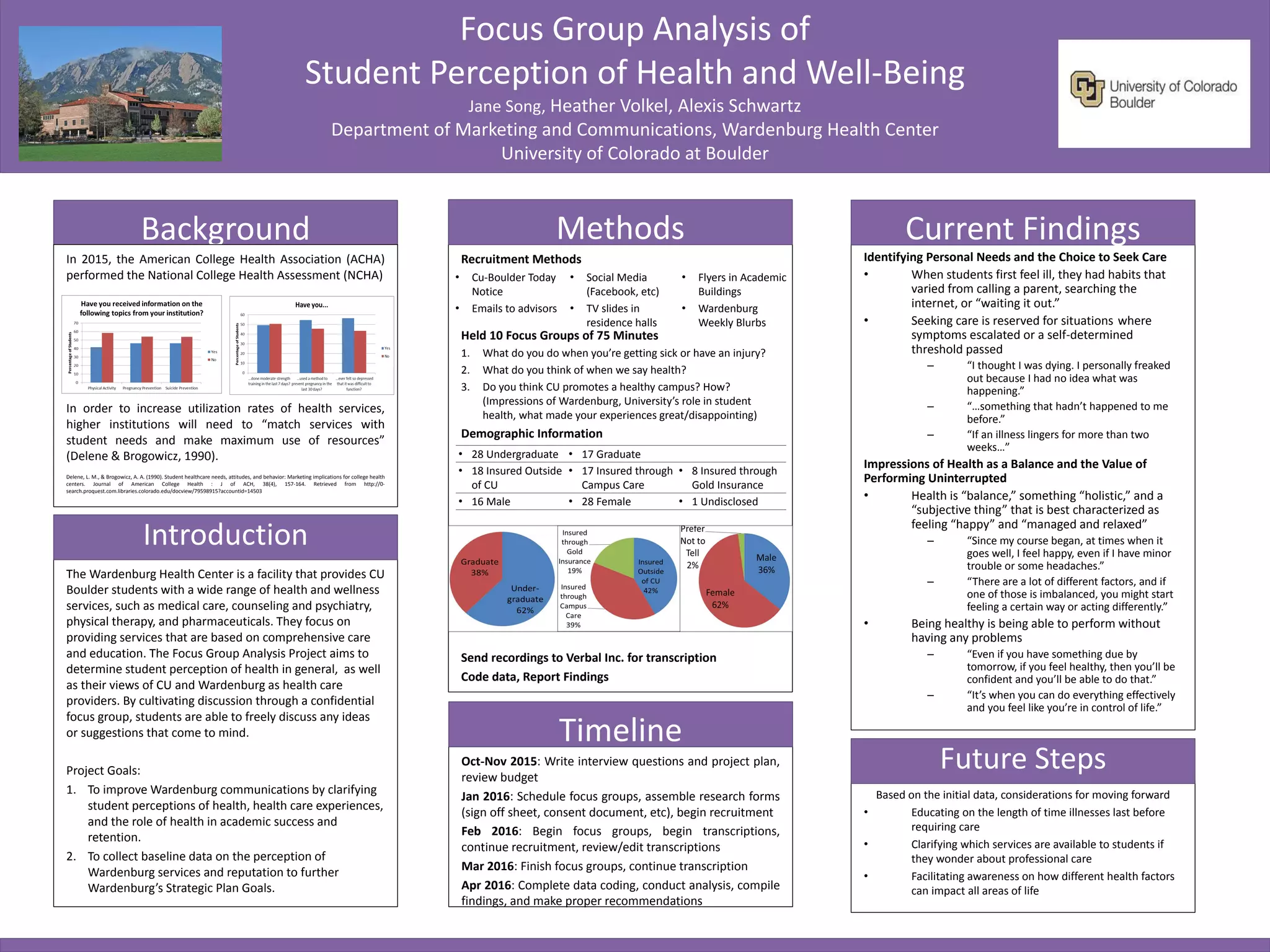
Focus Group Analysis of
Student Perception of Health and Well-Being
Jane Song, Heather Volkel, Alexis Schwartz
Department of Marketing and Communications, Wardenburg Health Center
University of Colorado at Boulder
Recruitment Methods
Held 10 Focus Groups of 75 Minutes
1. What do you do when you’re getting sick or have an injury?
2. What do you think of when we say health?
3. Do you think CU promotes a healthy campus? How?
(Impressions of Wardenburg, University’s role in student
health, what made your experiences great/disappointing)
Demographic Information
Send recordings to Verbal Inc. for transcription
Code data, Report Findings
Oct-Nov 2015: Write interview questions and project plan,
review budget
Jan 2016: Schedule focus groups, assemble research forms
(sign off sheet, consent document, etc), begin recruitment
Feb 2016: Begin focus groups, begin transcriptions,
continue recruitment, review/edit transcriptions
Mar 2016: Finish focus groups, continue transcription
Apr 2016: Complete data coding, conduct analysis, compile
findings, and make proper recommendations
Identifying Personal Needs and the Choice to Seek Care
• When students first feel ill, they had habits that
varied from calling a parent, searching the
internet, or “waiting it out.”
• Seeking care is reserved for situations where
symptoms escalated or a self-determined
threshold passed
– “I thought I was dying. I personally freaked
out because I had no idea what was
happening.”
– “…something that hadn’t happened to me
before.”
– “If an illness lingers for more than two
weeks…”
Impressions of Health as a Balance and the Value of
Performing Uninterrupted
• Health is “balance,” something “holistic,” and a
“subjective thing” that is best characterized as
feeling “happy” and “managed and relaxed”
– “Since my course began, at times when it
goes well, I feel happy, even if I have minor
trouble or some headaches.”
– “There are a lot of different factors, and if
one of those is imbalanced, you might start
feeling a certain way or acting differently.”
• Being healthy is being able to perform without
having any problems
– “Even if you have something due by
tomorrow, if you feel healthy, then you’ll be
confident and you’ll be able to do that.”
– “It’s when you can do everything effectively
and you feel like you’re in control of life.”
The Wardenburg Health Center is a facility that provides CU
Boulder students with a wide range of health and wellness
services, such as medical care, counseling and psychiatry,
physical therapy, and pharmaceuticals. They focus on
providing services that are based on comprehensive care
and education. The Focus Group Analysis Project aims to
determine student perception of health in general, as well
as their views of CU and Wardenburg as health care
providers. By cultivating discussion through a confidential
focus group, students are able to freely discuss any ideas
or suggestions that come to mind.
Project Goals:
1. To improve Wardenburg communications by clarifying
student perceptions of health, health care experiences,
and the role of health in academic success and
retention.
2. To collect baseline data on the perception of
Wardenburg services and reputation to further
Wardenburg’s Strategic Plan Goals.
Based on the initial data, considerations for moving forward
• Educating on the length of time illnesses last before
requiring care
• Clarifying which services are available to students if
they wonder about professional care
• Facilitating awareness on how different health factors
can impact all areas of life
Background
Introduction
Methods
Timeline
Current Findings
Future Steps
In 2015, the American College Health Association (ACHA)
performed the National College Health Assessment (NCHA)
In order to increase utilization rates of health services,
higher institutions will need to “match services with
student needs and make maximum use of resources”
(Delene & Brogowicz, 1990).
Delene, L. M., & Brogowicz, A. A. (1990). Student healthcare needs, attitudes, and behavior: Marketing implications for college health
centers. Journal of American College Health : J of ACH, 38(4), 157-164. Retrieved from http://0-
search.proquest.com.libraries.colorado.edu/docview/79598915?accountid=14503
• Cu-Boulder Today
Notice
• Social Media
(Facebook, etc)
• Flyers in Academic
Buildings
• Emails to advisors • TV slides in
residence halls
• Wardenburg
Weekly Blurbs
• 28 Undergraduate • 17 Graduate
• 18 Insured Outside
of CU
• 17 Insured through
Campus Care
• 8 Insured through
Gold Insurance
• 16 Male • 28 Female • 1 Undisclosed

Medical Scholars Research Poster

  • 1.
    Focus Group Analysisof Student Perception of Health and Well-Being Jane Song, Heather Volkel, Alexis Schwartz Department of Marketing and Communications, Wardenburg Health Center University of Colorado at Boulder Recruitment Methods Held 10 Focus Groups of 75 Minutes 1. What do you do when you’re getting sick or have an injury? 2. What do you think of when we say health? 3. Do you think CU promotes a healthy campus? How? (Impressions of Wardenburg, University’s role in student health, what made your experiences great/disappointing) Demographic Information Send recordings to Verbal Inc. for transcription Code data, Report Findings Oct-Nov 2015: Write interview questions and project plan, review budget Jan 2016: Schedule focus groups, assemble research forms (sign off sheet, consent document, etc), begin recruitment Feb 2016: Begin focus groups, begin transcriptions, continue recruitment, review/edit transcriptions Mar 2016: Finish focus groups, continue transcription Apr 2016: Complete data coding, conduct analysis, compile findings, and make proper recommendations Identifying Personal Needs and the Choice to Seek Care • When students first feel ill, they had habits that varied from calling a parent, searching the internet, or “waiting it out.” • Seeking care is reserved for situations where symptoms escalated or a self-determined threshold passed – “I thought I was dying. I personally freaked out because I had no idea what was happening.” – “…something that hadn’t happened to me before.” – “If an illness lingers for more than two weeks…” Impressions of Health as a Balance and the Value of Performing Uninterrupted • Health is “balance,” something “holistic,” and a “subjective thing” that is best characterized as feeling “happy” and “managed and relaxed” – “Since my course began, at times when it goes well, I feel happy, even if I have minor trouble or some headaches.” – “There are a lot of different factors, and if one of those is imbalanced, you might start feeling a certain way or acting differently.” • Being healthy is being able to perform without having any problems – “Even if you have something due by tomorrow, if you feel healthy, then you’ll be confident and you’ll be able to do that.” – “It’s when you can do everything effectively and you feel like you’re in control of life.” The Wardenburg Health Center is a facility that provides CU Boulder students with a wide range of health and wellness services, such as medical care, counseling and psychiatry, physical therapy, and pharmaceuticals. They focus on providing services that are based on comprehensive care and education. The Focus Group Analysis Project aims to determine student perception of health in general, as well as their views of CU and Wardenburg as health care providers. By cultivating discussion through a confidential focus group, students are able to freely discuss any ideas or suggestions that come to mind. Project Goals: 1. To improve Wardenburg communications by clarifying student perceptions of health, health care experiences, and the role of health in academic success and retention. 2. To collect baseline data on the perception of Wardenburg services and reputation to further Wardenburg’s Strategic Plan Goals. Based on the initial data, considerations for moving forward • Educating on the length of time illnesses last before requiring care • Clarifying which services are available to students if they wonder about professional care • Facilitating awareness on how different health factors can impact all areas of life Background Introduction Methods Timeline Current Findings Future Steps In 2015, the American College Health Association (ACHA) performed the National College Health Assessment (NCHA) In order to increase utilization rates of health services, higher institutions will need to “match services with student needs and make maximum use of resources” (Delene & Brogowicz, 1990). Delene, L. M., & Brogowicz, A. A. (1990). Student healthcare needs, attitudes, and behavior: Marketing implications for college health centers. Journal of American College Health : J of ACH, 38(4), 157-164. Retrieved from http://0- search.proquest.com.libraries.colorado.edu/docview/79598915?accountid=14503 • Cu-Boulder Today Notice • Social Media (Facebook, etc) • Flyers in Academic Buildings • Emails to advisors • TV slides in residence halls • Wardenburg Weekly Blurbs • 28 Undergraduate • 17 Graduate • 18 Insured Outside of CU • 17 Insured through Campus Care • 8 Insured through Gold Insurance • 16 Male • 28 Female • 1 Undisclosed