Minal Shah, Shoumodip Roy / International Journal of Engineering Research and Applications
(IJERA) ISSN: 2248-9622 www.ijera.com
Vol. 3, Issue 3, May-Jun 2013, pp.537-542
537 | P a g e
Study of LF slag composition and its correlation with the desulphurisation
and cleanliness aspect of liquid steel
Minal Shah1
, Shoumodip Roy2
Dept. of Metallurgy and Materials Engineering , NIT Jamshedpur, India
ABSTRACT:
Over the past few decades the demand
for steel around the world has been increasing at
a rapid rate, coupled with an increase in steel
quality. One major technique for improving the
quality of steel is to reduce its sulphur content.
Sulphur is one of the most detrimental impurities
in the steelmaking process, affecting both
internal and surface quality.
Desulphurization of steel at ladle furnace
depends on temperature, amount of oxygen and
sulphur in the steel, but mainly on chemical
composition and physical properties of slag.
Necessary requirement for effective
desulphurization is also minimum amount of
easy reducible oxides in the slag. There are many
correlations for expression of slag
desulphurization capacity, where their functional
dependency on each other can be found. This
paper presents graphical correlation of sulphur
capacity with different parameters, correlation of
slag colour with composition of slag ( FeO and
MnO mainly) ,ternary diagram of slag having
CaO , Al2O3 and SiO2 at constant 5% MgO from
set of approximately 30 heats and area occupied
by slag in ternary plot based on these, the
parameters responsible for slag desulphurization
capability are expressed using regression analysis
of industrial data.
Keywords –Desulfurization, sulphur capacity,
ternary diagram, regression analysis
I. INTRODUCTION
Over the past few decades the demand for
steel around the world has been increasing at a rapid
rate, coupled with an increase in steel quality. Steel
producers are required to maximise throughput,
minimise production outages and maintain high
quality standards while all the time minimising
costs. The modern metallurgy of iron and steel is
first of all oriented in quality improvement,
effectiveness and competitiveness of its production.
One major technique for improving the quality of
steel is to reduce its sulphur content. Sulphur is one
of the most detrimental impurities in the
steelmaking process, affecting both internal and
surface quality.
Desulphurization of steel at ladle furnace
depends on temperature, concentrations of oxygen
and sulphur in the steel, but mainly on chemical
composition and physical properties of slag. The
refining of molten steel in the ladle furnace to meet
the required compositional range requires the
optimisation of the process parameters. For sulphur
removal control, parameters such as argon gas flow
rate through the porous plugs, inductive stirring
effect, and vacuum pressure of the tank degasser in
case of tank degasser, amount & composition of the
top slag should be optimised.
In present work; thermodynamics and kinetics of
desulphurization and impact of slag properties on
desulphurization is studied.
II. SULPHUR IN STEEL
2.1 EFFECT OF SULPHUR ON
CONTINUOUS CASTING OF STEEL
 Formation of undesirable sulphides which
promotes granular weaknesses and cracks in
steel during solidification.
 It lowers the melting point and intergranular
strength.
 Sulphur contributes to the brittleness of steel
and thus acts as stress raiser in steel .
 Hot shortness
.
2.2 THERMODYNAMICS OF
DESULFURIZATION
A simplest approach to this issue is to recognize that
the CaO in slag is the predominant desulfizer. For
the reaction,
CaO(s)+ S → CaS(s) + O
(1)
With the data of analysis,
logK12 =-5140/T+ 0.961
(2)
K12 is equilibrium constant for reaction (2) is same
as KMS for a CaO-CaS reaction. At 1600˚C Eq (3)
gives K12 = 0.013.
Carlsson et al have proposed an alternative
correlation,viz.
logK12 = -5304/T+1.191
(3)
K12 = (aCaS )[ hO ]/(aCaO)[hS]
(4)
Proceeding similarly as in the derivation
m K12 (aCaO) =(Ws). [ hO ]/ [hS]=Csˈ
(5)
where m is a constant of proportionality.
logCs = logm + log(aCaO)-4204/T-0.184
(6)
Tsao et al performed equilibrium measurements and
proposed the following correlation :
Minal Shah, Shoumodip Roy / International Journal of Engineering Research and Applications
(IJERA) ISSN: 2248-9622 www.ijera.com
Vol. 3, Issue 3, May-Jun 2013, pp.537-542
538 | P a g e
logCs =3.44(XCaO +0.3XMgO-0.8XAl2O3 –XsiO2 )-
9894/T+2.05 (7)
Andersson et al studied the distribution of sulfur and
the extent of sulfur removal using
[S]+1/2O(g) =[O]+1/2S(g)
(8)
K7 = aO / aS .√(PS2/PO2)= (%S)/[%S]. aO /fS.Cs
(9)
Also, LogK12 = -935/T +1.375+LogCS +Log fS -Log
aO (10)
III. LADLE FURNACE OPERATIONS
AND PARAMETERS
3.1 PROCESS STEP AT LF:
 Transfer of ladle from OLP to LF
 Auto coupling for purging or manual purging
hose connection & start purging.
 Lowering of roof & take temperature.
 If temp> 1560˚C, then take the sample.
 If temp> 1560˚C, then start arcing by
swiveling of the electrode arms.
 Now start Fe- alloy addition as per grade
requirement.
 Al-wire feeding should be done to keep %Al
>0.08%
 Take the sample & temperature.
 Again Fe-alloy addition for minor correction.
 Mild purging for inclusion floatation.
 CaSi /café wire addition as per grade
requirement.
 Again mild purging before lifting the ladle.
 Take final sample & temperature.
3.2 ANALYSIS PROCEDURES AND
TECHNIQUES:
 TEMPERATURE: The temperature of the
molten steel was measured at each sampling
occasion. In some occasions for the purpose
the temperature was measured using the
electro nite Celox 6000
 CHEMICAL COMPOSITION STEEL
SAMPLES: Slag and steel samples were
collected before and after arcing and after
the stirring period. Steel samples were
taken using the automatic sampling
equipment installed at the ladle furnace. A
dual thickness („lollipop‟) sampler from
Rescon-Electro Nite was used to sample the
liquid steel to determine the amount of
sulphur as well as other elements that
dissolved in the steel. The pin (with diameter
of 6 mm) of each lollipop sample was used
for the determination of the C and S contents
in steel using the combustion method with a
Leco CS-230 instrument. The body of the
lollipop sample was used to determine the
chemical composition of elements like Mg,
Ca, Al, Ti, Sn and B using the Optical
Emission Spectroscopy (OES) method. The
remaining elements were analyzed using the
XRF method.
 CHEMICAL COMPOSITION OF SLAG
SAMPLES: The composition of slag samples
were analyzed using X-ray fluorescence
(XRF). First, the slag samples were crushed
into small particles. Thereafter, homogeneous
discs were prepared by sintering and pressing
of the crushed particles. Then, the chemical
composition of the slag components was
determined. Also, the content of main oxides
(such as CaO, Al2O3 , MgO, SiO2 ,CaF2 ,
Cr2O3 , MnO,P2O5 ,TiO2 and some other) in
slag were analyzed by a Thermo ARL
9800XP instrument. In addition, Sulphur in
the slag was determined based on a
combustion and Infra Red (IR) technology
using CS-444LS Leco equipment.
3.3. USEFUL PROPERTIES OF SLAG IN
LADLE REFINING:
 It insulates the bath, reduces temperature
losses
 It desulphurizes the steel
 It helps control the types of inclusions and
traps them in the ladle.
 It controls the steel oxygen levels and
chemistry of the steel.
 Can protect steel from oxygen and N2
pickup. It can influence H2 pickup.
 It protects the ladle from arc flare and
refractory erosion
IV. RESULTS
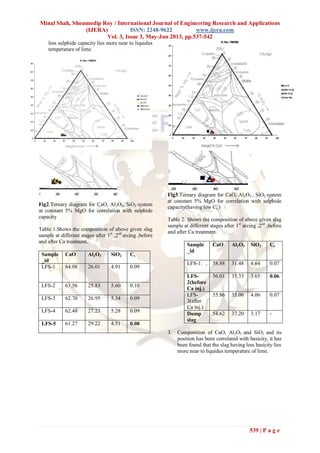
1. The ternary plot between Al2O3, SiO2,CaO
system at a constant MgO -5% is shown below:
Fig1.Ternary diagram for CaO, Al2O3 , SiO2 system
at constant 5% MgO
2. Composition of CaO, Al2O3 and SiO2 and its
position has been correlated with Sulfide
capacity, it has been found that the slag having
Minal Shah, Shoumodip Roy / International Journal of Engineering Research and Applications
(IJERA) ISSN: 2248-9622 www.ijera.com
Vol. 3, Issue 3, May-Jun 2013, pp.537-542
539 | P a g e
less sulphide capacity lies more near to liquidus
temperature of lime.
Fig2.Ternary diagram for CaO, Al2O3, SiO2 system
at constant 5% MgO for correlation with sulphide
capacity
Table 1.Shows the composition of above given slag
sample at different stages after 1st
,2nd
arcing ,before
and after Ca treatment.
Sample
_id
CaO Al2O3 SiO2 Cs
LFS-1 64.08 26.01 4.91 0.09
LFS-2 63.56 25.83 5.60 0.10
LFS-3 62.70 26.95 5.34 0.09
LFS-4 62.48 27.23 5.28 0.09
LFS-5 61.27 29.22 4.51 0.08
Fig3.Ternary diagram for CaO, Al2O3 , SiO2 system
at constant 5% MgO for correlation with sulphide
capacity(having low Cs )
Table 2: Shows the composition of above given slag
sample at different stages after 1st
arcing ,2nd
,before
and after Ca treatment.
Sample
_id
CaO Al2O3 SiO2 Cs
LFS-1: 58.88 31.48 4.64 0.07
LFS-
2(before
Ca inj.)
56.01 35.33 3.65 0.06
LFS-
3(after
Ca inj.)
55.86 35.06 4.06 0.07
Dump
slag
54.62 37.20 3.17 -
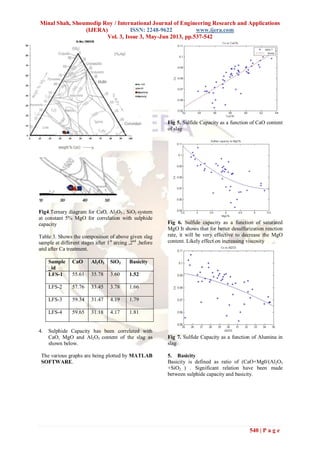
3. Composition of CaO, Al2O3 and SiO2 and its
position has been correlated with basicity, it has
been found that the slag having less basicity lies
more near to liquidus temperature of lime.
Minal Shah, Shoumodip Roy / International Journal of Engineering Research and Applications
(IJERA) ISSN: 2248-9622 www.ijera.com
Vol. 3, Issue 3, May-Jun 2013, pp.537-542
540 | P a g e
Fig4.Ternary diagram for CaO, Al2O3 , SiO2 system
at constant 5% MgO for correlation with sulphide
capacity
Table 3. Shows the composition of above given slag
sample at different stages after 1st
arcing ,2nd
,before
and after Ca treatment.
Sample
_id
CaO Al2O3 SiO2 Basicity
LFS-1 55.61 35.78 3.60 1.52
LFS-2 57.76 33.45 3.78 1.66
LFS-3 59.34 31.47 4.19 1.79
LFS-4 59.65 31.18 4.17 1.81
4. Sulphide Capacity has been correlated with
CaO, MgO and Al2O3 content of the slag as
shown below.
The various graphs are being plotted by MATLAB
SOFTWARE.
Fig 5. Sulfide Capacity as a function of CaO content
of slag
Fig 6. Sulfide capacity as a function of saturated
MgO It shows that for better desulfurization reaction
rate, it will be very effective to decrease the MgO
content. Likely effect on increasing viscosity
Fig 7. Sulfide Capacity as a function of Alumina in
slag
5. Basicity
Basicity is defined as ratio of (CaO+Mg0/(Al2O3
+SiO2 ) . Significant relation have been made
between sulphide capacity and basicity.
Minal Shah, Shoumodip Roy / International Journal of Engineering Research and Applications
(IJERA) ISSN: 2248-9622 www.ijera.com
Vol. 3, Issue 3, May-Jun 2013, pp.537-542
541 | P a g e
Fig 8.Sulfide Capacity values as a function of
Basicity
6. Temperature
Sulfide capacity is plotted as a function of
temperature. Figure shows that sulphide capacity is
improved at higher temperature.
Fig 9. Sulfide capacity as a function of Temperature
7. Fe Concentration
Sulphide Capacity has been correlated with Fe
content in slag.
Fig 10.. Sulfide capacity as a function of Fe content
in slag
;,
8. Regression Analysis
The Cs actual and predicted were plotted against
each other by mathematical regression
Fig 11. Sulphide capacity predicted as a function of
Sulphide Capacity calculated
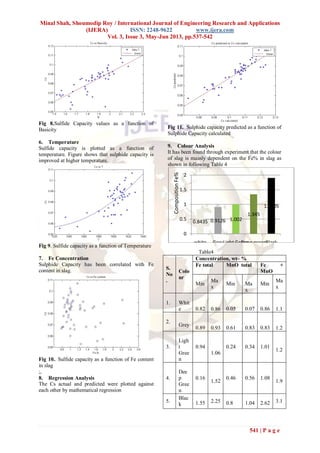
9. Colour Analysis
It has been found through experiment that the colour
of slag is mainly dependent on the Fe% in slag as
shown in following Table 4
Table4
S.
No
.
Colo
ur
Concentration, wt– %
Fe total MnO total Fe +
MnO
Min
Ma
x
Min Ma
x
Min
Ma
x
1. Whit
e 0.82 0.86 0.05 0.07 0.86 1.1
2.
Grey
0.89 0.93 0.61 0.83 0.83 1.2
3.
Ligh
t
Gree
n
0.94
1.06
0.24 0.34 1.01
1.2
4.
Dee
p
Gree
n
0.16
1.52
0.46 0.56 1.08
1.9
5.
Blac
k 1.55 2.25 0.8 1.04 2.62 3.1
0.8435 0.9126 1.002
1.345
1.9005
0
0.5
1
1.5
2
white GreyLight GreenDeep greenBlack
CompositionFe%
Minal Shah, Shoumodip Roy / International Journal of Engineering Research and Applications
(IJERA) ISSN: 2248-9622 www.ijera.com
Vol. 3, Issue 3, May-Jun 2013, pp.537-542
542 | P a g e
V. CONCLUSIONS
5.1 It was seen from the Ternary diagram of CaO-
Al2O3-SiO2 system that all the slag samples lies
in “Lime saturated region” i.e saturated with
CaO content. This is to say that the melting
points of these slag is going to be very high and
the intense heat generated below the arc would
only be able to keep it molten. To lower the
melting point of the slag - an optimization of
quantity of lime addition for slag making will
be required.
5.2 Composition of CaO, Al2O3 and SiO2 and its
position has been correlated with the sulfide
capacity, it has been found that the slag having
less sulphide capacity lies more near to liquidus
temperature of lime.
5.3 Composition of CaO, Al2O3 and SiO2 and its
position has been correlated with basicity, it has
been found that the slag having less basicity lies
more near to liquidus temperature of lime.
The sulphide capacity of the slag was found to
obey the linear relation given as:
Cs = 0.000307T+ 0.0011 Al2O3 % + 0.007402 
MnO% + 0.002848 
MgO%-0.0002 S% -0.00074 SiO2 + 0.006067
CaO% + 0.001062 Fe% - 0.00645 Basicity -
0.79608
where T is the temperature.
The Cs actual and predicted were plotted against
each other by mathematical regression and it was
seen that the result has a good accuracy with R2
value 0.983334 which means that the above relation
is valid with these compositions as well.
5.4 It has been concluded through experiment that
the colour of slag is mainly depends on the
composition of Fe% in slag.
5.5 It was concluded that sulphide capacity of steel
slag has a strong effect on composition of CaO
of the slag
5.6 It was concluded that sulphide capacity of steel
slag has a poor effect on composition of Al2O3
of the slag
5.7 Also it was seen that sulphide capacity (Cs)
decreases to a much lower value with increase
in MgO. This can be attributed to the fact that
MgO increases the viscosity of the slag which
in turn decreases the sulphur partition ratio or in
other words the ability to form sulphides
decreases and correspondingly increases the
sulphur content of the hot metal. A typical
grade of the steel (SA103) was selected for the
experimentation.
5.8 It is known that desulfurisation is improved
with slags of higher basicity. Basic slag have
high content of basic oxides which are network
breakers with ability to release its oxygen ion
(O2-
) in exchange for the dissolved sulphur in
steel.
5.9 As essential parameter in desulfurization is the
temperature at which the process is carried out.
It influences the viscosity (favourable kinetic
condition and sulphide capacity) of the slag and
also sulphur distribution in the metal and slag.
5.10. Sulphide Capacity has poor correlation with Fe
concentration in slag.
REFERENCES
Books
[1] Secondary Steelmaking by Dr. Ahindra
Ghosh
[2] Fundamentals of Steelmaking by Dr.
E.T.Turkdogan
[3] Principles of Steelmaking by Dr. Brahma
Deo
[4] Slag Atlas by Verein Deutscher
Eisenhuttenleute
[5] Steel Making by Dr. R.H.Tupkary
[6] Steel Plant Training Course
Software
[7] Math work by Matlab
Thesis
[8] Master Thesis on Improvement of the
Desulphurisation Process in the Ladle
Furnace by Slag Composition Control (
Dr.Stephen Famurewa Mayowa).
[9] Optimisation Slag Composition in Ladle
furnace considering to effective
desulfurization (Buľko B., Kijac J,
Domovec M.)
Journal Papers:
[10] Deep Steel Desulphurisation Technology in
the Ladle Furnace at KSC (D.Takahashi,
M.Kamo, Y.Kurose and H.Nomura).
[11] Use of Phase diagrams in studies of
refractories corrosion ( S.Zhang and
W.E.Lee)
[12] Slag–metal reactions during ladle treatment
with focus on desulphurisation ( M.
Andersson, M. Hallberg, L. Jonsson, and P.
Jo ¨nsson)

Cm33537542

  • 1.
    Minal Shah, ShoumodipRoy / International Journal of Engineering Research and Applications (IJERA) ISSN: 2248-9622 www.ijera.com Vol. 3, Issue 3, May-Jun 2013, pp.537-542 537 | P a g e Study of LF slag composition and its correlation with the desulphurisation and cleanliness aspect of liquid steel Minal Shah1 , Shoumodip Roy2 Dept. of Metallurgy and Materials Engineering , NIT Jamshedpur, India ABSTRACT: Over the past few decades the demand for steel around the world has been increasing at a rapid rate, coupled with an increase in steel quality. One major technique for improving the quality of steel is to reduce its sulphur content. Sulphur is one of the most detrimental impurities in the steelmaking process, affecting both internal and surface quality. Desulphurization of steel at ladle furnace depends on temperature, amount of oxygen and sulphur in the steel, but mainly on chemical composition and physical properties of slag. Necessary requirement for effective desulphurization is also minimum amount of easy reducible oxides in the slag. There are many correlations for expression of slag desulphurization capacity, where their functional dependency on each other can be found. This paper presents graphical correlation of sulphur capacity with different parameters, correlation of slag colour with composition of slag ( FeO and MnO mainly) ,ternary diagram of slag having CaO , Al2O3 and SiO2 at constant 5% MgO from set of approximately 30 heats and area occupied by slag in ternary plot based on these, the parameters responsible for slag desulphurization capability are expressed using regression analysis of industrial data. Keywords –Desulfurization, sulphur capacity, ternary diagram, regression analysis I. INTRODUCTION Over the past few decades the demand for steel around the world has been increasing at a rapid rate, coupled with an increase in steel quality. Steel producers are required to maximise throughput, minimise production outages and maintain high quality standards while all the time minimising costs. The modern metallurgy of iron and steel is first of all oriented in quality improvement, effectiveness and competitiveness of its production. One major technique for improving the quality of steel is to reduce its sulphur content. Sulphur is one of the most detrimental impurities in the steelmaking process, affecting both internal and surface quality. Desulphurization of steel at ladle furnace depends on temperature, concentrations of oxygen and sulphur in the steel, but mainly on chemical composition and physical properties of slag. The refining of molten steel in the ladle furnace to meet the required compositional range requires the optimisation of the process parameters. For sulphur removal control, parameters such as argon gas flow rate through the porous plugs, inductive stirring effect, and vacuum pressure of the tank degasser in case of tank degasser, amount & composition of the top slag should be optimised. In present work; thermodynamics and kinetics of desulphurization and impact of slag properties on desulphurization is studied. II. SULPHUR IN STEEL 2.1 EFFECT OF SULPHUR ON CONTINUOUS CASTING OF STEEL  Formation of undesirable sulphides which promotes granular weaknesses and cracks in steel during solidification.  It lowers the melting point and intergranular strength.  Sulphur contributes to the brittleness of steel and thus acts as stress raiser in steel .  Hot shortness . 2.2 THERMODYNAMICS OF DESULFURIZATION A simplest approach to this issue is to recognize that the CaO in slag is the predominant desulfizer. For the reaction, CaO(s)+ S → CaS(s) + O (1) With the data of analysis, logK12 =-5140/T+ 0.961 (2) K12 is equilibrium constant for reaction (2) is same as KMS for a CaO-CaS reaction. At 1600˚C Eq (3) gives K12 = 0.013. Carlsson et al have proposed an alternative correlation,viz. logK12 = -5304/T+1.191 (3) K12 = (aCaS )[ hO ]/(aCaO)[hS] (4) Proceeding similarly as in the derivation m K12 (aCaO) =(Ws). [ hO ]/ [hS]=Csˈ (5) where m is a constant of proportionality. logCs = logm + log(aCaO)-4204/T-0.184 (6) Tsao et al performed equilibrium measurements and proposed the following correlation :
  • 2.
    Minal Shah, ShoumodipRoy / International Journal of Engineering Research and Applications (IJERA) ISSN: 2248-9622 www.ijera.com Vol. 3, Issue 3, May-Jun 2013, pp.537-542 538 | P a g e logCs =3.44(XCaO +0.3XMgO-0.8XAl2O3 –XsiO2 )- 9894/T+2.05 (7) Andersson et al studied the distribution of sulfur and the extent of sulfur removal using [S]+1/2O(g) =[O]+1/2S(g) (8) K7 = aO / aS .√(PS2/PO2)= (%S)/[%S]. aO /fS.Cs (9) Also, LogK12 = -935/T +1.375+LogCS +Log fS -Log aO (10) III. LADLE FURNACE OPERATIONS AND PARAMETERS 3.1 PROCESS STEP AT LF:  Transfer of ladle from OLP to LF  Auto coupling for purging or manual purging hose connection & start purging.  Lowering of roof & take temperature.  If temp> 1560˚C, then take the sample.  If temp> 1560˚C, then start arcing by swiveling of the electrode arms.  Now start Fe- alloy addition as per grade requirement.  Al-wire feeding should be done to keep %Al >0.08%  Take the sample & temperature.  Again Fe-alloy addition for minor correction.  Mild purging for inclusion floatation.  CaSi /café wire addition as per grade requirement.  Again mild purging before lifting the ladle.  Take final sample & temperature. 3.2 ANALYSIS PROCEDURES AND TECHNIQUES:  TEMPERATURE: The temperature of the molten steel was measured at each sampling occasion. In some occasions for the purpose the temperature was measured using the electro nite Celox 6000  CHEMICAL COMPOSITION STEEL SAMPLES: Slag and steel samples were collected before and after arcing and after the stirring period. Steel samples were taken using the automatic sampling equipment installed at the ladle furnace. A dual thickness („lollipop‟) sampler from Rescon-Electro Nite was used to sample the liquid steel to determine the amount of sulphur as well as other elements that dissolved in the steel. The pin (with diameter of 6 mm) of each lollipop sample was used for the determination of the C and S contents in steel using the combustion method with a Leco CS-230 instrument. The body of the lollipop sample was used to determine the chemical composition of elements like Mg, Ca, Al, Ti, Sn and B using the Optical Emission Spectroscopy (OES) method. The remaining elements were analyzed using the XRF method.  CHEMICAL COMPOSITION OF SLAG SAMPLES: The composition of slag samples were analyzed using X-ray fluorescence (XRF). First, the slag samples were crushed into small particles. Thereafter, homogeneous discs were prepared by sintering and pressing of the crushed particles. Then, the chemical composition of the slag components was determined. Also, the content of main oxides (such as CaO, Al2O3 , MgO, SiO2 ,CaF2 , Cr2O3 , MnO,P2O5 ,TiO2 and some other) in slag were analyzed by a Thermo ARL 9800XP instrument. In addition, Sulphur in the slag was determined based on a combustion and Infra Red (IR) technology using CS-444LS Leco equipment. 3.3. USEFUL PROPERTIES OF SLAG IN LADLE REFINING:  It insulates the bath, reduces temperature losses  It desulphurizes the steel  It helps control the types of inclusions and traps them in the ladle.  It controls the steel oxygen levels and chemistry of the steel.  Can protect steel from oxygen and N2 pickup. It can influence H2 pickup.  It protects the ladle from arc flare and refractory erosion IV. RESULTS 1. The ternary plot between Al2O3, SiO2,CaO system at a constant MgO -5% is shown below: Fig1.Ternary diagram for CaO, Al2O3 , SiO2 system at constant 5% MgO 2. Composition of CaO, Al2O3 and SiO2 and its position has been correlated with Sulfide capacity, it has been found that the slag having
  • 3.
    Minal Shah, ShoumodipRoy / International Journal of Engineering Research and Applications (IJERA) ISSN: 2248-9622 www.ijera.com Vol. 3, Issue 3, May-Jun 2013, pp.537-542 539 | P a g e less sulphide capacity lies more near to liquidus temperature of lime. Fig2.Ternary diagram for CaO, Al2O3, SiO2 system at constant 5% MgO for correlation with sulphide capacity Table 1.Shows the composition of above given slag sample at different stages after 1st ,2nd arcing ,before and after Ca treatment. Sample _id CaO Al2O3 SiO2 Cs LFS-1 64.08 26.01 4.91 0.09 LFS-2 63.56 25.83 5.60 0.10 LFS-3 62.70 26.95 5.34 0.09 LFS-4 62.48 27.23 5.28 0.09 LFS-5 61.27 29.22 4.51 0.08 Fig3.Ternary diagram for CaO, Al2O3 , SiO2 system at constant 5% MgO for correlation with sulphide capacity(having low Cs ) Table 2: Shows the composition of above given slag sample at different stages after 1st arcing ,2nd ,before and after Ca treatment. Sample _id CaO Al2O3 SiO2 Cs LFS-1: 58.88 31.48 4.64 0.07 LFS- 2(before Ca inj.) 56.01 35.33 3.65 0.06 LFS- 3(after Ca inj.) 55.86 35.06 4.06 0.07 Dump slag 54.62 37.20 3.17 - 3. Composition of CaO, Al2O3 and SiO2 and its position has been correlated with basicity, it has been found that the slag having less basicity lies more near to liquidus temperature of lime.
  • 4.
    Minal Shah, ShoumodipRoy / International Journal of Engineering Research and Applications (IJERA) ISSN: 2248-9622 www.ijera.com Vol. 3, Issue 3, May-Jun 2013, pp.537-542 540 | P a g e Fig4.Ternary diagram for CaO, Al2O3 , SiO2 system at constant 5% MgO for correlation with sulphide capacity Table 3. Shows the composition of above given slag sample at different stages after 1st arcing ,2nd ,before and after Ca treatment. Sample _id CaO Al2O3 SiO2 Basicity LFS-1 55.61 35.78 3.60 1.52 LFS-2 57.76 33.45 3.78 1.66 LFS-3 59.34 31.47 4.19 1.79 LFS-4 59.65 31.18 4.17 1.81 4. Sulphide Capacity has been correlated with CaO, MgO and Al2O3 content of the slag as shown below. The various graphs are being plotted by MATLAB SOFTWARE. Fig 5. Sulfide Capacity as a function of CaO content of slag Fig 6. Sulfide capacity as a function of saturated MgO It shows that for better desulfurization reaction rate, it will be very effective to decrease the MgO content. Likely effect on increasing viscosity Fig 7. Sulfide Capacity as a function of Alumina in slag 5. Basicity Basicity is defined as ratio of (CaO+Mg0/(Al2O3 +SiO2 ) . Significant relation have been made between sulphide capacity and basicity.
  • 5.
    Minal Shah, ShoumodipRoy / International Journal of Engineering Research and Applications (IJERA) ISSN: 2248-9622 www.ijera.com Vol. 3, Issue 3, May-Jun 2013, pp.537-542 541 | P a g e Fig 8.Sulfide Capacity values as a function of Basicity 6. Temperature Sulfide capacity is plotted as a function of temperature. Figure shows that sulphide capacity is improved at higher temperature. Fig 9. Sulfide capacity as a function of Temperature 7. Fe Concentration Sulphide Capacity has been correlated with Fe content in slag. Fig 10.. Sulfide capacity as a function of Fe content in slag ;, 8. Regression Analysis The Cs actual and predicted were plotted against each other by mathematical regression Fig 11. Sulphide capacity predicted as a function of Sulphide Capacity calculated 9. Colour Analysis It has been found through experiment that the colour of slag is mainly dependent on the Fe% in slag as shown in following Table 4 Table4 S. No . Colo ur Concentration, wt– % Fe total MnO total Fe + MnO Min Ma x Min Ma x Min Ma x 1. Whit e 0.82 0.86 0.05 0.07 0.86 1.1 2. Grey 0.89 0.93 0.61 0.83 0.83 1.2 3. Ligh t Gree n 0.94 1.06 0.24 0.34 1.01 1.2 4. Dee p Gree n 0.16 1.52 0.46 0.56 1.08 1.9 5. Blac k 1.55 2.25 0.8 1.04 2.62 3.1 0.8435 0.9126 1.002 1.345 1.9005 0 0.5 1 1.5 2 white GreyLight GreenDeep greenBlack CompositionFe%
  • 6.
    Minal Shah, ShoumodipRoy / International Journal of Engineering Research and Applications (IJERA) ISSN: 2248-9622 www.ijera.com Vol. 3, Issue 3, May-Jun 2013, pp.537-542 542 | P a g e V. CONCLUSIONS 5.1 It was seen from the Ternary diagram of CaO- Al2O3-SiO2 system that all the slag samples lies in “Lime saturated region” i.e saturated with CaO content. This is to say that the melting points of these slag is going to be very high and the intense heat generated below the arc would only be able to keep it molten. To lower the melting point of the slag - an optimization of quantity of lime addition for slag making will be required. 5.2 Composition of CaO, Al2O3 and SiO2 and its position has been correlated with the sulfide capacity, it has been found that the slag having less sulphide capacity lies more near to liquidus temperature of lime. 5.3 Composition of CaO, Al2O3 and SiO2 and its position has been correlated with basicity, it has been found that the slag having less basicity lies more near to liquidus temperature of lime. The sulphide capacity of the slag was found to obey the linear relation given as: Cs = 0.000307T+ 0.0011 Al2O3 % + 0.007402  MnO% + 0.002848  MgO%-0.0002 S% -0.00074 SiO2 + 0.006067 CaO% + 0.001062 Fe% - 0.00645 Basicity - 0.79608 where T is the temperature. The Cs actual and predicted were plotted against each other by mathematical regression and it was seen that the result has a good accuracy with R2 value 0.983334 which means that the above relation is valid with these compositions as well. 5.4 It has been concluded through experiment that the colour of slag is mainly depends on the composition of Fe% in slag. 5.5 It was concluded that sulphide capacity of steel slag has a strong effect on composition of CaO of the slag 5.6 It was concluded that sulphide capacity of steel slag has a poor effect on composition of Al2O3 of the slag 5.7 Also it was seen that sulphide capacity (Cs) decreases to a much lower value with increase in MgO. This can be attributed to the fact that MgO increases the viscosity of the slag which in turn decreases the sulphur partition ratio or in other words the ability to form sulphides decreases and correspondingly increases the sulphur content of the hot metal. A typical grade of the steel (SA103) was selected for the experimentation. 5.8 It is known that desulfurisation is improved with slags of higher basicity. Basic slag have high content of basic oxides which are network breakers with ability to release its oxygen ion (O2- ) in exchange for the dissolved sulphur in steel. 5.9 As essential parameter in desulfurization is the temperature at which the process is carried out. It influences the viscosity (favourable kinetic condition and sulphide capacity) of the slag and also sulphur distribution in the metal and slag. 5.10. Sulphide Capacity has poor correlation with Fe concentration in slag. REFERENCES Books [1] Secondary Steelmaking by Dr. Ahindra Ghosh [2] Fundamentals of Steelmaking by Dr. E.T.Turkdogan [3] Principles of Steelmaking by Dr. Brahma Deo [4] Slag Atlas by Verein Deutscher Eisenhuttenleute [5] Steel Making by Dr. R.H.Tupkary [6] Steel Plant Training Course Software [7] Math work by Matlab Thesis [8] Master Thesis on Improvement of the Desulphurisation Process in the Ladle Furnace by Slag Composition Control ( Dr.Stephen Famurewa Mayowa). [9] Optimisation Slag Composition in Ladle furnace considering to effective desulfurization (Buľko B., Kijac J, Domovec M.) Journal Papers: [10] Deep Steel Desulphurisation Technology in the Ladle Furnace at KSC (D.Takahashi, M.Kamo, Y.Kurose and H.Nomura). [11] Use of Phase diagrams in studies of refractories corrosion ( S.Zhang and W.E.Lee) [12] Slag–metal reactions during ladle treatment with focus on desulphurisation ( M. Andersson, M. Hallberg, L. Jonsson, and P. Jo ¨nsson)