Clinker burning process and its
influence on the refractory material
Hugo Ordóñez
What is the goal of
clinker burning ?
The production of
GOOD QUALITY
cement...
OF COURSE !
What is quality?
Quality of cement
Characteristics & Properties:
•Chemical Composition
•Strength
•Workability Setting Behavior,
•Chemical Resistance ..Etc.
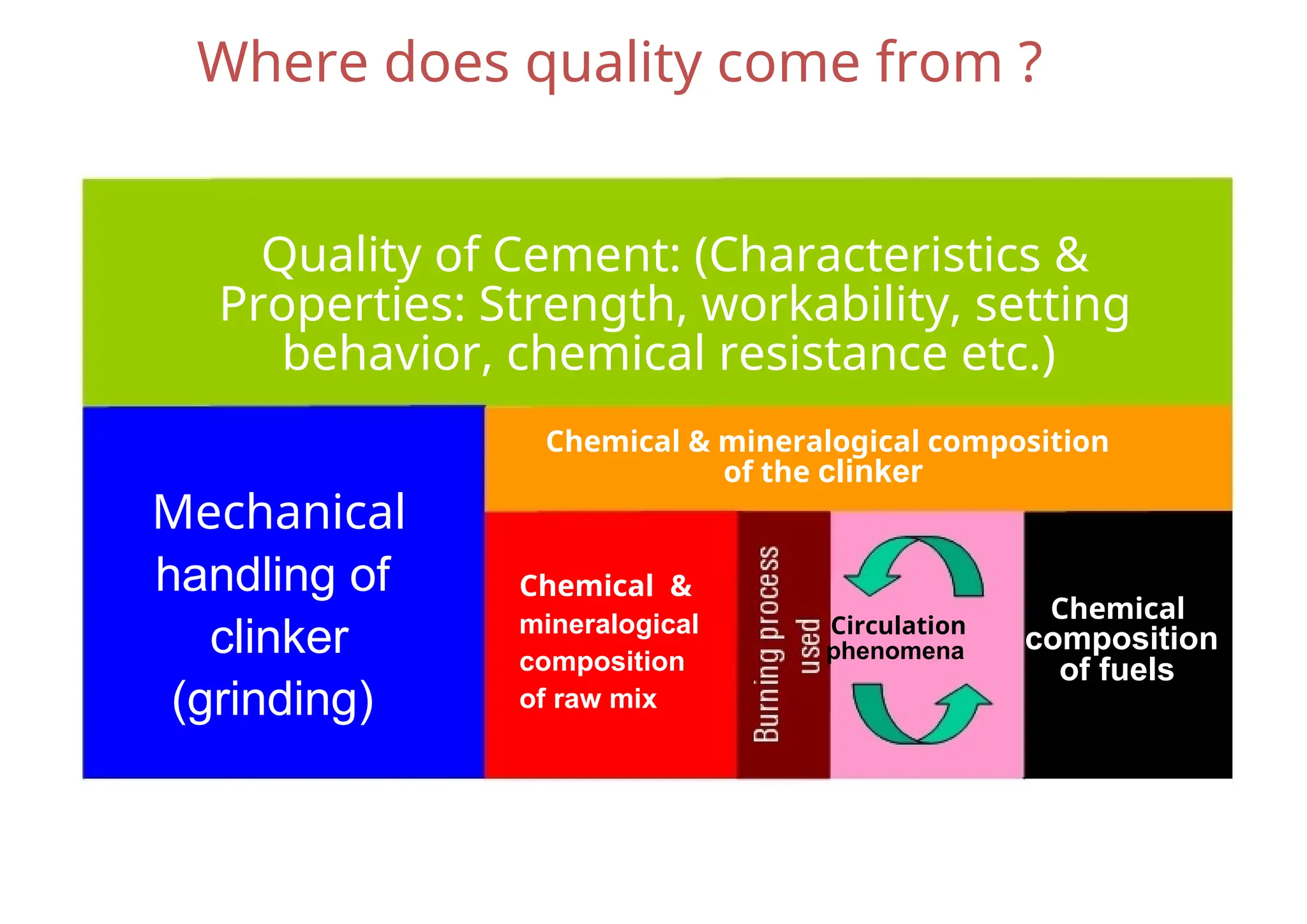
Where does quality come from ?
Quality of Cement: (Characteristics &
Properties: Strength, workability, setting
behavior, chemical resistance etc.)
Chemical & mineralogical composition
of the clinker
Mechanical
handling of
clinker
(grinding)
Chemical &
mineralogical
composition
of raw mix
Chemical
composition
of fuels
Circulation
phenomena
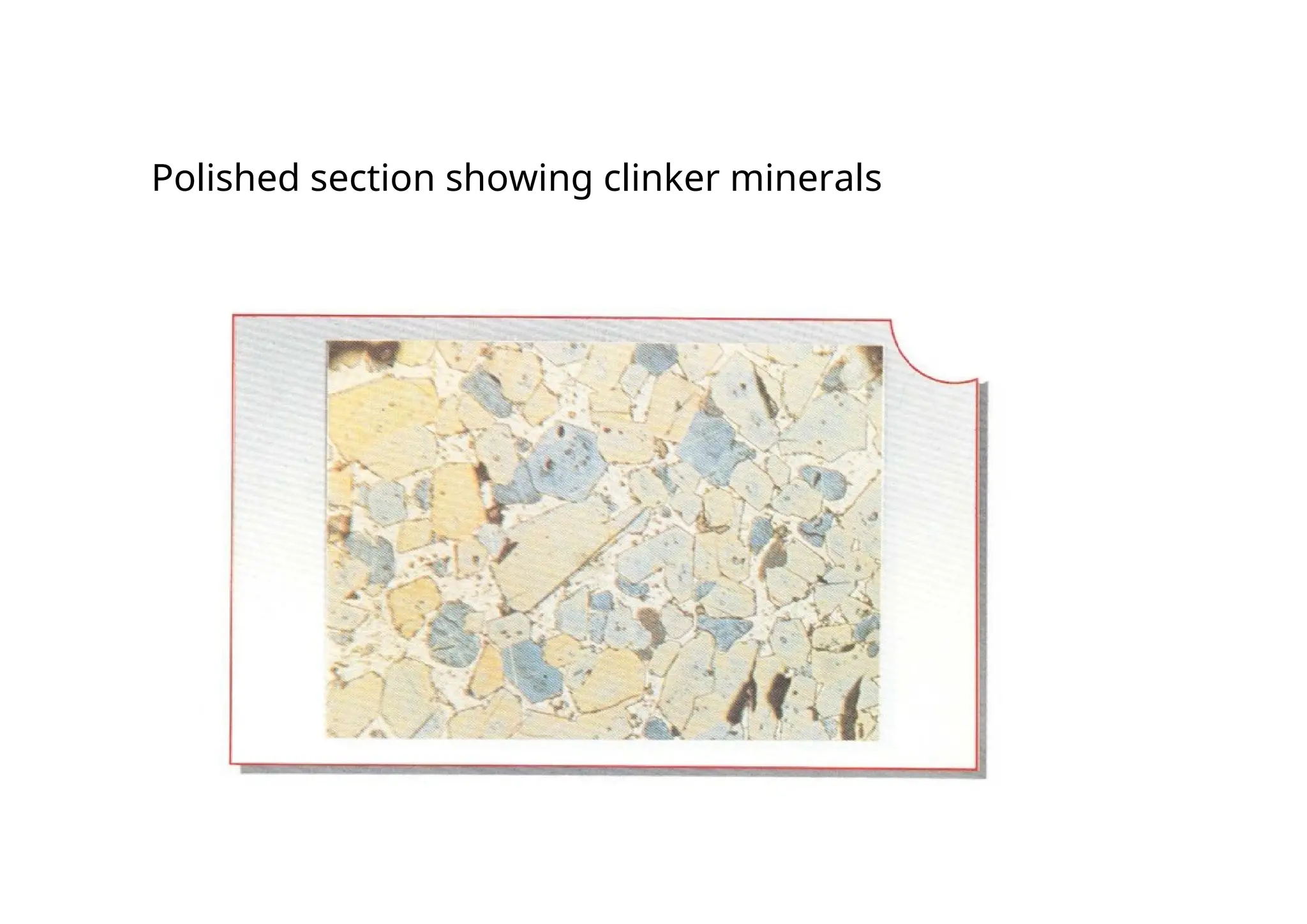
Polished section showing clinker minerals
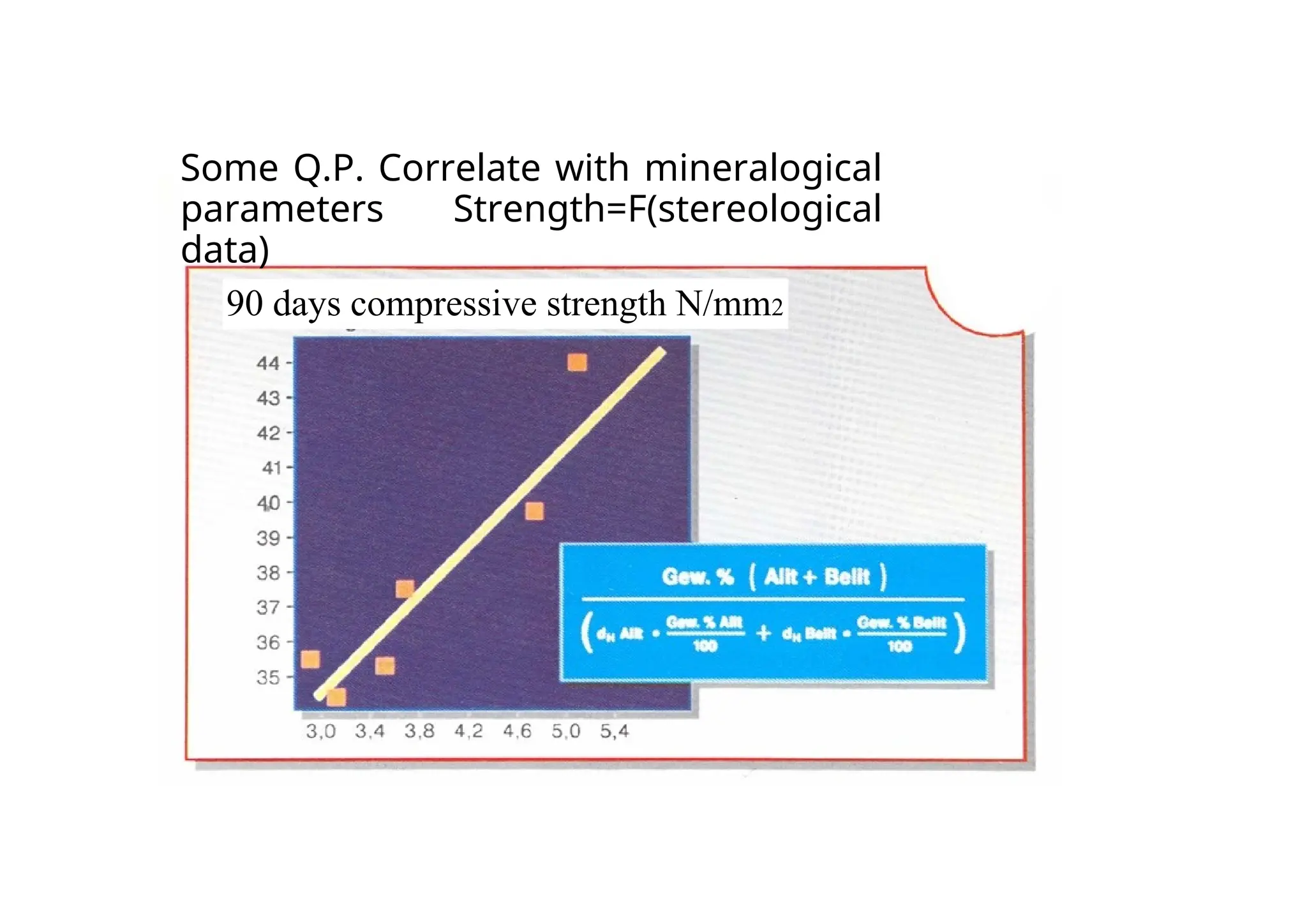
Some Q.P. Correlate with mineralogical
parameters Strength=F(stereological
data)
90 days compressive strength N/mm2
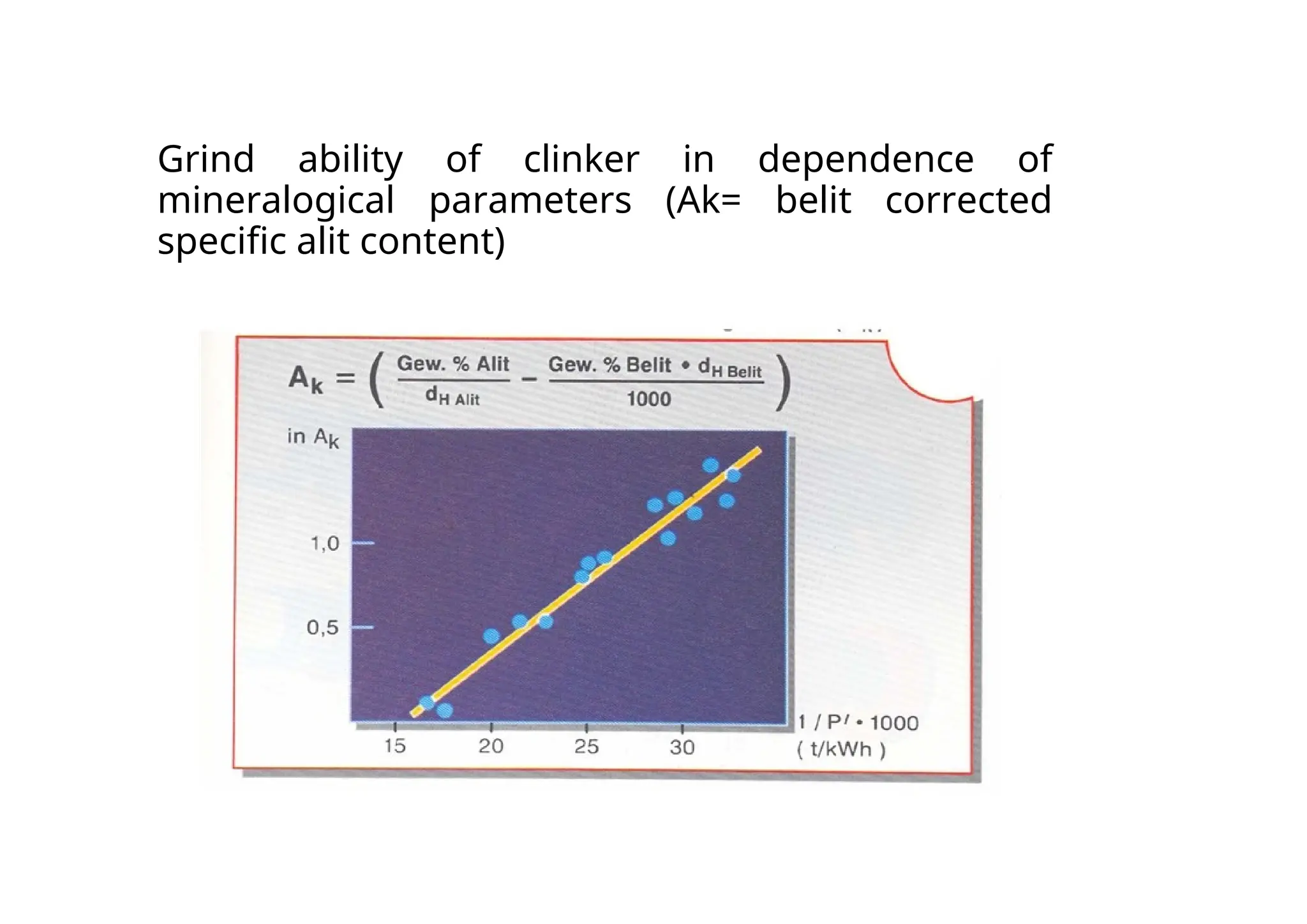
Grind ability of clinker in dependence of
mineralogical parameters (Ak= belit corrected
specific alit content)
Starting Points
Available Raw materials & fuels
Available process equipment
Available knowledge
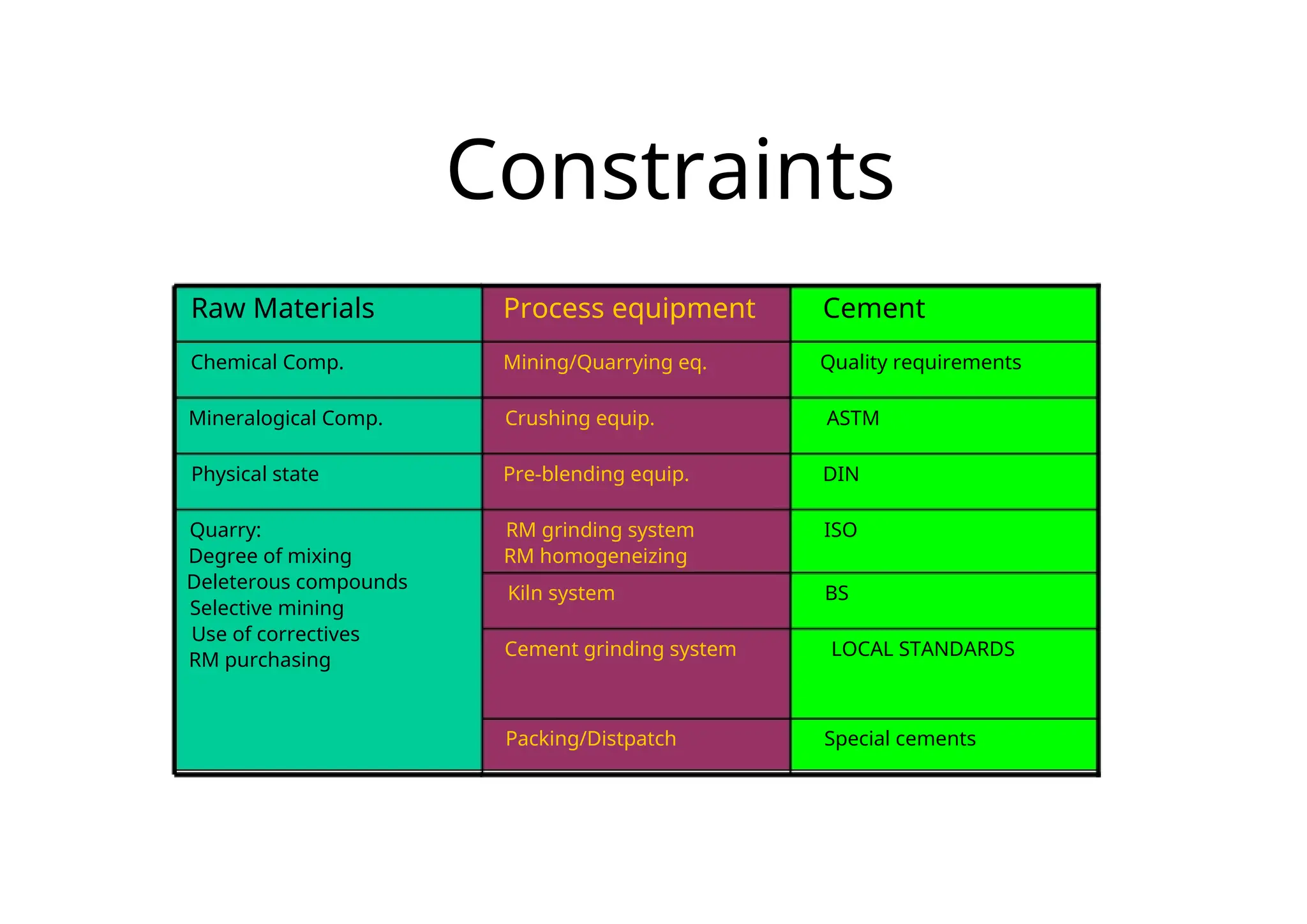
Constraints
Raw Materials Process equipment Cement
Chemical Comp. Mining/Quarrying eq. Quality requirements
Mineralogical Comp. Crushing equip. ASTM
Physical state Pre-blending equip. DIN
Quarry: RM grinding system ISO
Degree of mixing RM homogeneizing
Deleterous compounds
Kiln system BS
Selective mining
Use of correctives
Cement grinding system LOCAL STANDARDS
RM purchasing
Packing/Distpatch Special cements
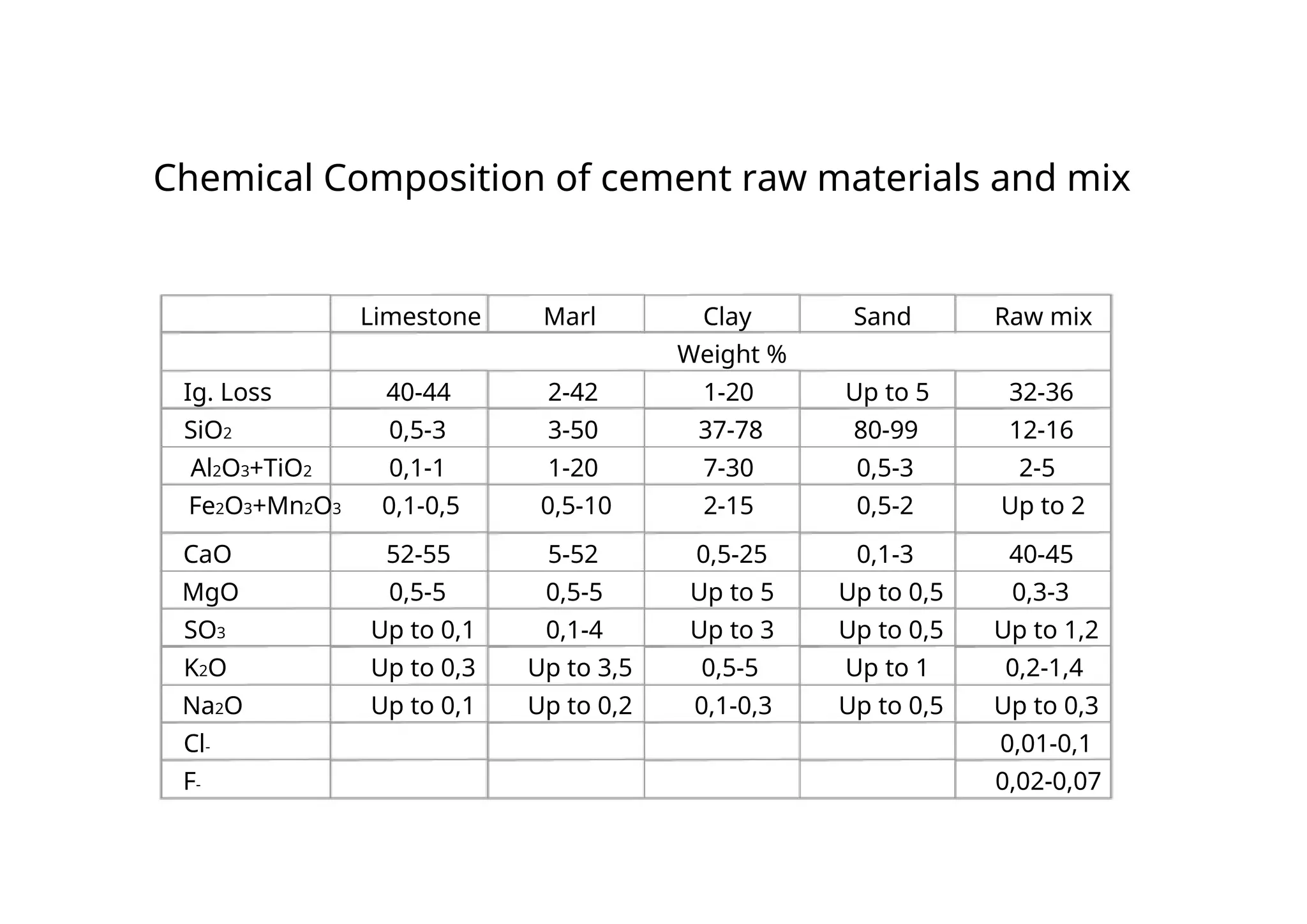
Chemical Composition of cement raw materials and mix
Limestone Marl Clay Sand Raw mix
Weight %
Ig. Loss 40-44 2-42 1-20 Up to 5 32-36
SiO2 0,5-3 3-50 37-78 80-99 12-16
Al2O3+TiO2 0,1-1 1-20 7-30 0,5-3 2-5
Fe2O3+Mn2O3 0,1-0,5 0,5-10 2-15 0,5-2 Up to 2
CaO 52-55 5-52 0,5-25 0,1-3 40-45
MgO 0,5-5 0,5-5 Up to 5 Up to 0,5 0,3-3
SO3 Up to 0,1 0,1-4 Up to 3 Up to 0,5 Up to 1,2
K2O Up to 0,3 Up to 3,5 0,5-5 Up to 1 0,2-1,4
Na2O Up to 0,1 Up to 0,2 0,1-0,3 Up to 0,5 Up to 0,3
Cl- 0,01-0,1
F- 0,02-0,07
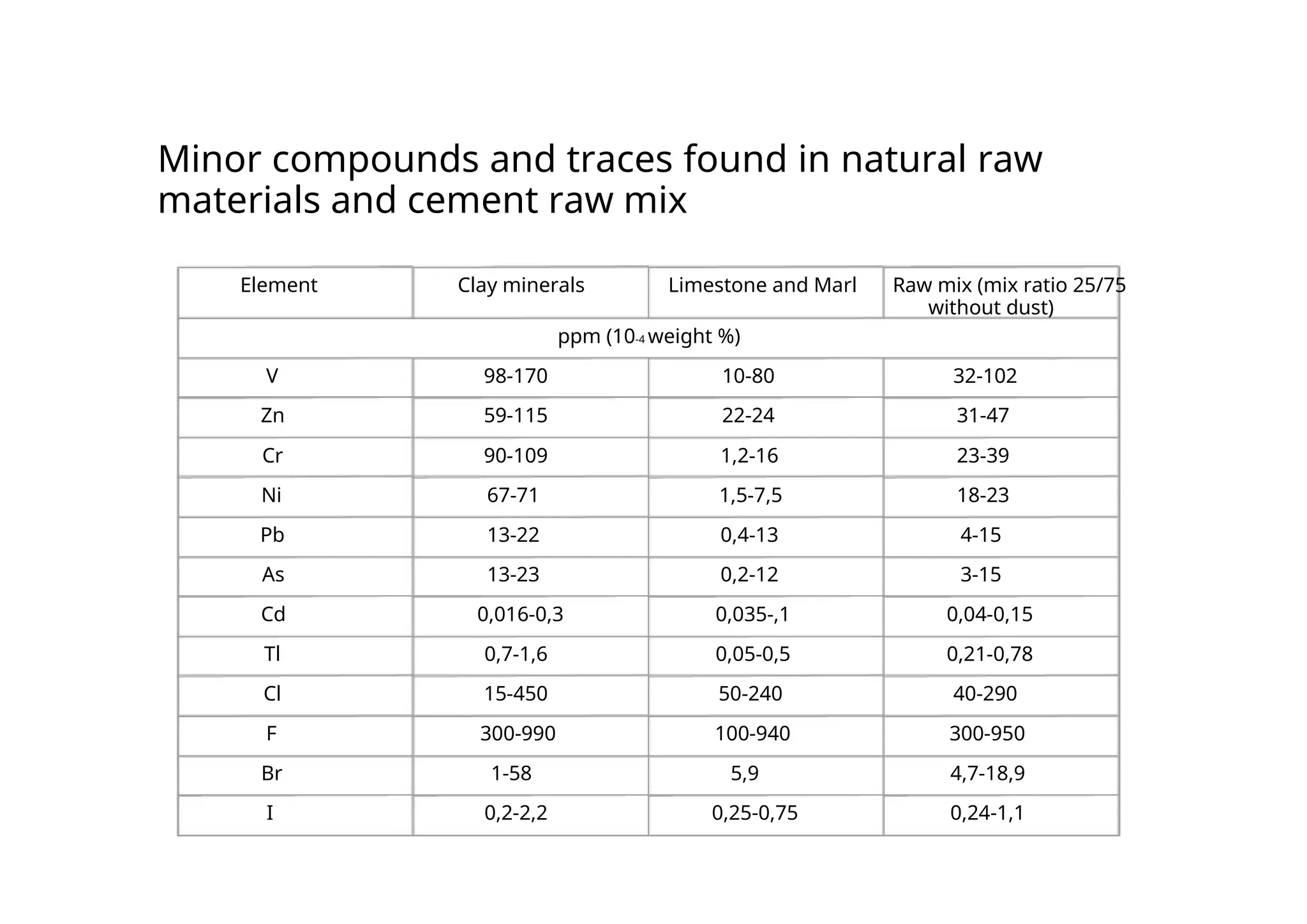
Minor compounds and traces found in natural raw
materials and cement raw mix
Element Clay minerals Limestone and Marl Raw mix (mix ratio 25/75
without dust)
ppm (10-4 weight %)
V 98-170 10-80 32-102
Zn 59-115 22-24 31-47
Cr 90-109 1,2-16 23-39
Ni 67-71 1,5-7,5 18-23
Pb 13-22 0,4-13 4-15
As 13-23 0,2-12 3-15
Cd 0,016-0,3 0,035-,1 0,04-0,15
Tl 0,7-1,6 0,05-0,5 0,21-0,78
Cl 15-450 50-240 40-290
F 300-990 100-940 300-950
Br 1-58 5,9 4,7-18,9
I 0,2-2,2 0,25-0,75 0,24-1,1
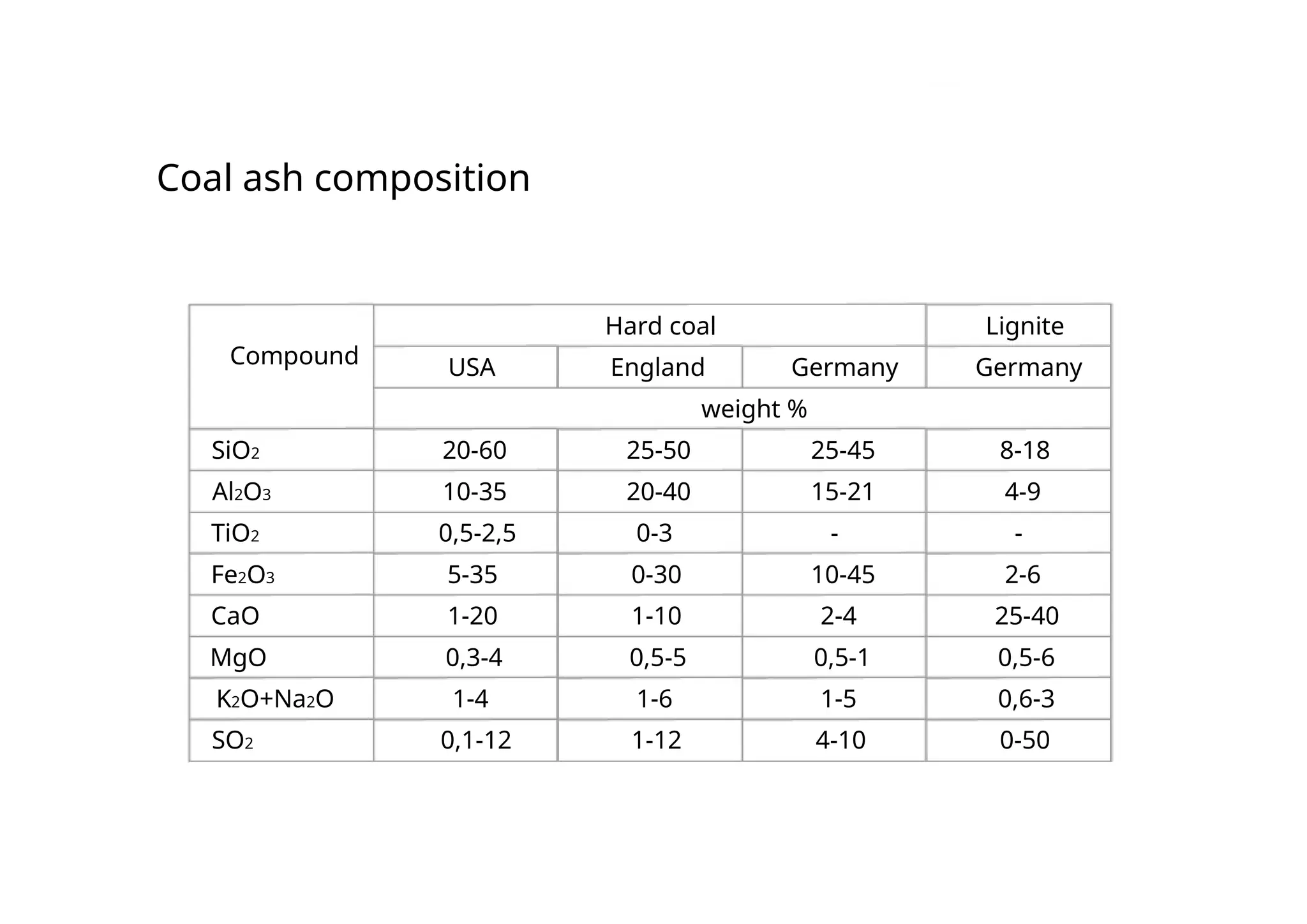
Coal ash composition
Hard coal Lignite
Compound USA England Germany Germany
weight %
SiO2 20-60 25-50 25-45 8-18
Al2O3 10-35 20-40 15-21 4-9
TiO2 0,5-2,5 0-3 - -
Fe2O3 5-35 0-30 10-45 2-6
CaO 1-20 1-10 2-4 25-40
MgO 0,3-4 0,5-5 0,5-1 0,5-6
K2O+Na2O 1-4 1-6 1-5 0,6-3
SO2 0,1-12 1-12 4-10 0-50
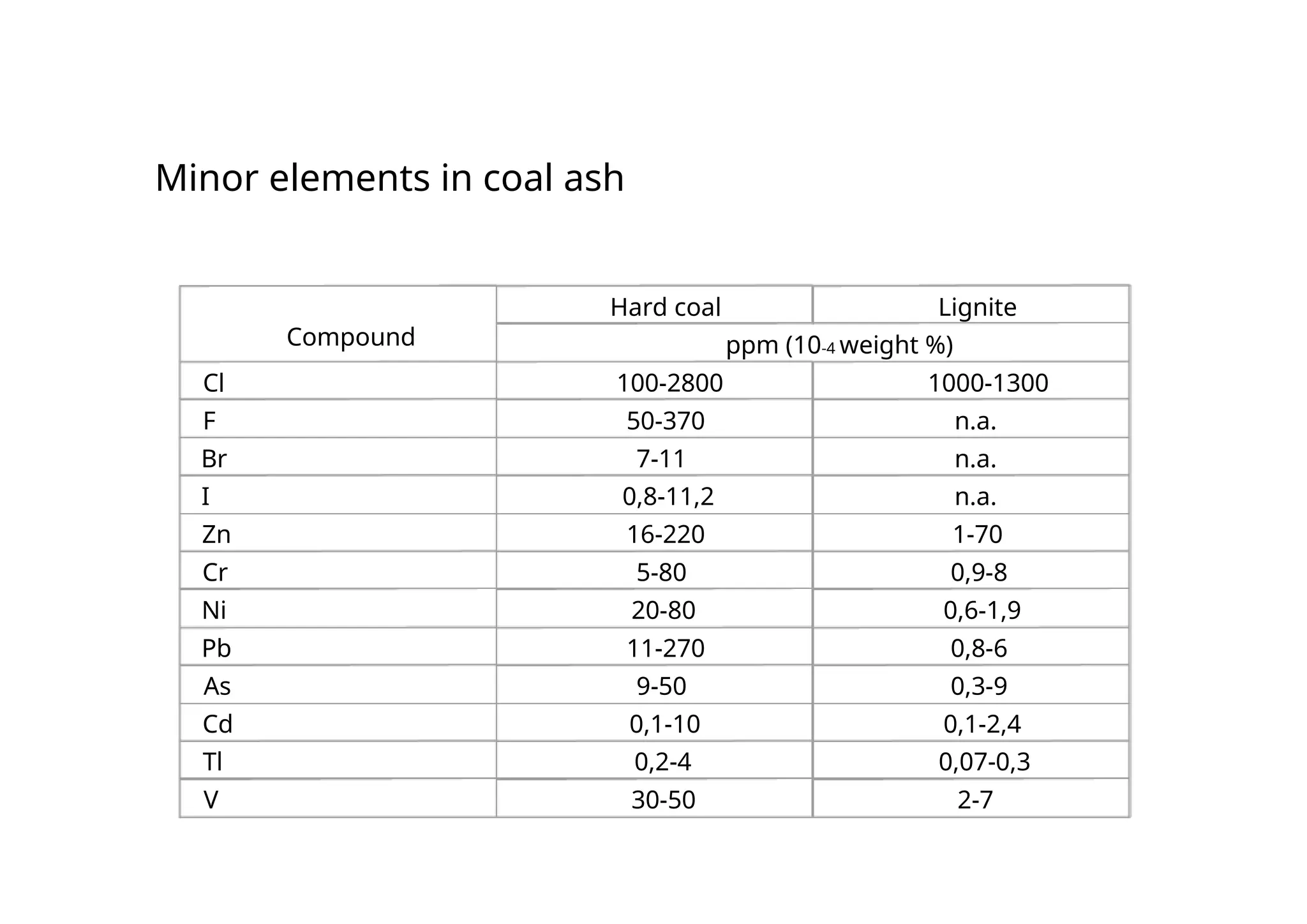
Minor elements in coal ash
Hard coal Lignite
Compound ppm (10-4 weight %)
Cl 100-2800 1000-1300
F 50-370 n.a.
Br 7-11 n.a.
I 0,8-11,2 n.a.
Zn 16-220 1-70
Cr 5-80 0,9-8
Ni 20-80 0,6-1,9
Pb 11-270 0,8-6
As 9-50 0,3-9
Cd 0,1-10 0,1-2,4
Tl 0,2-4 0,07-0,3
V 30-50 2-7
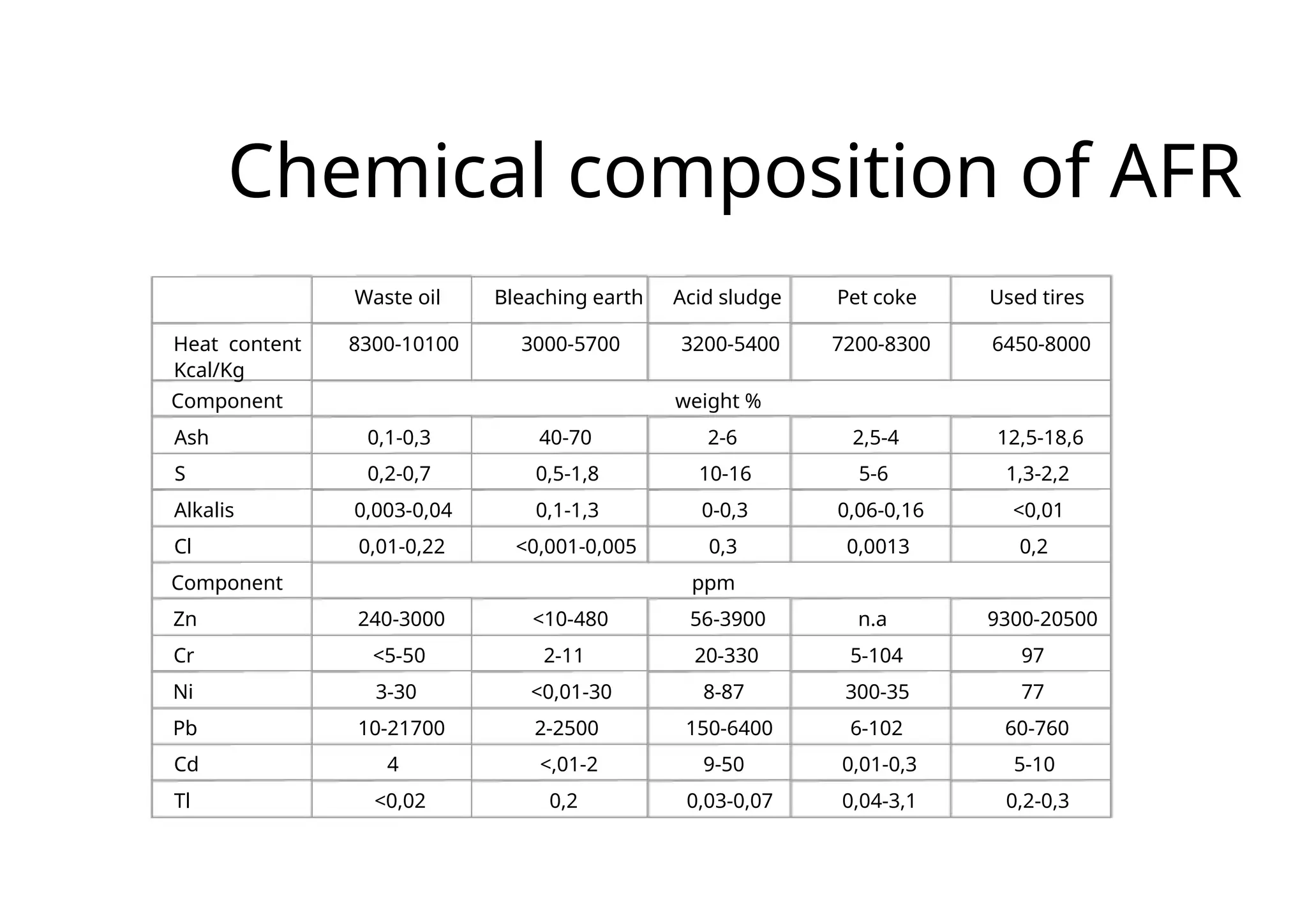
Chemical composition of AFR
Waste oil Bleaching earth Acid sludge Pet coke Used tires
Heat content 8300-10100 3000-5700 3200-5400 7200-8300 6450-8000
Kcal/Kg
Component weight %
Ash 0,1-0,3 40-70 2-6 2,5-4 12,5-18,6
S 0,2-0,7 0,5-1,8 10-16 5-6 1,3-2,2
Alkalis 0,003-0,04 0,1-1,3 0-0,3 0,06-0,16 <0,01
Cl 0,01-0,22 <0,001-0,005 0,3 0,0013 0,2
Component ppm
Zn 240-3000 <10-480 56-3900 n.a 9300-20500
Cr <5-50 2-11 20-330 5-104 97
Ni 3-30 <0,01-30 8-87 300-35 77
Pb 10-21700 2-2500 150-6400 6-102 60-760
Cd 4 <,01-2 9-50 0,01-0,3 5-10
Tl <0,02 0,2 0,03-0,07 0,04-3,1 0,2-0,3
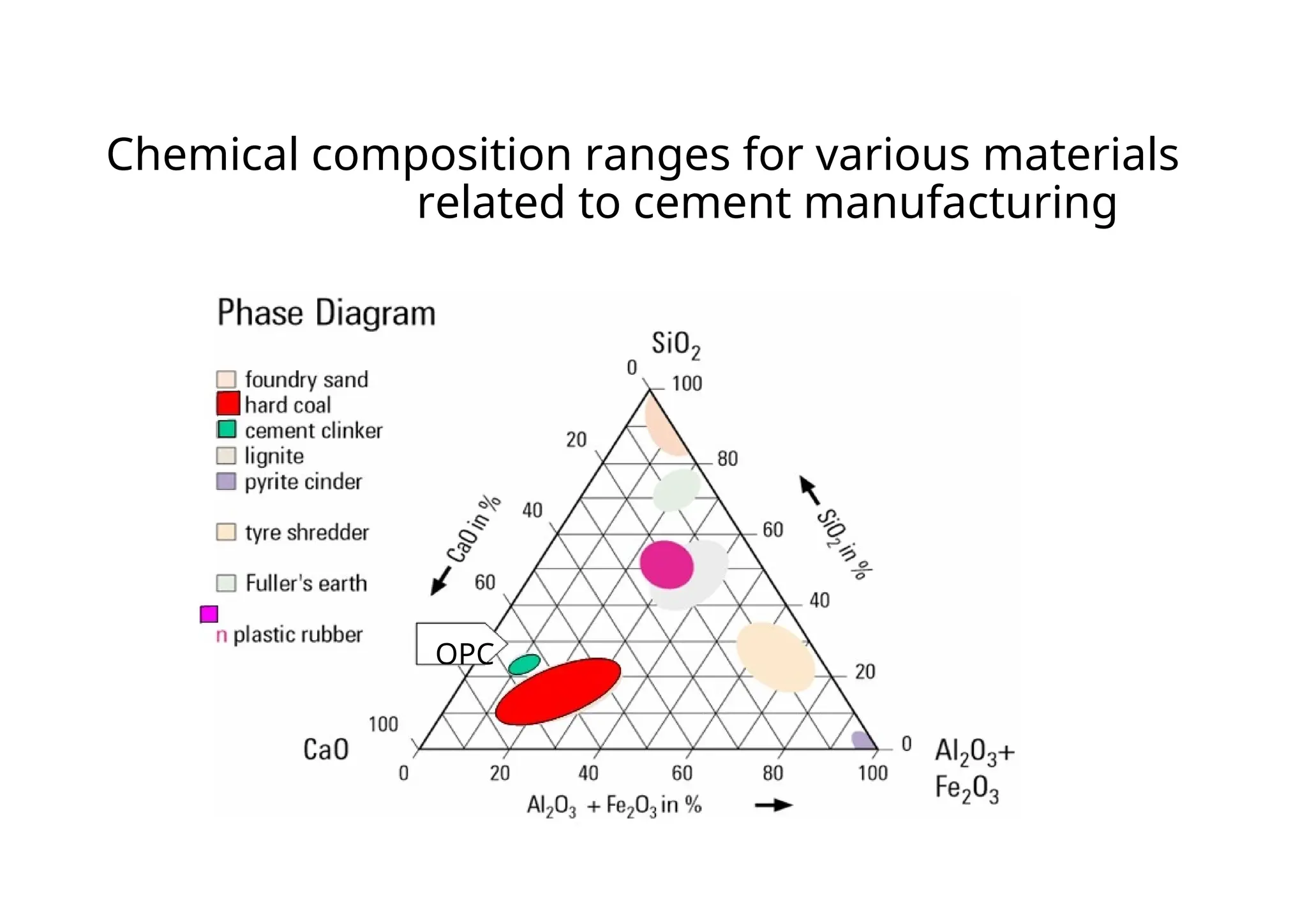
Chemical composition ranges for various materials
related to cement manufacturing
OPC
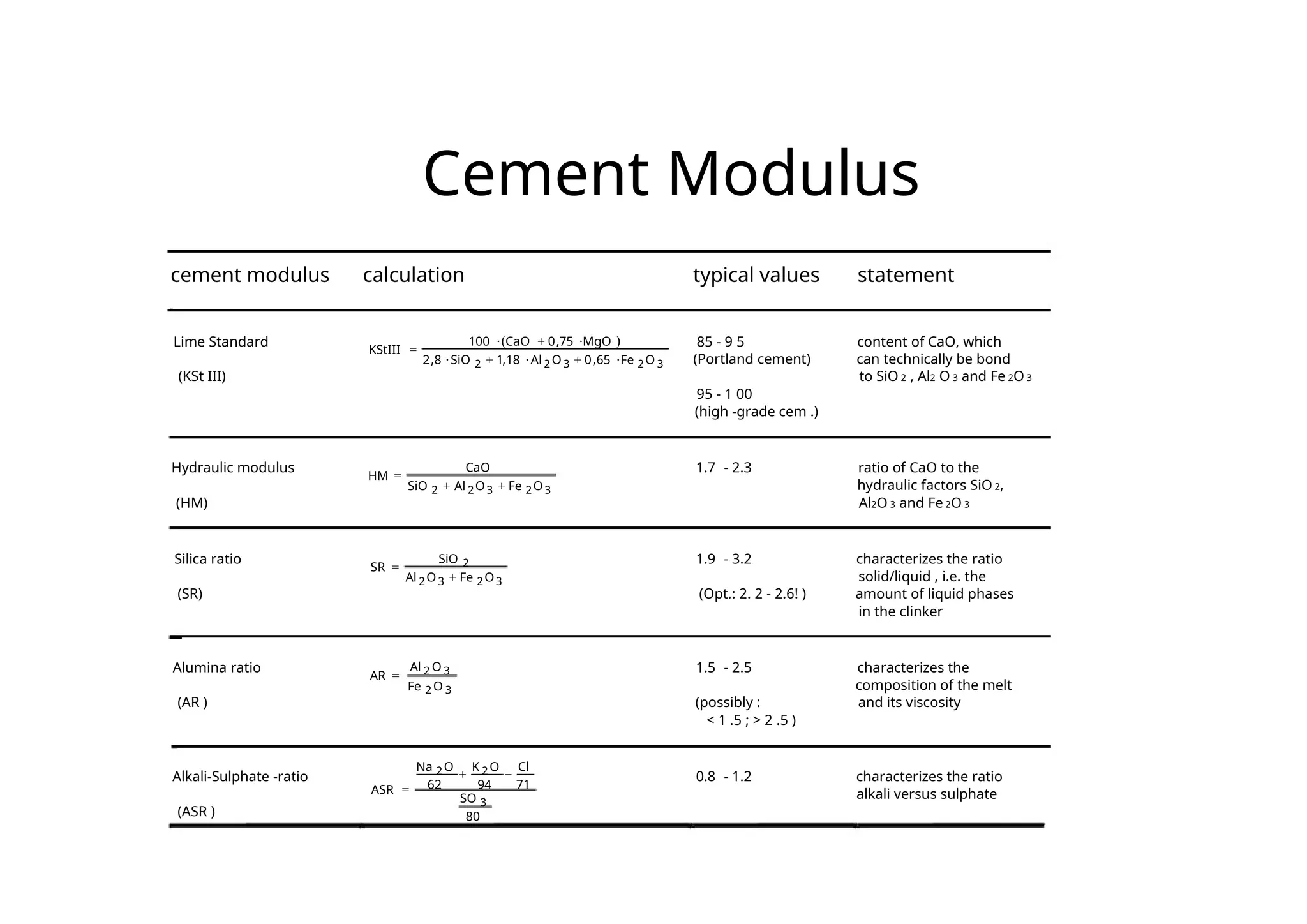
Cement Modulus
cement modulus calculation typical values statement
Lime Standard 100 ⋅(CaO + 0,75 ⋅MgO ) 85 - 9 5 content of CaO, which
KStIII =
2,8 ⋅SiO 2 + 1,18 ⋅Al 2 O3 + 0,65 ⋅Fe 2O 3 (Portland cement) can technically be bond
(KSt III) to SiO 2 , Al2 O 3 and Fe 2O 3
95 - 1 00
(high -grade cem .)
Hydraulic modulus CaO 1.7 - 2.3 ratio of CaO to the
HM =
SiO 2 + Al 2O3 + Fe 2O3 hydraulic factors SiO 2,
(HM) Al2O 3 and Fe 2O 3
Silica ratio SiO 2 1.9 - 3.2 characterizes the ratio
SR =
Al 2O 3 + Fe 2O3 solid/liquid , i.e. the
(SR) (Opt.: 2. 2 - 2.6! ) amount of liquid phases
in the clinker
Alumina ratio Al 2 O 3 1.5 - 2.5 characterizes the
AR =
Fe 2 O 3 composition of the melt
(AR ) (possibly : and its viscosity
< 1 .5 ; > 2 .5 )
Na 2 O K 2 O Cl
Alkali-Sulphate -ratio + − 0.8 - 1.2 characterizes the ratio
62 94 71
ASR =
SO alkali versus sulphate
3
(ASR ) 80
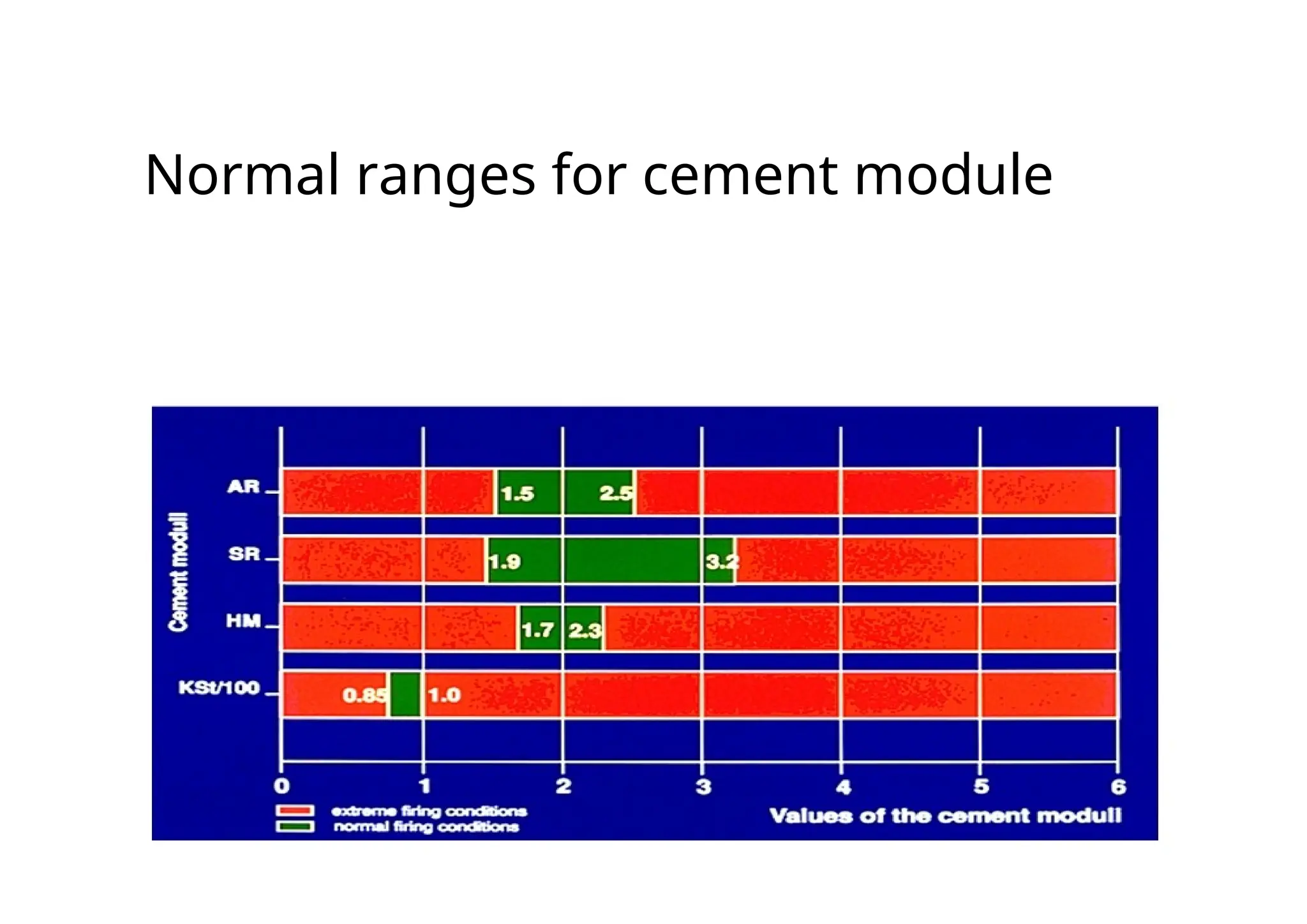
Normal ranges for cement module
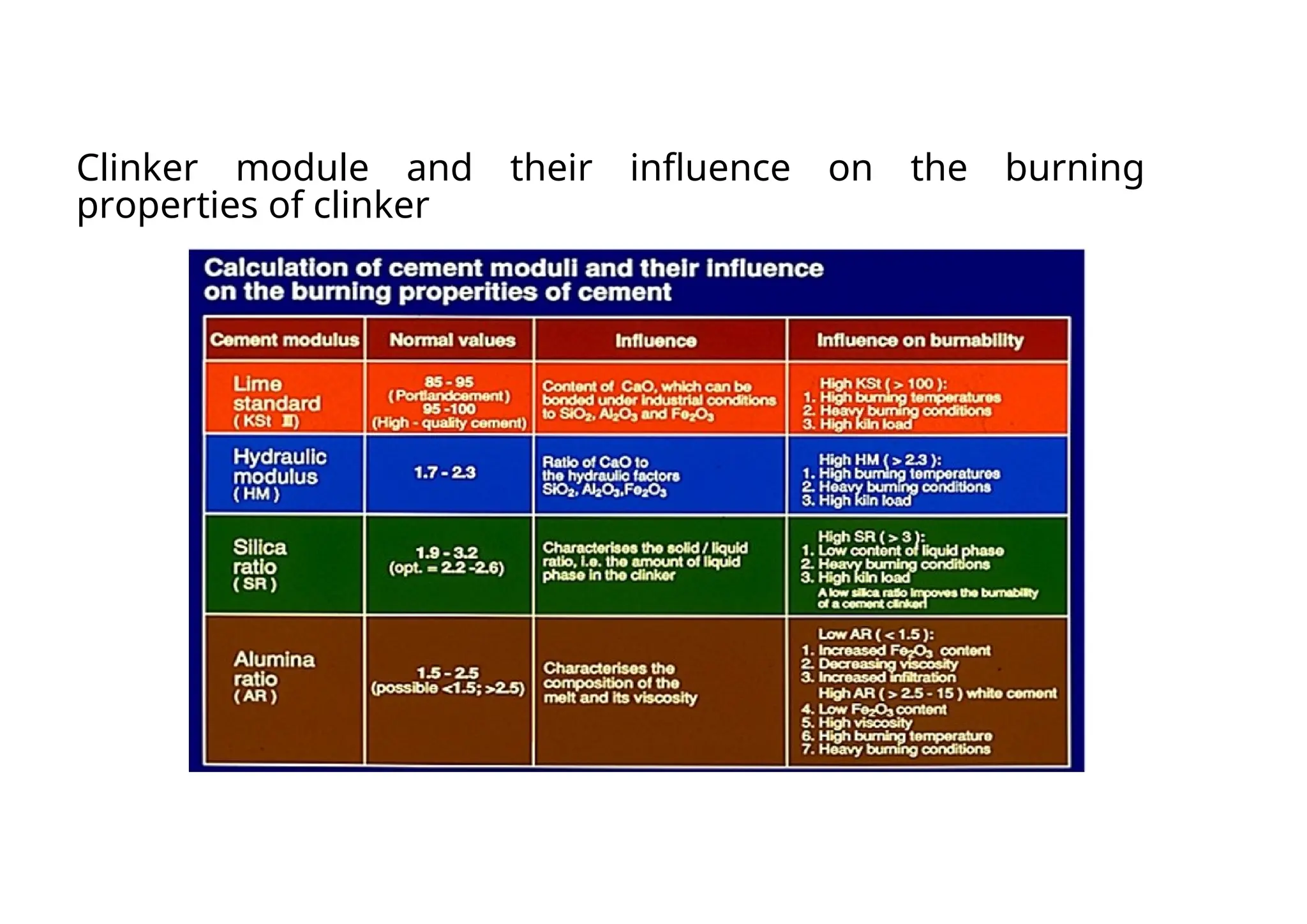
Clinker module and their influence on the burning
properties of clinker
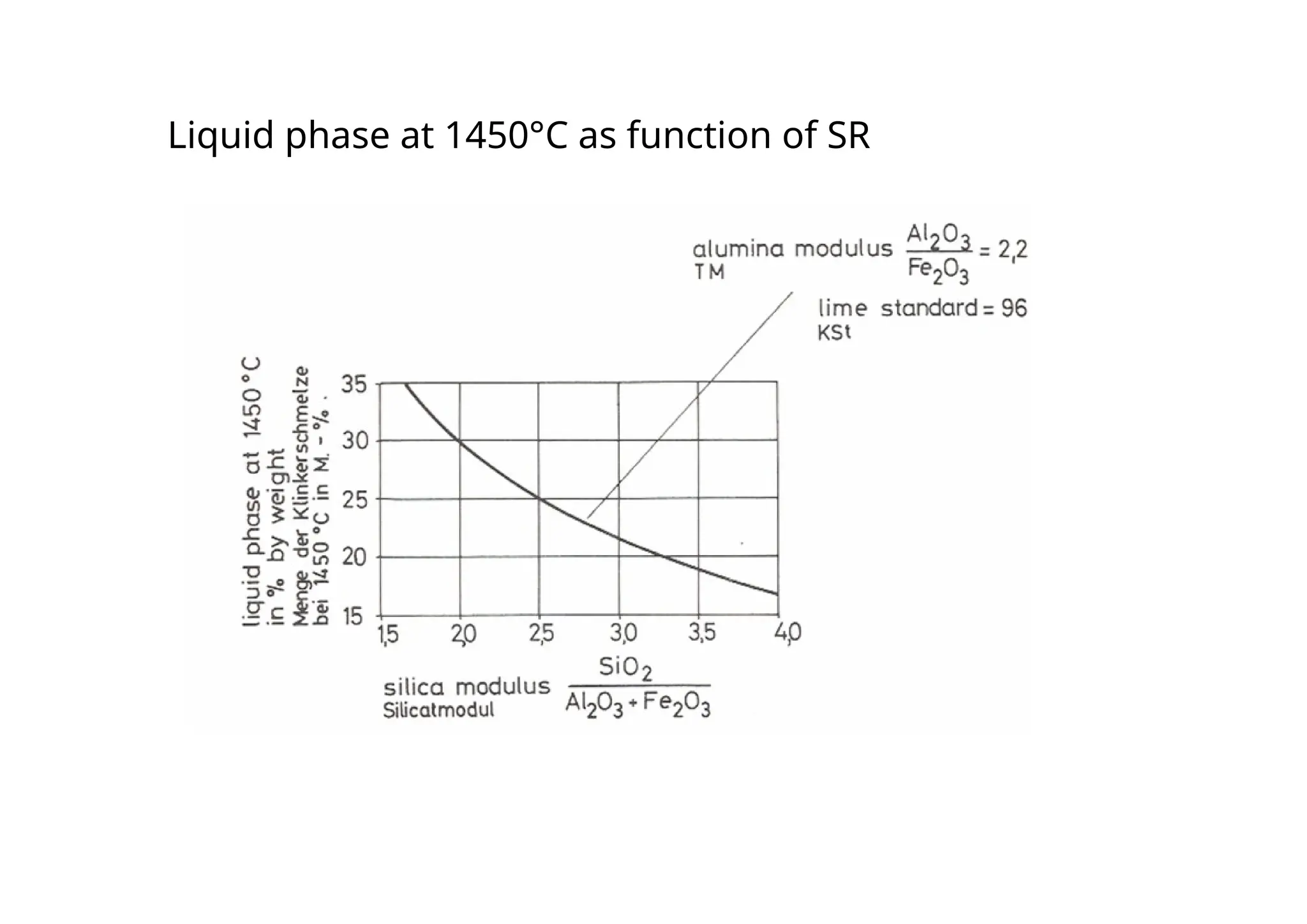
Liquid phase at 1450°C as function of SR
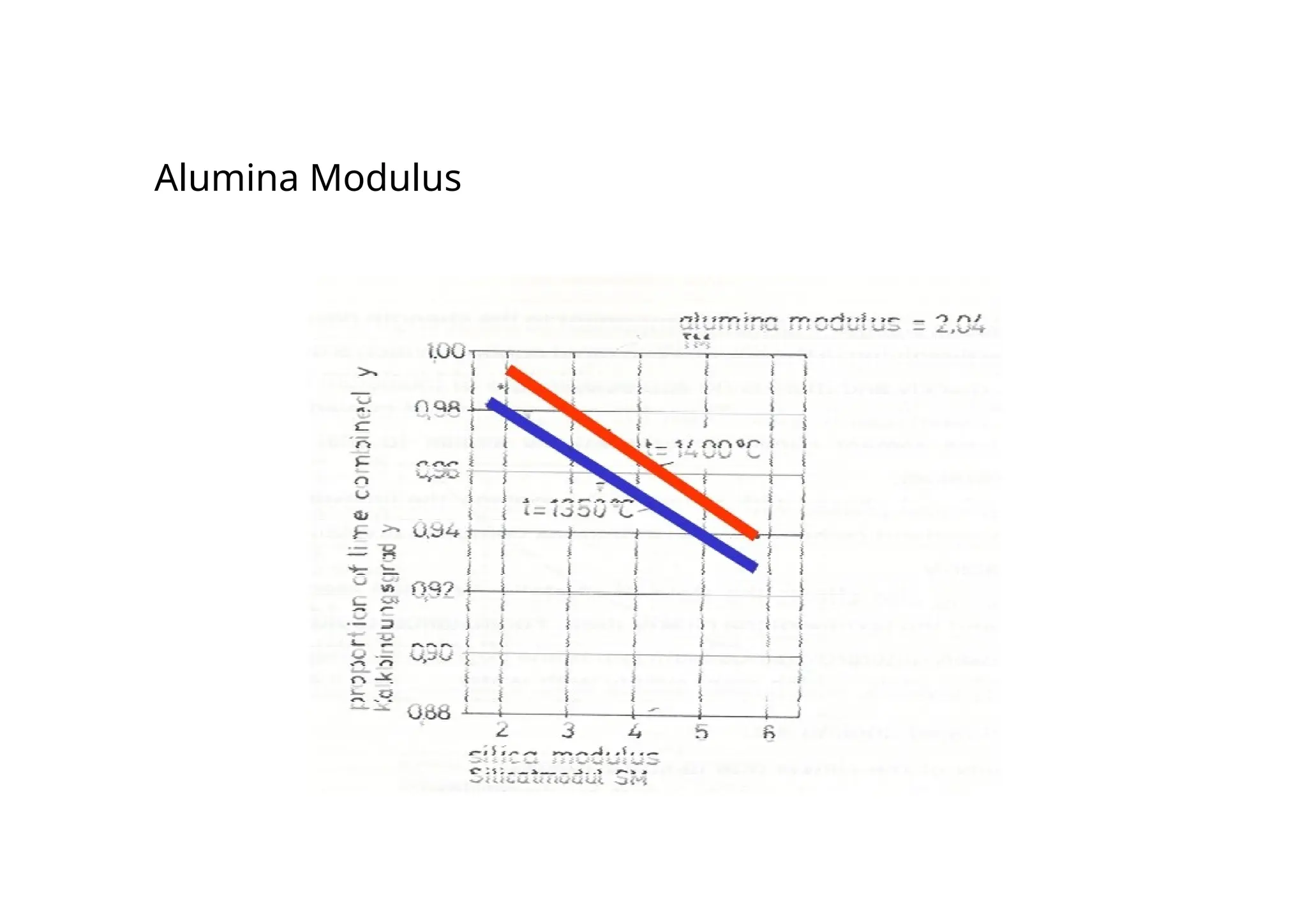
Alumina Modulus
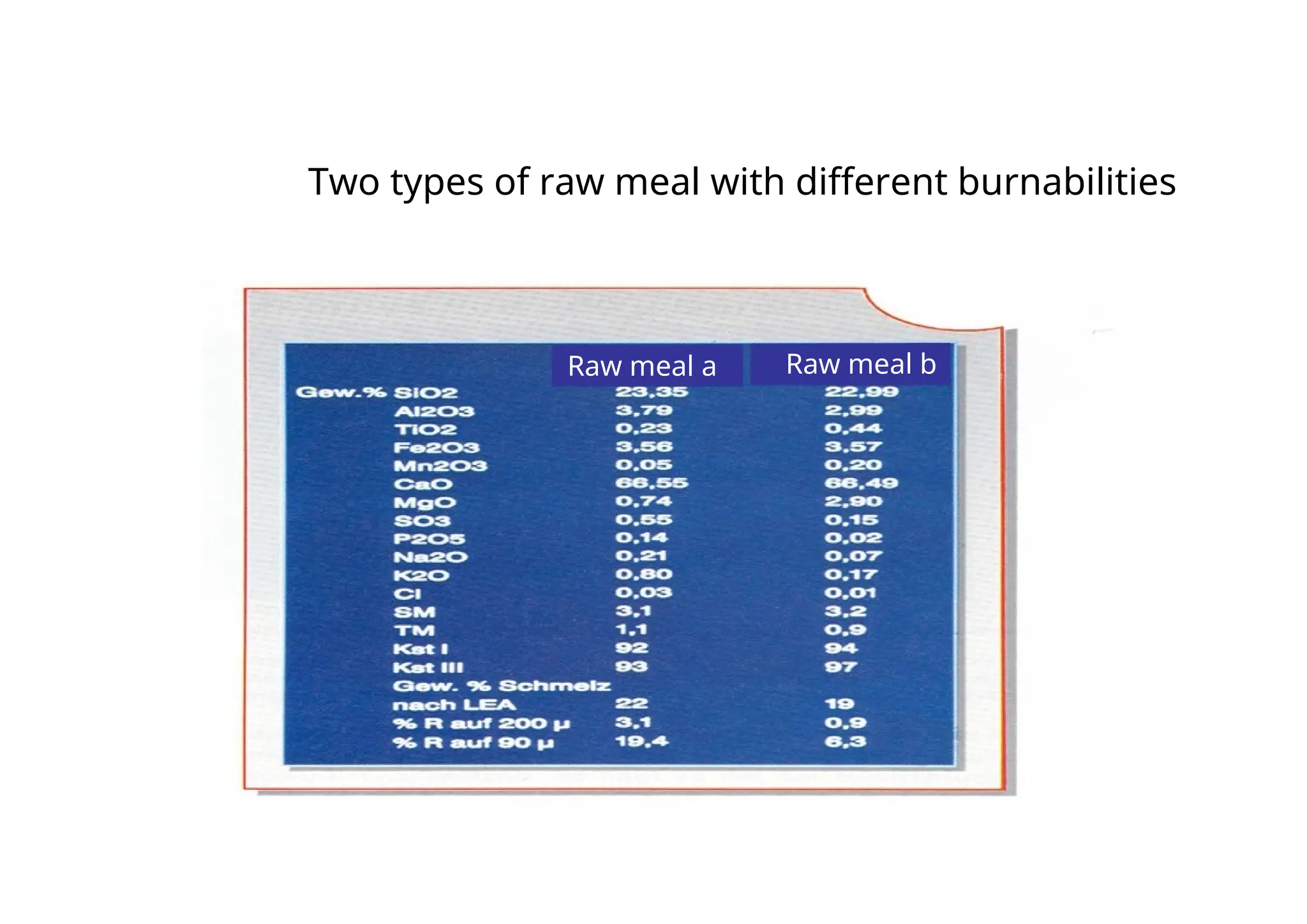
Two types of raw meal with different burnabilities
Raw meal a Raw meal b
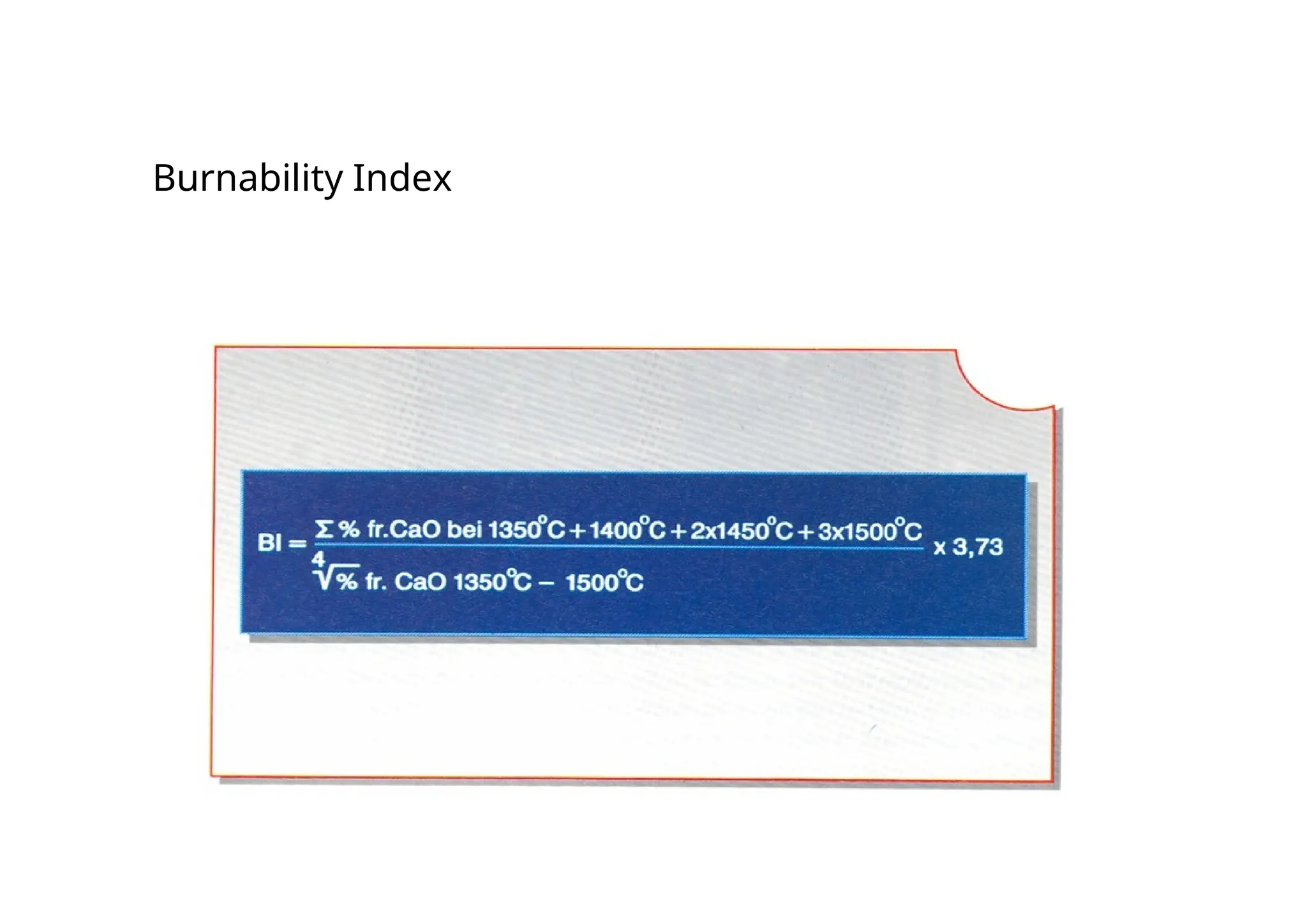
Burnability Index
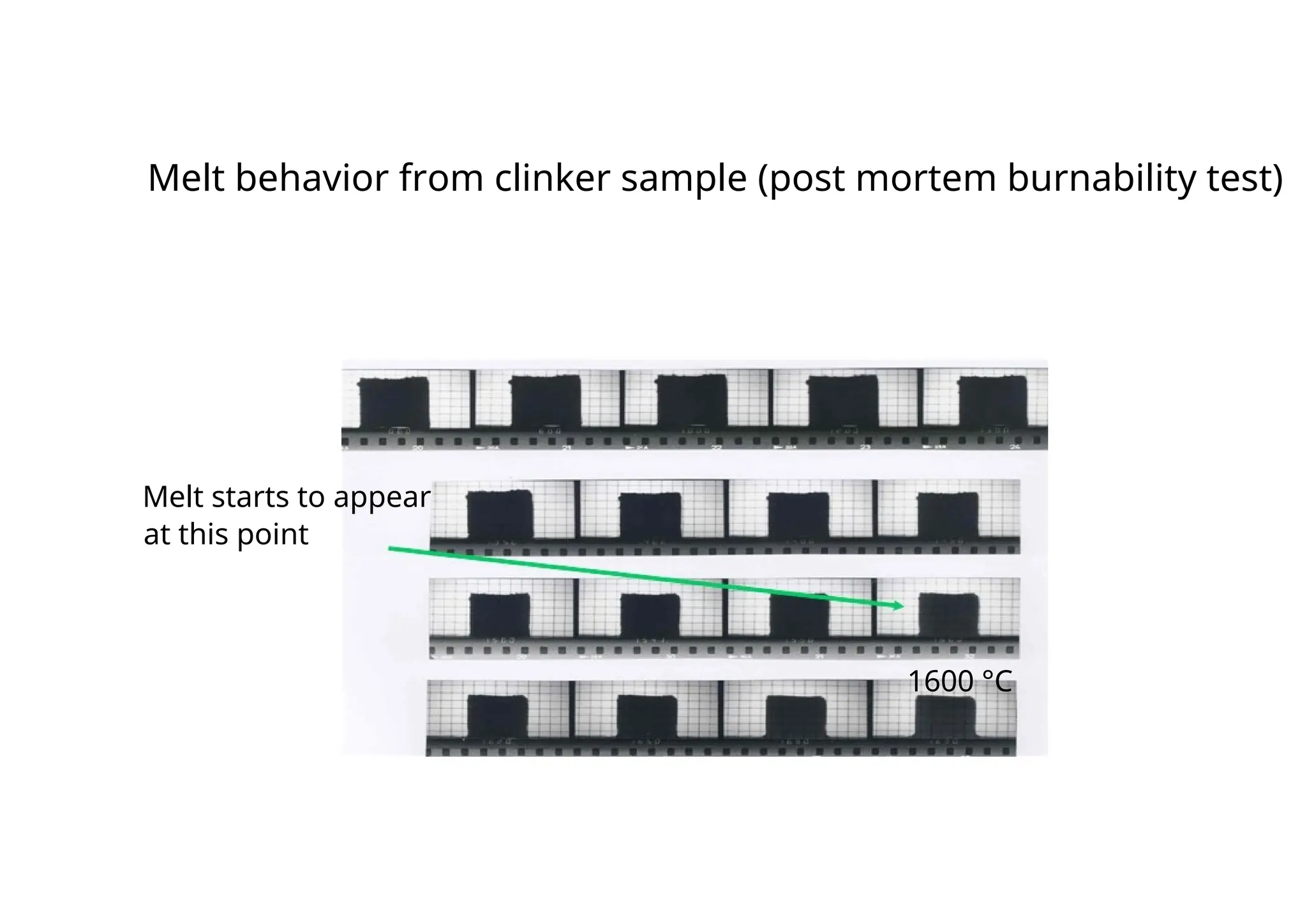
Melt behavior from clinker sample (post mortem burnability test)
Melt starts to appear
at this point
1600 °C
1620
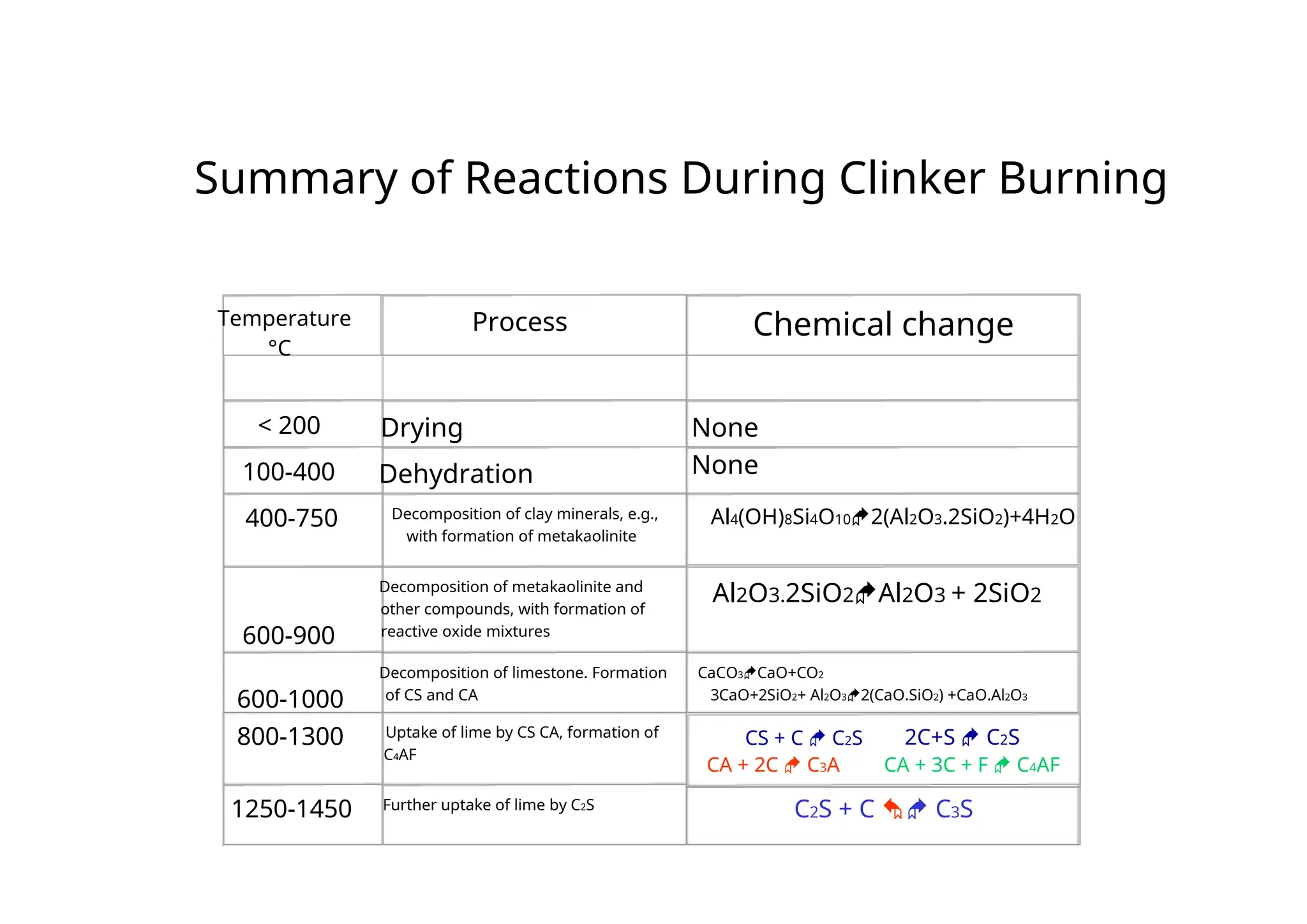
Summary of Reactions During Clinker Burning
Temperature Process Chemical change
°C
< 200 Drying None
None
100-400 Dehydration
Decomposition of clay minerals, e.g.,
400-750 Al4(OH)8Si4O102(Al2O3.2SiO2)+4H2O
with formation of metakaolinite
Decomposition of metakaolinite and
Al2O3.2SiO2Al2O3 + 2SiO2
other compounds, with formation of
reactive oxide mixtures
600-900
Decomposition of limestone. Formation CaCO3CaO+CO2
of CS and CA 3CaO+2SiO2+ Al2O32(CaO.SiO2) +CaO.Al2O3
600-1000
Uptake of lime by CS CA, formation of
800-1300 CS + C  C2S 2C+S  C2S
C4AF
CA + 2C  C3A CA + 3C + F  C4AF
Further uptake of lime by C2S
1250-1450 C2S + C  C3S
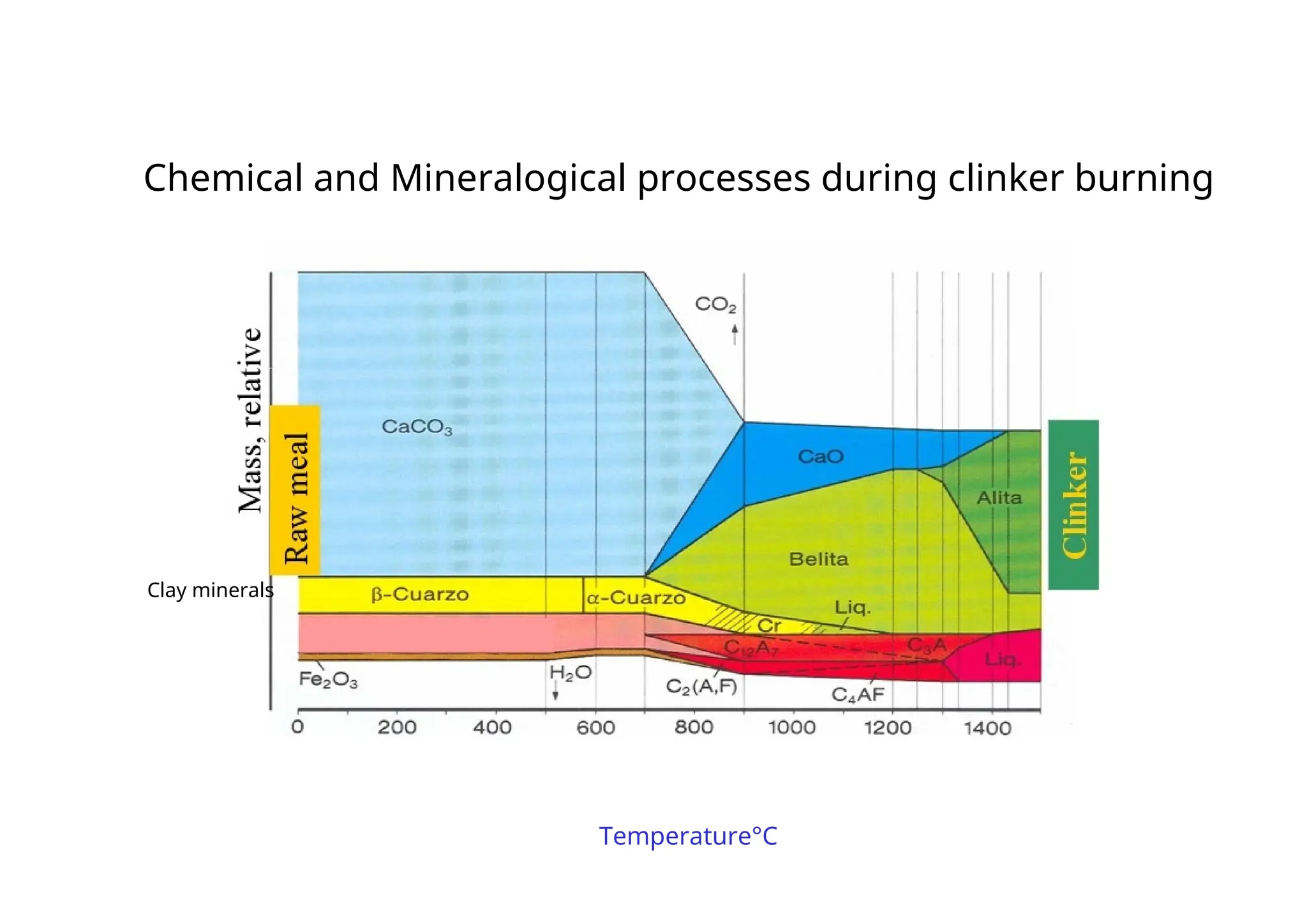
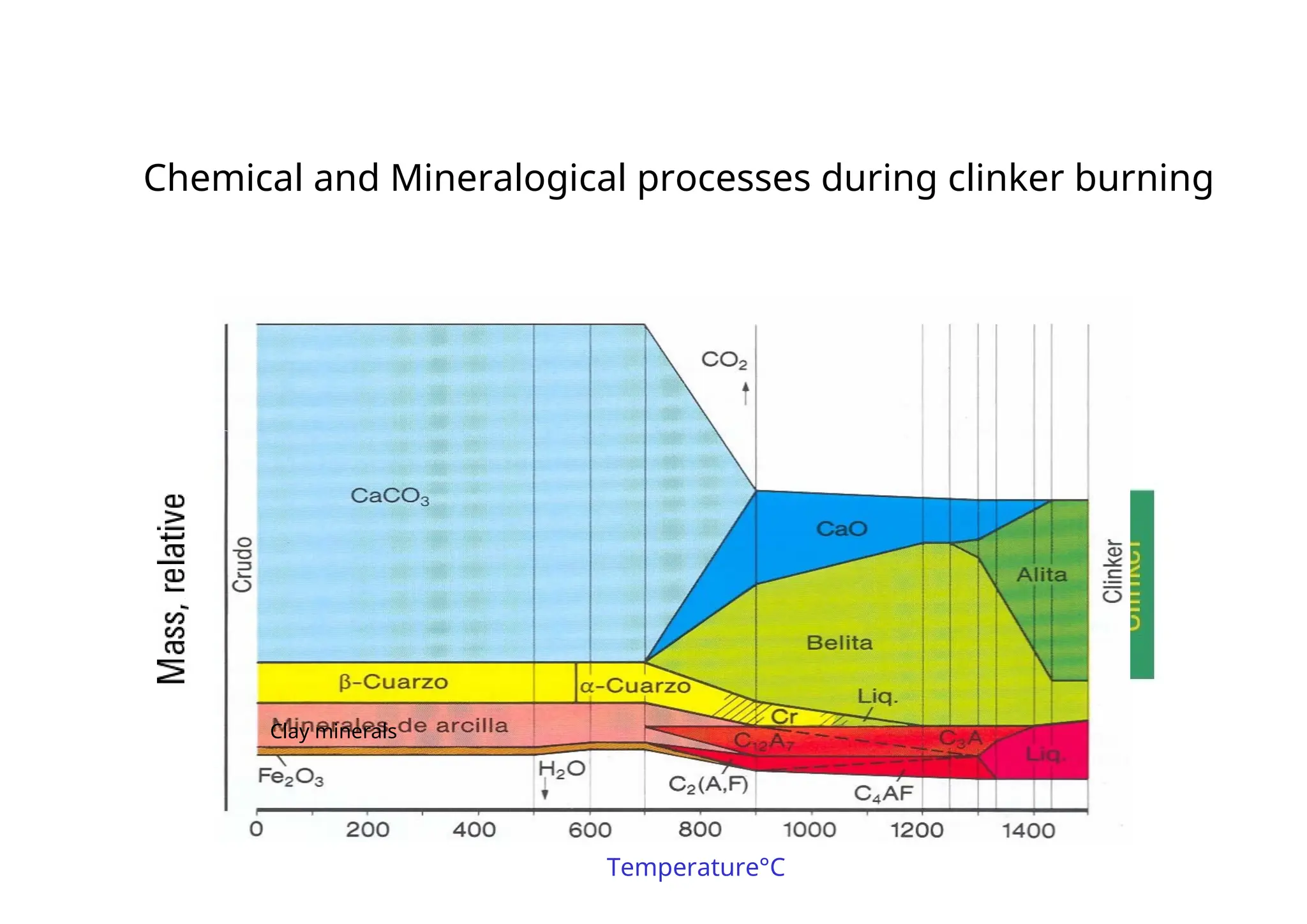
Chemical and Mineralogical processes during clinker burning
Clay minerals
Temperature°C
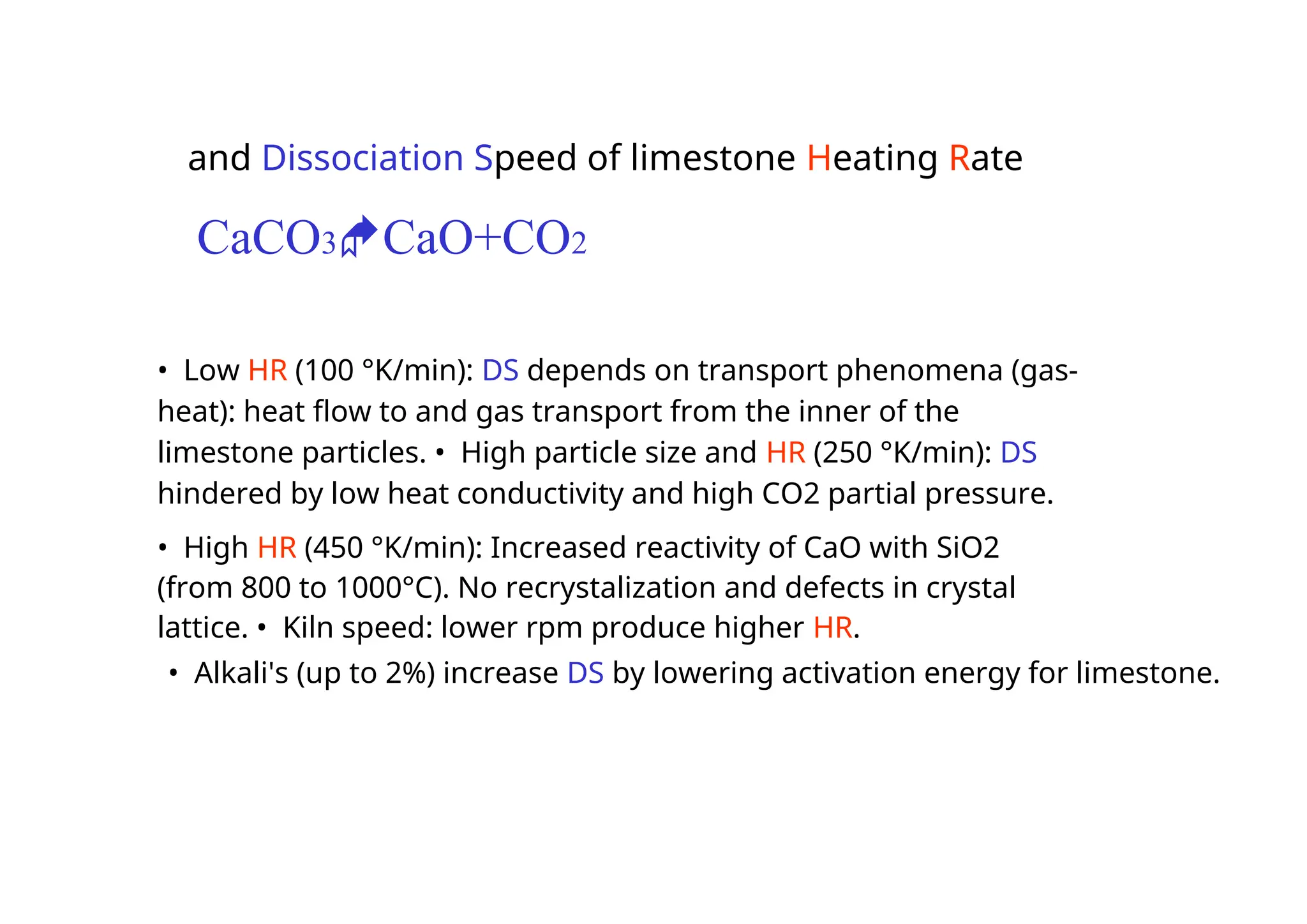
and Dissociation Speed of limestone Heating Rate
CaCO3CaO+CO2
• Low HR (100 °K/min): DS depends on transport phenomena (gas-
heat): heat flow to and gas transport from the inner of the
limestone particles. • High particle size and HR (250 °K/min): DS
hindered by low heat conductivity and high CO2 partial pressure.
• High HR (450 °K/min): Increased reactivity of CaO with SiO2
(from 800 to 1000°C). No recrystalization and defects in crystal
lattice. • Kiln speed: lower rpm produce higher HR.
• Alkali's (up to 2%) increase DS by lowering activation energy for limestone.
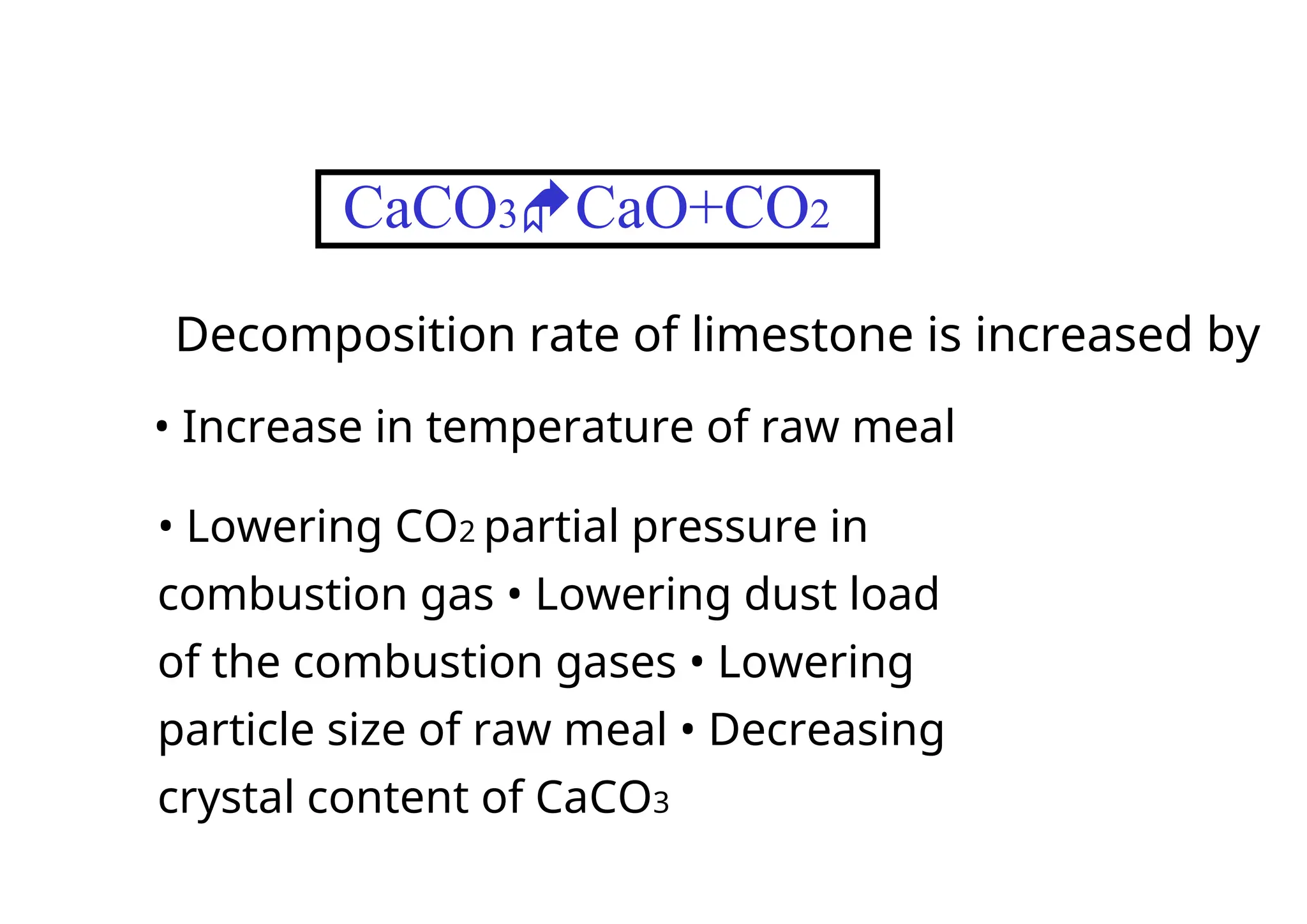
CaCO3CaO+CO2
Decomposition rate of limestone is increased by
• Increase in temperature of raw meal
• Lowering CO2 partial pressure in
combustion gas • Lowering dust load
of the combustion gases • Lowering
particle size of raw meal • Decreasing
crystal content of CaCO3
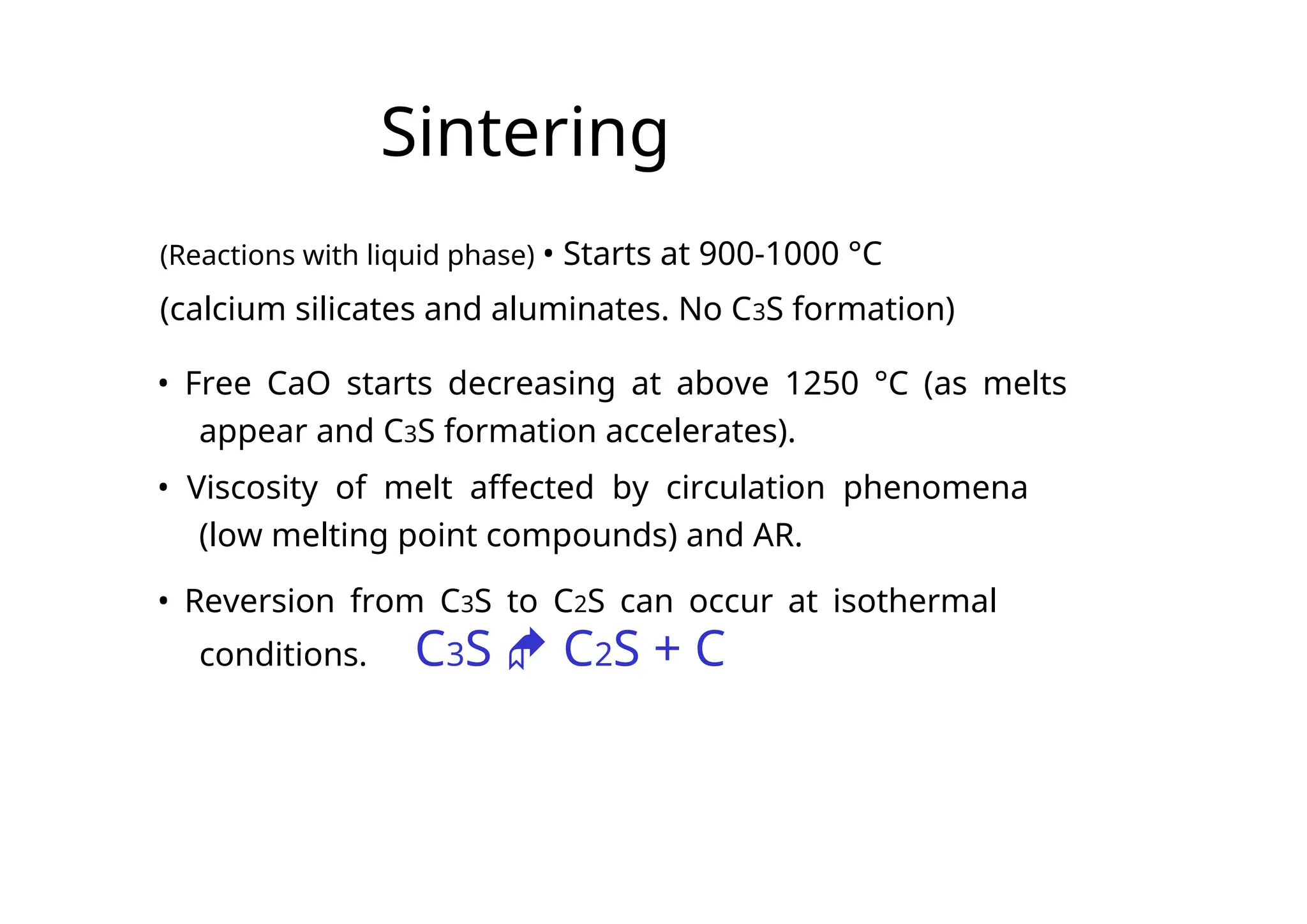
Sintering
(Reactions with liquid phase) • Starts at 900-1000 °C
(calcium silicates and aluminates. No C3S formation)
• Free CaO starts decreasing at above 1250 °C (as melts
appear and C3S formation accelerates).
• Viscosity of melt affected by circulation phenomena
(low melting point compounds) and AR.
• Reversion from C3S to C2S can occur at isothermal
conditions. C3S  C2S + C
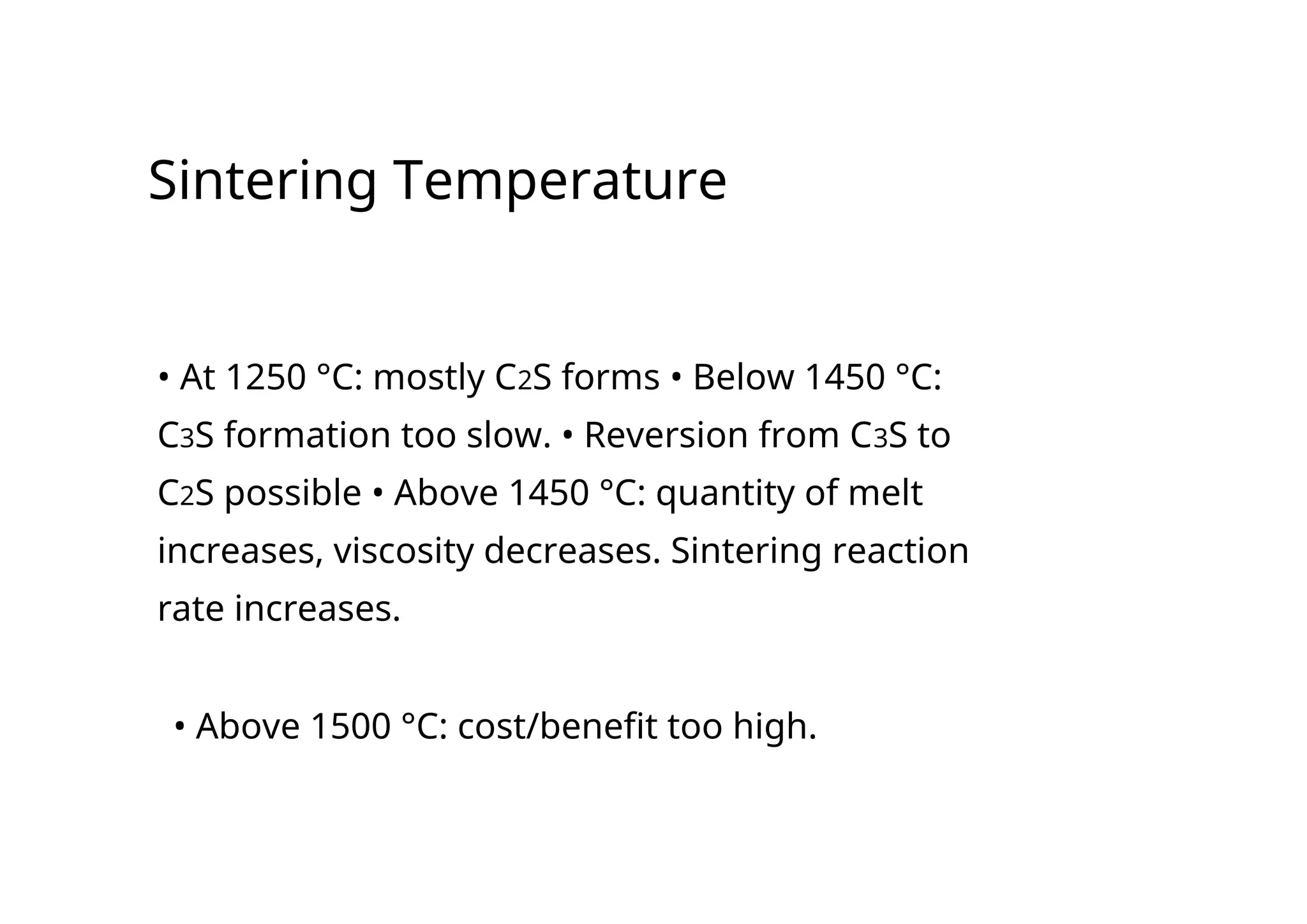
Sintering Temperature
• At 1250 °C: mostly C2S forms • Below 1450 °C:
C3S formation too slow. • Reversion from C3S to
C2S possible • Above 1450 °C: quantity of melt
increases, viscosity decreases. Sintering reaction
rate increases.
• Above 1500 °C: cost/benefit too high.
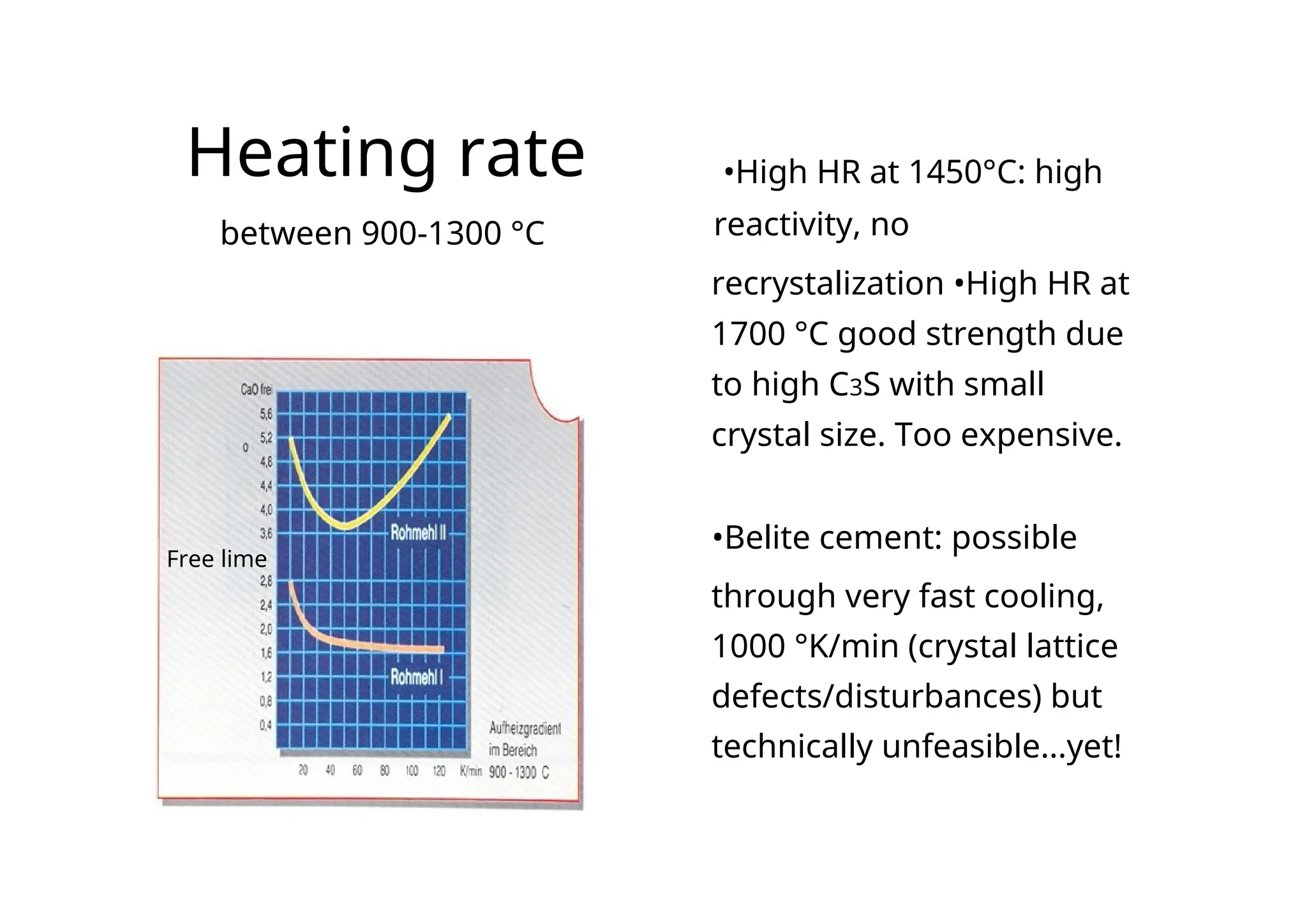
Heating rate •High HR at 1450°C: high
reactivity, no
between 900-1300 °C
recrystalization •High HR at
1700 °C good strength due
to high C3S with small
crystal size. Too expensive.
•Belite cement: possible
Free lime
through very fast cooling,
1000 °K/min (crystal lattice
defects/disturbances) but
technically unfeasible...yet!
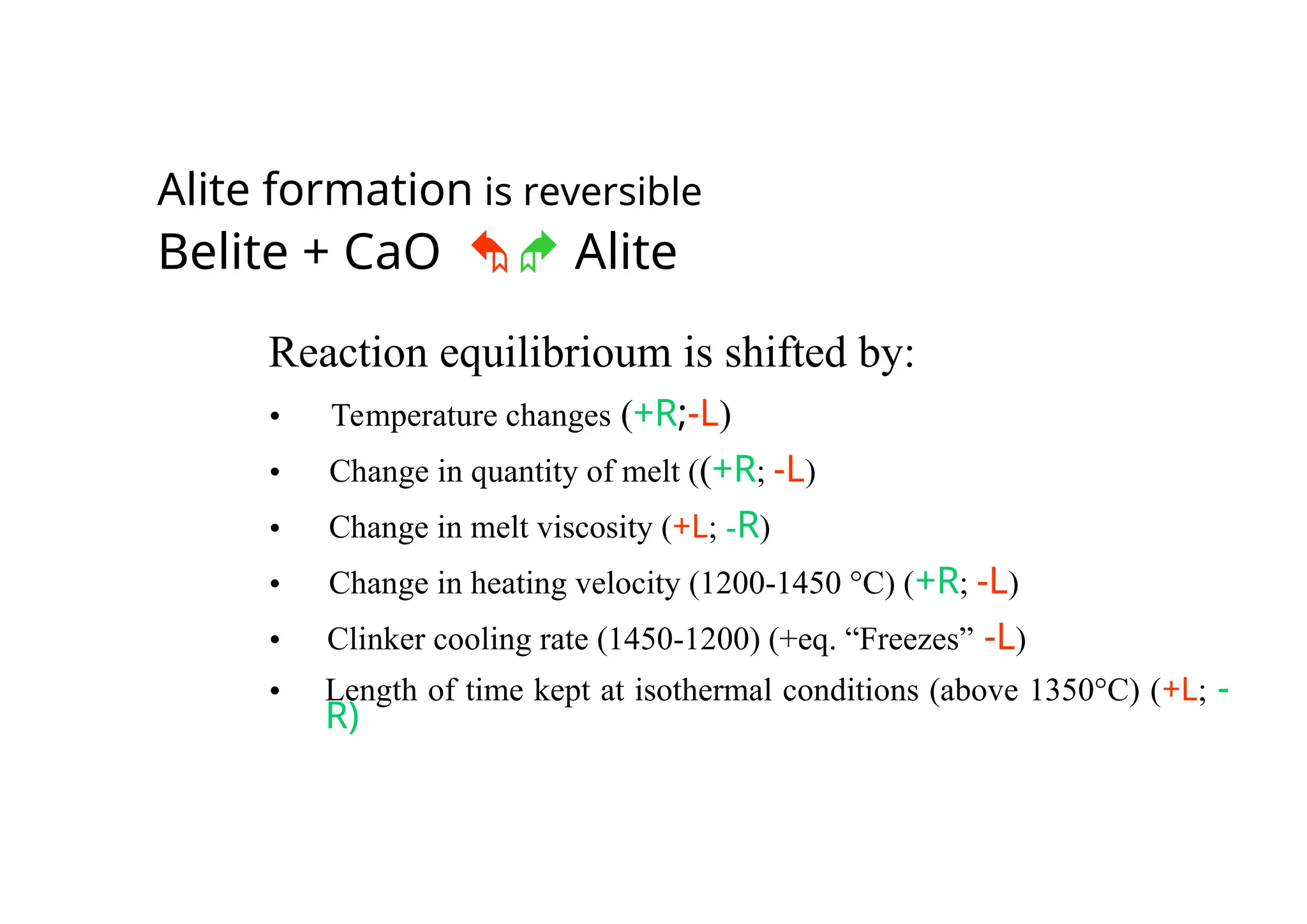
Alite formation is reversible
Belite + CaO Alite
Reaction equilibrioum is shifted by:
• Temperature changes (+R;-L)
• Change in quantity of melt ((+R; -L)
• Change in melt viscosity (+L; -R)
• Change in heating velocity (1200-1450 °C) (+R; -L)
• Clinker cooling rate (1450-1200) (+eq. “Freezes” -L)
• Length of time kept at isothermal conditions (above 1350°C) (+L; -
R)
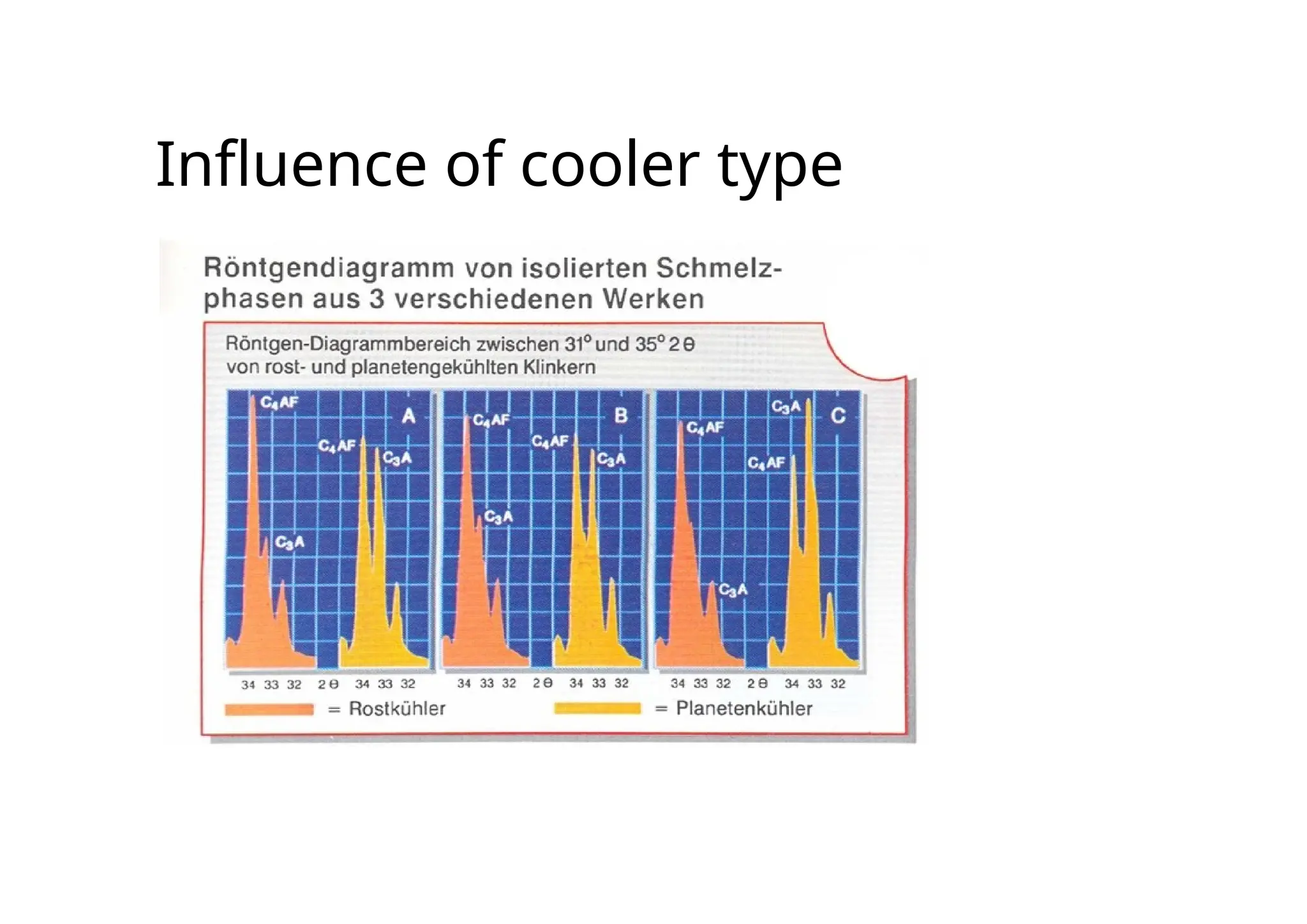
Influence of cooler type
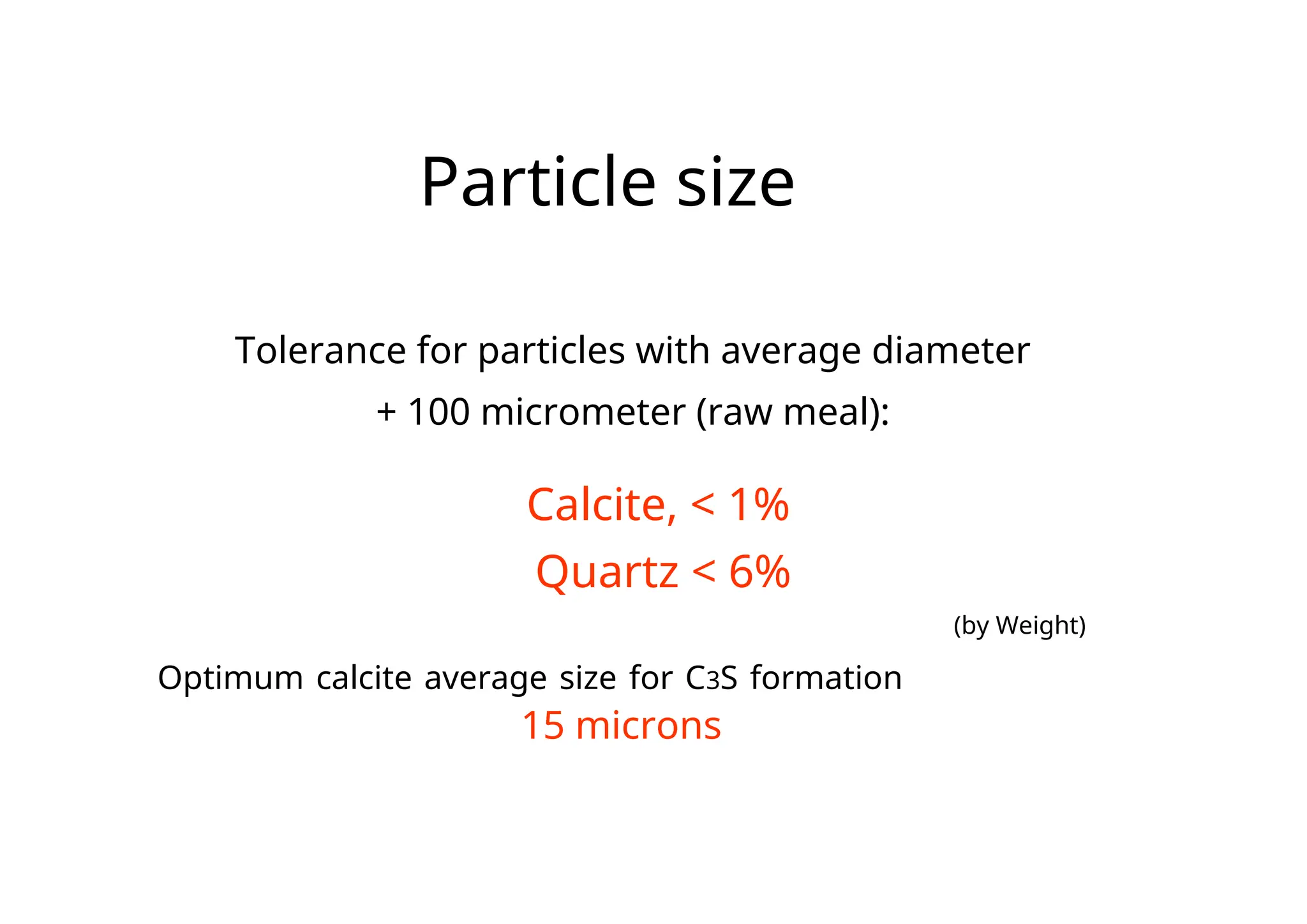
Particle size
Tolerance for particles with average diameter
+ 100 micrometer (raw meal):
Calcite, < 1%
Quartz < 6%
(by Weight)
Optimum calcite average size for C3S formation
15 microns
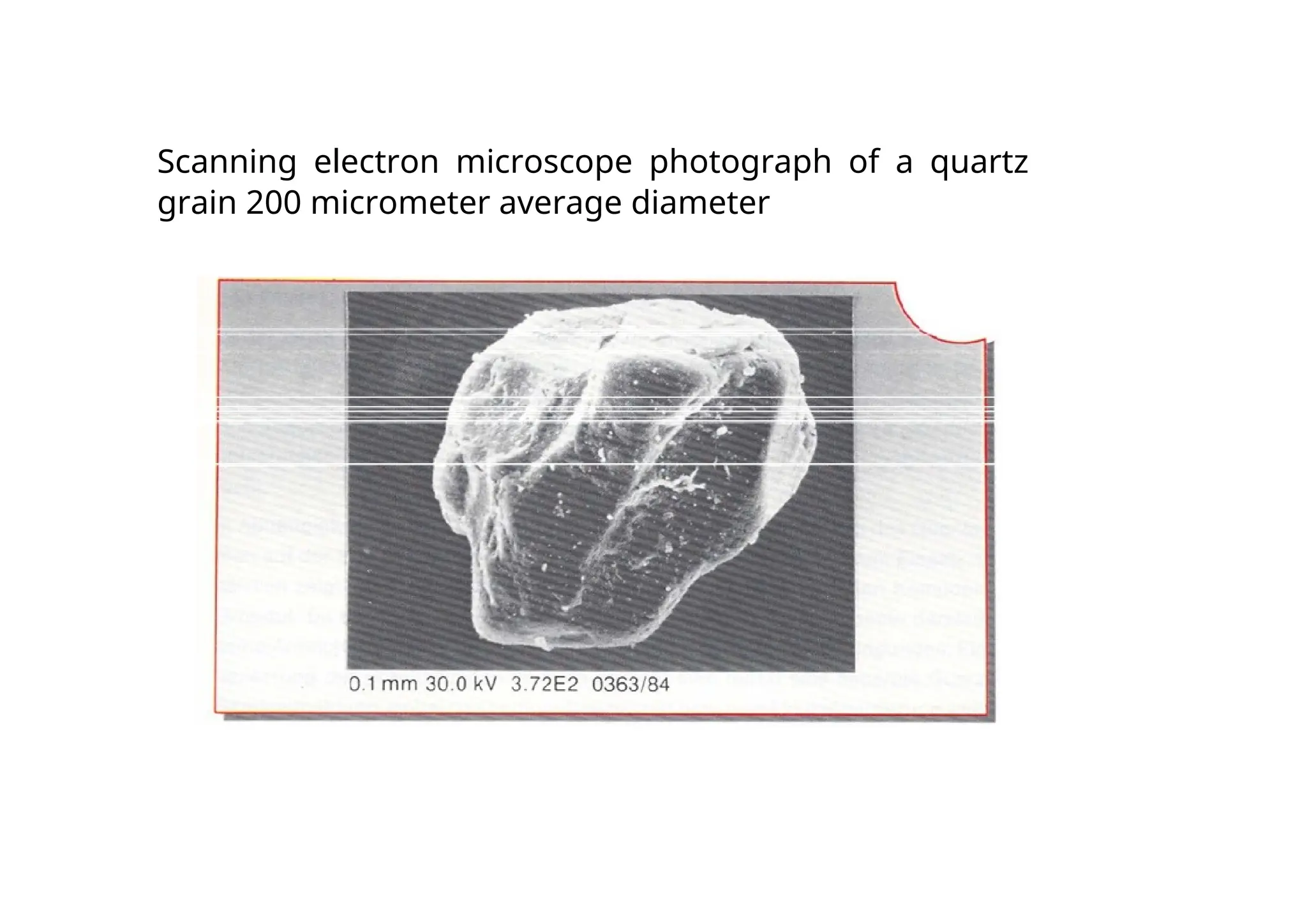
Scanning electron microscope photograph of a quartz
grain 200 micrometer average diameter
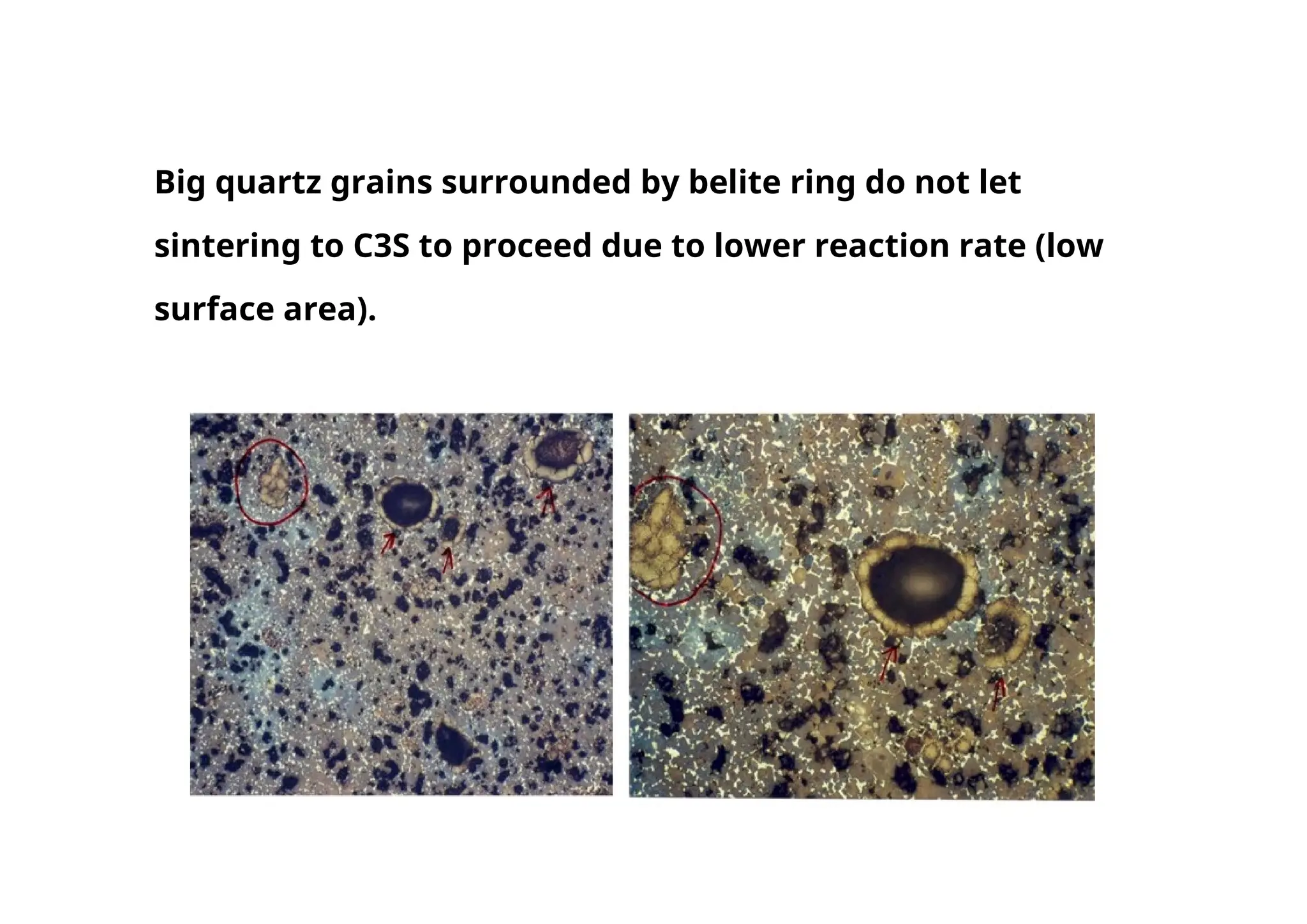
Big quartz grains surrounded by belite ring do not let
sintering to C3S to proceed due to lower reaction rate (low
surface area).
1620
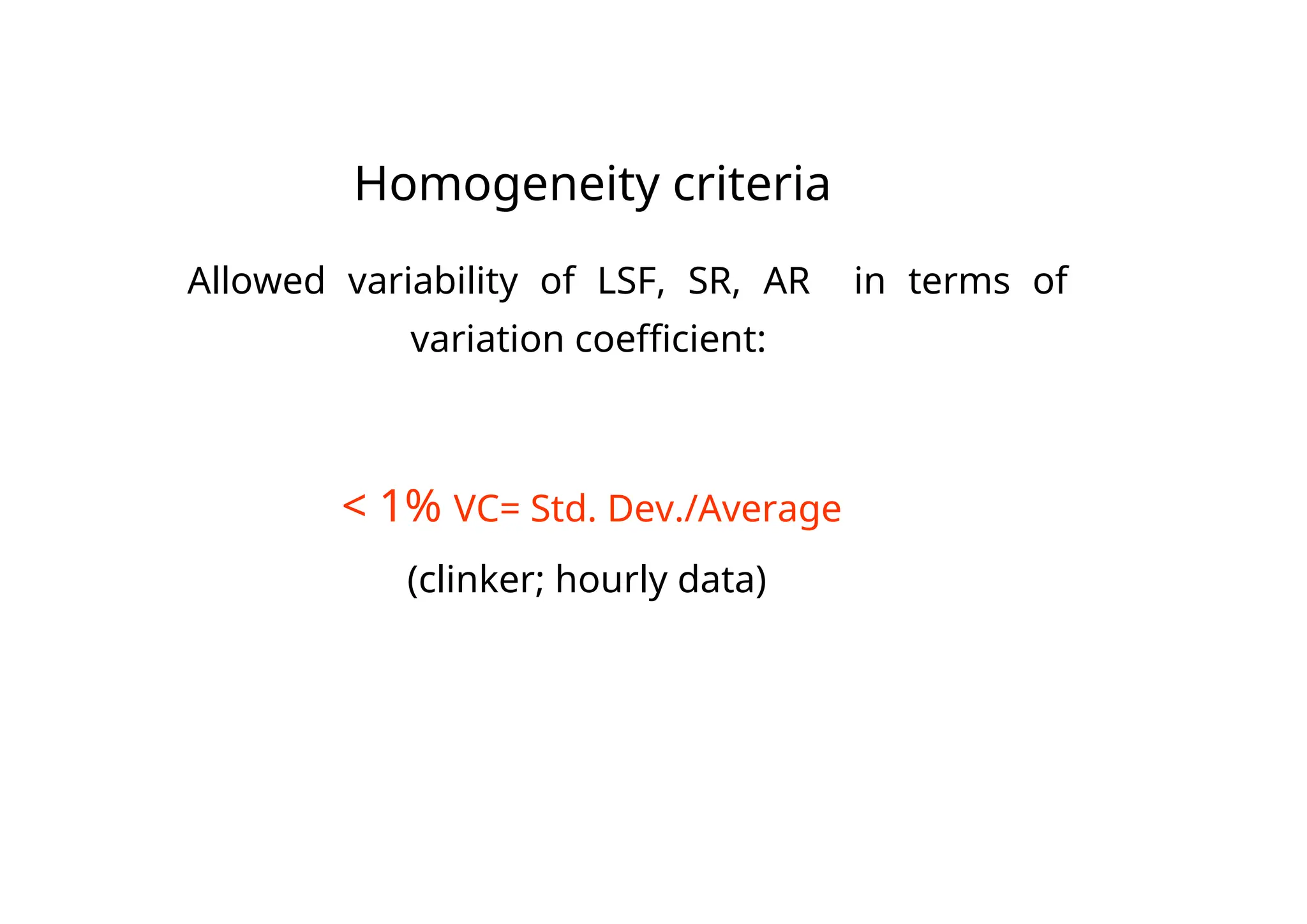
Homogeneity criteria
Allowed variability of LSF, SR, AR in terms of
variation coefficient:
< 1% VC= Std. Dev./Average
(clinker; hourly data)
Why hourly?
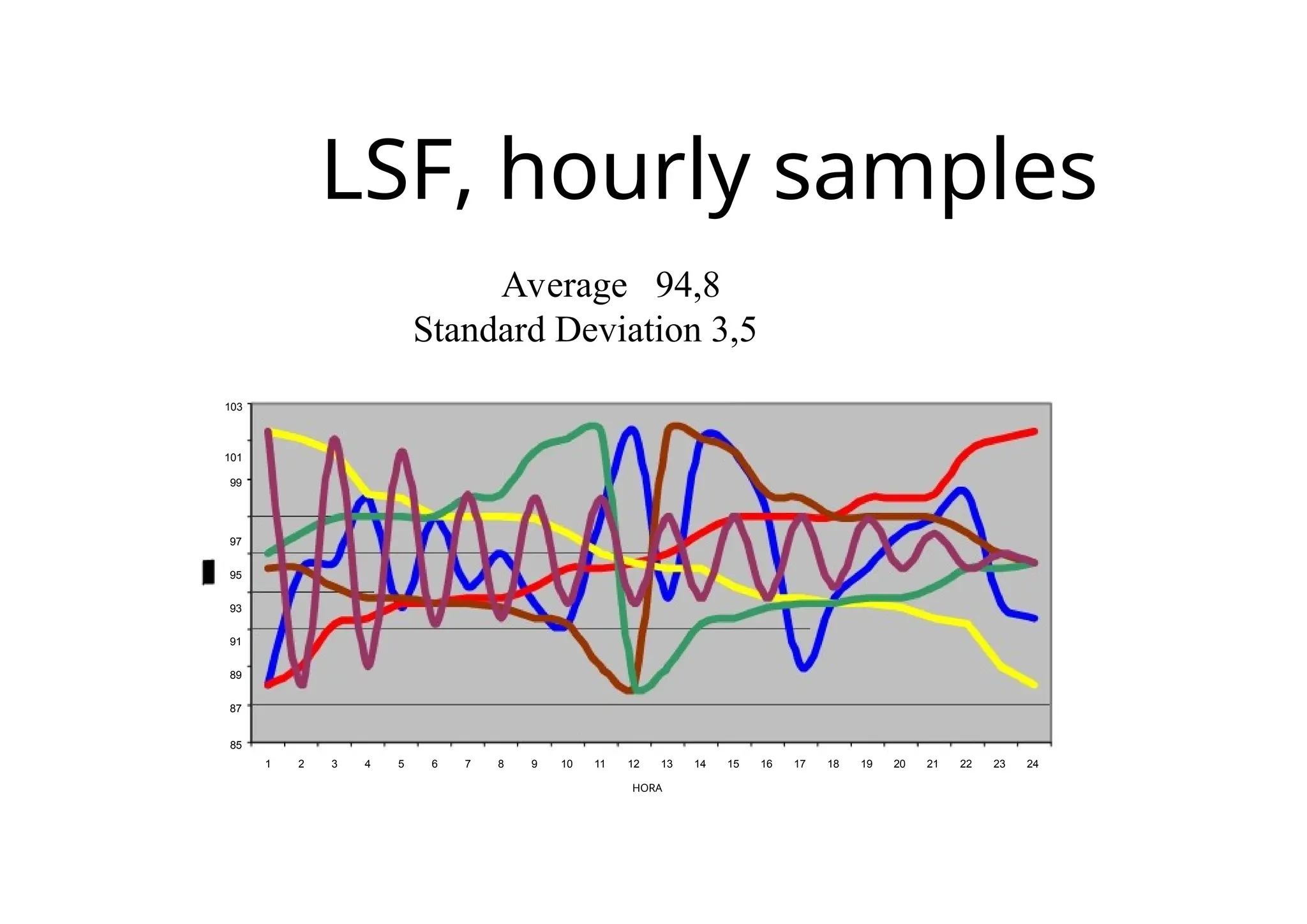
LSF, hourly samples
Average 94,8
Standard Deviation 3,5
103
101
99
97
95
93
91
89
87
85
1 2 3 4 5 6 7 8 9 10 11 12 13 14 15 16 17 18 19 20 21 22 23 24
HORA
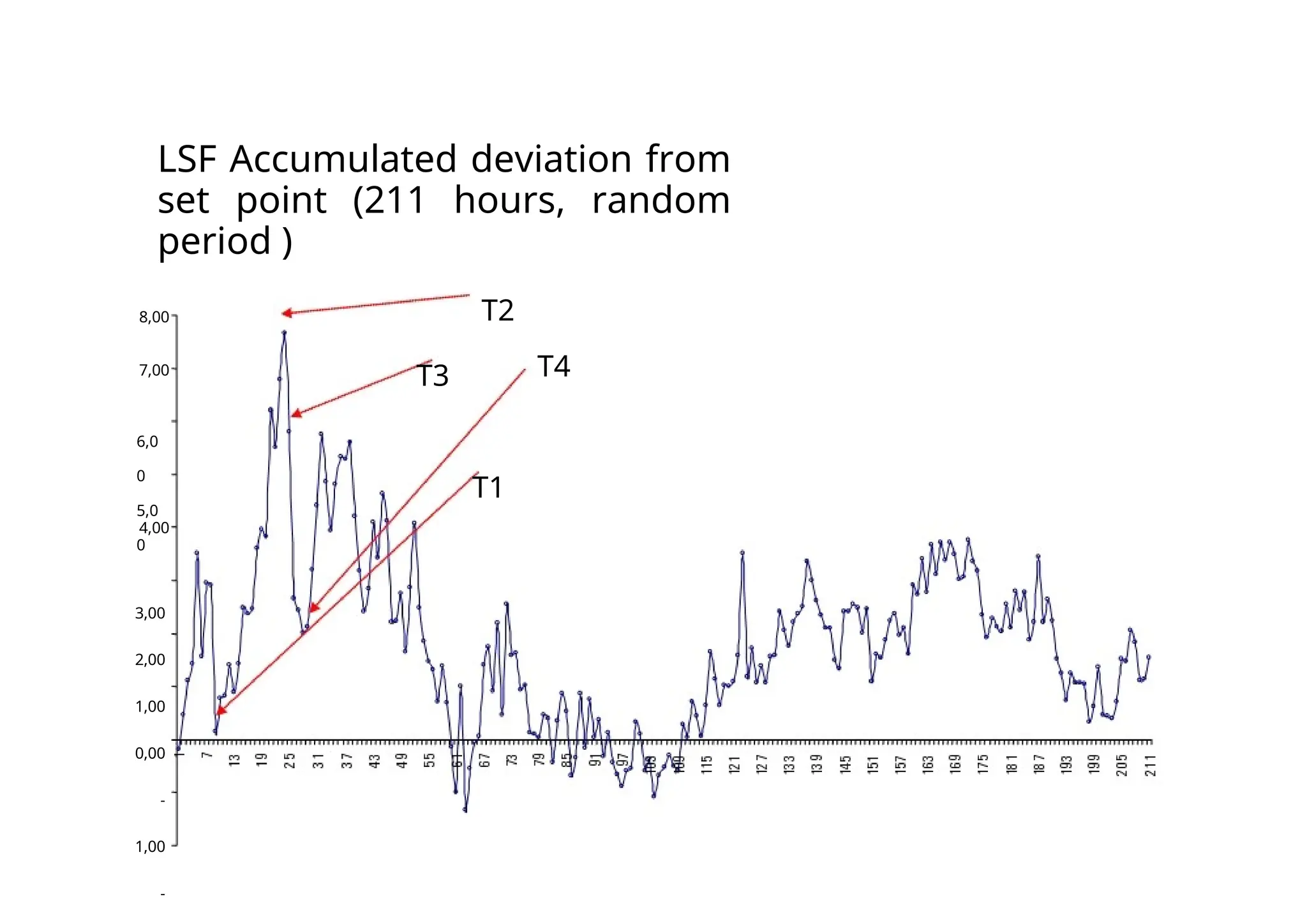
LSF Accumulated deviation from
set point (211 hours, random
period )
8,00 T2
7,00 T4
T3
6,0
0
5,0
0
T1
4,00
3,00
2,00
1,00
0,00
-
1,00
-
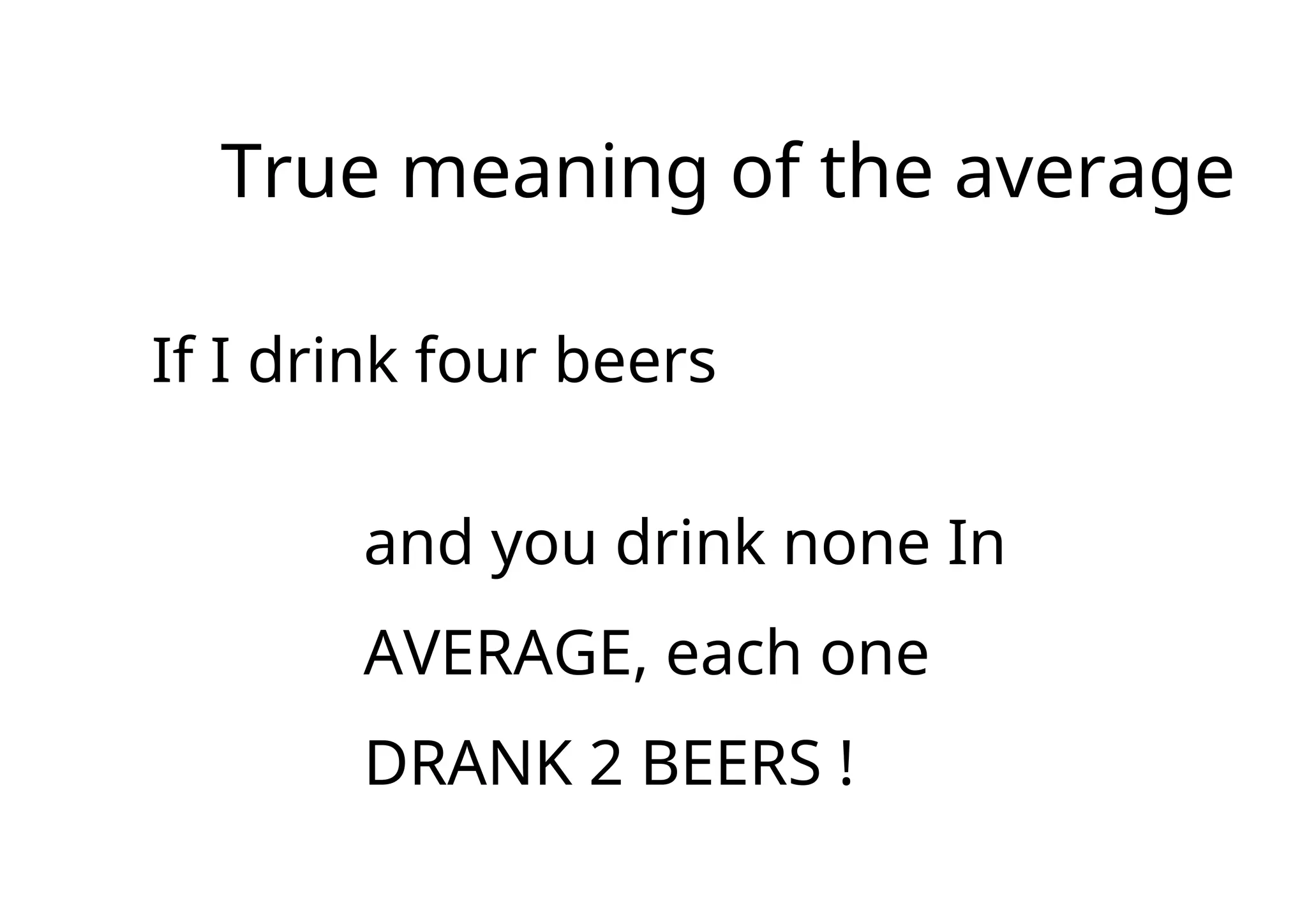
True meaning of the average
If I drink four beers
and you drink none In
AVERAGE, each one
DRANK 2 BEERS !
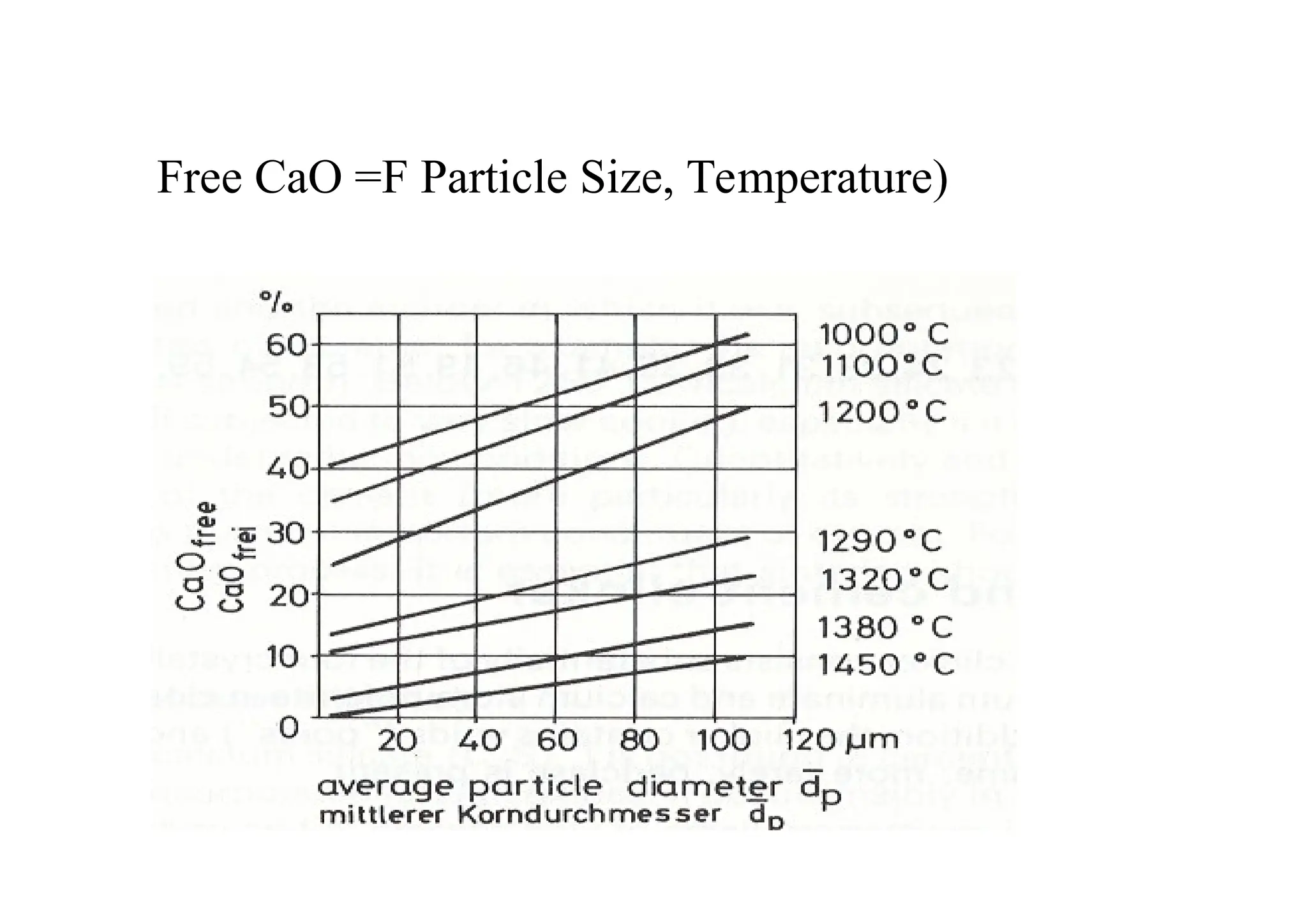
Free CaO =F Particle Size, Temperature)
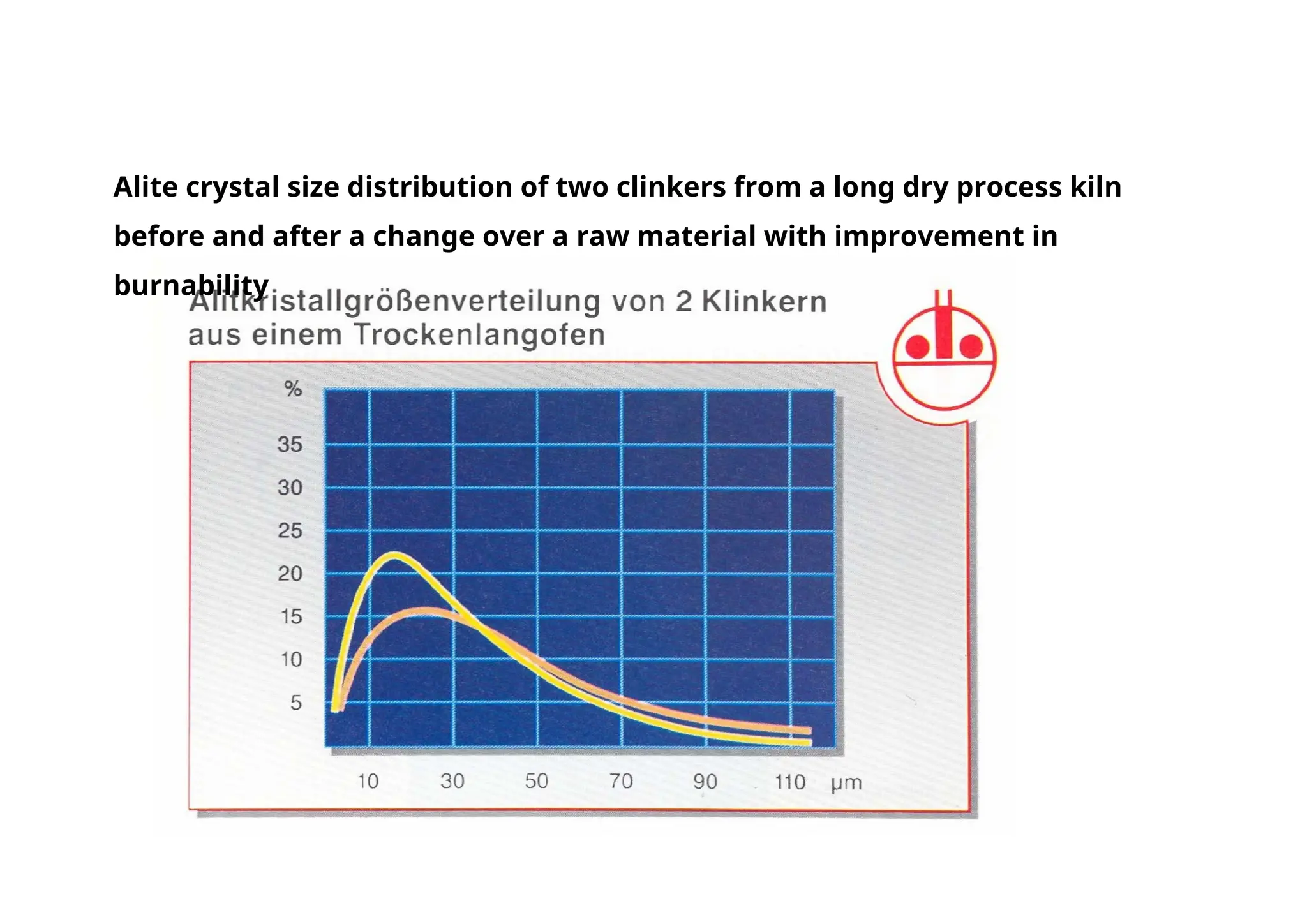
Alite crystal size distribution of two clinkers from a long dry process kiln
before and after a change over a raw material with improvement in
burnability
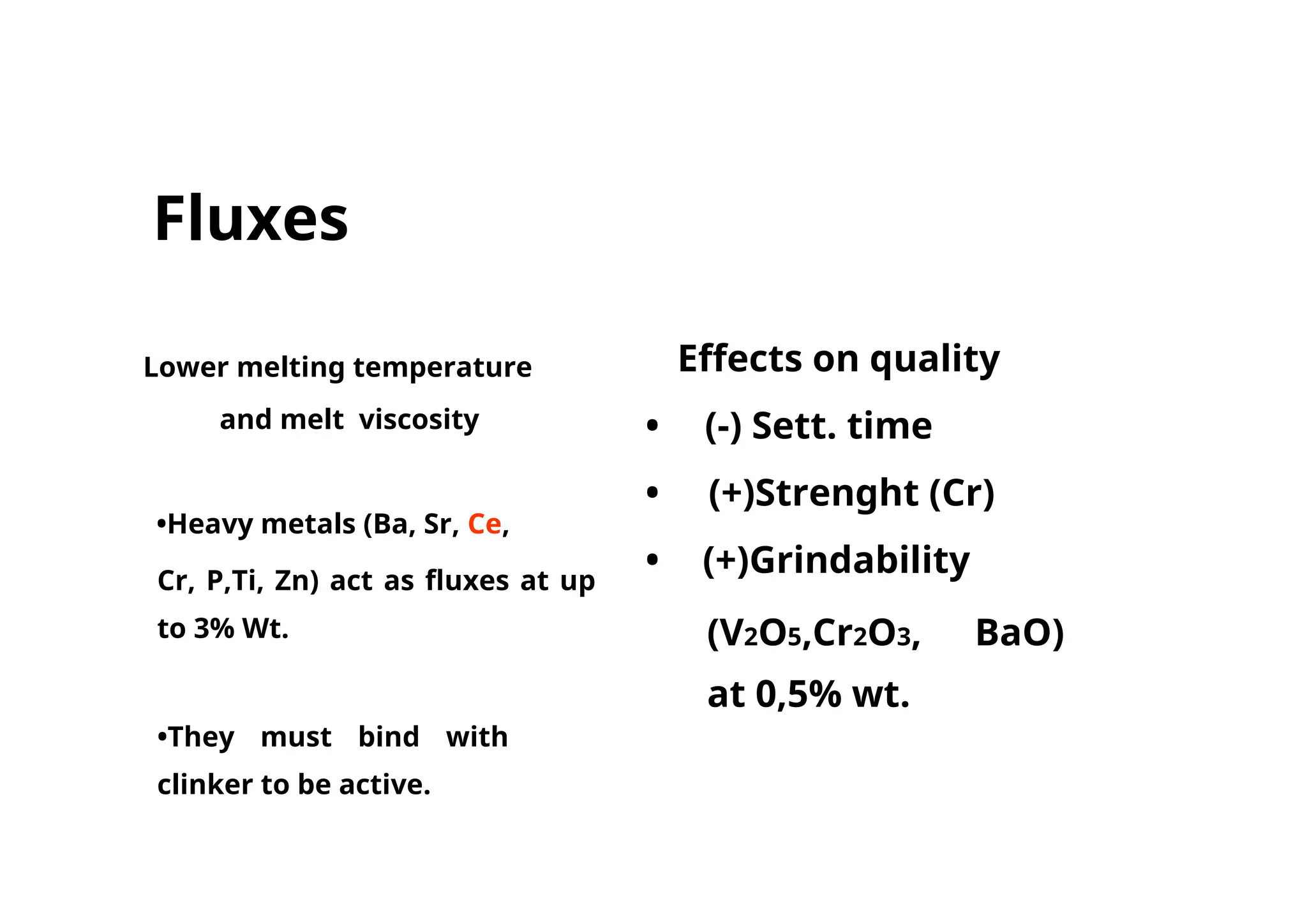
Fluxes
Lower melting temperature Effects on quality
and melt viscosity • (-) Sett. time
• (+)Strenght (Cr)
•Heavy metals (Ba, Sr, Ce,
• (+)Grindability
Cr, P,Ti, Zn) act as fluxes at up
to 3% Wt. (V2O5,Cr2O3, BaO)
at 0,5% wt.
•They must bind with
clinker to be active.
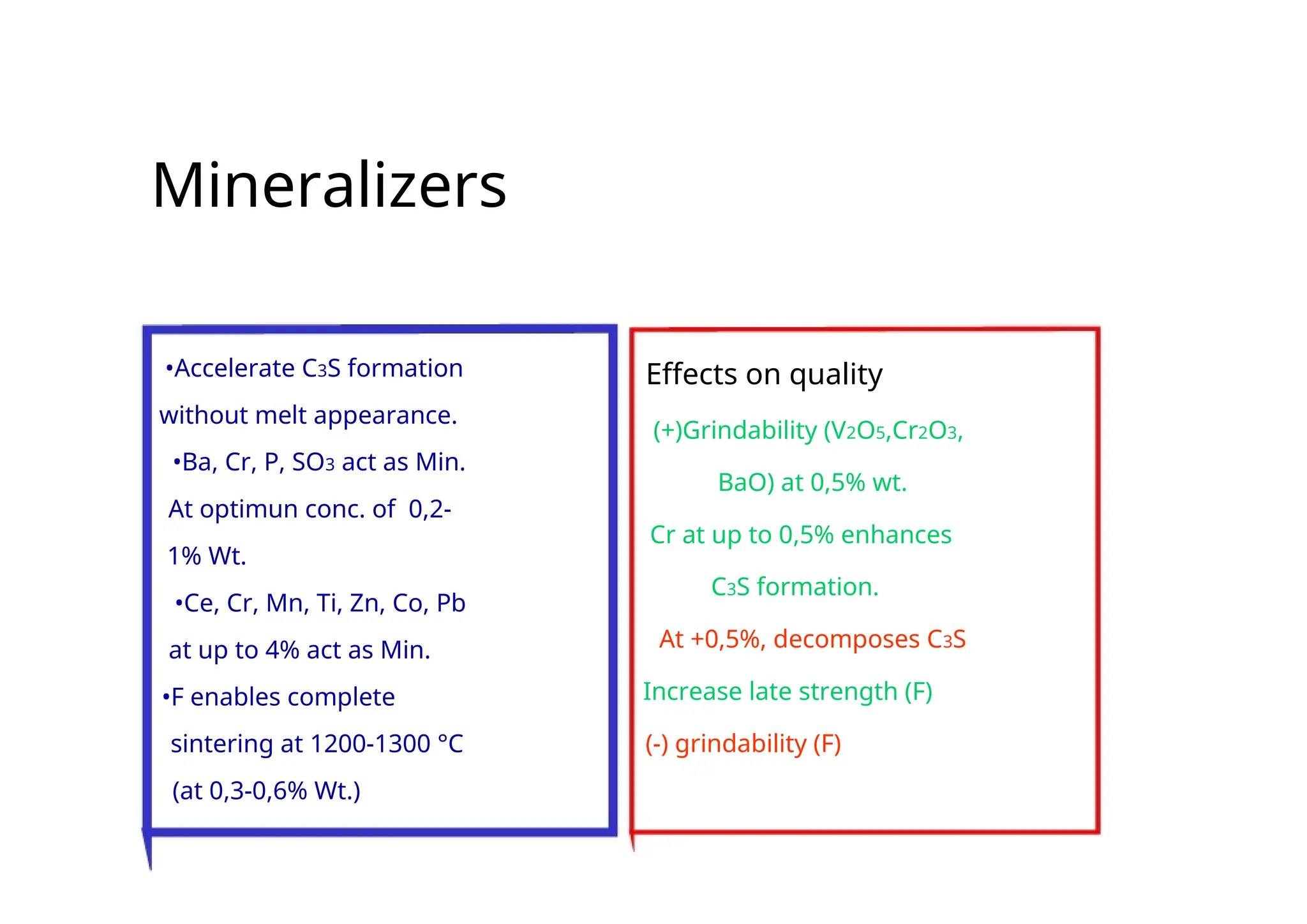
Mineralizers
•Accelerate C3S formation Effects on quality
without melt appearance.
(+)Grindability (V2O5,Cr2O3,
•Ba, Cr, P, SO3 act as Min.
BaO) at 0,5% wt.
At optimun conc. of 0,2-
Cr at up to 0,5% enhances
1% Wt.
C3S formation.
•Ce, Cr, Mn, Ti, Zn, Co, Pb
At +0,5%, decomposes C3S
at up to 4% act as Min.
Increase late strength (F)
•F enables complete
sintering at 1200-1300 °C (-) grindability (F)
(at 0,3-0,6% Wt.)
AFRS May Contain Fluxing and
Mineralizing Compounds in
Dangerous Concentrations !!!!
Chemical and Mineralogical processes during clinker burning
Clay minerals
Temperature°C
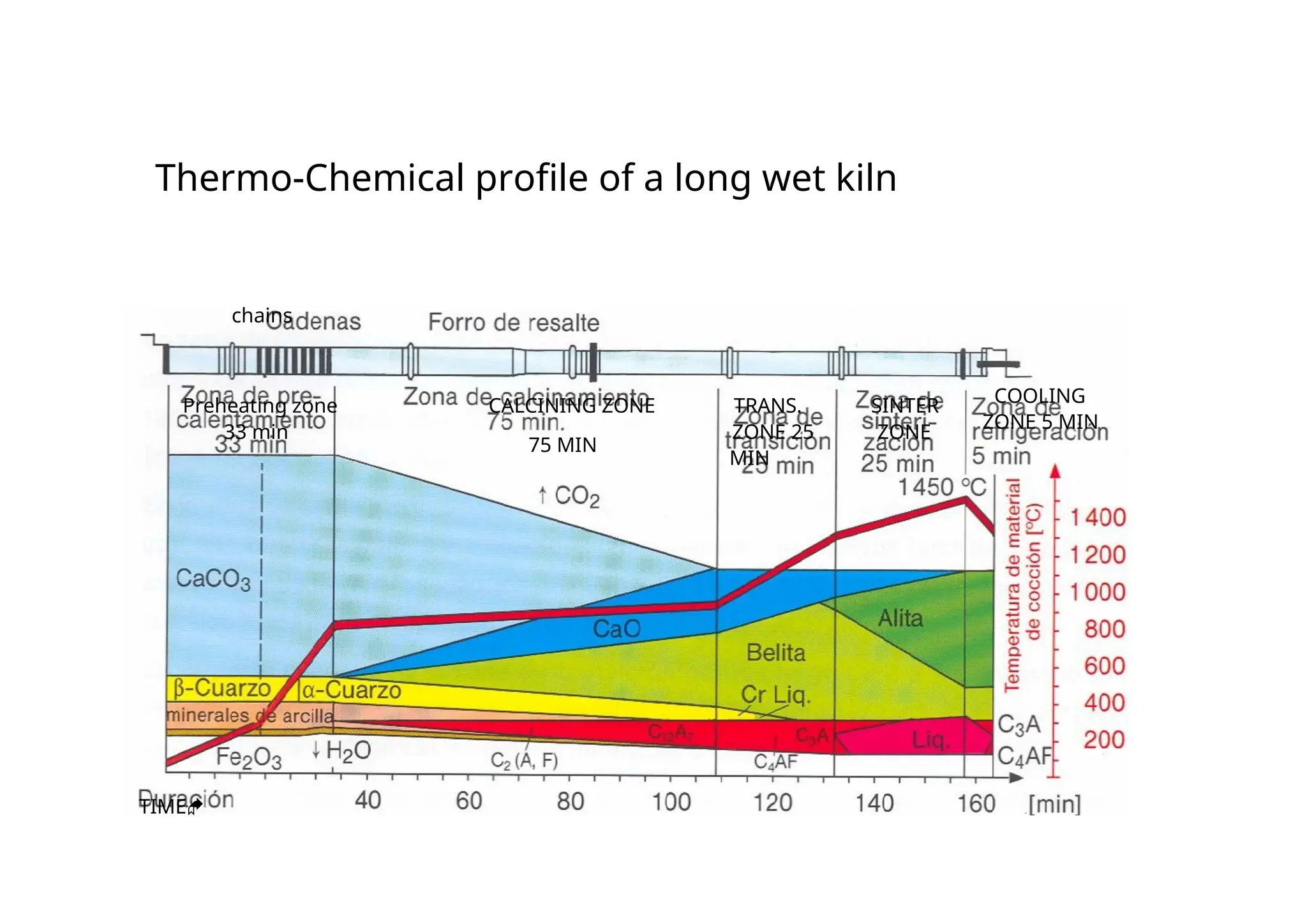
Thermo-Chemical profile of a long wet kiln
chains
COOLING
Preheating zone CALCINING ZONE TRANS. SINTER
ZONE 5 MIN
33 min ZONE 25 ZONE
75 MIN
MIN
TIME
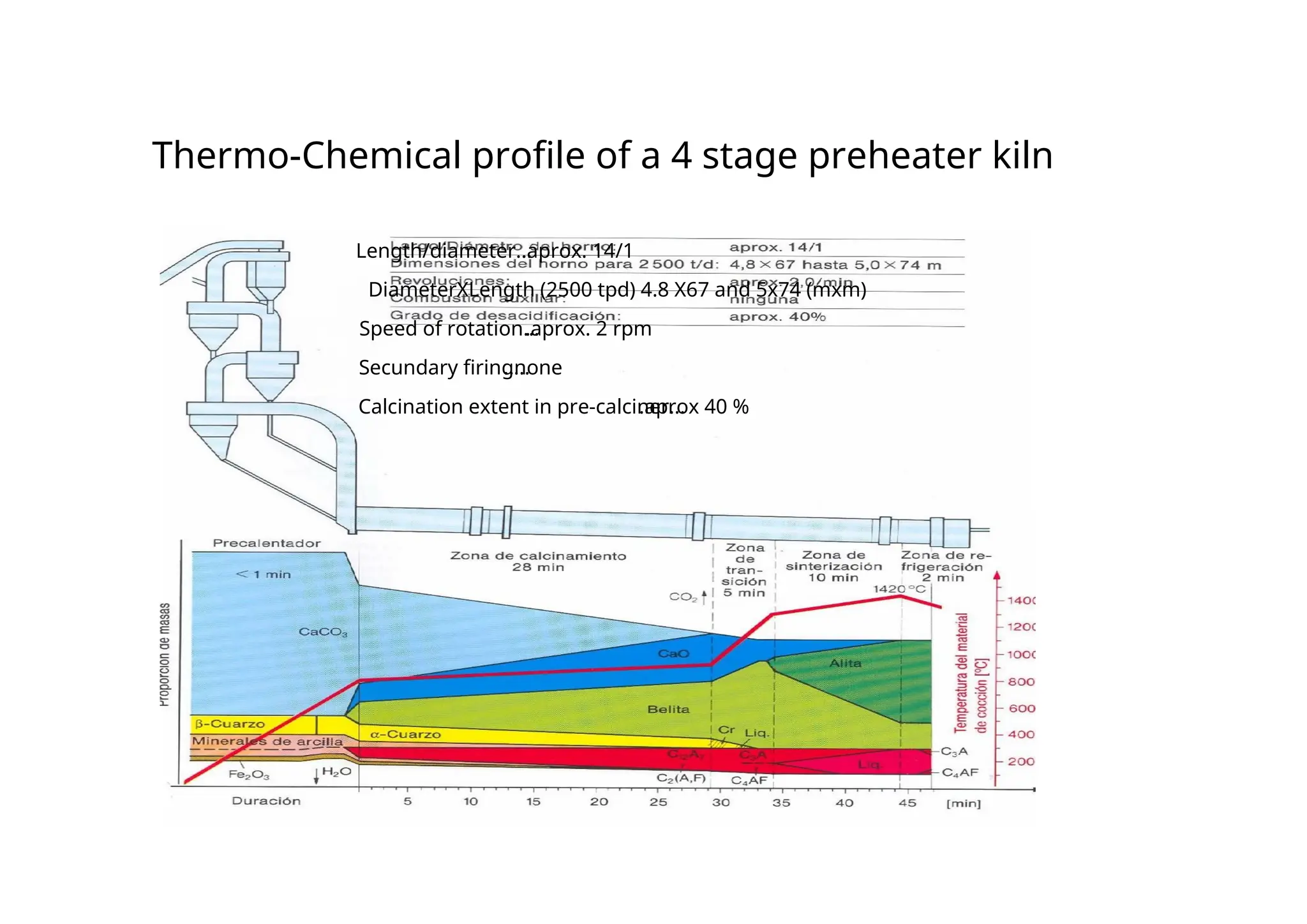
Thermo-Chemical profile of a 4 stage preheater kiln
Length/diameter...
.aprox. 14/1
DiameterXLength (2500 tpd) 4.8 X67 and 5x74 (mxm)
Speed of rotation...
.aprox. 2 rpm
Secundary firing...
..none
Calcination extent in pre-calciner...
.aprox 40 %
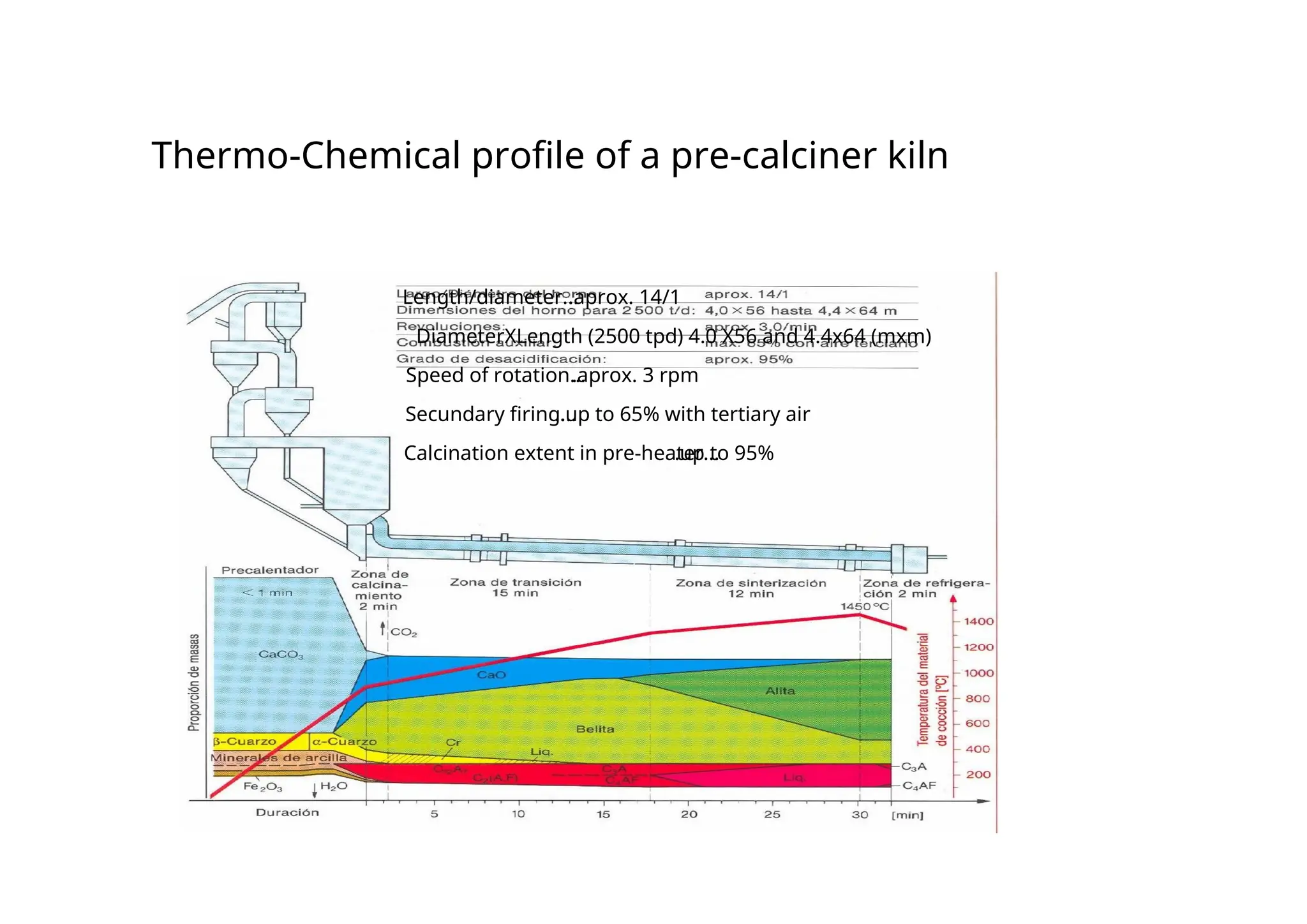
Thermo-Chemical profile of a pre-calciner kiln
Length/diameter...
.aprox. 14/1
DiameterXLength (2500 tpd) 4.0 X56 and 4.4x64 (mxm)
Speed of rotation...
.aprox. 3 rpm
Secundary firing...
..up to 65% with tertiary air
Calcination extent in pre-heater...
.up to 95%
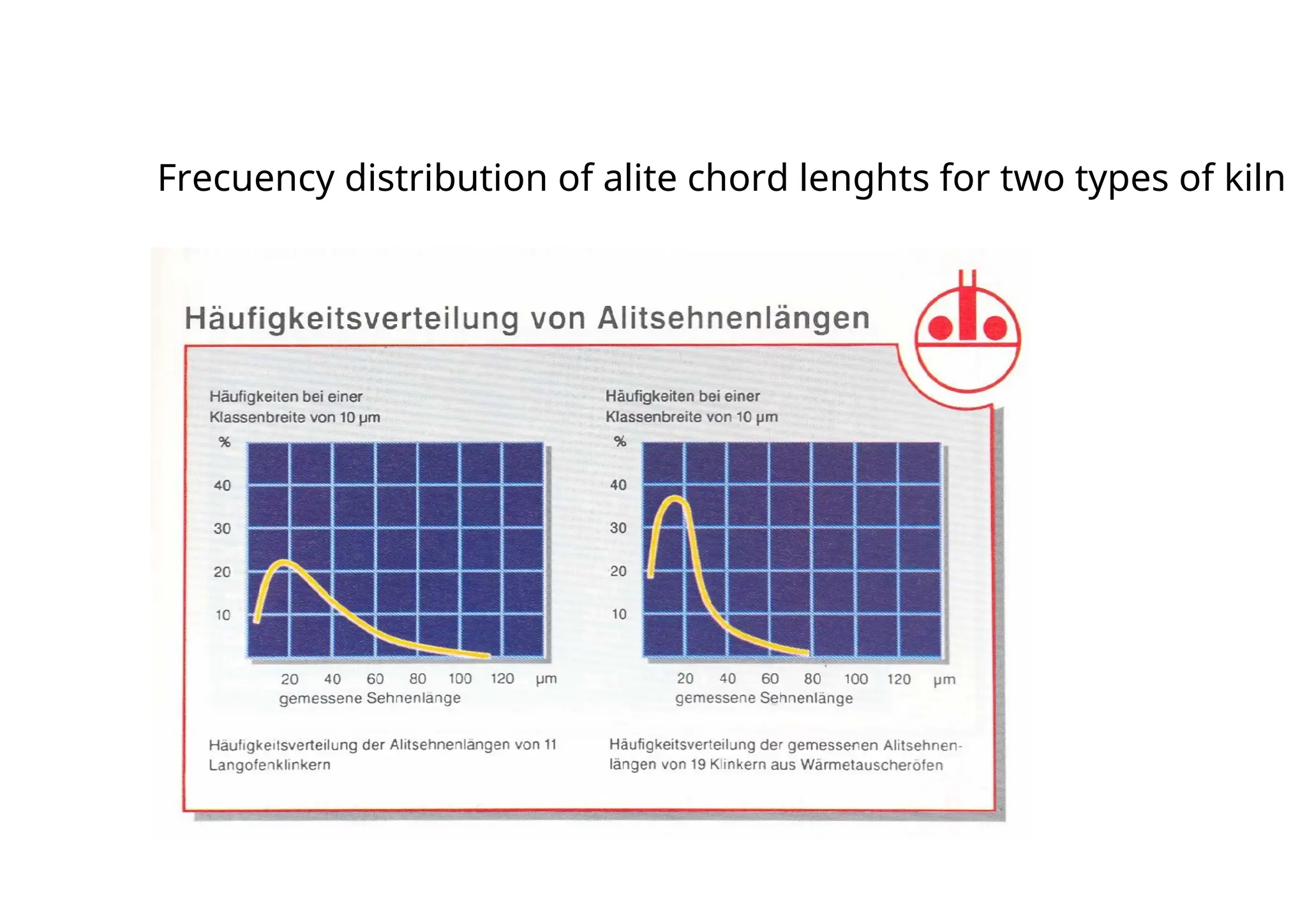
Frecuency distribution of alite chord lenghts for two types of kiln
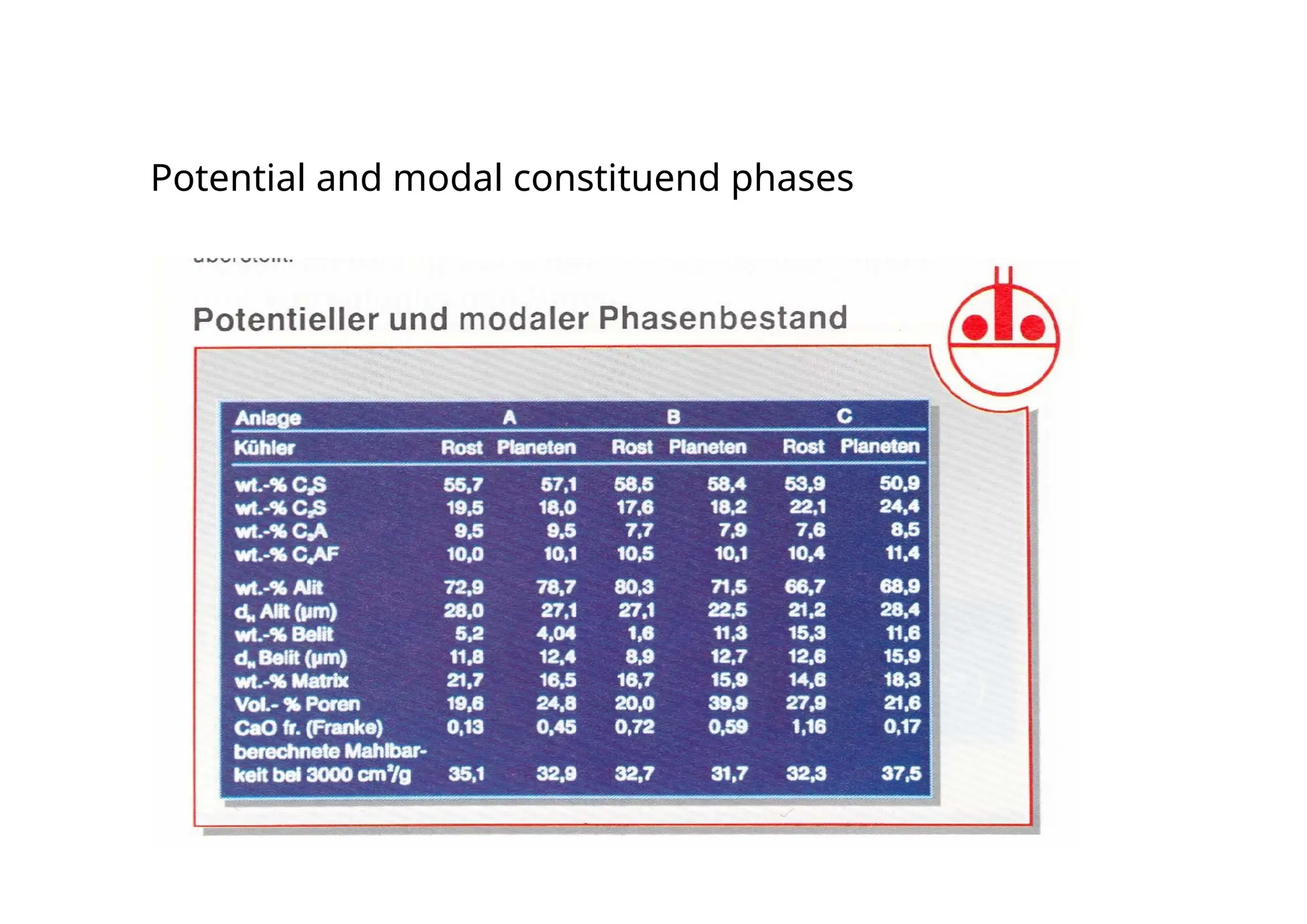
Potential and modal constituend phases
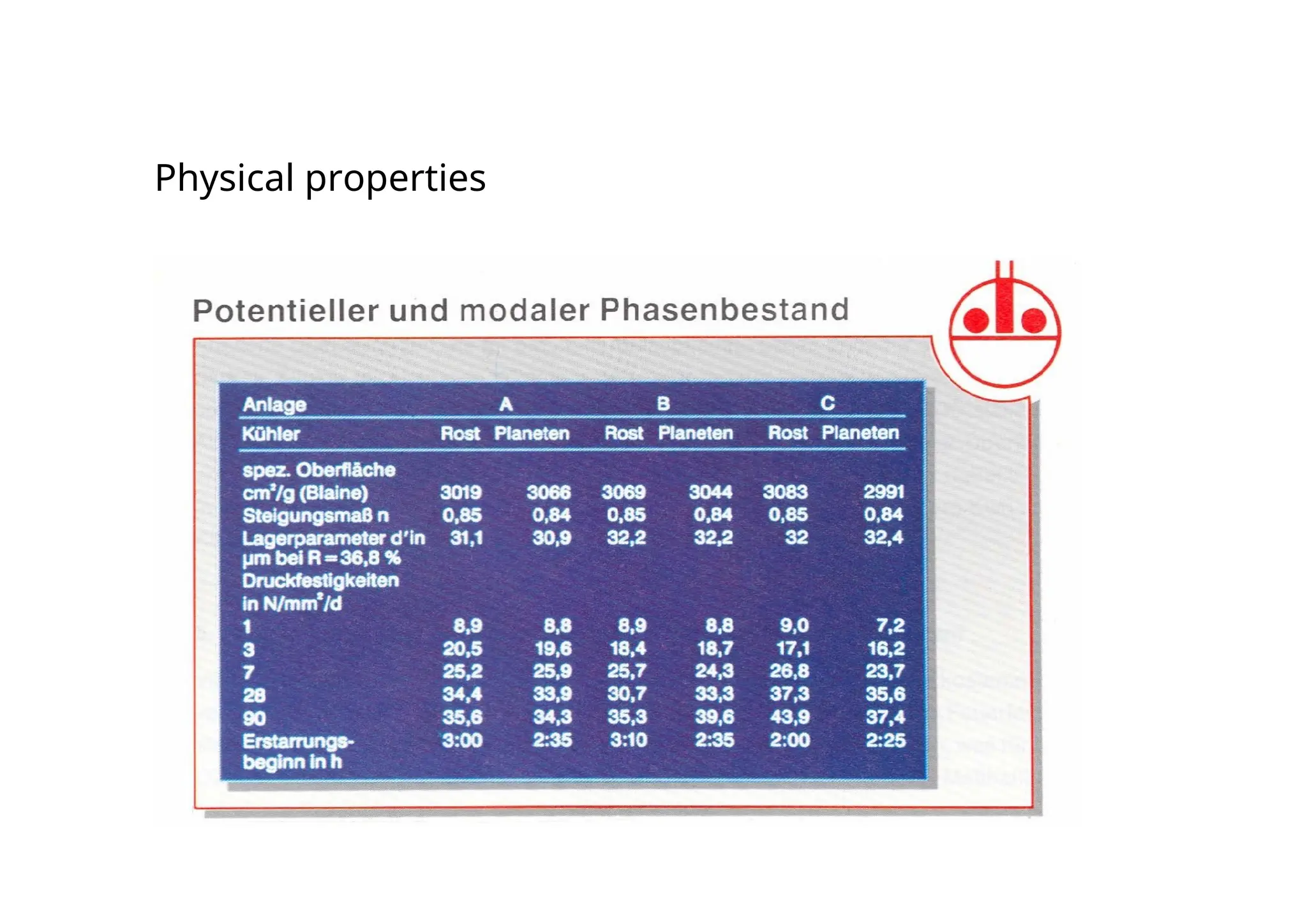
Physical properties
In summary
We can not go further into the many details of clinker burning in this
brief overview. But we already know that clinker burning is a very
complex process, which must be thoroughly understood for each
particular system, as every production arrangement is
characterized by its own “constellation of variables”. Although some
generalizations can be made, it is fundamental to assess the
relative importance or “weight” of the individual factors
generating an effect or combination of outcomes upon the
refractory materials.
Only this basic understanding may enable us to look at the questions
concerning refractory materials from a rational perspective. This
includes proper selection, which means matching specific products
with specific requirements at different parts of the system. But it
also means the development of engineering concepts and
installation methods for the refractory materials to be suited to
the desired optimisation of the system.
Refractory Selection Criteria
• Refractory must be suited to particular requirement of
the system •Phenomena within the system must be
understood clearly
•Zones must be clearly defined and monitored along time as
conditions in a cement plant always change
•Customer usually has more knowledge of the relevant
operating conditions of their systems
•Refractory supplier usually has more experience with the
application of refractory products to particular cases...many
cases...thousand of systems.
Best achieved by close cooperation between
cement producer- Refractory
supplier
Thank you very much
for your attention!

07. clinker burning ordonez 2005.ppt07. clinker burning ordonez 2005.ppt

  • 1.
    Clinker burning processand its influence on the refractory material Hugo Ordóñez
  • 2.
    What is thegoal of clinker burning ?
  • 3.
    The production of GOODQUALITY cement... OF COURSE !
  • 4.
  • 5.
    Quality of cement Characteristics& Properties: •Chemical Composition •Strength •Workability Setting Behavior, •Chemical Resistance ..Etc.
  • 6.
    Where does qualitycome from ? Quality of Cement: (Characteristics & Properties: Strength, workability, setting behavior, chemical resistance etc.) Chemical & mineralogical composition of the clinker Mechanical handling of clinker (grinding) Chemical & mineralogical composition of raw mix Chemical composition of fuels Circulation phenomena
  • 7.
    Polished section showingclinker minerals
  • 8.
    Some Q.P. Correlatewith mineralogical parameters Strength=F(stereological data) 90 days compressive strength N/mm2
  • 9.
    Grind ability ofclinker in dependence of mineralogical parameters (Ak= belit corrected specific alit content)
  • 10.
    Starting Points Available Rawmaterials & fuels Available process equipment Available knowledge
  • 11.
    Constraints Raw Materials Processequipment Cement Chemical Comp. Mining/Quarrying eq. Quality requirements Mineralogical Comp. Crushing equip. ASTM Physical state Pre-blending equip. DIN Quarry: RM grinding system ISO Degree of mixing RM homogeneizing Deleterous compounds Kiln system BS Selective mining Use of correctives Cement grinding system LOCAL STANDARDS RM purchasing Packing/Distpatch Special cements
  • 12.
    Chemical Composition ofcement raw materials and mix Limestone Marl Clay Sand Raw mix Weight % Ig. Loss 40-44 2-42 1-20 Up to 5 32-36 SiO2 0,5-3 3-50 37-78 80-99 12-16 Al2O3+TiO2 0,1-1 1-20 7-30 0,5-3 2-5 Fe2O3+Mn2O3 0,1-0,5 0,5-10 2-15 0,5-2 Up to 2 CaO 52-55 5-52 0,5-25 0,1-3 40-45 MgO 0,5-5 0,5-5 Up to 5 Up to 0,5 0,3-3 SO3 Up to 0,1 0,1-4 Up to 3 Up to 0,5 Up to 1,2 K2O Up to 0,3 Up to 3,5 0,5-5 Up to 1 0,2-1,4 Na2O Up to 0,1 Up to 0,2 0,1-0,3 Up to 0,5 Up to 0,3 Cl- 0,01-0,1 F- 0,02-0,07
  • 13.
    Minor compounds andtraces found in natural raw materials and cement raw mix Element Clay minerals Limestone and Marl Raw mix (mix ratio 25/75 without dust) ppm (10-4 weight %) V 98-170 10-80 32-102 Zn 59-115 22-24 31-47 Cr 90-109 1,2-16 23-39 Ni 67-71 1,5-7,5 18-23 Pb 13-22 0,4-13 4-15 As 13-23 0,2-12 3-15 Cd 0,016-0,3 0,035-,1 0,04-0,15 Tl 0,7-1,6 0,05-0,5 0,21-0,78 Cl 15-450 50-240 40-290 F 300-990 100-940 300-950 Br 1-58 5,9 4,7-18,9 I 0,2-2,2 0,25-0,75 0,24-1,1
  • 14.
    Coal ash composition Hardcoal Lignite Compound USA England Germany Germany weight % SiO2 20-60 25-50 25-45 8-18 Al2O3 10-35 20-40 15-21 4-9 TiO2 0,5-2,5 0-3 - - Fe2O3 5-35 0-30 10-45 2-6 CaO 1-20 1-10 2-4 25-40 MgO 0,3-4 0,5-5 0,5-1 0,5-6 K2O+Na2O 1-4 1-6 1-5 0,6-3 SO2 0,1-12 1-12 4-10 0-50
  • 15.
    Minor elements incoal ash Hard coal Lignite Compound ppm (10-4 weight %) Cl 100-2800 1000-1300 F 50-370 n.a. Br 7-11 n.a. I 0,8-11,2 n.a. Zn 16-220 1-70 Cr 5-80 0,9-8 Ni 20-80 0,6-1,9 Pb 11-270 0,8-6 As 9-50 0,3-9 Cd 0,1-10 0,1-2,4 Tl 0,2-4 0,07-0,3 V 30-50 2-7
  • 16.
    Chemical composition ofAFR Waste oil Bleaching earth Acid sludge Pet coke Used tires Heat content 8300-10100 3000-5700 3200-5400 7200-8300 6450-8000 Kcal/Kg Component weight % Ash 0,1-0,3 40-70 2-6 2,5-4 12,5-18,6 S 0,2-0,7 0,5-1,8 10-16 5-6 1,3-2,2 Alkalis 0,003-0,04 0,1-1,3 0-0,3 0,06-0,16 <0,01 Cl 0,01-0,22 <0,001-0,005 0,3 0,0013 0,2 Component ppm Zn 240-3000 <10-480 56-3900 n.a 9300-20500 Cr <5-50 2-11 20-330 5-104 97 Ni 3-30 <0,01-30 8-87 300-35 77 Pb 10-21700 2-2500 150-6400 6-102 60-760 Cd 4 <,01-2 9-50 0,01-0,3 5-10 Tl <0,02 0,2 0,03-0,07 0,04-3,1 0,2-0,3
  • 17.
    Chemical composition rangesfor various materials related to cement manufacturing OPC
  • 18.
    Cement Modulus cement moduluscalculation typical values statement Lime Standard 100 ⋅(CaO + 0,75 ⋅MgO ) 85 - 9 5 content of CaO, which KStIII = 2,8 ⋅SiO 2 + 1,18 ⋅Al 2 O3 + 0,65 ⋅Fe 2O 3 (Portland cement) can technically be bond (KSt III) to SiO 2 , Al2 O 3 and Fe 2O 3 95 - 1 00 (high -grade cem .) Hydraulic modulus CaO 1.7 - 2.3 ratio of CaO to the HM = SiO 2 + Al 2O3 + Fe 2O3 hydraulic factors SiO 2, (HM) Al2O 3 and Fe 2O 3 Silica ratio SiO 2 1.9 - 3.2 characterizes the ratio SR = Al 2O 3 + Fe 2O3 solid/liquid , i.e. the (SR) (Opt.: 2. 2 - 2.6! ) amount of liquid phases in the clinker Alumina ratio Al 2 O 3 1.5 - 2.5 characterizes the AR = Fe 2 O 3 composition of the melt (AR ) (possibly : and its viscosity < 1 .5 ; > 2 .5 ) Na 2 O K 2 O Cl Alkali-Sulphate -ratio + − 0.8 - 1.2 characterizes the ratio 62 94 71 ASR = SO alkali versus sulphate 3 (ASR ) 80
  • 19.
    Normal ranges forcement module
  • 20.
    Clinker module andtheir influence on the burning properties of clinker
  • 21.
    Liquid phase at1450°C as function of SR
  • 22.
  • 23.
    Two types ofraw meal with different burnabilities Raw meal a Raw meal b
  • 24.
  • 25.
    Melt behavior fromclinker sample (post mortem burnability test) Melt starts to appear at this point 1600 °C 1620
  • 26.
    Summary of ReactionsDuring Clinker Burning Temperature Process Chemical change °C < 200 Drying None None 100-400 Dehydration Decomposition of clay minerals, e.g., 400-750 Al4(OH)8Si4O102(Al2O3.2SiO2)+4H2O with formation of metakaolinite Decomposition of metakaolinite and Al2O3.2SiO2Al2O3 + 2SiO2 other compounds, with formation of reactive oxide mixtures 600-900 Decomposition of limestone. Formation CaCO3CaO+CO2 of CS and CA 3CaO+2SiO2+ Al2O32(CaO.SiO2) +CaO.Al2O3 600-1000 Uptake of lime by CS CA, formation of 800-1300 CS + C  C2S 2C+S  C2S C4AF CA + 2C  C3A CA + 3C + F  C4AF Further uptake of lime by C2S 1250-1450 C2S + C  C3S
  • 27.
    Chemical and Mineralogicalprocesses during clinker burning Clay minerals Temperature°C
  • 28.
    and Dissociation Speedof limestone Heating Rate CaCO3CaO+CO2 • Low HR (100 °K/min): DS depends on transport phenomena (gas- heat): heat flow to and gas transport from the inner of the limestone particles. • High particle size and HR (250 °K/min): DS hindered by low heat conductivity and high CO2 partial pressure. • High HR (450 °K/min): Increased reactivity of CaO with SiO2 (from 800 to 1000°C). No recrystalization and defects in crystal lattice. • Kiln speed: lower rpm produce higher HR. • Alkali's (up to 2%) increase DS by lowering activation energy for limestone.
  • 29.
    CaCO3CaO+CO2 Decomposition rate oflimestone is increased by • Increase in temperature of raw meal • Lowering CO2 partial pressure in combustion gas • Lowering dust load of the combustion gases • Lowering particle size of raw meal • Decreasing crystal content of CaCO3
  • 30.
    Sintering (Reactions with liquidphase) • Starts at 900-1000 °C (calcium silicates and aluminates. No C3S formation) • Free CaO starts decreasing at above 1250 °C (as melts appear and C3S formation accelerates). • Viscosity of melt affected by circulation phenomena (low melting point compounds) and AR. • Reversion from C3S to C2S can occur at isothermal conditions. C3S  C2S + C
  • 31.
    Sintering Temperature • At1250 °C: mostly C2S forms • Below 1450 °C: C3S formation too slow. • Reversion from C3S to C2S possible • Above 1450 °C: quantity of melt increases, viscosity decreases. Sintering reaction rate increases. • Above 1500 °C: cost/benefit too high.
  • 32.
    Heating rate •HighHR at 1450°C: high reactivity, no between 900-1300 °C recrystalization •High HR at 1700 °C good strength due to high C3S with small crystal size. Too expensive. •Belite cement: possible Free lime through very fast cooling, 1000 °K/min (crystal lattice defects/disturbances) but technically unfeasible...yet!
  • 33.
    Alite formation isreversible Belite + CaO Alite Reaction equilibrioum is shifted by: • Temperature changes (+R;-L) • Change in quantity of melt ((+R; -L) • Change in melt viscosity (+L; -R) • Change in heating velocity (1200-1450 °C) (+R; -L) • Clinker cooling rate (1450-1200) (+eq. “Freezes” -L) • Length of time kept at isothermal conditions (above 1350°C) (+L; - R)
  • 34.
  • 35.
    Particle size Tolerance forparticles with average diameter + 100 micrometer (raw meal): Calcite, < 1% Quartz < 6% (by Weight) Optimum calcite average size for C3S formation 15 microns
  • 36.
    Scanning electron microscopephotograph of a quartz grain 200 micrometer average diameter
  • 37.
    Big quartz grainssurrounded by belite ring do not let sintering to C3S to proceed due to lower reaction rate (low surface area). 1620
  • 38.
    Homogeneity criteria Allowed variabilityof LSF, SR, AR in terms of variation coefficient: < 1% VC= Std. Dev./Average (clinker; hourly data)
  • 39.
  • 40.
    LSF, hourly samples Average94,8 Standard Deviation 3,5 103 101 99 97 95 93 91 89 87 85 1 2 3 4 5 6 7 8 9 10 11 12 13 14 15 16 17 18 19 20 21 22 23 24 HORA
  • 41.
    LSF Accumulated deviationfrom set point (211 hours, random period ) 8,00 T2 7,00 T4 T3 6,0 0 5,0 0 T1 4,00 3,00 2,00 1,00 0,00 - 1,00 -
  • 42.
    True meaning ofthe average If I drink four beers and you drink none In AVERAGE, each one DRANK 2 BEERS !
  • 43.
    Free CaO =FParticle Size, Temperature)
  • 44.
    Alite crystal sizedistribution of two clinkers from a long dry process kiln before and after a change over a raw material with improvement in burnability
  • 45.
    Fluxes Lower melting temperatureEffects on quality and melt viscosity • (-) Sett. time • (+)Strenght (Cr) •Heavy metals (Ba, Sr, Ce, • (+)Grindability Cr, P,Ti, Zn) act as fluxes at up to 3% Wt. (V2O5,Cr2O3, BaO) at 0,5% wt. •They must bind with clinker to be active.
  • 46.
    Mineralizers •Accelerate C3S formationEffects on quality without melt appearance. (+)Grindability (V2O5,Cr2O3, •Ba, Cr, P, SO3 act as Min. BaO) at 0,5% wt. At optimun conc. of 0,2- Cr at up to 0,5% enhances 1% Wt. C3S formation. •Ce, Cr, Mn, Ti, Zn, Co, Pb At +0,5%, decomposes C3S at up to 4% act as Min. Increase late strength (F) •F enables complete sintering at 1200-1300 °C (-) grindability (F) (at 0,3-0,6% Wt.)
  • 47.
    AFRS May ContainFluxing and Mineralizing Compounds in Dangerous Concentrations !!!!
  • 48.
    Chemical and Mineralogicalprocesses during clinker burning Clay minerals Temperature°C
  • 49.
    Thermo-Chemical profile ofa long wet kiln chains COOLING Preheating zone CALCINING ZONE TRANS. SINTER ZONE 5 MIN 33 min ZONE 25 ZONE 75 MIN MIN TIME
  • 50.
    Thermo-Chemical profile ofa 4 stage preheater kiln Length/diameter... .aprox. 14/1 DiameterXLength (2500 tpd) 4.8 X67 and 5x74 (mxm) Speed of rotation... .aprox. 2 rpm Secundary firing... ..none Calcination extent in pre-calciner... .aprox 40 %
  • 51.
    Thermo-Chemical profile ofa pre-calciner kiln Length/diameter... .aprox. 14/1 DiameterXLength (2500 tpd) 4.0 X56 and 4.4x64 (mxm) Speed of rotation... .aprox. 3 rpm Secundary firing... ..up to 65% with tertiary air Calcination extent in pre-heater... .up to 95%
  • 52.
    Frecuency distribution ofalite chord lenghts for two types of kiln
  • 53.
    Potential and modalconstituend phases
  • 54.
  • 55.
    In summary We cannot go further into the many details of clinker burning in this brief overview. But we already know that clinker burning is a very complex process, which must be thoroughly understood for each particular system, as every production arrangement is characterized by its own “constellation of variables”. Although some generalizations can be made, it is fundamental to assess the relative importance or “weight” of the individual factors generating an effect or combination of outcomes upon the refractory materials. Only this basic understanding may enable us to look at the questions concerning refractory materials from a rational perspective. This includes proper selection, which means matching specific products with specific requirements at different parts of the system. But it also means the development of engineering concepts and installation methods for the refractory materials to be suited to the desired optimisation of the system.
  • 56.
    Refractory Selection Criteria •Refractory must be suited to particular requirement of the system •Phenomena within the system must be understood clearly •Zones must be clearly defined and monitored along time as conditions in a cement plant always change •Customer usually has more knowledge of the relevant operating conditions of their systems •Refractory supplier usually has more experience with the application of refractory products to particular cases...many cases...thousand of systems. Best achieved by close cooperation between cement producer- Refractory supplier
  • 57.
    Thank you verymuch for your attention!