Best E-Learning Project
E-Learning Awards 2012
© Brightwave Ltd.
Introductions
Brightwave
Mike Dalglish
Clyde Valley Council Learning and
Development Group
Gerry Farrell – South Lanarkshire Council
Simon Hall – Renfrewshire Council
How the largest
peer-managed shared
service project in the
UK has transformed
learning across
Scotland to improve
public services and the
lives of the people
who live there
This is a story about…
Agenda
1. Drivers for change
2. The solution
3. Challenges
4. Case studies
5. Results and impact
Why is this project
special?
1. Largest UK peer-managed e-learning shared service project
2. Only local government shared service to be sustained – 5 years
3. Widened access reaching non-desk based workforce
4. Positive ROI in individual councils
5. £9.4m saved on training reinvested
Centre of excellence for e-learning
created by Councils for Councils
Drivers for change
Not just about saving money…
An imperative for innovation:
“increase response to rapid
organisational change”
Ultimate goal to improve
employee engagement and
customer service
Clyde Valley Learning
and Development Group
Shared E-Learning Strategy
Clyde Valley Learning
and Development Group
19 councils
(out of 32)
181,000
employees (62%)
Serving 3.5m
residents (67%)
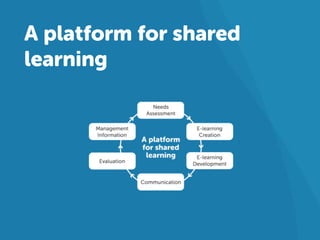
A platform for shared
learning
A platform for shared
learning
360° Feedback tool /
tactical needs assessment
LMS comms tool
LMS
SaaS Authoring tool
Qualitative Evaluation tool
LMS reporting
and management
A platform for shared
learning
Challenges overcome
Challenge 1 – Ensuring success at each Council
• Peer-led incremental implementation
• Sharing learning before / during and after
Challenges overcome
Challenge 2 – Maximising collaboration
• Shared content
• Identified common needs and jointly developed content
Challenge 2
Maximising collaboration
One example in action –
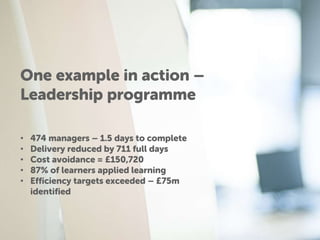
Leadership programme
• 474 managers – 1.5 days to complete
• Delivery reduced by 711 full days
• Cost avoidance = £150,720
• 87% of learners applied learning
• Efficiency targets exceeded – £75m
identified
Challenge 3 – Developing expertise and building
capacity
• Developed each others skills, encouraging innovation and creativity
• Built capacity to respond to a challenging environment
Helping each other to help ourselves...
Challenges overcome
Impact
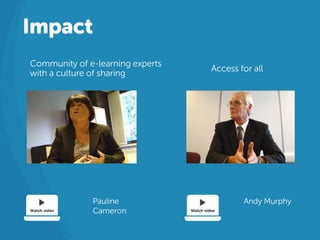
Community of e-learning experts
with a culture of sharing
Access for all
Pauline
Cameron
Andy Murphy
Positive learner reaction:
Increased
flexibility is
helping learners
and
organisations
reach goals
Impact in numbers
• 19 councils (out of 32 in Scotland)
• 181,000 learners
• Over 200 course builders across Scotland
• Over 500 new e-learning courses created
• Over 350,000 course completions
• £9.4m saved on training
Impact
– beyond the numbers
Culture legacy sustainability…
“This is how we do things now”
Questions?
www.brightwave.co.uk
@BrightTweet
Thank you for your attention
© Brightwave Ltd.

Webinar slides - What makes a successful e-learning project?

  • 1.
    Best E-Learning Project E-LearningAwards 2012 © Brightwave Ltd.
  • 2.
    Introductions Brightwave Mike Dalglish Clyde ValleyCouncil Learning and Development Group Gerry Farrell – South Lanarkshire Council Simon Hall – Renfrewshire Council
  • 3.
    How the largest peer-managedshared service project in the UK has transformed learning across Scotland to improve public services and the lives of the people who live there This is a story about…
  • 4.
    Agenda 1. Drivers forchange 2. The solution 3. Challenges 4. Case studies 5. Results and impact
  • 5.
    Why is thisproject special? 1. Largest UK peer-managed e-learning shared service project 2. Only local government shared service to be sustained – 5 years 3. Widened access reaching non-desk based workforce 4. Positive ROI in individual councils 5. £9.4m saved on training reinvested Centre of excellence for e-learning created by Councils for Councils
  • 6.
    Drivers for change Notjust about saving money… An imperative for innovation: “increase response to rapid organisational change” Ultimate goal to improve employee engagement and customer service
  • 7.
    Clyde Valley Learning andDevelopment Group
  • 8.
  • 9.
    Clyde Valley Learning andDevelopment Group 19 councils (out of 32) 181,000 employees (62%) Serving 3.5m residents (67%)
  • 10.
    A platform forshared learning
  • 11.
    A platform forshared learning 360° Feedback tool / tactical needs assessment LMS comms tool LMS SaaS Authoring tool Qualitative Evaluation tool LMS reporting and management
  • 12.
    A platform forshared learning
  • 18.
    Challenges overcome Challenge 1– Ensuring success at each Council • Peer-led incremental implementation • Sharing learning before / during and after
  • 19.
    Challenges overcome Challenge 2– Maximising collaboration • Shared content • Identified common needs and jointly developed content
  • 20.
  • 21.
    One example inaction – Leadership programme • 474 managers – 1.5 days to complete • Delivery reduced by 711 full days • Cost avoidance = £150,720 • 87% of learners applied learning • Efficiency targets exceeded – £75m identified
  • 22.
    Challenge 3 –Developing expertise and building capacity • Developed each others skills, encouraging innovation and creativity • Built capacity to respond to a challenging environment Helping each other to help ourselves... Challenges overcome
  • 23.
    Impact Community of e-learningexperts with a culture of sharing Access for all Pauline Cameron Andy Murphy
  • 24.
    Positive learner reaction: Increased flexibilityis helping learners and organisations reach goals
  • 25.
    Impact in numbers •19 councils (out of 32 in Scotland) • 181,000 learners • Over 200 course builders across Scotland • Over 500 new e-learning courses created • Over 350,000 course completions • £9.4m saved on training
  • 26.
    Impact – beyond thenumbers Culture legacy sustainability… “This is how we do things now”
  • 27.

Editor's Notes

  • #3 If we manage to secure videos from some of the other Councils then we could allude to extra digital cameos here …
  • #4 Direction to graphics … can we capture this statement visually please.This needs to be a bold arresting statement that you could imagine being part of the judges citation for the winning entry.
  • #5 The context and running order for today’s presentation … what can the judges expect to hear.
  • #6 This slide has to address and exceed upfront all of the award criteria – what else should we draw out?Proven shared and sustainable learning strategy Directly meets needs of councils - uniquely focussed on adding value – direct response to clear imperative for innovation to increase response to the speed of organisation change – beyond the typical efficiency drive More training, better learning for less [figures to show increase and positive reaction to e-learning – far beyond efficiency drive – widened access across workforce …]Peer-led innovation – one collective learning curve [this is in relation to the excellent peer-led council onboarding process where experience and expertise is built and shared – best practice is next practice ….] Impact on leadership and front line – case studies reflect impact on organisation and individual performance
  • #7 This slide has to address and exceed upfront all of the award criteria – what else should we draw out?Proven shared and sustainable learning strategy Directly meets needs of councils - uniquely focussed on adding value – direct response to clear imperative for innovation to increase response to the speed of organisation change – beyond the typical efficiency drive More training, better learning for less [figures to show increase and positive reaction to e-learning – far beyond efficiency drive – widened access across workforce …]Peer-led innovation – one collective learning curve [this is in relation to the excellent peer-led council onboarding process where experience and expertise is built and shared – best practice is next practice ….] Impact on leadership and front line – case studies reflect impact on organisation and individual performance
  • #9 We now have a shared e-learning strategy across the length and breadth of Scottish Councils.All different in terms of size, structure and political make-up. However the peer-led innovation has allowed us to remove much of the politics which would usually be involved.
  • #10 Add 19 councils – 59% of Scottish Local Authorities which represents 156,000 employees out of a total 252,000 Scottish local government employees (Q2 2012) ….All of those employees have seen an increase in the development options available to them through the use of e-learning. Development is now available to them ‘just in time’ rather than ‘just in case’. Leading to more developed and able employees.These councils serve over 3.5m residents and numerous businesses, who are seeing improved service delivery across a range of areas.
  • #11 Include outstanding elements of solution and answer need Reinforce the point that this isn’t just learning content it is a full solution Include the fact that this is about performance improvement not just learning (360 tool for example).
  • #12 Include outstanding elements of solution and answer need Reinforce the point that this isn’t just learning content it is a full solution Include the fact that this is about performance improvement not just learning (360 tool for example).
  • #13 Include outstanding elements of solution and answer need Reinforce the point that this isn’t just learning content it is a full solution Include the fact that this is about performance improvement not just learning (360 tool for example).
  • #17 Here’s another approach
  • #19 Many of us didn’t have much experience for elearning or launching & managing an LMS, so we supported each other throughout. We worked together to project manage each phase of implementation. Identifed how to engage with the key internal stakeholders (IT, unions, communications, managers, users, non-traditional learners) As each new council came onboard they were allocated mentor(s) and supplied with contact details. Some councils freed up resources for a short time to assist other councils. An online community of practice was created to share learning, ask questions and to minimise duplication of error.
  • #20 At the same time as we were engaging with key stakeholders to launch the platforms, we also needed to work together to develop content. We agreed a strategy and process for developing content that would be of a good standard and suitable for as wide an audience as possible. – First thought should always be the wider picture, rather than a single council focus! We freely shared what content we already had and agreed to share whatever content we developed in the future. We identified the common gaps, areas of need and agreed priority topics for development. We worked together to jointly develop content that could then be shared across the group.
  • #21 There has been a significant amount of free sharing done between the Councils. This diagram shows just some of the content that has been shared. The orange shaded areas show the percentage of people who have completed a shared course in these broad subject areas. 78% of those who completed a ‘Health & safety’ course, completed one that had been shared with other Councils. Customer Service (73%) Equality and Diversity (67%) Social Care (58%) These were all shared, freely at no cost what so ever. The true success of this project has been the altruistic approach that the people involved have taken. Remarkably, this wasn’t anyone’s sole job or responsibility. No one was employed specifically to make this happen. It was all done, above and beyond our day jobs!
  • #22 An example of this in action: One of the key areas identified was leading through change – so the group developed several courses on different aspects of this. At the same time, Renfrewshire Council was planning a leadership programme for its senior managers, focussing on their role in leading the Council through the challenging changes we were encountering. By using a blended learning approach we significantly reduced the time taken for the 474 managers to complete the programme, saving 711 delivery days and £150,420 costs avoided. What’s more the managers reported exceedingly high levels of applied learning as a result of the approach
  • #23 However we weren’t satisfied at just creating content, we wanted to get better at it. We learned from each other, and built on each others successes. We started to run workshops that focused on how to create better, more innovative and engaging courses. We drove each other to develop our skills and not settle for ‘good’, where ‘excellent’ was possible. By doing this we have developed capacity within each Council to develop courses that meet their needs and the needs of the wider community.Our key throughout has been “Helping each other to help ourselves …..”
  • #24 This project has involved disparate organisations working together to deliver significant benefits over a remarkably short period of time. Here’s what it’s meant for a couple of the people involved: Pauline Cameron works in East Renfrewshire Council, one of the smaller Councils in this partnership. Andy Murphy works with one of the Trades Unions.I’ll now hand back to Gerry, who will further discuss the impact that this project has had.
  • #25 Link to independent survey Note responses from 17 / 19 Councils – within less than a week (Unheard of!)Demonstrates the employee engagement we were seeking to achieve.Run through extremely positive responses.
  • #27 Shared costs, shared skills, no duplication of effortOngoing take-up – councils and learners added every yearLong-term commitmentPowerful and lasting adoption of e-learning