Digital business
simulations
Design, strategy and
serious play
Caroline Freeman, Director of Design - @freemancaro
Colin Welch, Head of Production - @colinwelch
Have you designed digital business
simulations or are planning to do so?
It’s a growing field
Worldwide revenue from
simulation-based learning
set to grow by 17% to
US$ 11m by 2021
Ambient Insights 2016
One must learn by
doing the thing; for
though you think
you know it, you
have no certainty,
until you try.
- Sophocles
Experiential digital
learning
• Branching gamified narratives
• Interactive video
• Business simulations
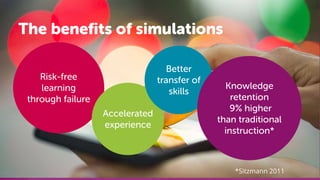
The benefits of simulations
*Sitzmann 2011
Risk-free
learning
through failure
Accelerated
experience
Better
transfer of
skills
Knowledge
retention
9% higher
than traditional
instruction*
Practice (alone) doesn’t
make perfect
If you never push yourself
beyond your comfort zone,
you will never improve.
Anders Ericsson
Deliberate practice
is a highly structured
activity designed
specifically to improve
performance.
The Role of Deliberate Practice in the Acquisition of Expert Performance
K. Anders Ericsson, Ralf Th. Krampe, and Clemens Tesch-Romer
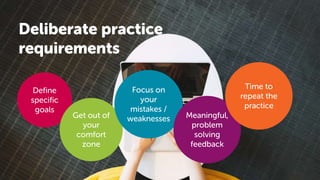
Deliberate practice
requirements
Define
specific
goals
Get out of
your
comfort
zone
Focus on
your
mistakes /
weaknesses Meaningful,
problem
solving
feedback
Time to
repeat the
practice
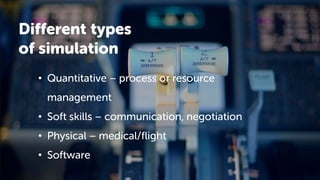
Different types
of simulation
• Quantitative – process or resource
management
• Soft skills – communication, negotiation
• Physical – medical/flight
• Software
“You can have a game
that’s not a simulation
and a simulation that’s
not a game, but when
you get one that does
both, it’s a real kick-
ass situation.“
- Elliott Masie
Examples of our work
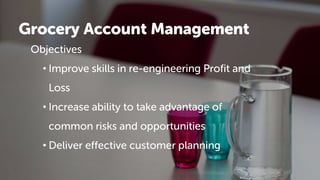
Grocery Account Management
Objectives
• Improve skills in re-engineering Profit and
Loss
• Increase ability to take advantage of
common risks and opportunities
• Deliver effective customer planning
Account
Management
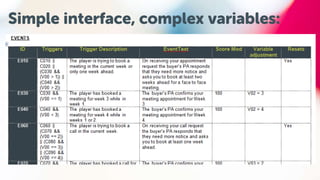
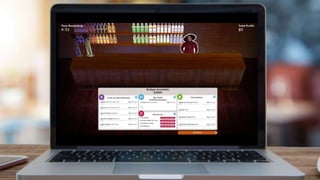
Simple interface, complex variables:
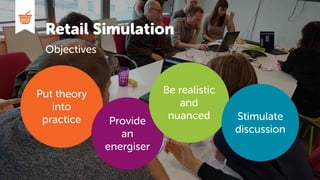
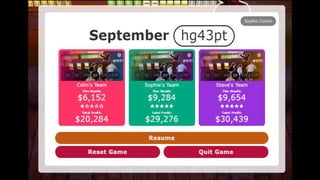
Retail Simulation
Objectives
Put theory
into
practice Provide
an
energiser
Be realistic
and
nuanced Stimulate
discussion
Retail promotions
and pricing
Designing the
simulation
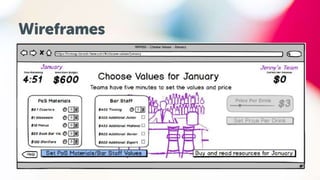
Wireframes
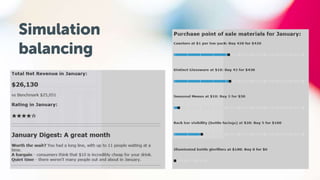
Simulation
balancing
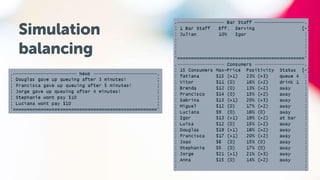
Simulation
balancing
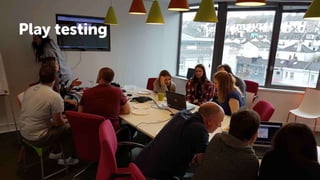
Play testing
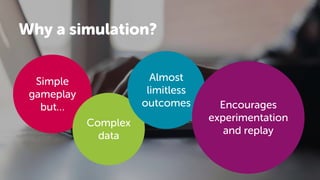
Why a simulation?
Simple
gameplay
but…
Complex
data
Almost
limitless
outcomes Encourages
experimentation
and replay
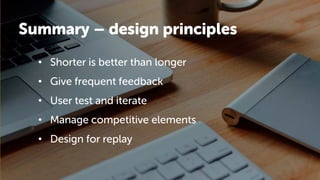
Summary – design principles
• Shorter is better than longer
• Give frequent feedback
• User test and iterate
• Manage competitive elements
• Design for replay
Thank you!
Questions?
Visit us on stand 15

Business Simulations at #LTSF17