



Chapter 5
Electronic Commerce in
Service Industries
1
Opening Vignette:
Ordering Journals Electronically
How a large university automated the
purchasing of magazines and journals,
saving $365,000/year
Direct E-Marketing: Buyer-to-seller; orders
and payments
Market maker charges $5/transaction vs.
about $32 (conventional agents)
Ordering time reduced by up to 80%
Rowe.com—Internet IPO that survived the
stock market in the industry
Broker-Based Services
Brokers work as intermediaries between buyers and
sellers
Agents basically make the markets
Agents provide many services
Most of the value-added tasks of brokers can be
automated

Major electronic agent-based services
Travel
Employment
Real estate
Stocks

Electronic auctions
At-home banking
Insurance
Broker-Based Services (cont.)
Service Industries vs. Manufacturing and Product Retailing
Service Industries
Pure EC: substantially reduced cost
Bank and brokerage houses
Possible digitation of the entire process
Travel and real estate agents
Viewing an online video clip or seeing photos of a
hotel or a house for sale

Manufacturing and product retailing
Physical delivery cost may be high
Travel and Tourism Services
Any experienced traveler knows that good
planning and shopping around can save
money
The Internet is an ideal place to plan,
explore, and arrange almost any trip
Travel-related information available at many
sites including:
Expedia.com
Travelocity.com
Asiatravel.com

Travelweb.com
Trip.com
Priceline.com
Travel and Tourism Services (cont.)
Services provided:
Information and
booking of airlines,
hotels, cars, and even
golf courses
Fare comparisons
360 degree video tours
of top destinations
Electronic Travel
magazine
Converting 200
currencies

Providing maps
Pictures of major
attractions
Information about
entertainment and
ticket purchasing
(ticketmaster.com)
Tips provided by
people that
experienced certain
situations (like a visa
problem)
Travel and Tourism Services (cont.)
Services provided:
Special discount
information
Chat rooms and bulletin
boards
Shopping for travel
accessories and books
Experts’ options
Frequent flier deals
Restaurant reviews
Current status of flights
(real time)
Driving directions in the
US

Travel news
Fare tracker (free e-mail
alerts on low fares)
Major international news
Worldwide business and
places locator
Special interest vacations
Bed and breakfast
recommendations
E-mail to intermediary
Weather watch
Travel and Tourism Services (cont.)
Auctions, bids, and special sales

American airlines (aa.com) auctions tickets
during low-volume seasons
Cathay (cathaypacific.com) auctions tickets on
competitive routes
Aer Lingus (aerlingus.ie) auctions tickets that
expire in 1 or 2 weeks
Priceline (priceline.com) asks consumers to
specify the price they are willing to pay
Travel and Tourism Services (cont.)
Special services

Wireless services
Direct marketing
Alliances and consortia
Other services

Interactive kiosks in
hotels
Internet access in hotels
Benefits

Free information is
tremendous
Free information is
accessible anytime
Substantial discounts

Limitations

Not all people use
the Internet
It may take a long
time to find what
you want
People are still
reluctant to
provide credit card
numbers
Travel and Tourism Services (cont.)
Corporate Travel: New Business Model
The Impact of EC on the Travel Industry
Porter’s framework of competitive advantage
(the five forces)
Focus:
Environment
Competitive responses
Firm’s strategy

The industry is clearly transformed
Taking away some functions traditionally
performed by travel agents
Travel and Tourism Services (cont.)
Impacts on the industry

Multimedia helps customers understand the
products
Offering of lower-cost trips
Providing a more personalized service
Saving money in a paperless environment
Increasing the convenience of getting information at
home
Supporting a customer-focused strategy (such as
targeted advertisement and integration of products);
push information to customers
Travel and Tourism Services (cont.)
Travel agencies, as we know them today, will
disappear
Only their complex value-added activities will
not be automated
These complex activities will be performed
by a new breed of intermediaries
Survival strategy
Minor improvements due to process changes
BPR with significant improvements
Organizational transformation
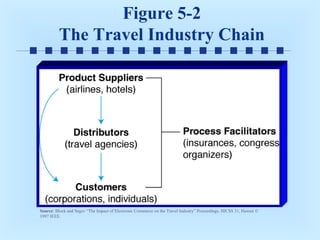
Figure 5-2
The Travel Industry Chain

Source: Block and Segev “The Impact of Electronic Commerce on the Travel Industry” Proceedings, HICSS 31, Hawaii ©
1997 IEEE.
Travel and Tourism Services (cont.)
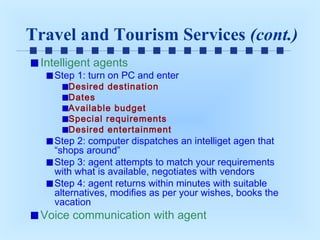
Intelligent agents

Step 1: turn on PC and enter
Desired destination
Dates
Available budget
Special requirements
Desired entertainment

Step 2: computer dispatches an intelliget agen that
“shops around”
Step 3: agent attempts to match your requirements
with what is available, negotiates with vendors
Step 4: agent returns within minutes with suitable
alternatives, modifies as per your wishes, books the
vacation

Voice communication with agent
The Employment Placement:
Deficiencies of Manual Market
Job markets
Employers are looking for employees with
specific skills, and individuals are looking for
jobs
Very volatile market
Moved to the Internet
Millions of job seekers, hundreds of thousands
of jobs
The Employment Placement:
Deficiencies of Manual Market (cont.)
Driving forces of electronic job market

Cost—classified ads are expensive
Life cycle—the life of the ads is only days or
weeks
Place—most ads are local; nationwide and
international ads are more expensive
Minimum information—because of the high cost,
the information provided is minimal
Search—Time consuming for individuals to find all
relevant newspapers
The Employment Placement:
Deficiencies of Manual Market (cont.)
Driving forces of electronic job market (cont.)
Finding applicants—during pre-Internet era, job seekers

did not place ads about their availability making it
difficult for companies to find employees with special
skills
Matching—it was difficult to match candidates to open
jobs, supply and demand
Lost and dated material— some applications or letters of
response tended to get lost, or arrive late

Speed—communication by mail and processing of a

large number of applications is slow; employers lose
good employees, the applicant had taken another job
being afraid to wait too long
Comparisons—difficult for job seekers to compare
monetary value of available positions
The Employment Placement:
Deficiencies of Manual Market (cont.)
The Internet Job Market
The Internet offers a perfect environment; it is
especially effective for technology-oriented
jobs
Job seekers
Job offerers
Recruiting firms
Government agencies and institutions
The Employment Placement:
Deficiencies of Manual Market (cont.)
The Advantage of the Electronic Job Market
For job seekers
Find very detailed and
timely information on a
large number of jobs
world-wide
Quickly communicate
with potential employers
Post resumes for largevolume distribution

Search for jobs quickly
from any place at any time
Obtain several support
services at no cost
Find employer profile &
industry guides
(valuereports.Com)
The Employment Placement:
Deficiencies of Manual Market (cont.)
The Advantage of the Electronic Job Market
For employers
Advertise to a large
number of job seekers
Save on advertisement
costs
Lower the cost of
processing (using
electronic application
forms)
Provide greater (‘equal
opportunity’) for job
seekers

Find highly skilled
employees
Conduct tests quickly,
online
Change and update ads
quickly
Fill up positions rapidly
Interviewing from
distance
The Employment Placement:
Deficiencies of Manual Market (cont.)
The Limitations of Electronic Job Markets
Many people do not use the Internet
Security
Privacy
Lack of face-to-face contact

Examples of online job services
Locating jobs
Writing and posting resumes
Career planning
Newsgroups

Examples of career services on the Internet
Recruiters online network
StaffNET
Global employment network
Employment opportunities
Intranet job market

Intelligent agents
Intelligent agents for job seekers (jobsleuth.com)
Intelligent agents for employers (resumix.com)
Real Estate
You can view many properties on the screen
You can sort and organize properties
You can find detailed information about the
properties
You can search, compare and apply for
loans
Real Estate (cont.)
Real Estate Applications (cont.)
The National Association of Realtors, realtor.com has links to
property listings in all major US cities
To find how much house you can afford, consult:
replace.com
Mortgage brokers can pass on loan applications over the Net
and receive bids from lenders that want to issue the
mortgages
To find mortgage interest rates online use:
Lendingtree.com
Eloan.com
Homeside.com.au

Insurance—auto, home life, health at substantial discount
Insureate.com
Order.com
Quotesmith.com
Investing and Trading Stocks Online
Online stock trading
Costs between $7 and $29 per transaction (vs.
$10 - $35 in traditional brokerage)
No waiting on busy telephone lines
No oral communication, less chance for errors
Place orders from anywhere, any time, day or
night
No biased broker to push you
Considerable amount of free information
Trading Stocks Online (cont.)
Initial public offerings
(IPOs)
Spring Street Brewing
Offers initial and
secondary securities
trading over the
Internet
See ipo.com

Global stock exchanges—
around-the-clock global
trading

Related markets
Financial derivatives
Commodities
Mutual funds

Individual investors and
day trading
Electronic trading of
interest rate derivatives
Swapswire.com
Forbes.com
Cyberbanking and Personal Finance
Electronic banking
Saves time and
money for users
Offers an
inexpensive
alternative to
branch banking

Application Case:
Cyberbanking at
Wells Fargo

Capabilities of home
banking
Get current account
balances any time
Obtain charge and
credit card statements
Pay bills
Download account
transactions
Transfer money between
accounts
Cyberbanking and Personal Finance
International and multiple-currency banking

Some international retail purchasing can be done by
credit card
Other transactions may require international banking
support
Hong Kong Bank’s HEXAGON provides ebanking in Asia
Mark Twain Bank in the U.S. uses e-cash to
support trading in 20 foreign currencies
Bank of America and other banks offer:
International capital raising
Cash management
Other services on an international level
Cyberbanking and Personal Finance (cont.)
Implementation issues in banking and online
stock trading
Securing financial transactions

Application case: Bank of America Online

Using the extranet

Banks provide large business customers
with personalized service by allowing them
access to the bank’s intranet
Access accounts
Historical transactions
Intranet-based decision-support
applications
Cyberbanking and Personal Finance (cont.)
Imaging systems—allow customers to view
images of all:
Incoming checks
Invoices
Other related online correspondence

Pricing online vs. off-line services
Some banks offer free services (fee per
check or transfer)
Some banks charge $5 to $10

Risks—especially in international banking
Cyberbanking and Personal Finance (cont.)
Banking: 4 scenarios

Building alliances quickly with banks, software
vendors, and information providers
Effective outsourcing without neglecting to
build in-house skills (customer information
systems)
Focusing on the profitable customers to
provide broad channels for services and
products
Keeping a central role in the payment
environment
The Future of Online Banking
Three core strategies to pursue
1. Customers Agents—banks unable to achieve economies of
scale
Offer customers the widest possible choices
Include products from multiple sources
Provide the customers with integrated
information services

1. Product Manufacturers – banks able to achieve
economies of scale
Strengthen a trend that can already be seen in a
number of product segments
In core processing services for small and mediumsized institutions
The Future of Online Banking (cont.)
Three core strategies to pursue (cont.)
3. Integrated Players—banks with a strong brand
and position from manufacturing to delivery
Many banks will adopt a hybrid strategy
Every player needs to make crucial
decisions about which areas are
strategically too risky:
To outsource
Which capabilities need to be built up inhouse
The Future of Online Banking (cont.)
Personal finance online

Bill paying and e-checks
Tracking bank accounts etc.
Portfolio management
Investment tracking
Quotes and prices (past and current)
Budget organization
Record keeping
Tax computations
Retirement goals, planning and budgeting
Billing Online
Automatic transfer of
mortgages
This method has
existed for several
years
The payer
authorizes its bank
to pay the
mortgage,
including tax
escrow payments

Automatic transfer of
funds to pay monthly utility
bills
Since1997, the city of
Long Beach has
allowed its customers
to pay their gas and
water bills from their
bank accounts
Many utility
companies worldwide
provide this option
Billing Online (cont.)
Paying bills from online banking account
Can be made into any bank account
Monthly rent and other bills paid directly into
the payee’s bank accounts
Billing Online (cont.)
A merchant-to-customer direct billing
A merchant posts bills on its Web site
Customers can view and pay their bill
Customers have to go to many Web sites to
pay all their bills
Several utilities in Los Angeles allow
customers to pay bills on the utilities’ Web site
(20 cents per transaction )
Billing Online (cont.)
Using an intermediary
A third party consolidates all bills related to each
customer in one site in a standard format
Collects a certain commission
Makes it convenient to complete transactions
E*Trade and Intuit

ISPs services
Trying to sell customized solutions
Do not have adequate billing platforms
See moneymain.com
Online Publishing
The electronic delivery of newspapers,
magazines, news, and other information
through the Internet
Online Publishing Today and Tomorrow
Today— mainly used for disseminating
information and for conducting sales
transactions interactively
Tomorrow— include more customized material
that the reader will receive free, or will pay for
Online Publishing (cont.)
Publishing Modes
Newspapers
Magazines
News
Textbooks
Music
Artwork
Video clips
Movies
Online Publishing (cont.)
Publishing Methods
Online archive: digital archive (library
catalogs, bibliographic databases)
New medium: extra comprehensiveness to
issue or topic
Publishing intermediation: online directory
for news services
Dynamic or just-in-time: create content in
real-time and transmit on the fly
Online Publishing (cont.)
Publishing music, videos, and games
Major issue is payment of intellectual property
fees
People-to-people (P2P) model—people swap
files
3rd-party organizer may be in violation of
copyright laws (Napster)
Online Publishing (cont.)
Digital delivery of documents—secure
environment
U.S. Postal Service, UPS, Eparcel.com
Encryption
Software for digital signature
Authentication
Notarization
Online Publishing (cont.)
Edutainment—combination of:

Education
Entertainment
Games
Goal: encourage students to become
active learners
Managerial issues
Educational games delivered as CDROMs
Distance-learning format
Online Publishing (cont.)
Electronic books

Frequent updates possible
Contain up-to-the-minute information
Special eBook device necessary to view books
See:
Wizap.com
Ebookconnections.com
Netlibrary.com
Knowledge Dissemination
Virtual teaching and online universities

Distance learning and virtual universities
Many universities offer limited courses and
degrees, but use innovative teaching methods
and multimedia support
MBA program in Hong Kong
Lectures delivered on interactive TV
(iTV), now on the Web
Students decide what and when they
“attend” the lecture
Lecture, support material exercises,
etc., provided on the Web
Knowledge Dissemination (cont.)
Online advice and consulting
Medical advice—provide consultation with top
experts
Management consulting—provide
accumulated expertise from knowledge bases
Legal advice—delivery of legal consultation
services to business has considerable
prospects
Knowledge Dissemination (cont.)
Online advice and consulting (cont.)
Financial advice— offer extensive financial
advice
Other service online
Healthcare
Matchmaking
Electronic stamps
Disintermediation and
Reintermediation
Change the role of agents to:
Assists in comparison shopping from multiple
sources
Providing total solutions by combining services
from several vendors
Providing certifications and trusted third party
control and evaluation systems
Disintermediation and
Reintermediation (cont.)
Issues impacting future of intermediaries
The success of intelligent agents

Travel intelligent agents
Agents that support job matching
Agents that interpret resumes
The more intelligent the software agents
become, the less human agents will be needed

Customer attitudes and behavior are important

Good experience with online agencies means
fewer customers use human agents
Insurance purchasing
Stock purchasing
Virtual travel agencies
Disintermediation and
Reintermediation (cont.)
New roles of electronic marketing
intermediaries
To extend what we are familiar with in physical
markets to the virtual world (e.g., search
services and electronic malls)
To extend payment clearing functions into the
Internet (e.g., electronic cash and digital credit
card services)
Disintermediation and
Reintermediation (cont.)
Disintermediation in B2B
Exchanges decrease number of calls a sales rep pays on
purchasing managers
Reengineering marketing and sales organizations is
necessary

Cybermediation
Electronic intermediary (rowe.com)
Affects most market functions

Hypermediation—human/electronic intermediation;
may profit greatly from EC
Managerial Issues
Effectiveness of out-of-town recruitment
Privacy may be in danger
International legal issues may impact services
more than products
Ethical issues are prevalent in services
The intermediaries and their roles are changing
Alliances for online initiatives are spreading
rapidly

E-Commerce 06

  • 1.
    Chapter 5 Electronic Commercein Service Industries 1
  • 2.
    Opening Vignette: Ordering JournalsElectronically How a large university automated the purchasing of magazines and journals, saving $365,000/year Direct E-Marketing: Buyer-to-seller; orders and payments Market maker charges $5/transaction vs. about $32 (conventional agents) Ordering time reduced by up to 80% Rowe.com—Internet IPO that survived the stock market in the industry
  • 3.
    Broker-Based Services Brokers workas intermediaries between buyers and sellers Agents basically make the markets Agents provide many services Most of the value-added tasks of brokers can be automated Major electronic agent-based services Travel Employment Real estate Stocks Electronic auctions At-home banking Insurance
  • 4.
    Broker-Based Services (cont.) ServiceIndustries vs. Manufacturing and Product Retailing Service Industries Pure EC: substantially reduced cost Bank and brokerage houses Possible digitation of the entire process Travel and real estate agents Viewing an online video clip or seeing photos of a hotel or a house for sale Manufacturing and product retailing Physical delivery cost may be high
  • 5.
    Travel and TourismServices Any experienced traveler knows that good planning and shopping around can save money The Internet is an ideal place to plan, explore, and arrange almost any trip Travel-related information available at many sites including: Expedia.com Travelocity.com Asiatravel.com Travelweb.com Trip.com Priceline.com
  • 6.
    Travel and TourismServices (cont.) Services provided: Information and booking of airlines, hotels, cars, and even golf courses Fare comparisons 360 degree video tours of top destinations Electronic Travel magazine Converting 200 currencies Providing maps Pictures of major attractions Information about entertainment and ticket purchasing (ticketmaster.com) Tips provided by people that experienced certain situations (like a visa problem)
  • 7.
    Travel and TourismServices (cont.) Services provided: Special discount information Chat rooms and bulletin boards Shopping for travel accessories and books Experts’ options Frequent flier deals Restaurant reviews Current status of flights (real time) Driving directions in the US Travel news Fare tracker (free e-mail alerts on low fares) Major international news Worldwide business and places locator Special interest vacations Bed and breakfast recommendations E-mail to intermediary Weather watch
  • 8.
    Travel and TourismServices (cont.) Auctions, bids, and special sales American airlines (aa.com) auctions tickets during low-volume seasons Cathay (cathaypacific.com) auctions tickets on competitive routes Aer Lingus (aerlingus.ie) auctions tickets that expire in 1 or 2 weeks Priceline (priceline.com) asks consumers to specify the price they are willing to pay
  • 9.
    Travel and TourismServices (cont.) Special services Wireless services Direct marketing Alliances and consortia Other services Interactive kiosks in hotels Internet access in hotels Benefits Free information is tremendous Free information is accessible anytime Substantial discounts Limitations Not all people use the Internet It may take a long time to find what you want People are still reluctant to provide credit card numbers
  • 10.
    Travel and TourismServices (cont.) Corporate Travel: New Business Model The Impact of EC on the Travel Industry Porter’s framework of competitive advantage (the five forces) Focus: Environment Competitive responses Firm’s strategy The industry is clearly transformed Taking away some functions traditionally performed by travel agents
  • 11.
    Travel and TourismServices (cont.) Impacts on the industry Multimedia helps customers understand the products Offering of lower-cost trips Providing a more personalized service Saving money in a paperless environment Increasing the convenience of getting information at home Supporting a customer-focused strategy (such as targeted advertisement and integration of products); push information to customers
  • 12.
    Travel and TourismServices (cont.) Travel agencies, as we know them today, will disappear Only their complex value-added activities will not be automated These complex activities will be performed by a new breed of intermediaries Survival strategy Minor improvements due to process changes BPR with significant improvements Organizational transformation
  • 13.
    Figure 5-2 The TravelIndustry Chain Source: Block and Segev “The Impact of Electronic Commerce on the Travel Industry” Proceedings, HICSS 31, Hawaii © 1997 IEEE.
  • 14.
    Travel and TourismServices (cont.) Intelligent agents Step 1: turn on PC and enter Desired destination Dates Available budget Special requirements Desired entertainment Step 2: computer dispatches an intelliget agen that “shops around” Step 3: agent attempts to match your requirements with what is available, negotiates with vendors Step 4: agent returns within minutes with suitable alternatives, modifies as per your wishes, books the vacation Voice communication with agent
  • 15.
    The Employment Placement: Deficienciesof Manual Market Job markets Employers are looking for employees with specific skills, and individuals are looking for jobs Very volatile market Moved to the Internet Millions of job seekers, hundreds of thousands of jobs
  • 16.
    The Employment Placement: Deficienciesof Manual Market (cont.) Driving forces of electronic job market Cost—classified ads are expensive Life cycle—the life of the ads is only days or weeks Place—most ads are local; nationwide and international ads are more expensive Minimum information—because of the high cost, the information provided is minimal Search—Time consuming for individuals to find all relevant newspapers
  • 17.
    The Employment Placement: Deficienciesof Manual Market (cont.) Driving forces of electronic job market (cont.) Finding applicants—during pre-Internet era, job seekers did not place ads about their availability making it difficult for companies to find employees with special skills Matching—it was difficult to match candidates to open jobs, supply and demand Lost and dated material— some applications or letters of response tended to get lost, or arrive late Speed—communication by mail and processing of a large number of applications is slow; employers lose good employees, the applicant had taken another job being afraid to wait too long Comparisons—difficult for job seekers to compare monetary value of available positions
  • 18.
    The Employment Placement: Deficienciesof Manual Market (cont.) The Internet Job Market The Internet offers a perfect environment; it is especially effective for technology-oriented jobs Job seekers Job offerers Recruiting firms Government agencies and institutions
  • 19.
    The Employment Placement: Deficienciesof Manual Market (cont.) The Advantage of the Electronic Job Market For job seekers Find very detailed and timely information on a large number of jobs world-wide Quickly communicate with potential employers Post resumes for largevolume distribution Search for jobs quickly from any place at any time Obtain several support services at no cost Find employer profile & industry guides (valuereports.Com)
  • 20.
    The Employment Placement: Deficienciesof Manual Market (cont.) The Advantage of the Electronic Job Market For employers Advertise to a large number of job seekers Save on advertisement costs Lower the cost of processing (using electronic application forms) Provide greater (‘equal opportunity’) for job seekers Find highly skilled employees Conduct tests quickly, online Change and update ads quickly Fill up positions rapidly Interviewing from distance
  • 21.
    The Employment Placement: Deficienciesof Manual Market (cont.) The Limitations of Electronic Job Markets Many people do not use the Internet Security Privacy Lack of face-to-face contact Examples of online job services Locating jobs Writing and posting resumes Career planning Newsgroups Examples of career services on the Internet Recruiters online network StaffNET Global employment network Employment opportunities Intranet job market Intelligent agents Intelligent agents for job seekers (jobsleuth.com) Intelligent agents for employers (resumix.com)
  • 22.
    Real Estate You canview many properties on the screen You can sort and organize properties You can find detailed information about the properties You can search, compare and apply for loans
  • 23.
    Real Estate (cont.) RealEstate Applications (cont.) The National Association of Realtors, realtor.com has links to property listings in all major US cities To find how much house you can afford, consult: replace.com Mortgage brokers can pass on loan applications over the Net and receive bids from lenders that want to issue the mortgages To find mortgage interest rates online use: Lendingtree.com Eloan.com Homeside.com.au Insurance—auto, home life, health at substantial discount Insureate.com Order.com Quotesmith.com
  • 24.
    Investing and TradingStocks Online Online stock trading Costs between $7 and $29 per transaction (vs. $10 - $35 in traditional brokerage) No waiting on busy telephone lines No oral communication, less chance for errors Place orders from anywhere, any time, day or night No biased broker to push you Considerable amount of free information
  • 25.
    Trading Stocks Online(cont.) Initial public offerings (IPOs) Spring Street Brewing Offers initial and secondary securities trading over the Internet See ipo.com Global stock exchanges— around-the-clock global trading Related markets Financial derivatives Commodities Mutual funds Individual investors and day trading Electronic trading of interest rate derivatives Swapswire.com Forbes.com
  • 26.
    Cyberbanking and PersonalFinance Electronic banking Saves time and money for users Offers an inexpensive alternative to branch banking Application Case: Cyberbanking at Wells Fargo Capabilities of home banking Get current account balances any time Obtain charge and credit card statements Pay bills Download account transactions Transfer money between accounts
  • 27.
    Cyberbanking and PersonalFinance International and multiple-currency banking Some international retail purchasing can be done by credit card Other transactions may require international banking support Hong Kong Bank’s HEXAGON provides ebanking in Asia Mark Twain Bank in the U.S. uses e-cash to support trading in 20 foreign currencies Bank of America and other banks offer: International capital raising Cash management Other services on an international level
  • 28.
    Cyberbanking and PersonalFinance (cont.) Implementation issues in banking and online stock trading Securing financial transactions Application case: Bank of America Online Using the extranet Banks provide large business customers with personalized service by allowing them access to the bank’s intranet Access accounts Historical transactions Intranet-based decision-support applications
  • 29.
    Cyberbanking and PersonalFinance (cont.) Imaging systems—allow customers to view images of all: Incoming checks Invoices Other related online correspondence Pricing online vs. off-line services Some banks offer free services (fee per check or transfer) Some banks charge $5 to $10 Risks—especially in international banking
  • 30.
    Cyberbanking and PersonalFinance (cont.) Banking: 4 scenarios Building alliances quickly with banks, software vendors, and information providers Effective outsourcing without neglecting to build in-house skills (customer information systems) Focusing on the profitable customers to provide broad channels for services and products Keeping a central role in the payment environment
  • 31.
    The Future ofOnline Banking Three core strategies to pursue 1. Customers Agents—banks unable to achieve economies of scale Offer customers the widest possible choices Include products from multiple sources Provide the customers with integrated information services 1. Product Manufacturers – banks able to achieve economies of scale Strengthen a trend that can already be seen in a number of product segments In core processing services for small and mediumsized institutions
  • 32.
    The Future ofOnline Banking (cont.) Three core strategies to pursue (cont.) 3. Integrated Players—banks with a strong brand and position from manufacturing to delivery Many banks will adopt a hybrid strategy Every player needs to make crucial decisions about which areas are strategically too risky: To outsource Which capabilities need to be built up inhouse
  • 33.
    The Future ofOnline Banking (cont.) Personal finance online Bill paying and e-checks Tracking bank accounts etc. Portfolio management Investment tracking Quotes and prices (past and current) Budget organization Record keeping Tax computations Retirement goals, planning and budgeting
  • 34.
    Billing Online Automatic transferof mortgages This method has existed for several years The payer authorizes its bank to pay the mortgage, including tax escrow payments Automatic transfer of funds to pay monthly utility bills Since1997, the city of Long Beach has allowed its customers to pay their gas and water bills from their bank accounts Many utility companies worldwide provide this option
  • 35.
    Billing Online (cont.) Payingbills from online banking account Can be made into any bank account Monthly rent and other bills paid directly into the payee’s bank accounts
  • 36.
    Billing Online (cont.) Amerchant-to-customer direct billing A merchant posts bills on its Web site Customers can view and pay their bill Customers have to go to many Web sites to pay all their bills Several utilities in Los Angeles allow customers to pay bills on the utilities’ Web site (20 cents per transaction )
  • 37.
    Billing Online (cont.) Usingan intermediary A third party consolidates all bills related to each customer in one site in a standard format Collects a certain commission Makes it convenient to complete transactions E*Trade and Intuit ISPs services Trying to sell customized solutions Do not have adequate billing platforms See moneymain.com
  • 38.
    Online Publishing The electronicdelivery of newspapers, magazines, news, and other information through the Internet Online Publishing Today and Tomorrow Today— mainly used for disseminating information and for conducting sales transactions interactively Tomorrow— include more customized material that the reader will receive free, or will pay for
  • 39.
    Online Publishing (cont.) PublishingModes Newspapers Magazines News Textbooks Music Artwork Video clips Movies
  • 40.
    Online Publishing (cont.) PublishingMethods Online archive: digital archive (library catalogs, bibliographic databases) New medium: extra comprehensiveness to issue or topic Publishing intermediation: online directory for news services Dynamic or just-in-time: create content in real-time and transmit on the fly
  • 41.
    Online Publishing (cont.) Publishingmusic, videos, and games Major issue is payment of intellectual property fees People-to-people (P2P) model—people swap files 3rd-party organizer may be in violation of copyright laws (Napster)
  • 42.
    Online Publishing (cont.) Digitaldelivery of documents—secure environment U.S. Postal Service, UPS, Eparcel.com Encryption Software for digital signature Authentication Notarization
  • 43.
    Online Publishing (cont.) Edutainment—combinationof: Education Entertainment Games Goal: encourage students to become active learners Managerial issues Educational games delivered as CDROMs Distance-learning format
  • 44.
    Online Publishing (cont.) Electronicbooks Frequent updates possible Contain up-to-the-minute information Special eBook device necessary to view books See: Wizap.com Ebookconnections.com Netlibrary.com
  • 45.
    Knowledge Dissemination Virtual teachingand online universities Distance learning and virtual universities Many universities offer limited courses and degrees, but use innovative teaching methods and multimedia support MBA program in Hong Kong Lectures delivered on interactive TV (iTV), now on the Web Students decide what and when they “attend” the lecture Lecture, support material exercises, etc., provided on the Web
  • 46.
    Knowledge Dissemination (cont.) Onlineadvice and consulting Medical advice—provide consultation with top experts Management consulting—provide accumulated expertise from knowledge bases Legal advice—delivery of legal consultation services to business has considerable prospects
  • 47.
    Knowledge Dissemination (cont.) Onlineadvice and consulting (cont.) Financial advice— offer extensive financial advice Other service online Healthcare Matchmaking Electronic stamps
  • 48.
    Disintermediation and Reintermediation Change therole of agents to: Assists in comparison shopping from multiple sources Providing total solutions by combining services from several vendors Providing certifications and trusted third party control and evaluation systems
  • 49.
    Disintermediation and Reintermediation (cont.) Issuesimpacting future of intermediaries The success of intelligent agents Travel intelligent agents Agents that support job matching Agents that interpret resumes The more intelligent the software agents become, the less human agents will be needed Customer attitudes and behavior are important Good experience with online agencies means fewer customers use human agents Insurance purchasing Stock purchasing Virtual travel agencies
  • 50.
    Disintermediation and Reintermediation (cont.) Newroles of electronic marketing intermediaries To extend what we are familiar with in physical markets to the virtual world (e.g., search services and electronic malls) To extend payment clearing functions into the Internet (e.g., electronic cash and digital credit card services)
  • 51.
    Disintermediation and Reintermediation (cont.) Disintermediationin B2B Exchanges decrease number of calls a sales rep pays on purchasing managers Reengineering marketing and sales organizations is necessary Cybermediation Electronic intermediary (rowe.com) Affects most market functions Hypermediation—human/electronic intermediation; may profit greatly from EC
  • 52.
    Managerial Issues Effectiveness ofout-of-town recruitment Privacy may be in danger International legal issues may impact services more than products Ethical issues are prevalent in services The intermediaries and their roles are changing Alliances for online initiatives are spreading rapidly