Cloud Series
Cloud Foundry NG Deep Dive
Animesh Singh (singhan@us.ibm.com)
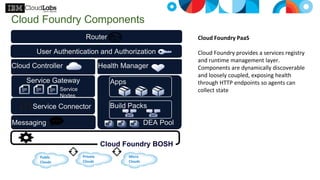
Cloud Foundry PaaS
Cloud Foundry provides a services registry
and runtime management layer.
Components are dynamically discoverable
and loosely coupled, exposing health
through HTTP endpoints so agents can
collect state
Cloud Foundry Components
User Authentication and Authorization
Router
DEA Pool
Service Gateway Apps
Service Connector
Health Manager
Messaging
Cloud Controller
Build Packs
Cloud Foundry BOSH
Micro
Clouds
Private
Clouds
Public
Clouds
Service
Nodes
User Authentication and Authorization
Router
DEA Pool
Service Gateway Apps
Service Connector
Health Manager
Messaging
Cloud Controller
Build Packs
Cloud Foundry BOSH
Micro
Clouds
Private
Clouds
Public
Clouds
Service
Nodes
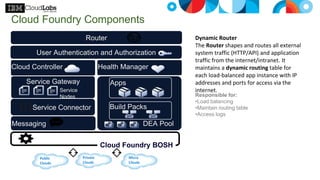
Dynamic Router
The Router shapes and routes all external
system traffic (HTTP/API) and application
traffic from the internet/intranet. It
maintains a dynamic routing table for
each load-balanced app instance with IP
addresses and ports for access via the
internet.
Cloud Foundry Components
Responsible for:
•Load balancing
•Maintain routing table
•Access logs
User Authentication and Authorization
Router
DEA Pool
Service Gateway Apps
Service Connector
Health Manager
Messaging
Cloud Controller
Build Packs
Cloud Foundry BOSH
Micro
Clouds
Private
Clouds
Public
Clouds
Service
Nodes
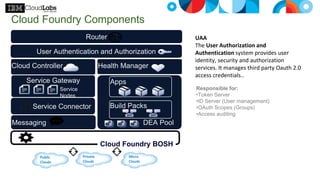
UAA
The User Authorization and
Authentication system provides user
identity, security and authorization
services. It manages third party Oauth 2.0
access credentials..
Cloud Foundry Components
Responsible for:
•Token Server
•ID Server (User management)
•OAuth Scopes (Groups)
•Access auditing
User Authentication and Authorization
Router
DEA Pool
Service Gateway Apps
Service Connector
Health Manager
Messaging
Cloud Controller
Build Packs
Cloud Foundry BOSH
Micro
Clouds
Private
Clouds
Public
Clouds
Service
Nodes
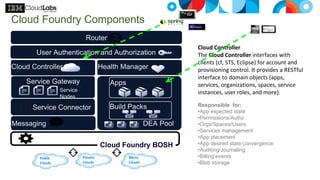
Cloud Controller
The Cloud Controller interfaces with
clients (cf, STS, Eclipse) for account and
provisioning control. It provides a RESTful
interface to domain objects (apps,
services, organizations, spaces, service
instances, user roles, and more).
CLI
Cloud Foundry Components
Responsible for:
•App expected state
•Permissions/Authz
•Orgs/Spaces/Users
•Services management
•App placement
•App desired state convergence
•Auditing/Journaling
•Billing events
•Blob storage
User Authentication and Authorization
Router
DEA Pool
Service Gateway Apps
Service Connector
Health Manager
Messaging
Cloud Controller
Build Packs
Cloud Foundry BOSH
Micro
Clouds
Private
Clouds
Public
Clouds
Service
Nodes
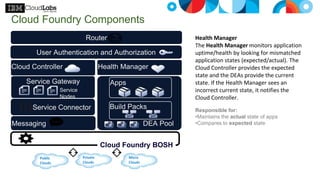
Health Manager
The Health Manager monitors application
uptime/health by looking for mismatched
application states (expected/actual). The
Cloud Controller provides the expected
state and the DEAs provide the current
state. If the Health Manager sees an
incorrect current state, it notifies the
Cloud Controller.
Cloud Foundry Components
Responsible for:
•Maintains the actual state of apps
•Compares to expected state
User Authentication and Authorization
Router
DEA Pool
Service Gateway Apps
Service Connector
Health Manager
Messaging
Cloud Controller
Build Packs
Cloud Foundry BOSH
Micro
Clouds
Private
Clouds
Public
Clouds
Service
Nodes
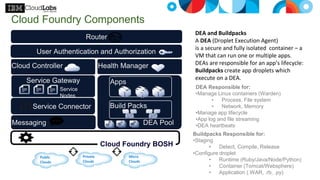
DEA and Buildpacks
A DEA (Droplet Execution Agent)
is a secure and fully isolated container – a
VM that can run one or multiple apps.
DEAs are responsible for an app’s lifecycle:
Buildpacks create app droplets which
execute on a DEA.
Cloud Foundry Components
DEA Responsible for:
•Manage Linux containers (Warden)
• Process, File system
• Network, Memory
•Manage app lifecycle
•App log and file streaming
•DEA heartbeats
Buildpacks Responsible for:
•Staging
• Detect, Compile, Release
•Configure droplet
• Runtime (Ruby/Java/Node/Python)
• Container (Tomcat/Websphere)
• Application (.WAR, .rb, .py)
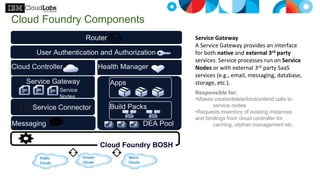
Service Gateway
A Service Gateway provides an interface
for both native and external 3rd party
services. Service processes run on Service
Nodes or with external 3rd party SaaS
services (e.g., email, messaging, database,
storage, etc.).
User Authentication and Authorization
Router
DEA Pool
Service Gateway Apps
Service Connector
Health Manager
Messaging
Cloud Controller
Build Packs
Cloud Foundry BOSH
Micro
Clouds
Private
Clouds
Public
Clouds
Service
Nodes
Cloud Foundry Components
Responsible for:
•Makes create/delete/bind/unbind calls to
service nodes
•Requests inventory of existing instances
and bindings from cloud controller for
caching, orphan management etc.
User Authentication and Authorization
Router
DEA Pool
Service Gateway Apps
Service Connector
Health Manager
Messaging
Cloud Controller
Build Packs
Cloud Foundry BOSH
Micro
Clouds
Private
Clouds
Public
Clouds
Service
Nodes
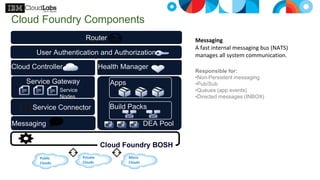
Messaging
A fast internal messaging bus (NATS)
manages all system communication.
Cloud Foundry Components
Responsible for:
•Non-Persistent messaging
•Pub/Sub
•Queues (app events)
•Directed messages (INBOX)
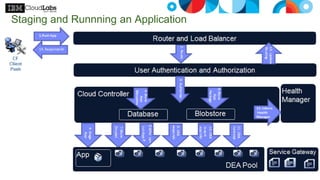
Staging and Runnning an Application
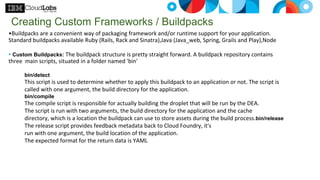
Creating Custom Frameworks / Buildpacks
•Buildpacks are a convenient way of packaging framework and/or runtime support for your application.
Standard buildpacks available Ruby (Rails, Rack and Sinatra),Java (Java_web, Spring, Grails and Play),Node
• Custom Buildpacks: The buildpack structure is pretty straight forward. A buildpack repository contains
three main scripts, situated in a folder named 'bin'
bin/detect
This script is used to determine whether to apply this buildpack to an application or not. The script is
called with one argument, the build directory for the application.
bin/compile
The compile script is responsible for actually building the droplet that will be run by the DEA.
The script is run with two arguments, the build directory for the application and the cache
directory, which is a location the buildpack can use to store assets during the build process.bin/release
The release script provides feedback metadata back to Cloud Foundry, it's
run with one argument, the build location of the application.
The expected format for the return data is YAML
DEAs and Warden Containers
•DEAs: The Droplet Execution Agent (DEA) is written in Ruby and managing an application instance's life cycle.
It can be instructed by the Cloud Controller to start and stop application instances. It keeps track of all started
instances, and periodically broadcasts messages about their state over NATS (meant to be picked up by the
Health Manager). The DEA depends on Warden to run application instances.
•Warden: Warden is a framework that allows you to spawn containers in seconds and programmatically control
resource isolation (memory, bandwidth, disk), mounts, processes and other things using APIs.
Isolation is achieved by namespacing kernel resources that would otherwise be shared. The intended level of
isolation is set such that multiple containers present on the same host should not be aware of each others
presence Resource control is done by using Linux Control Groups. Every container is placed in its own control
group At its core warden is a Ruby daemon. Currently tested and verified for Ubuntu and CentOS, though
experimental version exists for Windows.
DEA Pool
Apps
Build Packs
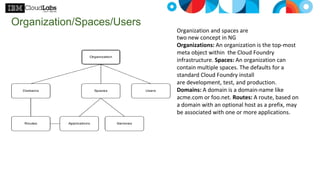
Organization and spaces are
two new concept in NG
Organizations: An organization is the top-most
meta object within the Cloud Foundry
infrastructure. Spaces: An organization can
contain multiple spaces. The defaults for a
standard Cloud Foundry install
are development, test, and production.
Domains: A domain is a domain-name like
acme.com or foo.net. Routes: A route, based on
a domain with an optional host as a prefix, may
be associated with one or more applications.
Organization/Spaces/Users
© 2013 IBM Corporation

Cloud foundry architecture and deep dive

  • 1.
    Cloud Series Cloud FoundryNG Deep Dive Animesh Singh (singhan@us.ibm.com)
  • 2.
    Cloud Foundry PaaS CloudFoundry provides a services registry and runtime management layer. Components are dynamically discoverable and loosely coupled, exposing health through HTTP endpoints so agents can collect state Cloud Foundry Components User Authentication and Authorization Router DEA Pool Service Gateway Apps Service Connector Health Manager Messaging Cloud Controller Build Packs Cloud Foundry BOSH Micro Clouds Private Clouds Public Clouds Service Nodes
  • 3.
    User Authentication andAuthorization Router DEA Pool Service Gateway Apps Service Connector Health Manager Messaging Cloud Controller Build Packs Cloud Foundry BOSH Micro Clouds Private Clouds Public Clouds Service Nodes Dynamic Router The Router shapes and routes all external system traffic (HTTP/API) and application traffic from the internet/intranet. It maintains a dynamic routing table for each load-balanced app instance with IP addresses and ports for access via the internet. Cloud Foundry Components Responsible for: •Load balancing •Maintain routing table •Access logs
  • 4.
    User Authentication andAuthorization Router DEA Pool Service Gateway Apps Service Connector Health Manager Messaging Cloud Controller Build Packs Cloud Foundry BOSH Micro Clouds Private Clouds Public Clouds Service Nodes UAA The User Authorization and Authentication system provides user identity, security and authorization services. It manages third party Oauth 2.0 access credentials.. Cloud Foundry Components Responsible for: •Token Server •ID Server (User management) •OAuth Scopes (Groups) •Access auditing
  • 5.
    User Authentication andAuthorization Router DEA Pool Service Gateway Apps Service Connector Health Manager Messaging Cloud Controller Build Packs Cloud Foundry BOSH Micro Clouds Private Clouds Public Clouds Service Nodes Cloud Controller The Cloud Controller interfaces with clients (cf, STS, Eclipse) for account and provisioning control. It provides a RESTful interface to domain objects (apps, services, organizations, spaces, service instances, user roles, and more). CLI Cloud Foundry Components Responsible for: •App expected state •Permissions/Authz •Orgs/Spaces/Users •Services management •App placement •App desired state convergence •Auditing/Journaling •Billing events •Blob storage
  • 6.
    User Authentication andAuthorization Router DEA Pool Service Gateway Apps Service Connector Health Manager Messaging Cloud Controller Build Packs Cloud Foundry BOSH Micro Clouds Private Clouds Public Clouds Service Nodes Health Manager The Health Manager monitors application uptime/health by looking for mismatched application states (expected/actual). The Cloud Controller provides the expected state and the DEAs provide the current state. If the Health Manager sees an incorrect current state, it notifies the Cloud Controller. Cloud Foundry Components Responsible for: •Maintains the actual state of apps •Compares to expected state
  • 7.
    User Authentication andAuthorization Router DEA Pool Service Gateway Apps Service Connector Health Manager Messaging Cloud Controller Build Packs Cloud Foundry BOSH Micro Clouds Private Clouds Public Clouds Service Nodes DEA and Buildpacks A DEA (Droplet Execution Agent) is a secure and fully isolated container – a VM that can run one or multiple apps. DEAs are responsible for an app’s lifecycle: Buildpacks create app droplets which execute on a DEA. Cloud Foundry Components DEA Responsible for: •Manage Linux containers (Warden) • Process, File system • Network, Memory •Manage app lifecycle •App log and file streaming •DEA heartbeats Buildpacks Responsible for: •Staging • Detect, Compile, Release •Configure droplet • Runtime (Ruby/Java/Node/Python) • Container (Tomcat/Websphere) • Application (.WAR, .rb, .py)
  • 8.
    Service Gateway A ServiceGateway provides an interface for both native and external 3rd party services. Service processes run on Service Nodes or with external 3rd party SaaS services (e.g., email, messaging, database, storage, etc.). User Authentication and Authorization Router DEA Pool Service Gateway Apps Service Connector Health Manager Messaging Cloud Controller Build Packs Cloud Foundry BOSH Micro Clouds Private Clouds Public Clouds Service Nodes Cloud Foundry Components Responsible for: •Makes create/delete/bind/unbind calls to service nodes •Requests inventory of existing instances and bindings from cloud controller for caching, orphan management etc.
  • 9.
    User Authentication andAuthorization Router DEA Pool Service Gateway Apps Service Connector Health Manager Messaging Cloud Controller Build Packs Cloud Foundry BOSH Micro Clouds Private Clouds Public Clouds Service Nodes Messaging A fast internal messaging bus (NATS) manages all system communication. Cloud Foundry Components Responsible for: •Non-Persistent messaging •Pub/Sub •Queues (app events) •Directed messages (INBOX)
  • 10.
    Staging and Runnningan Application
  • 11.
    Creating Custom Frameworks/ Buildpacks •Buildpacks are a convenient way of packaging framework and/or runtime support for your application. Standard buildpacks available Ruby (Rails, Rack and Sinatra),Java (Java_web, Spring, Grails and Play),Node • Custom Buildpacks: The buildpack structure is pretty straight forward. A buildpack repository contains three main scripts, situated in a folder named 'bin' bin/detect This script is used to determine whether to apply this buildpack to an application or not. The script is called with one argument, the build directory for the application. bin/compile The compile script is responsible for actually building the droplet that will be run by the DEA. The script is run with two arguments, the build directory for the application and the cache directory, which is a location the buildpack can use to store assets during the build process.bin/release The release script provides feedback metadata back to Cloud Foundry, it's run with one argument, the build location of the application. The expected format for the return data is YAML
  • 12.
    DEAs and WardenContainers •DEAs: The Droplet Execution Agent (DEA) is written in Ruby and managing an application instance's life cycle. It can be instructed by the Cloud Controller to start and stop application instances. It keeps track of all started instances, and periodically broadcasts messages about their state over NATS (meant to be picked up by the Health Manager). The DEA depends on Warden to run application instances. •Warden: Warden is a framework that allows you to spawn containers in seconds and programmatically control resource isolation (memory, bandwidth, disk), mounts, processes and other things using APIs. Isolation is achieved by namespacing kernel resources that would otherwise be shared. The intended level of isolation is set such that multiple containers present on the same host should not be aware of each others presence Resource control is done by using Linux Control Groups. Every container is placed in its own control group At its core warden is a Ruby daemon. Currently tested and verified for Ubuntu and CentOS, though experimental version exists for Windows. DEA Pool Apps Build Packs
  • 13.
    Organization and spacesare two new concept in NG Organizations: An organization is the top-most meta object within the Cloud Foundry infrastructure. Spaces: An organization can contain multiple spaces. The defaults for a standard Cloud Foundry install are development, test, and production. Domains: A domain is a domain-name like acme.com or foo.net. Routes: A route, based on a domain with an optional host as a prefix, may be associated with one or more applications. Organization/Spaces/Users
  • 14.
    © 2013 IBMCorporation