Confidential
PaaS Solutions Comparison
Volodymyr Davydenko
GlobalLogic Cloud Practice
June 2018
Confidential
Platform as a Service (PaaS)
is a category of cloud computing services that
enable customers to develop, run, and manage
applications without the complexity of building
and maintaining own infrastructure.
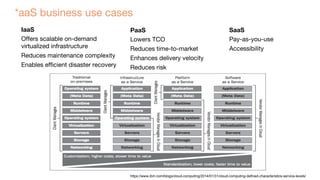
IaaS
Offers scalable on-demand
virtualized infrastructure
Reduces maintenance complexity
Enables efficient disaster recovery
*aaS business use cases
https://www.ibm.com/blogs/cloud-computing/2014/01/31/cloud-computing-defined-characteristics-service-levels/
SaaS
Pay-as-you-use
Accessibility
PaaS
Lowers TCO
Reduces time-to-market
Enhances delivery velocity
Reduces risk
Confidential
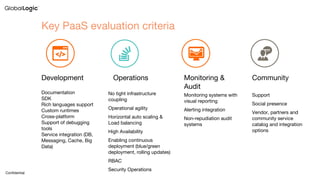
Documentation
SDK
Rich languages support
Custom runtimes
Cross-platform
Support of debugging
tools
Service integration (DB,
Messaging, Cache, Big
Data)
Key PaaS evaluation criteria
No tight infrastructure
coupling
Operational agility
Horizontal auto scaling &
Load balancing
High Availability
Enabling continuous
deployment (blue/green
deployment, rolling updates)
RBAC
Security Operations
Monitoring systems with
visual reporting
Alerting integration
Non-repudiation audit
systems
Development Operations Monitoring &
Audit
Community
Support
Social presence
Vendor, partners and
community service
catalog and integration
options
PaaS business enablement landscape
Confidential
Public Cloud Application Platforms
Examples
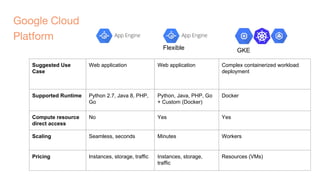
Google Cloud
Platform
GKE
Suggested Use
Case
Web application Web application Complex containerized workload
deployment
Supported Runtime Python 2.7, Java 8, PHP,
Go
Python, Java, PHP, Go
+ Custom (Docker)
Docker
Compute resource
direct access
No Yes Yes
Scaling Seamless, seconds Minutes Workers
Pricing Instances, storage, traffic Instances, storage,
traffic
Resources (VMs)
Flexible
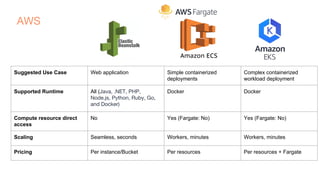
AWS
Suggested Use Case Web application Simple containerized
deployments
Complex containerized
workload deployment
Supported Runtime All (Java, .NET, PHP,
Node.js, Python, Ruby, Go,
and Docker)
Docker Docker
Compute resource direct
access
No Yes (Fargate: No) Yes (Fargate: No)
Scaling Seamless, seconds Workers, minutes Workers, minutes
Pricing Per instance/Bucket Per resources Per resources + Fargate
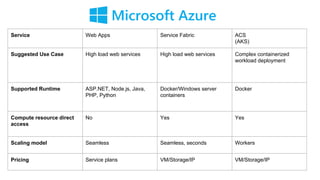
Service Web Apps Service Fabric ACS
(AKS)
Suggested Use Case High load web services High load web services Complex containerized
workload deployment
Supported Runtime ASP.NET, Node.js, Java,
PHP, Python
Docker/Windows server
containers
Docker
Compute resource direct
access
No Yes Yes
Scaling model Seamless Seamless, seconds Workers
Pricing Service plans VM/Storage/IP VM/Storage/IP
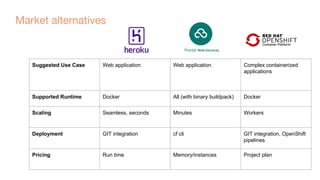
Market alternatives
Suggested Use Case Web application Web application Complex containerized
applications
Supported Runtime Docker All (with binary buildpack) Docker
Scaling Seamless, seconds Minutes Workers
Deployment GIT integration cf cli GIT integration, OpenShift
pipelines
Pricing Run time Memory/instances Project plan
Confidential
Enterprise multi-cloud PaaS
examples with on-premise
installation possibility
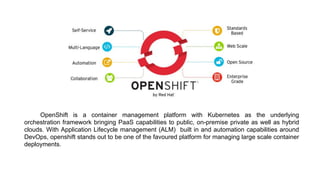
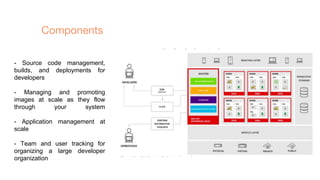
OpenShift is a container management platform with Kubernetes as the underlying
orchestration framework bringing PaaS capabilities to public, on-premise private as well as hybrid
clouds. With Application Lifecycle management (ALM) built in and automation capabilities around
DevOps, openshift stands out to be one of the favoured platform for managing large scale container
deployments.
Components
- Source code management,
builds, and deployments for
developers
- Managing and promoting
images at scale as they flow
through your system
- Application management at
scale
- Team and user tracking for
organizing a large developer
organization
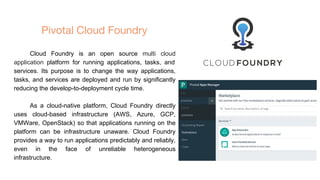
Pivotal Cloud Foundry
Cloud Foundry is an open source multi cloud
application platform for running applications, tasks, and
services. Its purpose is to change the way applications,
tasks, and services are deployed and run by significantly
reducing the develop-to-deployment cycle time.
As a cloud-native platform, Cloud Foundry directly
uses cloud-based infrastructure (AWS, Azure, GCP,
VMWare, OpenStack) so that applications running on the
platform can be infrastructure unaware. Cloud Foundry
provides a way to run applications predictably and reliably,
even in the face of unreliable heterogeneous
infrastructure.
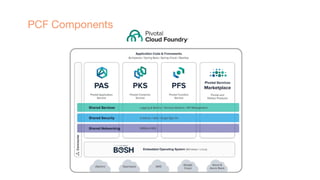
PCF Components
Kubernetes
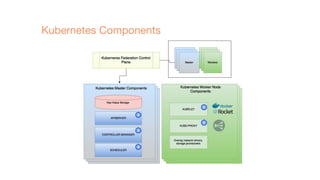
Kubernetes is an open-source platform for managing containerized applications across clusters of
nodes that allows you to solve your application orchestration requirements by:
Choosing vanilla Kubernetes might be a great choice for companies with strong DevOps teams who would
like to experiment with latest Kubernetes features that are not yet available within the specific
Kubernetes-based solution vendors, and a great choice for building own on-premise platforms. You get
battle tested container and storage orchestration, however you need to build your own personalized
release processing, and operations solutions.
● Automatic resource-based scheduling for containers and storage
● Automatic healing
● In-built automatic roll-out mechanisms
● Service discovery, HA and load balancing
● In-built configuration management
● Workloads management
● Built as fast and scalable system
Kubernetes Components
Mesosphere DC/OS
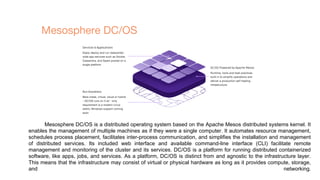
Mesosphere DC/OS is a distributed operating system based on the Apache Mesos distributed systems kernel. It
enables the management of multiple machines as if they were a single computer. It automates resource management,
schedules process placement, facilitates inter-process communication, and simplifies the installation and management
of distributed services. Its included web interface and available command-line interface (CLI) facilitate remote
management and monitoring of the cluster and its services. DC/OS is a platform for running distributed containerized
software, like apps, jobs, and services. As a platform, DC/OS is distinct from and agnostic to the infrastructure layer.
This means that the infrastructure may consist of virtual or physical hardware as long as it provides compute, storage,
and networking.
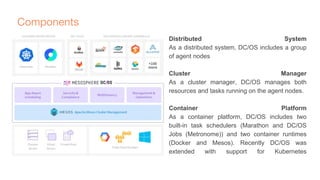
Components
Distributed System
As a distributed system, DC/OS includes a group
of agent nodes
Cluster Manager
As a cluster manager, DC/OS manages both
resources and tasks running on the agent nodes.
Container Platform
As a container platform, DC/OS includes two
built-in task schedulers (Marathon and DC/OS
Jobs (Metronome)) and two container runtimes
(Docker and Mesos). Recently DC/OS was
extended with support for Kubernetes
Azure Service Fabric
Docker EE
Tectonic
Rancher
Other notable platforms
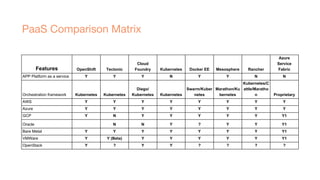
Features OpenShift Tectonic
Cloud
Foundry Kubernetes Docker EE Mesosphere Rancher
Azure
Service
Fabric
APP Platform as a service Y Y Y N Y Y N N
Orchestration framework Kubernetes Kubernetes
Diego/
Kubernetes Kubernetes
Swarm/Kuber
netes
Marathon/Ku
bernetes
Kubernetes/C
attle/Maratho
n Proprietary
AWS Y Y Y Y Y Y Y Y
Azure Y Y Y Y Y Y Y Y
GCP Y N Y Y Y Y Y Y1
Oracle N N Y ? Y Y Y1
Bare Metal Y Y Y Y Y Y Y Y1
VMWare Y Y (Beta) Y Y Y Y Y Y1
OpenStack Y ? Y Y ? ? ? ?
PaaS Comparison Matrix
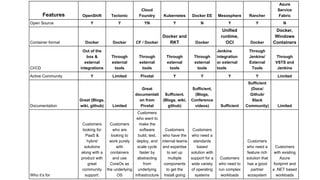
Features OpenShift Tectonic
Cloud
Foundry Kubernetes Docker EE Mesosphere Rancher
Azure
Service
Fabric
Open Source Y Y YN Y N Y Y N
Container format Docker Docker CF / Docker
Docker and
RKT Docker
Unified
runtime,
OCI Docker
Docker,
Windows
Containers
CI/CD
Out of the
box &
external
integrations
Through
external
tools
Through
external
tools
Through
external
tools
Through
external
tools
Jenkins
integration
or external
tools
Through
Jenkins/
External
Tools
Through
VSTS and
Jenkins
Active Community Y Limited Pivotal Y Y Y Y Limited
Documentation
Great (Blogs,
wiki, github) Limited
Great
documentati
on from
Pivotal
Sufficient.
(Blogs, wiki,
github)
Sufficient,
(Blogs,
Conference
videos) Sufficient
Sufficient
(Docs/
Github/
Slack
Community) Limited
Who it’s for
Customers
looking for
PaaS &
hybrid
solutions
along with a
product with
great
community
support.
Customers
who are
looking to
work purely
with
containers
and use
CoreOs as
the underlying
OS
Customers
who want to
make the
software
build, test,
deploy, and
scale cycle
faster by
abstracting
from
underlying
infrastructure
Customers
who have the
internal teams
and expertise
to set up
multiple
components
to get the
install going
Customers
who need a
standards
based
solution with
support for a
wide variety
of operating
systems
Customers
who need to
run complex
workloads
Customers
who need a
feature rich
solution that
has a good
partner
ecosystem
Customers
with existing
Azure
footprint and
a .NET based
workloads
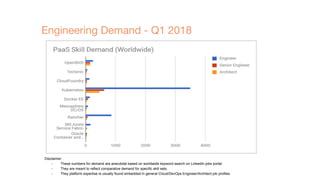
Engineering Demand - Q1 2018
Disclaimer:
- These numbers for demand are anecdotal based on worldwide keyword search on LinkedIn jobs portal.
- They are meant to reflect comparative demand for specific skill sets.
- They platform expertise is usually found embedded in general Cloud/DevOps Engineer/Architect job profiles.
Confidential
Thank you
Global Logic Cloud Practice
Discussion time

PaaS Solutions Comparison

  • 1.
    Confidential PaaS Solutions Comparison VolodymyrDavydenko GlobalLogic Cloud Practice June 2018
  • 2.
    Confidential Platform as aService (PaaS) is a category of cloud computing services that enable customers to develop, run, and manage applications without the complexity of building and maintaining own infrastructure.
  • 3.
    IaaS Offers scalable on-demand virtualizedinfrastructure Reduces maintenance complexity Enables efficient disaster recovery *aaS business use cases https://www.ibm.com/blogs/cloud-computing/2014/01/31/cloud-computing-defined-characteristics-service-levels/ SaaS Pay-as-you-use Accessibility PaaS Lowers TCO Reduces time-to-market Enhances delivery velocity Reduces risk
  • 4.
    Confidential Documentation SDK Rich languages support Customruntimes Cross-platform Support of debugging tools Service integration (DB, Messaging, Cache, Big Data) Key PaaS evaluation criteria No tight infrastructure coupling Operational agility Horizontal auto scaling & Load balancing High Availability Enabling continuous deployment (blue/green deployment, rolling updates) RBAC Security Operations Monitoring systems with visual reporting Alerting integration Non-repudiation audit systems Development Operations Monitoring & Audit Community Support Social presence Vendor, partners and community service catalog and integration options
  • 5.
  • 6.
  • 7.
    Google Cloud Platform GKE Suggested Use Case Webapplication Web application Complex containerized workload deployment Supported Runtime Python 2.7, Java 8, PHP, Go Python, Java, PHP, Go + Custom (Docker) Docker Compute resource direct access No Yes Yes Scaling Seamless, seconds Minutes Workers Pricing Instances, storage, traffic Instances, storage, traffic Resources (VMs) Flexible
  • 8.
    AWS Suggested Use CaseWeb application Simple containerized deployments Complex containerized workload deployment Supported Runtime All (Java, .NET, PHP, Node.js, Python, Ruby, Go, and Docker) Docker Docker Compute resource direct access No Yes (Fargate: No) Yes (Fargate: No) Scaling Seamless, seconds Workers, minutes Workers, minutes Pricing Per instance/Bucket Per resources Per resources + Fargate
  • 9.
    Service Web AppsService Fabric ACS (AKS) Suggested Use Case High load web services High load web services Complex containerized workload deployment Supported Runtime ASP.NET, Node.js, Java, PHP, Python Docker/Windows server containers Docker Compute resource direct access No Yes Yes Scaling model Seamless Seamless, seconds Workers Pricing Service plans VM/Storage/IP VM/Storage/IP
  • 10.
    Market alternatives Suggested UseCase Web application Web application Complex containerized applications Supported Runtime Docker All (with binary buildpack) Docker Scaling Seamless, seconds Minutes Workers Deployment GIT integration cf cli GIT integration, OpenShift pipelines Pricing Run time Memory/instances Project plan
  • 11.
    Confidential Enterprise multi-cloud PaaS exampleswith on-premise installation possibility
  • 12.
    OpenShift is acontainer management platform with Kubernetes as the underlying orchestration framework bringing PaaS capabilities to public, on-premise private as well as hybrid clouds. With Application Lifecycle management (ALM) built in and automation capabilities around DevOps, openshift stands out to be one of the favoured platform for managing large scale container deployments.
  • 13.
    Components - Source codemanagement, builds, and deployments for developers - Managing and promoting images at scale as they flow through your system - Application management at scale - Team and user tracking for organizing a large developer organization
  • 14.
    Pivotal Cloud Foundry CloudFoundry is an open source multi cloud application platform for running applications, tasks, and services. Its purpose is to change the way applications, tasks, and services are deployed and run by significantly reducing the develop-to-deployment cycle time. As a cloud-native platform, Cloud Foundry directly uses cloud-based infrastructure (AWS, Azure, GCP, VMWare, OpenStack) so that applications running on the platform can be infrastructure unaware. Cloud Foundry provides a way to run applications predictably and reliably, even in the face of unreliable heterogeneous infrastructure.
  • 15.
  • 16.
    Kubernetes Kubernetes is anopen-source platform for managing containerized applications across clusters of nodes that allows you to solve your application orchestration requirements by: Choosing vanilla Kubernetes might be a great choice for companies with strong DevOps teams who would like to experiment with latest Kubernetes features that are not yet available within the specific Kubernetes-based solution vendors, and a great choice for building own on-premise platforms. You get battle tested container and storage orchestration, however you need to build your own personalized release processing, and operations solutions. ● Automatic resource-based scheduling for containers and storage ● Automatic healing ● In-built automatic roll-out mechanisms ● Service discovery, HA and load balancing ● In-built configuration management ● Workloads management ● Built as fast and scalable system
  • 17.
  • 18.
    Mesosphere DC/OS Mesosphere DC/OSis a distributed operating system based on the Apache Mesos distributed systems kernel. It enables the management of multiple machines as if they were a single computer. It automates resource management, schedules process placement, facilitates inter-process communication, and simplifies the installation and management of distributed services. Its included web interface and available command-line interface (CLI) facilitate remote management and monitoring of the cluster and its services. DC/OS is a platform for running distributed containerized software, like apps, jobs, and services. As a platform, DC/OS is distinct from and agnostic to the infrastructure layer. This means that the infrastructure may consist of virtual or physical hardware as long as it provides compute, storage, and networking.
  • 19.
    Components Distributed System As adistributed system, DC/OS includes a group of agent nodes Cluster Manager As a cluster manager, DC/OS manages both resources and tasks running on the agent nodes. Container Platform As a container platform, DC/OS includes two built-in task schedulers (Marathon and DC/OS Jobs (Metronome)) and two container runtimes (Docker and Mesos). Recently DC/OS was extended with support for Kubernetes
  • 20.
    Azure Service Fabric DockerEE Tectonic Rancher Other notable platforms
  • 21.
    Features OpenShift Tectonic Cloud FoundryKubernetes Docker EE Mesosphere Rancher Azure Service Fabric APP Platform as a service Y Y Y N Y Y N N Orchestration framework Kubernetes Kubernetes Diego/ Kubernetes Kubernetes Swarm/Kuber netes Marathon/Ku bernetes Kubernetes/C attle/Maratho n Proprietary AWS Y Y Y Y Y Y Y Y Azure Y Y Y Y Y Y Y Y GCP Y N Y Y Y Y Y Y1 Oracle N N Y ? Y Y Y1 Bare Metal Y Y Y Y Y Y Y Y1 VMWare Y Y (Beta) Y Y Y Y Y Y1 OpenStack Y ? Y Y ? ? ? ? PaaS Comparison Matrix
  • 22.
    Features OpenShift Tectonic Cloud FoundryKubernetes Docker EE Mesosphere Rancher Azure Service Fabric Open Source Y Y YN Y N Y Y N Container format Docker Docker CF / Docker Docker and RKT Docker Unified runtime, OCI Docker Docker, Windows Containers CI/CD Out of the box & external integrations Through external tools Through external tools Through external tools Through external tools Jenkins integration or external tools Through Jenkins/ External Tools Through VSTS and Jenkins Active Community Y Limited Pivotal Y Y Y Y Limited Documentation Great (Blogs, wiki, github) Limited Great documentati on from Pivotal Sufficient. (Blogs, wiki, github) Sufficient, (Blogs, Conference videos) Sufficient Sufficient (Docs/ Github/ Slack Community) Limited Who it’s for Customers looking for PaaS & hybrid solutions along with a product with great community support. Customers who are looking to work purely with containers and use CoreOs as the underlying OS Customers who want to make the software build, test, deploy, and scale cycle faster by abstracting from underlying infrastructure Customers who have the internal teams and expertise to set up multiple components to get the install going Customers who need a standards based solution with support for a wide variety of operating systems Customers who need to run complex workloads Customers who need a feature rich solution that has a good partner ecosystem Customers with existing Azure footprint and a .NET based workloads
  • 23.
    Engineering Demand -Q1 2018 Disclaimer: - These numbers for demand are anecdotal based on worldwide keyword search on LinkedIn jobs portal. - They are meant to reflect comparative demand for specific skill sets. - They platform expertise is usually found embedded in general Cloud/DevOps Engineer/Architect job profiles.
  • 24.
    Confidential Thank you Global LogicCloud Practice Discussion time