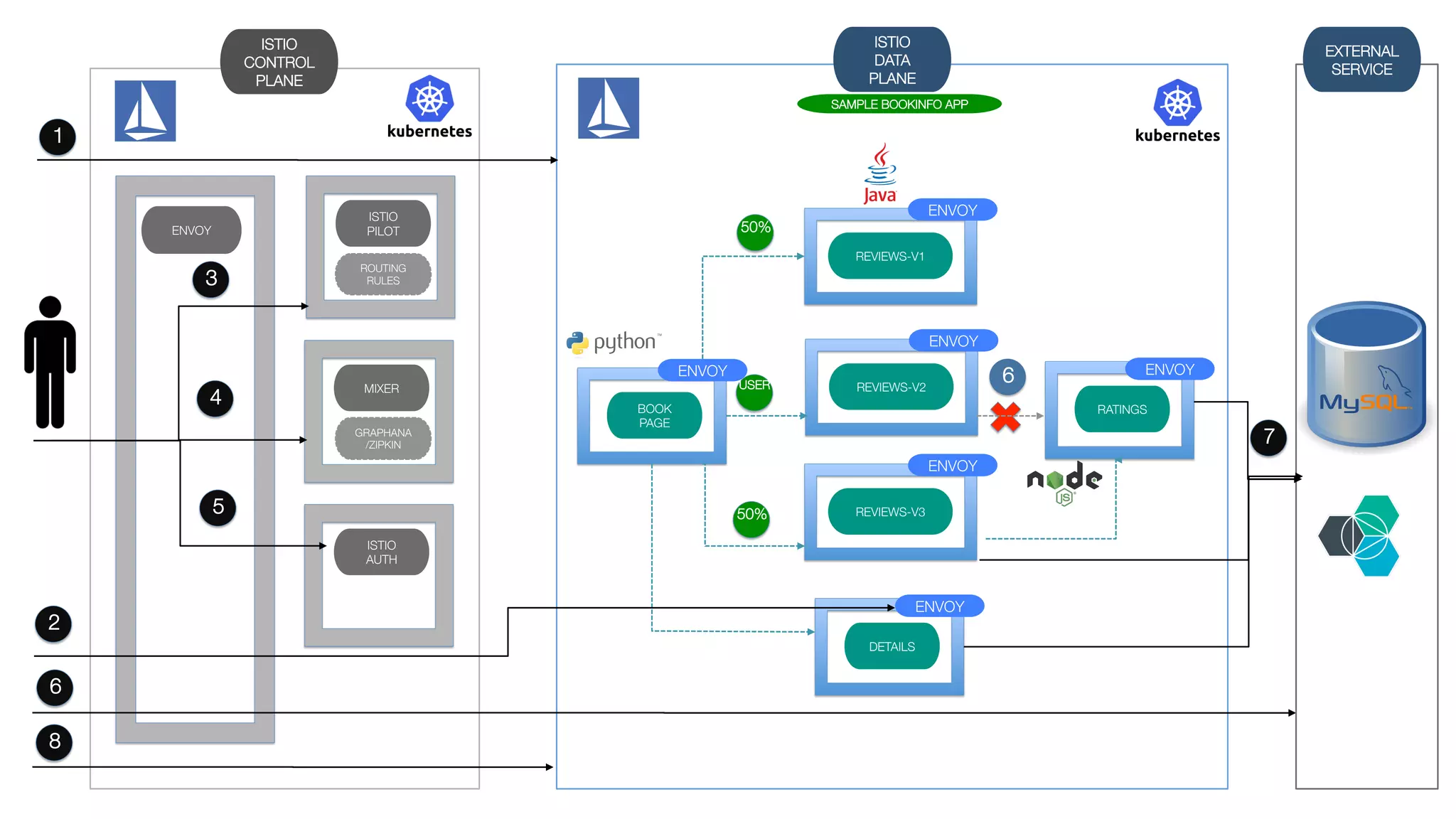
ENVOY
BOOK
PAGE
REVIEWS-V1
ENVOY
ENVOY
REVIEWS-V2
ENVOY
REVIEWS-V3
ENVOY
RATINGS

ENVOY
r
MIXER
ISTIO
PILOT
ISTIO
AUTH
ISTIO
CONTROL
PLANE
50%
50%
USER
DETAILS

ENVOY
r
ISTIO 
DATA
PLANE
SAMPLE BOOKINFO APP
Microservices, Kubernetes & Istio - A great fit!
Presenters: !
!
Animesh Singh!
Anthony Amanse !
Tommy Li!
!
Panelists: !
!
Chris Rosen
Nilesh Patel!
Microservices, Kubernetes & Istio - A great fit!
Presenters: !
!
Animesh Singh!
Anthony Amanse !
Tommy Li!
!
Panelists: !
!
Chris Rosen
Nilesh Patel!
!
Slides : http://ibm.biz/kube-istio!
!
Developer Journeys: http://ibm.biz/kube-journeys!
!
Reach out to us at:!
!
@AnimeshSingh!
!
@AnthonyAmanse!
!
@Tomipli!
!
@ChrisRosen188!
!
@nileshandweb!
!
Evolution of Microservices
An engineering approach focused on decomposing
an application into single-function modules with
well defined interfaces which are independently
deployed and operated by a small team who owns
the entire lifecycle of the service.
Microservices accelerate delivery by minimizing
communication and coordination between people
while reducing the scope and risk of change.
Microservices!
Microservices
Application
Interactions
Microservices
Application
Scaling
Microservices
Application
Update
Microservices, Containers
and Container Orchestrator
Typically microservices are encapsulated inside containers…
One:One relationship between a microservice and a container
Everyone’s container journey starts with one container….
IBM Bluemix Container Service
At first the growth is easy to handle….
IBM Bluemix Container Service
But soon it is overwhelming…we need container
and microservices management
IBM Bluemix Container Service
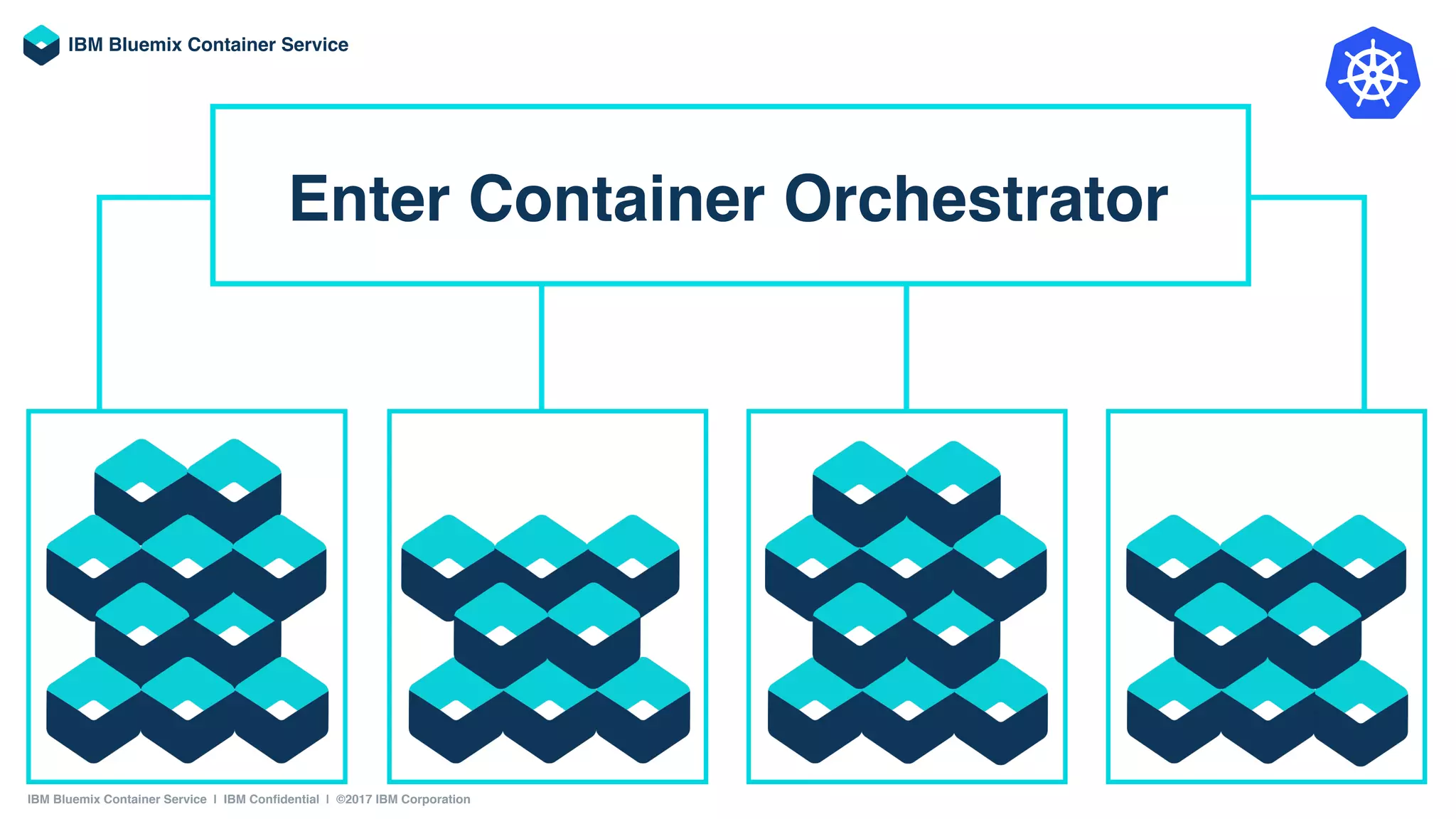
Enter Container Orchestrator
IBM Bluemix Container Service
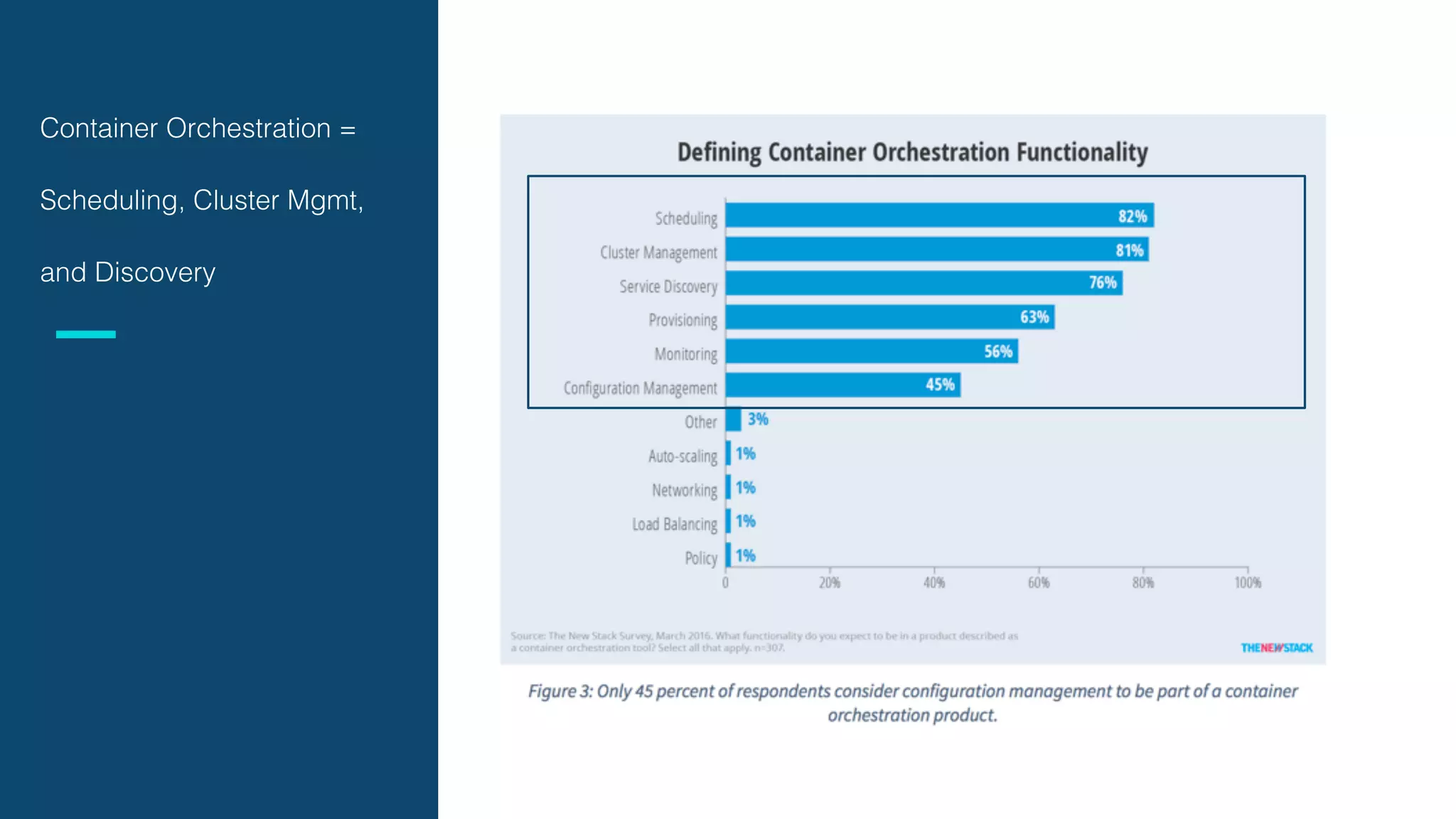
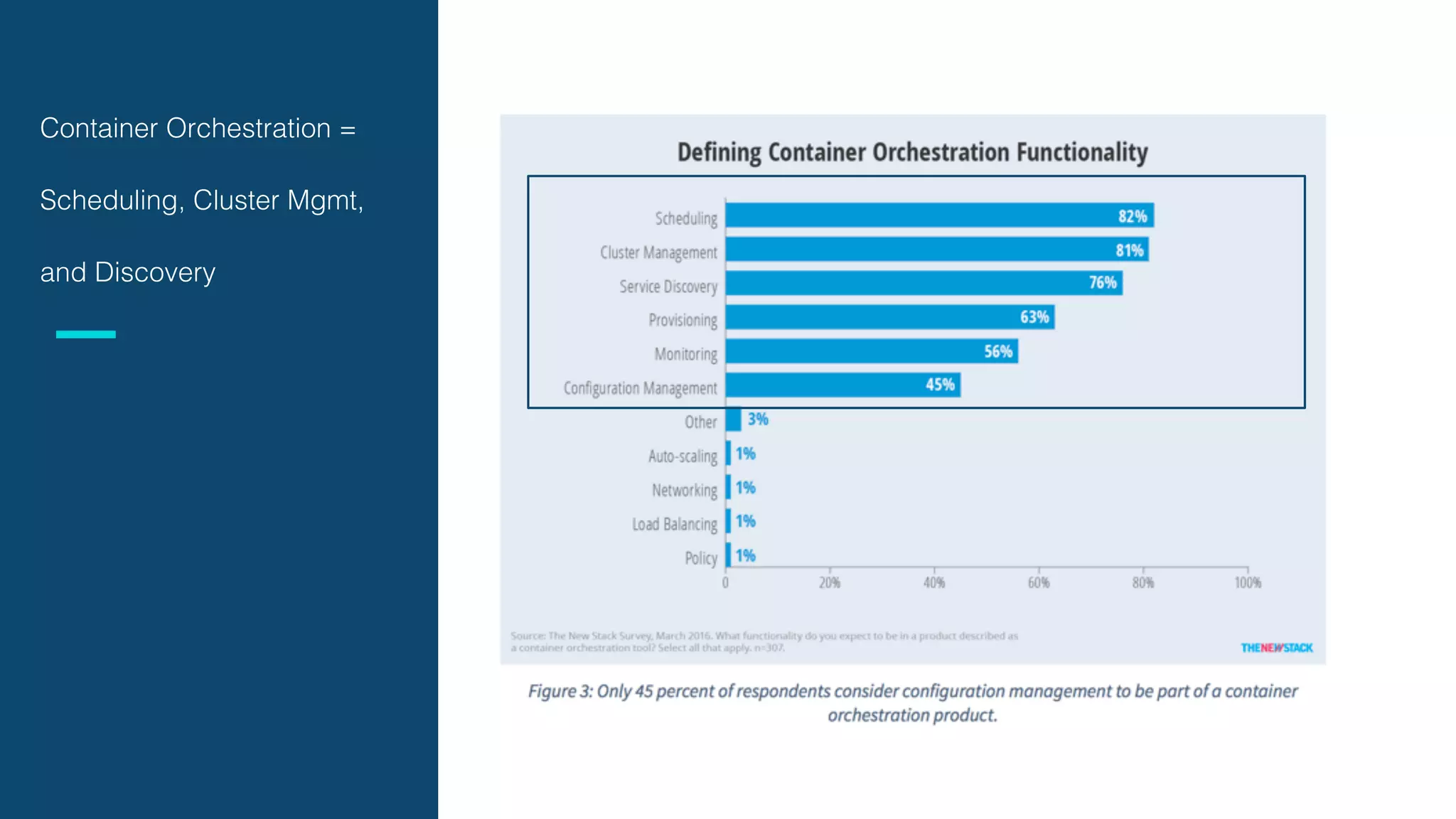
Container Orchestration = !
Scheduling, Cluster Mgmt, !
and Discovery!
Slide Title Goes Here
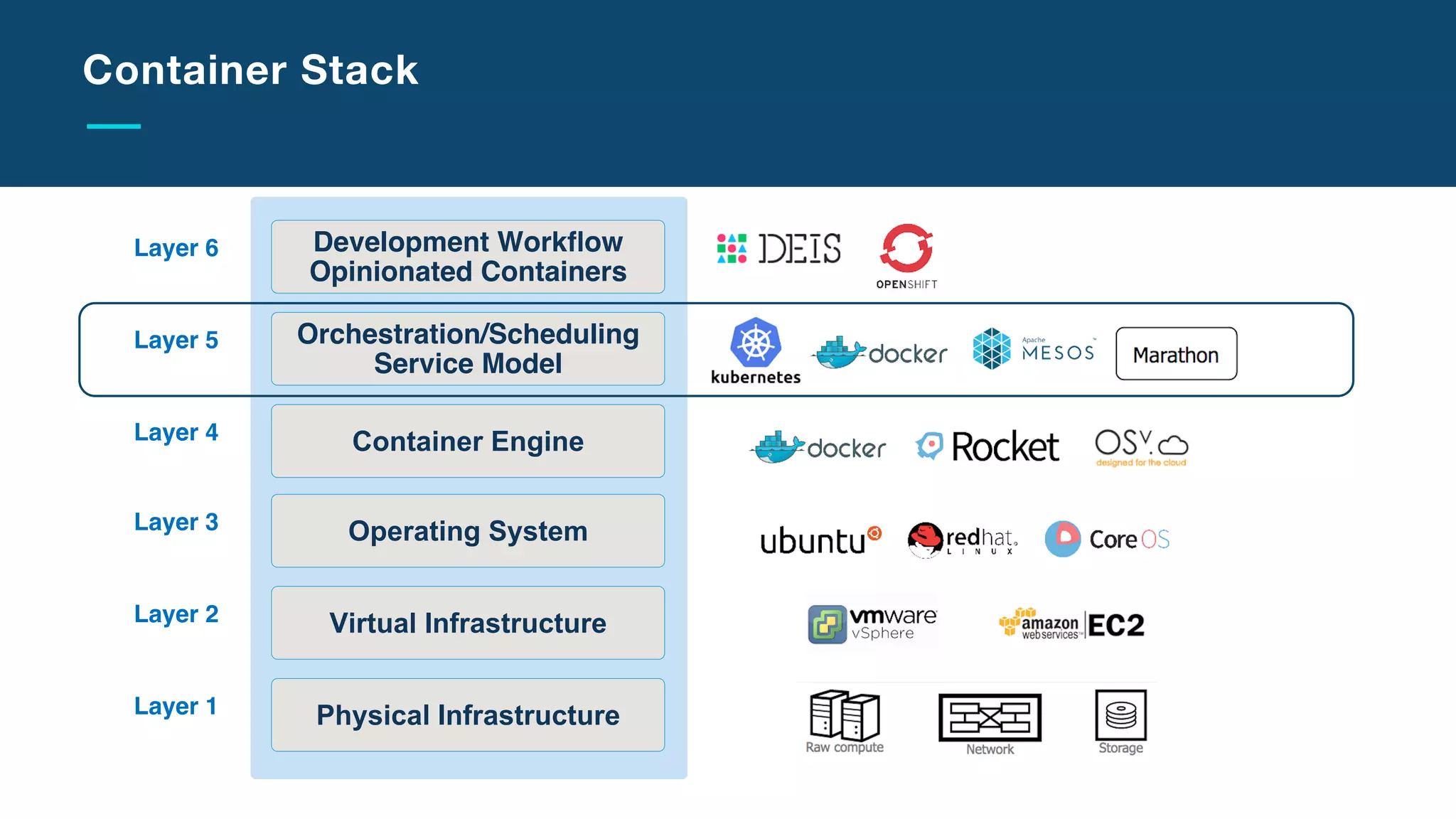
Container Stack
Physical InfrastructureLayer 1
Virtual InfrastructureLayer 2
Operating SystemLayer 3
Container EngineLayer 4
Orchestration/Scheduling
Service Model
Layer 5
Development Workflow
Opinionated Containers
Layer 6
Slide Title Goes Here
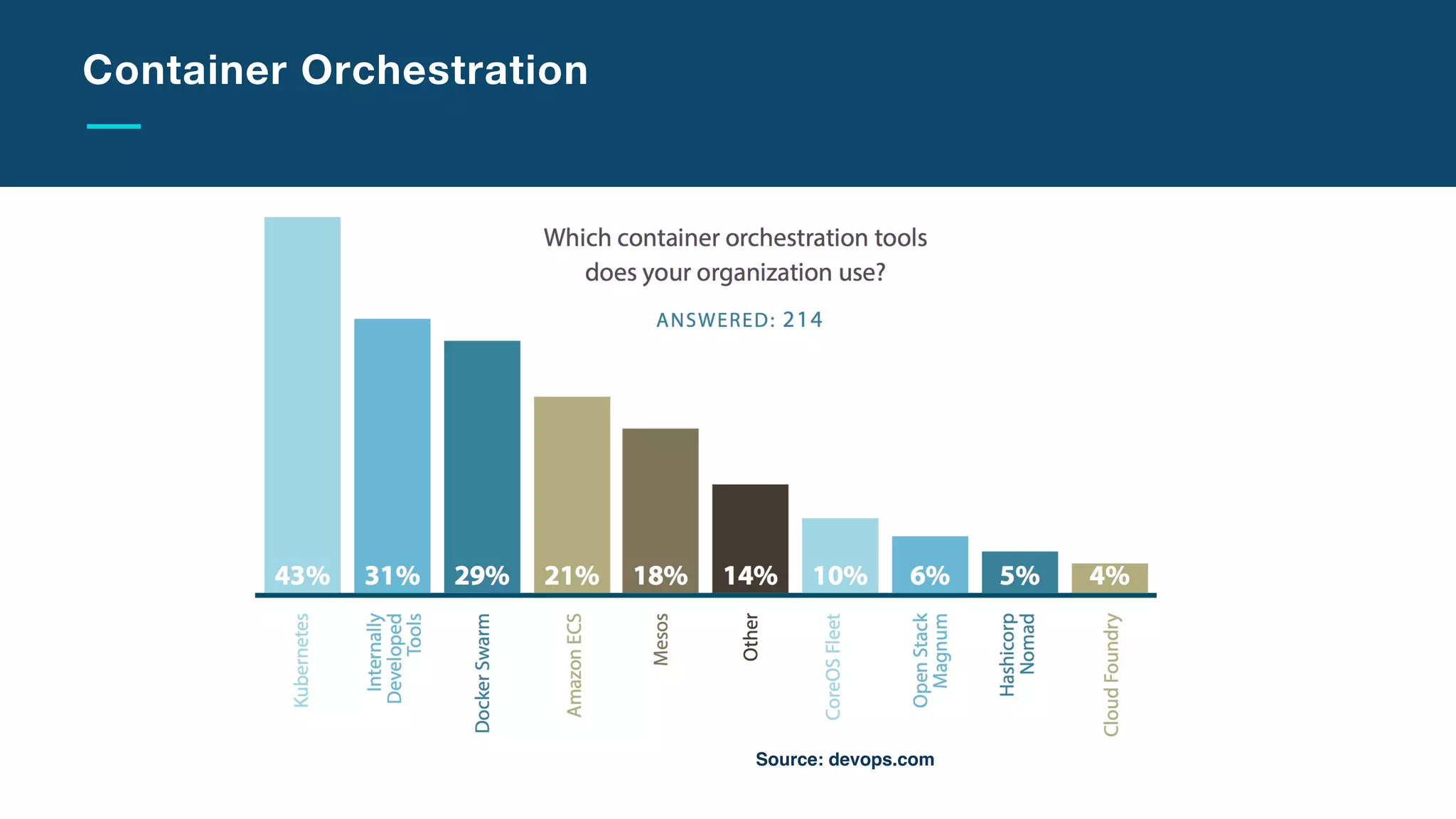
Container Orchestration
Source: devops.com
Kubernetes
Slide Title Goes Here
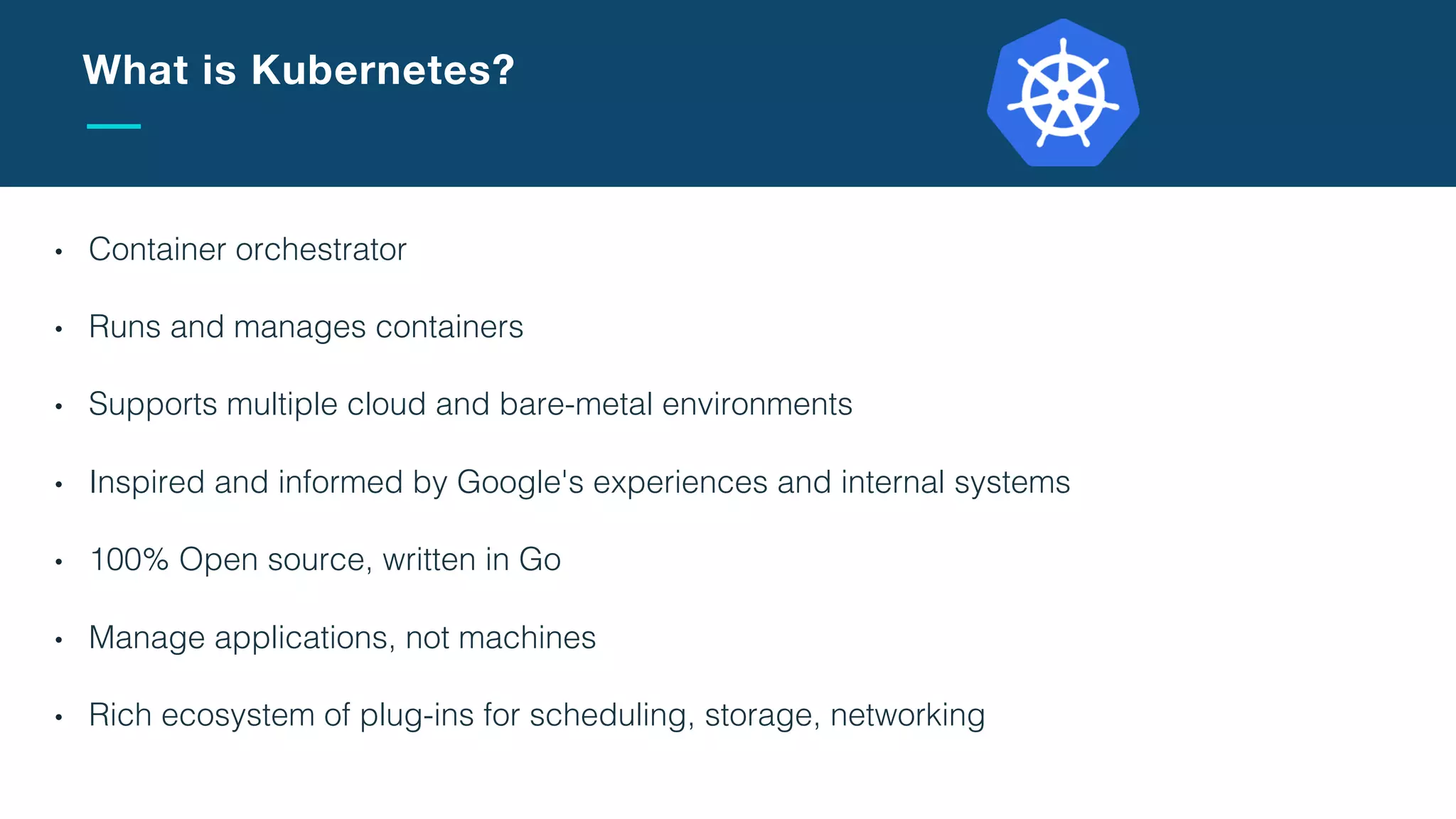
What is Kubernetes?
•  Container orchestrator!
•  Runs and manages containers!
•  Supports multiple cloud and bare-metal environments!
•  Inspired and informed by Google's experiences and internal systems!
•  100% Open source, written in Go!
•  Manage applications, not machines!
•  Rich ecosystem of plug-ins for scheduling, storage, networking!
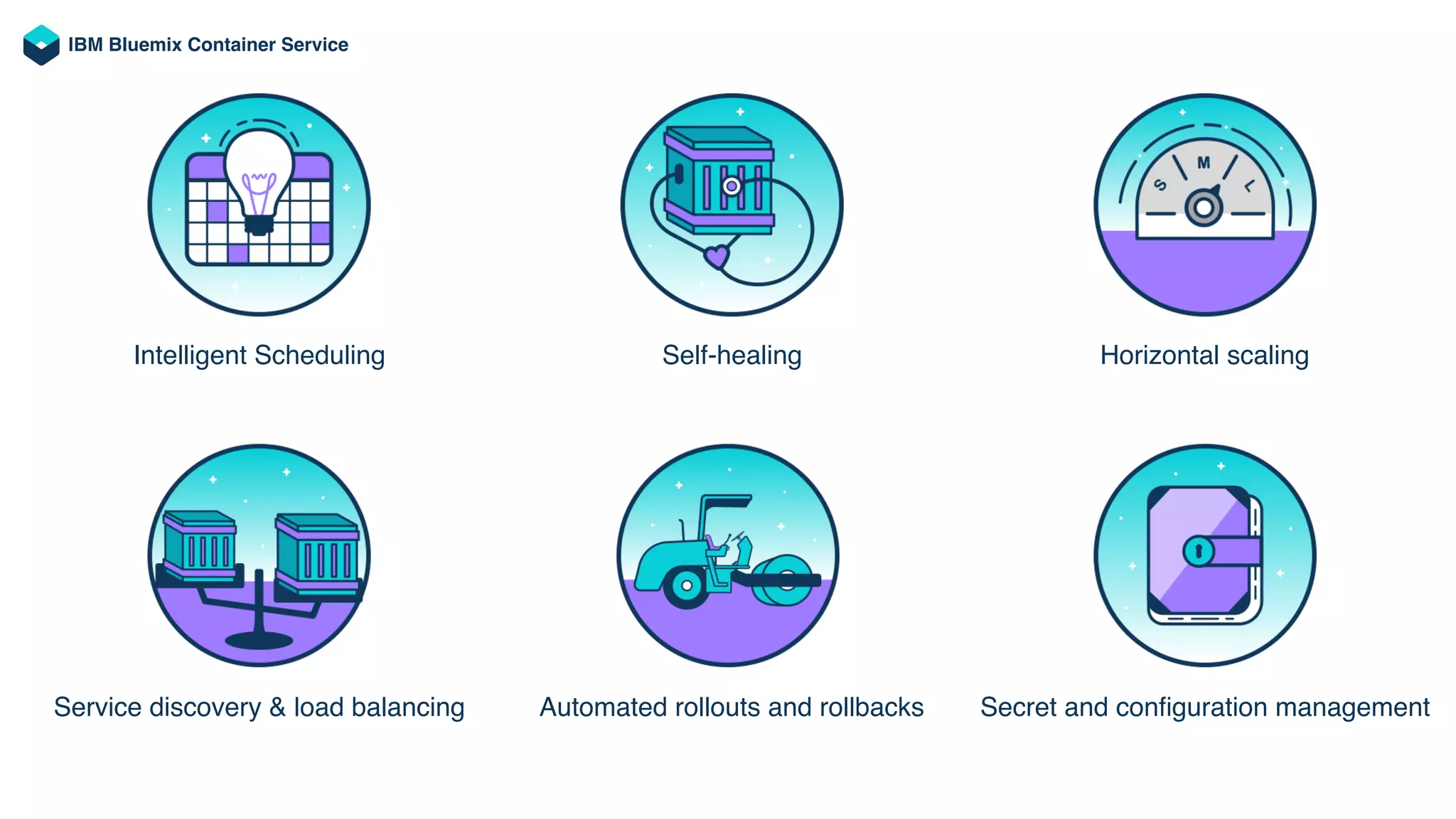
Intelligent Scheduling Self-healing Horizontal scaling
Service discovery & load balancing Automated rollouts and rollbacks Secret and configuration management
IBM Bluemix Container Service
Slide Title Goes Here
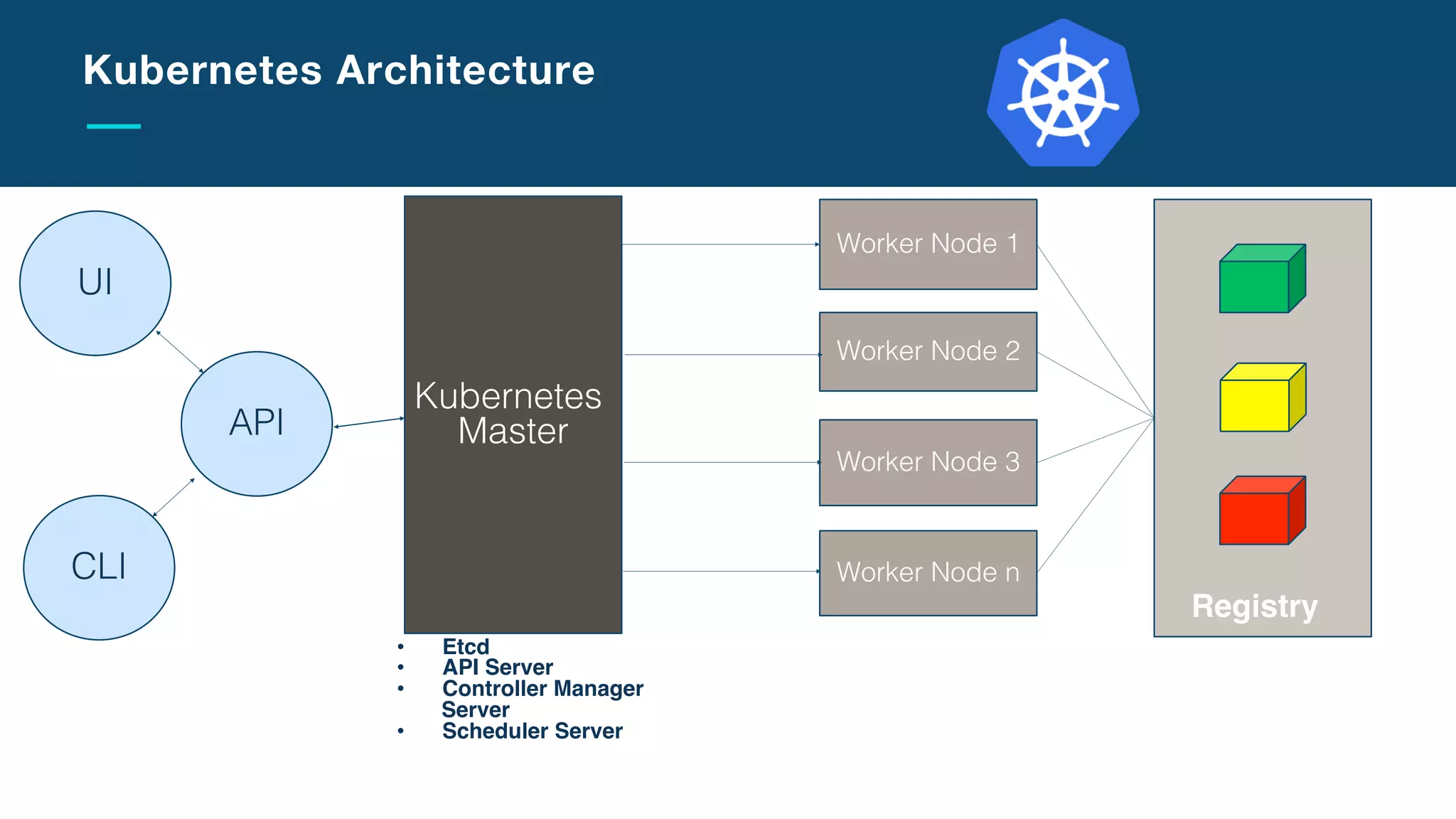
Kubernetes Architecture
API!
UI!
CLI!
Kubernetes
Master!
Worker Node 1!
Worker Node 2!
Worker Node 3!
Worker Node n!
Registry
•  Etcd
•  API Server
•  Controller Manager
Server
•  Scheduler Server
Slide Title Goes Here
Kubernetes Architecture
API!
UI!
CLI!
Kubernetes
Master!
Worker Node 1!
Worker Node 2!
Worker Node 3!
Worker Node n!
Registry
•  Etcd
•  API Server
•  Controller Manager
Server
•  Scheduler Server
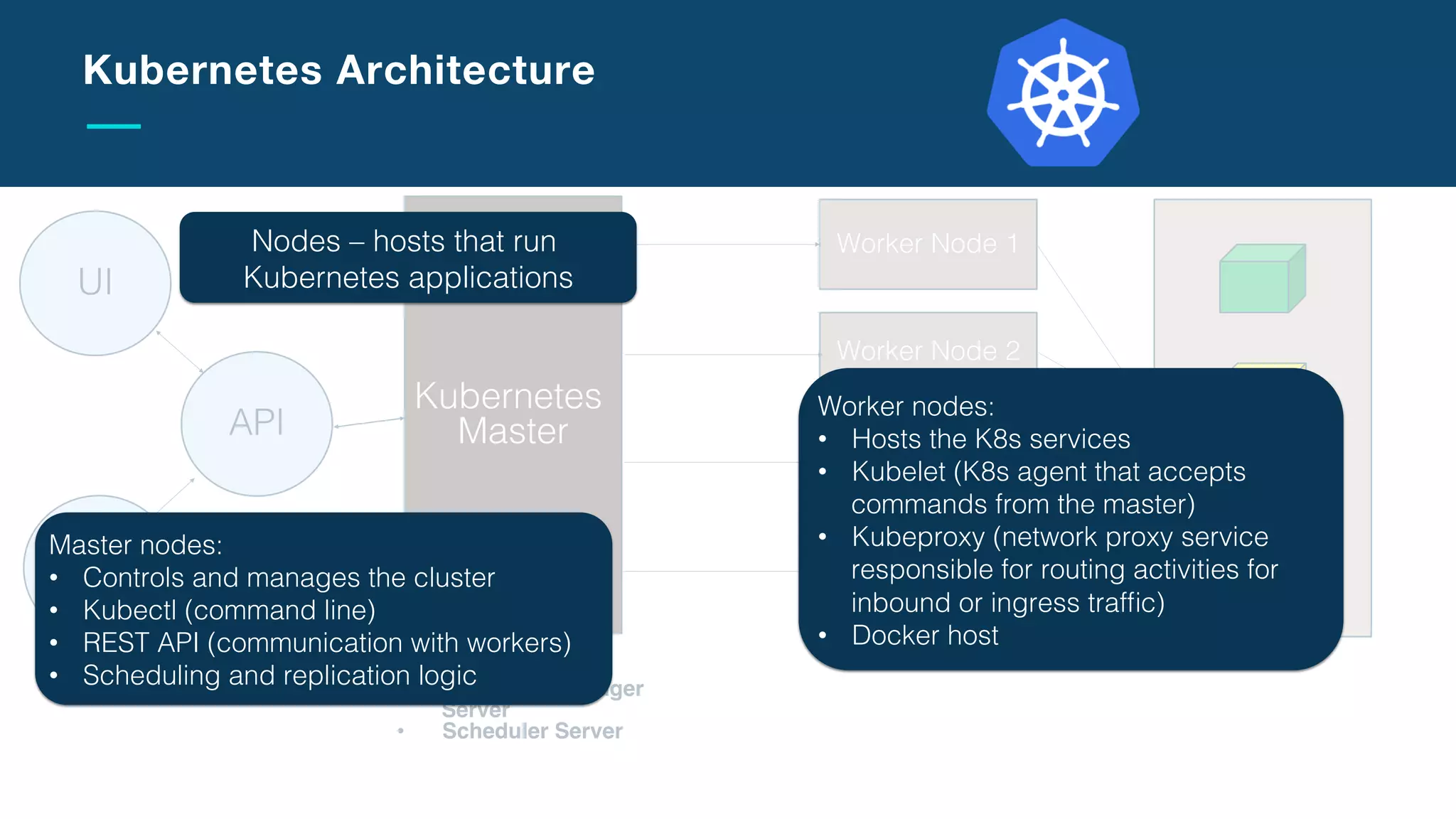
Nodes – hosts that run
Kubernetes applications!
Master nodes:
•  Controls and manages the cluster
•  Kubectl (command line)
•  REST API (communication with workers)
•  Scheduling and replication logic!
Worker nodes:
•  Hosts the K8s services
•  Kubelet (K8s agent that accepts
commands from the master)
•  Kubeproxy (network proxy service
responsible for routing activities for
inbound or ingress traffic)
•  Docker host!
Slide Title Goes Here
Kubernetes Architecture
API!
UI!
CLI!
Kubernetes
Master!
Worker Node 1!
Worker Node 2!
Worker Node 3!
Worker Node n!
Registry
•  Etcd
•  API Server
•  Controller Manager
Server
•  Scheduler Server
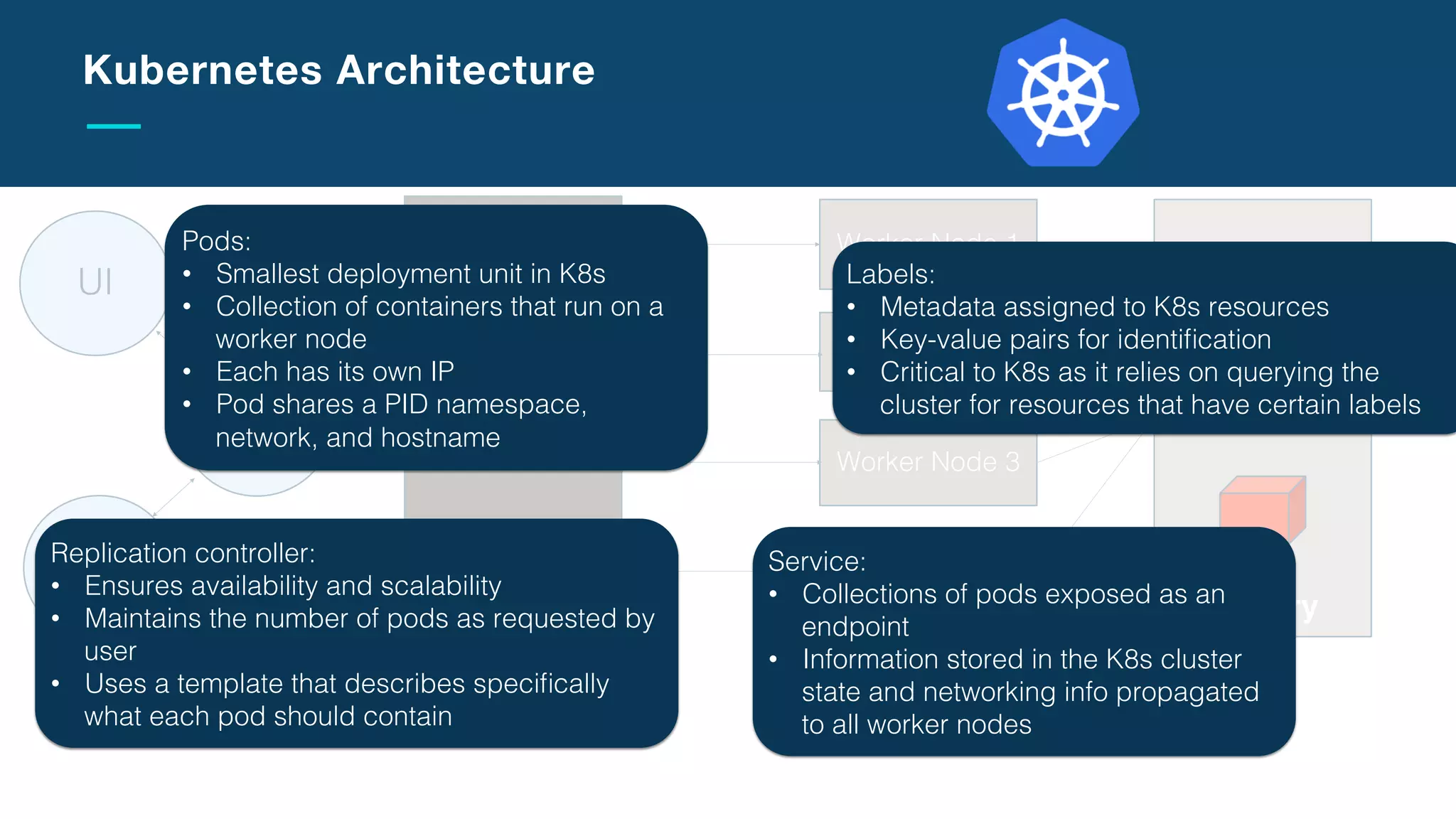
Pods:
•  Smallest deployment unit in K8s
•  Collection of containers that run on a
worker node
•  Each has its own IP
•  Pod shares a PID namespace,
network, and hostname!
Replication controller:
•  Ensures availability and scalability
•  Maintains the number of pods as requested by
user
•  Uses a template that describes specifically
what each pod should contain!
Labels:
•  Metadata assigned to K8s resources
•  Key-value pairs for identification
•  Critical to K8s as it relies on querying the
cluster for resources that have certain labels!
Service:
•  Collections of pods exposed as an
endpoint
•  Information stored in the K8s cluster
state and networking info propagated
to all worker nodes!
Slide Title Goes Here
IBM Bluemix Container Service
API!
UI!
CLI!
Kubernetes
Master!
Worker Node 1!
Worker Node 2!
Worker Node 3!
Worker Node n!
Registry
•  Etcd
•  API Server
•  Controller Manager
Server
•  Scheduler Server
•  Single tenant k8s master
•  Running in IBM managed account
•  Key managed to maintain account separation
•  Single tenant worker nodes
•  Dedicated nodes are single
tenant top to bottom (worker
nodes, hypervisor,
hardware)
•  No core or RAM over
subscription to ensure
allocated resources and
ensure no noisy neighbors
(
https://www.ibm.com/cloud-computing/bluemix/virtual-
servers)
Multi-tenant
services with per
tenant isolation!
Kubernetes
Developer
Journeys
Slide Title Goes Here
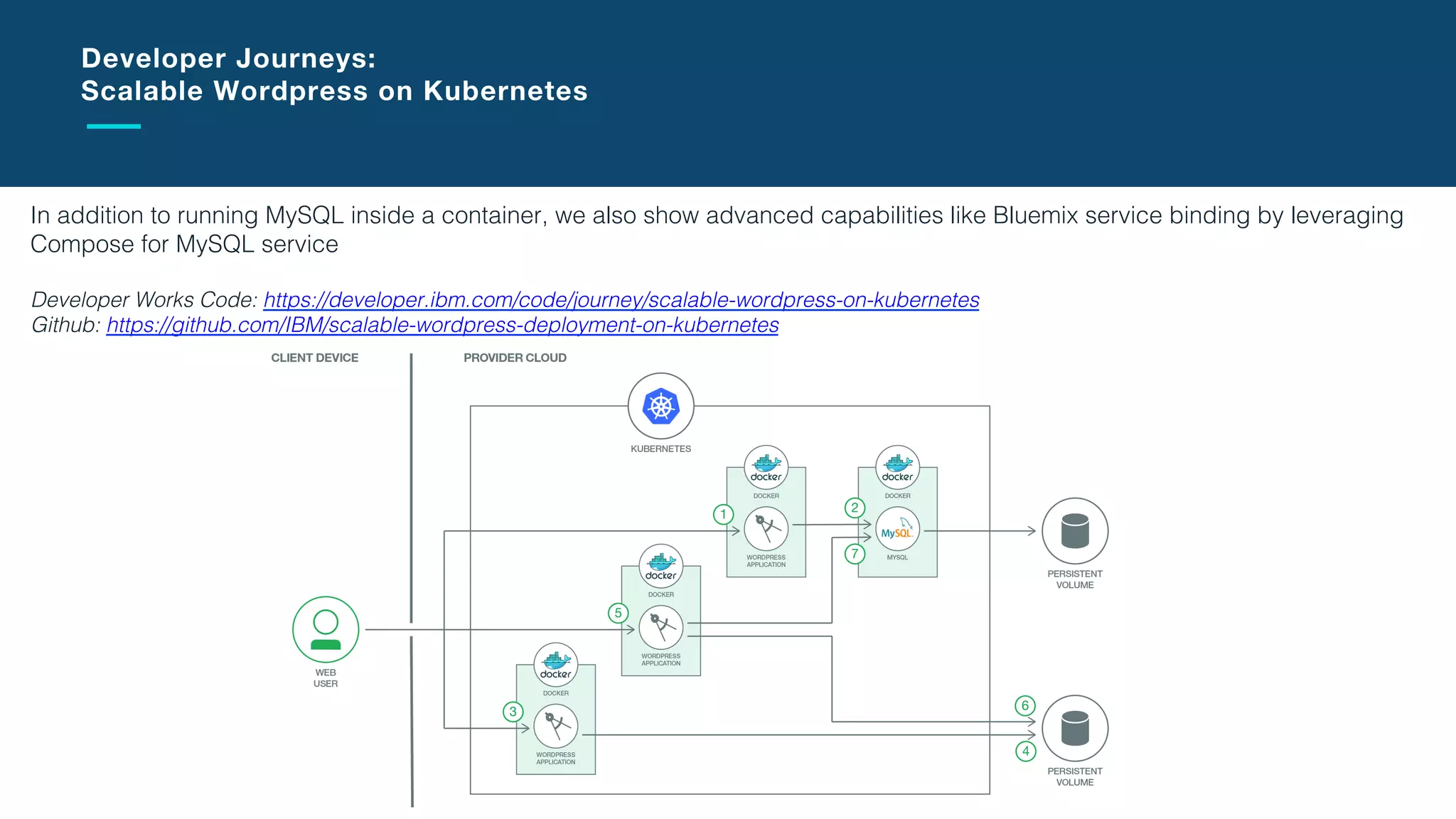
In addition to running MySQL inside a container, we also show advanced capabilities like Bluemix service binding by leveraging
Compose for MySQL service!
!
Developer Works Code: https://developer.ibm.com/code/journey/scalable-wordpress-on-kubernetes!
Github: https://github.com/IBM/scalable-wordpress-deployment-on-kubernetes"
Developer Journeys:
Scalable Wordpress on Kubernetes
Slide Title Goes Here
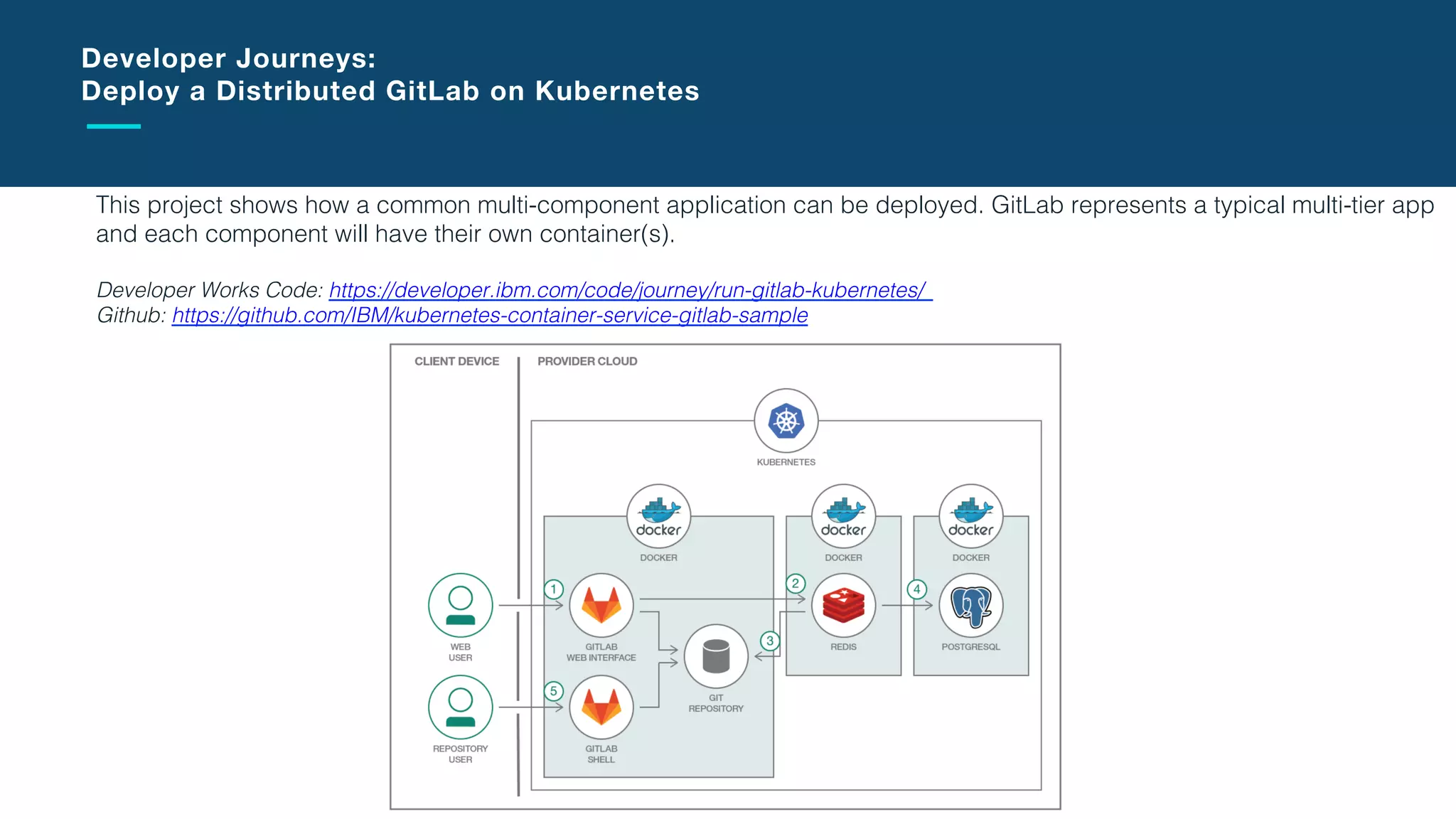
This project shows how a common multi-component application can be deployed. GitLab represents a typical multi-tier app
and each component will have their own container(s).!
!
Developer Works Code: https://developer.ibm.com/code/journey/run-gitlab-kubernetes/ "
Github: https://github.com/IBM/kubernetes-container-service-gitlab-sample"
Developer Journeys:
Deploy a Distributed GitLab on Kubernetes
Slide Title Goes Here
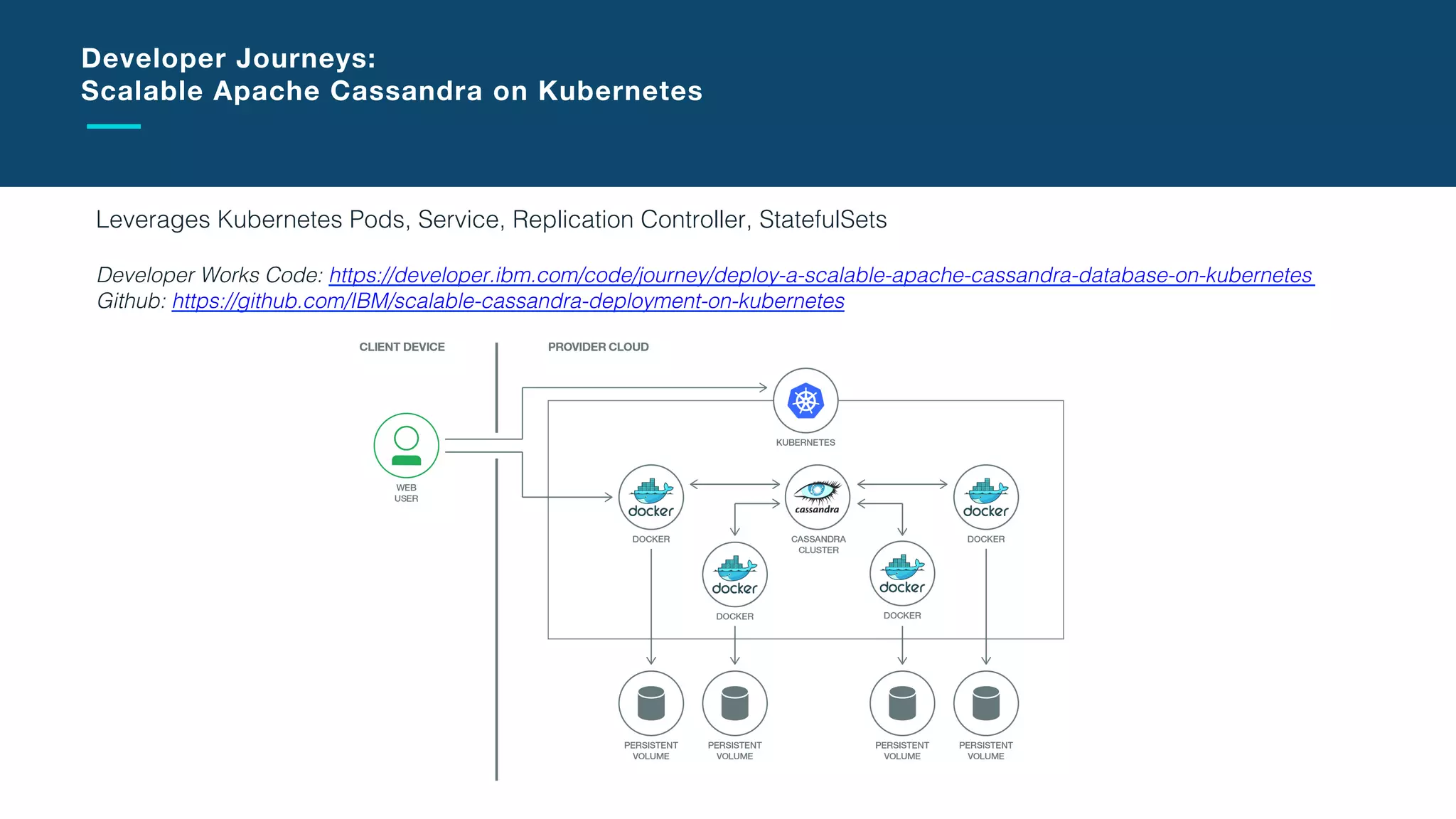
Leverages Kubernetes Pods, Service, Replication Controller, StatefulSets!
!
Developer Works Code: https://developer.ibm.com/code/journey/deploy-a-scalable-apache-cassandra-database-on-kubernetes"
Github: https://github.com/IBM/scalable-cassandra-deployment-on-kubernetes"
Developer Journeys:
Scalable Apache Cassandra on Kubernetes
Kubernetes &
Microservices


Developer Journeys
Slide Title Goes Here
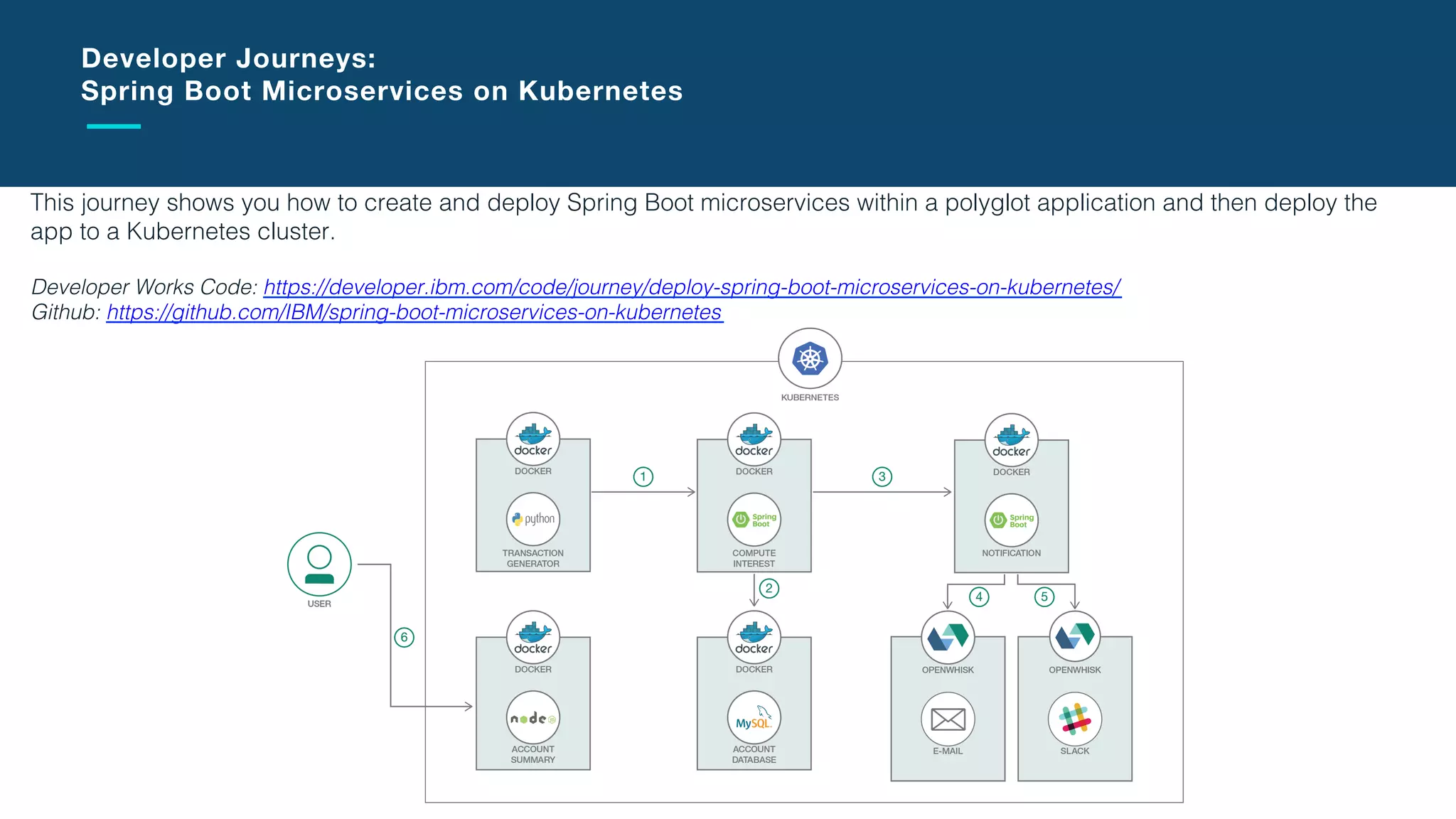
This journey shows you how to create and deploy Spring Boot microservices within a polyglot application and then deploy the
app to a Kubernetes cluster.!
!
Developer Works Code: https://developer.ibm.com/code/journey/deploy-spring-boot-microservices-on-kubernetes/"
Github: https://github.com/IBM/spring-boot-microservices-on-kubernetes"
"
Developer Journeys:
Spring Boot Microservices on Kubernetes
Slide Title Goes Here
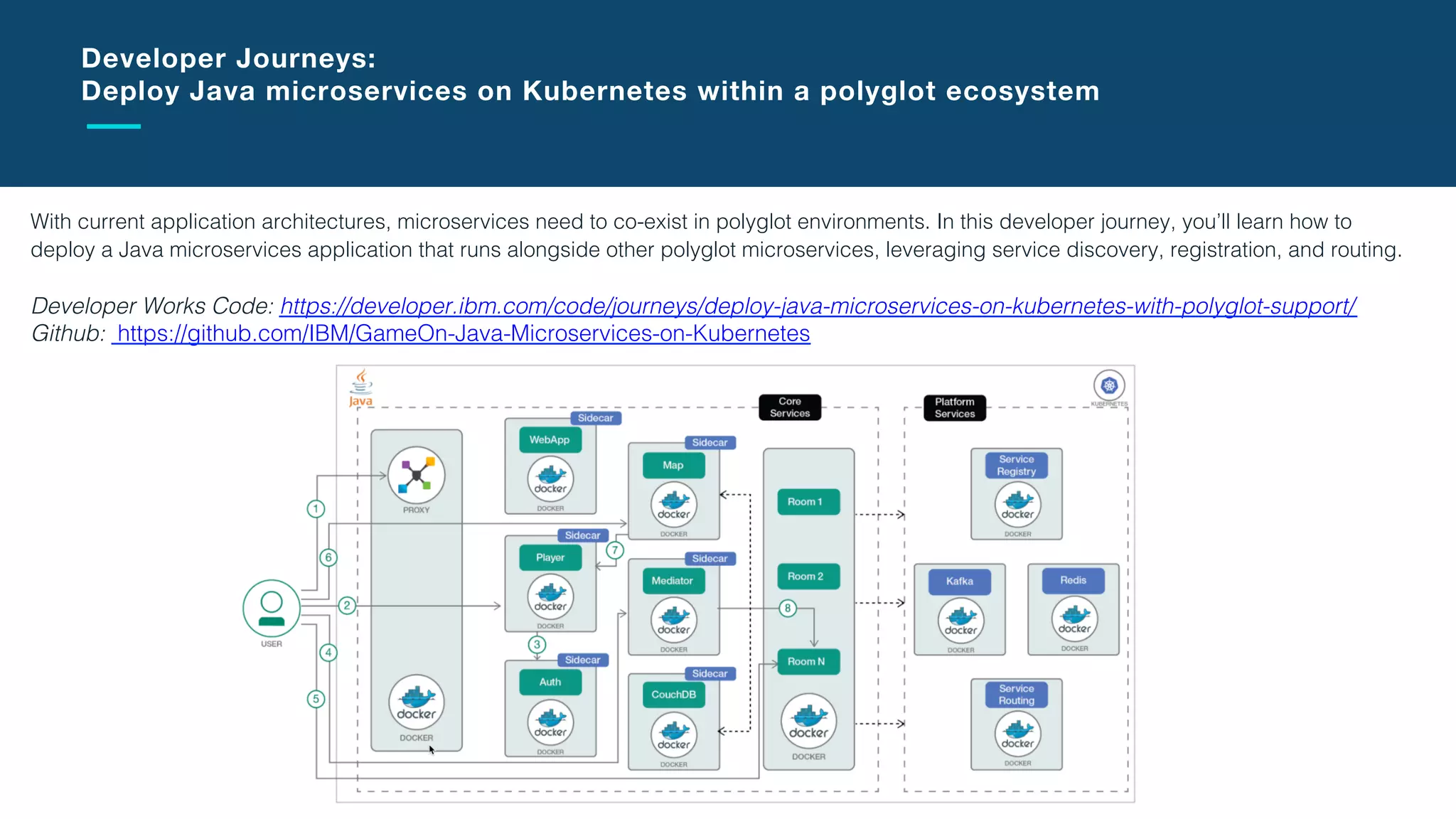
With current application architectures, microservices need to co-exist in polyglot environments. In this developer journey, you’ll learn how to
deploy a Java microservices application that runs alongside other polyglot microservices, leveraging service discovery, registration, and routing.!
!
Developer Works Code: https://developer.ibm.com/code/journeys/deploy-java-microservices-on-kubernetes-with-polyglot-support/ "
Github:  https://github.com/IBM/GameOn-Java-Microservices-on-Kubernetes!
Developer Journeys:
Deploy Java microservices on Kubernetes within a polyglot ecosystem
Slide Title Goes Here
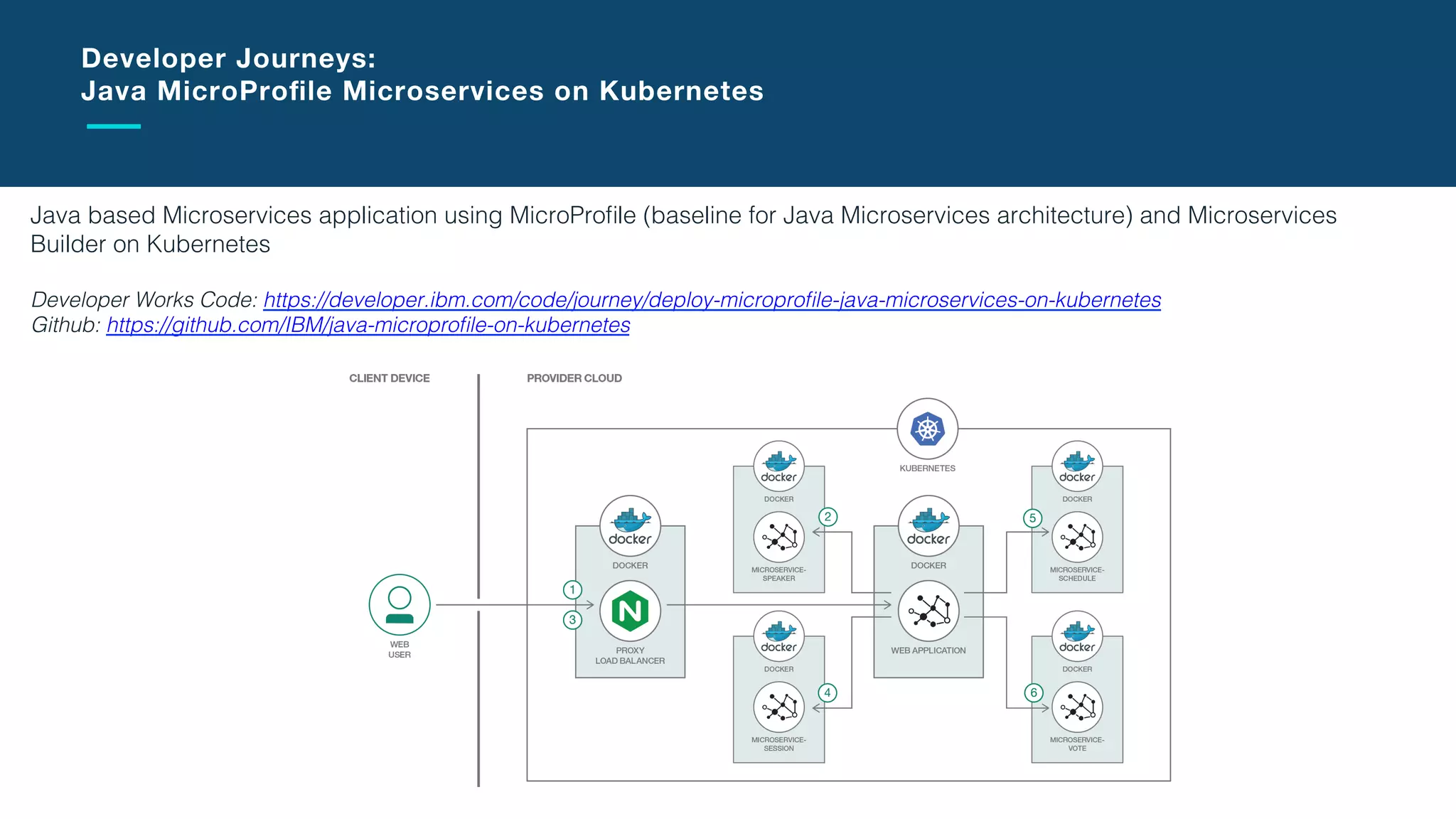
Java based Microservices application using MicroProfile (baseline for Java Microservices architecture) and Microservices
Builder on Kubernetes!
!
Developer Works Code: https://developer.ibm.com/code/journey/deploy-microprofile-java-microservices-on-kubernetes!
Github: https://github.com/IBM/java-microprofile-on-kubernetes"
Developer Journeys:
Java MicroProfile Microservices on Kubernetes
Slide Title Goes Here
Java based Microservices application using MicroProfile (baseline for Java Microservices architecture) and Microservices
Builder on Kubernetes!
!
Developer Works Code: https://developer.ibm.com/code/journey/deploy-microprofile-java-microservices-on-kubernetes!
Github: https://github.com/IBM/java-microprofile-on-kubernetes"
Developer Journeys:
Java MicroProfile Microservices on Kubernetes
DEMO
Kubernetes is great for
Microservices…
Why do we need a Service
mesh and what is it?
Container Orchestration = !
Scheduling, Cluster Mgmt, !
and Discovery!
What else do we need for"
Microservices?
●  Visibility!
●  Resiliency & Efficiency!
●  Traffic Control!
●  Security!
●  Policy Enforcement!
!
Enter Service Mesh"
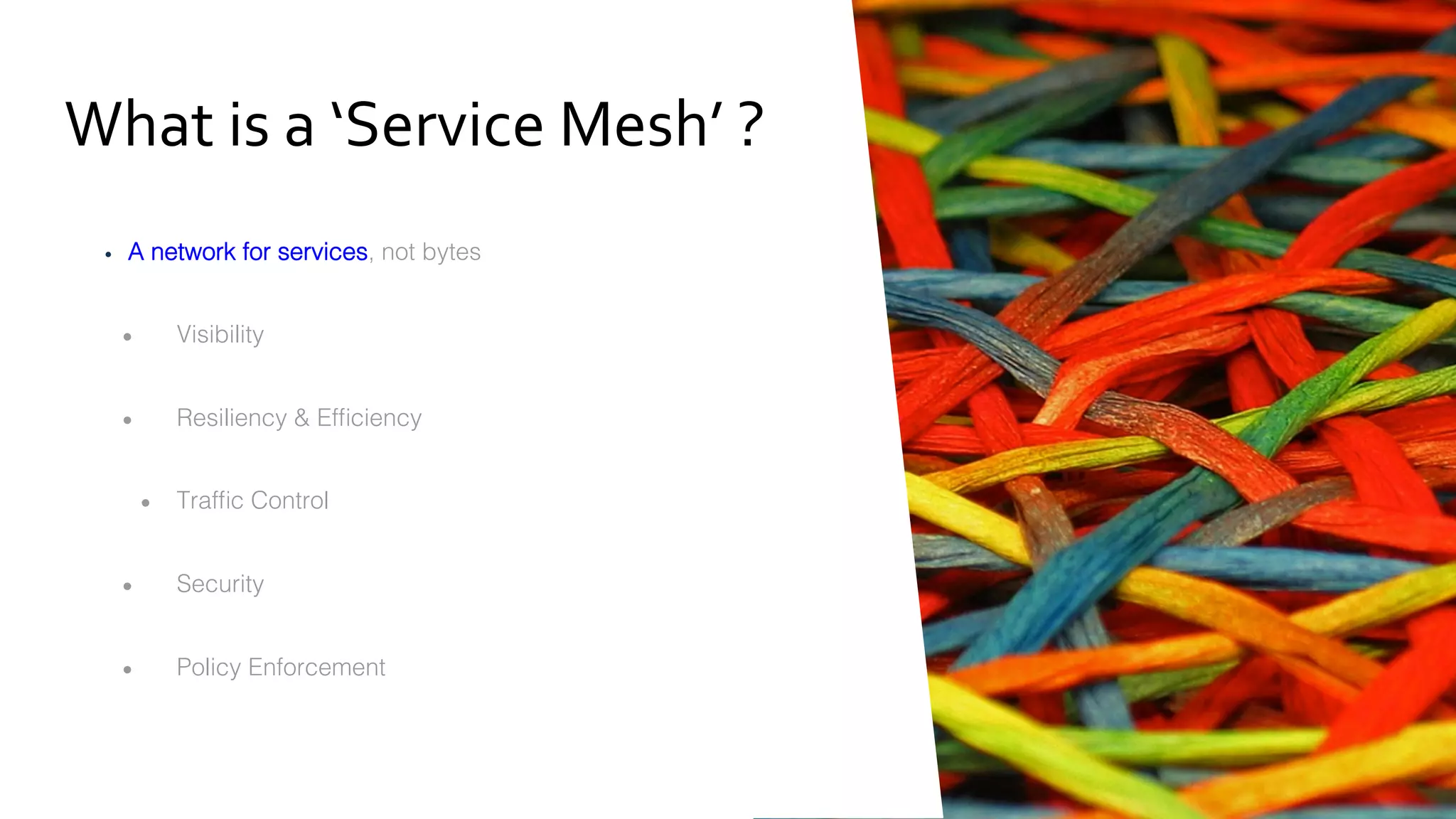
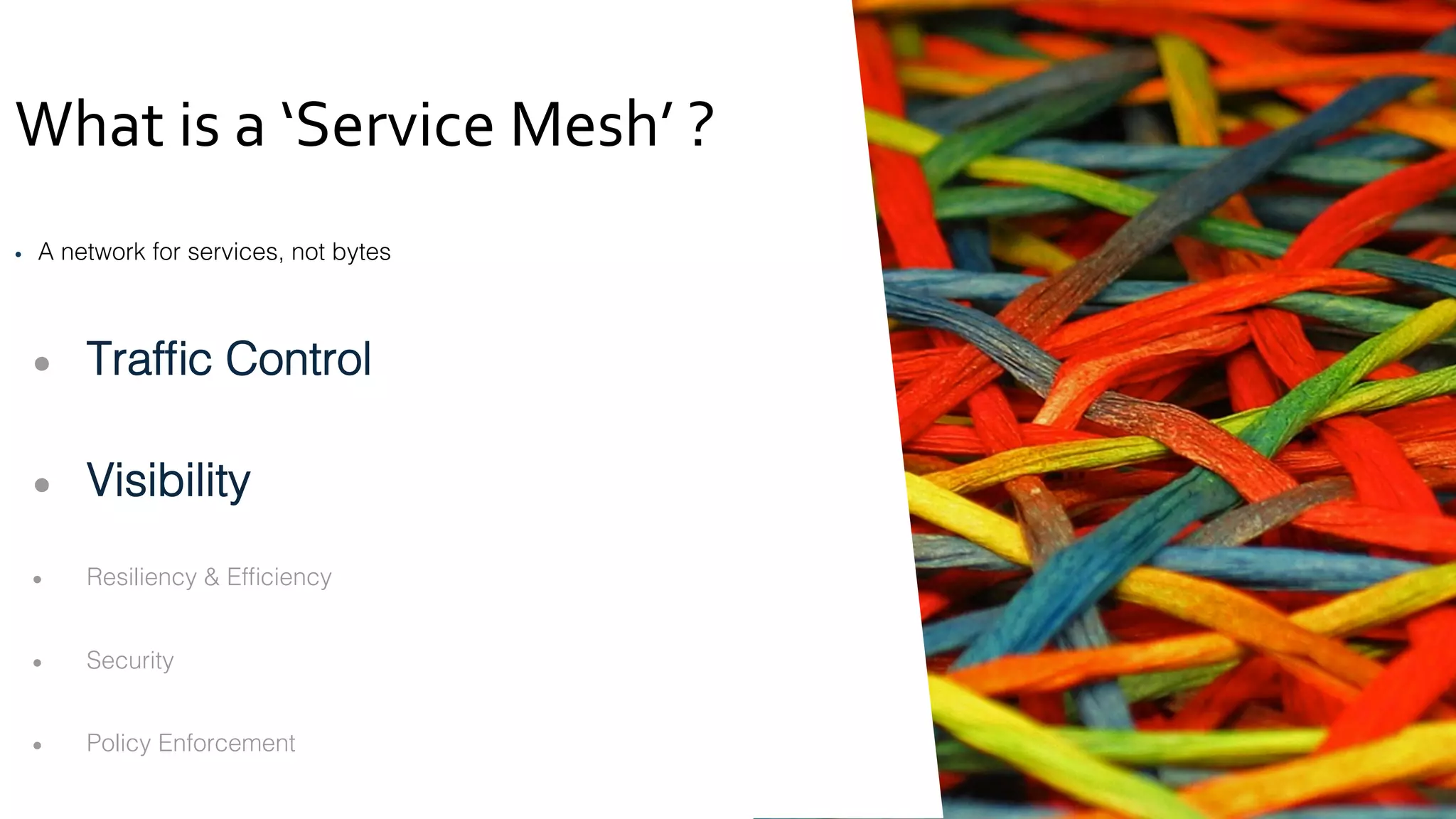
What is a ‘Service Mesh’ ?
•  A network for services, not bytes!
●  Visibility!
●  Resiliency & Efficiency!
●  Traffic Control!
●  Security!
●  Policy Enforcement!
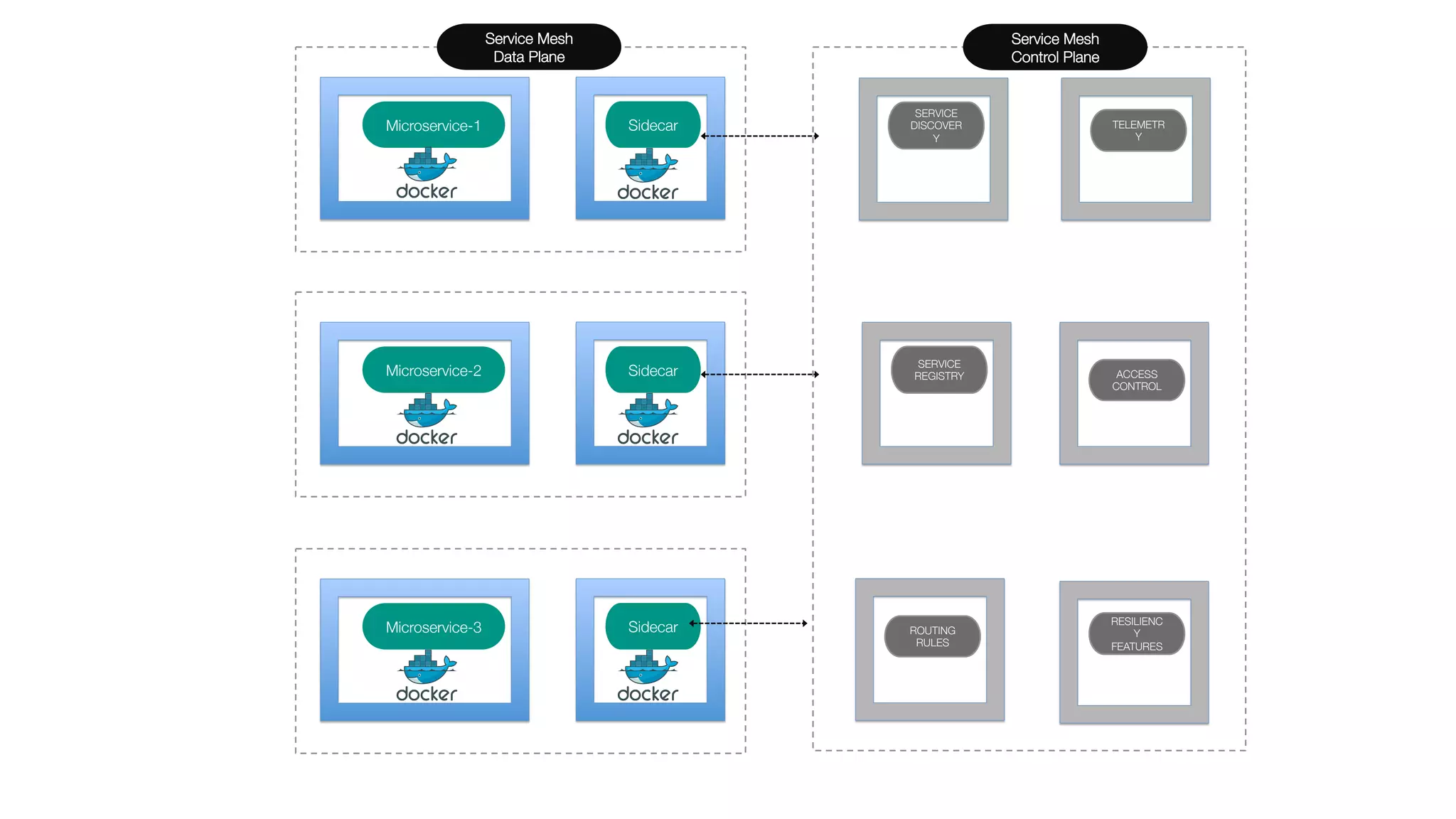
Microservice-1
 Sidecar
SERVICE
DISCOVER
Y
Service Mesh
Control Plane
SERVICE
REGISTRY
Microservice-2
 Sidecar
Microservice-3
 Sidecar
 ROUTING
RULES
TELEMETR
Y
ACCESS
CONTROL
RESILIENC
Y
FEATURES
Service Mesh
Data Plane
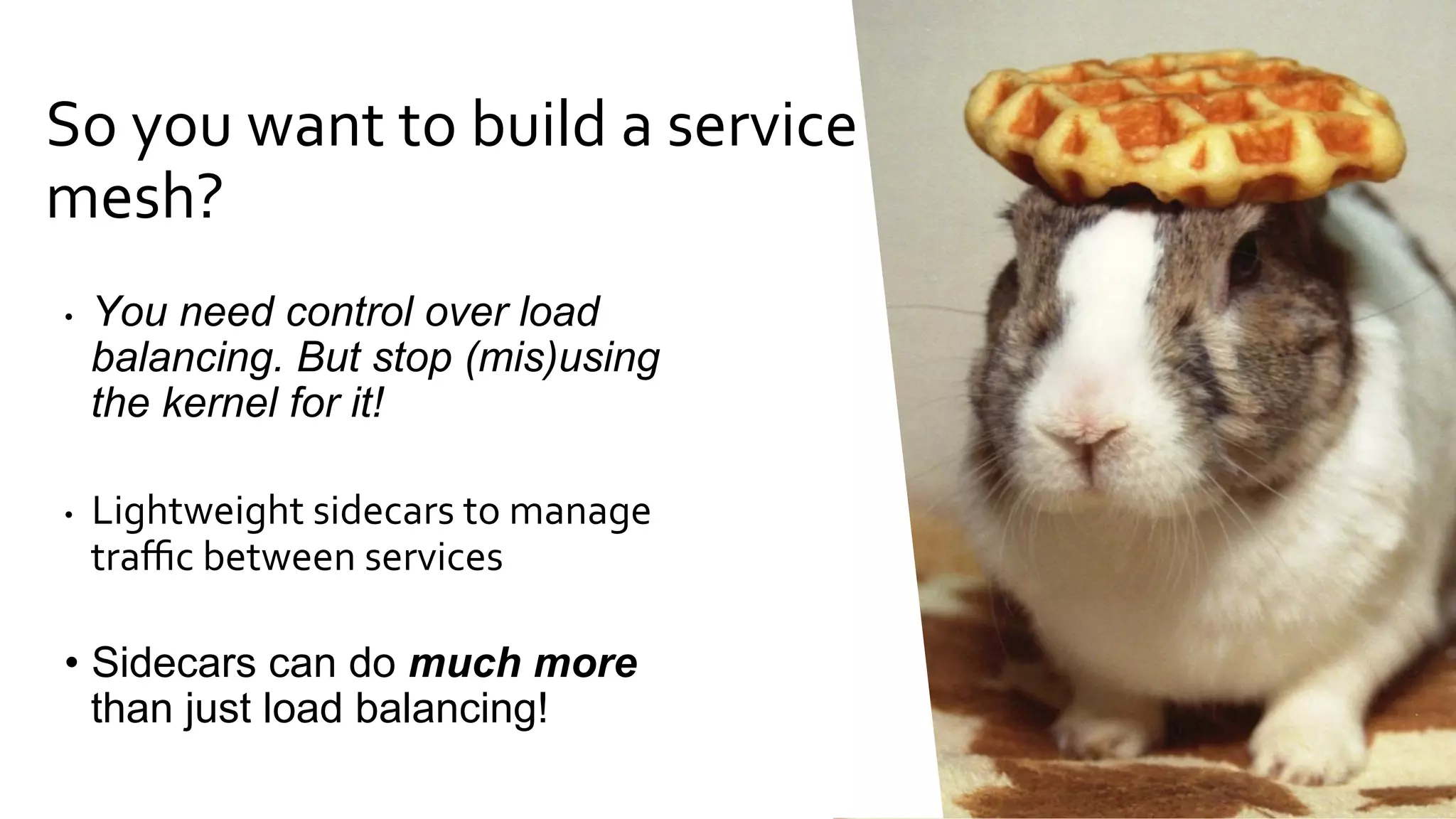
•  Lightweight sidecars "
to manage traffic "
between services"

•  Sidecars can do
much more
than just load
balancing!
How to build a
‘Service Mesh’ ?
Istio
Istio!
Concepts!
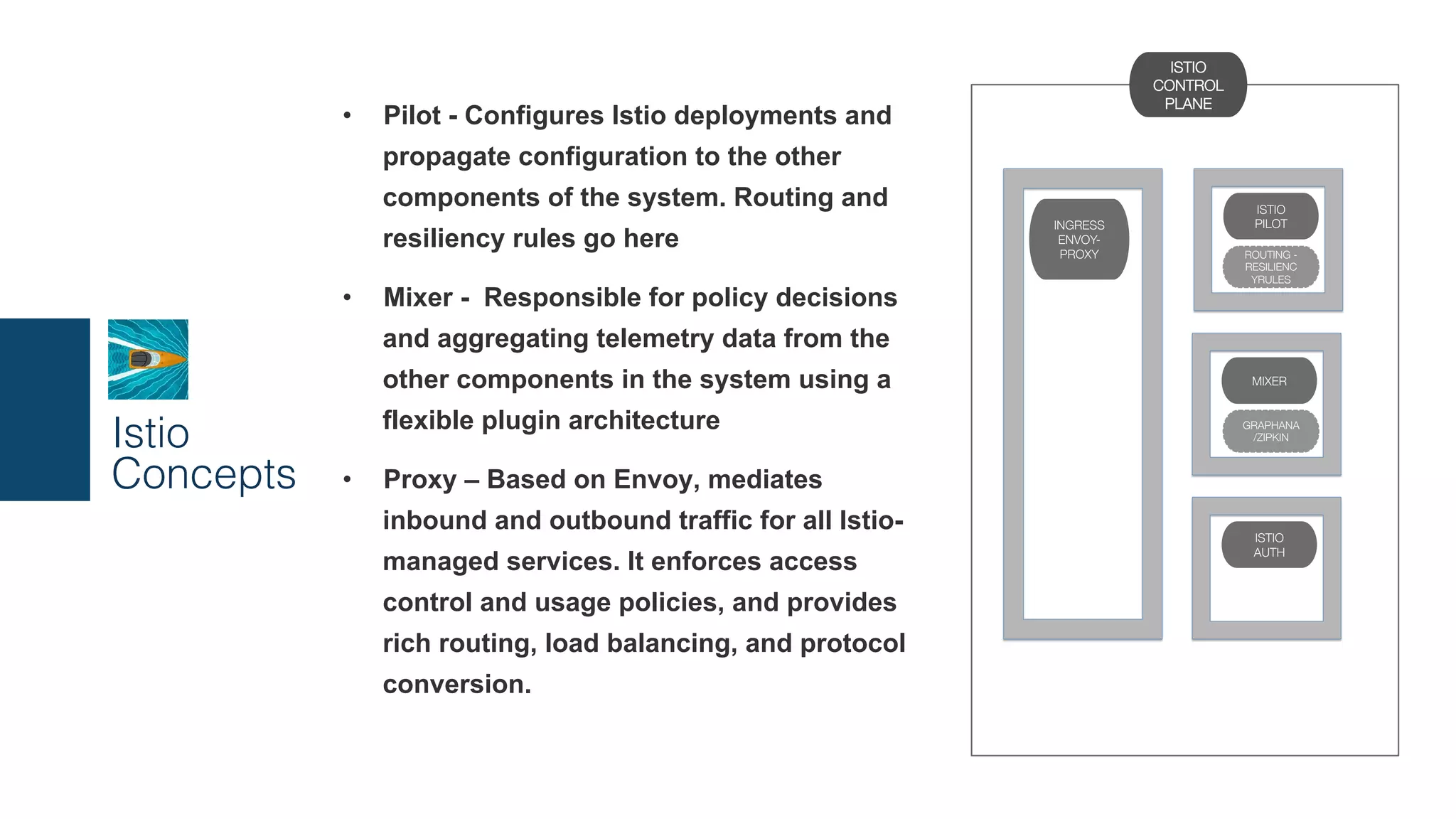
•  Pilot - Configures Istio deployments
and propagate configuration to the
other components of the system.
Routing and resiliency rules go here
•  Mixer - Responsible for policy
decisions and aggregating telemetry
data from the other components in the
system using a flexible plugin
architecture
•  Proxy – Based on Envoy, mediates
inbound and outbound traffic for all
Istio-managed services. It enforces
access control and usage policies, and
provides rich routing, load balancing,
and protocol conversion.
ENVOY
MIXER
ISTIO
PILOT
ISTIO
AUTH
ISTIO
CONTROL
PLANE
ROUTING
RULES
GRAPHANA
/ZIPKIN
MICROSERVICE
ENVOY
MICROSERVICE
ENVOY
MICROSERVICE
ENVOY
MICROSERVICE
ENVOY
ISTIO 
DATA
PLANE
Istio!
Concepts!
ENVOY
BOOK
PAGE
REVIEWS-V1
ENVOY
ENVOY
REVIEWS-V2
ENVOY
REVIEWS-V3
ENVOY
RATINGS

ENVOY
r
MIXER
ISTIO
PILOT
ISTIO
AUTH
ISTIO
CONTROL
PLANE
50%
50%
USER
DETAILS

ENVOY
r
ROUTING
RULES
GRAPHANA
/ZIPKIN
ISTIO 
DATA
PLANE
SAMPLE BOOKINFO APP
Istio
Architecture
appA
Proxy
Pod
Proxy
Istio ingress
Controller
Service A
appB
Proxy
Service B
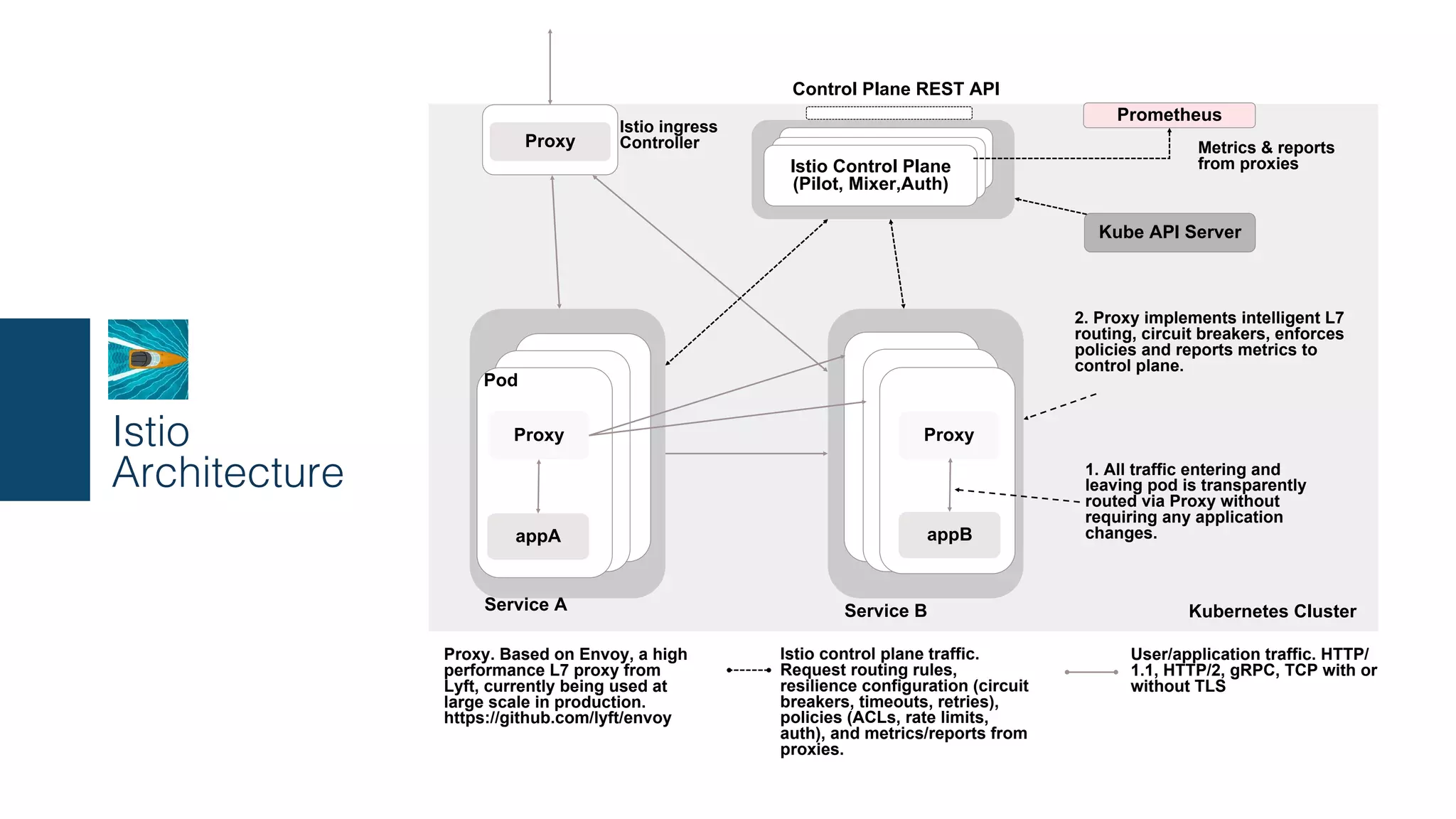
1. All traffic entering and
leaving pod is transparently
routed via Proxy without
requiring any application
changes.
Kube API Server
User/application traffic. HTTP/
1.1, HTTP/2, gRPC, TCP with or
without TLS
Istio control plane traffic.
Request routing rules,
resilience configuration (circuit
breakers, timeouts, retries),
policies (ACLs, rate limits,
auth), and metrics/reports from
proxies.
Prometheus
Metrics & reports
from proxiesIstio Control Plane
Istio Control PlaneIstio Control Plane
(Pilot, Mixer,Auth)
Control Plane REST API
Kubernetes Cluster
Proxy. Based on Envoy, a high
performance L7 proxy from
Lyft, currently being used at
large scale in production.
https://github.com/lyft/envoy
2. Proxy implements intelligent L7
routing, circuit breakers, enforces
policies and reports metrics to
control plane.
Kubernetes,
Microservices

and Istio
Developer Journeys
What is a ‘Service Mesh’ ?
A network for services, not bytes!
"  Resiliency & Efficiency
●  Traffic Control!
●  Visibility!
●  Security!
●  Policy Enforcement!
•  Istio	adds	fault	tolerance	to	your	application	
without	any	changes	to	code	
•  Resilience	features	
❖  Timeouts
❖  Retries with timeout budget
❖  Circuit breakers
❖  Health checks
❖  AZ-aware load balancing w/
automatic failover
❖  Control connection pool size and
request load
❖  Systematic fault injection
•  //	Circuit	breakers	
•  destination:	serviceB.example.cluster.local	
policy:	
-	tags:	
				version:	v1	
		circuitBreaker:	
				simpleCb:	
						maxConnections:	100	
						httpMaxRequests:	1000	
						httpMaxRequestsPerConnection:	10	
						httpConsecutiveErrors:	7	
						sleepWindow:	15m	
						httpDetectionInterval:	5m	
	
Resiliency
•  Systematic fault injection to identify weaknesses in failure recovery policies
–  HTTP/gRPC error codes 
–  Delay injection
svcA
Envoy
Service
A
svcB
Envoy
Service
B
svcC
Envoy
Service
C
Timeout: 100ms
Retries: 3
300ms
Timeout: 200ms
Retries: 2
400ms
Resiliency Testing
Slide	Title	Goes	Here	
Twelve-factor apps make a strong case for designing and implementing your microservices for failure. What that means is with the
proliferation of microservices, failure is inevitable, and applications should be fault-tolerant. Istio, a service mesh, can help make your
microservices resilient without changing application code.!
!
Developer Works Code: https://developer.ibm.com/code/journey/make-java-microservices-resilient-with-istio/"
Github: https://github.com/IBM/resilient-java-microservices-with-istio"
Developer	Journey:	
Leverage	Is3o	to	create	resilient	and	fault	tolerant	Microservices
Resilient Microservices with Istio
speaker
ENVOY
session
ENVOY
schedule
ENVOY
vote
web-application
ENVOY
ENVOY
MIXER
ISTIO
PILOT
ISTIO
AUTH
ISTIO
CONTROL
PLANE
ISTIO 
DATA
PLANE
1
2
3
5
RESILIENC
Y & FAULT
TOLERANC
E RULES
ENVOY
ENVOY
"
Load
Balancing 
Pool

NOT 
RSPONDING"
- CIRCUIT
BREAK

4
3
5
4
DELAYED 
RESPONSE
- TIME OUT
MAX 

CONNECTIONS
- CIRCUIT
BREAK
ENVOY
MS-A	Is2o	Ingress	 Envoy	
User	Input	
Envoy	Is2o	Pilot	
Circuit	Breaker	
(	X	Max	Conn,	
	Y	Max	Pending)	
Administrator	
Set	Des2na2on	Policy	
N	requests	 N	requests	
Reached	maximum	connec2ons	–		
put	the	incoming	requests	in	pending	state	
Reached	maximum	pending	
requests	-	eject	all	the	incoming	
requests.	
MS-B
MS-A	Envoy	
MS-B	Pod	2	
(Broken)	
Is2o	Pilot	
Circuit	Breaker	Administrator	
Set	Des2na2on	Policy	 503	
Load	Balancing	Pool	for	MS-B	
MS-B	Pod	1	
(Working)	
Eject	X	minutes	
1 2 3
MS-B	Envoy	MS-B	Envoy	
Is2o	Ingress	
User	Input	
N	requests	 N	requests
MS-B	Pod	
Is2o	Pilot	
Timeout	
X	seconds	delay	
Fault	Injec2on	
504	error	
Administrator	
Set	Route	Rule	
MS-A	Envoy	
MS-B	Envoy	
Is2o	Ingress	 N	requests	
User	Input	
N	requests
What is a ‘Service Mesh’ ?
A	network	for	services,	not	bytes	
●  Resiliency	&	Efficiency	
●  Traffic	Control	
●  Visibility	
●  Security	
●  Policy	Enforcement
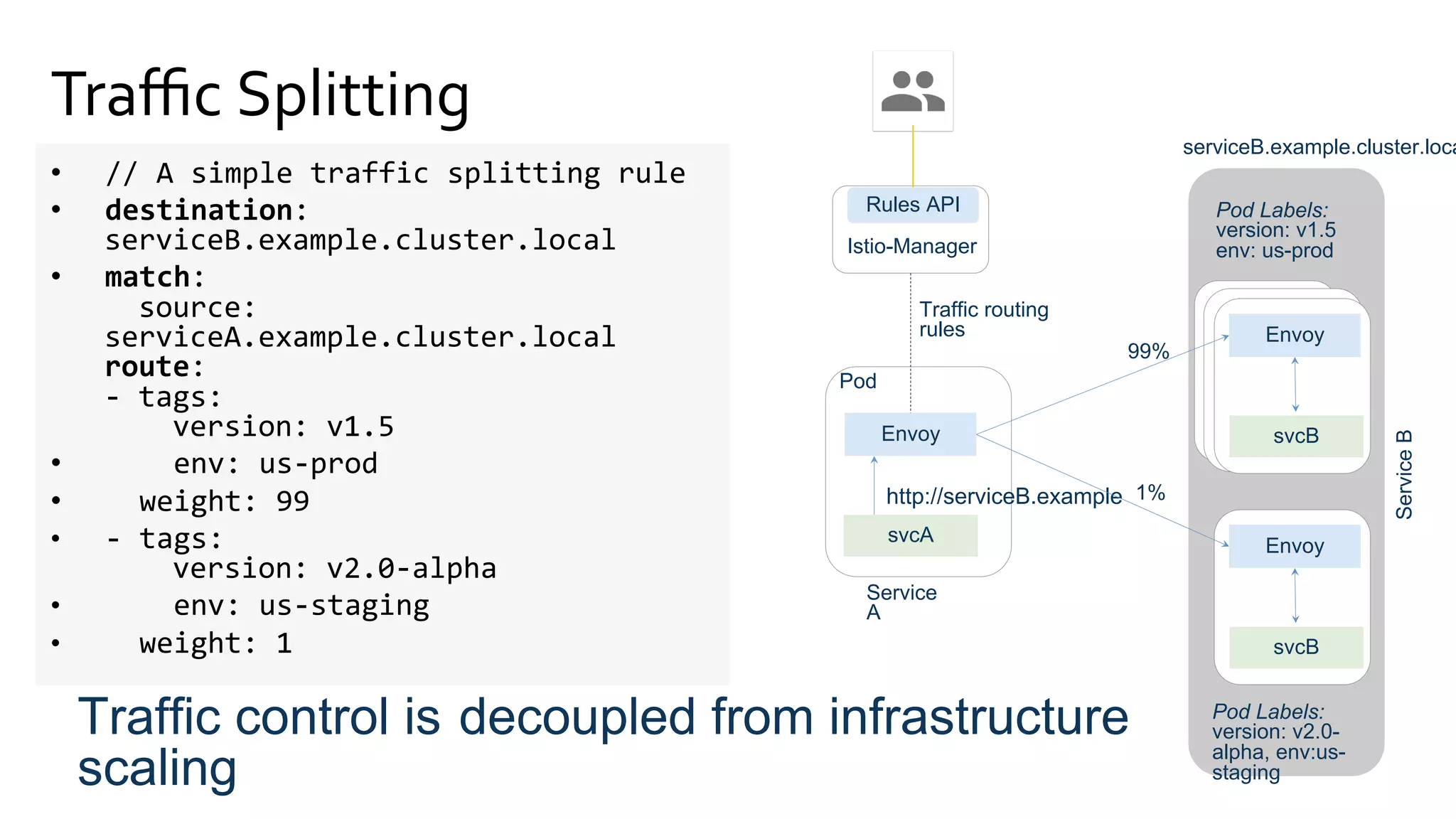
•  //	A	simple	traffic	splitting	rule	
•  destination:	
serviceB.example.cluster.local	
•  match:	
		source:	
serviceA.example.cluster.local	
route:	
-	tags:	
				version:	v1.5	
•  				env:	us-prod	
•  		weight:	99	
•  -	tags:	
				version:	v2.0-alpha	
•  				env:	us-staging	
•  		weight:	1	
svcA
Envoy
Pod
Service
A
svcB
Envoy
ServiceB
http://serviceB.example
Pod Labels:
version: v1.5
env: us-prod
svcB
Envoy
Pod Labels:
version: v2.0-
alpha, env:us-
staging
serviceB.example.cluster.loca
Traffic routing
rules
99%
1%
Rules API
Istio-Manager
Traffic Splitting
© IBM Corporation / ConfidentialIBM Cloud I Internal Usage Only
svcA
Service A
svcB
Service B
version: v1
Pod 3
Pod 2
Pod 1
Content-based traffic steering
svcA
Service A
svcB
Service B
version: v1
Pod 3
Pod 2
Pod 1
svcB’
version: canary
Pod 4
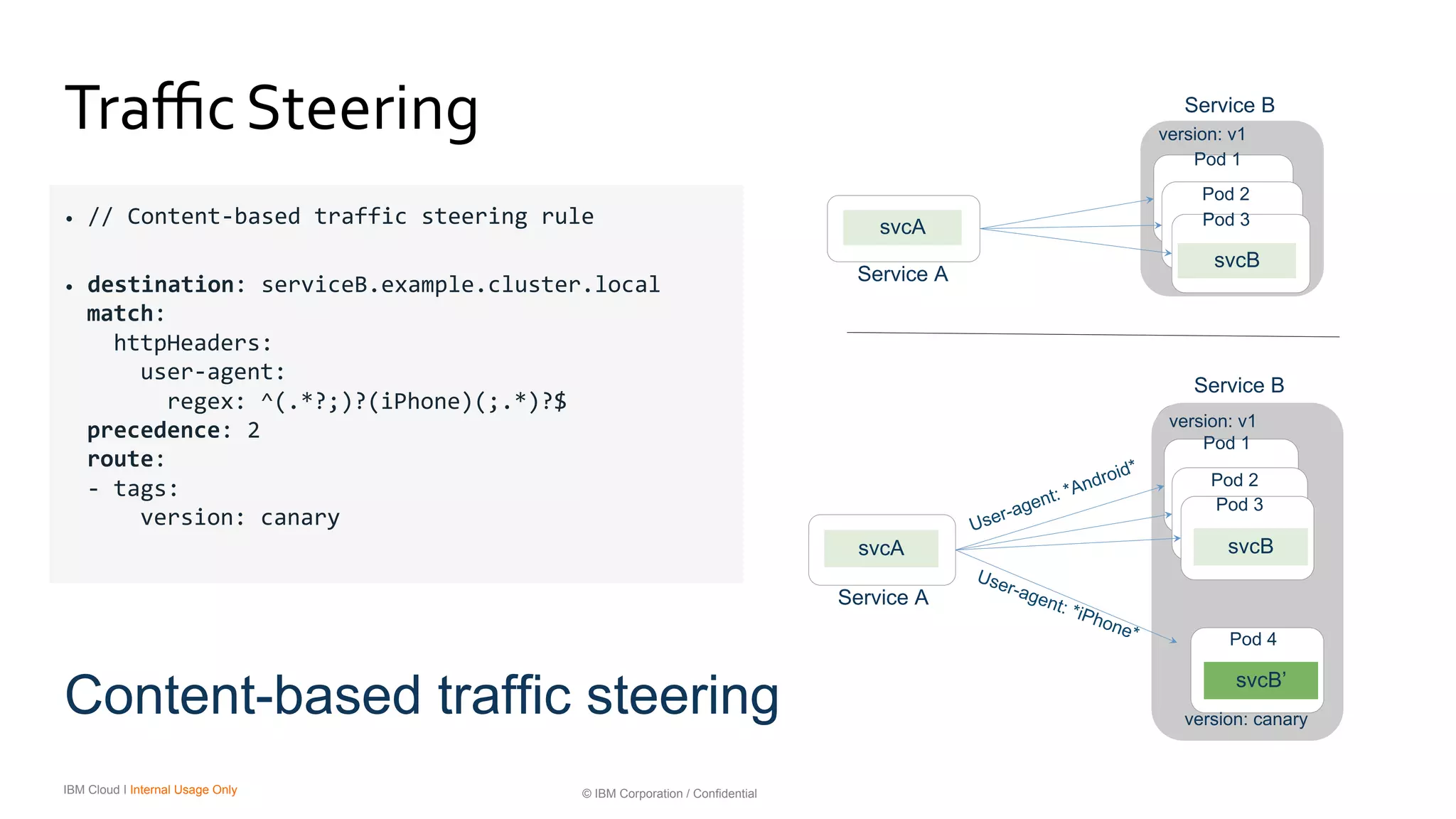
•  //	Content-based	traffic	steering	rule	
•  destination:	serviceB.example.cluster.local	
match:	
		httpHeaders:	
				user-agent:	
						regex:	^(.*?;)?(iPhone)(;.*)?$	
precedence:	2	
route:	
-	tags:	
				version:	canary	
Traffic Steering
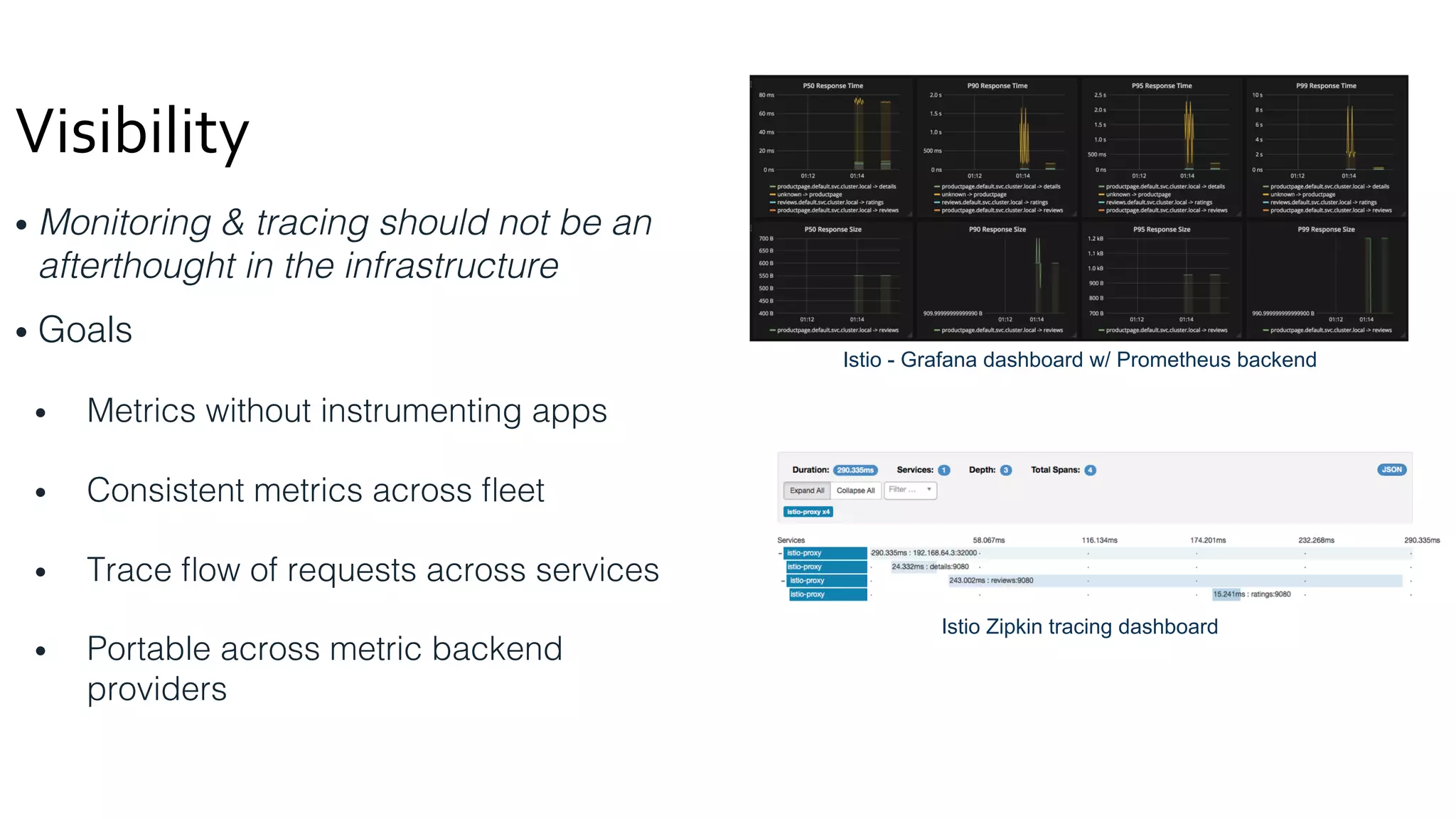
•  Monitoring & tracing should not be an
afterthought in the infrastructure"
•  Goals!
•  Metrics without instrumenting apps!
•  Consistent metrics across fleet!
•  Trace flow of requests across services!
•  Portable across metric backend
providers!
Istio Zipkin tracing dashboard
Istio - Grafana dashboard w/ Prometheus backend
Visibility
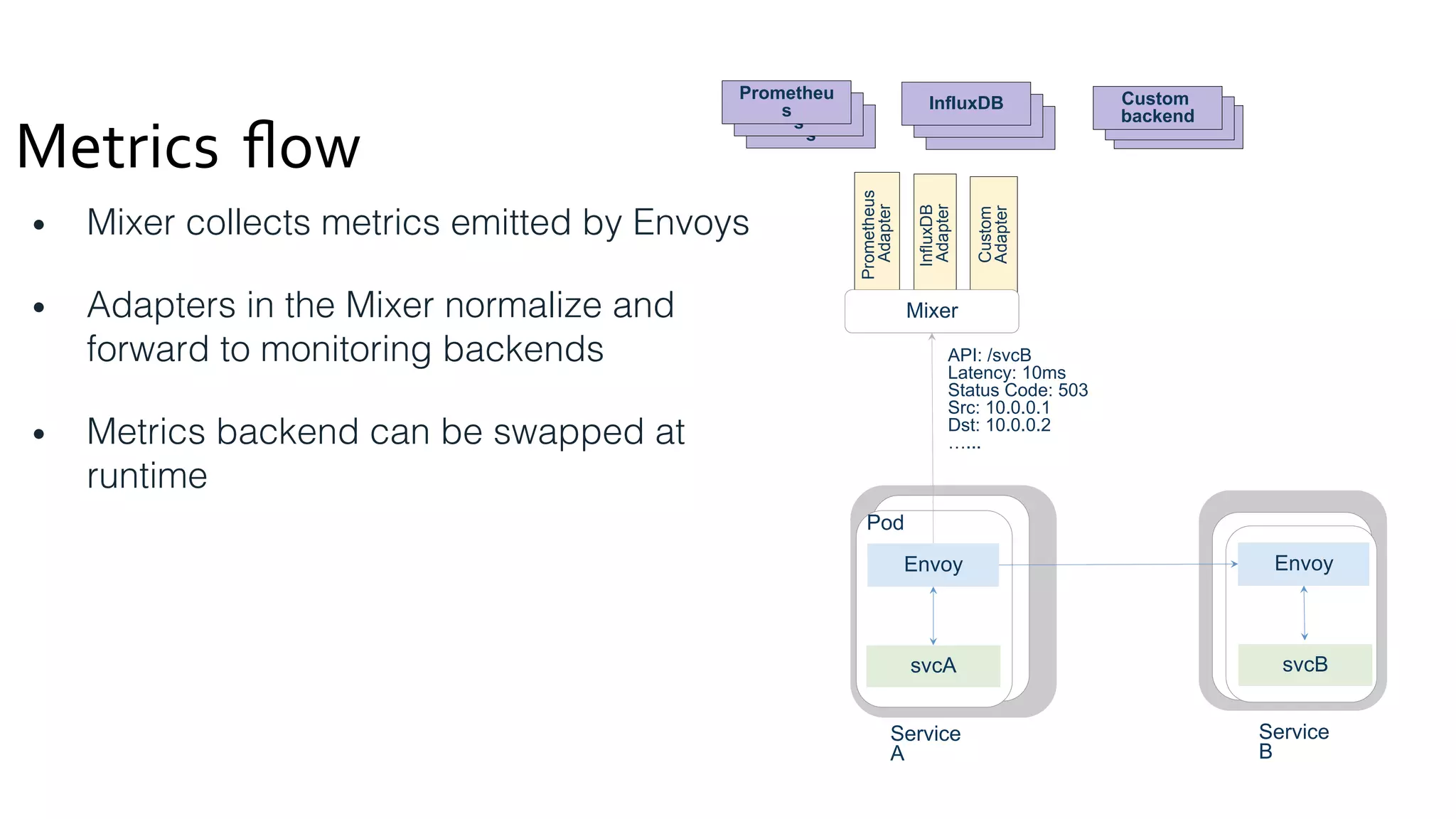
•  Mixer collects metrics emitted by Envoys!
•  Adapters in the Mixer normalize and
forward to monitoring backends!
•  Metrics backend can be swapped at
runtime!
svcA
Envoy
Pod
Service
A
svcB
Envoy
Service
B
API: /svcB
Latency: 10ms
Status Code: 503
Src: 10.0.0.1
Dst: 10.0.0.2
…...
Prometheu
s InfluxDB
Prometheus
Adapter
InfluxDB
Adapter
Custom
Adapter
Mixer
Prometheu
s
Prometheu
s InfluxDB
InfluxDB Custom
backend
Metric Flow
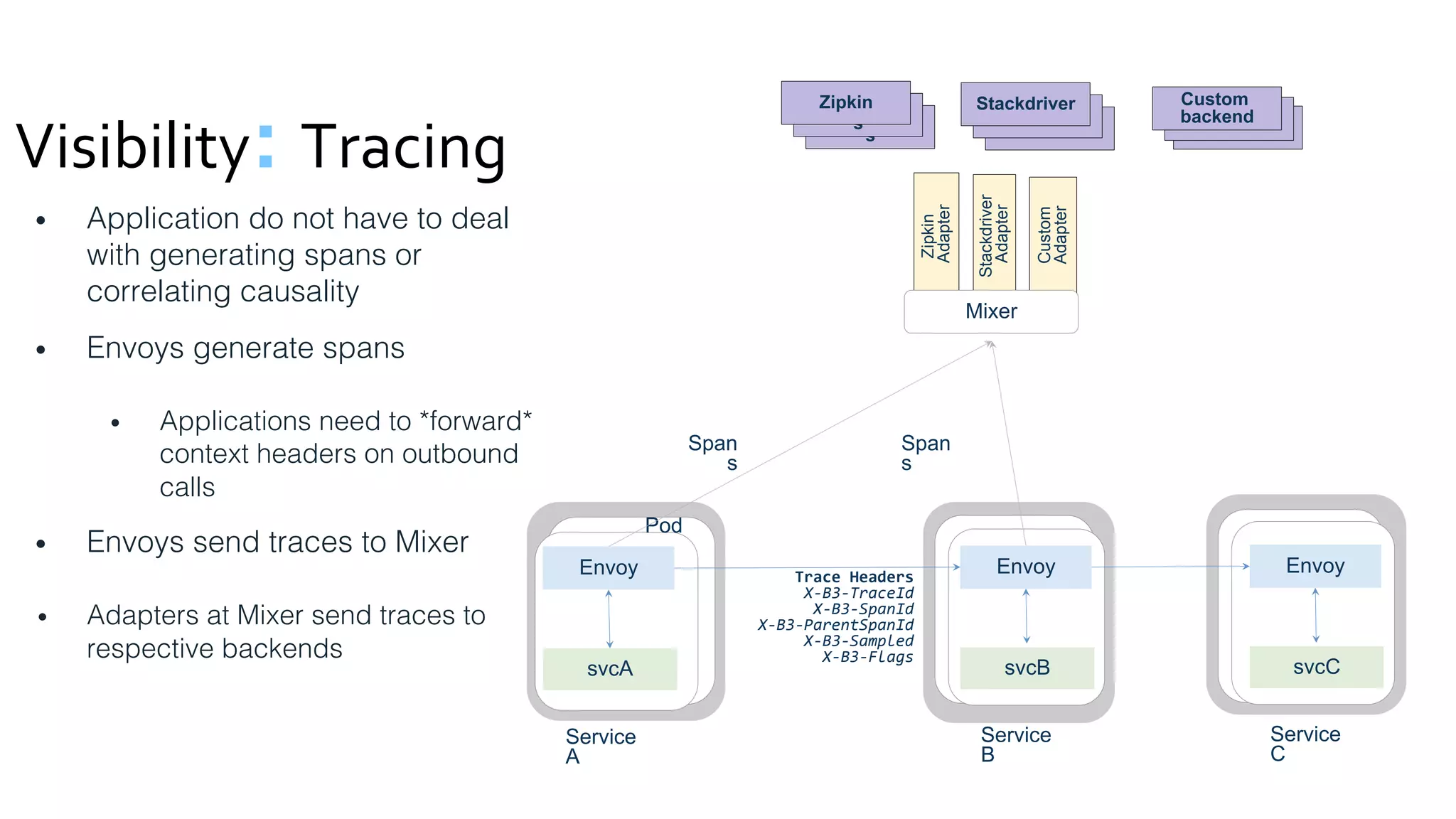
•  Application do not have to deal
with generating spans or
correlating causality!
•  Envoys generate spans!
•  Applications need to *forward*
context headers on outbound
calls!
•  Envoys send traces to Mixer!
•  Adapters at Mixer send traces to
respective backends!
svcA
Envoy
Pod
Service
A
svcB
Envoy
Service
B
Trace	Headers	
X-B3-TraceId	
X-B3-SpanId	
X-B3-ParentSpanId	
X-B3-Sampled	
X-B3-Flags	
svcC
Envoy
Service
C
Span
s
Span
s
Prometheu
s InfluxDB
Zipkin
Adapter
Stackdriver
Adapter
Custom
Adapter
Mixer
Prometheu
s
Zipkin
InfluxDB
Stackdriver Custom
backend
Visibility : Tracing
Slide Title Goes Here
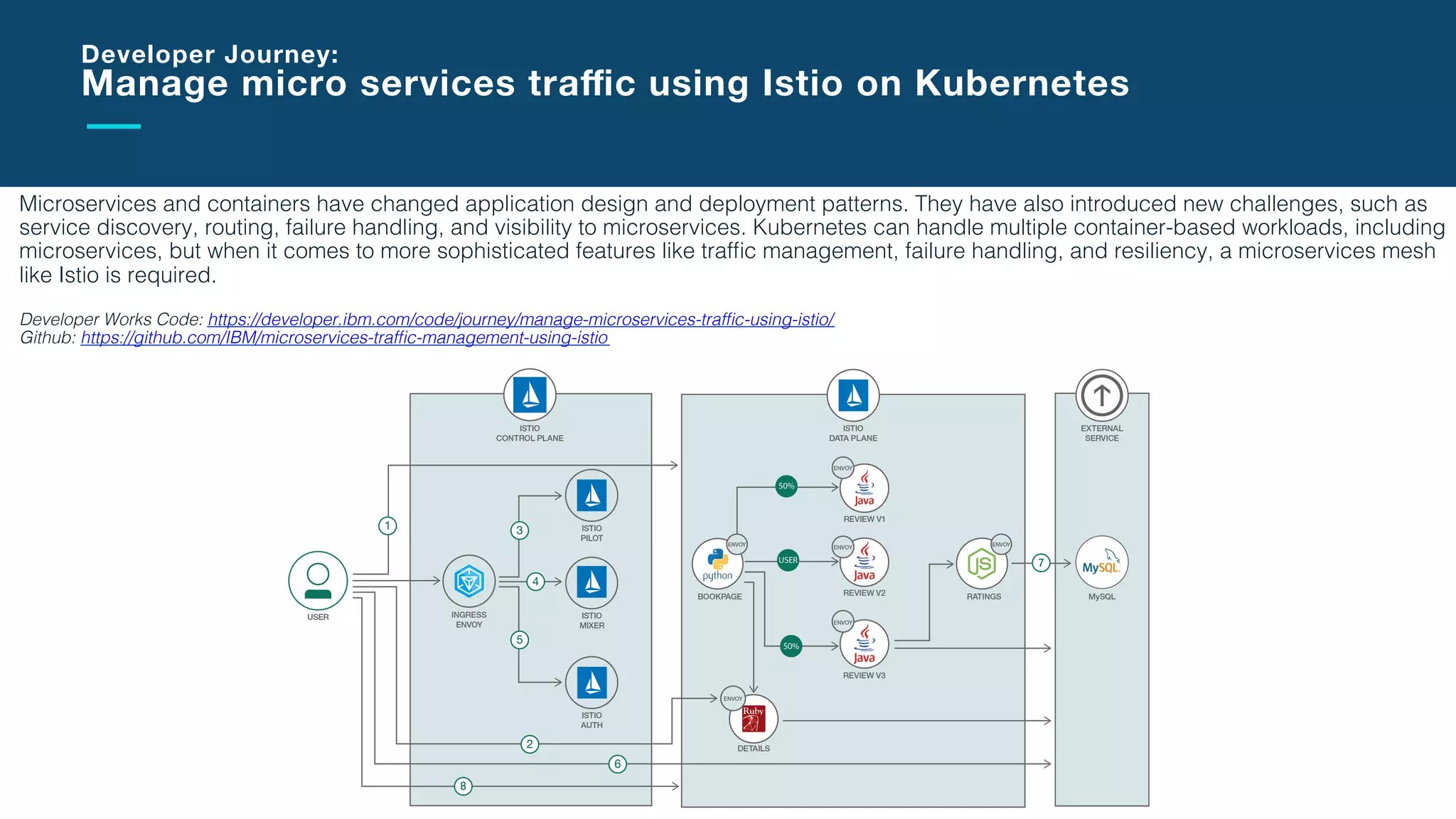
Microservices and containers have changed application design and deployment patterns. They have also introduced new challenges, such as
service discovery, routing, failure handling, and visibility to microservices. Kubernetes can handle multiple container-based workloads, including
microservices, but when it comes to more sophisticated features like traffic management, failure handling, and resiliency, a microservices mesh
like Istio is required.!
!
Developer Works Code: https://developer.ibm.com/code/journey/manage-microservices-traffic-using-istio/ "
Github: https://github.com/IBM/microservices-traffic-management-using-istio "
Developer Journey:
Manage micro services traffic using Istio on Kubernetes
ENVOY
BOOK
PAGE
REVIEWS-V1
ENVOY
ENVOY
REVIEWS-V2
ENVOY
REVIEWS-V3
ENVOY
RATINGS

ENVOY
r
MIXER
ISTIO
PILOT
ISTIO
AUTH
ISTIO
CONTROL
PLANE
50%
50%
USER
6
DETAILS

ENVOY
r
ROUTING
RULES
GRAPHANA
/ZIPKIN
ISTIO 
DATA
PLANE
3
EXTERNAL
SERVICE
7
SAMPLE BOOKINFO APP
6
5
4
8
1
2
Slide Title Goes Here
Microservices and containers have changed application design and deployment patterns. They have also introduced new challenges, such as
service discovery, routing, failure handling, and visibility to microservices. Kubernetes can handle multiple container-based workloads, including
microservices, but when it comes to more sophisticated features like traffic management, failure handling, and resiliency, a microservices mesh
like Istio is required.!
!
Developer Works Code: https://developer.ibm.com/code/journey/manage-microservices-traffic-using-istio/ "
Github: https://github.com/IBM/microservices-traffic-management-using-istio "
Developer Journey:
Manage micro services traffic using Istio on Kubernetes
DEMO
Part A
Pod
Traffic Route
Pod	 50%	
50%
Traffic Route
Pod	 user	=	jason
Traffic Route
Pod	
100%
Access Policy
Pod	
100%
Part B
Pod
ENVOY
BOOK
PAGE
REVIEWS-V1
ENVOY
ENVOY
REVIEWS-V2
ENVOY
REVIEWS-V3
ENVOY
RATINGS

ENVOY
r
MIXER
ISTIO
PILOT
ISTIO
AUTH
ISTIO
CONTROL
PLANE
50%
50%
USER
DETAILS

ENVOY
r
ROUTING
RULES
GRAPHANA
/ZIPKIN
ISTIO 
DATA
PLANE
EXTERNAL
SERVICE
SAMPLE BOOKINFO APP
Thank you!

Microservices, Kubernetes and Istio - A Great Fit!

  • 1.
    ENVOY BOOK PAGE REVIEWS-V1 ENVOY ENVOY REVIEWS-V2 ENVOY REVIEWS-V3 ENVOY RATINGS ENVOY r MIXER ISTIO PILOT ISTIO AUTH ISTIO CONTROL PLANE 50% 50% USER DETAILS ENVOY r ISTIO DATA PLANE SAMPLE BOOKINFOAPP Microservices, Kubernetes & Istio - A great fit! Presenters: ! ! Animesh Singh! Anthony Amanse ! Tommy Li! ! Panelists: ! ! Chris Rosen Nilesh Patel!
  • 2.
    Microservices, Kubernetes &Istio - A great fit! Presenters: ! ! Animesh Singh! Anthony Amanse ! Tommy Li! ! Panelists: ! ! Chris Rosen Nilesh Patel! ! Slides : http://ibm.biz/kube-istio! ! Developer Journeys: http://ibm.biz/kube-journeys! ! Reach out to us at:! ! @AnimeshSingh! ! @AnthonyAmanse! ! @Tomipli! ! @ChrisRosen188! ! @nileshandweb! !
  • 3.
  • 4.
    An engineering approachfocused on decomposing an application into single-function modules with well defined interfaces which are independently deployed and operated by a small team who owns the entire lifecycle of the service. Microservices accelerate delivery by minimizing communication and coordination between people while reducing the scope and risk of change. Microservices!
  • 5.
  • 6.
  • 7.
  • 8.
  • 9.
    Typically microservices areencapsulated inside containers… One:One relationship between a microservice and a container Everyone’s container journey starts with one container…. IBM Bluemix Container Service
  • 10.
    At first thegrowth is easy to handle…. IBM Bluemix Container Service
  • 11.
    But soon itis overwhelming…we need container and microservices management IBM Bluemix Container Service
  • 12.
    Enter Container Orchestrator IBMBluemix Container Service
  • 13.
    Container Orchestration =! Scheduling, Cluster Mgmt, ! and Discovery!
  • 14.
    Slide Title GoesHere Container Stack Physical InfrastructureLayer 1 Virtual InfrastructureLayer 2 Operating SystemLayer 3 Container EngineLayer 4 Orchestration/Scheduling Service Model Layer 5 Development Workflow Opinionated Containers Layer 6
  • 15.
    Slide Title GoesHere Container Orchestration Source: devops.com
  • 16.
  • 17.
    Slide Title GoesHere What is Kubernetes? •  Container orchestrator! •  Runs and manages containers! •  Supports multiple cloud and bare-metal environments! •  Inspired and informed by Google's experiences and internal systems! •  100% Open source, written in Go! •  Manage applications, not machines! •  Rich ecosystem of plug-ins for scheduling, storage, networking!
  • 18.
    Intelligent Scheduling Self-healingHorizontal scaling Service discovery & load balancing Automated rollouts and rollbacks Secret and configuration management IBM Bluemix Container Service
  • 19.
    Slide Title GoesHere Kubernetes Architecture API! UI! CLI! Kubernetes Master! Worker Node 1! Worker Node 2! Worker Node 3! Worker Node n! Registry •  Etcd •  API Server •  Controller Manager Server •  Scheduler Server
  • 20.
    Slide Title GoesHere Kubernetes Architecture API! UI! CLI! Kubernetes Master! Worker Node 1! Worker Node 2! Worker Node 3! Worker Node n! Registry •  Etcd •  API Server •  Controller Manager Server •  Scheduler Server Nodes – hosts that run Kubernetes applications! Master nodes: •  Controls and manages the cluster •  Kubectl (command line) •  REST API (communication with workers) •  Scheduling and replication logic! Worker nodes: •  Hosts the K8s services •  Kubelet (K8s agent that accepts commands from the master) •  Kubeproxy (network proxy service responsible for routing activities for inbound or ingress traffic) •  Docker host!
  • 21.
    Slide Title GoesHere Kubernetes Architecture API! UI! CLI! Kubernetes Master! Worker Node 1! Worker Node 2! Worker Node 3! Worker Node n! Registry •  Etcd •  API Server •  Controller Manager Server •  Scheduler Server Pods: •  Smallest deployment unit in K8s •  Collection of containers that run on a worker node •  Each has its own IP •  Pod shares a PID namespace, network, and hostname! Replication controller: •  Ensures availability and scalability •  Maintains the number of pods as requested by user •  Uses a template that describes specifically what each pod should contain! Labels: •  Metadata assigned to K8s resources •  Key-value pairs for identification •  Critical to K8s as it relies on querying the cluster for resources that have certain labels! Service: •  Collections of pods exposed as an endpoint •  Information stored in the K8s cluster state and networking info propagated to all worker nodes!
  • 22.
    Slide Title GoesHere IBM Bluemix Container Service API! UI! CLI! Kubernetes Master! Worker Node 1! Worker Node 2! Worker Node 3! Worker Node n! Registry •  Etcd •  API Server •  Controller Manager Server •  Scheduler Server •  Single tenant k8s master •  Running in IBM managed account •  Key managed to maintain account separation •  Single tenant worker nodes •  Dedicated nodes are single tenant top to bottom (worker nodes, hypervisor, hardware) •  No core or RAM over subscription to ensure allocated resources and ensure no noisy neighbors ( https://www.ibm.com/cloud-computing/bluemix/virtual- servers) Multi-tenant services with per tenant isolation!
  • 23.
  • 24.
    Slide Title GoesHere In addition to running MySQL inside a container, we also show advanced capabilities like Bluemix service binding by leveraging Compose for MySQL service! ! Developer Works Code: https://developer.ibm.com/code/journey/scalable-wordpress-on-kubernetes! Github: https://github.com/IBM/scalable-wordpress-deployment-on-kubernetes" Developer Journeys: Scalable Wordpress on Kubernetes
  • 25.
    Slide Title GoesHere This project shows how a common multi-component application can be deployed. GitLab represents a typical multi-tier app and each component will have their own container(s).! ! Developer Works Code: https://developer.ibm.com/code/journey/run-gitlab-kubernetes/ " Github: https://github.com/IBM/kubernetes-container-service-gitlab-sample" Developer Journeys: Deploy a Distributed GitLab on Kubernetes
  • 26.
    Slide Title GoesHere Leverages Kubernetes Pods, Service, Replication Controller, StatefulSets! ! Developer Works Code: https://developer.ibm.com/code/journey/deploy-a-scalable-apache-cassandra-database-on-kubernetes" Github: https://github.com/IBM/scalable-cassandra-deployment-on-kubernetes" Developer Journeys: Scalable Apache Cassandra on Kubernetes
  • 27.
  • 28.
    Slide Title GoesHere This journey shows you how to create and deploy Spring Boot microservices within a polyglot application and then deploy the app to a Kubernetes cluster.! ! Developer Works Code: https://developer.ibm.com/code/journey/deploy-spring-boot-microservices-on-kubernetes/" Github: https://github.com/IBM/spring-boot-microservices-on-kubernetes" " Developer Journeys: Spring Boot Microservices on Kubernetes
  • 29.
    Slide Title GoesHere With current application architectures, microservices need to co-exist in polyglot environments. In this developer journey, you’ll learn how to deploy a Java microservices application that runs alongside other polyglot microservices, leveraging service discovery, registration, and routing.! ! Developer Works Code: https://developer.ibm.com/code/journeys/deploy-java-microservices-on-kubernetes-with-polyglot-support/ " Github:  https://github.com/IBM/GameOn-Java-Microservices-on-Kubernetes! Developer Journeys: Deploy Java microservices on Kubernetes within a polyglot ecosystem
  • 30.
    Slide Title GoesHere Java based Microservices application using MicroProfile (baseline for Java Microservices architecture) and Microservices Builder on Kubernetes! ! Developer Works Code: https://developer.ibm.com/code/journey/deploy-microprofile-java-microservices-on-kubernetes! Github: https://github.com/IBM/java-microprofile-on-kubernetes" Developer Journeys: Java MicroProfile Microservices on Kubernetes
  • 31.
    Slide Title GoesHere Java based Microservices application using MicroProfile (baseline for Java Microservices architecture) and Microservices Builder on Kubernetes! ! Developer Works Code: https://developer.ibm.com/code/journey/deploy-microprofile-java-microservices-on-kubernetes! Github: https://github.com/IBM/java-microprofile-on-kubernetes" Developer Journeys: Java MicroProfile Microservices on Kubernetes DEMO
  • 32.
    Kubernetes is greatfor Microservices… Why do we need a Service mesh and what is it?
  • 33.
    Container Orchestration =! Scheduling, Cluster Mgmt, ! and Discovery!
  • 34.
    What else dowe need for" Microservices? ●  Visibility! ●  Resiliency & Efficiency! ●  Traffic Control! ●  Security! ●  Policy Enforcement! ! Enter Service Mesh"
  • 35.
    What is a‘Service Mesh’ ? •  A network for services, not bytes! ●  Visibility! ●  Resiliency & Efficiency! ●  Traffic Control! ●  Security! ●  Policy Enforcement!
  • 36.
    Microservice-1 Sidecar SERVICE DISCOVER Y Service Mesh ControlPlane SERVICE REGISTRY Microservice-2 Sidecar Microservice-3 Sidecar ROUTING RULES TELEMETR Y ACCESS CONTROL RESILIENC Y FEATURES Service Mesh Data Plane •  Lightweight sidecars " to manage traffic " between services" •  Sidecars can do much more than just load balancing! How to build a ‘Service Mesh’ ?
  • 37.
  • 38.
    Istio! Concepts! •  Pilot -Configures Istio deployments and propagate configuration to the other components of the system. Routing and resiliency rules go here •  Mixer - Responsible for policy decisions and aggregating telemetry data from the other components in the system using a flexible plugin architecture •  Proxy – Based on Envoy, mediates inbound and outbound traffic for all Istio-managed services. It enforces access control and usage policies, and provides rich routing, load balancing, and protocol conversion. ENVOY MIXER ISTIO PILOT ISTIO AUTH ISTIO CONTROL PLANE ROUTING RULES GRAPHANA /ZIPKIN MICROSERVICE ENVOY MICROSERVICE ENVOY MICROSERVICE ENVOY MICROSERVICE ENVOY ISTIO DATA PLANE
  • 39.
  • 40.
    Istio Architecture appA Proxy Pod Proxy Istio ingress Controller Service A appB Proxy ServiceB 1. All traffic entering and leaving pod is transparently routed via Proxy without requiring any application changes. Kube API Server User/application traffic. HTTP/ 1.1, HTTP/2, gRPC, TCP with or without TLS Istio control plane traffic. Request routing rules, resilience configuration (circuit breakers, timeouts, retries), policies (ACLs, rate limits, auth), and metrics/reports from proxies. Prometheus Metrics & reports from proxiesIstio Control Plane Istio Control PlaneIstio Control Plane (Pilot, Mixer,Auth) Control Plane REST API Kubernetes Cluster Proxy. Based on Envoy, a high performance L7 proxy from Lyft, currently being used at large scale in production. https://github.com/lyft/envoy 2. Proxy implements intelligent L7 routing, circuit breakers, enforces policies and reports metrics to control plane.
  • 41.
  • 42.
    What is a‘Service Mesh’ ? A network for services, not bytes! "  Resiliency & Efficiency ●  Traffic Control! ●  Visibility! ●  Security! ●  Policy Enforcement!
  • 43.
    •  Istio adds fault tolerance to your application without any changes to code •  Resilience features ❖ Timeouts ❖  Retries with timeout budget ❖  Circuit breakers ❖  Health checks ❖  AZ-aware load balancing w/ automatic failover ❖  Control connection pool size and request load ❖  Systematic fault injection •  // Circuit breakers •  destination: serviceB.example.cluster.local policy: - tags: version: v1 circuitBreaker: simpleCb: maxConnections: 100 httpMaxRequests: 1000 httpMaxRequestsPerConnection: 10 httpConsecutiveErrors: 7 sleepWindow: 15m httpDetectionInterval: 5m Resiliency
  • 44.
    •  Systematic faultinjection to identify weaknesses in failure recovery policies –  HTTP/gRPC error codes –  Delay injection svcA Envoy Service A svcB Envoy Service B svcC Envoy Service C Timeout: 100ms Retries: 3 300ms Timeout: 200ms Retries: 2 400ms Resiliency Testing
  • 45.
    Slide Title Goes Here Twelve-factor apps makea strong case for designing and implementing your microservices for failure. What that means is with the proliferation of microservices, failure is inevitable, and applications should be fault-tolerant. Istio, a service mesh, can help make your microservices resilient without changing application code.! ! Developer Works Code: https://developer.ibm.com/code/journey/make-java-microservices-resilient-with-istio/" Github: https://github.com/IBM/resilient-java-microservices-with-istio" Developer Journey: Leverage Is3o to create resilient and fault tolerant Microservices
  • 46.
    Resilient Microservices withIstio speaker ENVOY session ENVOY schedule ENVOY vote web-application ENVOY ENVOY MIXER ISTIO PILOT ISTIO AUTH ISTIO CONTROL PLANE ISTIO DATA PLANE 1 2 3 5 RESILIENC Y & FAULT TOLERANC E RULES ENVOY ENVOY " Load Balancing Pool NOT RSPONDING" - CIRCUIT BREAK 4 3 5 4 DELAYED RESPONSE - TIME OUT MAX CONNECTIONS - CIRCUIT BREAK ENVOY
  • 47.
  • 48.
  • 49.
  • 50.
    What is a‘Service Mesh’ ? A network for services, not bytes ●  Resiliency & Efficiency ●  Traffic Control ●  Visibility ●  Security ●  Policy Enforcement
  • 51.
    •  // A simple traffic splitting rule •  destination: serviceB.example.cluster.local • match: source: serviceA.example.cluster.local route: - tags: version: v1.5 •  env: us-prod •  weight: 99 •  - tags: version: v2.0-alpha •  env: us-staging •  weight: 1 svcA Envoy Pod Service A svcB Envoy ServiceB http://serviceB.example Pod Labels: version: v1.5 env: us-prod svcB Envoy Pod Labels: version: v2.0- alpha, env:us- staging serviceB.example.cluster.loca Traffic routing rules 99% 1% Rules API Istio-Manager Traffic Splitting
  • 52.
    © IBM Corporation/ ConfidentialIBM Cloud I Internal Usage Only svcA Service A svcB Service B version: v1 Pod 3 Pod 2 Pod 1 Content-based traffic steering svcA Service A svcB Service B version: v1 Pod 3 Pod 2 Pod 1 svcB’ version: canary Pod 4 •  // Content-based traffic steering rule •  destination: serviceB.example.cluster.local match: httpHeaders: user-agent: regex: ^(.*?;)?(iPhone)(;.*)?$ precedence: 2 route: - tags: version: canary Traffic Steering
  • 53.
    •  Monitoring &tracing should not be an afterthought in the infrastructure" •  Goals! •  Metrics without instrumenting apps! •  Consistent metrics across fleet! •  Trace flow of requests across services! •  Portable across metric backend providers! Istio Zipkin tracing dashboard Istio - Grafana dashboard w/ Prometheus backend Visibility
  • 54.
    •  Mixer collectsmetrics emitted by Envoys! •  Adapters in the Mixer normalize and forward to monitoring backends! •  Metrics backend can be swapped at runtime! svcA Envoy Pod Service A svcB Envoy Service B API: /svcB Latency: 10ms Status Code: 503 Src: 10.0.0.1 Dst: 10.0.0.2 …... Prometheu s InfluxDB Prometheus Adapter InfluxDB Adapter Custom Adapter Mixer Prometheu s Prometheu s InfluxDB InfluxDB Custom backend Metric Flow
  • 55.
    •  Application donot have to deal with generating spans or correlating causality! •  Envoys generate spans! •  Applications need to *forward* context headers on outbound calls! •  Envoys send traces to Mixer! •  Adapters at Mixer send traces to respective backends! svcA Envoy Pod Service A svcB Envoy Service B Trace Headers X-B3-TraceId X-B3-SpanId X-B3-ParentSpanId X-B3-Sampled X-B3-Flags svcC Envoy Service C Span s Span s Prometheu s InfluxDB Zipkin Adapter Stackdriver Adapter Custom Adapter Mixer Prometheu s Zipkin InfluxDB Stackdriver Custom backend Visibility : Tracing
  • 56.
    Slide Title GoesHere Microservices and containers have changed application design and deployment patterns. They have also introduced new challenges, such as service discovery, routing, failure handling, and visibility to microservices. Kubernetes can handle multiple container-based workloads, including microservices, but when it comes to more sophisticated features like traffic management, failure handling, and resiliency, a microservices mesh like Istio is required.! ! Developer Works Code: https://developer.ibm.com/code/journey/manage-microservices-traffic-using-istio/ " Github: https://github.com/IBM/microservices-traffic-management-using-istio " Developer Journey: Manage micro services traffic using Istio on Kubernetes
  • 57.
  • 58.
    Slide Title GoesHere Microservices and containers have changed application design and deployment patterns. They have also introduced new challenges, such as service discovery, routing, failure handling, and visibility to microservices. Kubernetes can handle multiple container-based workloads, including microservices, but when it comes to more sophisticated features like traffic management, failure handling, and resiliency, a microservices mesh like Istio is required.! ! Developer Works Code: https://developer.ibm.com/code/journey/manage-microservices-traffic-using-istio/ " Github: https://github.com/IBM/microservices-traffic-management-using-istio " Developer Journey: Manage micro services traffic using Istio on Kubernetes DEMO
  • 59.
  • 60.
  • 61.
  • 62.
  • 63.
  • 64.
  • 65.

Editor's Notes

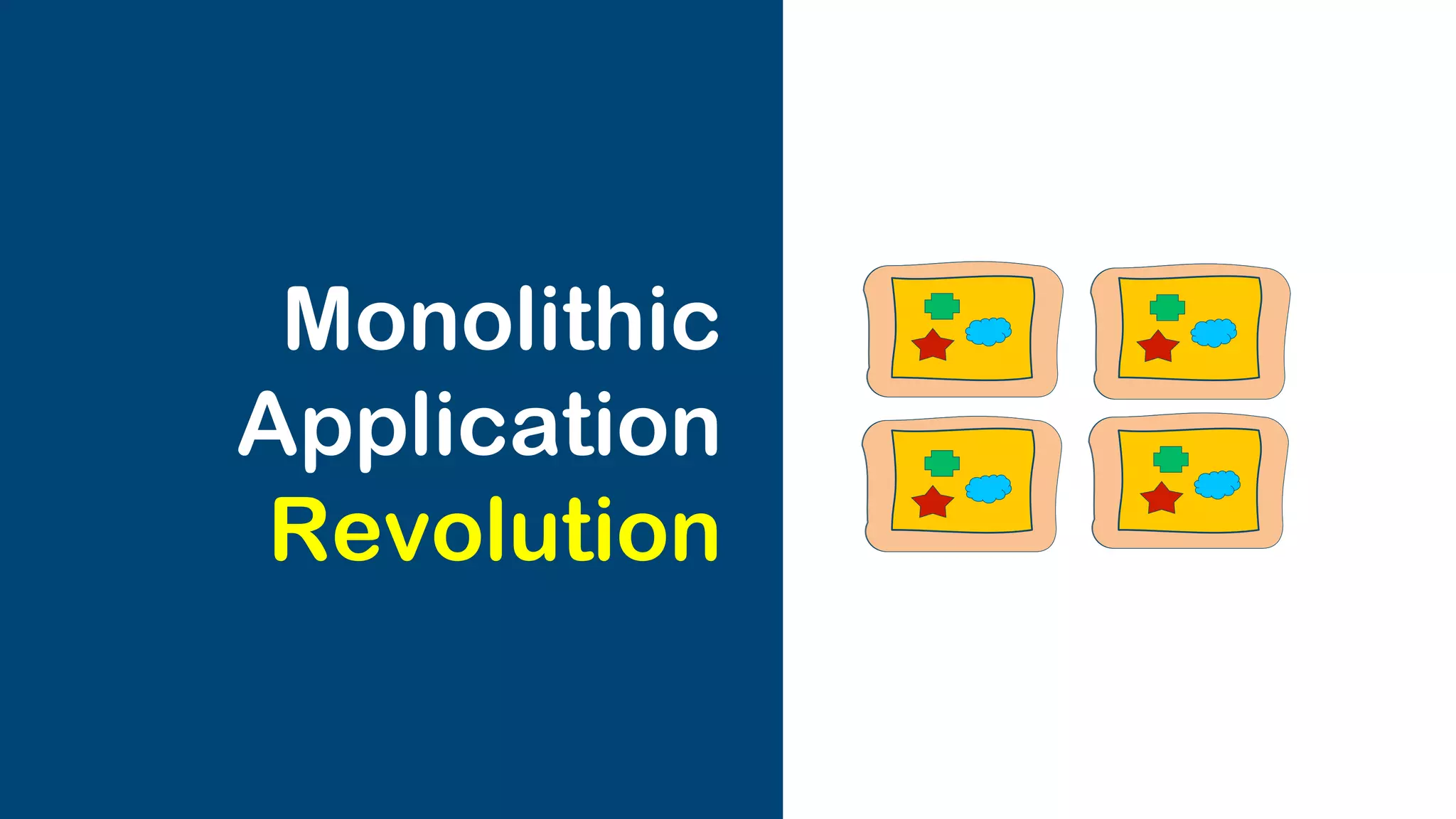
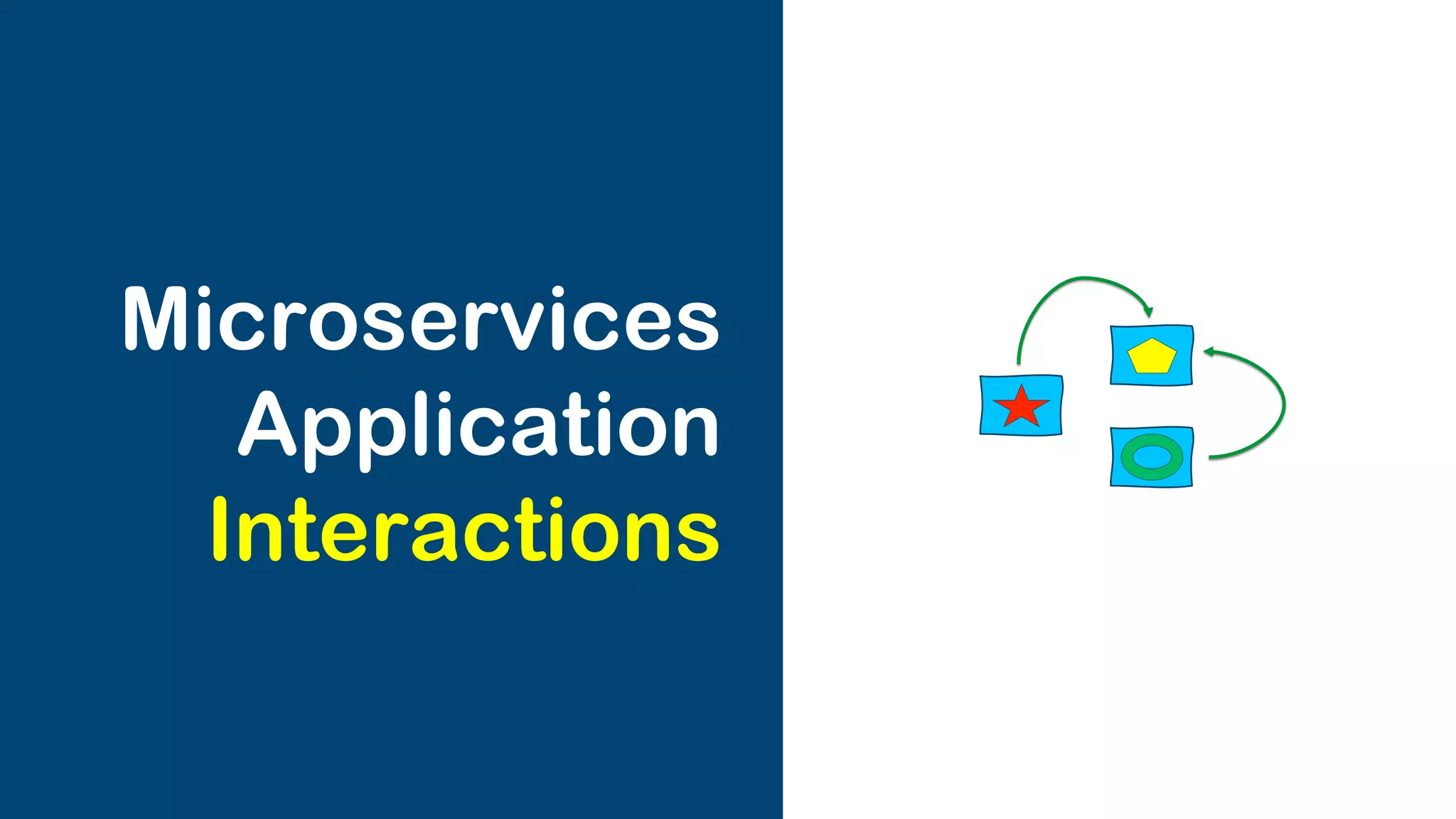
  • #5 Communication between microservices is typically REST based. Payload may be JSON or, where serialization efficiency is important, other options such as Apache Thrift or Google Protocol Buffers may be appropriate. Typically applications begin with synchronous communication but, depending on the interaction style, it may be appropriate to introduce asynchronous messaging. Due to the potential for large number of service interactions (in a typical customer facing application, a single front end invocation could spawn off 20-30 calls to services and data sources) parallel invocation may be required to keep latency to a minimum. Options here might include a reactive streams implementation such as Netflix’s RxJava or, for those using Java 8, CompletableFuture.
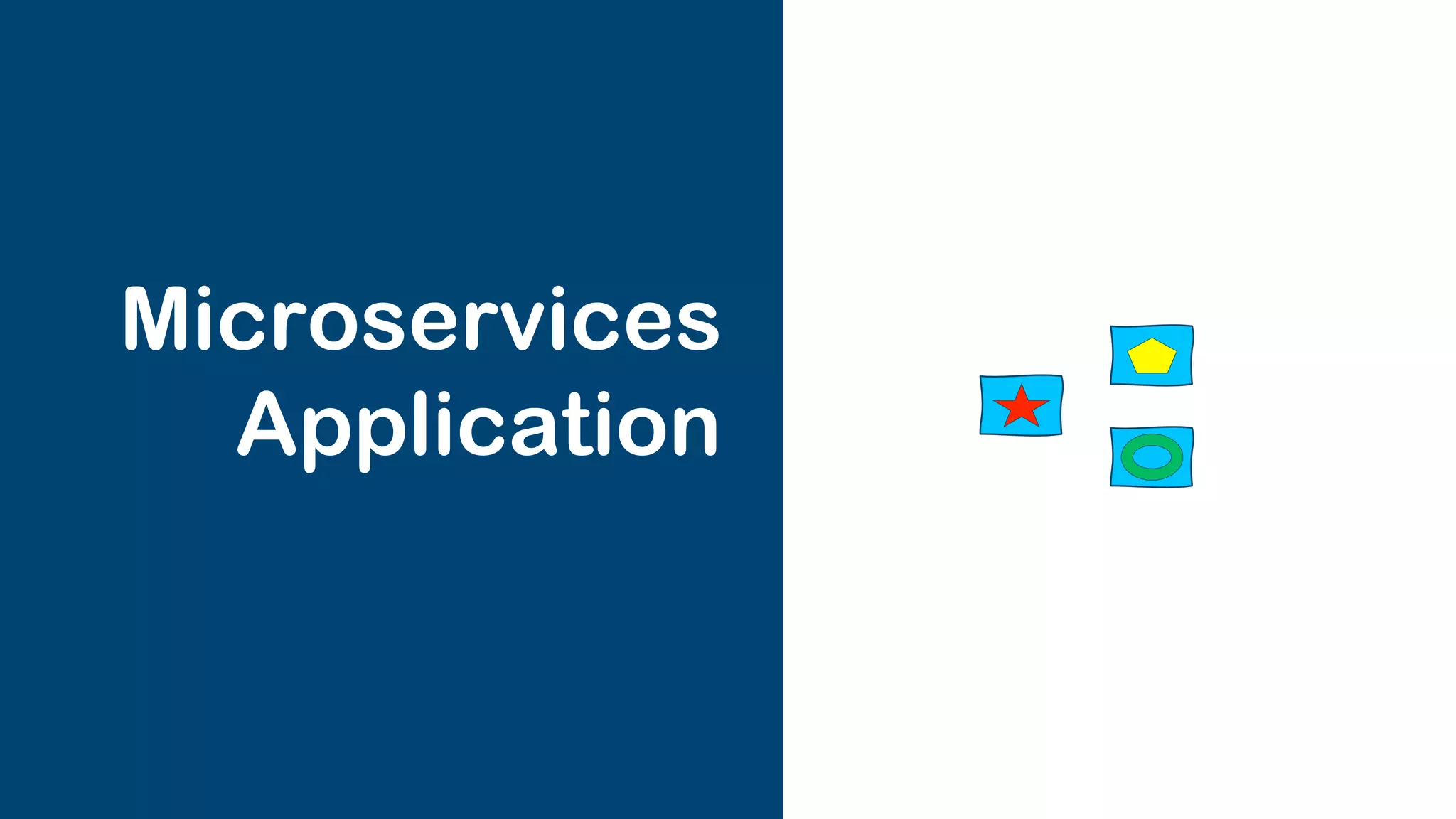
  • #6 Now, when we scale the application, we can scale up and down instances of each service independently. When a service fails, it can fail independently rather than causing the whole application to fail. Having lots of microservices brings it’s own challenges though. For example, you now need to be more rigorous about deployment. We also have to consider how the services will discover one another.
  • #7 Now, when we want to make an update, whether that’s a simple code change or a complete change of the technology stack, this can be achieved at the service level. We even have the option to perform canary testing, slowly migrating traffic to the new implementation until we’re ready to remove the old. v Having lots of microservices brings it’s own challenges though. For example, you now need to be more rigorous about deployment. We also have to consider how the services will find one another.
  • #34 Images is https://pixabay.com/en/plaid-coaster-bast-colorful-color-1173135/ CC0 license Today application developers think of the network as big pipes of bits that don’t do very much else. They don’t really help with service-level concerns. We need a network that operates at the same level as the services we build and deploy. To OSI geeks this is a layer-7 network. So, what should this kind of network do? Route traffic away from failures to increase the aggregate reliability of my cluster Avoid needless overheads like high-latency routes or servers with cold-caches It should provide insight. Highlight unexpected dependencies & root causes of failure Let me impose policies at the granularity of service behaviors, not just at the connection level Ensure that the traffic flowing between services is secure against trivial attack … so let’s walk through a little bit of this in action
  • #35 Handoff - If we were to reimagine the network that connects our microservices, what would we want out of it? Think of the kernel’s TCP/IP stack today. Do we care where in the planet an IP address is or how to route to it? No How about discovering MAC address associated with the IP or the next hop router? Nope. Do we care about packet loss or congestion control? Heck no. Essentially, the kernel provides a reliable communication fabric at Layer 4. It frees you from having to deal with discovery, failure recovery, flow control, and a host of other issues that you may not even be aware of. Isn’t this a nice property to have at the services layer, that is, layer-7? We seem to be having some similar issues: discovery, resiliency, routing, etc. and other issues specific such as load balancing, monitoring, policy enforcement, authentication and authorization, etc.
  • #42 Handoff - Lets look at the operational visibility aspect of the service mesh. What is so different about Istio when compared to the monitoring solutions you are used to?
  • #43 In our experience working with a diverse set of clients, 95% of them are happy with an out of process sidecar implementing all the resiliency features such as circuit breakers instead of having to build them into the application code. Secondly, in most of the cases, there is a fair amount of parameter tweaking - e.g., making sure that timeouts across services are not too tight or ensuring that a circuit doesn’t open too early. Istio provides dynamically configurable resilience features that you can tweak at runtime, *in production*.
  • #44 Systematic resilience testing allows you to test the ability of your services to recover from failures. You can isolate failures to specific subset of requests (such as those coming from QA teams), while running these tests in production. If you recall the excellent Linkerd talk that Oliver gave this morning, he talked about a scenario where a chain of service calls had incompatible timeouts and retries. Well, you can always recover from these issues by using timeouts/retries/circuit breakers on the very first service in the call chain. But think of all the wasted work in the backend services (resources being held up). Worse yet, think of the impact on your users. For example, consider Netflix recommendations. When the system is running well, you get personalized recommendations. That is a “feature”. When the personalized recommendations system is down, Netflix falls back to “generic recommendations”. This is great as long as the outage is temporary. But what if this becomes the permanent user experience for weeks at a stretch, because some frontend system had a misconfigured timeout that caused it to prematurely terminate API calls to the recommendation engine.
  • #47 Circuit Breaker, max connection and pending requests
  • #48 Circuit breaker, load balancing pool ejection.
  • #49 Timeout and Fault Tolerance
  • #50 Handoff - Lets look at the operational visibility aspect of the service mesh. What is so different about Istio when compared to the monitoring solutions you are used to?
  • #51 Traffic control is decoupled from infrastructure scaling - i.e., the proportion of traffic routed to a version is independent of number of instances supporting the version You can program these traffic routing rules using istio on the fly using simple rules as shown in the slide. These rules get translated into low level Envoy configs. Envoy periodically fetches configs from the manager and updates its internal routing table. There are no hot restarts, no impact to existing traffic. We call this tag based routing.
  • #52 Content-based traffic steering - The content of a request can be used to determine the destination of a request Another way to route requests is the age old method. Look at the contents of a request and route it to a specific set of instances. This opens up all sorts of possibilities. For a user facing service, you could route a portion of mobile traffic from a particular device, say an iPhone, to a specific version of the service. For internal services, callers would have the ability to explicitly request a particular version of the service. In fact, Verizon is using this particular technique in production today.
  • #53 Baseline visibility even for black boxes. Holistic view of the entire fleet. No need to rely on development process to instrument code to emit metrics. Metrics are not special. Its just that every component emits metrics. Consistent metrics enables automation - things like autoscaling for example. Policy engines have to operate on same data that telemetry systems have. Right now, we operate on two inconsistent data streams. Log scrapping is an after thought. In addition, the sidecars are ideally positioned to trace the flow of requests across services, when you need to drill down on performance issues or trouble shoot problems in the application.
  • #54 We can write a variety of adapters for various metrics backends. You can plug different backends into the mixer. Whats nice about this design is that you can switch from one metrics backend to another, as your requirements change, without ever having to rewrire your entire infrastructure.