Cloud Computing
What Is A Cloud Computing?
 Cloud computing is a model on-demand network
access to a shared pool of configurable computing
resources
 For Example:- networks, servers, storage, applications, and
services.
 That can be rapidly provisioned and released with minimal
management effort or service provider interaction.
Objectives of Cloud Computing
 Elasticity:
Ability to scale virtual machines resources up or down
 On-demand usage:
Ability to add or delete computing power (CPU,
memory), and storage according to demand
 Pay-per-use:
Pay only for what you use
 Multitenancy:
Ability to have multiplecustomers access their servers in the
data center in an isolated manner
5 Essential Cloud Characteristics
 On-demand self-service
 Broad network access
 Resource pooling
 Rapid elasticity
 Measured service
Models of Cloud Computing
3 Cloud Service Models
1. Software as a Service (SaaS)
 SaaS is a software delivery methodology that provides licensed
multi-tenant access to software and its functions remotely as a Web-
based service.
 Usually billed based on usage
 Usually multi tenant environment
 Highly scalable architecture
SaaS Examples
2. Platform as a Service (PaaS)
 The capability provided to the consumer is to deploy onto
the cloud infrastructure consumer-created applications
using programming languages and tools supported by the
provider
 For Example:- e.g., Java, Python, .Net.
 The consumer does not manage or control the underlying cloud
infrastructure, network, servers, operating systems, or storage,
but the consumer has control over the deployed applications and
possibly application hosting environment configurations.
Platform as a Service (PaaS)
 PaaS provides all of the facilities required
to support the complete life cycle of
building and delivering web applications
and services entirely from the Internet.
 Typically applications must be developed
with a particular platform in mind
 Multi tenant environments
 Highly scalable multi tier architecture
2. Platform as a Service (PaaS)
PaaS Examples:
3. Infrastructure as a Service (IaaS)
 The capability provided to the consumer is to rent
processing, storage, networks, and other fundamental
computing resources where the consumer is able to deploy
and run arbitrary software, which can include operating systems
and applications.
 The consumer does not manage or control the underlying cloud
infrastructure but has control over operating systems, storage,
deployed applications, and possibly select networking
components (e.g., firewalls, load balancers).
IaaS is not Managed Hosting
 Traditional managed hosting is a form
of web hosting where a user chooses
to lease entire server(s) housed in an
off-site data center.
 Term based contracts based on
projected resource requirements
IaaS Examples
Service Model Architectures
.
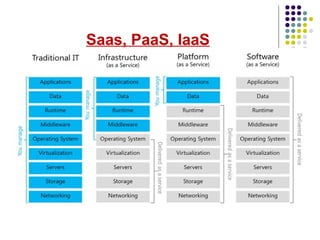
Saas, PaaS, IaaS

.
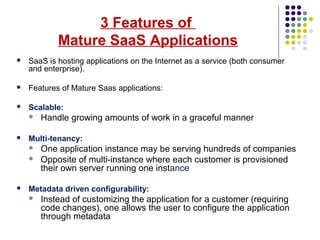
3 Features of
Mature SaaS Applications
 SaaS is hosting applications on the Internet as a service (both consumer
and enterprise).
 Features of Mature Saas applications:
 Scalable:
 Handle growing amounts of work in a graceful manner
 Multi-tenancy:
 One application instance may be serving hundreds of companies
 Opposite of multi-instance where each customer is provisioned
their own server running one instance
 Metadata driven configurability:
 Instead of customizing the application for a customer (requiring
code changes), one allows the user to configure the application
through metadata
SaaS Example
SaaS Maturity Levels
 Level 1: Ad-Hoc/Custom
 Level 2: Configurable
 Level 3: Configurable,
Multi-Tenant-Efficient
 Level 4: Scalable,
Configurable,
Multi-Tenant-Efficient
Deployment Models Of Cloud
 Private cloud
 The cloud infrastructure is operated solely for an organization. It may be
managed by the organization or a third party and may exist on premise
or off premise.
 Public cloud
 Mega-scale cloud infrastructure is made available to the general public
or a large industry group and is owned by an organization selling cloud
services.
 Hybrid cloud
 The cloud infrastructure is a composition of two or more clouds (private
or public) that remain unique entities but are bound together by
standardized or proprietary technology that enables data and application
portability
Common Cloud Characteristics
 Cloud computing often leverages:
 Massive scale
 Homogeneity
 Virtualization
 Low cost software
 Geographic distribution
 Advanced security technologies
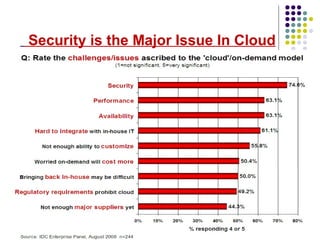
Security is the Major Issue In Cloud
 Cloud computing often leverages:
 Massive scale
 Homogeneity
 Virtualization
 Low cost software
 Geographic distribution
 Advanced security technologies
.
Security In Cloud
 Shifting public data to a external cloud reduces the exposure of the
internal sensitive data
 Dedicated Security Team
 Greater Investment in Security Infrastructure
 Cloud homogeneity makes security auditing/testing simpler
 Clouds enable automated security management and real-time
detection of system tampering
 Rapid Re-Constitution of Services
 Redundancy / Disaster Recovery
Cloud Security Challenges
 Trusting vendor’s security model
 Multi-tenancy
 Data ownership issues
 QoS guarantees
 Attraction to hackers (high-value target)
 Security of virtual OSs in the cloud
 Obtaining support from cloud vendor for security related investigations
Cloud Security
Advantages Of Cloud
Advantages Of Cloud
 Secure storage and Management.
 High Level Computing.
 Low Total Cost OwnerShip.
 Utility Based,Timing Sharing Model.
 Pay-as-you-use
 Virtualized & Dyanamic.
 24/7 Support.
 Location Independent.
Disadvantages Of Cloud Computing
1) Possible downtime. Cloud computing makes your small business
dependent on the reliability of your Internet connection. When it's offline, you're
offline. If your internet service suffers from frequent outages or slow speeds
cloud computing may not be suitable for your business. And even the most
reliable cloud computing service providers suffer server outages now and again
2.Security issues. How safe is your data? Cloud computing means Internet
computing. So you should not be using cloud computing applications that
involve using or storing data that you are not comfortable having on the
Internet. Established cloud computing vendors have gone to great lengths to
promote the idea that they have the latest, most sophisticated data security
systems possible as they want your business and realize that data security is a
big concern; however, their credibility in this regard has suffered greatly in the
wake of the recent NSA snooping scandals.
Disadvantages Of Cloud Computing
 3.cost. At first glance, a cloud computing application may appear to
be a lot cheaper than a particular software solution installed and run
in-house, but you need to be sure you're comparing apples and
apples. Does the cloud application have all the features that the
software does and if not, are the missing features important to you?
 4) Inflexibility. Be careful when you're choosing a cloud computing
vendor that you're not locking your business into using their
proprietary applications or formats. You can't insert a document
created in another application into a Google Docs spreadsheet, for
instance. Also make sure that you can add and subtract cloud
computing users as necessary as your business grows or contracts.
Disadvantages Of Cloud Computing
 5) Lack of support. In These Issues Need to be Resolved Before
Cloud Computing Becomes Ubiquitous, (OPEN Forum) Anita
Campbell writes, "Customer service for Web apps leaves a lot to be
desired -- All too many cloud-based apps make it difficult to
getcustomer service promptly – or at all. Sending an email and
hoping for a response within 48 hours is not an acceptable way for
most of us to run a business".
Future Scope Of Cloud Computing
 Existence of Internet will improve its future: The cloud
computing will change into everything the greater outstanding
in the company of ubiquity of high-speed, broadband Internet.
Easily but quickly we are becoming nearer.
software revises:For the most part of the computer specialist
spend lots of their time and creation downloading distinct
variants of software so that they can approach the distinct
programs and data with brief efforts. It is not necessary to
download that particular software.
Future Scope Of Cloud Computing
 Hardware discretionary:With the emergence of cloud
computing it is no thirstier essential to investment hard
drives with large warehouse size, as it can be kept on
cloud. So keep the fear of loosing your data away.
 Limitless Entertainment:As hardware is no more
required, so there is limitless on entertainment choices.
Uploading modish software and purchasing events from
the market outlet is going to be goods of the olden days.
In the upcoming days, there will be mobile 3D games to
entertain for kids.
Future Scope Of Cloud Computing
 Medical therapy clarified: The time to come of cloud
computing is not limited to entertainment and gaming
preference as it can subscribe massively in the area of
modern medical sciences as well. In inclusion, it will
create comfortable the activity of data handling.
 Weather Forecasting: It is supported that with enhanced
cover up of computing paired in the company of better
climate design it will be perform more comfortable task
to weather forecasts
Conclusion
 Cloud Computing is outpacing the IT industry
 Real business value can be realized by customers of all sizes
 Cloud solutions are simple to acquire, don’t require long term
contracts and are easier to scale up and down as needed
 Proper planning and migration services are needed to ensure a
successful implementation
 Public and Private Clouds can be deployed together to leverage the
best of both
 Third party monitoring services ensure customer are getting the
most out of their cloud environment
 Security Compliance and Monitoring is achievable with careful
planning and analysis

Cloud computings

  • 2.
  • 3.
    What Is ACloud Computing?  Cloud computing is a model on-demand network access to a shared pool of configurable computing resources  For Example:- networks, servers, storage, applications, and services.  That can be rapidly provisioned and released with minimal management effort or service provider interaction.
  • 4.
    Objectives of CloudComputing  Elasticity: Ability to scale virtual machines resources up or down  On-demand usage: Ability to add or delete computing power (CPU, memory), and storage according to demand  Pay-per-use: Pay only for what you use  Multitenancy: Ability to have multiplecustomers access their servers in the data center in an isolated manner
  • 5.
    5 Essential CloudCharacteristics  On-demand self-service  Broad network access  Resource pooling  Rapid elasticity  Measured service
  • 6.
    Models of CloudComputing
  • 7.
    3 Cloud ServiceModels 1. Software as a Service (SaaS)  SaaS is a software delivery methodology that provides licensed multi-tenant access to software and its functions remotely as a Web- based service.  Usually billed based on usage  Usually multi tenant environment  Highly scalable architecture
  • 8.
  • 9.
    2. Platform asa Service (PaaS)  The capability provided to the consumer is to deploy onto the cloud infrastructure consumer-created applications using programming languages and tools supported by the provider  For Example:- e.g., Java, Python, .Net.  The consumer does not manage or control the underlying cloud infrastructure, network, servers, operating systems, or storage, but the consumer has control over the deployed applications and possibly application hosting environment configurations.
  • 10.
    Platform as aService (PaaS)  PaaS provides all of the facilities required to support the complete life cycle of building and delivering web applications and services entirely from the Internet.  Typically applications must be developed with a particular platform in mind  Multi tenant environments  Highly scalable multi tier architecture
  • 11.
    2. Platform asa Service (PaaS)
  • 12.
  • 13.
    3. Infrastructure asa Service (IaaS)  The capability provided to the consumer is to rent processing, storage, networks, and other fundamental computing resources where the consumer is able to deploy and run arbitrary software, which can include operating systems and applications.  The consumer does not manage or control the underlying cloud infrastructure but has control over operating systems, storage, deployed applications, and possibly select networking components (e.g., firewalls, load balancers).
  • 14.
    IaaS is notManaged Hosting  Traditional managed hosting is a form of web hosting where a user chooses to lease entire server(s) housed in an off-site data center.  Term based contracts based on projected resource requirements
  • 15.
  • 16.
  • 17.
  • 18.
    3 Features of MatureSaaS Applications  SaaS is hosting applications on the Internet as a service (both consumer and enterprise).  Features of Mature Saas applications:  Scalable:  Handle growing amounts of work in a graceful manner  Multi-tenancy:  One application instance may be serving hundreds of companies  Opposite of multi-instance where each customer is provisioned their own server running one instance  Metadata driven configurability:  Instead of customizing the application for a customer (requiring code changes), one allows the user to configure the application through metadata
  • 19.
  • 20.
    SaaS Maturity Levels Level 1: Ad-Hoc/Custom  Level 2: Configurable  Level 3: Configurable, Multi-Tenant-Efficient  Level 4: Scalable, Configurable, Multi-Tenant-Efficient
  • 21.
    Deployment Models OfCloud  Private cloud  The cloud infrastructure is operated solely for an organization. It may be managed by the organization or a third party and may exist on premise or off premise.  Public cloud  Mega-scale cloud infrastructure is made available to the general public or a large industry group and is owned by an organization selling cloud services.  Hybrid cloud  The cloud infrastructure is a composition of two or more clouds (private or public) that remain unique entities but are bound together by standardized or proprietary technology that enables data and application portability
  • 22.
    Common Cloud Characteristics Cloud computing often leverages:  Massive scale  Homogeneity  Virtualization  Low cost software  Geographic distribution  Advanced security technologies
  • 23.
    Security is theMajor Issue In Cloud  Cloud computing often leverages:  Massive scale  Homogeneity  Virtualization  Low cost software  Geographic distribution  Advanced security technologies .
  • 24.
    Security In Cloud Shifting public data to a external cloud reduces the exposure of the internal sensitive data  Dedicated Security Team  Greater Investment in Security Infrastructure  Cloud homogeneity makes security auditing/testing simpler  Clouds enable automated security management and real-time detection of system tampering  Rapid Re-Constitution of Services  Redundancy / Disaster Recovery
  • 25.
    Cloud Security Challenges Trusting vendor’s security model  Multi-tenancy  Data ownership issues  QoS guarantees  Attraction to hackers (high-value target)  Security of virtual OSs in the cloud  Obtaining support from cloud vendor for security related investigations
  • 26.
  • 27.
  • 28.
    Advantages Of Cloud Secure storage and Management.  High Level Computing.  Low Total Cost OwnerShip.  Utility Based,Timing Sharing Model.  Pay-as-you-use  Virtualized & Dyanamic.  24/7 Support.  Location Independent.
  • 29.
    Disadvantages Of CloudComputing 1) Possible downtime. Cloud computing makes your small business dependent on the reliability of your Internet connection. When it's offline, you're offline. If your internet service suffers from frequent outages or slow speeds cloud computing may not be suitable for your business. And even the most reliable cloud computing service providers suffer server outages now and again 2.Security issues. How safe is your data? Cloud computing means Internet computing. So you should not be using cloud computing applications that involve using or storing data that you are not comfortable having on the Internet. Established cloud computing vendors have gone to great lengths to promote the idea that they have the latest, most sophisticated data security systems possible as they want your business and realize that data security is a big concern; however, their credibility in this regard has suffered greatly in the wake of the recent NSA snooping scandals.
  • 30.
    Disadvantages Of CloudComputing  3.cost. At first glance, a cloud computing application may appear to be a lot cheaper than a particular software solution installed and run in-house, but you need to be sure you're comparing apples and apples. Does the cloud application have all the features that the software does and if not, are the missing features important to you?  4) Inflexibility. Be careful when you're choosing a cloud computing vendor that you're not locking your business into using their proprietary applications or formats. You can't insert a document created in another application into a Google Docs spreadsheet, for instance. Also make sure that you can add and subtract cloud computing users as necessary as your business grows or contracts.
  • 31.
    Disadvantages Of CloudComputing  5) Lack of support. In These Issues Need to be Resolved Before Cloud Computing Becomes Ubiquitous, (OPEN Forum) Anita Campbell writes, "Customer service for Web apps leaves a lot to be desired -- All too many cloud-based apps make it difficult to getcustomer service promptly – or at all. Sending an email and hoping for a response within 48 hours is not an acceptable way for most of us to run a business".
  • 32.
    Future Scope OfCloud Computing  Existence of Internet will improve its future: The cloud computing will change into everything the greater outstanding in the company of ubiquity of high-speed, broadband Internet. Easily but quickly we are becoming nearer. software revises:For the most part of the computer specialist spend lots of their time and creation downloading distinct variants of software so that they can approach the distinct programs and data with brief efforts. It is not necessary to download that particular software.
  • 33.
    Future Scope OfCloud Computing  Hardware discretionary:With the emergence of cloud computing it is no thirstier essential to investment hard drives with large warehouse size, as it can be kept on cloud. So keep the fear of loosing your data away.  Limitless Entertainment:As hardware is no more required, so there is limitless on entertainment choices. Uploading modish software and purchasing events from the market outlet is going to be goods of the olden days. In the upcoming days, there will be mobile 3D games to entertain for kids.
  • 34.
    Future Scope OfCloud Computing  Medical therapy clarified: The time to come of cloud computing is not limited to entertainment and gaming preference as it can subscribe massively in the area of modern medical sciences as well. In inclusion, it will create comfortable the activity of data handling.  Weather Forecasting: It is supported that with enhanced cover up of computing paired in the company of better climate design it will be perform more comfortable task to weather forecasts
  • 35.
    Conclusion  Cloud Computingis outpacing the IT industry  Real business value can be realized by customers of all sizes  Cloud solutions are simple to acquire, don’t require long term contracts and are easier to scale up and down as needed  Proper planning and migration services are needed to ensure a successful implementation  Public and Private Clouds can be deployed together to leverage the best of both  Third party monitoring services ensure customer are getting the most out of their cloud environment  Security Compliance and Monitoring is achievable with careful planning and analysis

Editor's Notes

  • #4 Note 1: Cloud computing is still an evolving paradigm. Its definitions, use cases, underlying technologies, issues, risks, and benefits will be refined in a spirited debate by the public and private sectors. These definitions, attributes, and characteristics will evolve and change over time. Note 2: The cloud computing industry represents a large ecosystem of many models, vendors, and market niches. This definition attempts to encompass all of the various cloud approaches