Presented By:
Ms Mamta
 Cloud computing is a type of computing that relies
on sharing computing resources rather than having
local servers or personal devices to
handle applications.
 In cloud computing, the word cloud(also phrased
as "the cloud") is used as a metaphor for "the
Internet," so the phrase cloud computing means "a
type of Internet-based computing," where different
services — such as servers, storage and
applications —are delivered to an organization's
computers and devices through the Internet.
Cloud computing security also known as Cloud
Security.
It refers to a broad set of policies, technologies,
and controls deployed to protect data,
applications, and the associated infrastructure
of cloud computing .
1.Security issues faced by cloud providers
2.Security issues faced by their customers
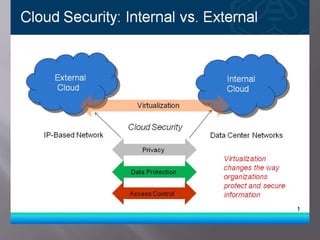
The extensive use of virtualization in
implementing cloud infrastructure brings unique
security concerns for customers or tenants of a
public cloud service
Virtualization alters the relationship between the
OS and underlying hardware , be it computing,
storage or even networking.
1. Internal Cloud
An internal cloud is a cloud computing
service model that is implemented within an
organization's dedicated resources and
infrastructure.
Key Benefits are:
Total cloud security
Reduced infrastructure costs
Reduced hardware requirements
2. External Cloud
An external cloud is a cloud solution
that exists outside of an organization's
physical boundaries. It can be private,
public or community-based, as long as
it is not located on an organization's
property.
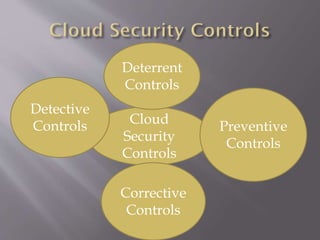
Cloud
Security
Controls
Deterrent
Controls
Preventive
Controls
Detective
Controls
Corrective
Controls
Correct security controls should be
implemented according to asset,
threat, and vulnerability risk
assessment matrices. While cloud
security concerns can be grouped into
any number of dimensions these
dimensions have been aggregated into
following general areas:
•Security and Privacy
•Compliance
•Legal issues
•Contractual Issues
Cloud computing offers clear and powerful
benefits to IT organizations of all sizes, but
the path to cloud computing is often cloudy.
With cloud computing, IT resources can scale
almost immediately in response to business
needs and can be delivered under a predictable
(and budget friendly) pay-as-you-go model.
Cloud computing security

Cloud computing security

  • 1.
  • 2.
     Cloud computingis a type of computing that relies on sharing computing resources rather than having local servers or personal devices to handle applications.  In cloud computing, the word cloud(also phrased as "the cloud") is used as a metaphor for "the Internet," so the phrase cloud computing means "a type of Internet-based computing," where different services — such as servers, storage and applications —are delivered to an organization's computers and devices through the Internet.
  • 3.
    Cloud computing securityalso known as Cloud Security. It refers to a broad set of policies, technologies, and controls deployed to protect data, applications, and the associated infrastructure of cloud computing .
  • 4.
    1.Security issues facedby cloud providers 2.Security issues faced by their customers
  • 5.
    The extensive useof virtualization in implementing cloud infrastructure brings unique security concerns for customers or tenants of a public cloud service Virtualization alters the relationship between the OS and underlying hardware , be it computing, storage or even networking.
  • 7.
    1. Internal Cloud Aninternal cloud is a cloud computing service model that is implemented within an organization's dedicated resources and infrastructure. Key Benefits are: Total cloud security Reduced infrastructure costs Reduced hardware requirements
  • 8.
    2. External Cloud Anexternal cloud is a cloud solution that exists outside of an organization's physical boundaries. It can be private, public or community-based, as long as it is not located on an organization's property.
  • 9.
  • 10.
    Correct security controlsshould be implemented according to asset, threat, and vulnerability risk assessment matrices. While cloud security concerns can be grouped into any number of dimensions these dimensions have been aggregated into following general areas:
  • 11.
  • 12.
    Cloud computing offersclear and powerful benefits to IT organizations of all sizes, but the path to cloud computing is often cloudy. With cloud computing, IT resources can scale almost immediately in response to business needs and can be delivered under a predictable (and budget friendly) pay-as-you-go model.