Cloud Computing
Members
.
Rana M Zubair Arshad(35)
Enam-ul-Haq(53)
Areeba Shahzad(44)
Talha Malik(48)
M Ahsan(32)
Moin Abba(04)
Shah Zaman(46) NFC Institute of Engineering
& Technology Multan
Pakistan
BSCS
Session 2013-2017
• Rana M Zubair Arshad
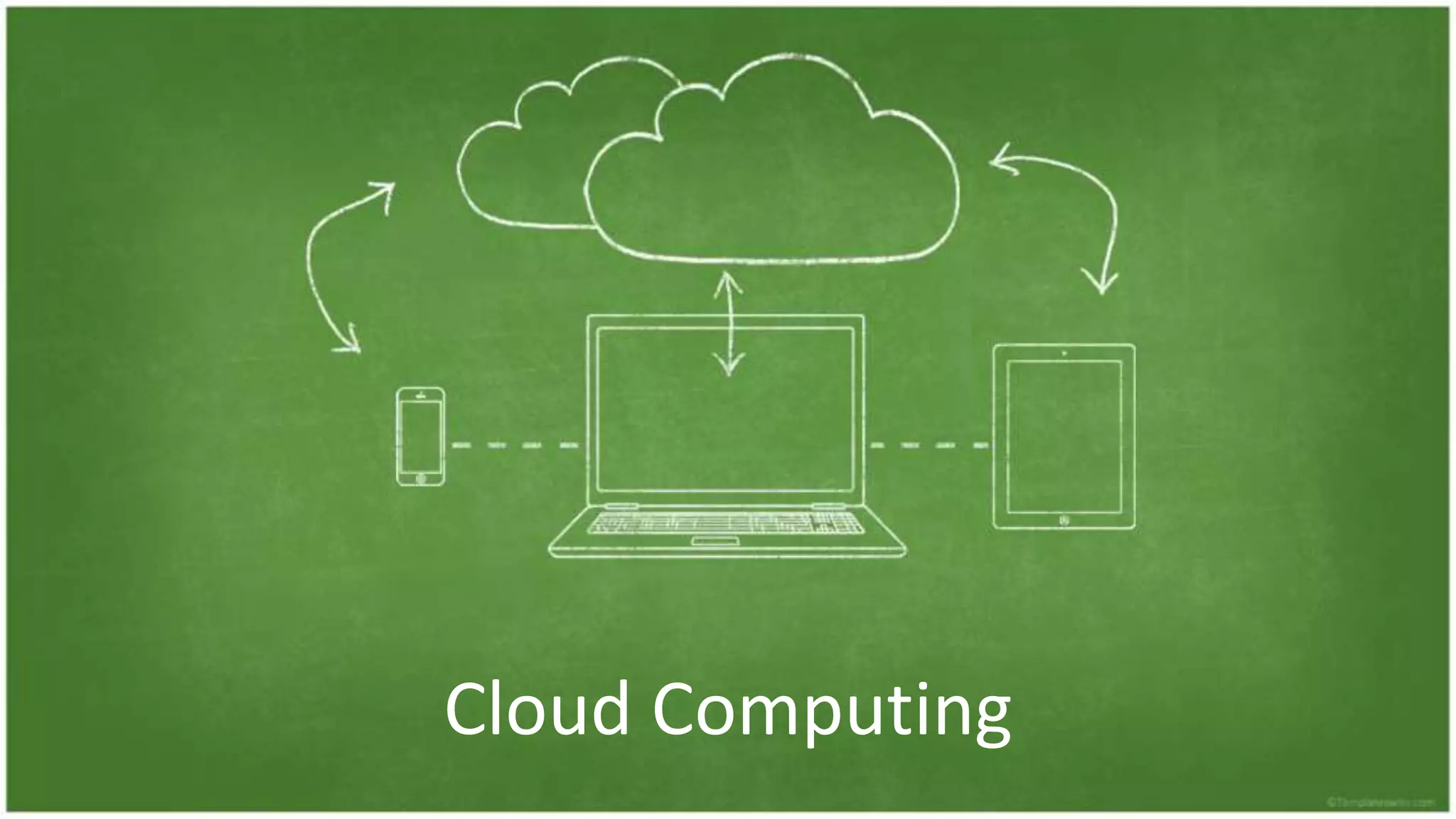
“Cloud” ?
• In cloud computing, the word cloud (also
phrased as "the cloud") is used as a
metaphor for "the Internet,"
• The phrase cloud computing means "a
type of Internet-based computing," where
different services— such as servers,
storage and applications — are delivered
to an organization's computers and
devices through the Internet.
Definition
• The practice of using a network of
remote servers hosted on the
Internet to store, manage, and
process data, rather than a local
server or a personal computer.
Cloud computing is a model for delivering information
technology services in which resources are retrieved
from the internet through web-based tools and
applications, rather than a direct connection to a
server
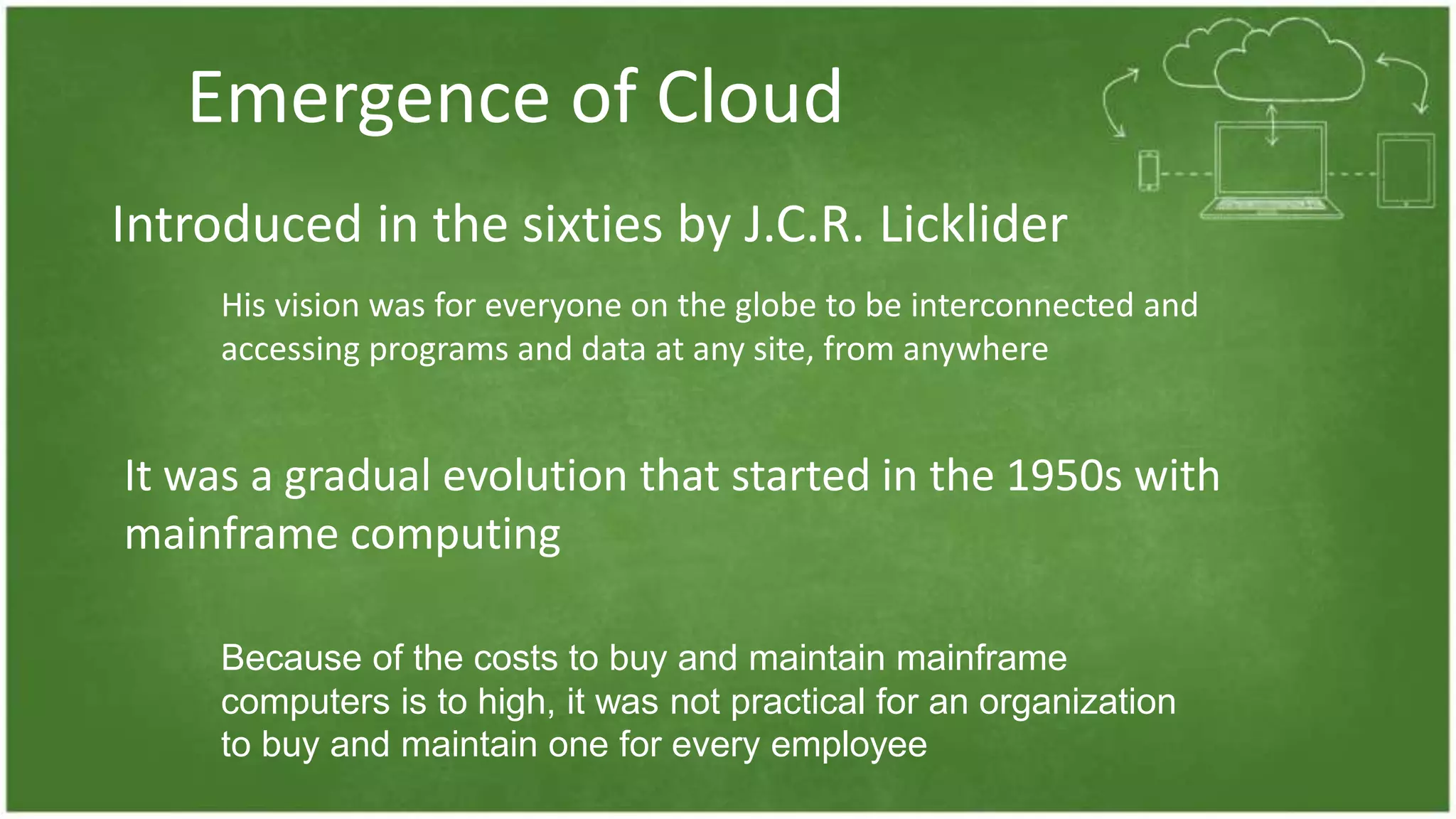
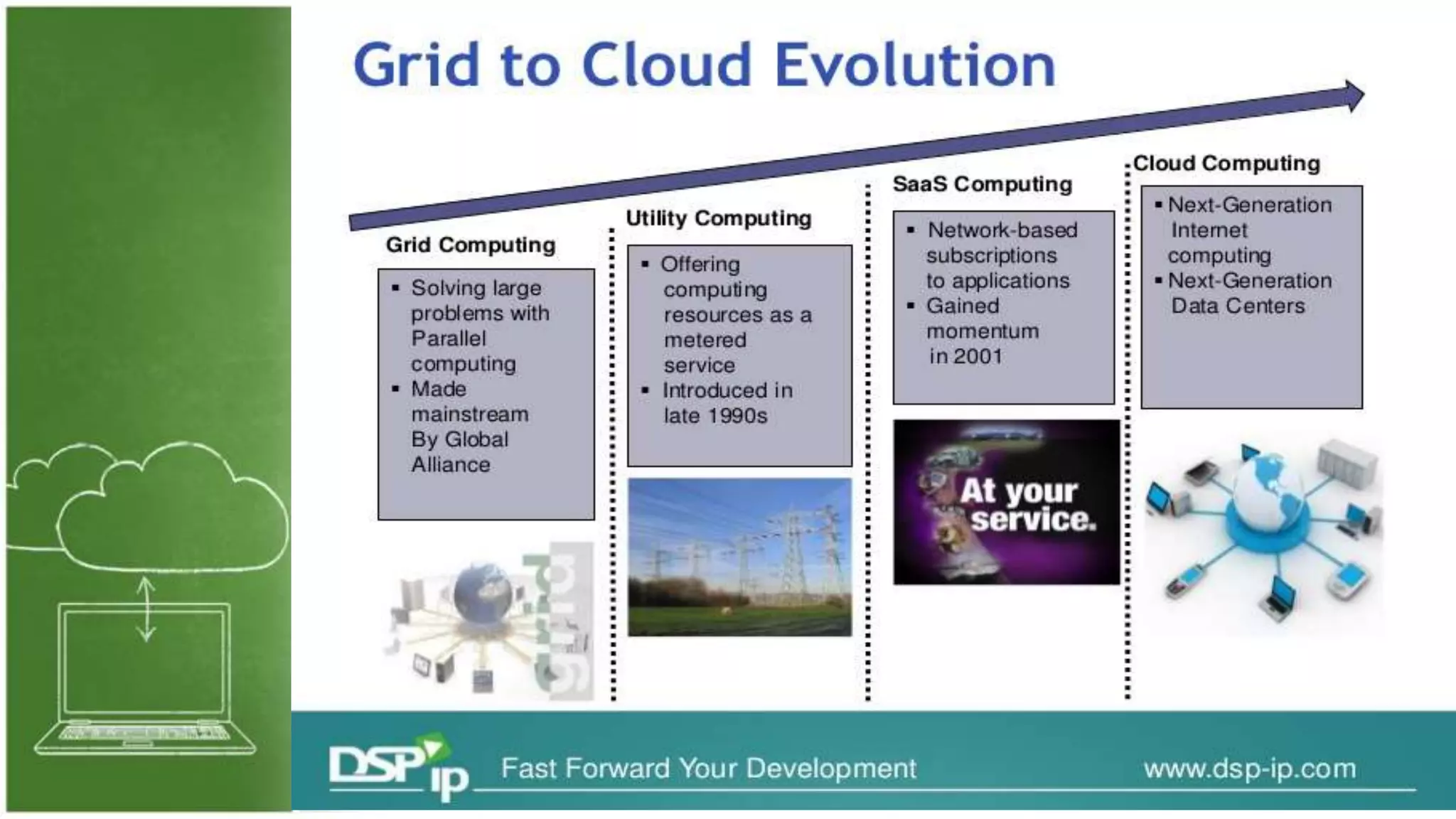
Emergence of Cloud
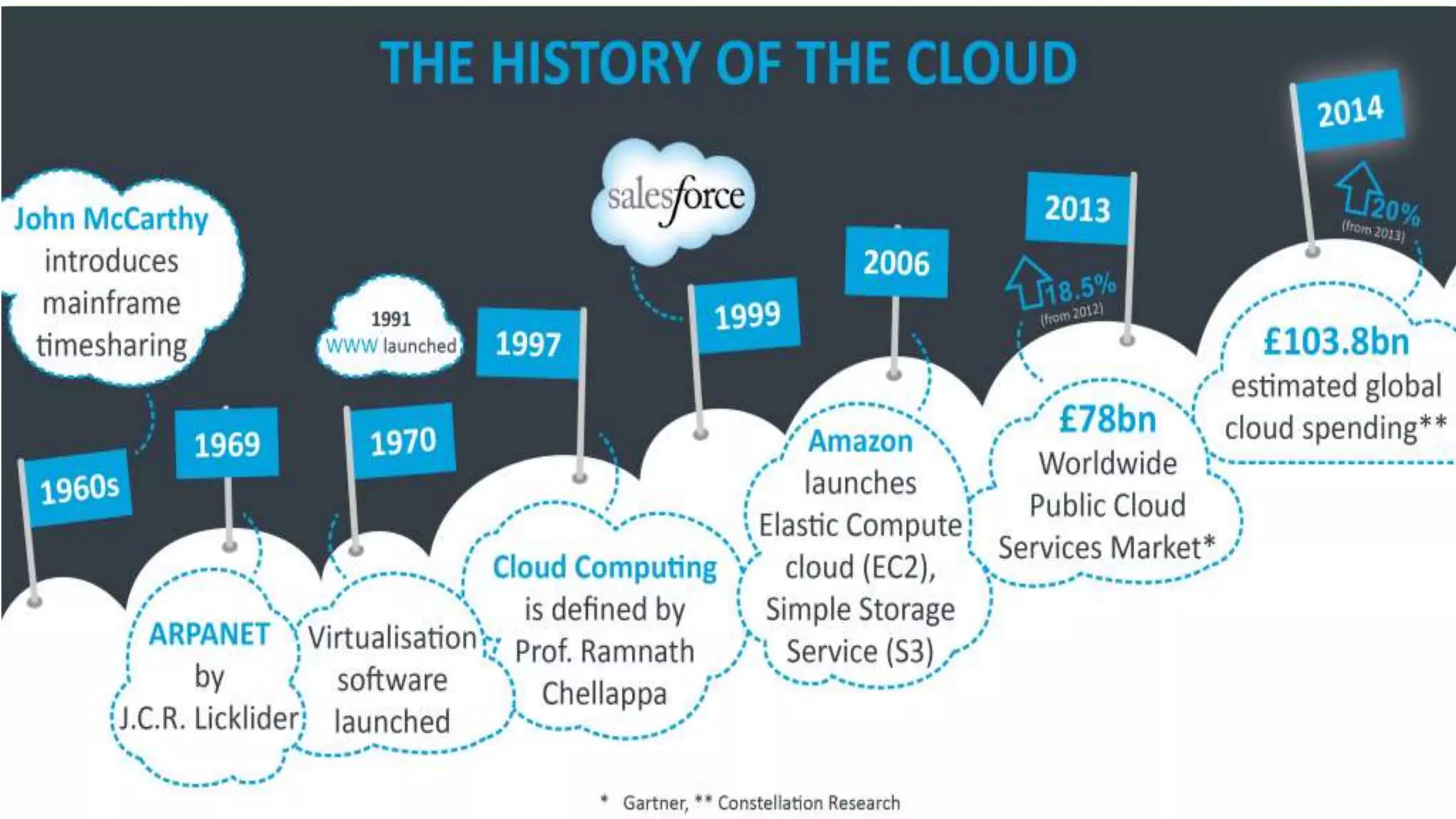
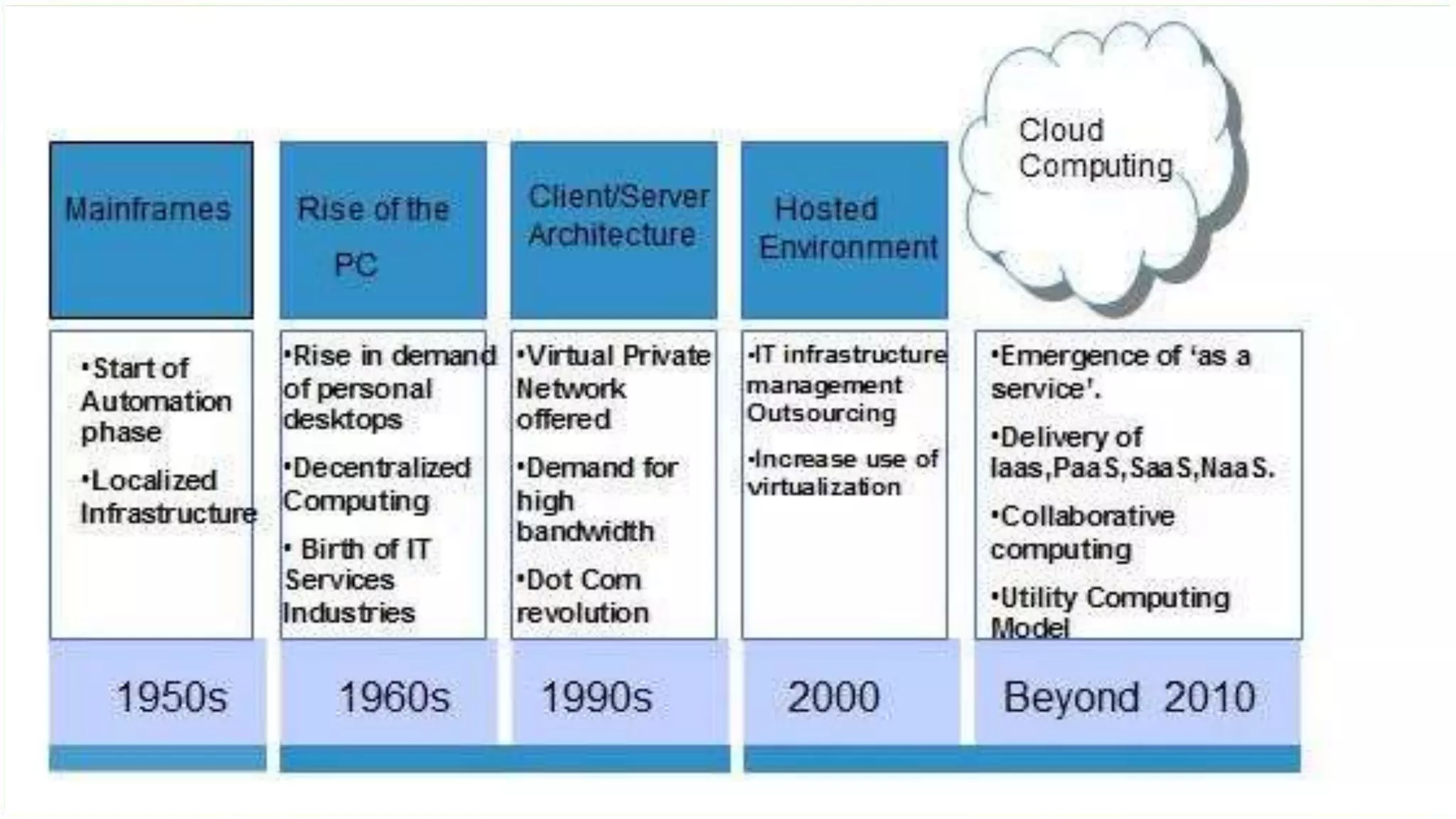
Introduced in the sixties by J.C.R. Licklider
His vision was for everyone on the globe to be interconnected and
accessing programs and data at any site, from anywhere
It was a gradual evolution that started in the 1950s with
mainframe computing
Because of the costs to buy and maintain mainframe
computers is to high, it was not practical for an organization
to buy and maintain one for every employee
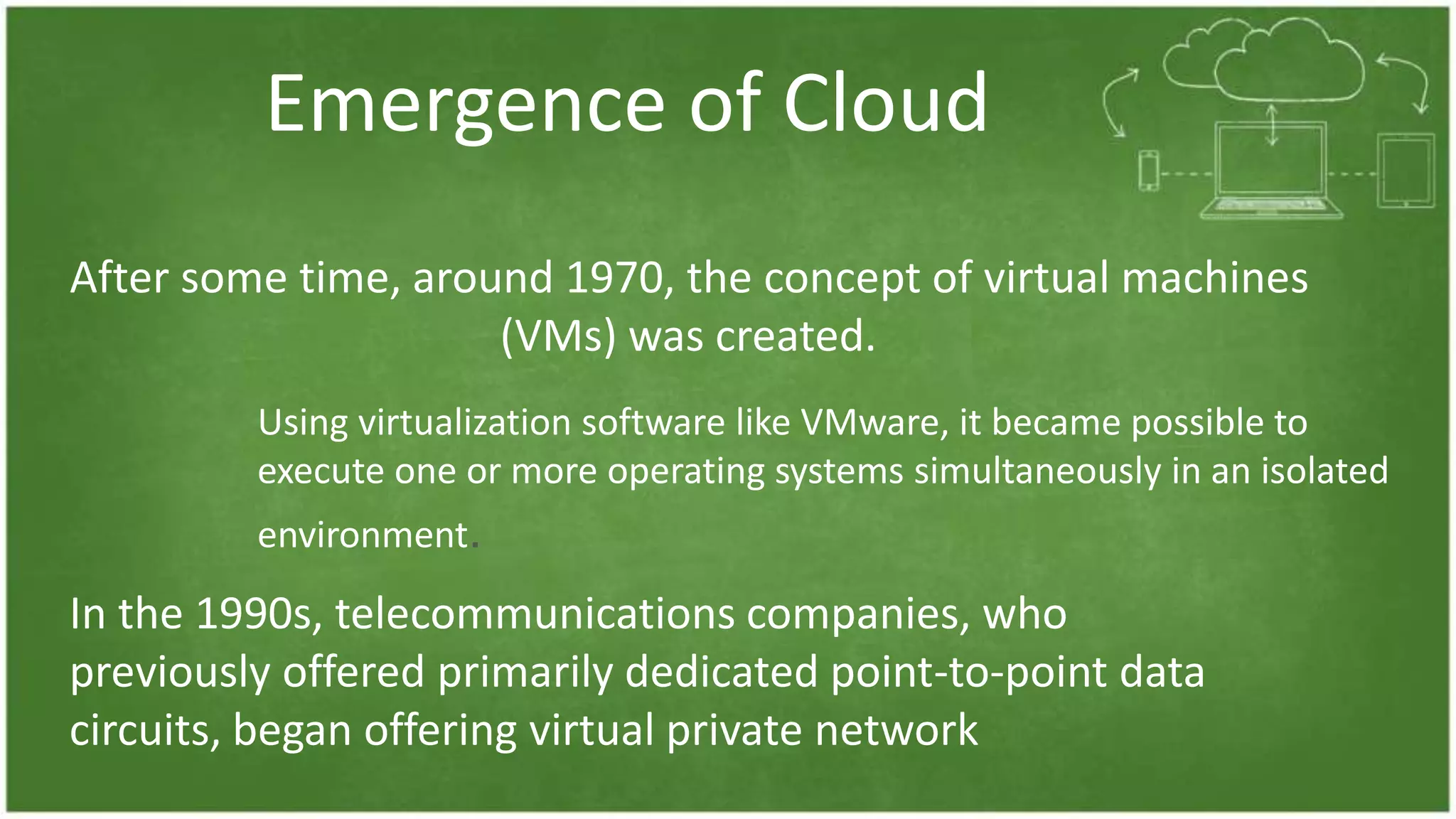
Emergence of Cloud
After some time, around 1970, the concept of virtual machines
(VMs) was created.
Using virtualization software like VMware, it became possible to
execute one or more operating systems simultaneously in an isolated
environment.
In the 1990s, telecommunications companies, who
previously offered primarily dedicated point-to-point data
circuits, began offering virtual private network
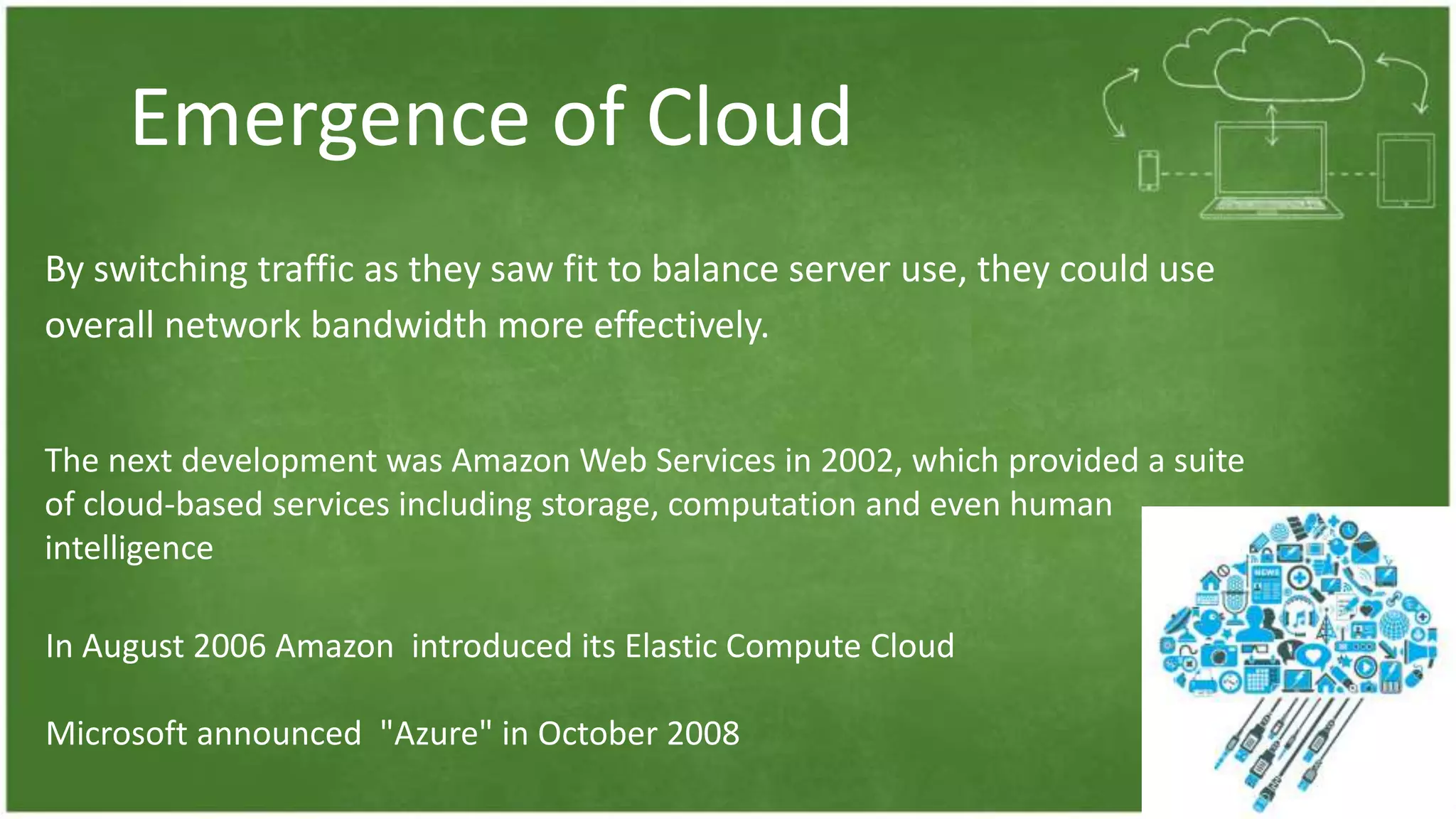
Emergence of Cloud
By switching traffic as they saw fit to balance server use, they could use
overall network bandwidth more effectively.
The next development was Amazon Web Services in 2002, which provided a suite
of cloud-based services including storage, computation and even human
intelligence
In August 2006 Amazon introduced its Elastic Compute Cloud
Microsoft announced "Azure" in October 2008
Talha Malik
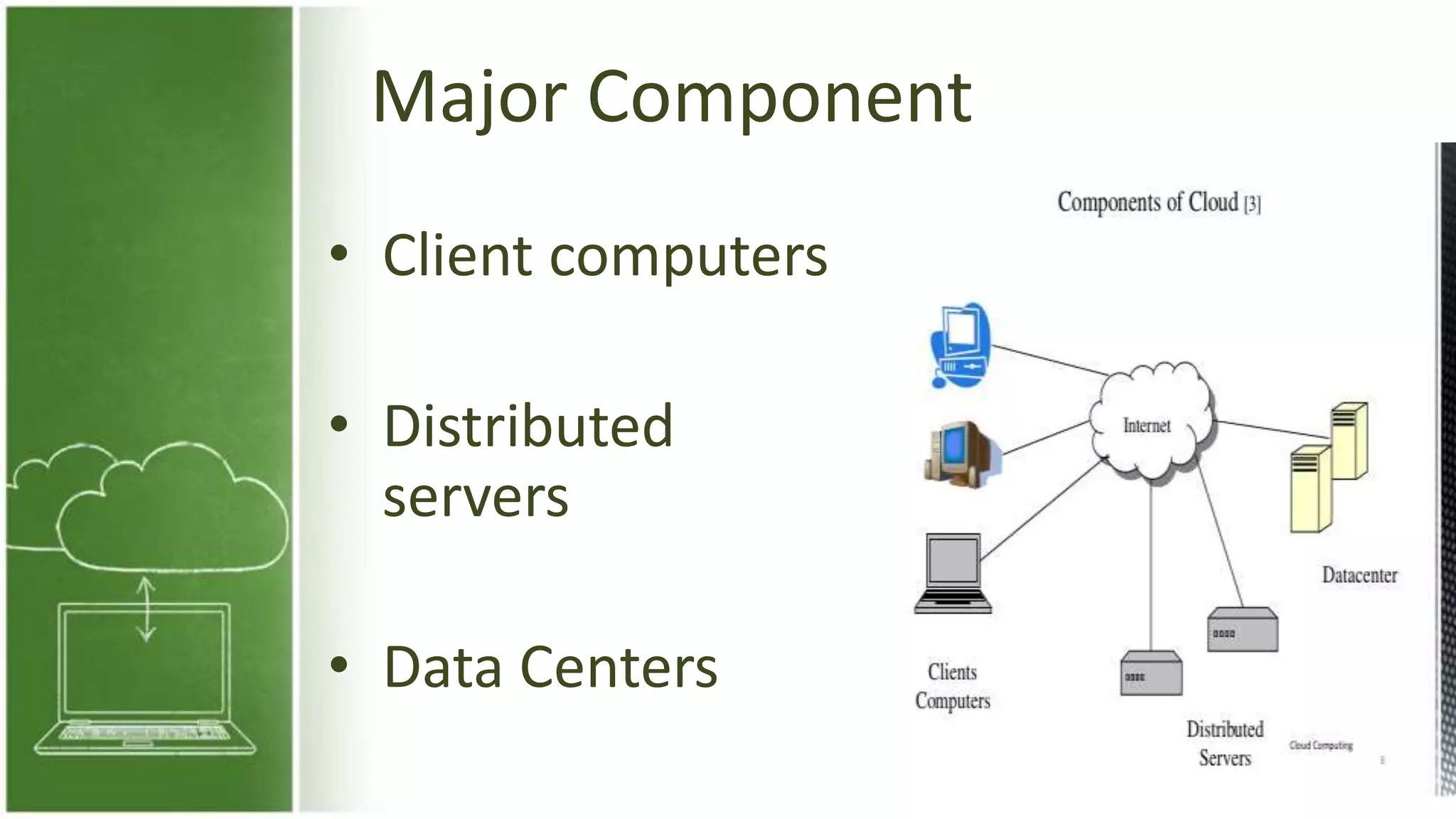
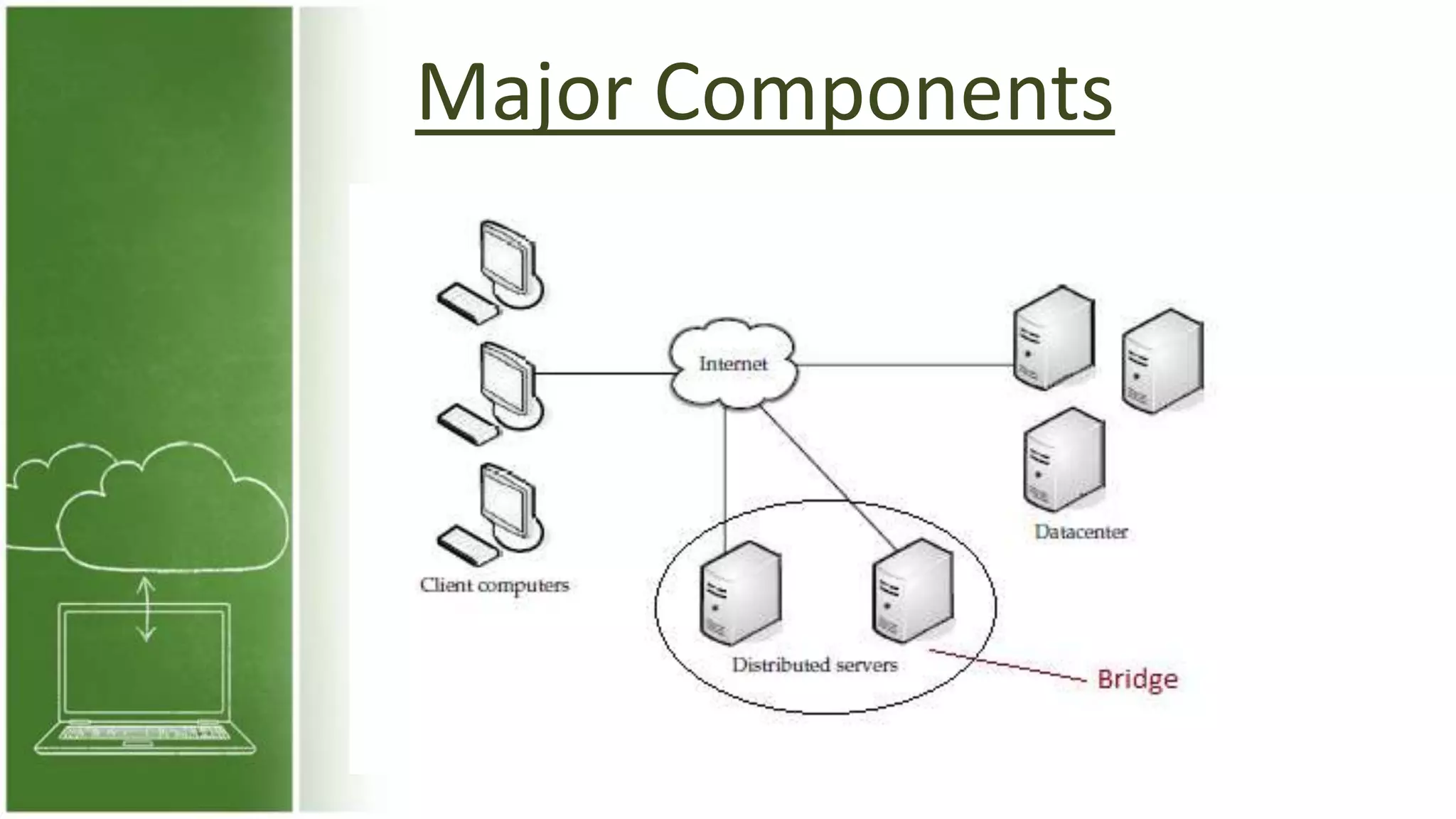
Major Component
• Client computers
• Distributed
servers
• Data Centers
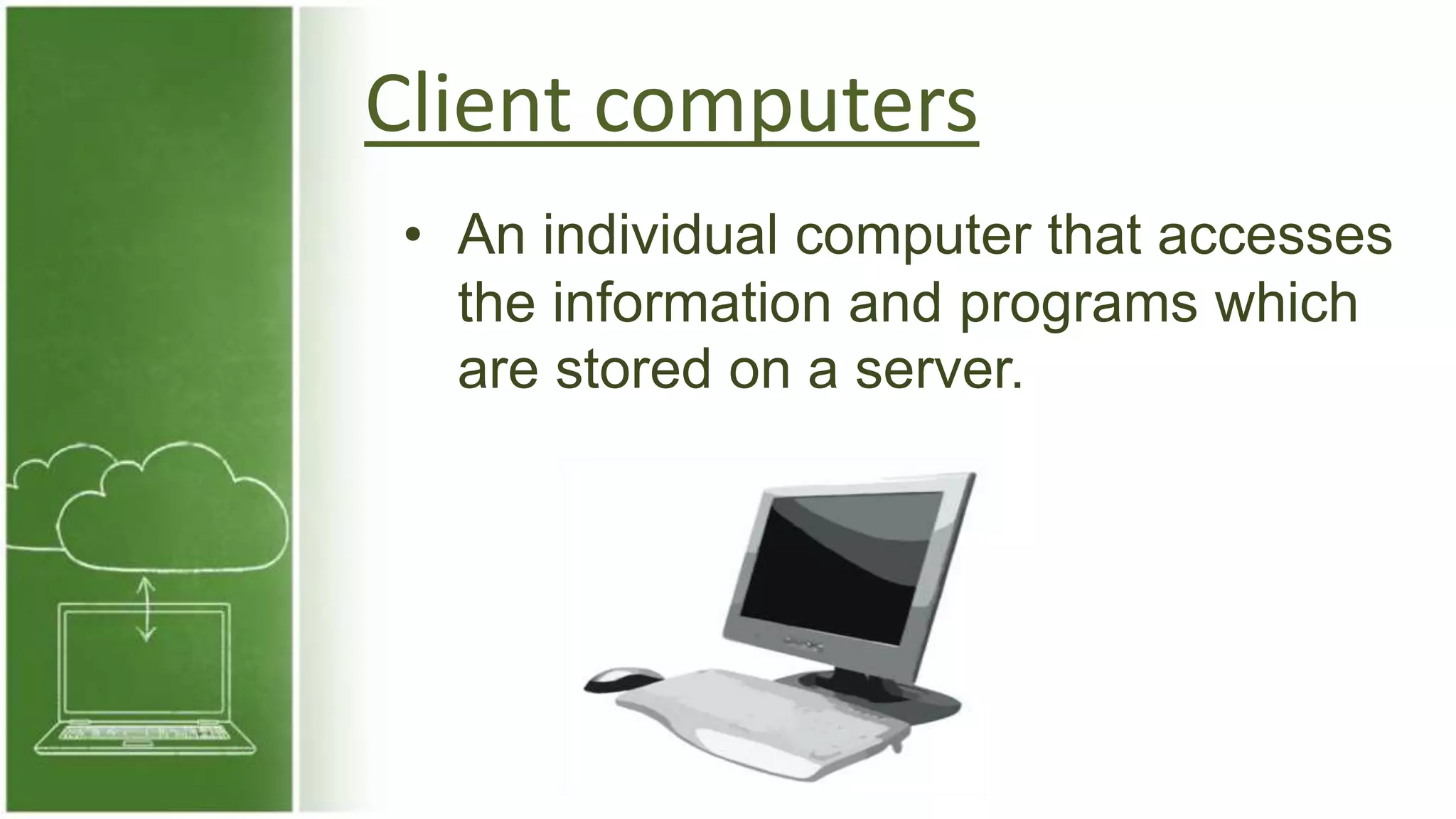
Client computers
• An individual computer that accesses
the information and programs which
are stored on a server.
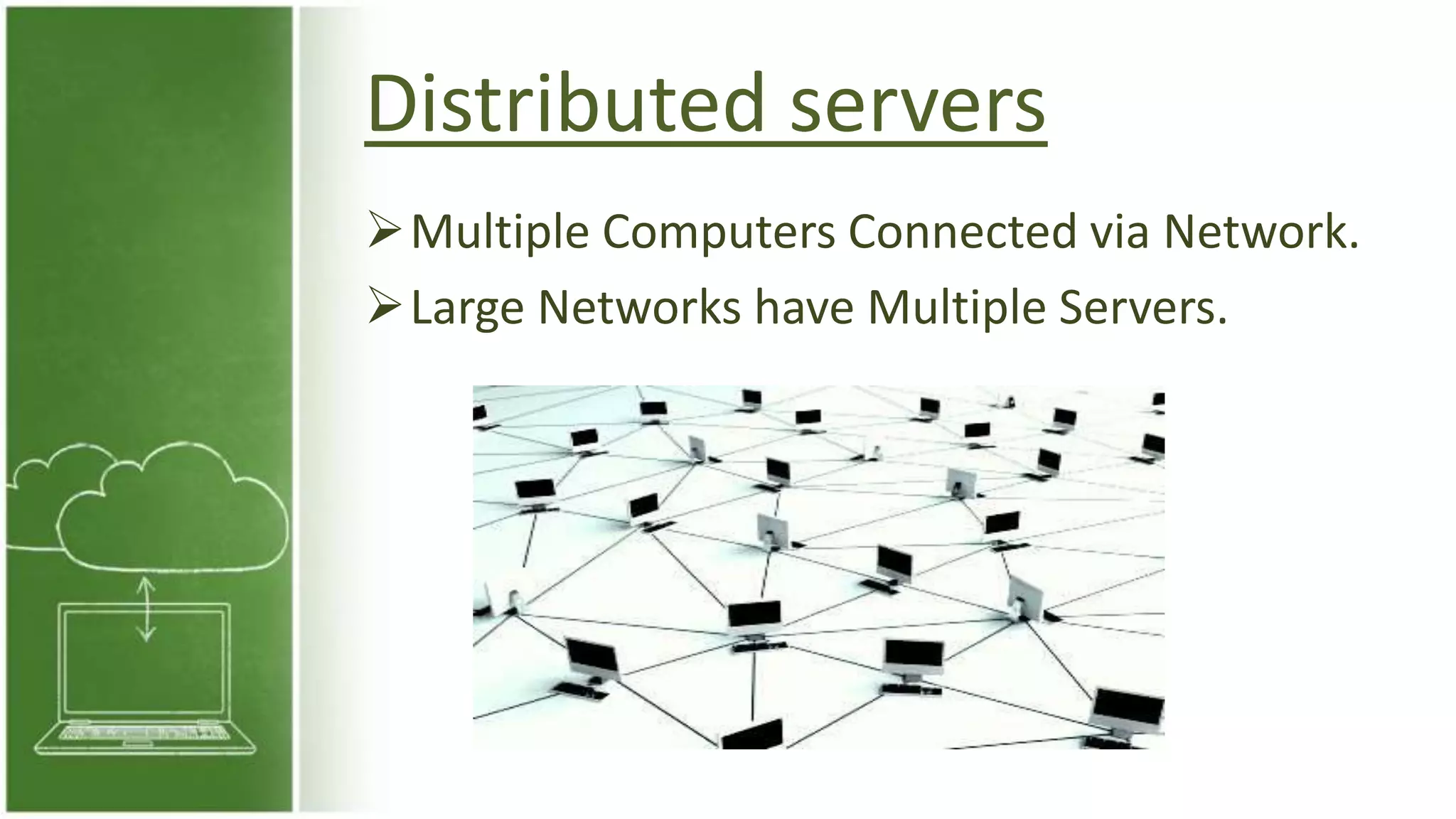
Distributed servers
Multiple Computers Connected via Network.
Large Networks have Multiple Servers.
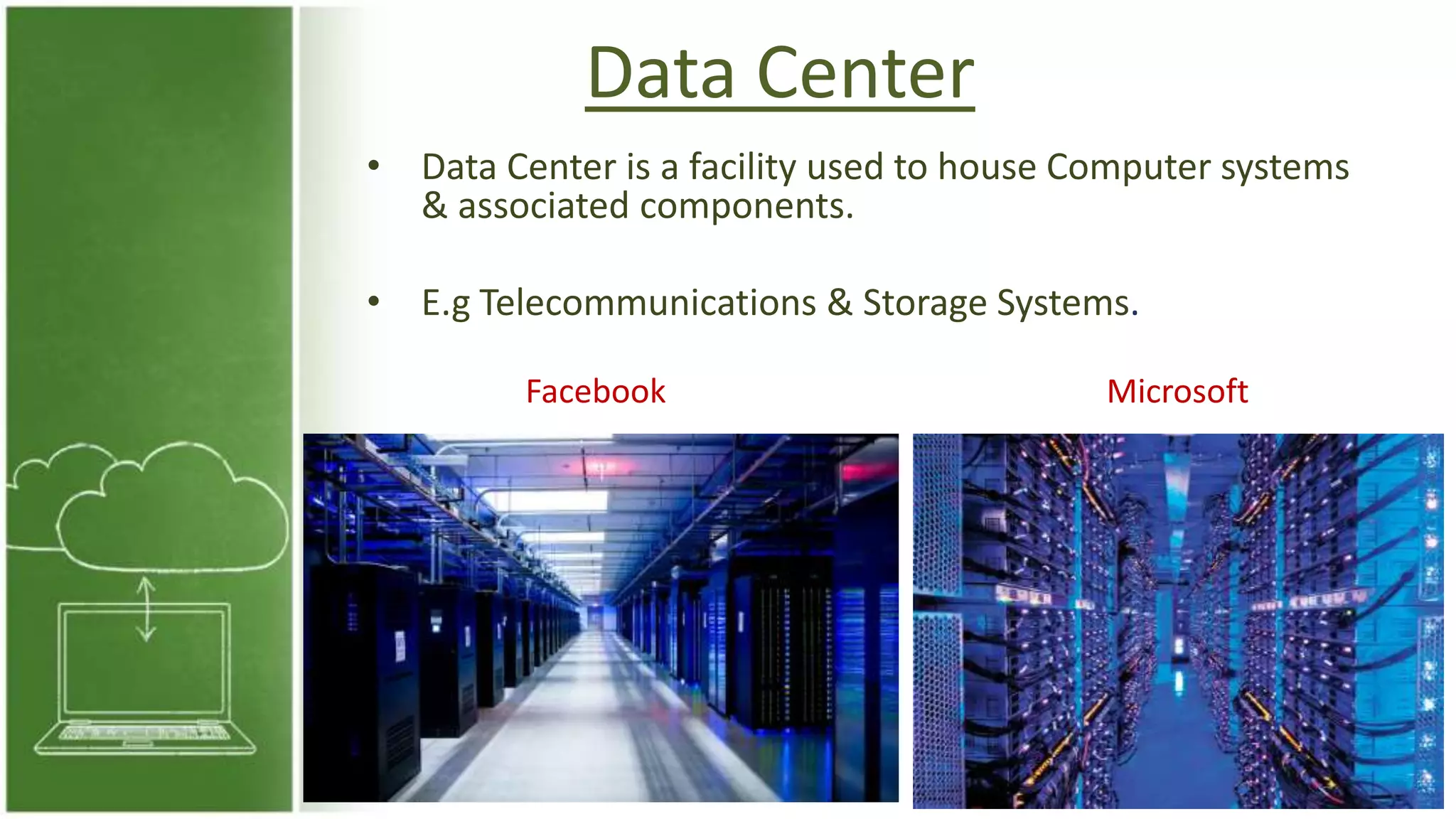
Data Center
• Data Center is a facility used to house Computer systems
& associated components.
• E.g Telecommunications & Storage Systems.
Facebook Microsoft
Major Components
Architecture
• Front-end device
• Back-end platform
• Cloud-based delivery
• Network
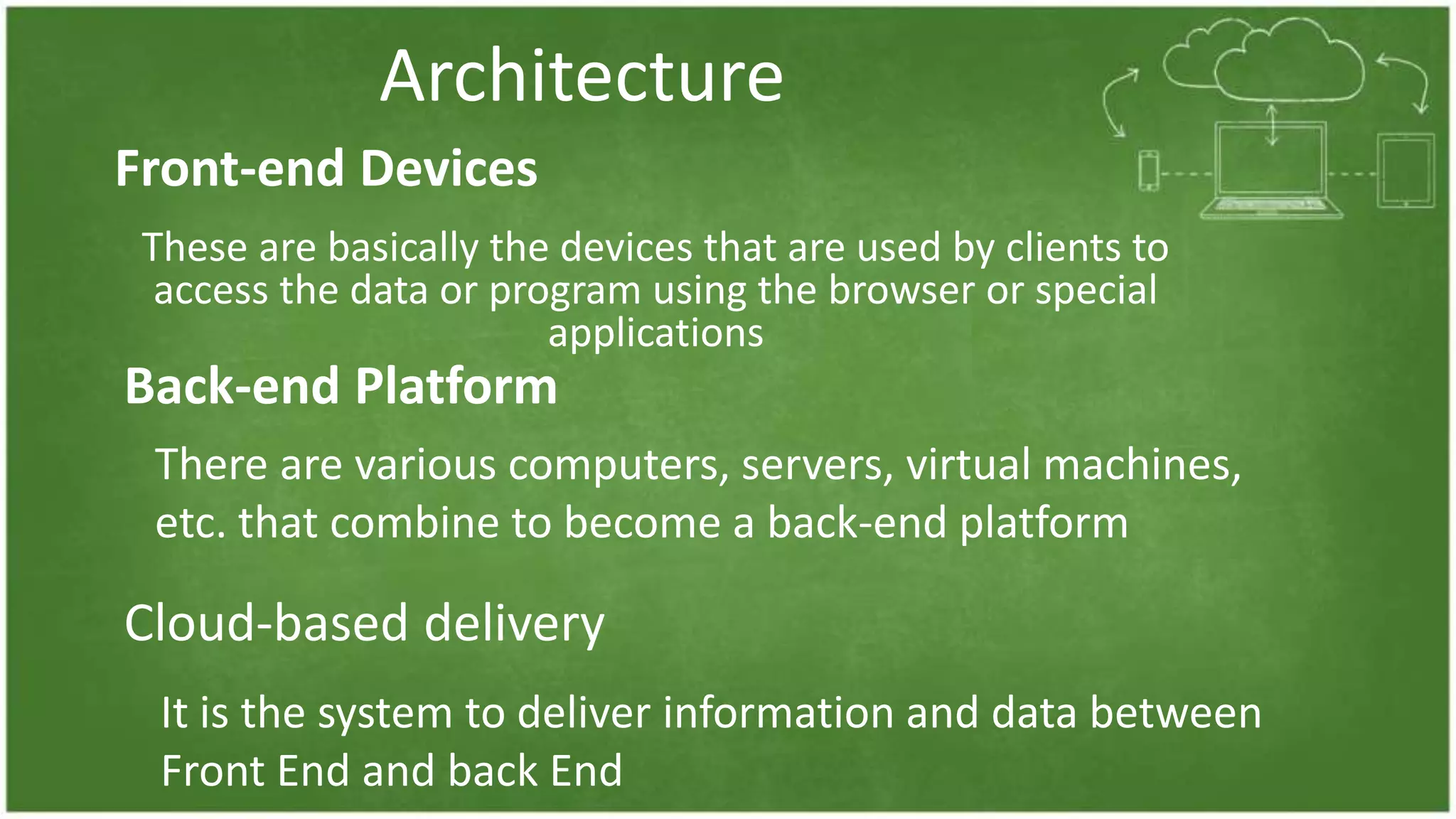
The architecture of cloud computing comprises of the following
components
Architecture
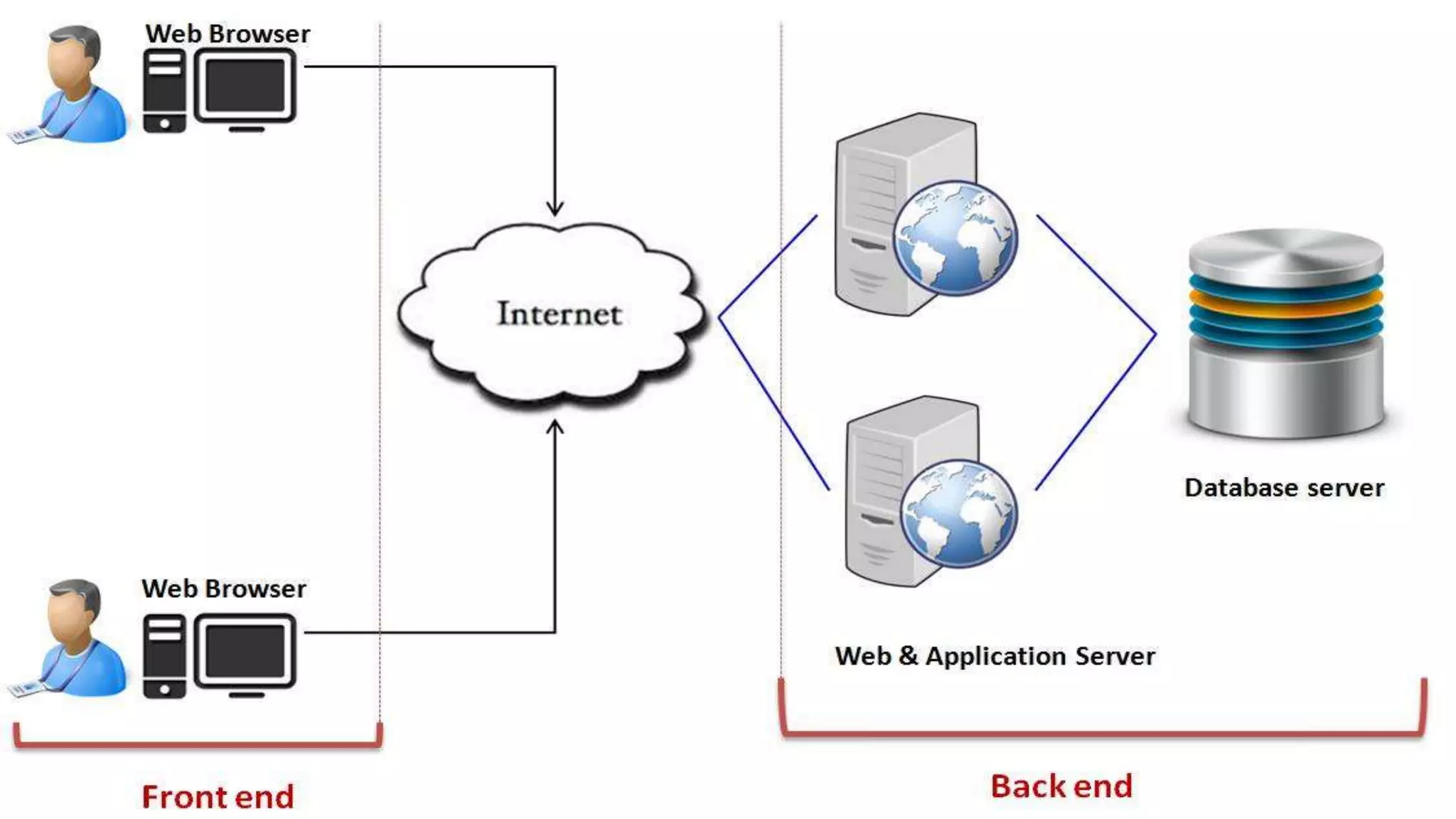
These are basically the devices that are used by clients to
access the data or program using the browser or special
applications
Front-end Devices
Back-end Platform
There are various computers, servers, virtual machines,
etc. that combine to become a back-end platform
Cloud-based delivery
It is the system to deliver information and data between
Front End and back End
Example
Enam-Ul-Haq
Service Structure/Models
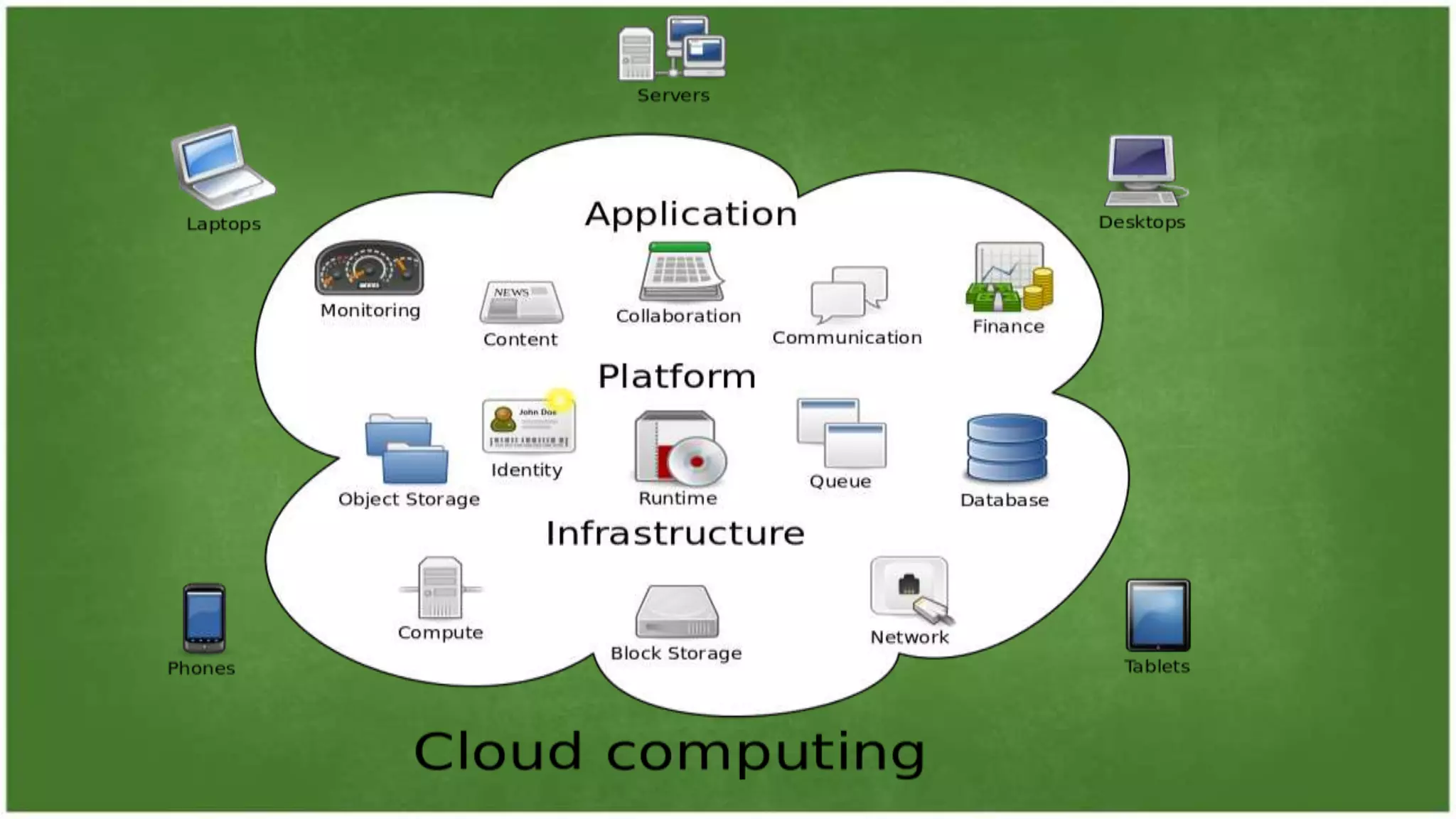
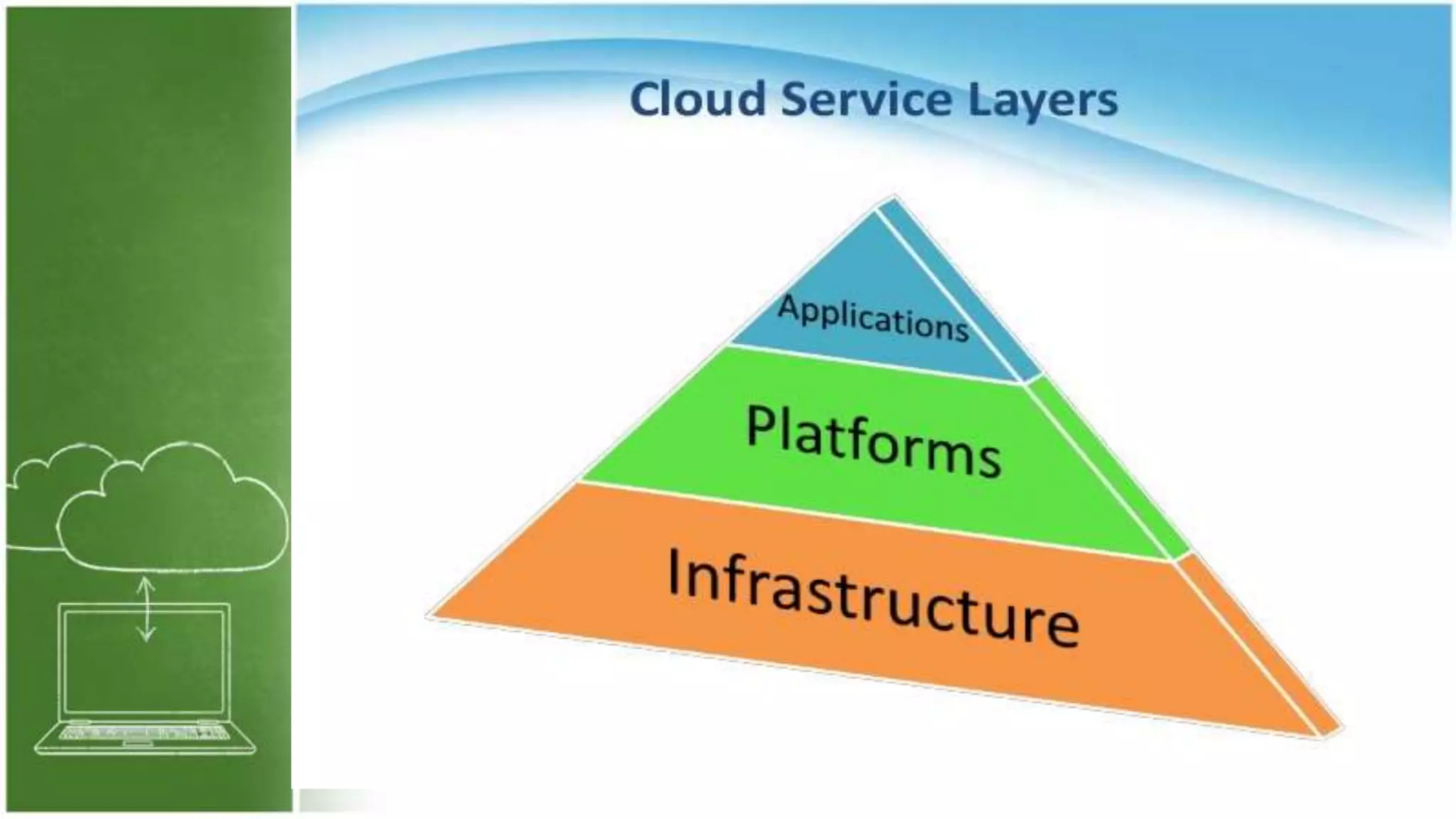
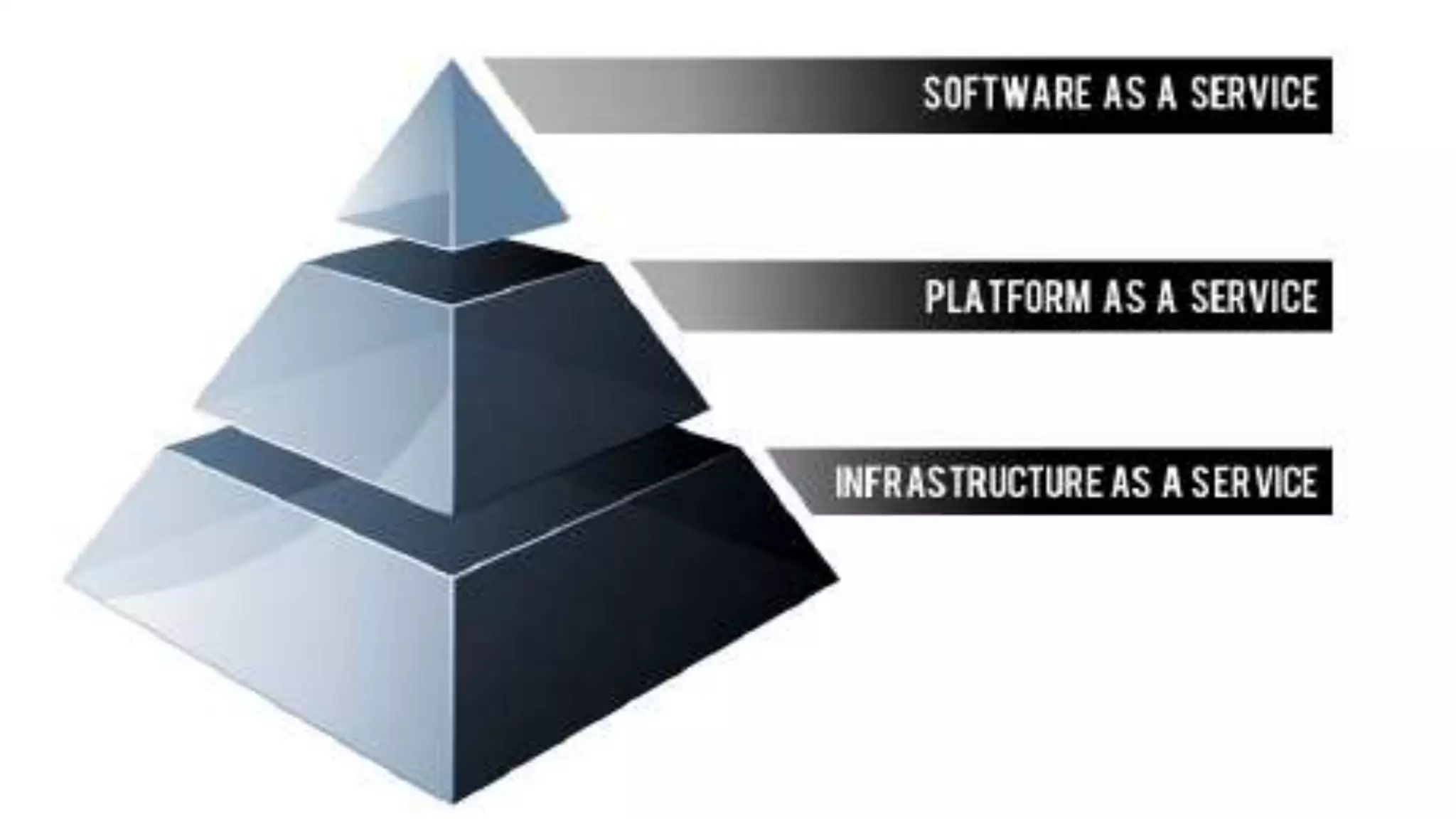
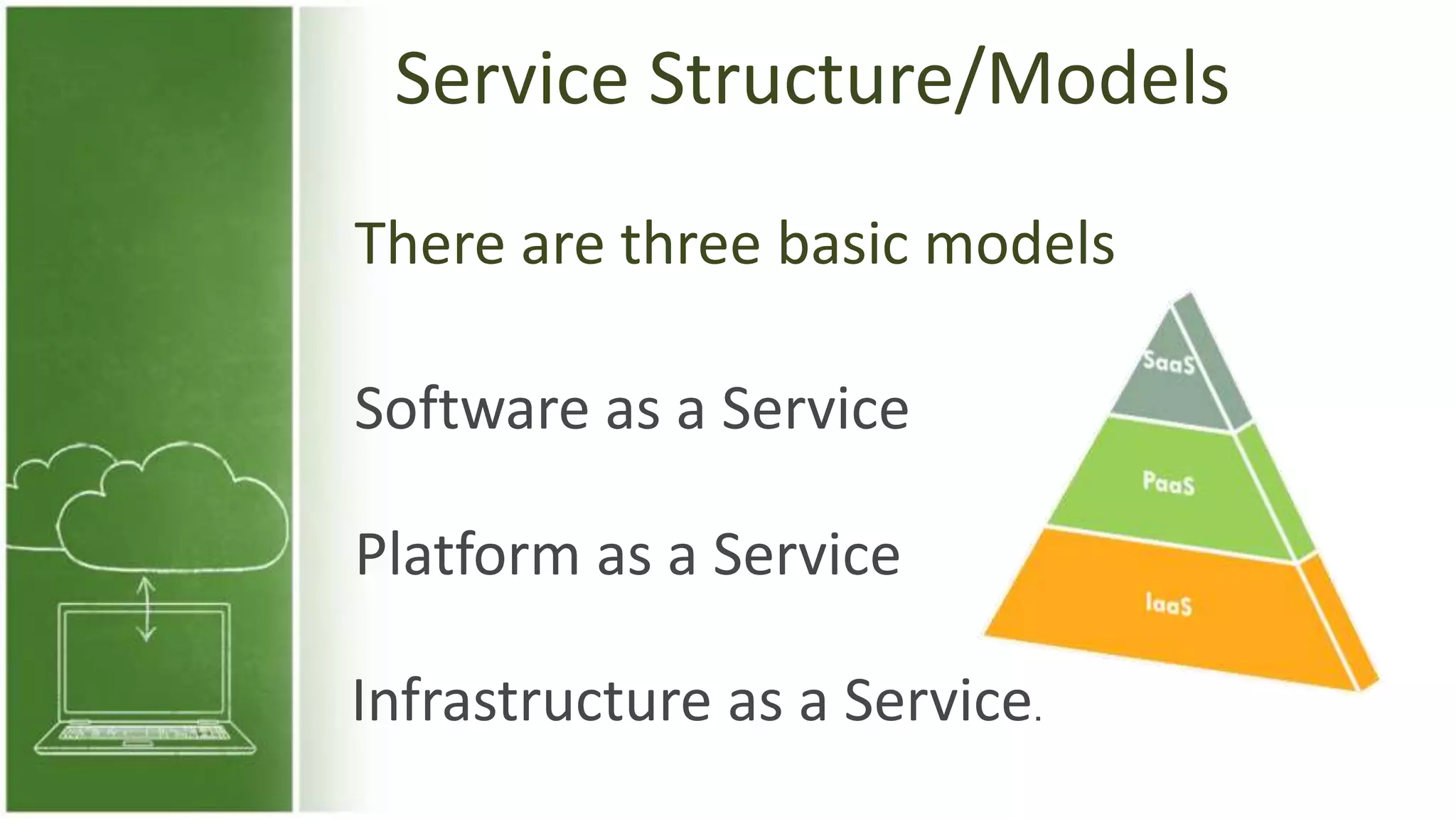
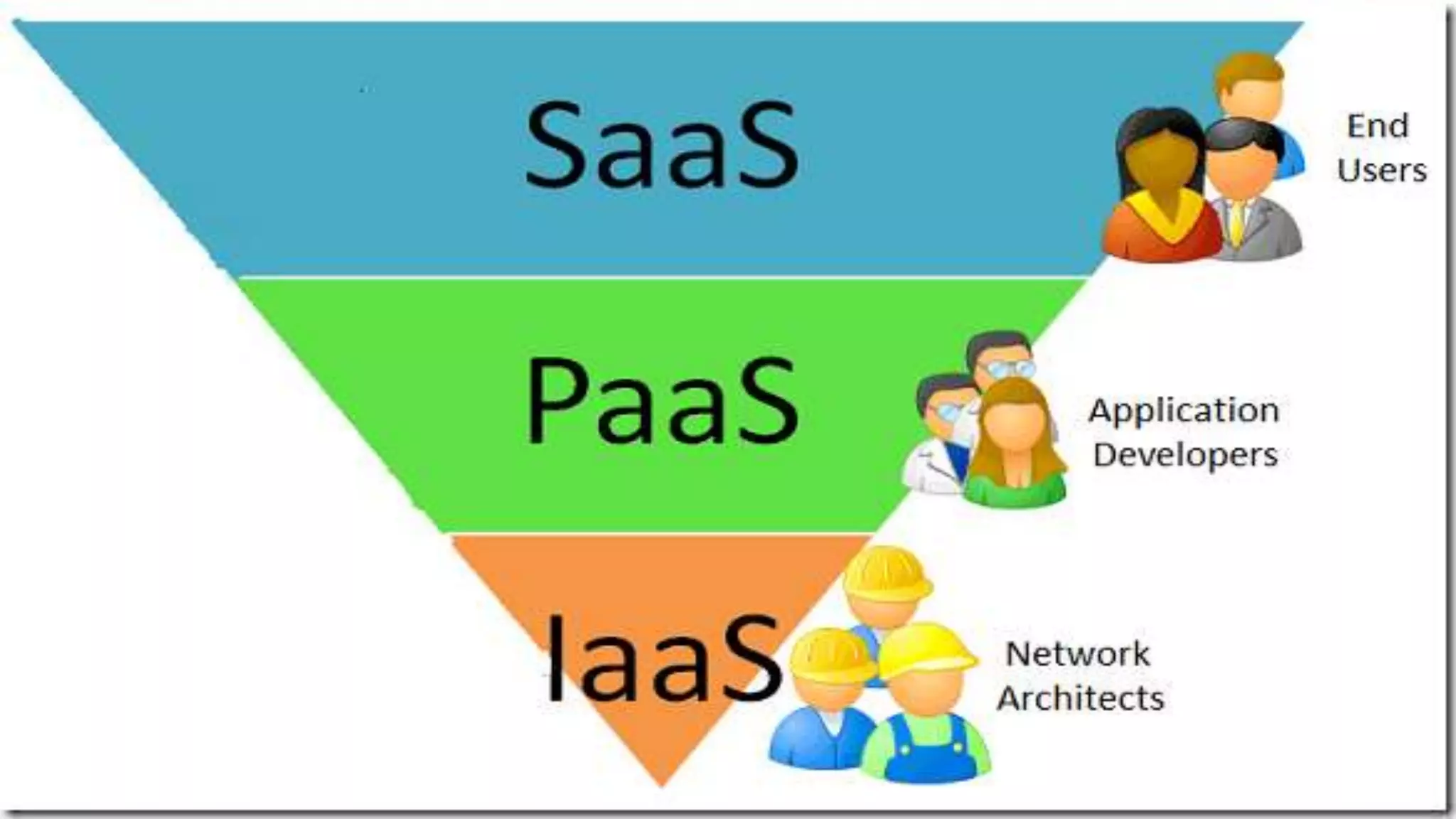
There are three basic models
Software as a Service
Platform as a Service
Infrastructure as a Service.
• Infrastructure as a Service (IaaS) is
a way of delivering Cloud
Computing infrastructure –
servers, storage, network and
operating systems – as an on-
demand service
Characteristics of Iass
• Resources are distributed as a service
• Allows for dynamic scaling
• Has a variable cost, utility pricing model
• Generally includes multiple users on a single
piece of hardware
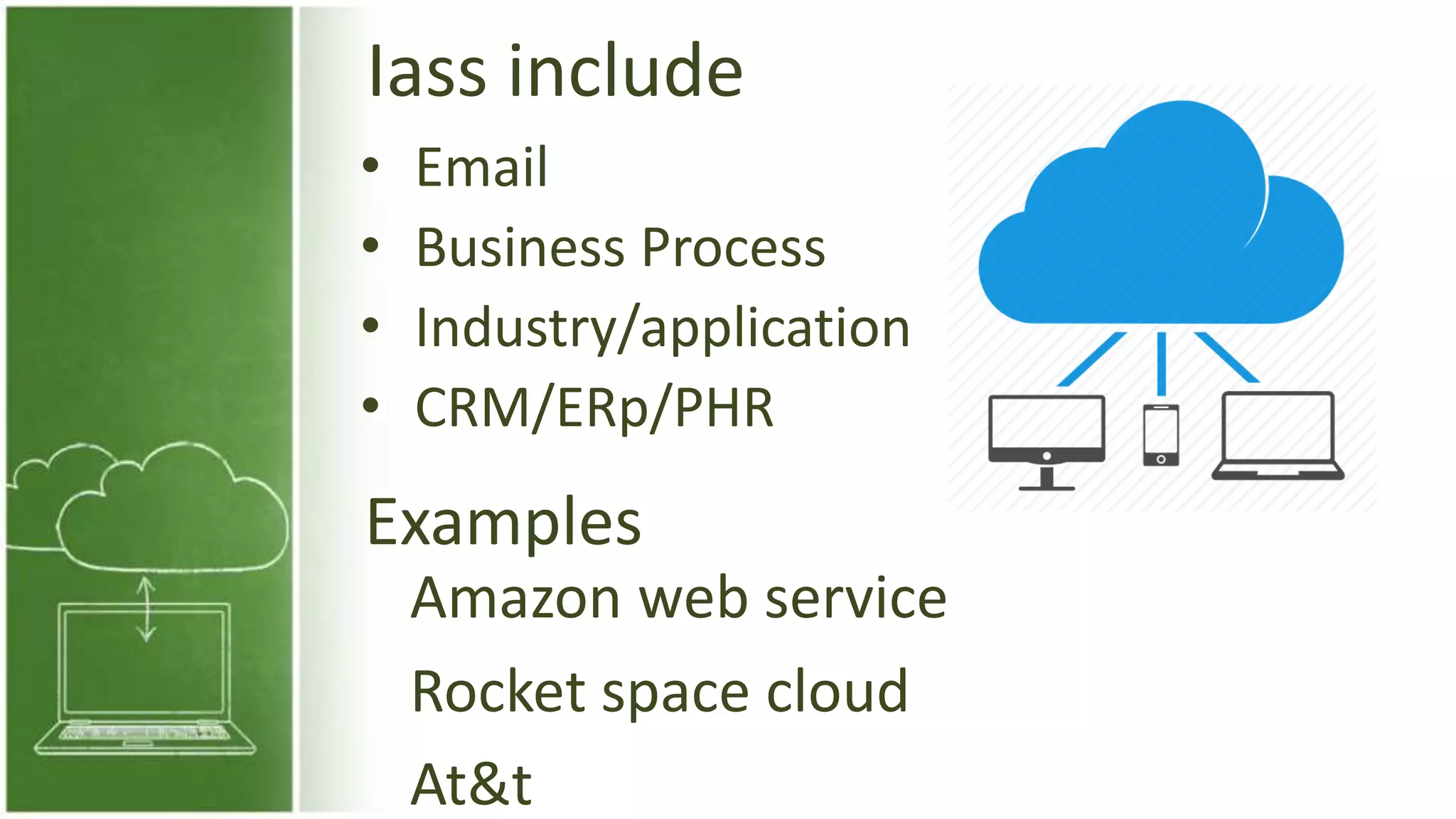
Iass include
• Email
• Business Process
• Industry/application
• CRM/ERp/PHR
Examples
Amazon web service
Rocket space cloud
At&t
Platform as a Service
• PaaS can be defined as a computing
platform that allows the creation of
web applications quickly and easily
and without the complexity of buying
and maintaining the software and
infrastructure underneath it
it is a platform for the creation of
software, delivered over the web
Characteristics of pass
• Services to develop, test, deploy, host and maintain applications in the same
integrated development environment. All the varying services needed to fulfil the
application development process
• Web based user interface creation tools help to create, modify, test and deploy
different UI scenarios
• Multi-tenant architecture where multiple concurrent users utilize the same
development application
• Built in scalability of deployed software including load balancing and failover
• Integration with web services and databases via common standards
• Support for development team collaboration – some PaaS solutions include project
planning and communication tools
• Tools to handle billing and subscription management
Pass include
• Middleware
• Web 2.0 Aplication Runtime
• Development Tooling
• Database
• Java Runtime
Example
Google App Engine
Force.com Window Azure
Software as a Service
• software that is deployed over the
internet
• In the software as a service (SaaS)
model, users gain access to
application software and databases
Characteristics of sass
• Web access to commercial software
• Software is managed from a central location
• Software delivered in a “one to many” model
• Users not required to handle software
upgrades and patches
• Application Programming Interfaces (APIs)
allow for integration between different pieces of
software
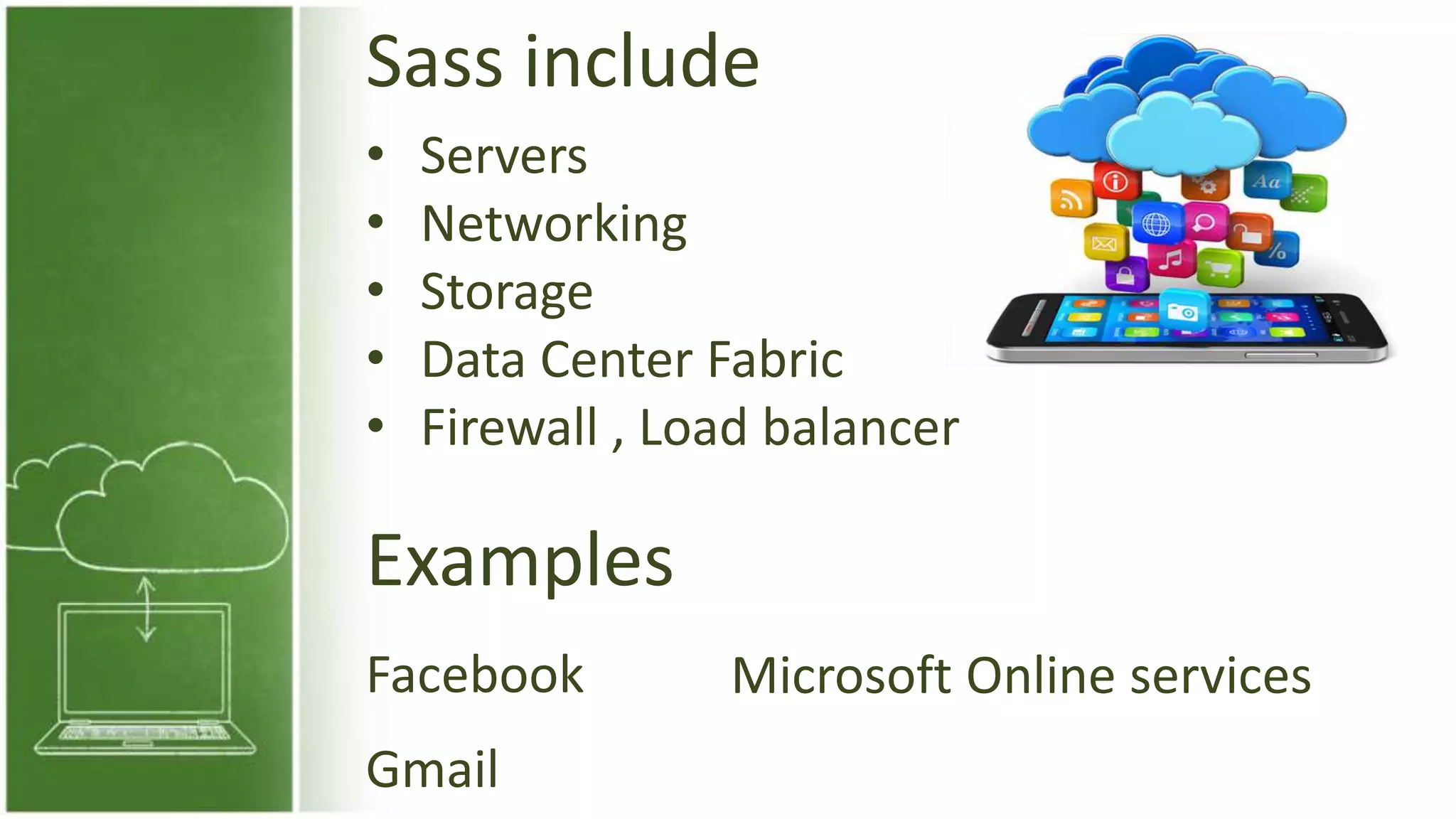
Sass include
• Servers
• Networking
• Storage
• Data Center Fabric
• Firewall , Load balancer
Gmail
Facebook Microsoft Online services
Examples
Ahsan
Cloud Characteristics
• On demand self service
• Ubiquitous network access
• Location Independent
• Rapid Elasticity
• Pay per use
Supporting Factors
• Advancement in processor
• Virtualization Technology
• Distributed Storage
• Automated Management
• Broadband internet Access
• Fast and Inexpensive server
Areeba Shahzad
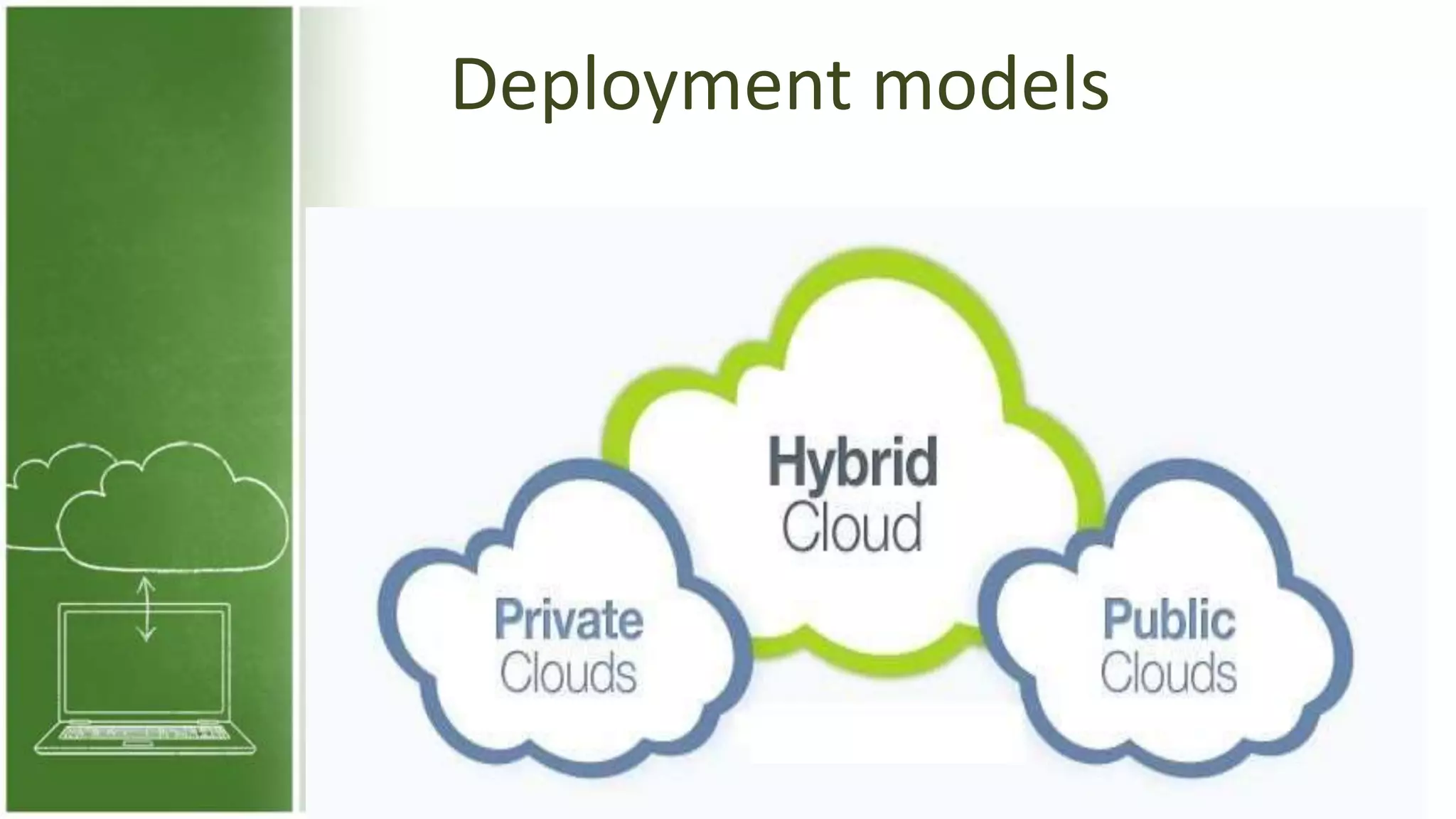
Deployment models
Public Cloud
• when the services are rendered over a network that
is open for public use
• The customers do not have any distinguishability
and control over the location of the infrastructure
• From the technical viewpoint, there may be slight or
no difference between private and public clouds’
structural design except in the level of security
• Public cloud is better suited for business
requirements which require managing the load; host
application
Private Cloud
• is also known as internal cloud
• the platform for cloud computing is implemented on a
cloud-based secure environment that is safeguarded by a
firewall
• Private cloud as it permits only the authorized users,
gives the organization greater and direct control over
their data
• Businesses that have dynamic or unforeseen needs,
assignments which are mission critical, security alarms,
management demands and uptime requirements are
better suited to adopt private cloud
Hybrid Cloud
• It is integrated and can be an arrangement of two or
more cloud servers
• Organizations can use the hybrid cloud model for
processing big data
• It permits the user to increase the capacity or the
capability by aggregation, assimilation or
customization with another cloud package / service
• Hybrid cloud hosting is enabled with features like
scalability, flexibility and security
Others Cloud Models
• is a type of cloud hosting in which the setup is
mutually shared between many Organizations that
belong to a particular community, i.e. banks and
trading firms.
• The community members generally share similar
privacy, performance and security concerns
• The cost is shared by the specific Organizations
within the community, hence, community cloud has
cost saving capacity
Community Model
Others Cloud Models
A cloud computing platform can be assembled from a distributed
set of machines in different locations, connected to a single network
or hub service.
Distributed Cloud
Inter cloud
is an interconnected global "cloud of clouds“The focus is on
direct interoperability between public cloud service providers,
more so than between providers and consumers
Shah Zaman
Security
• potentially sensitive data is at risk from insider
attacks
• More than one user on same server by Cloud
service provider
• Hacked interfaces and APIs
• Exploited system vulnerabilities
Security
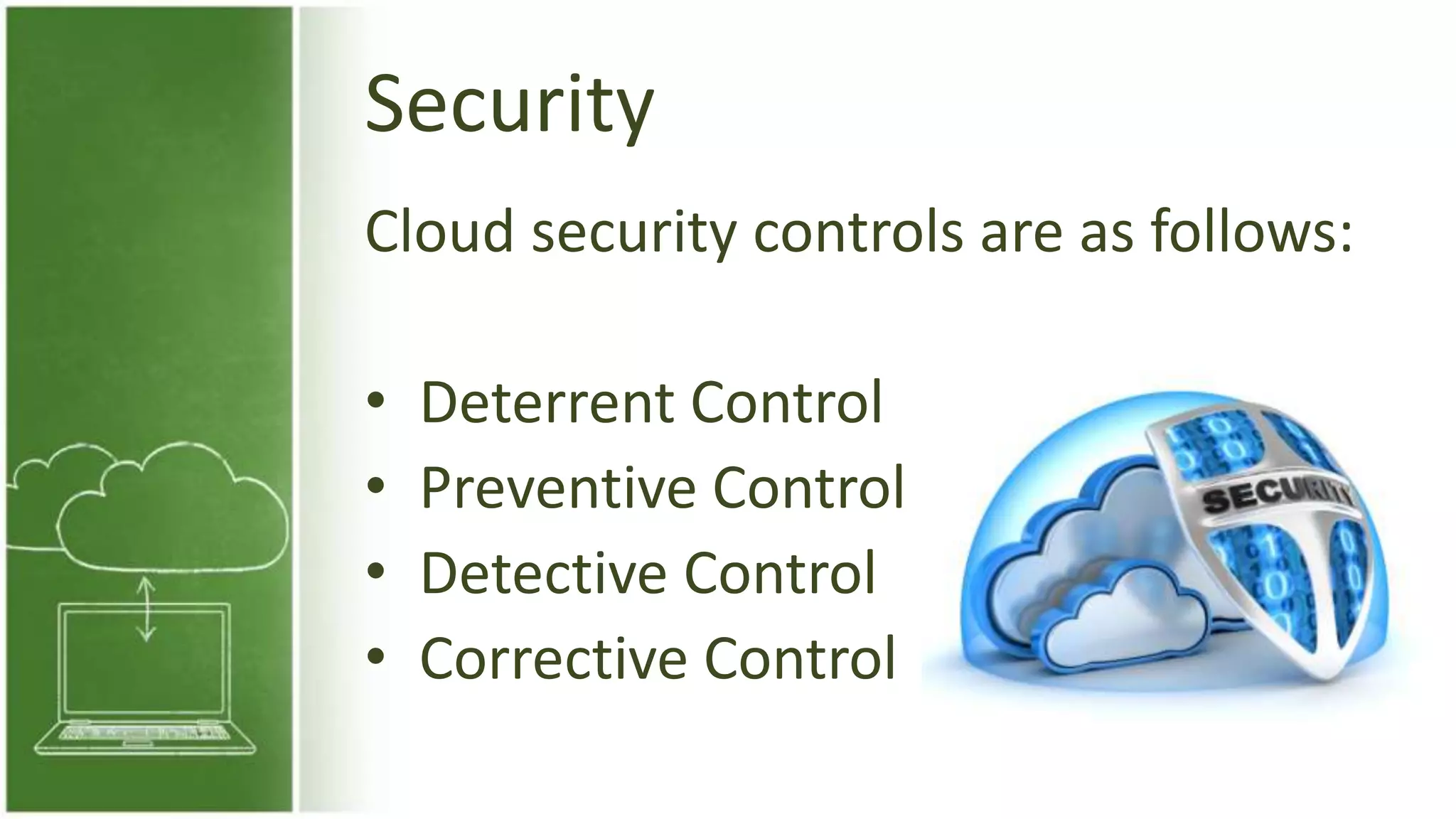
Cloud security controls are as follows:
• Deterrent Control
• Preventive Control
• Detective Control
• Corrective Control
Cloud security controls
• Deterrent controls
These controls are intended to
reduce attacks on a cloud system. Much
like a warning sign.
Preventive controls
Examples of these include:
Logon Warning – Ensure that a
person is aware of the rights to
enter your site or information
storage.
Cloud security controls
Preventive Control:
It controls strengthen the system against
incidents, generally by reducing if not actually
eliminating vulnerabilities.
One example of this would be the inclusion of a
proxy server.
This can act as a ‘bouncer’ between your
information and the person(s) wishing to access
it. Requests for your information can pass
through this server, reducing the risk of a security
breach.
Cloud security controls
• Detective controls are intended to
detect and react appropriately to
any incidents that occur.
• An example might be hiring or
yourself trying to unlawfully access
your information in an attempt to
test the defenses.
Detective Control
Cloud security controls
Corrective controls reduce the
consequences of an incident,
normally by limiting the damage
An example might include
the changing of passwords and
usernames as soon as you are alerted
to the security breach
Corrective Control
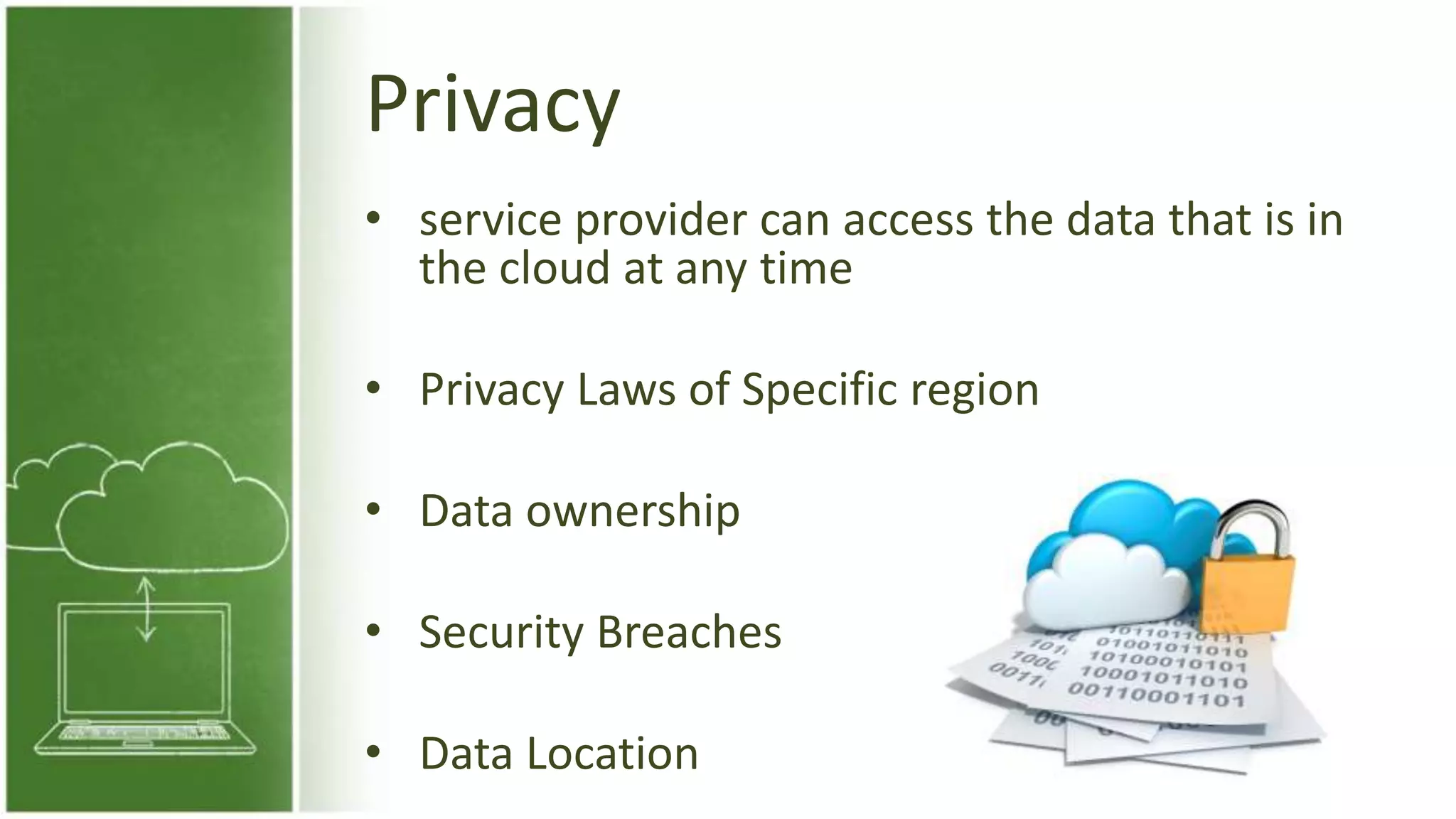
Privacy
• service provider can access the data that is in
the cloud at any time
• Privacy Laws of Specific region
• Data ownership
• Security Breaches
• Data Location
Challenges
• Organizational barrier
• Reliability
• Customization
• Integration with others Apps
• Limited languages and API’s
• Encryption needs and Standards
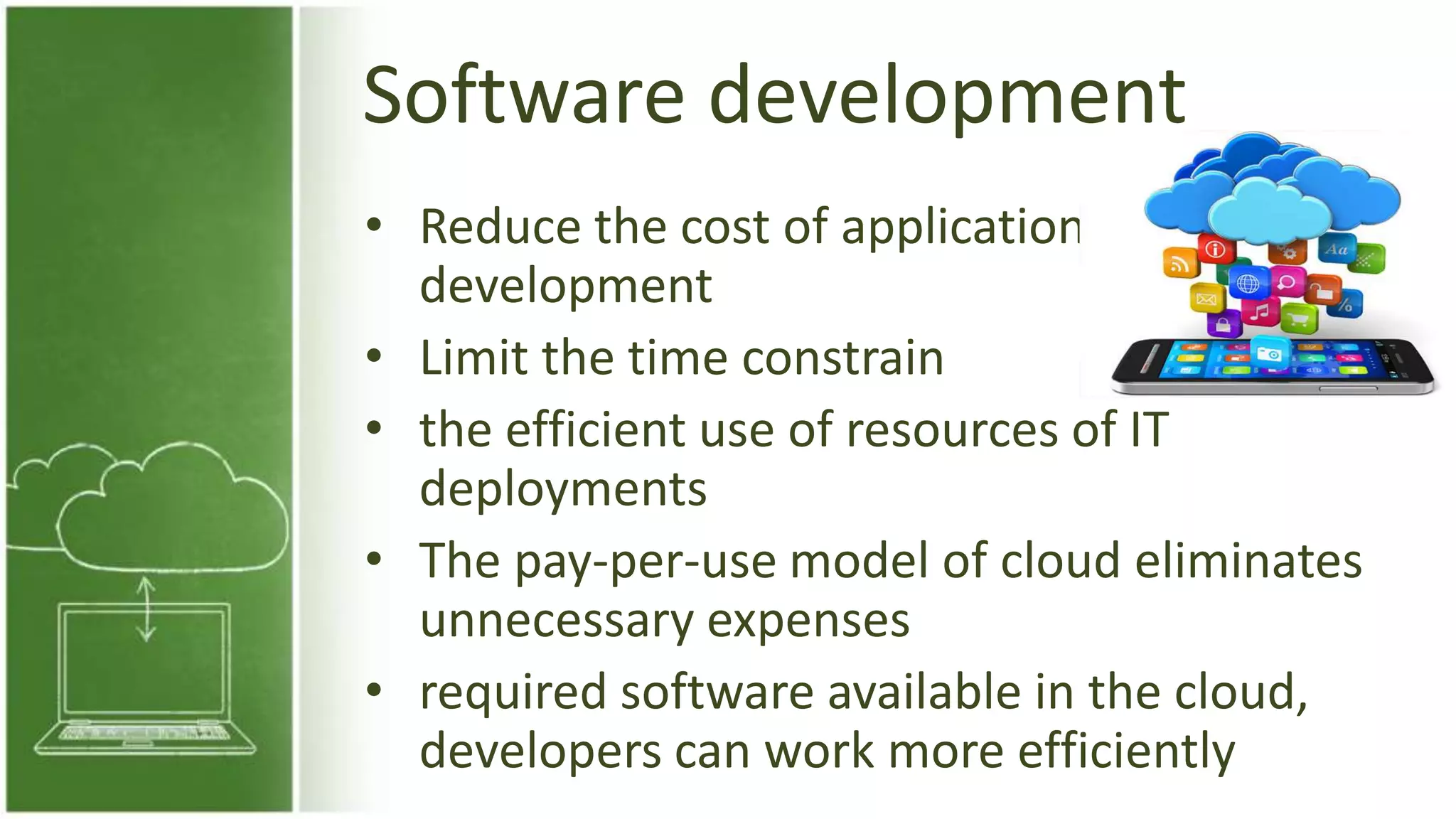
Software development
• Reduce the cost of application
development
• Limit the time constrain
• the efficient use of resources of IT
deployments
• The pay-per-use model of cloud eliminates
unnecessary expenses
• required software available in the cloud,
developers can work more efficiently
Moin Abbas
examples of cloud computing
• Google Drive
This is a pure cloud computing service,
with all the storage found online so it can
work with the cloud apps: Google Docs,
Google Sheets, and Google Slides
Apple iCloud
Apple's cloud service is primarily used for
online storage, backup, and
synchronization of your mail, contacts,
calendar, and more
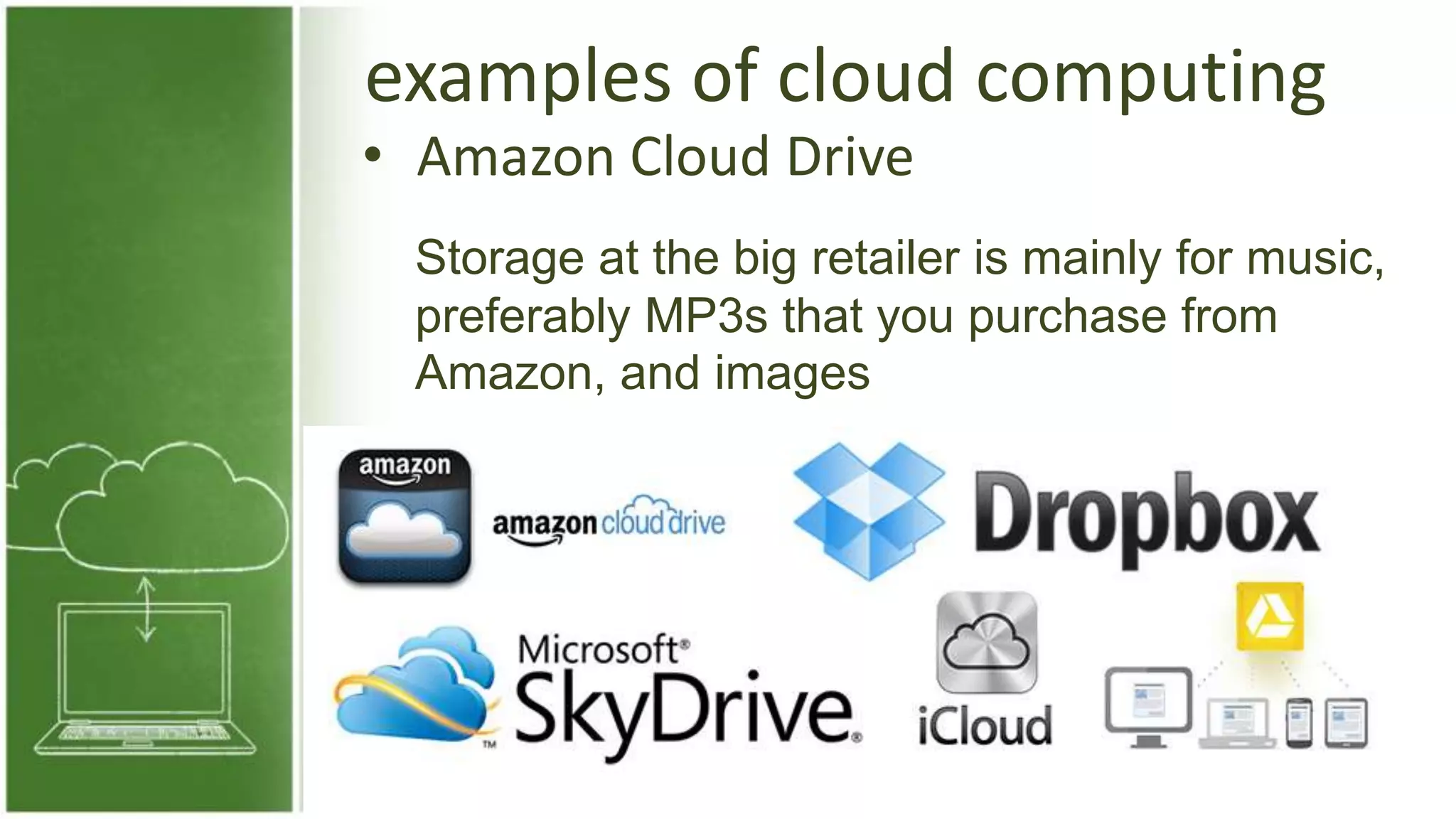
examples of cloud computing
• Amazon Cloud Drive
Storage at the big retailer is mainly for music,
preferably MP3s that you purchase from
Amazon, and images
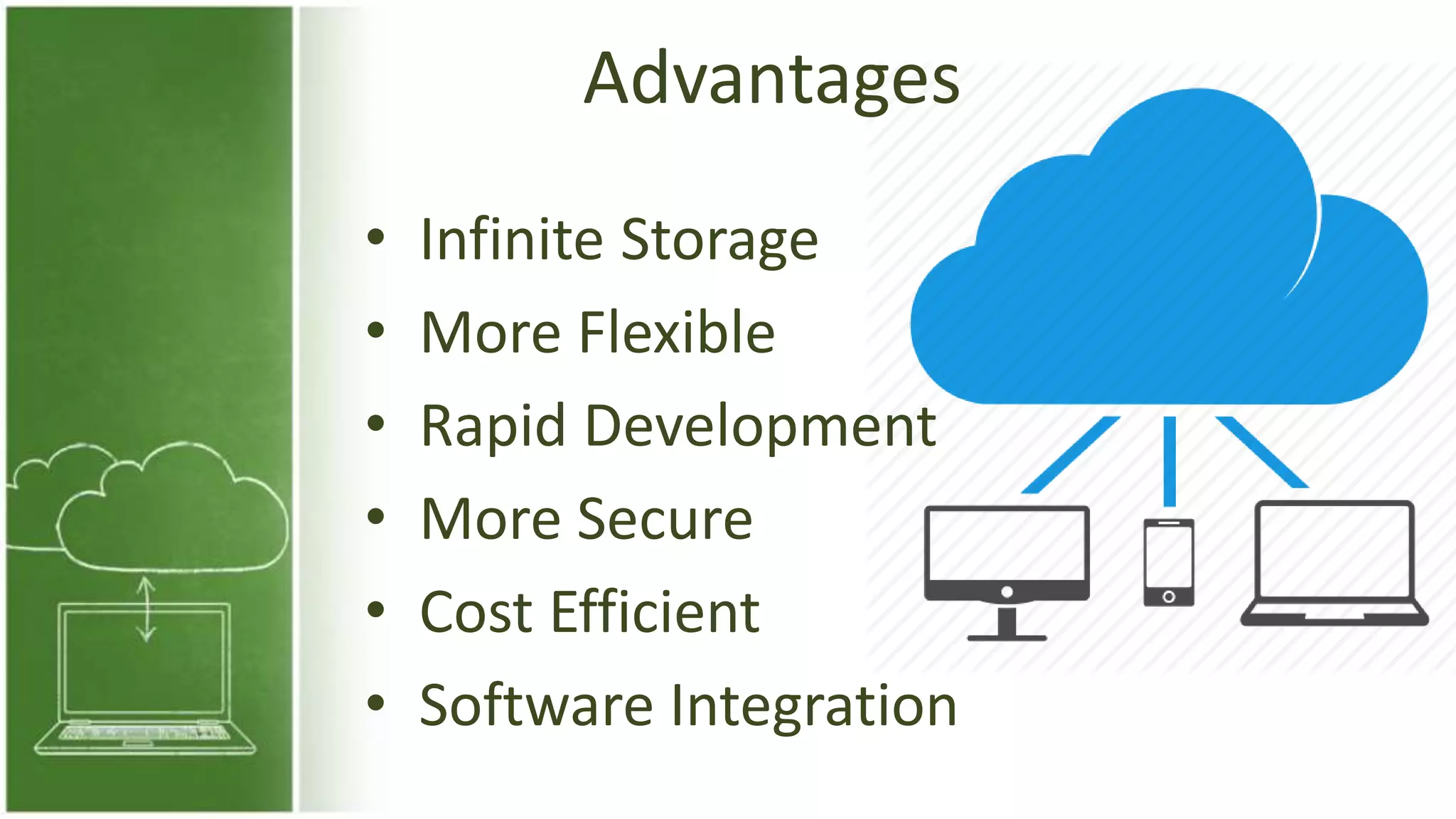
Advantages
• Infinite Storage
• More Flexible
• Rapid Development
• More Secure
• Cost Efficient
• Software Integration
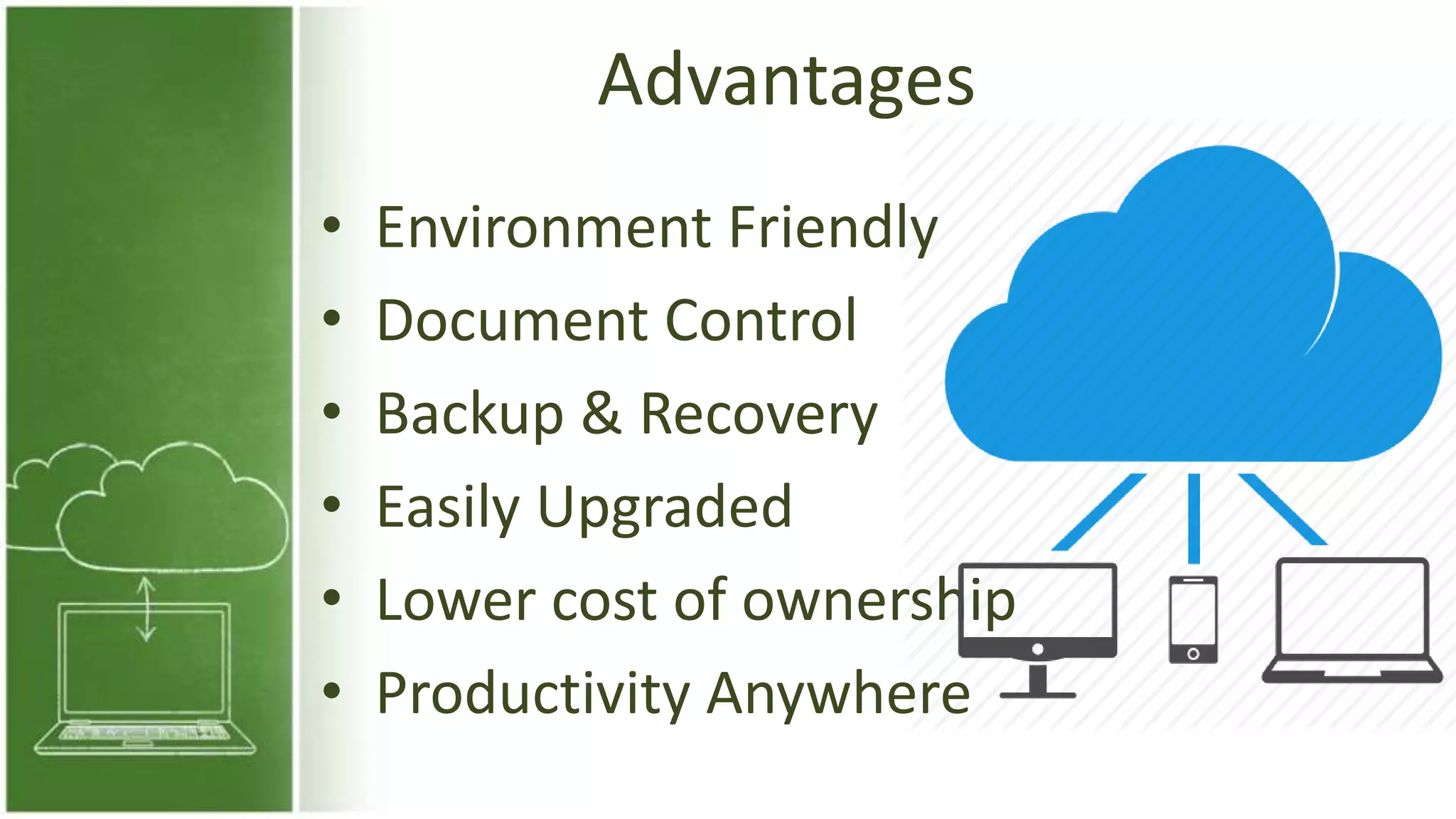
Advantages
• Environment Friendly
• Document Control
• Backup & Recovery
• Easily Upgraded
• Lower cost of ownership
• Productivity Anywhere
Disadvantages
• Dependence on service provider
• Security breach
• Unawareness of network
• Physical Location is unknown
• Internet Connection
• Control and Reliability
Future !
• We will see more cloud-like capabilities in traditional
datacenter
• Consumer mobility use will continue to drive enterprise
use.
• Big data will continue to drive adoption.
• more industries are turning to cloud technology as an
efficient way to improve quality services due to its
capabilities to reduce overhead costs, downtime, and
automate infrastructure deployment
Cloud computing

Cloud computing

  • 2.
  • 3.
    Members . Rana M ZubairArshad(35) Enam-ul-Haq(53) Areeba Shahzad(44) Talha Malik(48) M Ahsan(32) Moin Abba(04) Shah Zaman(46) NFC Institute of Engineering & Technology Multan Pakistan BSCS Session 2013-2017
  • 4.
    • Rana MZubair Arshad
  • 6.
    “Cloud” ? • Incloud computing, the word cloud (also phrased as "the cloud") is used as a metaphor for "the Internet," • The phrase cloud computing means "a type of Internet-based computing," where different services— such as servers, storage and applications — are delivered to an organization's computers and devices through the Internet.
  • 7.
    Definition • The practiceof using a network of remote servers hosted on the Internet to store, manage, and process data, rather than a local server or a personal computer. Cloud computing is a model for delivering information technology services in which resources are retrieved from the internet through web-based tools and applications, rather than a direct connection to a server
  • 9.
    Emergence of Cloud Introducedin the sixties by J.C.R. Licklider His vision was for everyone on the globe to be interconnected and accessing programs and data at any site, from anywhere It was a gradual evolution that started in the 1950s with mainframe computing Because of the costs to buy and maintain mainframe computers is to high, it was not practical for an organization to buy and maintain one for every employee
  • 10.
    Emergence of Cloud Aftersome time, around 1970, the concept of virtual machines (VMs) was created. Using virtualization software like VMware, it became possible to execute one or more operating systems simultaneously in an isolated environment. In the 1990s, telecommunications companies, who previously offered primarily dedicated point-to-point data circuits, began offering virtual private network
  • 11.
    Emergence of Cloud Byswitching traffic as they saw fit to balance server use, they could use overall network bandwidth more effectively. The next development was Amazon Web Services in 2002, which provided a suite of cloud-based services including storage, computation and even human intelligence In August 2006 Amazon introduced its Elastic Compute Cloud Microsoft announced "Azure" in October 2008
  • 15.
  • 16.
    Major Component • Clientcomputers • Distributed servers • Data Centers
  • 17.
    Client computers • Anindividual computer that accesses the information and programs which are stored on a server.
  • 18.
    Distributed servers Multiple ComputersConnected via Network. Large Networks have Multiple Servers.
  • 19.
    Data Center • DataCenter is a facility used to house Computer systems & associated components. • E.g Telecommunications & Storage Systems. Facebook Microsoft
  • 20.
  • 21.
    Architecture • Front-end device •Back-end platform • Cloud-based delivery • Network The architecture of cloud computing comprises of the following components
  • 22.
    Architecture These are basicallythe devices that are used by clients to access the data or program using the browser or special applications Front-end Devices Back-end Platform There are various computers, servers, virtual machines, etc. that combine to become a back-end platform Cloud-based delivery It is the system to deliver information and data between Front End and back End
  • 23.
  • 26.
  • 27.
    Service Structure/Models There arethree basic models Software as a Service Platform as a Service Infrastructure as a Service.
  • 28.
    Infrastructure as aService. • Infrastructure as a Service (IaaS) is a way of delivering Cloud Computing infrastructure – servers, storage, network and operating systems – as an on- demand service
  • 29.
    Characteristics of Iass •Resources are distributed as a service • Allows for dynamic scaling • Has a variable cost, utility pricing model • Generally includes multiple users on a single piece of hardware
  • 30.
    Iass include • Email •Business Process • Industry/application • CRM/ERp/PHR Examples Amazon web service Rocket space cloud At&t
  • 31.
    Platform as aService • PaaS can be defined as a computing platform that allows the creation of web applications quickly and easily and without the complexity of buying and maintaining the software and infrastructure underneath it it is a platform for the creation of software, delivered over the web
  • 32.
    Characteristics of pass •Services to develop, test, deploy, host and maintain applications in the same integrated development environment. All the varying services needed to fulfil the application development process • Web based user interface creation tools help to create, modify, test and deploy different UI scenarios • Multi-tenant architecture where multiple concurrent users utilize the same development application • Built in scalability of deployed software including load balancing and failover • Integration with web services and databases via common standards • Support for development team collaboration – some PaaS solutions include project planning and communication tools • Tools to handle billing and subscription management
  • 33.
    Pass include • Middleware •Web 2.0 Aplication Runtime • Development Tooling • Database • Java Runtime Example Google App Engine Force.com Window Azure
  • 34.
    Software as aService • software that is deployed over the internet • In the software as a service (SaaS) model, users gain access to application software and databases
  • 35.
    Characteristics of sass •Web access to commercial software • Software is managed from a central location • Software delivered in a “one to many” model • Users not required to handle software upgrades and patches • Application Programming Interfaces (APIs) allow for integration between different pieces of software
  • 36.
    Sass include • Servers •Networking • Storage • Data Center Fabric • Firewall , Load balancer Gmail Facebook Microsoft Online services Examples
  • 38.
  • 41.
    Cloud Characteristics • Ondemand self service • Ubiquitous network access • Location Independent • Rapid Elasticity • Pay per use
  • 42.
    Supporting Factors • Advancementin processor • Virtualization Technology • Distributed Storage • Automated Management • Broadband internet Access • Fast and Inexpensive server
  • 43.
  • 44.
  • 45.
    Public Cloud • whenthe services are rendered over a network that is open for public use • The customers do not have any distinguishability and control over the location of the infrastructure • From the technical viewpoint, there may be slight or no difference between private and public clouds’ structural design except in the level of security • Public cloud is better suited for business requirements which require managing the load; host application
  • 46.
    Private Cloud • isalso known as internal cloud • the platform for cloud computing is implemented on a cloud-based secure environment that is safeguarded by a firewall • Private cloud as it permits only the authorized users, gives the organization greater and direct control over their data • Businesses that have dynamic or unforeseen needs, assignments which are mission critical, security alarms, management demands and uptime requirements are better suited to adopt private cloud
  • 47.
    Hybrid Cloud • Itis integrated and can be an arrangement of two or more cloud servers • Organizations can use the hybrid cloud model for processing big data • It permits the user to increase the capacity or the capability by aggregation, assimilation or customization with another cloud package / service • Hybrid cloud hosting is enabled with features like scalability, flexibility and security
  • 48.
    Others Cloud Models •is a type of cloud hosting in which the setup is mutually shared between many Organizations that belong to a particular community, i.e. banks and trading firms. • The community members generally share similar privacy, performance and security concerns • The cost is shared by the specific Organizations within the community, hence, community cloud has cost saving capacity Community Model
  • 49.
    Others Cloud Models Acloud computing platform can be assembled from a distributed set of machines in different locations, connected to a single network or hub service. Distributed Cloud Inter cloud is an interconnected global "cloud of clouds“The focus is on direct interoperability between public cloud service providers, more so than between providers and consumers
  • 50.
  • 51.
    Security • potentially sensitivedata is at risk from insider attacks • More than one user on same server by Cloud service provider • Hacked interfaces and APIs • Exploited system vulnerabilities
  • 52.
    Security Cloud security controlsare as follows: • Deterrent Control • Preventive Control • Detective Control • Corrective Control
  • 53.
    Cloud security controls •Deterrent controls These controls are intended to reduce attacks on a cloud system. Much like a warning sign. Preventive controls Examples of these include: Logon Warning – Ensure that a person is aware of the rights to enter your site or information storage.
  • 54.
    Cloud security controls PreventiveControl: It controls strengthen the system against incidents, generally by reducing if not actually eliminating vulnerabilities. One example of this would be the inclusion of a proxy server. This can act as a ‘bouncer’ between your information and the person(s) wishing to access it. Requests for your information can pass through this server, reducing the risk of a security breach.
  • 55.
    Cloud security controls •Detective controls are intended to detect and react appropriately to any incidents that occur. • An example might be hiring or yourself trying to unlawfully access your information in an attempt to test the defenses. Detective Control
  • 56.
    Cloud security controls Correctivecontrols reduce the consequences of an incident, normally by limiting the damage An example might include the changing of passwords and usernames as soon as you are alerted to the security breach Corrective Control
  • 57.
    Privacy • service providercan access the data that is in the cloud at any time • Privacy Laws of Specific region • Data ownership • Security Breaches • Data Location
  • 58.
    Challenges • Organizational barrier •Reliability • Customization • Integration with others Apps • Limited languages and API’s • Encryption needs and Standards
  • 59.
    Software development • Reducethe cost of application development • Limit the time constrain • the efficient use of resources of IT deployments • The pay-per-use model of cloud eliminates unnecessary expenses • required software available in the cloud, developers can work more efficiently
  • 60.
  • 61.
    examples of cloudcomputing • Google Drive This is a pure cloud computing service, with all the storage found online so it can work with the cloud apps: Google Docs, Google Sheets, and Google Slides Apple iCloud Apple's cloud service is primarily used for online storage, backup, and synchronization of your mail, contacts, calendar, and more
  • 62.
    examples of cloudcomputing • Amazon Cloud Drive Storage at the big retailer is mainly for music, preferably MP3s that you purchase from Amazon, and images
  • 63.
    Advantages • Infinite Storage •More Flexible • Rapid Development • More Secure • Cost Efficient • Software Integration
  • 64.
    Advantages • Environment Friendly •Document Control • Backup & Recovery • Easily Upgraded • Lower cost of ownership • Productivity Anywhere
  • 65.
    Disadvantages • Dependence onservice provider • Security breach • Unawareness of network • Physical Location is unknown • Internet Connection • Control and Reliability
  • 66.
    Future ! • Wewill see more cloud-like capabilities in traditional datacenter • Consumer mobility use will continue to drive enterprise use. • Big data will continue to drive adoption. • more industries are turning to cloud technology as an efficient way to improve quality services due to its capabilities to reduce overhead costs, downtime, and automate infrastructure deployment