A model is more like a
Than a
-Dominic Di Toro
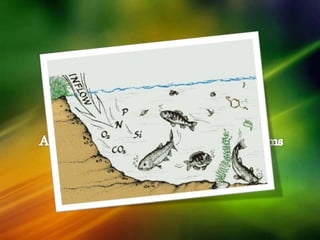
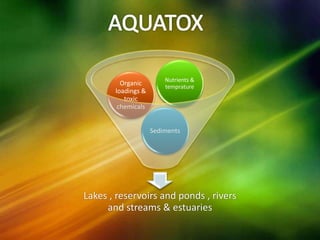
Lakes , reservoirs and ponds , rivers
and streams & estuaries
Sediments
Organic
loadings &
toxic
chemicals
Nutrients &
temprature
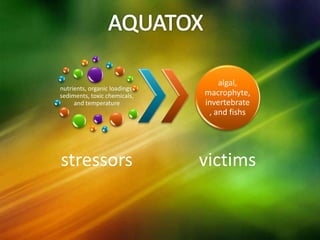
nutrients, organic loadings,
sediments, toxic chemicals,
and temperature
stressors
algal,
macrophyte,
invertebrate
, and fishs
victims
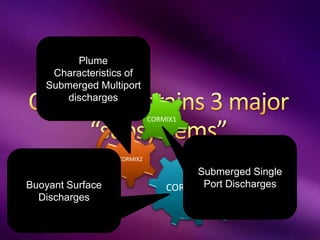
CORMIX3
CORMIX2
CORMIX1
Submerged Single
Port Discharges
Plume
Characteristics of
Submerged Multiport
discharges
Buoyant Surface
Discharges
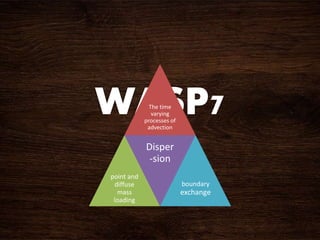
The time
varying
processes of
advection
point and
diffuse
mass
loading
Disper
-sion
boundary
exchange
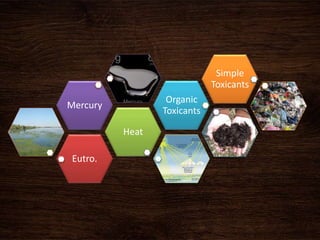
Eutro.
Heat
Mercury
Organic
Toxicants
Simple
Toxicants
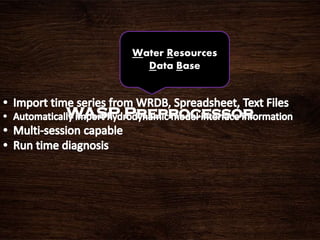
Water Resources
Data Base
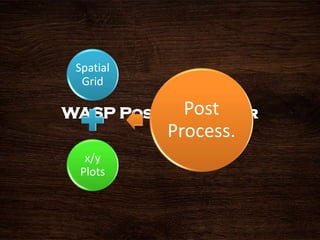
Spatial
Grid
x/y
Plots
Post
Process.
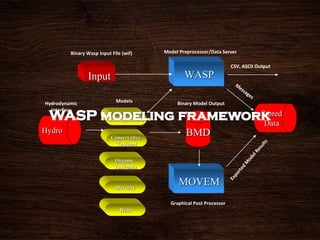
WASPInput
BMD
Eutrophication
Conservative
Toxicant
MOVEM
Stored
Data
Hydro
Model Preprocessor/Data Server
Mercury
Binary Model Output
Graphical Post Processor
ModelsHydrodynamic
Interface
CSV, ASCII Output
Organic
Toxicants
Heat
Binary Wasp Input File (wif)
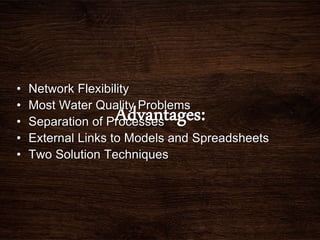
• Network Flexibility
• Most Water Quality Problems
• Separation of Processes
• External Links to Models and Spreadsheets
• Two Solution Techniques
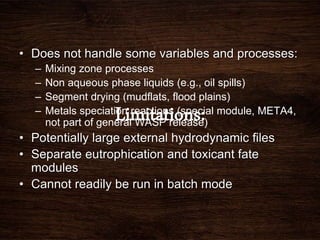
• Does not handle some variables and processes:
– Mixing zone processes
– Non aqueous phase liquids (e.g., oil spills)
– Segment drying (mudflats, flood plains)
– Metals speciation reactions (special module, META4,
not part of general WASP release)
• Potentially large external hydrodynamic files
• Separate eutrophication and toxicant fate
modules
• Cannot readily be run in batch mode
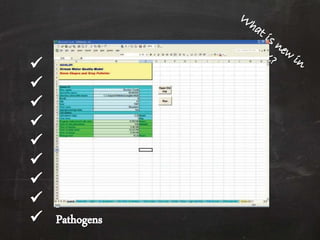
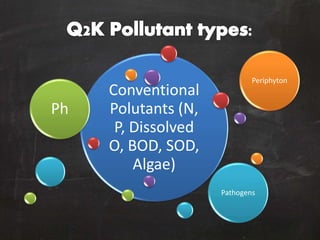
Conventional
Polutants (N,
P, Dissolved
O, BOD, SOD,
Algae)
Ph
Periphyton
Pathogens
REFERENCES
 U.S Environnemental Protection Agency (EPA.gov)
AQUATOX fact sheet
CORMIX user manual
WASP7 spread sheet
Qual2K user manual
Environmental Laboratory of U.S Army
(el.erdc.usace.army.mil)
an introduction to water quality models

an introduction to water quality models