Cloud Computing for DoD

             Kevin L. Jackson
             Founder & Editor
Cloud Musings | Government Cloud Computing
DISCLAIMER
The comments contained in this
presentation are the personal views of Kevin
L. Jackson and do not represent the views
or policy of NJVC or the United States
Government.
Agenda
   DoD Cloud Computing 2009
   DoD Policy and Direction
   DoD Use of Cloud Computing
   What does this mean?
DoD Cloud Computing 2009
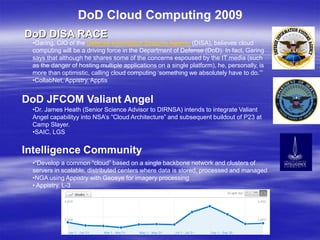
DoD DISA RACE
 •Garing, CIO of the Defense Information Systems Agency (DISA), believes cloud
 computing will be a driving force in the Department of Defense (DoD). In fact, Garing
 says that although he shares some of the concerns espoused by the IT media (such
 as the danger of hosting multiple applications on a single platform), he, personally, is
 more than optimistic, calling cloud computing „something we absolutely have to do.‟”
 •CollabNet, Appistry, Apptis


DoD JFCOM Valiant Angel
 •Dr. James Heath (Senior Science Advisor to DIRNSA) intends to integrate Valiant
 Angel capabilityy into NSA‟s “Cloud Architecture” and subsequent buildout of P23 at
 Camp Slayer.
 •SAIC, LGS


Intelligence Community
 •“Develop a common “cloud” based on a single backbone network and clusters of
 servers in scalable, distributed centers where data is stored, processed and managed
 •NGA using Appistry with Geoeye for imagery processing
 • Appistry, L-3
MR. ROBERT F. LENTZ DEPUTY ASSISTANT SECRETARY OF DEFENSE,
FOR CYBER, IDENTITY AND INFORMATION ASSURANCE BEFORE THE
 U.S. HOUSE OF REPRESENTATIVES ARMED SERVICES COMMITTEE
  SUBCOMMITTEE ON TERRORISM, UNCONVENTIONAL THREATS &
                        CAPABILITIES
                         May 5, 2009
                     Cloud computing builds on these ideas to offer a virtual
                     computing fabric with almost limitless and infinitely definable
                     processing and storage capacity. In the future, many enterprises
                     will choose not to invest in their own IT departments, but will pay
                     as they go, relying on ability to access commercial computing
                     services in the cloud. For many DoD applications, the
                     commercial cloud will be too risky, but a private cloud could
                     bring us many benefits. Besides the obvious economic benefits
                     of scalable, on-demand computing, a private cloud also gives us
                     the ideal platform with which to provide the virtual monitoring
                     and provisioning described earlier. A cloud is also an ideal place
                     from which to make capabilities available to the whole
                     enterprise. While, in the DoD, we have encountered challenges
                     moving towards a service-oriented architecture (SOA), in the
                     private sector, companies like Google and Salesforce are
                     basing their business models on an insatiable public hunger for
                     software and applications as a service. Emulating their delivery
                     mechanisms within our own private cloud may be key to how we
                     realize the true potential of net-centricity.
Deputy Assistant Secretary of Defense for
Cyber, Identity, and Information Assurance
                  Strategy
 Capability 7. Mission-based Architecture
 Networks, services, and data organized and optimized for
 mission availability
 Current GIG network segmentation (e.g., NIPRNet, SIPRNet) is
 driven by information confidentiality needs, not by mission
 needs. The primary mission drivers are availability and integrity.
 As reliance on network segmentation for confidentiality
 diminishes through realization of the strategic capabilities
 described above, missions and information enterprise need to
 be co-designed to reduce the mission consequences of adverse
 cyber events. This includes the ability to:
 •Securely realize the promise of platforms, software, and
 infrastructure as services (i.e., “cloud computing”) and evolving
 software development and design methods (i.e. “Web 2.0/3.0”)
 •…
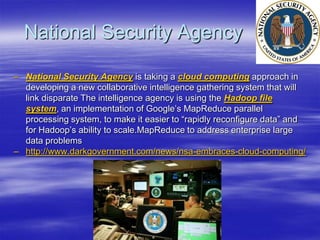
National Security Agency

– National Security Agency is taking a cloud computing approach in
  developing a new collaborative intelligence gathering system that will
  link disparate The intelligence agency is using the Hadoop file
  system, an implementation of Google‟s MapReduce parallel
  processing system, to make it easier to “rapidly reconfigure data” and
  for Hadoop‟s ability to scale.MapReduce to address enterprise large
  data problems
– http://www.darkgovernment.com/news/nsa-embraces-cloud-computing/
US Transportation
            Command
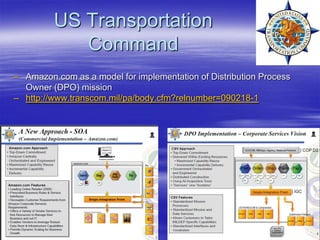
– Amazon.com as a model for implementation of Distribution Process
  Owner (DPO) mission
– http://www.transcom.mil/pa/body.cfm?relnumber=090218-1
US Army
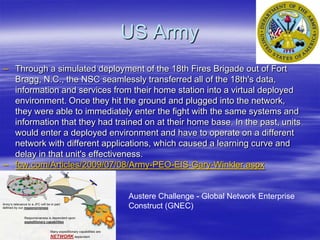
– Through a simulated deployment of the 18th Fires Brigade out of Fort
  Bragg, N.C., the NSC seamlessly transferred all of the 18th's data,
  information and services from their home station into a virtual deployed
  environment. Once they hit the ground and plugged into the network,
  they were able to immediately enter the fight with the same systems and
  information that they had trained on at their home base. In the past, units
  would enter a deployed environment and have to operate on a different
  network with different applications, which caused a learning curve and
  delay in that unit's effectiveness.
– fcw.com/Articles/2009/07/08/Army-PEO-EIS-Gary-Winkler.aspx


                                Austere Challenge - Global Network Enterprise
                                Construct (GNEC)
National Geospatial
        Intelligence Agency
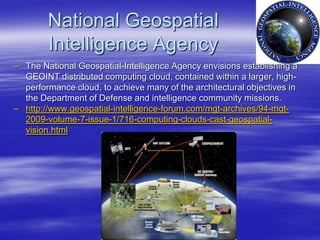
– The National Geospatial-Intelligence Agency envisions establishing a
  GEOINT distributed computing cloud, contained within a larger, high-
  performance cloud, to achieve many of the architectural objectives in
  the Department of Defense and intelligence community missions.
– http://www.geospatial-intelligence-forum.com/mgt-archives/94-mgt-
  2009-volume-7-issue-1/716-computing-clouds-cast-geospatial-
  vision.html
US Air Force
– The 10-month project will introduce cybersecurity and analytics
  technologies developed by IBM Research into a cloud computing
  architecture. "Our goal is to demonstrate how cloud computing can be a
  tool to enable our Air Force to manage, monitor and secure the
  information flowing through our network," said Lt. Gen. William Lord, chief
  information officer and chief of warfighting integration for the Air Force.
– http://www.defensesystems.com/Articles/2010/02/04/Air-Force-IBM-
  Cloud-Computing.aspx
US Navy


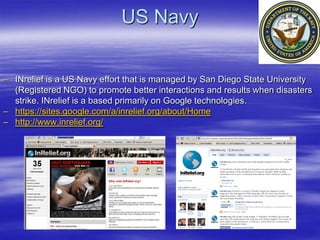
– INrelief is a US Navy effort that is managed by San Diego State University
  (Registered NGO) to promote better interactions and results when disasters
  strike. INrelief is a based primarily on Google technologies.
– https://sites.google.com/a/inrelief.org/about/Home
– http://www.inrelief.org/
What Does This All Mean?

 Cloud computing in the DoD and the Intelligence
  Community is REAL !!
 Applicable use cases extend to the operational
  domain.
 System integrator are rapidly building their skills and
  offerings in the area.
 Benefits appear to outweigh security concerns so
  adoption has been rapid.
Thank You !!


http://kevinljackson.blogspot.com           http://govcloud.ulitzer.com
                             Kevin L. Jackson
                           kvjacksn@gmail.com
                              (703) 335-0830

Cloud Computing In DoD, IDGA Presentation

  • 1.
    Cloud Computing forDoD Kevin L. Jackson Founder & Editor Cloud Musings | Government Cloud Computing
  • 2.
    DISCLAIMER The comments containedin this presentation are the personal views of Kevin L. Jackson and do not represent the views or policy of NJVC or the United States Government.
  • 3.
    Agenda  DoD Cloud Computing 2009  DoD Policy and Direction  DoD Use of Cloud Computing  What does this mean?
  • 4.
    DoD Cloud Computing2009 DoD DISA RACE •Garing, CIO of the Defense Information Systems Agency (DISA), believes cloud computing will be a driving force in the Department of Defense (DoD). In fact, Garing says that although he shares some of the concerns espoused by the IT media (such as the danger of hosting multiple applications on a single platform), he, personally, is more than optimistic, calling cloud computing „something we absolutely have to do.‟” •CollabNet, Appistry, Apptis DoD JFCOM Valiant Angel •Dr. James Heath (Senior Science Advisor to DIRNSA) intends to integrate Valiant Angel capabilityy into NSA‟s “Cloud Architecture” and subsequent buildout of P23 at Camp Slayer. •SAIC, LGS Intelligence Community •“Develop a common “cloud” based on a single backbone network and clusters of servers in scalable, distributed centers where data is stored, processed and managed •NGA using Appistry with Geoeye for imagery processing • Appistry, L-3
  • 5.
    MR. ROBERT F.LENTZ DEPUTY ASSISTANT SECRETARY OF DEFENSE, FOR CYBER, IDENTITY AND INFORMATION ASSURANCE BEFORE THE U.S. HOUSE OF REPRESENTATIVES ARMED SERVICES COMMITTEE SUBCOMMITTEE ON TERRORISM, UNCONVENTIONAL THREATS & CAPABILITIES May 5, 2009 Cloud computing builds on these ideas to offer a virtual computing fabric with almost limitless and infinitely definable processing and storage capacity. In the future, many enterprises will choose not to invest in their own IT departments, but will pay as they go, relying on ability to access commercial computing services in the cloud. For many DoD applications, the commercial cloud will be too risky, but a private cloud could bring us many benefits. Besides the obvious economic benefits of scalable, on-demand computing, a private cloud also gives us the ideal platform with which to provide the virtual monitoring and provisioning described earlier. A cloud is also an ideal place from which to make capabilities available to the whole enterprise. While, in the DoD, we have encountered challenges moving towards a service-oriented architecture (SOA), in the private sector, companies like Google and Salesforce are basing their business models on an insatiable public hunger for software and applications as a service. Emulating their delivery mechanisms within our own private cloud may be key to how we realize the true potential of net-centricity.
  • 6.
    Deputy Assistant Secretaryof Defense for Cyber, Identity, and Information Assurance Strategy Capability 7. Mission-based Architecture Networks, services, and data organized and optimized for mission availability Current GIG network segmentation (e.g., NIPRNet, SIPRNet) is driven by information confidentiality needs, not by mission needs. The primary mission drivers are availability and integrity. As reliance on network segmentation for confidentiality diminishes through realization of the strategic capabilities described above, missions and information enterprise need to be co-designed to reduce the mission consequences of adverse cyber events. This includes the ability to: •Securely realize the promise of platforms, software, and infrastructure as services (i.e., “cloud computing”) and evolving software development and design methods (i.e. “Web 2.0/3.0”) •…
  • 7.
    National Security Agency –National Security Agency is taking a cloud computing approach in developing a new collaborative intelligence gathering system that will link disparate The intelligence agency is using the Hadoop file system, an implementation of Google‟s MapReduce parallel processing system, to make it easier to “rapidly reconfigure data” and for Hadoop‟s ability to scale.MapReduce to address enterprise large data problems – http://www.darkgovernment.com/news/nsa-embraces-cloud-computing/
  • 8.
    US Transportation Command – Amazon.com as a model for implementation of Distribution Process Owner (DPO) mission – http://www.transcom.mil/pa/body.cfm?relnumber=090218-1
  • 9.
    US Army – Througha simulated deployment of the 18th Fires Brigade out of Fort Bragg, N.C., the NSC seamlessly transferred all of the 18th's data, information and services from their home station into a virtual deployed environment. Once they hit the ground and plugged into the network, they were able to immediately enter the fight with the same systems and information that they had trained on at their home base. In the past, units would enter a deployed environment and have to operate on a different network with different applications, which caused a learning curve and delay in that unit's effectiveness. – fcw.com/Articles/2009/07/08/Army-PEO-EIS-Gary-Winkler.aspx Austere Challenge - Global Network Enterprise Construct (GNEC)
  • 10.
    National Geospatial Intelligence Agency – The National Geospatial-Intelligence Agency envisions establishing a GEOINT distributed computing cloud, contained within a larger, high- performance cloud, to achieve many of the architectural objectives in the Department of Defense and intelligence community missions. – http://www.geospatial-intelligence-forum.com/mgt-archives/94-mgt- 2009-volume-7-issue-1/716-computing-clouds-cast-geospatial- vision.html
  • 11.
    US Air Force –The 10-month project will introduce cybersecurity and analytics technologies developed by IBM Research into a cloud computing architecture. "Our goal is to demonstrate how cloud computing can be a tool to enable our Air Force to manage, monitor and secure the information flowing through our network," said Lt. Gen. William Lord, chief information officer and chief of warfighting integration for the Air Force. – http://www.defensesystems.com/Articles/2010/02/04/Air-Force-IBM- Cloud-Computing.aspx
  • 12.
    US Navy – INreliefis a US Navy effort that is managed by San Diego State University (Registered NGO) to promote better interactions and results when disasters strike. INrelief is a based primarily on Google technologies. – https://sites.google.com/a/inrelief.org/about/Home – http://www.inrelief.org/
  • 13.
    What Does ThisAll Mean?  Cloud computing in the DoD and the Intelligence Community is REAL !!  Applicable use cases extend to the operational domain.  System integrator are rapidly building their skills and offerings in the area.  Benefits appear to outweigh security concerns so adoption has been rapid.
  • 14.
    Thank You !! http://kevinljackson.blogspot.com http://govcloud.ulitzer.com Kevin L. Jackson kvjacksn@gmail.com (703) 335-0830