Cloud Computing Expanding IT flexibility and agility Virgílio Vargas IBM [email_address]
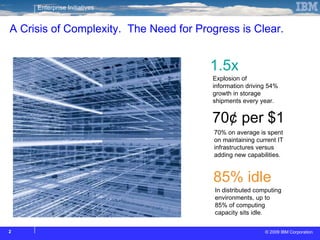
A Crisis of Complexity.  The Need for Progress is Clear. 85% idle In distributed computing environments, up to 85% of computing capacity sits idle. Explosion of information driving 54% growth in storage shipments every year.  1.5x 70¢ per $1 70% on average is spent on maintaining current IT infrastructures versus adding new capabilities.
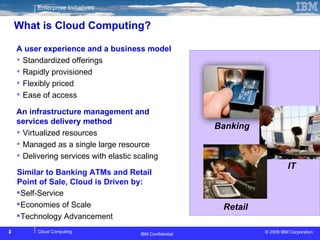
What is Cloud Computing? IBM Confidential Banking  Retail IT  Self-Service Economies of Scale Technology Advancement  A user experience and a business model Standardized offerings Rapidly provisioned Flexibly priced Ease of access An infrastructure management and services delivery method Virtualized resources Managed as a single large resource Delivering services with elastic scaling Similar to Banking ATMs and Retail Point of Sale, Cloud is Driven by:
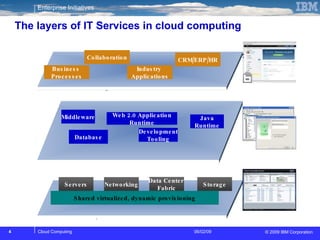
The layers of IT Services in cloud computing Infrastructure as a Service Platform as a Service High Volume Transactions Software as a Service Servers Networking Storage Middleware Collaboration Business  Processes CRM/ERP/HR Industry  Applications Data Center  Fabric Shared virtualized, dynamic provisioning Database Web 2.0 Application Runtime Java Runtime Development Tooling
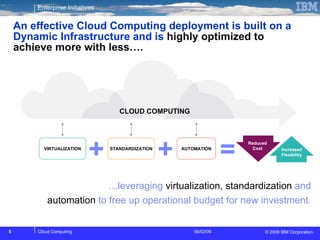
An effective Cloud Computing deployment is built on a Dynamic Infrastructure and is  highly optimized to achieve more with less…. = CLOUD COMPUTING … leveraging  virtualization, standardization  and automation  to free up operational budget for new investment. VIRTUALIZATION + STANDARDIZATION AUTOMATION + Increased Flexibility Reduced  Cost
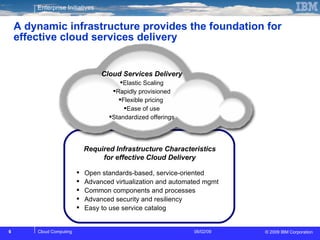
A dynamic infrastructure provides the foundation for effective cloud services delivery   Cloud Services Delivery Elastic Scaling Rapidly provisioned Flexible pricing  Ease of use Standardized offerings Required Infrastructure Characteristics for effective Cloud Delivery Open standards-based, service-oriented Advanced virtualization and automated mgmt Common components and processes Advanced security and resiliency Easy to use service catalog
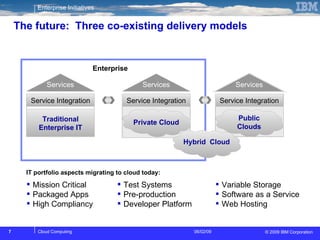
The future:  Three co-existing delivery models Mission Critical Packaged Apps High Compliancy Test Systems Pre-production Developer Platform Variable Storage Software as a Service Web Hosting Service Integration Service Integration Traditional Enterprise IT Private Cloud Services Services Service Integration Public Clouds Services Hybrid  Cloud Enterprise IT portfolio aspects migrating to cloud today:
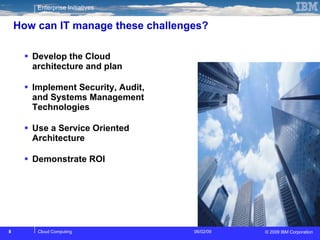
How can IT manage these challenges?  Develop the Cloud architecture and plan Implement Security, Audit, and Systems Management Technologies  Use a Service Oriented Architecture Demonstrate ROI
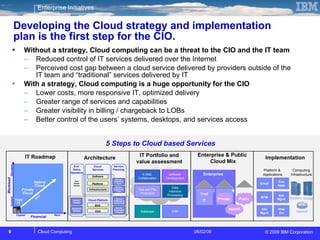
Developing the Cloud strategy and implementation plan is the first step for the CIO. Without a strategy, Cloud computing can be a threat to the CIO and the IT team Reduced control of IT services delivered over the Internet  Perceived cost gap between a cloud service delivered by providers outside of the IT team and “traditional” services delivered by IT With a strategy, Cloud computing is a huge opportunity for the CIO Lower costs, more responsive IT, optimized delivery Greater range of services and capabilities Greater visibility in billing / chargeback to LOBs Better control of the users’ systems, desktops, and services access  5 Steps to Cloud based Services IT Roadmap Architecture IT Portfolio and value assessment Enterprise & Public  Cloud Mix Implementation Service  Definition Tools Service  Publishing Tools Service Fulfillment & Config Tools Service Reporting & Analytics Service Planning Role Based Access End  Users, Operators Service Catalog Operational Console Cloud  Services Cloud Platform Systems Storage Network Computing Infrastructure Platform &  Applications Email Bus Apps BPM Sys Mgmt Info Mgmt Web Svr E-Mail, Collaboration Software Development Test and Pre-Production Data Intensive Processing Database ERP Enterprise Private Public Hybrid Trad IT Capital Private Cloud Hybrid Cloud Time Trad IT Rent Financial  Workload Custom Standard OSS BSS Infrastructure Platform  Software
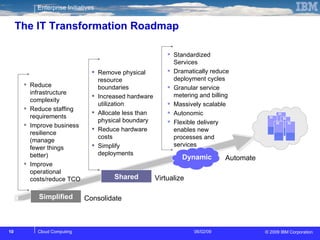
The IT Transformation Roadmap Simplified Shared Dynamic Consolidate Virtualize Automate Reduce infrastructure complexity Reduce staffing requirements Improve business  resilience (manage  fewer things better) Improve operational  costs/reduce TCO Remove physical resource boundaries Increased hardware utilization Allocate less than physical boundary Reduce hardware  costs Simplify deployments Standardized Services Dramatically reduce deployment cycles Granular service metering and billing Massively scalable Autonomic Flexible delivery enables new processes and services
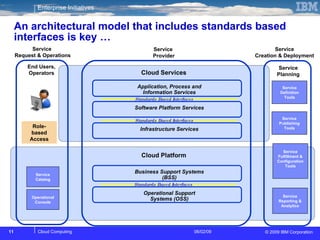
An architectural model that includes standards based interfaces is key … Service Creation & Deployment Service  Request & Operations Service  Provider Service Definition Tools Service Publishing Tools Service Fulfillment & Configuration Tools Service Reporting & Analytics Service Planning Role-based Access End Users, Operators Service Catalog Operational Console Cloud Services Cloud Platform Operational Support Systems (OSS) Business Support Systems (BSS) Infrastructure Services Software Platform Services Application, Process and Information Services Standards Based Interfaces Standards Based Interfaces Standards Based Interfaces
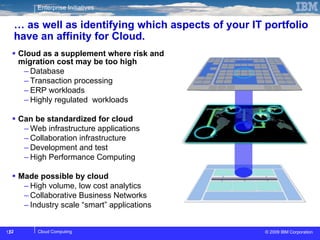
…  as well as identifying which aspects of your IT portfolio have an affinity for Cloud.  Cloud as a supplement where risk and migration cost may be too high Database Transaction processing  ERP workloads Highly regulated  workloads Can be standardized for cloud  Web infrastructure applications Collaboration infrastructure Development and test High Performance Computing Made possible by cloud High volume, low cost analytics Collaborative Business Networks Industry scale “smart” applications
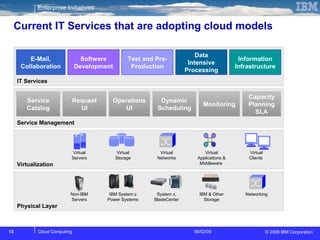
Current IT Services that are adopting cloud models IT Services Service Management Virtualization Physical Layer E-Mail, Collaboration Software Development Test and Pre-Production Data Intensive Processing Information Infrastructure Service Catalog Request UI Operations UI Dynamic Scheduling Monitoring Capacity Planning SLA Virtual Applications & Middleware  Virtual Clients  Virtual Networks Virtual Storage Virtual Servers IBM & Other Storage Networking System x, BladeCenter IBM System z Power Systems Non-IBM Servers
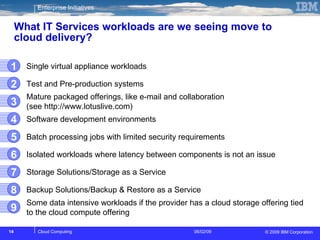
What IT Services workloads are we seeing move to cloud delivery? Single virtual appliance workloads Test and Pre-production systems Mature packaged offerings, like e-mail and collaboration  (see http://www.lotuslive.com) Software development environments Batch processing jobs with limited security requirements Isolated workloads where latency between components is not an issue Storage Solutions/Storage as a Service Backup Solutions/Backup & Restore as a Service Some data intensive workloads if the provider has a cloud storage offering tied to the cloud compute offering 1 2 3 4 5 6 7 8 9
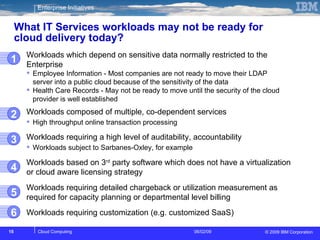
What IT Services workloads may not be ready for cloud delivery today? Workloads which depend on sensitive data normally restricted to the Enterprise Employee Information - Most companies are not ready to move their LDAP server into a public cloud because of the sensitivity of the data Health Care Records - May not be ready to move until the security of the cloud provider is well established Workloads composed of multiple, co-dependent services High throughput online transaction processing Workloads requiring a high level of auditability, accountability Workloads subject to Sarbanes-Oxley, for example Workloads based on 3 rd  party software which does not have a virtualization or cloud aware licensing strategy Workloads requiring detailed chargeback or utilization measurement as required for capacity planning or departmental level billing Workloads requiring customization (e.g. customized SaaS)‏ 1 2 3 4 5 6
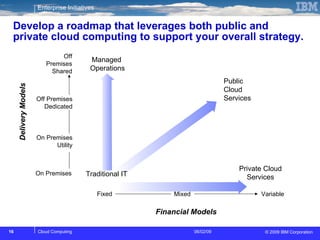
Develop a roadmap that leverages both public and private cloud computing to support your overall strategy. Fixed Traditional IT Managed  Operations Public Cloud Services Private Cloud Services Financial Models Delivery Models Off Premises Shared Variable Off Premises Dedicated On Premises Utility Mixed On Premises
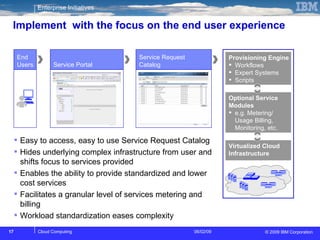
Implement  with the focus on the end user experience End  Users Service Portal Service Request  Catalog Provisioning Engine Workflows Expert Systems Scripts Optional Service Modules  e.g. Metering/ Usage Billing, Monitoring, etc. Virtualized Cloud Infrastructure Easy to access, easy to use Service Request Catalog Hides underlying complex infrastructure from user and shifts focus to services provided Enables the ability to provide standardized and lower cost services Facilitates a granular level of services metering and billing Workload standardization eases complexity
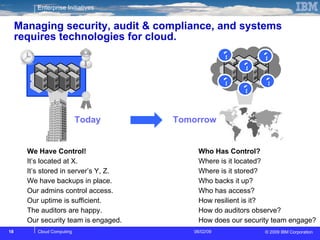
Managing security, audit & compliance, and systems requires technologies for cloud.  We Have Control! It’s located at X. It’s stored in server’s Y, Z. We have backups in place. Our admins control access. Our uptime is sufficient. The auditors are happy. Our security team is engaged. Who Has Control? Where is it located? Where is it stored? Who backs it up? Who has access? How resilient is it? How do auditors observe? How does our security team engage? Today ? ? ? ? ? ? Tomorrow
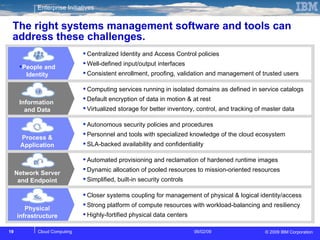
The right systems management software and tools can address these challenges. Computing services running in isolated domains as defined in service catalogs Default encryption of data in motion & at rest Virtualized storage for better inventory, control, and tracking of master data Information  and Data Autonomous security policies and procedures Personnel and tools with specialized knowledge of the cloud ecosystem  SLA-backed availability and confidentiality Process & Application Automated provisioning and reclamation of hardened runtime images Dynamic allocation of pooled resources to mission-oriented resources Simplified, built-in security controls  Network Server and Endpoint Closer systems coupling for management of physical & logical identity/access Strong platform of compute resources with workload-balancing and resiliency Highly-fortified physical data centers Physical infrastructure Centralized Identity and Access Control policies Well-defined input/output interfaces Consistent enrollment, proofing, validation and management of trusted users People and Identity
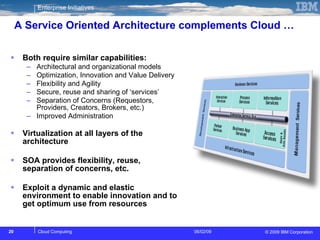
A Service Oriented Architecture complements Cloud …  Both require similar capabilities:   Architectural and organizational models Optimization, Innovation and Value Delivery Flexibility and Agility Secure, reuse and sharing of ‘services’  Separation of Concerns (Requestors, Providers, Creators, Brokers, etc.) Improved Administration Virtualization at all layers of the architecture SOA provides flexibility, reuse, separation of concerns, etc. Exploit a dynamic and elastic environment to enable innovation and to get optimum use from resources
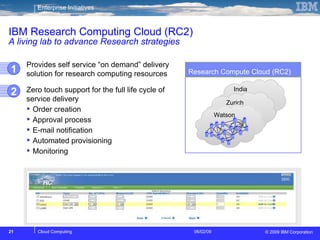
IBM Research Computing Cloud (RC2)  A living lab to advance Research strategies India Zurich Provides self service “on demand” delivery solution for research computing resources Zero touch support for the full life cycle of service delivery Order creation Approval process E-mail notification Automated provisioning Monitoring Research Compute Cloud (RC2) Watson 1 2
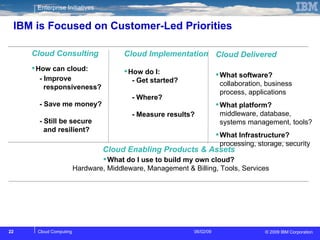
IBM is Focused on Customer-Led Priorities Cloud Consulting How can cloud: - Improve  responsiveness? - Save me money?  - Still be secure  and resilient? Cloud Implementation How do I: - Get started? - Where? - Measure results? Cloud Delivered What software?  collaboration, business process, applications What platform?  middleware, database, systems management, tools? What Infrastructure?  processing, storage, security Cloud Enabling Products & Assets What do I use to build my own cloud? Hardware, Middleware, Management & Billing, Tools, Services
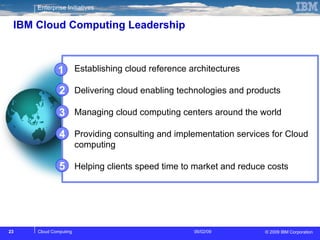
IBM Cloud Computing Leadership Establishing cloud reference architectures Delivering cloud enabling technologies and products  Managing cloud computing centers around the world Providing consulting and implementation services for Cloud computing Helping clients speed time to market and reduce costs 1 2 4 3 5
Thank you! For more information, please visit: ibm.com/cloud Or contact me at: [email_address]

Virgílio Vargas Presentations / CloudViews.Org - Cloud Computing Conference 2009

  • 1.
    Cloud Computing ExpandingIT flexibility and agility Virgílio Vargas IBM [email_address]
  • 2.
    A Crisis ofComplexity. The Need for Progress is Clear. 85% idle In distributed computing environments, up to 85% of computing capacity sits idle. Explosion of information driving 54% growth in storage shipments every year. 1.5x 70¢ per $1 70% on average is spent on maintaining current IT infrastructures versus adding new capabilities.
  • 3.
    What is CloudComputing? IBM Confidential Banking Retail IT Self-Service Economies of Scale Technology Advancement A user experience and a business model Standardized offerings Rapidly provisioned Flexibly priced Ease of access An infrastructure management and services delivery method Virtualized resources Managed as a single large resource Delivering services with elastic scaling Similar to Banking ATMs and Retail Point of Sale, Cloud is Driven by:
  • 4.
    The layers ofIT Services in cloud computing Infrastructure as a Service Platform as a Service High Volume Transactions Software as a Service Servers Networking Storage Middleware Collaboration Business Processes CRM/ERP/HR Industry Applications Data Center Fabric Shared virtualized, dynamic provisioning Database Web 2.0 Application Runtime Java Runtime Development Tooling
  • 5.
    An effective CloudComputing deployment is built on a Dynamic Infrastructure and is highly optimized to achieve more with less…. = CLOUD COMPUTING … leveraging virtualization, standardization and automation to free up operational budget for new investment. VIRTUALIZATION + STANDARDIZATION AUTOMATION + Increased Flexibility Reduced Cost
  • 6.
    A dynamic infrastructureprovides the foundation for effective cloud services delivery Cloud Services Delivery Elastic Scaling Rapidly provisioned Flexible pricing Ease of use Standardized offerings Required Infrastructure Characteristics for effective Cloud Delivery Open standards-based, service-oriented Advanced virtualization and automated mgmt Common components and processes Advanced security and resiliency Easy to use service catalog
  • 7.
    The future: Three co-existing delivery models Mission Critical Packaged Apps High Compliancy Test Systems Pre-production Developer Platform Variable Storage Software as a Service Web Hosting Service Integration Service Integration Traditional Enterprise IT Private Cloud Services Services Service Integration Public Clouds Services Hybrid Cloud Enterprise IT portfolio aspects migrating to cloud today:
  • 8.
    How can ITmanage these challenges? Develop the Cloud architecture and plan Implement Security, Audit, and Systems Management Technologies Use a Service Oriented Architecture Demonstrate ROI
  • 9.
    Developing the Cloudstrategy and implementation plan is the first step for the CIO. Without a strategy, Cloud computing can be a threat to the CIO and the IT team Reduced control of IT services delivered over the Internet Perceived cost gap between a cloud service delivered by providers outside of the IT team and “traditional” services delivered by IT With a strategy, Cloud computing is a huge opportunity for the CIO Lower costs, more responsive IT, optimized delivery Greater range of services and capabilities Greater visibility in billing / chargeback to LOBs Better control of the users’ systems, desktops, and services access 5 Steps to Cloud based Services IT Roadmap Architecture IT Portfolio and value assessment Enterprise & Public Cloud Mix Implementation Service Definition Tools Service Publishing Tools Service Fulfillment & Config Tools Service Reporting & Analytics Service Planning Role Based Access End Users, Operators Service Catalog Operational Console Cloud Services Cloud Platform Systems Storage Network Computing Infrastructure Platform & Applications Email Bus Apps BPM Sys Mgmt Info Mgmt Web Svr E-Mail, Collaboration Software Development Test and Pre-Production Data Intensive Processing Database ERP Enterprise Private Public Hybrid Trad IT Capital Private Cloud Hybrid Cloud Time Trad IT Rent Financial Workload Custom Standard OSS BSS Infrastructure Platform Software
  • 10.
    The IT TransformationRoadmap Simplified Shared Dynamic Consolidate Virtualize Automate Reduce infrastructure complexity Reduce staffing requirements Improve business resilience (manage fewer things better) Improve operational costs/reduce TCO Remove physical resource boundaries Increased hardware utilization Allocate less than physical boundary Reduce hardware costs Simplify deployments Standardized Services Dramatically reduce deployment cycles Granular service metering and billing Massively scalable Autonomic Flexible delivery enables new processes and services
  • 11.
    An architectural modelthat includes standards based interfaces is key … Service Creation & Deployment Service Request & Operations Service Provider Service Definition Tools Service Publishing Tools Service Fulfillment & Configuration Tools Service Reporting & Analytics Service Planning Role-based Access End Users, Operators Service Catalog Operational Console Cloud Services Cloud Platform Operational Support Systems (OSS) Business Support Systems (BSS) Infrastructure Services Software Platform Services Application, Process and Information Services Standards Based Interfaces Standards Based Interfaces Standards Based Interfaces
  • 12.
    … aswell as identifying which aspects of your IT portfolio have an affinity for Cloud. Cloud as a supplement where risk and migration cost may be too high Database Transaction processing ERP workloads Highly regulated workloads Can be standardized for cloud Web infrastructure applications Collaboration infrastructure Development and test High Performance Computing Made possible by cloud High volume, low cost analytics Collaborative Business Networks Industry scale “smart” applications
  • 13.
    Current IT Servicesthat are adopting cloud models IT Services Service Management Virtualization Physical Layer E-Mail, Collaboration Software Development Test and Pre-Production Data Intensive Processing Information Infrastructure Service Catalog Request UI Operations UI Dynamic Scheduling Monitoring Capacity Planning SLA Virtual Applications & Middleware Virtual Clients Virtual Networks Virtual Storage Virtual Servers IBM & Other Storage Networking System x, BladeCenter IBM System z Power Systems Non-IBM Servers
  • 14.
    What IT Servicesworkloads are we seeing move to cloud delivery? Single virtual appliance workloads Test and Pre-production systems Mature packaged offerings, like e-mail and collaboration (see http://www.lotuslive.com) Software development environments Batch processing jobs with limited security requirements Isolated workloads where latency between components is not an issue Storage Solutions/Storage as a Service Backup Solutions/Backup & Restore as a Service Some data intensive workloads if the provider has a cloud storage offering tied to the cloud compute offering 1 2 3 4 5 6 7 8 9
  • 15.
    What IT Servicesworkloads may not be ready for cloud delivery today? Workloads which depend on sensitive data normally restricted to the Enterprise Employee Information - Most companies are not ready to move their LDAP server into a public cloud because of the sensitivity of the data Health Care Records - May not be ready to move until the security of the cloud provider is well established Workloads composed of multiple, co-dependent services High throughput online transaction processing Workloads requiring a high level of auditability, accountability Workloads subject to Sarbanes-Oxley, for example Workloads based on 3 rd party software which does not have a virtualization or cloud aware licensing strategy Workloads requiring detailed chargeback or utilization measurement as required for capacity planning or departmental level billing Workloads requiring customization (e.g. customized SaaS)‏ 1 2 3 4 5 6
  • 16.
    Develop a roadmapthat leverages both public and private cloud computing to support your overall strategy. Fixed Traditional IT Managed Operations Public Cloud Services Private Cloud Services Financial Models Delivery Models Off Premises Shared Variable Off Premises Dedicated On Premises Utility Mixed On Premises
  • 17.
    Implement withthe focus on the end user experience End Users Service Portal Service Request Catalog Provisioning Engine Workflows Expert Systems Scripts Optional Service Modules e.g. Metering/ Usage Billing, Monitoring, etc. Virtualized Cloud Infrastructure Easy to access, easy to use Service Request Catalog Hides underlying complex infrastructure from user and shifts focus to services provided Enables the ability to provide standardized and lower cost services Facilitates a granular level of services metering and billing Workload standardization eases complexity
  • 18.
    Managing security, audit& compliance, and systems requires technologies for cloud. We Have Control! It’s located at X. It’s stored in server’s Y, Z. We have backups in place. Our admins control access. Our uptime is sufficient. The auditors are happy. Our security team is engaged. Who Has Control? Where is it located? Where is it stored? Who backs it up? Who has access? How resilient is it? How do auditors observe? How does our security team engage? Today ? ? ? ? ? ? Tomorrow
  • 19.
    The right systemsmanagement software and tools can address these challenges. Computing services running in isolated domains as defined in service catalogs Default encryption of data in motion & at rest Virtualized storage for better inventory, control, and tracking of master data Information and Data Autonomous security policies and procedures Personnel and tools with specialized knowledge of the cloud ecosystem SLA-backed availability and confidentiality Process & Application Automated provisioning and reclamation of hardened runtime images Dynamic allocation of pooled resources to mission-oriented resources Simplified, built-in security controls Network Server and Endpoint Closer systems coupling for management of physical & logical identity/access Strong platform of compute resources with workload-balancing and resiliency Highly-fortified physical data centers Physical infrastructure Centralized Identity and Access Control policies Well-defined input/output interfaces Consistent enrollment, proofing, validation and management of trusted users People and Identity
  • 20.
    A Service OrientedArchitecture complements Cloud … Both require similar capabilities: Architectural and organizational models Optimization, Innovation and Value Delivery Flexibility and Agility Secure, reuse and sharing of ‘services’ Separation of Concerns (Requestors, Providers, Creators, Brokers, etc.) Improved Administration Virtualization at all layers of the architecture SOA provides flexibility, reuse, separation of concerns, etc. Exploit a dynamic and elastic environment to enable innovation and to get optimum use from resources
  • 21.
    IBM Research ComputingCloud (RC2) A living lab to advance Research strategies India Zurich Provides self service “on demand” delivery solution for research computing resources Zero touch support for the full life cycle of service delivery Order creation Approval process E-mail notification Automated provisioning Monitoring Research Compute Cloud (RC2) Watson 1 2
  • 22.
    IBM is Focusedon Customer-Led Priorities Cloud Consulting How can cloud: - Improve responsiveness? - Save me money? - Still be secure and resilient? Cloud Implementation How do I: - Get started? - Where? - Measure results? Cloud Delivered What software? collaboration, business process, applications What platform? middleware, database, systems management, tools? What Infrastructure? processing, storage, security Cloud Enabling Products & Assets What do I use to build my own cloud? Hardware, Middleware, Management & Billing, Tools, Services
  • 23.
    IBM Cloud ComputingLeadership Establishing cloud reference architectures Delivering cloud enabling technologies and products Managing cloud computing centers around the world Providing consulting and implementation services for Cloud computing Helping clients speed time to market and reduce costs 1 2 4 3 5
  • 24.
    Thank you! Formore information, please visit: ibm.com/cloud Or contact me at: [email_address]