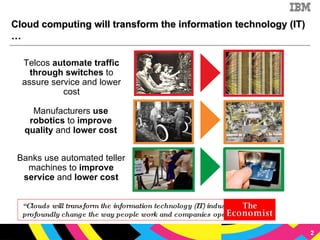
Banks use automated teller machines to  improve service  and  lower cost Manufacturers  use robotics  to  improve quality  and  lower cost Telcos  automate traffic through switches  to assure service and lower cost “ Clouds will transform the information technology (IT) industry…  profoundly change the way people work and companies operate.” Cloud computing will transform the information technology (IT)…
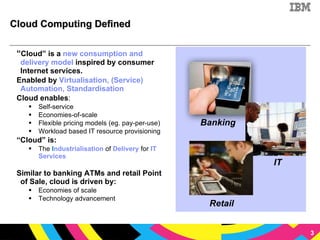
“ Cloud” is a   new consumption and delivery model  inspired by consumer Internet services.   Enabled by   Virtualisation, (Service) Automation, Standardisation Cloud enables :  Self-service  Economies-of-scale Flexible pricing models (eg. pay-per-use) Workload based IT resource provisioning “ Cloud” is:  The  I ndustrialisation  of  Delivery   for  IT   Services Similar to banking ATMs and retail Point of Sale, cloud is driven by: Economies of scale Technology advancement Cloud Computing Defined Banking  Retail IT
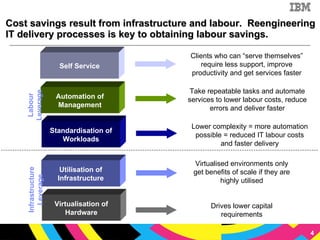
Cost savings result from infrastructure and labour.  Reengineering IT delivery processes is key to obtaining labour savings. Virtualisation of Hardware Standardisation of Workloads Utilisation of Infrastructure Automation of Management Virtualised environments only get benefits of scale if they are highly utilised Drives lower capital requirements Take repeatable tasks and automate services to lower labour costs, reduce errors and deliver faster Labour Leverage Infrastructure Leverage Self Service Clients who can “serve themselves” require less support, improve productivity and get services faster Lower complexity = more automation possible = reduced IT labour costs and faster delivery
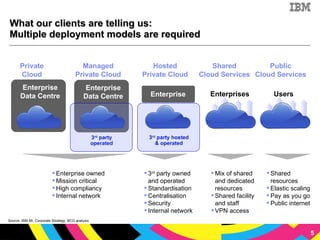
What our clients are telling us:  Multiple deployment models are required Enterprise Data Centre Private Cloud Managed Private Cloud Hosted Private Cloud Shared Cloud Services Public Cloud Services Enterprise Data Centre 3 rd  party operated Enterprise 3 rd  party hosted & operated Enterprises Users Enterprise owned Mission critical High compliancy Internal network 3 rd  party owned and operated  Standardisation Centralisation Security Internal network Mix of shared and dedicated resources Shared facility and staff VPN access Shared resources Elastic scaling Pay as you go Public internet Source: IBM MI, Corporate Strategy, BCG analysis
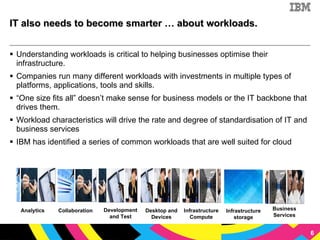
IT also needs to become smarter … about workloads. Understanding workloads is critical to helping businesses optimise their infrastructure.  Companies run many different workloads with investments in multiple types of platforms, applications, tools and skills.  “One size fits all” doesn’t make sense for business models or the IT backbone that drives them. Workload characteristics will drive the rate and degree of standardisation of IT and business services IBM has identified a series of common workloads that are well suited for cloud Desktop and Devices Development and Test Infrastructure Compute Business Services Collaboration Analytics Infrastructure storage
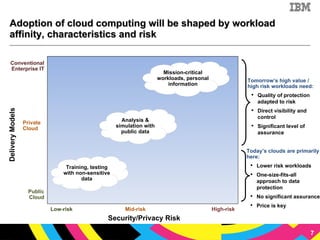
Adoption of cloud computing will be shaped by workload affinity, characteristics and risk Low-risk Mid-risk High-risk Mission-critical workloads, personal information Security/Privacy Risk Delivery Models Public Cloud Conventional Enterprise IT Training, testing with non-sensitive data Today’s clouds are primarily here: Lower risk workloads One-size-fits-all approach to data protection No significant assurance Price is key Tomorrow’s high value / high risk workloads need: Quality of protection adapted to risk Direct visibility and control Significant level of assurance Analysis & simulation with public data Private Cloud
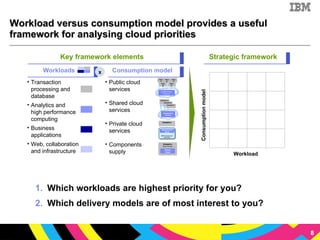
Workload versus consumption model provides a useful framework for analysing cloud priorities Key framework elements Strategic framework Which workloads are highest priority for you? Which delivery models are of most interest to you? Consumption model Workload Public cloud services Shared cloud services  Private cloud services Components supply Transaction processing and database Analytics and high performance computing Business applications Web, collaboration and infrastructure Workloads Consumption model x
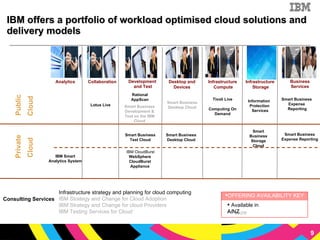
IBM offers a portfolio of workload optimised cloud solutions and delivery models Consulting Services Infrastructure strategy and planning for cloud computing  IBM Strategy and Change for Cloud Adoption IBM Strategy and Change for cloud Providers IBM Testing Services for Cloud Lotus Live Smart Business Test Cloud Smart Business Development & Test on the IBM Cloud Smart Business Desktop Cloud IBM Smart Analytics System Private Cloud WebSphere CloudBurst Appliance Smart Business  Expense  Reporting Smart Business Expense Reporting Tivoli Live Public Cloud Smart Business Desktop Cloud Future Available in A/NZ OFFERING AVAILABILITY KEY Smart Business Storage Cloud Information  Protection Services IBM CloudBurst Analytics Collaboration Development  and Test Desktop and Devices Infrastructure  Compute Business Services Infrastructure  Storage Computing On Demand Rational AppScan
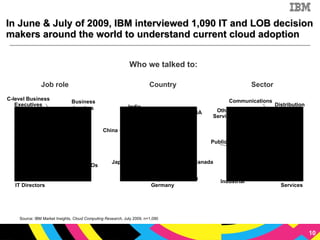
In June & July of 2009, IBM interviewed 1,090 IT and LOB decision makers around the world to understand current cloud adoption Who we talked to: Source: IBM Market Insights,  Cloud Computing Research , July 2009. n=1,090 Job role Country Sector C-level Business Executives Business Leaders CIOs IT Directors Japan China India USA Canada France Germany UK Communications Distribution Industrial Public Financial Services Other Services
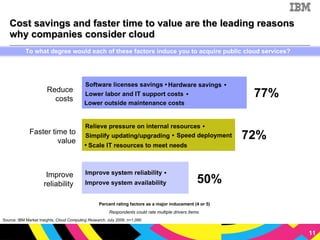
Cost savings and faster time to value are the leading reasons why companies consider cloud Percent rating factors as a major inducement (4 or 5) Respondents could rate multiple drivers items  50% 72% 77% Improve reliability Faster time to value Reduce costs Improve system availability Hardware savings Software licenses savings Lower labor and IT support costs Lower outside maintenance costs Relieve pressure on internal resources Simplify updating/upgrading Speed deployment Scale IT resources to meet needs • • • Improve system reliability • • • To what degree would each of these factors induce you to acquire public cloud services?  Source: IBM Market Insights,  Cloud Computing Research , July 2009. n=1,090 •
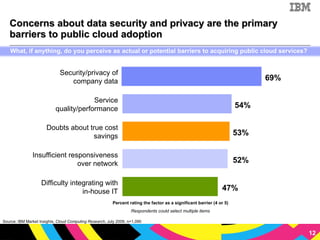
Concerns about data security and privacy are the primary barriers to public cloud adoption Percent rating the factor as a significant barrier (4 or 5) Respondents could select multiple items 69% 54% 53% 52% 47% Security/privacy of company data Service quality/performance Doubts about true cost savings Insufficient responsiveness over network Difficulty integrating with in-house IT What, if anything, do you perceive as actual or potential barriers to acquiring public cloud services?  Source: IBM Market Insights,  Cloud Computing Research , July 2009. n=1,090
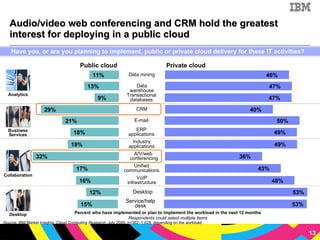
Audio/video web conferencing and CRM hold the greatest interest for deploying in a public cloud Public cloud Private cloud Percentage of respondents who have implemented or plan to implement a workload in a cloud environment Have you, or are you planning to implement, public or private cloud delivery for these IT activities?  Percent who have implemented or plan to implement the workload in the next 12 months Respondents could select multiple items Source: IBM Market Insights,  Cloud Computing Research , July 2009. n=362–1,029, depending on the workload. 47% 13% Data warehouse 47% 9% Transactional databases 40% 29% CRM 50% 21% E-mail 49% 18% ERP applications 49% 19% Industry applications 36% 32% A/V/web  conferencing 43% 17% Unified communications 48% 16% VoIP infrastructure 46% 11% Data mining Business Services Collaboration Analytics 53% 15% Service/help desk Desktop 53% 12% Desktop
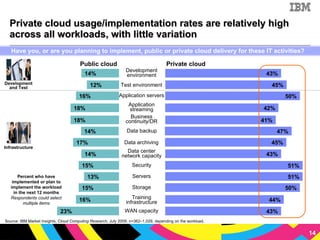
Private cloud usage/implementation rates are relatively high across all workloads, with little variation Public cloud Private cloud Have you, or are you planning to implement, public or private cloud delivery for these IT activities?  Source: IBM Market Insights,  Cloud Computing Research , July 2009. n=362–1,029, depending on the workload. Percent who have implemented or plan to implement the workload in the next 12 months Respondents could select multiple items 51% 13% Servers 43% 14% Development environment 50% 15% Storage 50% 16% Application servers 42% 18% Application streaming 41% 18% Business continuity/DR 43% 14% Data center network capacity 44% 16% Training infrastructure 45% 17% Data archiving 51% 15% Security 47% 14% Data backup 43% 23% WAN capacity Test environment 12% 45% Infrastructure Development and Test
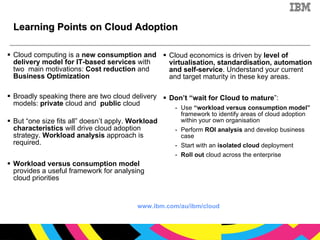
Cloud computing is a  new consumption and delivery model for IT-based services  with two  main motivations:  Cost reduction  and  Business Optimization Broadly speaking there are two cloud delivery models:  private  cloud and  public  cloud But “one size fits all” doesn’t apply.  Workload characteristics  will drive  cloud adoption strategy.  Workload analysis  approach is required. Workload versus consumption model  provides a useful framework for analysing cloud priorities   Cloud economics is driven by  level  of virtualisation, standardisation, automation and  self-service . Understand your current and target maturity in these key areas. Don’t “wait for Cloud to mature ”: Use  “workload versus consumption model”  framework to identify areas of cloud adoption within your own organisation Perform  ROI analysis  and develop business case Start with an  isolated cloud  deployment Roll out  cloud across the enterprise  Learning Points on Cloud Adoption www.ibm.com/au/ibm/cloud

Cloud computing (2)

  • 1.
  • 2.
    Banks use automatedteller machines to improve service and lower cost Manufacturers use robotics to improve quality and lower cost Telcos automate traffic through switches to assure service and lower cost “ Clouds will transform the information technology (IT) industry… profoundly change the way people work and companies operate.” Cloud computing will transform the information technology (IT)…
  • 3.
    “ Cloud” isa new consumption and delivery model inspired by consumer Internet services. Enabled by Virtualisation, (Service) Automation, Standardisation Cloud enables : Self-service Economies-of-scale Flexible pricing models (eg. pay-per-use) Workload based IT resource provisioning “ Cloud” is: The I ndustrialisation of Delivery for IT Services Similar to banking ATMs and retail Point of Sale, cloud is driven by: Economies of scale Technology advancement Cloud Computing Defined Banking Retail IT
  • 4.
    Cost savings resultfrom infrastructure and labour. Reengineering IT delivery processes is key to obtaining labour savings. Virtualisation of Hardware Standardisation of Workloads Utilisation of Infrastructure Automation of Management Virtualised environments only get benefits of scale if they are highly utilised Drives lower capital requirements Take repeatable tasks and automate services to lower labour costs, reduce errors and deliver faster Labour Leverage Infrastructure Leverage Self Service Clients who can “serve themselves” require less support, improve productivity and get services faster Lower complexity = more automation possible = reduced IT labour costs and faster delivery
  • 5.
    What our clientsare telling us: Multiple deployment models are required Enterprise Data Centre Private Cloud Managed Private Cloud Hosted Private Cloud Shared Cloud Services Public Cloud Services Enterprise Data Centre 3 rd party operated Enterprise 3 rd party hosted & operated Enterprises Users Enterprise owned Mission critical High compliancy Internal network 3 rd party owned and operated Standardisation Centralisation Security Internal network Mix of shared and dedicated resources Shared facility and staff VPN access Shared resources Elastic scaling Pay as you go Public internet Source: IBM MI, Corporate Strategy, BCG analysis
  • 6.
    IT also needsto become smarter … about workloads. Understanding workloads is critical to helping businesses optimise their infrastructure. Companies run many different workloads with investments in multiple types of platforms, applications, tools and skills. “One size fits all” doesn’t make sense for business models or the IT backbone that drives them. Workload characteristics will drive the rate and degree of standardisation of IT and business services IBM has identified a series of common workloads that are well suited for cloud Desktop and Devices Development and Test Infrastructure Compute Business Services Collaboration Analytics Infrastructure storage
  • 7.
    Adoption of cloudcomputing will be shaped by workload affinity, characteristics and risk Low-risk Mid-risk High-risk Mission-critical workloads, personal information Security/Privacy Risk Delivery Models Public Cloud Conventional Enterprise IT Training, testing with non-sensitive data Today’s clouds are primarily here: Lower risk workloads One-size-fits-all approach to data protection No significant assurance Price is key Tomorrow’s high value / high risk workloads need: Quality of protection adapted to risk Direct visibility and control Significant level of assurance Analysis & simulation with public data Private Cloud
  • 8.
    Workload versus consumptionmodel provides a useful framework for analysing cloud priorities Key framework elements Strategic framework Which workloads are highest priority for you? Which delivery models are of most interest to you? Consumption model Workload Public cloud services Shared cloud services Private cloud services Components supply Transaction processing and database Analytics and high performance computing Business applications Web, collaboration and infrastructure Workloads Consumption model x
  • 9.
    IBM offers aportfolio of workload optimised cloud solutions and delivery models Consulting Services Infrastructure strategy and planning for cloud computing IBM Strategy and Change for Cloud Adoption IBM Strategy and Change for cloud Providers IBM Testing Services for Cloud Lotus Live Smart Business Test Cloud Smart Business Development & Test on the IBM Cloud Smart Business Desktop Cloud IBM Smart Analytics System Private Cloud WebSphere CloudBurst Appliance Smart Business Expense Reporting Smart Business Expense Reporting Tivoli Live Public Cloud Smart Business Desktop Cloud Future Available in A/NZ OFFERING AVAILABILITY KEY Smart Business Storage Cloud Information Protection Services IBM CloudBurst Analytics Collaboration Development and Test Desktop and Devices Infrastructure Compute Business Services Infrastructure Storage Computing On Demand Rational AppScan
  • 10.
    In June &July of 2009, IBM interviewed 1,090 IT and LOB decision makers around the world to understand current cloud adoption Who we talked to: Source: IBM Market Insights, Cloud Computing Research , July 2009. n=1,090 Job role Country Sector C-level Business Executives Business Leaders CIOs IT Directors Japan China India USA Canada France Germany UK Communications Distribution Industrial Public Financial Services Other Services
  • 11.
    Cost savings andfaster time to value are the leading reasons why companies consider cloud Percent rating factors as a major inducement (4 or 5) Respondents could rate multiple drivers items 50% 72% 77% Improve reliability Faster time to value Reduce costs Improve system availability Hardware savings Software licenses savings Lower labor and IT support costs Lower outside maintenance costs Relieve pressure on internal resources Simplify updating/upgrading Speed deployment Scale IT resources to meet needs • • • Improve system reliability • • • To what degree would each of these factors induce you to acquire public cloud services? Source: IBM Market Insights, Cloud Computing Research , July 2009. n=1,090 •
  • 12.
    Concerns about datasecurity and privacy are the primary barriers to public cloud adoption Percent rating the factor as a significant barrier (4 or 5) Respondents could select multiple items 69% 54% 53% 52% 47% Security/privacy of company data Service quality/performance Doubts about true cost savings Insufficient responsiveness over network Difficulty integrating with in-house IT What, if anything, do you perceive as actual or potential barriers to acquiring public cloud services? Source: IBM Market Insights, Cloud Computing Research , July 2009. n=1,090
  • 13.
    Audio/video web conferencingand CRM hold the greatest interest for deploying in a public cloud Public cloud Private cloud Percentage of respondents who have implemented or plan to implement a workload in a cloud environment Have you, or are you planning to implement, public or private cloud delivery for these IT activities? Percent who have implemented or plan to implement the workload in the next 12 months Respondents could select multiple items Source: IBM Market Insights, Cloud Computing Research , July 2009. n=362–1,029, depending on the workload. 47% 13% Data warehouse 47% 9% Transactional databases 40% 29% CRM 50% 21% E-mail 49% 18% ERP applications 49% 19% Industry applications 36% 32% A/V/web conferencing 43% 17% Unified communications 48% 16% VoIP infrastructure 46% 11% Data mining Business Services Collaboration Analytics 53% 15% Service/help desk Desktop 53% 12% Desktop
  • 14.
    Private cloud usage/implementationrates are relatively high across all workloads, with little variation Public cloud Private cloud Have you, or are you planning to implement, public or private cloud delivery for these IT activities? Source: IBM Market Insights, Cloud Computing Research , July 2009. n=362–1,029, depending on the workload. Percent who have implemented or plan to implement the workload in the next 12 months Respondents could select multiple items 51% 13% Servers 43% 14% Development environment 50% 15% Storage 50% 16% Application servers 42% 18% Application streaming 41% 18% Business continuity/DR 43% 14% Data center network capacity 44% 16% Training infrastructure 45% 17% Data archiving 51% 15% Security 47% 14% Data backup 43% 23% WAN capacity Test environment 12% 45% Infrastructure Development and Test
  • 15.
    Cloud computing isa new consumption and delivery model for IT-based services with two main motivations: Cost reduction and Business Optimization Broadly speaking there are two cloud delivery models: private cloud and public cloud But “one size fits all” doesn’t apply. Workload characteristics will drive cloud adoption strategy. Workload analysis approach is required. Workload versus consumption model provides a useful framework for analysing cloud priorities Cloud economics is driven by level of virtualisation, standardisation, automation and self-service . Understand your current and target maturity in these key areas. Don’t “wait for Cloud to mature ”: Use “workload versus consumption model” framework to identify areas of cloud adoption within your own organisation Perform ROI analysis and develop business case Start with an isolated cloud deployment Roll out cloud across the enterprise Learning Points on Cloud Adoption www.ibm.com/au/ibm/cloud

Editor's Notes