THE CLOUD ECOSYSTEM
Bhaskar Chaudhury
20-Jul-2016
Concept of Cloud
Cloud Computing
Cloud Computing Technologies
Cloud Security
Cloud Computing Challenges
Cloud Computing Benefits
CONCEPT OF CLOUD
• Cloud refers to Internet or Network
• Cloud is an off-premise form of computing that stores
data on the Internet
• Cloud environment allow users to configure Virtual
Machines (VM) specifying node size, operating
system, network configuration, application software,
location of node, etc.
• Enterprises can choose to deploy applications in
Public (accessible to general public), Private (within
organization), Hybrid (mixture of private & public) or
Community (accessible within groups) clouds
• Cloud can provide services over network i.e. public or
private networks such as LAN, WAN or VPN
CLOUD COMPUTING
CLOUD COMPUTING
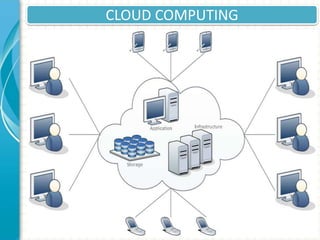
• Cloud computing is a model for enabling ubiquitous,
convenient, on-demand network access to a shared
pool of configurable computing resources (e.g.,
networks, servers, storage, applications and services)
that can be rapidly provisioned and released with
minimal management effort or service provider
interaction
• Cloud computing offers services that are broadly
classified as
 Software as a Service (SaaS): complete application is offered
to customer as a service on demand
 Platform as a Service (PaaS): a layer of software or
development environment is encapsulated and offered as a
service
 Infrastructure as a Service (IaaS): provides basic storage and
computing capabilities as standardized services over the
network
CLOUD COMPUTING TECHNOLOGIES
• Virtualization: allows to share single physical
instance of an application or resource among
multiple organizations or customers.
• Service Oriented Architecture (SOA): helps to
use applications as a service for other
applications regardless the type of vendor,
product or technology
• Grid Computing: refers to distributed computing
in which a group of computers from multiple
locations are connected with each other to
achieve common objective
• Utility Computing: based on Pay per Use model,
it offers computational resources on demand as
a metered service
CLOUD COMPUTING SECURITY
• Identity Management: Cloud providers either integrate the
customer’s identity management system into their own
infrastructure using federation or SSO technology or a
biometric-based identification system or provide an identity
management solution of their own
• Physical security: this method physically secures IT
hardware against unauthorized access
• Privacy: ensure that all critical data / information are
encrypted / masked and only authorized users have access
• Effective Governance: establish security and compliance
policies and procedures that are used to protect intellectual
property
• Personnel security: with roles & responsibilities defined
appropriately
CLOUD COMPUTING CHALLENGES
• Data Protection: service providers are responsible for
maintaining data security and enterprises would have to rely
on them
• Data Recovery & Availability: support on clustering &
failover, data replication, system monitoring, runtime
governance, disaster recovery and performance
management are key service requirements by cloud
provider
• Management capabilities: management of platform &
infrastructure are key requirements along with
improvement on scalability & load-balancing features
• Regulatory & Compliance restrictions: for countries which
do not allow customer’s personal information to be stored
outside country, there may be challenge infrastructure may
not be always feasible within country thus posing challenge
CLOUD COMPUTING BENEFITS
• Reduced Cost: the billing model is pay as per usage;
the infrastructure is not purchased thus lowering
maintenance. Initial expense and recurring expenses
are much lower than traditional computing.
• Increased Storage: storage & maintenance of large
volumes of data is a reality today. Sudden workload
spikes are also managed effectively & efficiently, since
the cloud can scale dynamically
• Flexibility: with enterprises having to adapt, even
more rapidly, to changing business conditions, speed
to deliver is critical. Cloud computing stresses on
getting applications to market very quickly, by using
the most appropriate building blocks necessary for
deployment

The cloud ecosystem

  • 1.
    THE CLOUD ECOSYSTEM BhaskarChaudhury 20-Jul-2016
  • 2.
    Concept of Cloud CloudComputing Cloud Computing Technologies Cloud Security Cloud Computing Challenges Cloud Computing Benefits
  • 3.
    CONCEPT OF CLOUD •Cloud refers to Internet or Network • Cloud is an off-premise form of computing that stores data on the Internet • Cloud environment allow users to configure Virtual Machines (VM) specifying node size, operating system, network configuration, application software, location of node, etc. • Enterprises can choose to deploy applications in Public (accessible to general public), Private (within organization), Hybrid (mixture of private & public) or Community (accessible within groups) clouds • Cloud can provide services over network i.e. public or private networks such as LAN, WAN or VPN
  • 4.
  • 5.
    CLOUD COMPUTING • Cloudcomputing is a model for enabling ubiquitous, convenient, on-demand network access to a shared pool of configurable computing resources (e.g., networks, servers, storage, applications and services) that can be rapidly provisioned and released with minimal management effort or service provider interaction • Cloud computing offers services that are broadly classified as  Software as a Service (SaaS): complete application is offered to customer as a service on demand  Platform as a Service (PaaS): a layer of software or development environment is encapsulated and offered as a service  Infrastructure as a Service (IaaS): provides basic storage and computing capabilities as standardized services over the network
  • 6.
    CLOUD COMPUTING TECHNOLOGIES •Virtualization: allows to share single physical instance of an application or resource among multiple organizations or customers. • Service Oriented Architecture (SOA): helps to use applications as a service for other applications regardless the type of vendor, product or technology • Grid Computing: refers to distributed computing in which a group of computers from multiple locations are connected with each other to achieve common objective • Utility Computing: based on Pay per Use model, it offers computational resources on demand as a metered service
  • 7.
    CLOUD COMPUTING SECURITY •Identity Management: Cloud providers either integrate the customer’s identity management system into their own infrastructure using federation or SSO technology or a biometric-based identification system or provide an identity management solution of their own • Physical security: this method physically secures IT hardware against unauthorized access • Privacy: ensure that all critical data / information are encrypted / masked and only authorized users have access • Effective Governance: establish security and compliance policies and procedures that are used to protect intellectual property • Personnel security: with roles & responsibilities defined appropriately
  • 8.
    CLOUD COMPUTING CHALLENGES •Data Protection: service providers are responsible for maintaining data security and enterprises would have to rely on them • Data Recovery & Availability: support on clustering & failover, data replication, system monitoring, runtime governance, disaster recovery and performance management are key service requirements by cloud provider • Management capabilities: management of platform & infrastructure are key requirements along with improvement on scalability & load-balancing features • Regulatory & Compliance restrictions: for countries which do not allow customer’s personal information to be stored outside country, there may be challenge infrastructure may not be always feasible within country thus posing challenge
  • 9.
    CLOUD COMPUTING BENEFITS •Reduced Cost: the billing model is pay as per usage; the infrastructure is not purchased thus lowering maintenance. Initial expense and recurring expenses are much lower than traditional computing. • Increased Storage: storage & maintenance of large volumes of data is a reality today. Sudden workload spikes are also managed effectively & efficiently, since the cloud can scale dynamically • Flexibility: with enterprises having to adapt, even more rapidly, to changing business conditions, speed to deliver is critical. Cloud computing stresses on getting applications to market very quickly, by using the most appropriate building blocks necessary for deployment