GREEN CLOUD COMPUTING- A 
PROGRESS TOWARDS 
ENVIRONMENT SUSTAINABILITY 
SUBMITTED BY:-
The World of Internet 
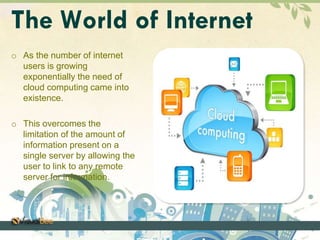
o As the number of internet 
users is growing 
exponentially the need of 
cloud computing came into 
existence. 
o This overcomes the 
limitation of the amount of 
information present on a 
single server by allowing the 
user to link to any remote 
server for information.
Why think for green cloud computing?? 
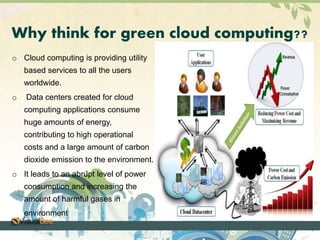
o Cloud computing is providing utility 
based services to all the users 
worldwide. 
o Data centers created for cloud 
computing applications consume 
huge amounts of energy, 
contributing to high operational 
costs and a large amount of carbon 
dioxide emission to the environment. 
o It leads to an abrupt level of power 
consumption and increasing the 
amount of harmful gases in 
environment.
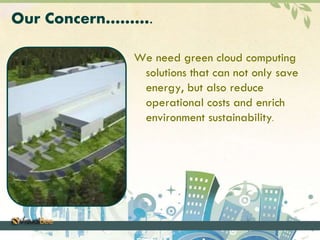
Our Concern………. 
We need green cloud computing 
solutions that can not only save 
energy, but also reduce 
operational costs and enrich 
environment sustainability.
What constitutes Green Cloud 
computing? 
1.Cloud computing 
2.Green Computing 
3.Green cloud computing
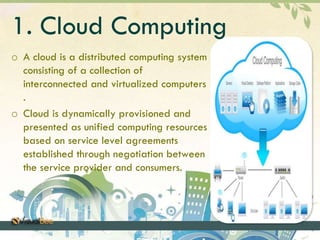
1. Cloud Computing 
o A cloud is a distributed computing system 
consisting of a collection of 
interconnected and virtualized computers 
. 
o Cloud is dynamically provisioned and 
presented as unified computing resources 
based on service level agreements 
established through negotiation between 
the service provider and consumers.
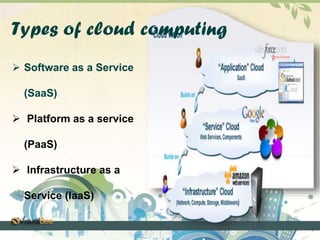
Types of cloud computing 
 Software as a Service 
(SaaS) 
 Platform as a service 
(PaaS) 
 Infrastructure as a 
Service (IaaS)
i) Software as a Service (SaaS): 
o Topmost layer of cloud computing architecture, which is a software delivery 
model providing on-demand access to application. 
o Referred to as “On demand software” and is usually priced on a pay per use 
basis. 
ii) Platform as a service (PaaS): 
o Facilitates the deployment of application without the cost of buying managing 
the hardware and software and provisioning the hosting capabilities. 
o It may also include facilities for application design, application development, 
testing and deployment. 
iii) Infrastructure as a Service (IaaS): 
o Presents computers as virtual machines and offers additional resources such 
as images in a virtual machine image library, block and file based storage, 
firewalls, load balancers and IP addresses.
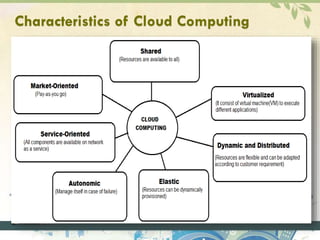
Characteristics of Cloud Computing
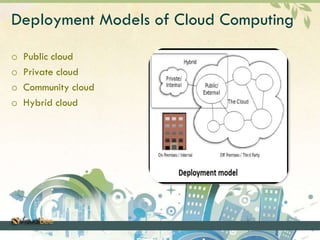
Deployment Models of Cloud Computing 
o Public cloud 
o Private cloud 
o Community cloud 
o Hybrid cloud
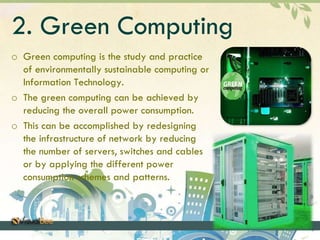
2. Green Computing 
o Green computing is the study and practice 
of environmentally sustainable computing or 
Information Technology. 
o The green computing can be achieved by 
reducing the overall power consumption. 
o This can be accomplished by redesigning 
the infrastructure of network by reducing 
the number of servers, switches and cables 
or by applying the different power 
consumption schemes and patterns.
3. Green Cloud Computing 
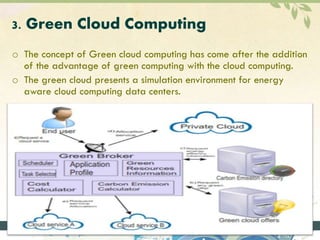
o The concept of Green cloud computing has come after the addition 
of the advantage of green computing with the cloud computing. 
o The green cloud presents a simulation environment for energy 
aware cloud computing data centers.
Core component of Green cloud 
computing ….. 
o Data Center : 
Data center is a subdivision of information and communication 
technology service provider organization where this organization can 
operate most of the ICT infrastructure that supports to their clients. 
the network system devices used in creating data centers are 
switches, links and servers.
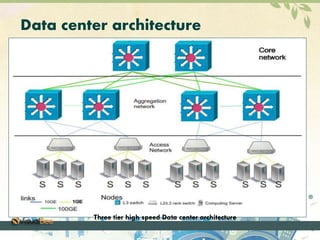
Data center architecture 
Three tier high speed Data center architecture
The architecture typically includes three 
layers: 
o Access layer 
Supports the loop-free topology due to the inexpensive Layer-2 (L2) switches in 
the access layer. 
o Aggregation layer 
Increase the number of server nodes to more than 10,000 servers but it leads to 
the increase in the cost due to increase in number of servers. 
o Core layer 
A typical three tier architecture includes eight core switches). An 8-way ECMP 
includes 10 GE (Gigabyte Ethernet) Line Aggregation Groups (LAGs) which 
permit a client to access several links and network ports with a single MAC 
address.
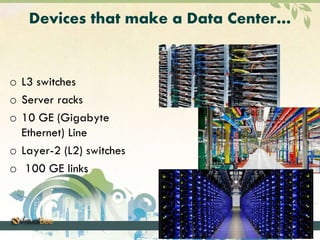
Devices that make a Data Center… 
o L3 switches 
o Server racks 
o 10 GE (Gigabyte 
Ethernet) Line 
o Layer-2 (L2) switches 
o 100 GE links
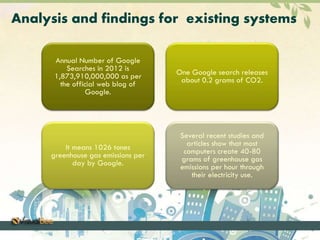
Analysis and findings for existing systems 
Annual Number of Google 
Searches in 2012 is 
1,873,910,000,000 as per 
the official web blog of 
Google. 
One Google search releases 
about 0.2 grams of CO2. 
It means 1026 tones 
greenhouse gas emissions per 
day by Google. 
Several recent studies and 
articles show that most 
computers create 40-80 
grams of greenhouse gas 
emissions per hour through 
their electricity use.
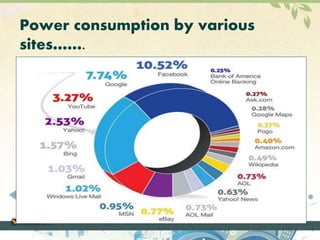
Power consumption by various 
sites…….
The key to the success of energy efficient 
clouds is “Virtualization”. 
( Green Cloud Simulator)
Green Cloud Simulator…. 
o Green cloud simulator provides the modeling environment for 
describing energy consumed by the elements of the data center 
such as server, switches and links. 
o The main focus of green cloud simulator is on the packet level 
simulation of communication in the data center infrastructure which 
provides the finest control and distinguishes it from any other 
cloud simulation environment. 
o The baseline of Green cloud simulator is derived from NS-2 
network simulator. It comes as a pre-confined virtual machine 
(VM) which works with VMWare player.
Green Cloud Simulator…. 
o The baseline of Green cloud is derived from NS-2 
network simulator. 
o It comes as a pre-confined virtual machine (VM) 
which works with VMWare player. 
o This VM contains: 
1. A default Ubuntu 12.04 Desktop 32-bit 
installation, with many extra packages removed. 
2. Use of Languages like TCL, TK, OTCL and TclCL to 
be built from source. 
3. NS2 and Green Cloud simulator is installed from 
source by merging process. 
4. It also includes Eclipse IDE with the NS2/Green 
Cloud project already set up.
Objective: 
We try building a new data center in order to describe the total 
power consumption by several devices of data center.
The steps are: 
1. Install VMPLayer which provides Ubuntu working environment on windows 
operating system. 
2. Open Eclipse IDE which is integrated with a default NS2/Green Cloud project 
set up. The source code is displayed in tool command language(TCL). 
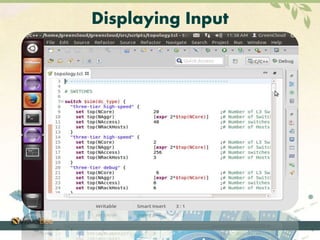
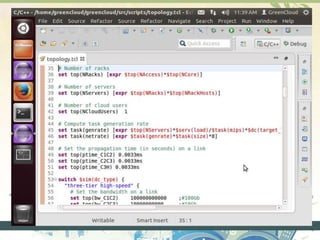
3. The source code consist of numerical values representing the number of servers, 
each type of switches and total number of users. To create a new data center, 
make changes in the numerical values applicable with the formulas. 
4. Run the green cloud simulator to perform the calculation on the values and for 
displaying the progress. It calculates the total energy consumption by each of 
the device used in data center. 
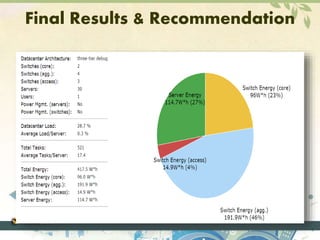
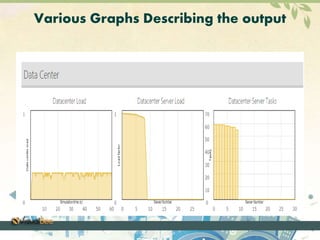
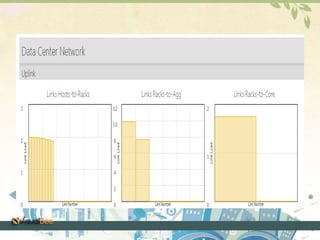
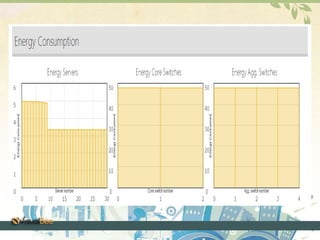
5. The statistical result is displayed on the default browser (i.e. Mozilla Firefox). The 
output is presented in the form of pie chart and various graphs.
Displaying Input
Final Results & Recommendation
Various Graphs Describing the output
Limitations of Green Cloud Computing 
The principle limitation is the high cost of purchase of components 
that are required to make the cloud computing more efficient (like 
cooling equipment, carbon emission rating meter, etc.). 
The high efficiency illustrated by the simulator is very difficult to 
implement in reality. 
The maintenance of the devices included in data center is also a 
prime limitation.
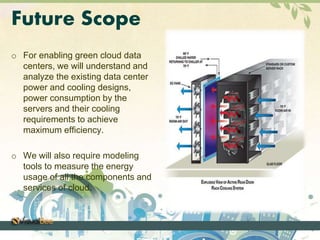
Future Scope 
o For enabling green cloud data 
centers, we will understand and 
analyze the existing data center 
power and cooling designs, 
power consumption by the 
servers and their cooling 
requirements to achieve 
maximum efficiency. 
o We will also require modeling 
tools to measure the energy 
usage of all the components and 
services of cloud.
Future Scope………. 
For designing the holistic solutions we will consider 
such as number of servers, each type of switches, 
number of users and total links in a data center to 
minimize the overall power usage of a data center. 
Our main aim will be improving the efficiency of the 
equipment used in the cloud computing.
Reference 
1 . http://csrc.nist.gov/publications/nistpubs/800-145/SP800-145.pdf 
2. Buyya R, Ranjan R, Calheiros RN (2009) Modeling and simulation of scalable cloud 
computing environments and the CloudSim toolkit: challenges and opportunities. In: 
Proceedings of the 7th high performance computing and simulation conference, Leipzig, 
Germany, June 
3. GreenCloud: a packet-level simulator of energy-aware cloud computing data centers 
Dzmitry Kliazovich · Pascal Bouvry ·Samee Ullah Khan 
4. Lewis, Grace. Cloud Computing: Finding the Silver Lining, Not the Silver Bullet. 
http://www.sei.cmu.edu/newsitems/cloudcomputing.cfm (2009). 
5. Lewis, Grace. Basics About Cloud Computing. http:// www.sei.cmu.edu / library /abstracts 
/whitepapers/cloudcomputingbasics.cfm (2010). 
6. Strowd,Harrison & Lewis, Grace. T-Check in System-of-Systems Technologies: Cloud 
Computing(CMU/SEI-2010-TN-09).SoftwareEngineeringInstitute,Carnegie 
MellonUniversity,2010.http://www.sei.cmu.edu/library/abstracts/reports/10tn009.cfm 
7. http://googleblog.blogspot.in/2009/01/powering-google-search.html 
8. Chen Y, Das A, Qin W, Sivasubramaniam A, Wang Q, Gautam N (2005) Managing 
server energy and operational costs in hosting centers. In: Proceedings of the ACM 
SIGMETRICS international conference on measurement and modeling of computer 
systems. ACM, New York, pp 303–314
9. Chen G, He W, Liu J, Nath S, Rigas L, Xiao L, Zhao F (2008) Energy-aware server 
provisioning and load dispatching for connection-intensive internet services. In: The 5th USENIX 
symposium on networked systems design and implementation, Berkeley, CA, USA 
10.Buyya, R., Yeo, C.S. and Venugopal, S. 2008. Market-oriented C10ud computing: 
Vision,hype, and reality for delivering it services as computing utilities. Proceedings of the 
10thIEEE International Conference on High Performance Computing and Communications,Los 
Ahmitos, CA, USA. 
11. New Datacenter Locations. 2008. http-Jlroyalpingdom.coml2008/04/11/map-of-all-googledata- 
center-1ocations 
12. Bianchini, R., and Rajamony, R. 2004, Power and energy management for server 
systems,Computer, 37 (11) 68-74. 
13. Rivoire, S., Shah, M. A., Ranganathan, P., and Kozyrakis, C. 2007. Joulesort: a balanced 
energy-efficiency benclnnark, Proceedings of the 2007 ACM SIGMOD International Conference 
on Management of Data, NY, USA. 
14. T. Singh and P. K. Vara "Smart metering the clouds", Proc. IEEE Int. Workshops Enabling 
Technol., Infrastructures for Collaborative Enterprises, pp.66 -71 2009 
15. D. Kondo , B. Javadi , P. Malecot , F. Cappello and D. P. Anderson "Cost-benefit analysis of 
cloud computing versus desktop grids", Proc. IEEE Int. Symp. Parallel Distrib. Process., 2009.
16. Greenberg A, Lahiri P, Maltz DA, Patel P, Sengupta S (2008) Towards a 
next generation data center architecture: scalability and commoditization. 
In: Proceedings of the ACM workshop on programmable routers for 
extensible services of tomorrow, Seattle, WA, USA, August 22–22 
17. Guo C, Wu H, Tan K, Shiy L, Zhang Y, Luz S (2008) DCell: a scalable and 
fault-tolerant network structure for data centers. In: ACM SIGCOMM, 
Seattle, Washington, USA 
18. Li B, Li J, Huai J, Wo T, Li Q, Zhong L (2009) EnaCloud: an energy-saving 
application live placementapproach for cloud computing environments. In: 
IEEE international conference on cloud computing,Bangalore, India 
19. Lim S-H, Sharma B, Nam G, Kim EK, Das CR (2009) MDCSim: a multi-tier 
data center simulation, platform. In: IEEE international conference on cluster 
computing and workshops (CLUSTER)

Green cloud computing

  • 1.
    GREEN CLOUD COMPUTING-A PROGRESS TOWARDS ENVIRONMENT SUSTAINABILITY SUBMITTED BY:-
  • 2.
    The World ofInternet o As the number of internet users is growing exponentially the need of cloud computing came into existence. o This overcomes the limitation of the amount of information present on a single server by allowing the user to link to any remote server for information.
  • 3.
    Why think forgreen cloud computing?? o Cloud computing is providing utility based services to all the users worldwide. o Data centers created for cloud computing applications consume huge amounts of energy, contributing to high operational costs and a large amount of carbon dioxide emission to the environment. o It leads to an abrupt level of power consumption and increasing the amount of harmful gases in environment.
  • 4.
    Our Concern………. Weneed green cloud computing solutions that can not only save energy, but also reduce operational costs and enrich environment sustainability.
  • 5.
    What constitutes GreenCloud computing? 1.Cloud computing 2.Green Computing 3.Green cloud computing
  • 6.
    1. Cloud Computing o A cloud is a distributed computing system consisting of a collection of interconnected and virtualized computers . o Cloud is dynamically provisioned and presented as unified computing resources based on service level agreements established through negotiation between the service provider and consumers.
  • 7.
    Types of cloudcomputing  Software as a Service (SaaS)  Platform as a service (PaaS)  Infrastructure as a Service (IaaS)
  • 8.
    i) Software asa Service (SaaS): o Topmost layer of cloud computing architecture, which is a software delivery model providing on-demand access to application. o Referred to as “On demand software” and is usually priced on a pay per use basis. ii) Platform as a service (PaaS): o Facilitates the deployment of application without the cost of buying managing the hardware and software and provisioning the hosting capabilities. o It may also include facilities for application design, application development, testing and deployment. iii) Infrastructure as a Service (IaaS): o Presents computers as virtual machines and offers additional resources such as images in a virtual machine image library, block and file based storage, firewalls, load balancers and IP addresses.
  • 9.
  • 10.
    Deployment Models ofCloud Computing o Public cloud o Private cloud o Community cloud o Hybrid cloud
  • 11.
    2. Green Computing o Green computing is the study and practice of environmentally sustainable computing or Information Technology. o The green computing can be achieved by reducing the overall power consumption. o This can be accomplished by redesigning the infrastructure of network by reducing the number of servers, switches and cables or by applying the different power consumption schemes and patterns.
  • 12.
    3. Green CloudComputing o The concept of Green cloud computing has come after the addition of the advantage of green computing with the cloud computing. o The green cloud presents a simulation environment for energy aware cloud computing data centers.
  • 13.
    Core component ofGreen cloud computing ….. o Data Center : Data center is a subdivision of information and communication technology service provider organization where this organization can operate most of the ICT infrastructure that supports to their clients. the network system devices used in creating data centers are switches, links and servers.
  • 14.
    Data center architecture Three tier high speed Data center architecture
  • 15.
    The architecture typicallyincludes three layers: o Access layer Supports the loop-free topology due to the inexpensive Layer-2 (L2) switches in the access layer. o Aggregation layer Increase the number of server nodes to more than 10,000 servers but it leads to the increase in the cost due to increase in number of servers. o Core layer A typical three tier architecture includes eight core switches). An 8-way ECMP includes 10 GE (Gigabyte Ethernet) Line Aggregation Groups (LAGs) which permit a client to access several links and network ports with a single MAC address.
  • 16.
    Devices that makea Data Center… o L3 switches o Server racks o 10 GE (Gigabyte Ethernet) Line o Layer-2 (L2) switches o 100 GE links
  • 17.
    Analysis and findingsfor existing systems Annual Number of Google Searches in 2012 is 1,873,910,000,000 as per the official web blog of Google. One Google search releases about 0.2 grams of CO2. It means 1026 tones greenhouse gas emissions per day by Google. Several recent studies and articles show that most computers create 40-80 grams of greenhouse gas emissions per hour through their electricity use.
  • 18.
    Power consumption byvarious sites…….
  • 19.
    The key tothe success of energy efficient clouds is “Virtualization”. ( Green Cloud Simulator)
  • 20.
    Green Cloud Simulator…. o Green cloud simulator provides the modeling environment for describing energy consumed by the elements of the data center such as server, switches and links. o The main focus of green cloud simulator is on the packet level simulation of communication in the data center infrastructure which provides the finest control and distinguishes it from any other cloud simulation environment. o The baseline of Green cloud simulator is derived from NS-2 network simulator. It comes as a pre-confined virtual machine (VM) which works with VMWare player.
  • 21.
    Green Cloud Simulator…. o The baseline of Green cloud is derived from NS-2 network simulator. o It comes as a pre-confined virtual machine (VM) which works with VMWare player. o This VM contains: 1. A default Ubuntu 12.04 Desktop 32-bit installation, with many extra packages removed. 2. Use of Languages like TCL, TK, OTCL and TclCL to be built from source. 3. NS2 and Green Cloud simulator is installed from source by merging process. 4. It also includes Eclipse IDE with the NS2/Green Cloud project already set up.
  • 22.
    Objective: We trybuilding a new data center in order to describe the total power consumption by several devices of data center.
  • 23.
    The steps are: 1. Install VMPLayer which provides Ubuntu working environment on windows operating system. 2. Open Eclipse IDE which is integrated with a default NS2/Green Cloud project set up. The source code is displayed in tool command language(TCL). 3. The source code consist of numerical values representing the number of servers, each type of switches and total number of users. To create a new data center, make changes in the numerical values applicable with the formulas. 4. Run the green cloud simulator to perform the calculation on the values and for displaying the progress. It calculates the total energy consumption by each of the device used in data center. 5. The statistical result is displayed on the default browser (i.e. Mozilla Firefox). The output is presented in the form of pie chart and various graphs.
  • 24.
  • 26.
    Final Results &Recommendation
  • 27.
  • 30.
    Limitations of GreenCloud Computing The principle limitation is the high cost of purchase of components that are required to make the cloud computing more efficient (like cooling equipment, carbon emission rating meter, etc.). The high efficiency illustrated by the simulator is very difficult to implement in reality. The maintenance of the devices included in data center is also a prime limitation.
  • 31.
    Future Scope oFor enabling green cloud data centers, we will understand and analyze the existing data center power and cooling designs, power consumption by the servers and their cooling requirements to achieve maximum efficiency. o We will also require modeling tools to measure the energy usage of all the components and services of cloud.
  • 32.
    Future Scope………. Fordesigning the holistic solutions we will consider such as number of servers, each type of switches, number of users and total links in a data center to minimize the overall power usage of a data center. Our main aim will be improving the efficiency of the equipment used in the cloud computing.
  • 33.
    Reference 1 .http://csrc.nist.gov/publications/nistpubs/800-145/SP800-145.pdf 2. Buyya R, Ranjan R, Calheiros RN (2009) Modeling and simulation of scalable cloud computing environments and the CloudSim toolkit: challenges and opportunities. In: Proceedings of the 7th high performance computing and simulation conference, Leipzig, Germany, June 3. GreenCloud: a packet-level simulator of energy-aware cloud computing data centers Dzmitry Kliazovich · Pascal Bouvry ·Samee Ullah Khan 4. Lewis, Grace. Cloud Computing: Finding the Silver Lining, Not the Silver Bullet. http://www.sei.cmu.edu/newsitems/cloudcomputing.cfm (2009). 5. Lewis, Grace. Basics About Cloud Computing. http:// www.sei.cmu.edu / library /abstracts /whitepapers/cloudcomputingbasics.cfm (2010). 6. Strowd,Harrison & Lewis, Grace. T-Check in System-of-Systems Technologies: Cloud Computing(CMU/SEI-2010-TN-09).SoftwareEngineeringInstitute,Carnegie MellonUniversity,2010.http://www.sei.cmu.edu/library/abstracts/reports/10tn009.cfm 7. http://googleblog.blogspot.in/2009/01/powering-google-search.html 8. Chen Y, Das A, Qin W, Sivasubramaniam A, Wang Q, Gautam N (2005) Managing server energy and operational costs in hosting centers. In: Proceedings of the ACM SIGMETRICS international conference on measurement and modeling of computer systems. ACM, New York, pp 303–314
  • 34.
    9. Chen G,He W, Liu J, Nath S, Rigas L, Xiao L, Zhao F (2008) Energy-aware server provisioning and load dispatching for connection-intensive internet services. In: The 5th USENIX symposium on networked systems design and implementation, Berkeley, CA, USA 10.Buyya, R., Yeo, C.S. and Venugopal, S. 2008. Market-oriented C10ud computing: Vision,hype, and reality for delivering it services as computing utilities. Proceedings of the 10thIEEE International Conference on High Performance Computing and Communications,Los Ahmitos, CA, USA. 11. New Datacenter Locations. 2008. http-Jlroyalpingdom.coml2008/04/11/map-of-all-googledata- center-1ocations 12. Bianchini, R., and Rajamony, R. 2004, Power and energy management for server systems,Computer, 37 (11) 68-74. 13. Rivoire, S., Shah, M. A., Ranganathan, P., and Kozyrakis, C. 2007. Joulesort: a balanced energy-efficiency benclnnark, Proceedings of the 2007 ACM SIGMOD International Conference on Management of Data, NY, USA. 14. T. Singh and P. K. Vara "Smart metering the clouds", Proc. IEEE Int. Workshops Enabling Technol., Infrastructures for Collaborative Enterprises, pp.66 -71 2009 15. D. Kondo , B. Javadi , P. Malecot , F. Cappello and D. P. Anderson "Cost-benefit analysis of cloud computing versus desktop grids", Proc. IEEE Int. Symp. Parallel Distrib. Process., 2009.
  • 35.
    16. Greenberg A,Lahiri P, Maltz DA, Patel P, Sengupta S (2008) Towards a next generation data center architecture: scalability and commoditization. In: Proceedings of the ACM workshop on programmable routers for extensible services of tomorrow, Seattle, WA, USA, August 22–22 17. Guo C, Wu H, Tan K, Shiy L, Zhang Y, Luz S (2008) DCell: a scalable and fault-tolerant network structure for data centers. In: ACM SIGCOMM, Seattle, Washington, USA 18. Li B, Li J, Huai J, Wo T, Li Q, Zhong L (2009) EnaCloud: an energy-saving application live placementapproach for cloud computing environments. In: IEEE international conference on cloud computing,Bangalore, India 19. Lim S-H, Sharma B, Nam G, Kim EK, Das CR (2009) MDCSim: a multi-tier data center simulation, platform. In: IEEE international conference on cluster computing and workshops (CLUSTER)