Service and Deployment Model of Cloud
Computing
PARTH MAISHERI
WHAT IS CLOUD COMPUTING ?
• It’s a type of computing which involves sharing of computer resources
rather than using local servers or dedicated devices for processing. In
simple words, it is the process of storing frequently use data on multiple
servers which could be accessed by using internet.
• In easy language cloud computing is virtual place where people get
together sitting at home.
2
SERVICES PROVIDED BY CLOUD
COMPUTING:
3
IaaS
• (Infrastructure as a service) This is the most
comprehensive cloud platform and is mainly
used by full-time developers or large-scale
enterprise customers.Examples : Amazon's
Cloud (EC2) , Rackspace,GOGRID.
4
PaaS
• (Platform as a service) provides developers with
proprietary to make an application that will run in a
specific environment. While a developer is free to
create any application they wish, the app is locked to
the platform used for its creation. Examples:
Windows Azure, Google App Engine.
5
SaaS
(Software as a service) is the most basic form of
cloud computing. There is no third-party
development or resources for the user, but SaaS
applications can offer powerful tools right from
your web browser. Examples: Google Apps.
6
DEPLOYMENT MODELS IN CLOUD
COMPUTING
• Cloud services can be deployed in different
ways, depending on the organizational
structure and the provisioning location. Four
deployment models are usually distinguished,
namely public, private, community and hybrid
cloud service usage.
7
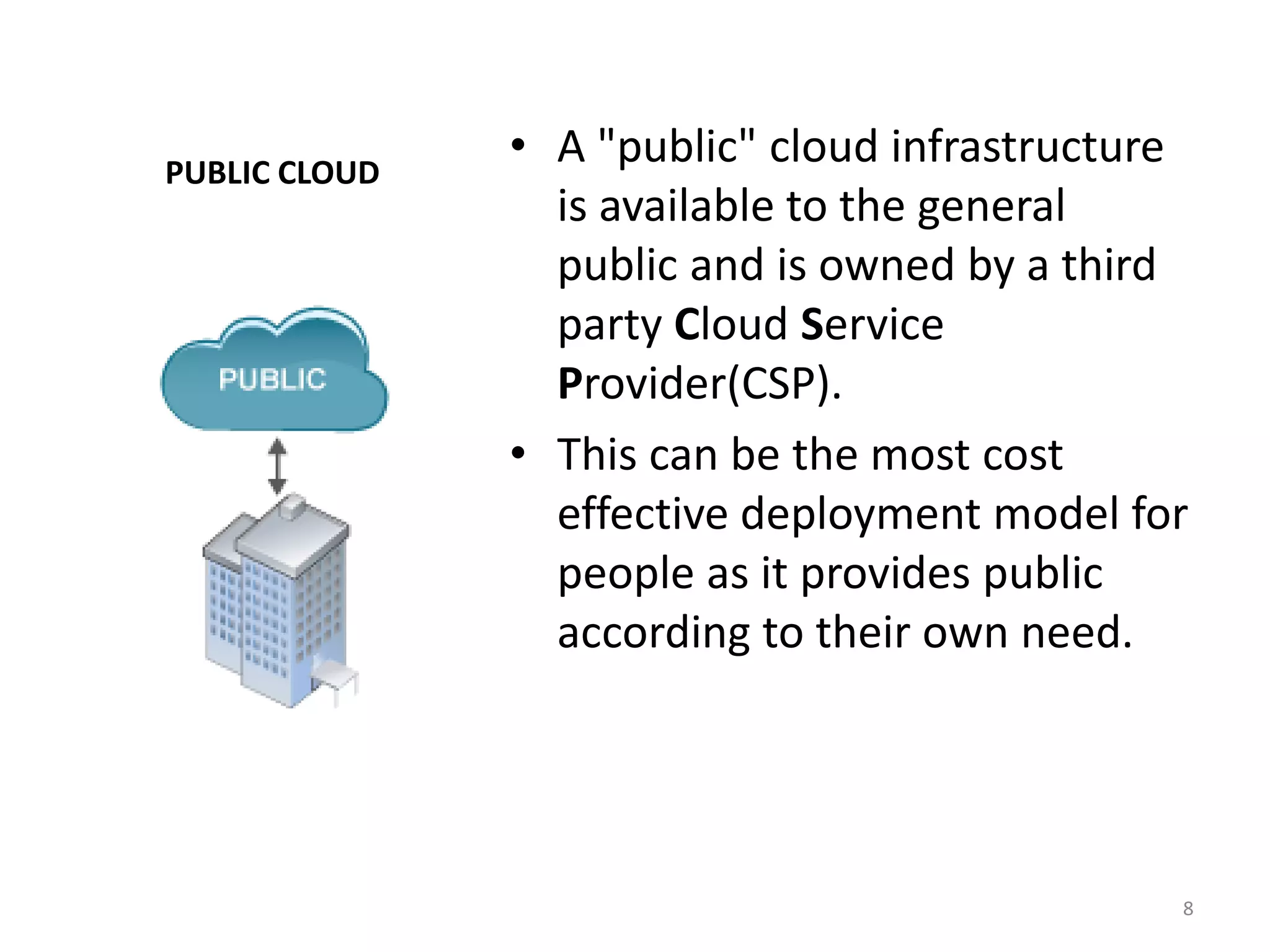
PUBLIC CLOUD
• A "public" cloud infrastructure
is available to the general
public and is owned by a third
party Cloud Service
Provider(CSP).
• This can be the most cost
effective deployment model for
people as it provides public
according to their own need.
8
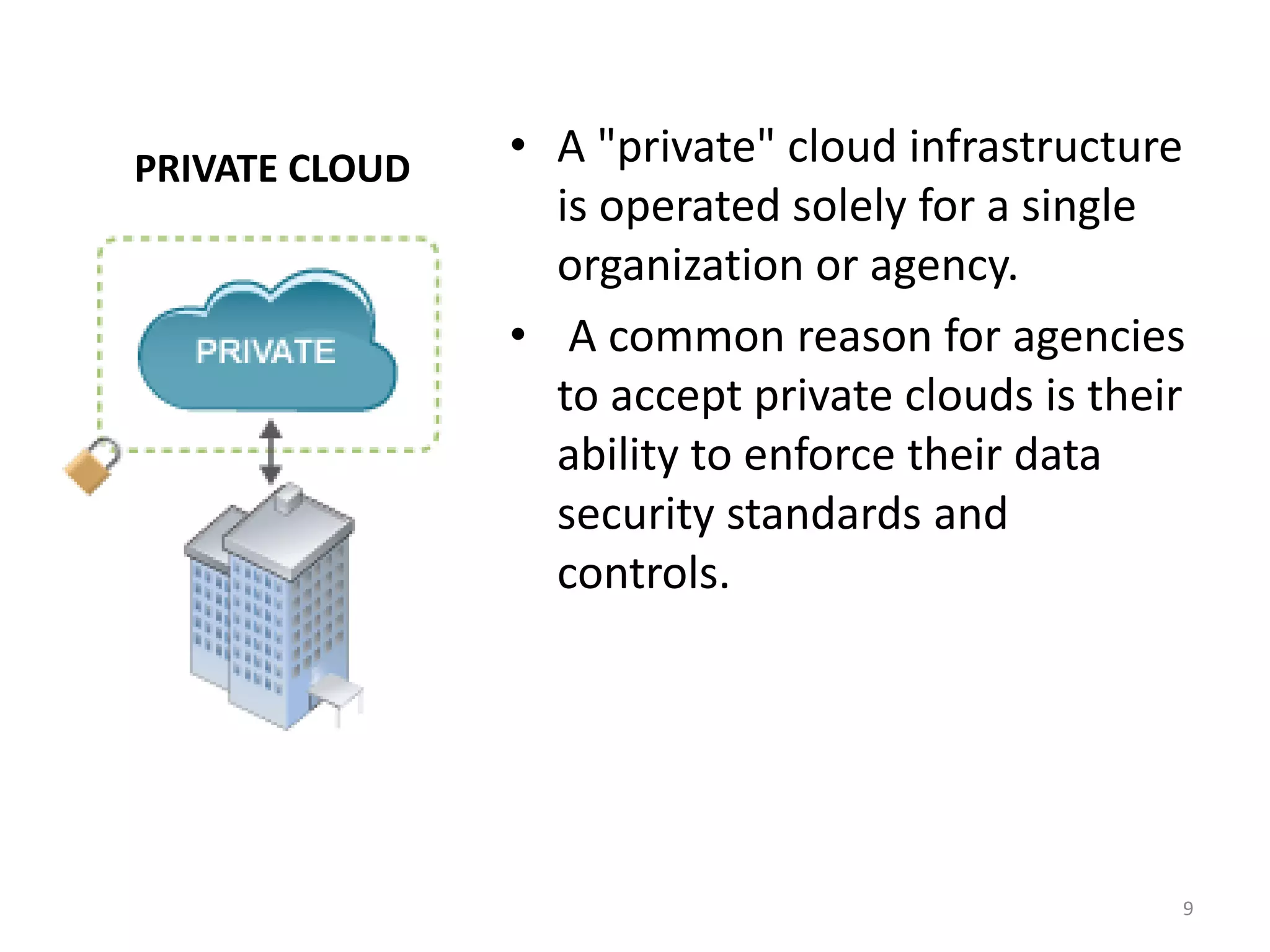
PRIVATE CLOUD • A "private" cloud infrastructure
is operated solely for a single
organization or agency.
• A common reason for agencies
to accept private clouds is their
ability to enforce their data
security standards and
controls.
9
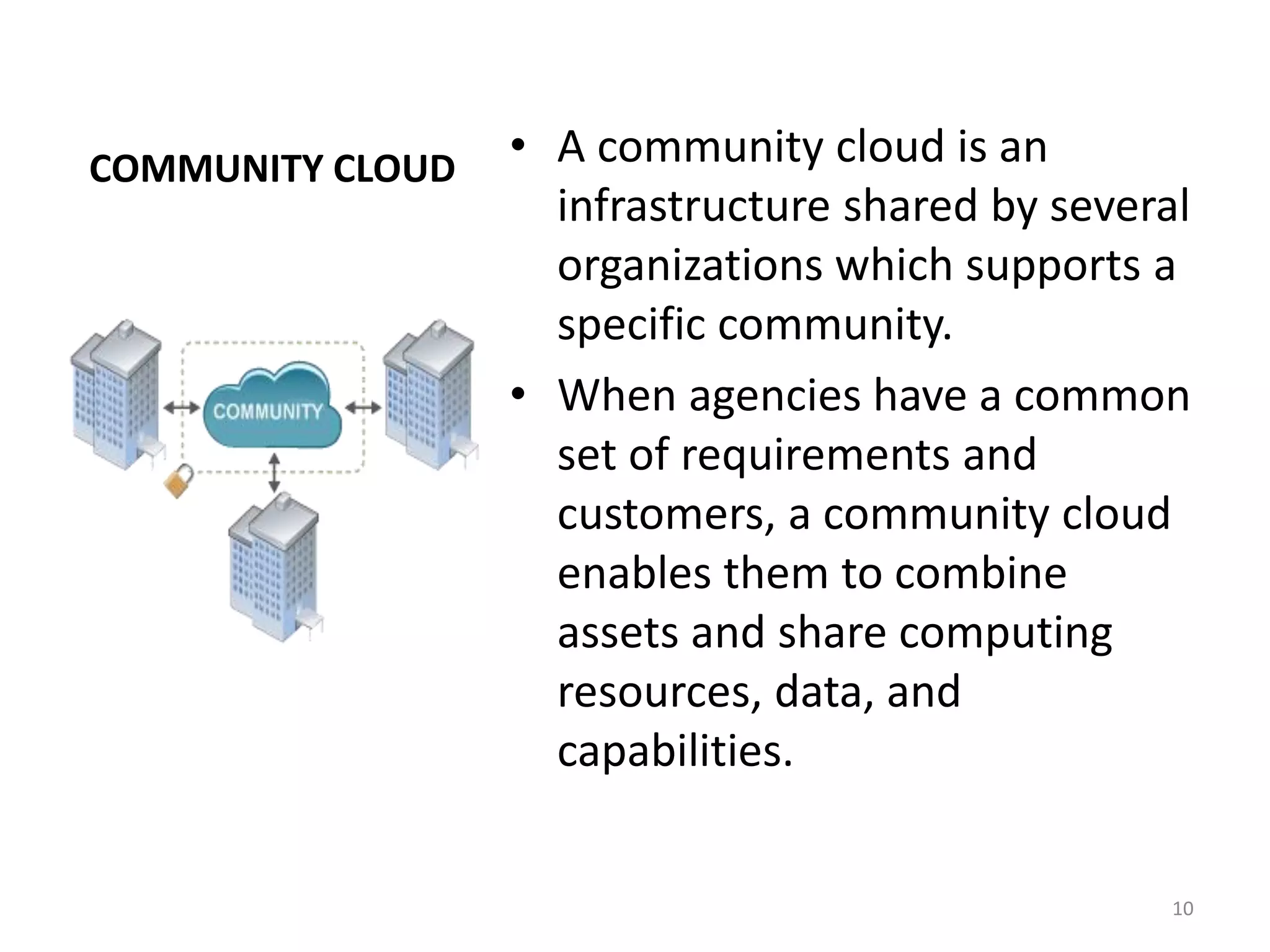
COMMUNITY CLOUD • A community cloud is an
infrastructure shared by several
organizations which supports a
specific community.
• When agencies have a common
set of requirements and
customers, a community cloud
enables them to combine
assets and share computing
resources, data, and
capabilities.
10
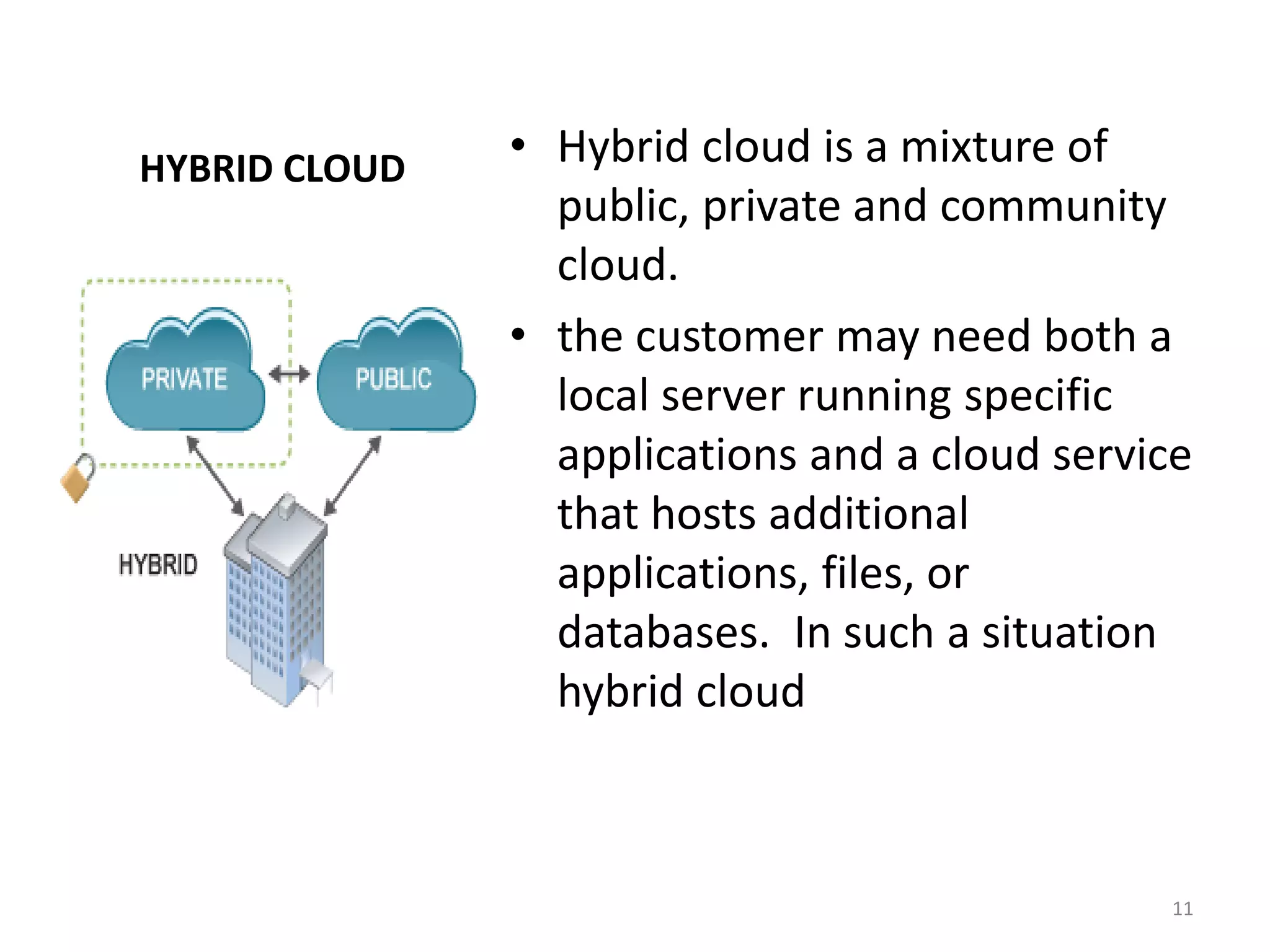
HYBRID CLOUD • Hybrid cloud is a mixture of
public, private and community
cloud.
• the customer may need both a
local server running specific
applications and a cloud service
that hosts additional
applications, files, or
databases. In such a situation
hybrid cloud
11
CONCLUSION
• Cloud solutions are simple to acquire, don’t require
long term contracts and are easier to scale up and
down as needed. Public and Private Clouds can be
deployed together to leverage the best of both.
Security Compliance and Monitoring is achievable
with careful planning and analysis.
12
References
[1] http://www.cloud-competence-
center.com/understanding/cloud-computing-
deployment-models/
[2] http://www.cloudtweaks.com/2012/07/the-4-
primary-cloud-deployment-models/
[3] http://www.thinkvidya.com/a/cloud-computing-
future-scope
13
14

Cloud computing

  • 1.
    Service and DeploymentModel of Cloud Computing PARTH MAISHERI
  • 2.
    WHAT IS CLOUDCOMPUTING ? • It’s a type of computing which involves sharing of computer resources rather than using local servers or dedicated devices for processing. In simple words, it is the process of storing frequently use data on multiple servers which could be accessed by using internet. • In easy language cloud computing is virtual place where people get together sitting at home. 2
  • 3.
    SERVICES PROVIDED BYCLOUD COMPUTING: 3
  • 4.
    IaaS • (Infrastructure asa service) This is the most comprehensive cloud platform and is mainly used by full-time developers or large-scale enterprise customers.Examples : Amazon's Cloud (EC2) , Rackspace,GOGRID. 4
  • 5.
    PaaS • (Platform asa service) provides developers with proprietary to make an application that will run in a specific environment. While a developer is free to create any application they wish, the app is locked to the platform used for its creation. Examples: Windows Azure, Google App Engine. 5
  • 6.
    SaaS (Software as aservice) is the most basic form of cloud computing. There is no third-party development or resources for the user, but SaaS applications can offer powerful tools right from your web browser. Examples: Google Apps. 6
  • 7.
    DEPLOYMENT MODELS INCLOUD COMPUTING • Cloud services can be deployed in different ways, depending on the organizational structure and the provisioning location. Four deployment models are usually distinguished, namely public, private, community and hybrid cloud service usage. 7
  • 8.
    PUBLIC CLOUD • A"public" cloud infrastructure is available to the general public and is owned by a third party Cloud Service Provider(CSP). • This can be the most cost effective deployment model for people as it provides public according to their own need. 8
  • 9.
    PRIVATE CLOUD •A "private" cloud infrastructure is operated solely for a single organization or agency. • A common reason for agencies to accept private clouds is their ability to enforce their data security standards and controls. 9
  • 10.
    COMMUNITY CLOUD •A community cloud is an infrastructure shared by several organizations which supports a specific community. • When agencies have a common set of requirements and customers, a community cloud enables them to combine assets and share computing resources, data, and capabilities. 10
  • 11.
    HYBRID CLOUD •Hybrid cloud is a mixture of public, private and community cloud. • the customer may need both a local server running specific applications and a cloud service that hosts additional applications, files, or databases. In such a situation hybrid cloud 11
  • 12.
    CONCLUSION • Cloud solutionsare simple to acquire, don’t require long term contracts and are easier to scale up and down as needed. Public and Private Clouds can be deployed together to leverage the best of both. Security Compliance and Monitoring is achievable with careful planning and analysis. 12
  • 13.
  • 14.