Migrating Existing Applications To The Cloud: A Phased Driven approach to Cloud MigrationJinesh Varia
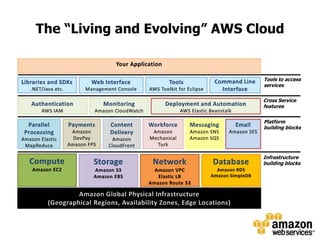
The “Living and Evolving” AWS CloudYour ApplicationTools to access servicesLibraries and SDKs.NET/Java etc.Web InterfaceManagement ConsoleToolsAWS Toolkit for EclipseCommand Line InterfaceCross Service featuresAuthenticationAWS IAMMonitoringAmazon CloudWatchDeployment and AutomationAWS Elastic BeanstalkPlatform building blocksContent DeliveryAmazon CloudFrontEmailAmazon SESPaymentsAmazon DevPayAmazon FPSParallel ProcessingAmazon Elastic MapReduceMessagingAmazon SNSAmazon SQSWorkforceAmazon Mechanical TurkInfrastructure building blocksComputeAmazon EC2 NetworkAmazon VPCElastic LBAmazon Route 53StorageAmazon S3Amazon EBSDatabaseAmazon RDSAmazon SimpleDBAmazon Global Physical Infrastructure (Geographical Regions, Availability Zones, Edge Locations)
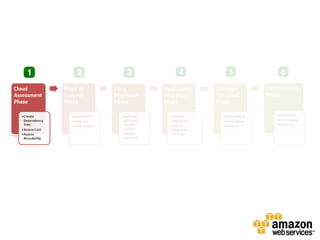
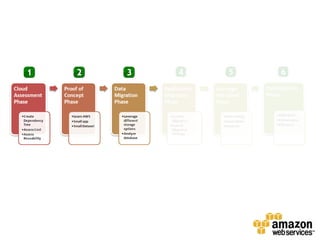
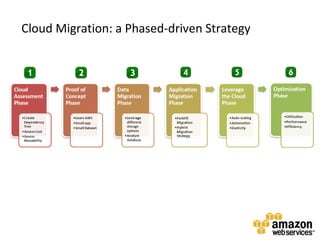
A Phased Driven approach to Cloud Migration
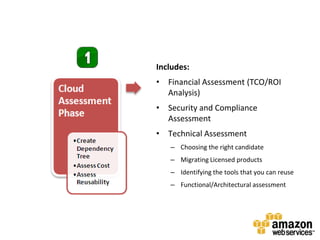
Includes:Financial Assessment (TCO/ROI Analysis)Security and Compliance Assessment Technical AssessmentChoosing the right candidateMigrating Licensed productsIdentifying the tools that you can reuseFunctional/Architectural assessment
Security and Compliance AssessmentYou own the data, not AWS.
You choose which geographic location to store the data. It doesn’t move unless you decide to move it.
You should consider the sensitivity of your data and decide if and how you will encrypt your data while it is in transit and while it is at rest.Involve your Security Teams early in the process
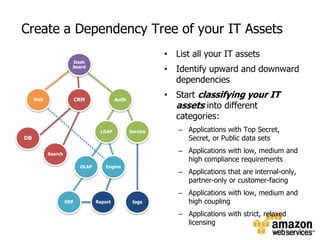
Create a Dependency Tree of your IT AssetsDashboardReportCRMSearchDBlogsServiceLDAPAuthWebEngineOLAPERPList all your IT assetsIdentify upward and downward dependenciesStart classifying your IT assetsinto different categories:Applications with Top Secret, Secret, or Public data setsApplications with low, medium and high compliance requirementsApplications that are internal-only, partner-only or customer-facingApplications with low, medium and high couplingApplications with strict, relaxed licensing
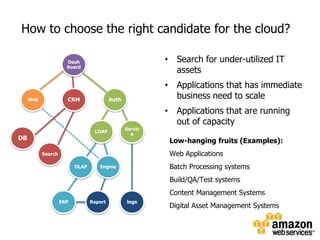
How to choose the right candidate for the cloud?DashboardReportCRMSearchDBlogsServiceLDAPAuthWebEngineOLAPERPSearch for under-utilized IT assetsApplications that has immediate business need to scaleApplications that are running out of capacityLow-hanging fruits (Examples):Web ApplicationsBatch Processing systemsBuild/QA/Test systemsContent Management SystemsDigital Asset Management Systems
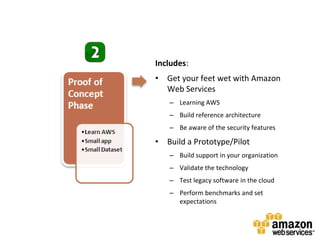
Includes:Get your feet wet with Amazon Web Services
Learning AWS
Build reference architecture
Be aware of the security features
Build a Prototype/Pilot
Build support in your organization
Validate the technology
Test legacy software in the cloud
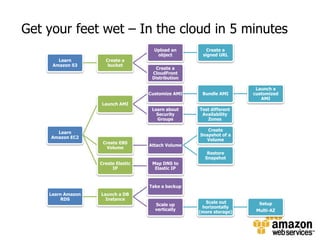
Perform benchmarks and set expectationsGet your feet wet – In the cloud in 5 minutes
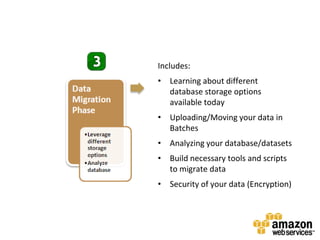
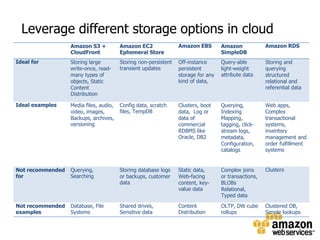
Includes:Learning about different database storage options available today
Uploading/Moving your data in Batches
Analyzing your database/datasets
Build necessary toolsand scripts to migrate data

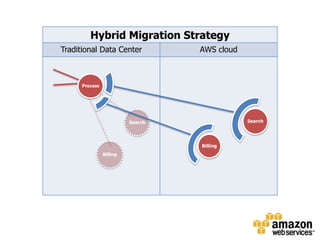
Migrating Existing Applications to AWS Cloud

  • 1.
    Migrating Existing ApplicationsTo The Cloud: A Phased Driven approach to Cloud MigrationJinesh Varia
  • 2.
    The “Living andEvolving” AWS CloudYour ApplicationTools to access servicesLibraries and SDKs.NET/Java etc.Web InterfaceManagement ConsoleToolsAWS Toolkit for EclipseCommand Line InterfaceCross Service featuresAuthenticationAWS IAMMonitoringAmazon CloudWatchDeployment and AutomationAWS Elastic BeanstalkPlatform building blocksContent DeliveryAmazon CloudFrontEmailAmazon SESPaymentsAmazon DevPayAmazon FPSParallel ProcessingAmazon Elastic MapReduceMessagingAmazon SNSAmazon SQSWorkforceAmazon Mechanical TurkInfrastructure building blocksComputeAmazon EC2 NetworkAmazon VPCElastic LBAmazon Route 53StorageAmazon S3Amazon EBSDatabaseAmazon RDSAmazon SimpleDBAmazon Global Physical Infrastructure (Geographical Regions, Availability Zones, Edge Locations)
  • 3.
    A Phased Drivenapproach to Cloud Migration
  • 5.
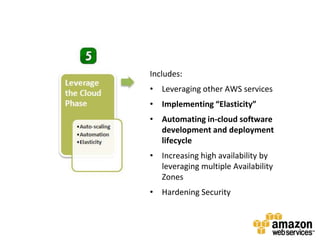
    Includes:Financial Assessment (TCO/ROIAnalysis)Security and Compliance Assessment Technical AssessmentChoosing the right candidateMigrating Licensed productsIdentifying the tools that you can reuseFunctional/Architectural assessment
  • 6.
    Security and ComplianceAssessmentYou own the data, not AWS.
  • 7.
    You choose whichgeographic location to store the data. It doesn’t move unless you decide to move it.
  • 8.
    You should considerthe sensitivity of your data and decide if and how you will encrypt your data while it is in transit and while it is at rest.Involve your Security Teams early in the process
  • 9.
    Create a DependencyTree of your IT AssetsDashboardReportCRMSearchDBlogsServiceLDAPAuthWebEngineOLAPERPList all your IT assetsIdentify upward and downward dependenciesStart classifying your IT assetsinto different categories:Applications with Top Secret, Secret, or Public data setsApplications with low, medium and high compliance requirementsApplications that are internal-only, partner-only or customer-facingApplications with low, medium and high couplingApplications with strict, relaxed licensing
  • 10.
    How to choosethe right candidate for the cloud?DashboardReportCRMSearchDBlogsServiceLDAPAuthWebEngineOLAPERPSearch for under-utilized IT assetsApplications that has immediate business need to scaleApplications that are running out of capacityLow-hanging fruits (Examples):Web ApplicationsBatch Processing systemsBuild/QA/Test systemsContent Management SystemsDigital Asset Management Systems
  • 11.
    Includes:Get your feetwet with Amazon Web Services
  • 12.
  • 13.
  • 14.
    Be aware ofthe security features
  • 15.
  • 16.
    Build support inyour organization
  • 17.
  • 18.
  • 19.
    Perform benchmarks andset expectationsGet your feet wet – In the cloud in 5 minutes
  • 21.
    Includes:Learning about differentdatabase storage options available today
  • 22.
  • 23.
  • 24.
    Build necessary toolsandscripts to migrate data

Editor's Notes

  • #23 The Blueprint offers a step by step approach to cloud migration and has been proven successful. When customers will follow this blueprint and focus on creating a proof of concept, they will immediately see value in their proof of concept projects and see tremendous potential in the AWS cloud. After they move their first application to the cloud, they will get new ideas and will want to move them into the cloud.