http://www.brizgo.net/
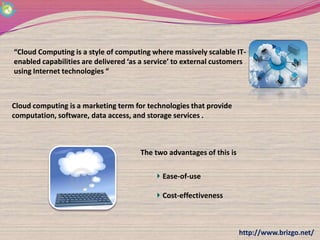
“Cloud Computing is a style of computing where massively scalable IT-
enabled capabilities are delivered ‘as a service’ to external customers
using Internet technologies “


Cloud computing is a marketing term for technologies that provide
computation, software, data access, and storage services .


                                      The two advantages of this is

                                             Ease-of-use

                                             Cost-effectiveness


                                                                      http://www.brizgo.net/
Cloud Computing Models
Cloud computing offers a variety of ways for businesses to increase their IT capacity
or functionality without having to add infrastructure, personnel, and software.

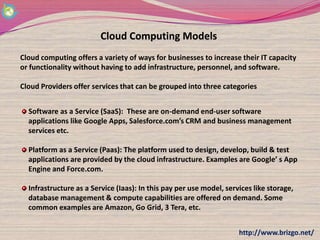
Cloud Providers offer services that can be grouped into three categories


  Software as a Service (SaaS): These are on-demand end-user software
  applications like Google Apps, Salesforce.com’s CRM and business management
  services etc.

  Platform as a Service (Paas): The platform used to design, develop, build & test
  applications are provided by the cloud infrastructure. Examples are Google’ s App
  Engine and Force.com.

  Infrastructure as a Service (Iaas): In this pay per use model, services like storage,
  database management & compute capabilities are offered on demand. Some
  common examples are Amazon, Go Grid, 3 Tera, etc.


                                                                     http://www.brizgo.net/
Benefits of Cloud Computing

Cloud computing is a comprehensive solution that delivers IT as a service.
Some benefits are here.

  Access a huge range of applications.

  Applications can be accessed from the computer in
  anywhere.

  Users can avoid expenditure on hardware and software.


                            Companies can share resources in one place.

                            With minimum cost.

                            Scalability via on-demand resources.


                                                                   http://www.brizgo.net/
Types of Cloud Computing

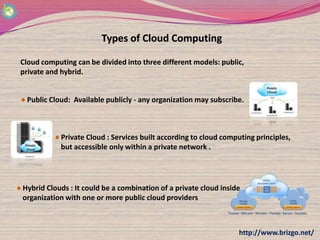
Cloud computing can be divided into three different models: public,
private and hybrid.


 Public Cloud: Available publicly - any organization may subscribe.


            Private Cloud : Services built according to cloud computing principles,
            but accessible only within a private network .


Hybrid Clouds : It could be a combination of a private cloud inside
organization with one or more public cloud providers


                                                                   http://www.brizgo.net/
Cloud Computing Architectures
Cloud Computing Architecture is web based, internet or “cloud" based progression
and the use of computer technology.
  Is Agile

  Is decreases Cost

  Is appliance and location freedom

  Is engages Multi-tenancy
                                  It can be further secure because of centralization of
  Is Reliable Is very scalable    data and backup recovery

                                  Is sustainable

                                  Is simpler to maintain

                                  Is metered

                                                                 http://www.brizgo.net/
Five Characteristics of Cloud Computing

• On-demand self-service: Individuals can set themselves up without needing
  anyone’s help.

• Ubiquitous network access: Available through standard Internet-enabled
  devices.

• Location independent resource pooling: Processing and storage demands
  are balanced across a common infrastructure with no particular resource
  assigned to any individual user.


                       • Rapid elasticity: consumers can increase or decrease capacity at
                         will.

                       • Pay per use: consumers are charged fees based on their usage of
                         a combination of computing power, bandwidth use and/or
                         storage


                                                                    http://www.brizgo.net/
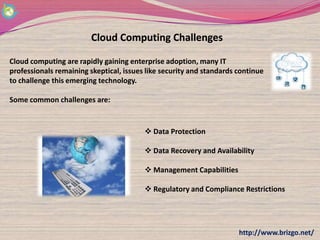
Cloud Computing Challenges

Cloud computing are rapidly gaining enterprise adoption, many IT
professionals remaining skeptical, issues like security and standards continue
to challenge this emerging technology.

Some common challenges are:


                                          Data Protection

                                          Data Recovery and Availability

                                          Management Capabilities

                                          Regulatory and Compliance Restrictions


                                                                      http://www.brizgo.net/
Cloud Computing Risks

Internet outage may degrade the quality of service for end users.

The physical security of the data center may be compromised,
causing a loss of service or data.

Privacy may be compromised or applications may be misused if
data is accessed by unauthorized users.


                           Software employed to manage data center resources can
                           malfunction, causing interruption in services.

                           A SaaS provider may go out of business, leaving customers
                           without access to their data or critical software applications.


                                                                    http://www.brizgo.net/
Cloud computing

Cloud computing

  • 1.
  • 2.
    “Cloud Computing isa style of computing where massively scalable IT- enabled capabilities are delivered ‘as a service’ to external customers using Internet technologies “ Cloud computing is a marketing term for technologies that provide computation, software, data access, and storage services . The two advantages of this is Ease-of-use Cost-effectiveness http://www.brizgo.net/
  • 3.
    Cloud Computing Models Cloudcomputing offers a variety of ways for businesses to increase their IT capacity or functionality without having to add infrastructure, personnel, and software. Cloud Providers offer services that can be grouped into three categories Software as a Service (SaaS): These are on-demand end-user software applications like Google Apps, Salesforce.com’s CRM and business management services etc. Platform as a Service (Paas): The platform used to design, develop, build & test applications are provided by the cloud infrastructure. Examples are Google’ s App Engine and Force.com. Infrastructure as a Service (Iaas): In this pay per use model, services like storage, database management & compute capabilities are offered on demand. Some common examples are Amazon, Go Grid, 3 Tera, etc. http://www.brizgo.net/
  • 4.
    Benefits of CloudComputing Cloud computing is a comprehensive solution that delivers IT as a service. Some benefits are here. Access a huge range of applications. Applications can be accessed from the computer in anywhere. Users can avoid expenditure on hardware and software. Companies can share resources in one place. With minimum cost. Scalability via on-demand resources. http://www.brizgo.net/
  • 5.
    Types of CloudComputing Cloud computing can be divided into three different models: public, private and hybrid. Public Cloud: Available publicly - any organization may subscribe. Private Cloud : Services built according to cloud computing principles, but accessible only within a private network . Hybrid Clouds : It could be a combination of a private cloud inside organization with one or more public cloud providers http://www.brizgo.net/
  • 6.
    Cloud Computing Architectures CloudComputing Architecture is web based, internet or “cloud" based progression and the use of computer technology. Is Agile Is decreases Cost Is appliance and location freedom Is engages Multi-tenancy It can be further secure because of centralization of Is Reliable Is very scalable data and backup recovery Is sustainable Is simpler to maintain Is metered http://www.brizgo.net/
  • 7.
    Five Characteristics ofCloud Computing • On-demand self-service: Individuals can set themselves up without needing anyone’s help. • Ubiquitous network access: Available through standard Internet-enabled devices. • Location independent resource pooling: Processing and storage demands are balanced across a common infrastructure with no particular resource assigned to any individual user. • Rapid elasticity: consumers can increase or decrease capacity at will. • Pay per use: consumers are charged fees based on their usage of a combination of computing power, bandwidth use and/or storage http://www.brizgo.net/
  • 8.
    Cloud Computing Challenges Cloudcomputing are rapidly gaining enterprise adoption, many IT professionals remaining skeptical, issues like security and standards continue to challenge this emerging technology. Some common challenges are:  Data Protection  Data Recovery and Availability  Management Capabilities  Regulatory and Compliance Restrictions http://www.brizgo.net/
  • 9.
    Cloud Computing Risks Internetoutage may degrade the quality of service for end users. The physical security of the data center may be compromised, causing a loss of service or data. Privacy may be compromised or applications may be misused if data is accessed by unauthorized users. Software employed to manage data center resources can malfunction, causing interruption in services. A SaaS provider may go out of business, leaving customers without access to their data or critical software applications. http://www.brizgo.net/