Presented By
Ravi Shankar Soni
CS-64/10(D)
8th Semester
Computer Science And Engineering
Jorhat Engineering College
What is Cloud Computing?
•Definition and Introduction
How it is Implemented?
•Architecture of Cloud Computing?
Why it is Used?
•Purpose.
Conclusion
Definitions :
Cloud computing is using the internet to access someone else's software
running on someone else's hardware in someone else's data center.
A Cloud is a type of parallel and distributed system consisting of a collection of
interconnected computers that are dynamically provisioned and presented as one or more
unified computing resources based on service-level agreements established through
negotiation between the service provider and consumers.
?
ARCHITECTURE
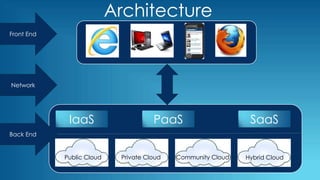
Cloud computing architecture refers to the components and
subcomponents required for Cloud Computing. These
components typically consist of a front end platform (fat
client, thin client, mobile device), back end platforms
(servers, storage), and a network (Internet, Intranet, inter-
cloud). Combined, these components make up cloud
computing architecture.
IaaS PaaS SaaS
Public Cloud Private Cloud Community Cloud Hybrid Cloud
Front End
Network
Back End
Architecture
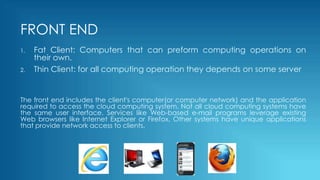
FRONT END
1. Fat Client: Computers that can preform computing operations on
their own.
2. Thin Client: for all computing operation they depends on some server
The front end includes the client's computer(or computer network) and the application
required to access the cloud computing system. Not all cloud computing systems have
the same user interface. Services like Web-based e-mail programs leverage existing
Web browsers like Internet Explorer or Firefox. Other systems have unique applications
that provide network access to clients.
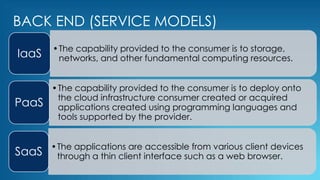
BACK END (SERVICE MODELS)
•The capability provided to the consumer is to storage,
networks, and other fundamental computing resources.IaaS
•The capability provided to the consumer is to deploy onto
the cloud infrastructure consumer created or acquired
applications created using programming languages and
tools supported by the provider.
PaaS
•The applications are accessible from various client devices
through a thin client interface such as a web browser.SaaS
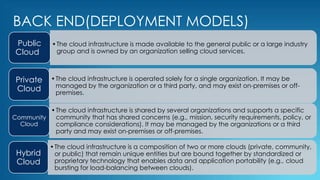
BACK END(DEPLOYMENT MODELS)
•The cloud infrastructure is made available to the general public or a large industry
group and is owned by an organization selling cloud services.
Public
Cloud
•The cloud infrastructure is operated solely for a single organization. It may be
managed by the organization or a third party, and may exist on-premises or off-
premises.
Private
Cloud
•The cloud infrastructure is shared by several organizations and supports a specific
community that has shared concerns (e.g., mission, security requirements, policy, or
compliance considerations). It may be managed by the organizations or a third
party and may exist on-premises or off-premises.
Community
Cloud
•The cloud infrastructure is a composition of two or more clouds (private, community,
or public) that remain unique entities but are bound together by standardized or
proprietary technology that enables data and application portability (e.g., cloud
bursting for load-balancing between clouds).
Hybrid
Cloud
NETWORK
•Allowing users to have uninterrupted access to their data
and applications.
High
Bandwidth
•On-demand access to resources requires the ability to move
quickly and efficiently between servers and possibly even
clouds.
Agile
network
•Security is always important, but when you are dealing with
multi-tenancy, it becomes much more important because
you're dealing with segregating multiple customers.
Network
security
WHY CLOUD COMPUTING?
Online Computing by network
•Everything is connected !!!
Service itself is more important
•Makes it possible everything As - a - Service
Ubiquitous Era
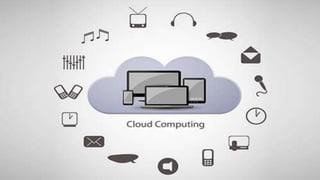
•Users can access data and applications from
just about anywhere via multiple devices
CLOUD PROVIDERS
AMAZON
MICROSOFT
GOOGLE
CONCLUSION
We can access it from any where via any computing device.
Agile in nature
Gives better security to valuable data using private cloud.
Infrastructure and Software provided on cloud minimizes the cost.
Pay only for what you actually use.
THANK YOU

Cloud computing

  • 1.
    Presented By Ravi ShankarSoni CS-64/10(D) 8th Semester Computer Science And Engineering Jorhat Engineering College
  • 2.
    What is CloudComputing? •Definition and Introduction How it is Implemented? •Architecture of Cloud Computing? Why it is Used? •Purpose. Conclusion
  • 3.
    Definitions : Cloud computingis using the internet to access someone else's software running on someone else's hardware in someone else's data center. A Cloud is a type of parallel and distributed system consisting of a collection of interconnected computers that are dynamically provisioned and presented as one or more unified computing resources based on service-level agreements established through negotiation between the service provider and consumers. ?
  • 4.
    ARCHITECTURE Cloud computing architecturerefers to the components and subcomponents required for Cloud Computing. These components typically consist of a front end platform (fat client, thin client, mobile device), back end platforms (servers, storage), and a network (Internet, Intranet, inter- cloud). Combined, these components make up cloud computing architecture.
  • 5.
    IaaS PaaS SaaS PublicCloud Private Cloud Community Cloud Hybrid Cloud Front End Network Back End Architecture
  • 6.
    FRONT END 1. FatClient: Computers that can preform computing operations on their own. 2. Thin Client: for all computing operation they depends on some server The front end includes the client's computer(or computer network) and the application required to access the cloud computing system. Not all cloud computing systems have the same user interface. Services like Web-based e-mail programs leverage existing Web browsers like Internet Explorer or Firefox. Other systems have unique applications that provide network access to clients.
  • 7.
    BACK END (SERVICEMODELS) •The capability provided to the consumer is to storage, networks, and other fundamental computing resources.IaaS •The capability provided to the consumer is to deploy onto the cloud infrastructure consumer created or acquired applications created using programming languages and tools supported by the provider. PaaS •The applications are accessible from various client devices through a thin client interface such as a web browser.SaaS
  • 8.
    BACK END(DEPLOYMENT MODELS) •Thecloud infrastructure is made available to the general public or a large industry group and is owned by an organization selling cloud services. Public Cloud •The cloud infrastructure is operated solely for a single organization. It may be managed by the organization or a third party, and may exist on-premises or off- premises. Private Cloud •The cloud infrastructure is shared by several organizations and supports a specific community that has shared concerns (e.g., mission, security requirements, policy, or compliance considerations). It may be managed by the organizations or a third party and may exist on-premises or off-premises. Community Cloud •The cloud infrastructure is a composition of two or more clouds (private, community, or public) that remain unique entities but are bound together by standardized or proprietary technology that enables data and application portability (e.g., cloud bursting for load-balancing between clouds). Hybrid Cloud
  • 9.
    NETWORK •Allowing users tohave uninterrupted access to their data and applications. High Bandwidth •On-demand access to resources requires the ability to move quickly and efficiently between servers and possibly even clouds. Agile network •Security is always important, but when you are dealing with multi-tenancy, it becomes much more important because you're dealing with segregating multiple customers. Network security
  • 10.
    WHY CLOUD COMPUTING? OnlineComputing by network •Everything is connected !!! Service itself is more important •Makes it possible everything As - a - Service Ubiquitous Era •Users can access data and applications from just about anywhere via multiple devices
  • 12.
  • 13.
    CONCLUSION We can accessit from any where via any computing device. Agile in nature Gives better security to valuable data using private cloud. Infrastructure and Software provided on cloud minimizes the cost. Pay only for what you actually use.
  • 14.