-Vaswani Payal
Bioinformatics
 The practice of using a network of
remote servers hosted on the
Internet to store, manage, and
process data, rather than a local
server or a personal computer.
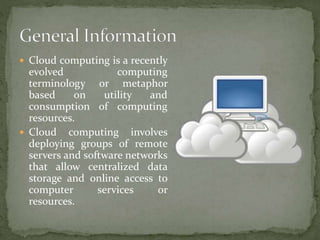
 Cloud computing is a recently
evolved computing
terminology or metaphor
based on utility and
consumption of computing
resources.
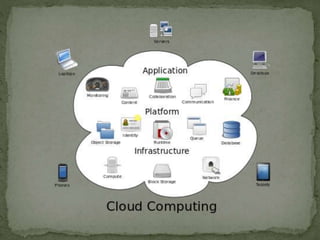
 Cloud computing involves
deploying groups of remote
servers and software networks
that allow centralized data
storage and online access to
computer services or
resources.
i. Agility:- It is very quick and graceful.
ii. Application Programming Interface:- It is a software which
allows the user to interact with the cloud software in a
similar way as a normal interface allows the interaction of
humans and computers.
iii. Cost:- The reduction is claimed by the cloud providers.
Most of the people have concluded that reduction depends
on the type of activities and the infrastructure provided.
iv. Maintenance:- It is easier because they do not need to be
installed on each user's computer and can be accessed
from different places.
v. Multitenancy:- enables sharing of resources and costs
across a large pool of users thus allowing for
centralization, peak load capacity, utilization and
efficiency.
vi. Productivity:- It may be increased when multiple users
can work on the same data simultaneously, rather than
waiting for it to be saved and emailed.
vii.Time:- Time may be saved as information does not
need to be re-entered when fields are matched, nor do
users need to install application software upgrades to
their computer.
viii.Security:- Security can improve due to centralization
of data, increased security-focused resources,
etc. Security is often as good as or better than other
traditional systems, in part because providers are able
to devote resources to solving security issues that many
customers cannot afford to tackle.
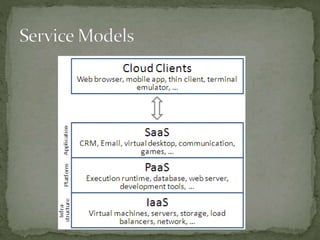
 Infrastructure as a service is sometimes referred to Hardware
as a service(HaaS).
 The reason behind this is that it is a model that provides
physical or most often virtual machines.
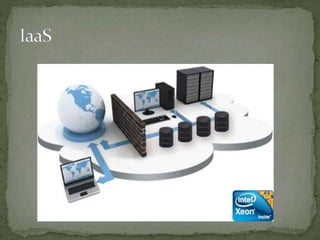
 Infrastructure as a Service is a provision model in which an
organization outsources the equipment used to support
operations, including storage, hardware, servers and
networking components.
 The service provider owns the equipment and is responsible
for housing, running and maintaining it.
 The client typically pays on a per-use basis.
 Now, as a name suggests, this model provides a platform to us
for getting into the cloud computing.
 It includes operating system, programming language
execution environment, database and web server.
 Application developers can develop and run their software
solutions on a cloud platform without the cost and complexity
of buying and managing the underlying hardware and
software layers.
 Platform as a service (PaaS) provides a computing platform
and a key chimney. It joins with software as a service (SaaS)
and infrastructure as a service (IaaS), model of cloud
computing.
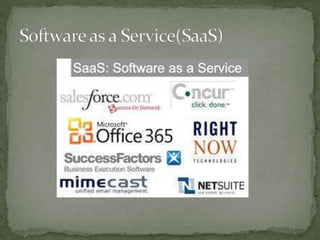
 In the business model using software as a service (SaaS), users
are provided access to application software and databases.
 Cloud providers manage the infrastructure and platforms that
run the applications.
 In the SaaS model, cloud providers install and operate
application software in the cloud and cloud users access the
software from cloud clients.
 Cloud users do not manage the cloud infrastructure and
platform where the application runs.
 This eliminates the need to install and run the application
on the cloud user's own computers, which simplifies
maintenance and support.
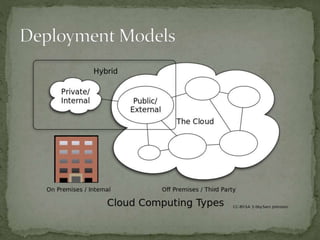
 There are three deployment models.
1) Private Cloud:- Private cloud is cloud infrastructure
operated solely for a single organization, whether managed
internally or by a third-party, and hosted either internally or
externally
2) Public Cloud:- A cloud is called a "public cloud" when the
services are rendered over a network that is open for public
use.
3) Hybrid Cloud:- Hybrid cloud is a composition of two or
more clouds that remain distinct entities but are bound
together, offering the benefits of multiple deployment
models.
Cloud computing

Cloud computing

  • 1.
  • 2.
     The practiceof using a network of remote servers hosted on the Internet to store, manage, and process data, rather than a local server or a personal computer.
  • 4.
     Cloud computingis a recently evolved computing terminology or metaphor based on utility and consumption of computing resources.  Cloud computing involves deploying groups of remote servers and software networks that allow centralized data storage and online access to computer services or resources.
  • 5.
    i. Agility:- Itis very quick and graceful. ii. Application Programming Interface:- It is a software which allows the user to interact with the cloud software in a similar way as a normal interface allows the interaction of humans and computers. iii. Cost:- The reduction is claimed by the cloud providers. Most of the people have concluded that reduction depends on the type of activities and the infrastructure provided. iv. Maintenance:- It is easier because they do not need to be installed on each user's computer and can be accessed from different places.
  • 6.
    v. Multitenancy:- enablessharing of resources and costs across a large pool of users thus allowing for centralization, peak load capacity, utilization and efficiency. vi. Productivity:- It may be increased when multiple users can work on the same data simultaneously, rather than waiting for it to be saved and emailed. vii.Time:- Time may be saved as information does not need to be re-entered when fields are matched, nor do users need to install application software upgrades to their computer. viii.Security:- Security can improve due to centralization of data, increased security-focused resources, etc. Security is often as good as or better than other traditional systems, in part because providers are able to devote resources to solving security issues that many customers cannot afford to tackle.
  • 8.
     Infrastructure asa service is sometimes referred to Hardware as a service(HaaS).  The reason behind this is that it is a model that provides physical or most often virtual machines.  Infrastructure as a Service is a provision model in which an organization outsources the equipment used to support operations, including storage, hardware, servers and networking components.  The service provider owns the equipment and is responsible for housing, running and maintaining it.  The client typically pays on a per-use basis.
  • 10.
     Now, asa name suggests, this model provides a platform to us for getting into the cloud computing.  It includes operating system, programming language execution environment, database and web server.  Application developers can develop and run their software solutions on a cloud platform without the cost and complexity of buying and managing the underlying hardware and software layers.  Platform as a service (PaaS) provides a computing platform and a key chimney. It joins with software as a service (SaaS) and infrastructure as a service (IaaS), model of cloud computing.
  • 12.
     In thebusiness model using software as a service (SaaS), users are provided access to application software and databases.  Cloud providers manage the infrastructure and platforms that run the applications.  In the SaaS model, cloud providers install and operate application software in the cloud and cloud users access the software from cloud clients.  Cloud users do not manage the cloud infrastructure and platform where the application runs.  This eliminates the need to install and run the application on the cloud user's own computers, which simplifies maintenance and support.
  • 15.
     There arethree deployment models. 1) Private Cloud:- Private cloud is cloud infrastructure operated solely for a single organization, whether managed internally or by a third-party, and hosted either internally or externally 2) Public Cloud:- A cloud is called a "public cloud" when the services are rendered over a network that is open for public use. 3) Hybrid Cloud:- Hybrid cloud is a composition of two or more clouds that remain distinct entities but are bound together, offering the benefits of multiple deployment models.

Editor's Notes

  • #6 Graphical user interface
  • #7 centralization of infrastructure in locations with lower costs (such as real estate, electricity, etc.) peak-load capacity increases (users need not engineer for highest possible load-levels) utilisation and efficiency improvements for systems that are often only 10–20% utilised