Cloud Computing  For the Corporate Data Center
Internet Companies: An Arms Race The Dalles, Oregon
Is this the end of Corporate Computing  So why doesn’t  company X  tear down their data centers and move everything to Amazon cloud? Security, integration with enterprise and proprietary systems, performance and control requirements will prohibit this from happening But can Company X  learn from Google and Amazon?
But what if ….. All running on a cloud of commodity infrastructure, automated to respond to changing requirements and optimized for performance and costs. … . You could operate like Google ? Services in the cloud that could be activated on demand … for an unlimited set of users With great user experience
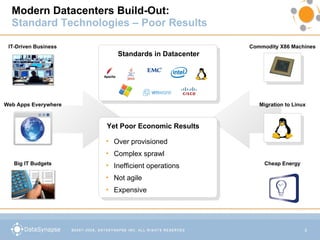
Modern Datacenters Build-Out: Standard Technologies – Poor Results Standards in Datacenter Yet Poor Economic Results Over provisioned Complex sprawl Inefficient operations Not agile Expensive IT-Driven Business Web Apps Everywhere Big IT Budgets Commodity X86 Machines Migration to Linux Cheap Energy
Analyst View  “ As grid deployments have matured and become more integrated with other activities, drivers for adoption have evolved ….. cost control, revenue generation, better utilization, support for additional workloads and the ability to more quickly respond to changing needs are all benefits that can now be realized.  This is no longer a one-dimensional world of performance improvement.”
CC for the CDC  Business Perspective
Datacenter Spend Data center facilities spend is a  large, quickly growing and very inefficient  portion of the total IT budget in many technology intensive industries….. Drivers Poor demand and capacity planning within and across functions  Significant failings in asset management (6% average server utilization, 56% facility utilization) Boards, CEOs, and CFOs are not holding CIOs accountable for critical data center facilities and operational efficiency Source: McKinsey
Constrained by Inefficiency – Impacts Profitability
Middleware As A Service Network Compute and  Storage VM VM VM VM VM VM VM VM Dynamic Application Service Management Packaging Provisioning Activation Management Developers Tools Tools Tools C L O U D Customers L O C A L On-Demand
Cost Reduction Prioritize cost cutting opportunities Lifecycle methodology for identifying, prioritizing and realizing business value (DART) Visualize infrastructure and cost models Integrated reporting on application service levels, costs and infrastructure utilization Eliminate waste and human errors Standardized, re-usable approach to dynamic application assembly and provisioning  Lower app dev costs Automated configuration and packaging for market-leading applications and platforms Lower infrastructure cost Buy only what you need Dynamically allocate infrastructure according to business policies  Cost Reduction Benefits Key DASM Features
Utilization VMware or Physical X86 or non Leverages investments in virtualization (servers / apps / networks / storage) Works with what you have New technologies integrate with existing investment (servers / apps / networks / storage) Visibility  Platform that reports on application cost, utilization & performance across shared infrastructure Automated  Dynamic  Policy-driven virtual application service level management Transportable across infrastructure Standardized packaging and provisioning of virtualized applications Utilization Benefits Key DASM Features
Given current design and architecture: Questions for the Data Center …. To  monitor  infrastructure costs To  minimize growth rates To  maximize response  time To  speed deployment To  control utilization   How do you meter and chargeback shared application services based on SLA? How do you optimize application performance based on changing demand in real time? How do you provision applications on demand? How do you standardize and automate application packaging and configuration? How do you define and enforce business service levels for critical applications?
 

Cloud and Utility Computing

  • 1.
    Cloud Computing For the Corporate Data Center
  • 2.
    Internet Companies: AnArms Race The Dalles, Oregon
  • 3.
    Is this theend of Corporate Computing So why doesn’t company X tear down their data centers and move everything to Amazon cloud? Security, integration with enterprise and proprietary systems, performance and control requirements will prohibit this from happening But can Company X learn from Google and Amazon?
  • 4.
    But what if….. All running on a cloud of commodity infrastructure, automated to respond to changing requirements and optimized for performance and costs. … . You could operate like Google ? Services in the cloud that could be activated on demand … for an unlimited set of users With great user experience
  • 5.
    Modern Datacenters Build-Out:Standard Technologies – Poor Results Standards in Datacenter Yet Poor Economic Results Over provisioned Complex sprawl Inefficient operations Not agile Expensive IT-Driven Business Web Apps Everywhere Big IT Budgets Commodity X86 Machines Migration to Linux Cheap Energy
  • 6.
    Analyst View “ As grid deployments have matured and become more integrated with other activities, drivers for adoption have evolved ….. cost control, revenue generation, better utilization, support for additional workloads and the ability to more quickly respond to changing needs are all benefits that can now be realized. This is no longer a one-dimensional world of performance improvement.”
  • 7.
    CC for theCDC Business Perspective
  • 8.
    Datacenter Spend Datacenter facilities spend is a large, quickly growing and very inefficient portion of the total IT budget in many technology intensive industries….. Drivers Poor demand and capacity planning within and across functions Significant failings in asset management (6% average server utilization, 56% facility utilization) Boards, CEOs, and CFOs are not holding CIOs accountable for critical data center facilities and operational efficiency Source: McKinsey
  • 9.
    Constrained by Inefficiency– Impacts Profitability
  • 10.
    Middleware As AService Network Compute and Storage VM VM VM VM VM VM VM VM Dynamic Application Service Management Packaging Provisioning Activation Management Developers Tools Tools Tools C L O U D Customers L O C A L On-Demand
  • 11.
    Cost Reduction Prioritizecost cutting opportunities Lifecycle methodology for identifying, prioritizing and realizing business value (DART) Visualize infrastructure and cost models Integrated reporting on application service levels, costs and infrastructure utilization Eliminate waste and human errors Standardized, re-usable approach to dynamic application assembly and provisioning Lower app dev costs Automated configuration and packaging for market-leading applications and platforms Lower infrastructure cost Buy only what you need Dynamically allocate infrastructure according to business policies Cost Reduction Benefits Key DASM Features
  • 12.
    Utilization VMware orPhysical X86 or non Leverages investments in virtualization (servers / apps / networks / storage) Works with what you have New technologies integrate with existing investment (servers / apps / networks / storage) Visibility Platform that reports on application cost, utilization & performance across shared infrastructure Automated Dynamic Policy-driven virtual application service level management Transportable across infrastructure Standardized packaging and provisioning of virtualized applications Utilization Benefits Key DASM Features
  • 13.
    Given current designand architecture: Questions for the Data Center …. To monitor infrastructure costs To minimize growth rates To maximize response time To speed deployment To control utilization How do you meter and chargeback shared application services based on SLA? How do you optimize application performance based on changing demand in real time? How do you provision applications on demand? How do you standardize and automate application packaging and configuration? How do you define and enforce business service levels for critical applications?
  • 14.