









Clostridium difficile
Infectious diseases
Dr.Ismael surchi
Overview: Clostridium difficile
• Clostridium difficile is a Gram-positive, of
the genus clostridium, spore - forming
anaerobic bacillus.
• Can cause Clostridium difficile Infection (CDI).
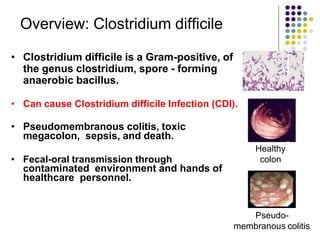
• Pseudomembranous colitis, toxic
megacolon, sepsis, and death.
• Fecal-oral transmission through
contaminated environment and hands of
healthcare personnel.
-
-
Pseudo-
membranous colitis
Healthy
colon
Overview: Clostridium difficile
• Can be part of the normal intestinal flora in
as many as 50% of children under age two
• Most common cause of nosocomial
diarrhea.
• Antimicrobial exposure is major risk factor
for disease
-
-
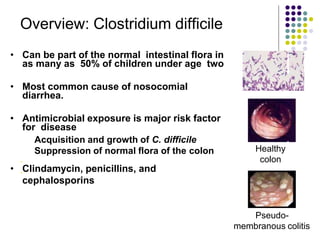
Acquisition and growth of C. difficile
Suppression of normal flora of the colon
• Clindamycin, penicillins, and
cephalosporins
Pseudo-
membranous colitis
Healthy
colon
What are the risk factors
for CDI?






 C. difficile-associated disease
occurs when the normal intestinal
flora is altered, allowing C. difficile to
flourish in the intestinal tract and
produce a toxin that causes a watery
diarrhea.
Antibiotic use
Proton-pump inhibitors (antacids)
Repeated enemas
Gastrointestinal tract surgery
Cross contamination from
environment
Food sources
Antibiotics and C. difficile?
 The overuse of antibiotics




penicillin (ampicillin)
Clindamycin
Cephalosporins
Fluorquinolones
alters the normal intestinal flora
and increase the risk of developing
C. difficile diarrhea.
Proton Pump Inhibitors
 Reduction of gastric acid secretion may allow C
difficile to be ingested and survive a "first wall of
host defense" -- the acidic gastric pool.
Reduced gastric acid facilitates survival of C.difficile
in the upper gastrointestinal tract, leading to
disease-associated sequelae
C difficile spores are resistant to gastric acid


 Reference: Proton pump inhibitors increase significantly the risk of Clostridium difficile
infection in a low-endemicity, non-outbreak hospital setting.
Aliment Pharmacol Ther. 2009; 29(6):626-34
Antidiarrheal Agents
 Antidiarrheal agents
such as Lomotil® or
Imodium® have
been shown to
increase the
severity of
symptoms and
should NOT be
taken.
CDC - Epidemiology






 1993-2005, there were 2,040,000 hospital
discharges with C. difficile-associated
infection
Average age - 68 years, with about two-thirds
older than 65.
58% of those diagnosed were female.
Admission accounted for more than 60% of CDI
cases.
Length of stay - 13 days on average and 9%
died during their stay.
Secondary diagnosis of CDI stayed longer (15
days on average) and more died (11%).).
1,100 patients in 2012 with C. difficile-associated
disease patients received subtotal colectomy
treatment for bowel perforation and peritonitis
resulting from fulminant disease.
Clinical Manifestation
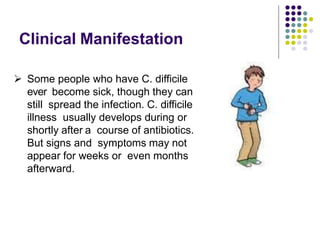
 Some people who have C. difficile
ever become sick, though they can
still spread the infection. C. difficile
illness usually develops during or
shortly after a course of antibiotics.
But signs and symptoms may not
appear for weeks or even months
afterward.
Signs and symptoms
• Watery diarrhea three or more times a day for
two or more days.
• Mild abdominal cramping and tenderness.
• Abdominal cramping and pain, which may be
severe.
• Fever
• Blood or pus in the stool
• Nausea
• Dehydration
• Loss of appetite
• Weight loss
Complications of
CDAD
 Pseudomembraneous colitis
 Dehydration
 Toxic mega colon
 Perforation of the colon
 Sepsis
 Death
Non-Specific Colitis
 C. difficile can also
cause non-specific
colitis quite reminiscent
of other intestinal
bacterial infections
such as Shigella or
Campylobacter
 This is a more serious
illness than simple
antibiotic-associated
diarrhea
Patients experience watery
diarrhea 10 to 20 times a
day and lower
Crampy abdominal pain.
low-grade fever,
dehydration, and non-
specific colitis are common
manifestations.


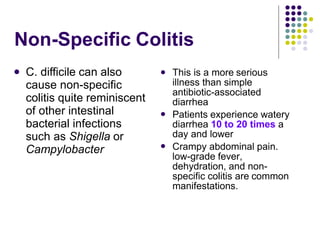
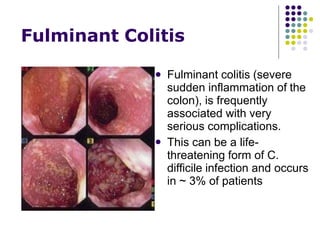
Fulminant Colitis
 Fulminant colitis (severe
sudden inflammation of the
colon), is frequently
associated with very
serious complications.
This can be a life-
threatening form of C.
difficile infection and occurs
in ~ 3% of patients

 C.difficile is transmitted
from person to person by
the fecal-oral route.
 High prevalence among
hospitalized patients.
 Some elderly adults
experience chronic diarrhea
e.g. medications, IBS
 Once people are colonized by
C. difficile, they remain carriers
for year-long time.
Transmission Factors
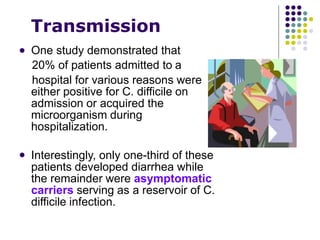
Transmission
 One study demonstrated that
20% of patients admitted to a
hospital for various reasons were
either positive for C. difficile on
admission or acquired the
microorganism during
hospitalization.
 Interestingly, only one-third of these
patients developed diarrhea while
the remainder were asymptomatic
carriers serving as a reservoir of C.
difficile infection.
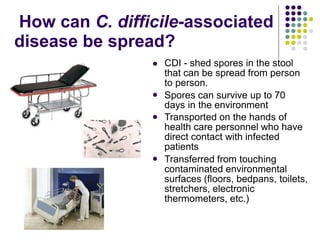
How can C. difficile-associated
disease be spread?



 CDI - shed spores in the stool
that can be spread from person
to person.
Spores can survive up to 70
days in the environment
Transported on the hands of
health care personnel who have
direct contact with infected
patients
Transferred from touching
contaminated environmental
surfaces (floors, bedpans, toilets,
stretchers, electronic
thermometers, etc.)
Hands and Gloved Hands as
Sources for Spread
 Scientists cultured the
imprint of a health care
worker's gloved hand
after examining a
patient infected with
Clostridium difficile.
The larger yellow colonies
outlining the fingers are
clusters of Clostridium
difficile
The patient had showered
an hour before the


specimen was collected. Clinical Infectious Diseases, February
2008.
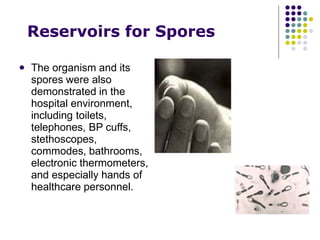
Reservoirs for Spores
 The organism and its
spores were also
demonstrated in the
hospital environment,
including toilets,
telephones, BP cuffs,
stethoscopes,
commodes, bathrooms,
electronic thermometers,
and especially hands of
healthcare personnel.
Environmental Sources
 Even after cleaning, studies show
that C. diff spores linger on
virtually every hospital surface,
including bedrails, telephones, call
buttons and toilets.
C. diff spores cling to patient skin
40% of patients diagnosed with
CDI infections tested positive for
C. diff on their hands.
20 % had the bacteria on
their forearms
60 % had C. diff detected on
their chest and abdomen.




Diagnosis of CDAD
• Endoscopy
pseudomembranous colitis.
• Culture
• Cell culture cytotoxin test
• EIA toxin test
• PCR toxin gene
detection
How is C. difficile-associated
disease diagnosed?
 C. difficile diarrhea is confirmed by the
presence of a toxin in a stool
specimen.
Enzyme immunoassay detects toxin
A & B
C.difficile toxin is very unstable. The
toxin degrades at room temperature
and may be undetectable within 2 hrs
after collecting the specimen.
Laboratory requests the specimen be
immediately brought to the lab within
½ hr.
Refrigeration does not stablilize the
toxin.




 Enzyme immunoassay (EIA) is most
often used to detect substances
produced by the bacteria. This test is
faster than other tests, and simpler to
perform. The results are ready in a few
hours.
 The Light Cycler PCR assay detects
the presence of Clostridium difficile
and the toxin B gene.
Hand Hygiene Key Prevention
Measure to Prevent Spread
 Practice good hygiene often
 Keep your hands clean by
washing thoroughly with
soap and water – especially
important with C. difficile to
remove spores
 Keep cuts and abrasions
clean and covered with a
proper dressing (e.g.
transparent bandage) until
healed
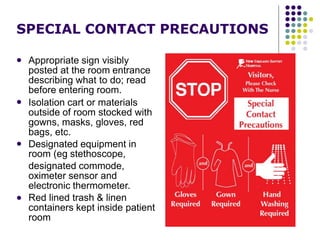
SPECIAL CONTACT PRECAUTIONS
 Appropriate sign visibly
posted at the room entrance
describing what to do; read
before entering room.
Isolation cart or materials
outside of room stocked with
gowns, masks, gloves, red
bags, etc.
Designated equipment in
room (eg stethoscope,
designated commode,
oximeter sensor and
electronic thermometer.
Red lined trash & linen
containers kept inside patient
room



Special Contact Precautions


 Gowns upon entering room –
contamination can occur from
touching patient, up against the
bed, changing a dressing, sitting
in the chair next to the bed,
moving the patient, changing bed
linen
Most contaminated area is within
3 feet of patient’s bed
Mask with faceshield if irrigating
wounds, suctioning, splashing of
blood or body fluids to prevent
blood/body fluid exposure
Protocol to Discontinue
Contact Precautions
 Continue until discharge – asymptomatic
carriage can occur
 No need to retest if diarrhea and
symptoms are gone after treatment
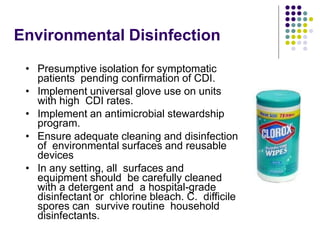
Environmental Disinfection
• Presumptive isolation for symptomatic
patients pending confirmation of CDI.
• Implement universal glove use on units
with high CDI rates.
• Implement an antimicrobial stewardship
program.
• Ensure adequate cleaning and disinfection
of environmental surfaces and reusable
devices
• In any setting, all surfaces and
equipment should be carefully cleaned
with a detergent and a hospital-grade
disinfectant or chlorine bleach. C. difficile
spores can survive routine household
disinfectants.
Therapy for C. difficile
 Directed against eradication of the
microorganism from the colonic
microflora.
No therapy is required for
asymptomatic carriers.
Discontinuation of antibiotics (if
possible) in noncomplicated
patients with mild diarrhea, no
fever, and modest lower
abdominal pain, is often enough to
alleviate symptoms and stop
diarrhea.
23% of patients will resolve within
2-3 days of discontinuing the
antibiotic.



Therapy continued…..
 Severe diarrhea and colitis:
 metronidazole or oral vancomycin, for 10 to 14 days.
Several clinical trials have shown that these
antibiotics are equally effective in cases of mild to
moderate C. difficile infection and more than 95%
of patients respond very well to this treatment.
Diarrhea following treatment with either
vancomycin or metronidazole is expected to
improve after 1 to 4 days with complete resolution
within 2 weeks.


Relapse of C. Difficile
 Approximately 15 to 20% of
patients will experience re-
appearance of diarrhea and
other symptoms weeks or
even months after initial
therapy has been
discontinued
Relapse
 Repeat the 10 to 14 day course of either
metronidazole or vancomycin
However, a subset of patients continues to
relapse whenever antibiotics are discontinued
and this represents a therapeutic challenge.
Some authorities recommend switching to the
alternative antibiotic from the one used initially


In Summary…..
 Clostridium difficile infections are a newly emerging
outbreak problem in hospitals
Resulting in increased morbidity and mortality
Infection control measures, such as Special Contact
Precaution techniques and excellent hand hygiene
have been shown to prevent the spread of
Clostridium difficile
Thorough cleaning of the environment with bleach is
vital to prevent cross-contamination of spores
Judicious use of antibiotics is an important
prevention measure.





clostridium difficile by Ismail surchi

  • 1.
  • 2.
    Overview: Clostridium difficile •Clostridium difficile is a Gram-positive, of the genus clostridium, spore - forming anaerobic bacillus. • Can cause Clostridium difficile Infection (CDI). • Pseudomembranous colitis, toxic megacolon, sepsis, and death. • Fecal-oral transmission through contaminated environment and hands of healthcare personnel. - - Pseudo- membranous colitis Healthy colon
  • 3.
    Overview: Clostridium difficile •Can be part of the normal intestinal flora in as many as 50% of children under age two • Most common cause of nosocomial diarrhea. • Antimicrobial exposure is major risk factor for disease - - Acquisition and growth of C. difficile Suppression of normal flora of the colon • Clindamycin, penicillins, and cephalosporins Pseudo- membranous colitis Healthy colon
  • 4.
    What are therisk factors for CDI?        C. difficile-associated disease occurs when the normal intestinal flora is altered, allowing C. difficile to flourish in the intestinal tract and produce a toxin that causes a watery diarrhea. Antibiotic use Proton-pump inhibitors (antacids) Repeated enemas Gastrointestinal tract surgery Cross contamination from environment Food sources
  • 5.
    Antibiotics and C.difficile?  The overuse of antibiotics     penicillin (ampicillin) Clindamycin Cephalosporins Fluorquinolones alters the normal intestinal flora and increase the risk of developing C. difficile diarrhea.
  • 6.
    Proton Pump Inhibitors Reduction of gastric acid secretion may allow C difficile to be ingested and survive a "first wall of host defense" -- the acidic gastric pool. Reduced gastric acid facilitates survival of C.difficile in the upper gastrointestinal tract, leading to disease-associated sequelae C difficile spores are resistant to gastric acid    Reference: Proton pump inhibitors increase significantly the risk of Clostridium difficile infection in a low-endemicity, non-outbreak hospital setting. Aliment Pharmacol Ther. 2009; 29(6):626-34
  • 7.
    Antidiarrheal Agents  Antidiarrhealagents such as Lomotil® or Imodium® have been shown to increase the severity of symptoms and should NOT be taken.
  • 8.
    CDC - Epidemiology       1993-2005, there were 2,040,000 hospital discharges with C. difficile-associated infection Average age - 68 years, with about two-thirds older than 65. 58% of those diagnosed were female. Admission accounted for more than 60% of CDI cases. Length of stay - 13 days on average and 9% died during their stay. Secondary diagnosis of CDI stayed longer (15 days on average) and more died (11%).). 1,100 patients in 2012 with C. difficile-associated disease patients received subtotal colectomy treatment for bowel perforation and peritonitis resulting from fulminant disease.
  • 9.
    Clinical Manifestation  Somepeople who have C. difficile ever become sick, though they can still spread the infection. C. difficile illness usually develops during or shortly after a course of antibiotics. But signs and symptoms may not appear for weeks or even months afterward.
  • 10.
    Signs and symptoms •Watery diarrhea three or more times a day for two or more days. • Mild abdominal cramping and tenderness. • Abdominal cramping and pain, which may be severe. • Fever • Blood or pus in the stool • Nausea • Dehydration • Loss of appetite • Weight loss
  • 11.
    Complications of CDAD  Pseudomembraneouscolitis  Dehydration  Toxic mega colon  Perforation of the colon  Sepsis  Death
  • 12.
    Non-Specific Colitis  C.difficile can also cause non-specific colitis quite reminiscent of other intestinal bacterial infections such as Shigella or Campylobacter  This is a more serious illness than simple antibiotic-associated diarrhea Patients experience watery diarrhea 10 to 20 times a day and lower Crampy abdominal pain. low-grade fever, dehydration, and non- specific colitis are common manifestations.  
  • 13.
    Fulminant Colitis  Fulminantcolitis (severe sudden inflammation of the colon), is frequently associated with very serious complications. This can be a life- threatening form of C. difficile infection and occurs in ~ 3% of patients 
  • 14.
     C.difficile istransmitted from person to person by the fecal-oral route.  High prevalence among hospitalized patients.  Some elderly adults experience chronic diarrhea e.g. medications, IBS  Once people are colonized by C. difficile, they remain carriers for year-long time. Transmission Factors
  • 15.
    Transmission  One studydemonstrated that 20% of patients admitted to a hospital for various reasons were either positive for C. difficile on admission or acquired the microorganism during hospitalization.  Interestingly, only one-third of these patients developed diarrhea while the remainder were asymptomatic carriers serving as a reservoir of C. difficile infection.
  • 16.
    How can C.difficile-associated disease be spread?     CDI - shed spores in the stool that can be spread from person to person. Spores can survive up to 70 days in the environment Transported on the hands of health care personnel who have direct contact with infected patients Transferred from touching contaminated environmental surfaces (floors, bedpans, toilets, stretchers, electronic thermometers, etc.)
  • 17.
    Hands and GlovedHands as Sources for Spread  Scientists cultured the imprint of a health care worker's gloved hand after examining a patient infected with Clostridium difficile. The larger yellow colonies outlining the fingers are clusters of Clostridium difficile The patient had showered an hour before the   specimen was collected. Clinical Infectious Diseases, February 2008.
  • 18.
    Reservoirs for Spores The organism and its spores were also demonstrated in the hospital environment, including toilets, telephones, BP cuffs, stethoscopes, commodes, bathrooms, electronic thermometers, and especially hands of healthcare personnel.
  • 19.
    Environmental Sources  Evenafter cleaning, studies show that C. diff spores linger on virtually every hospital surface, including bedrails, telephones, call buttons and toilets. C. diff spores cling to patient skin 40% of patients diagnosed with CDI infections tested positive for C. diff on their hands. 20 % had the bacteria on their forearms 60 % had C. diff detected on their chest and abdomen.    
  • 20.
    Diagnosis of CDAD •Endoscopy pseudomembranous colitis. • Culture • Cell culture cytotoxin test • EIA toxin test • PCR toxin gene detection
  • 21.
    How is C.difficile-associated disease diagnosed?  C. difficile diarrhea is confirmed by the presence of a toxin in a stool specimen. Enzyme immunoassay detects toxin A & B C.difficile toxin is very unstable. The toxin degrades at room temperature and may be undetectable within 2 hrs after collecting the specimen. Laboratory requests the specimen be immediately brought to the lab within ½ hr. Refrigeration does not stablilize the toxin.    
  • 22.
     Enzyme immunoassay(EIA) is most often used to detect substances produced by the bacteria. This test is faster than other tests, and simpler to perform. The results are ready in a few hours.  The Light Cycler PCR assay detects the presence of Clostridium difficile and the toxin B gene.
  • 23.
    Hand Hygiene KeyPrevention Measure to Prevent Spread  Practice good hygiene often  Keep your hands clean by washing thoroughly with soap and water – especially important with C. difficile to remove spores  Keep cuts and abrasions clean and covered with a proper dressing (e.g. transparent bandage) until healed
  • 24.
    SPECIAL CONTACT PRECAUTIONS Appropriate sign visibly posted at the room entrance describing what to do; read before entering room. Isolation cart or materials outside of room stocked with gowns, masks, gloves, red bags, etc. Designated equipment in room (eg stethoscope, designated commode, oximeter sensor and electronic thermometer. Red lined trash & linen containers kept inside patient room   
  • 25.
    Special Contact Precautions   Gowns upon entering room – contamination can occur from touching patient, up against the bed, changing a dressing, sitting in the chair next to the bed, moving the patient, changing bed linen Most contaminated area is within 3 feet of patient’s bed Mask with faceshield if irrigating wounds, suctioning, splashing of blood or body fluids to prevent blood/body fluid exposure
  • 26.
    Protocol to Discontinue ContactPrecautions  Continue until discharge – asymptomatic carriage can occur  No need to retest if diarrhea and symptoms are gone after treatment
  • 27.
    Environmental Disinfection • Presumptiveisolation for symptomatic patients pending confirmation of CDI. • Implement universal glove use on units with high CDI rates. • Implement an antimicrobial stewardship program. • Ensure adequate cleaning and disinfection of environmental surfaces and reusable devices • In any setting, all surfaces and equipment should be carefully cleaned with a detergent and a hospital-grade disinfectant or chlorine bleach. C. difficile spores can survive routine household disinfectants.
  • 28.
    Therapy for C.difficile  Directed against eradication of the microorganism from the colonic microflora. No therapy is required for asymptomatic carriers. Discontinuation of antibiotics (if possible) in noncomplicated patients with mild diarrhea, no fever, and modest lower abdominal pain, is often enough to alleviate symptoms and stop diarrhea. 23% of patients will resolve within 2-3 days of discontinuing the antibiotic.   
  • 29.
    Therapy continued…..  Severediarrhea and colitis:  metronidazole or oral vancomycin, for 10 to 14 days. Several clinical trials have shown that these antibiotics are equally effective in cases of mild to moderate C. difficile infection and more than 95% of patients respond very well to this treatment. Diarrhea following treatment with either vancomycin or metronidazole is expected to improve after 1 to 4 days with complete resolution within 2 weeks.  
  • 30.
    Relapse of C.Difficile  Approximately 15 to 20% of patients will experience re- appearance of diarrhea and other symptoms weeks or even months after initial therapy has been discontinued
  • 31.
    Relapse  Repeat the10 to 14 day course of either metronidazole or vancomycin However, a subset of patients continues to relapse whenever antibiotics are discontinued and this represents a therapeutic challenge. Some authorities recommend switching to the alternative antibiotic from the one used initially  
  • 32.
    In Summary…..  Clostridiumdifficile infections are a newly emerging outbreak problem in hospitals Resulting in increased morbidity and mortality Infection control measures, such as Special Contact Precaution techniques and excellent hand hygiene have been shown to prevent the spread of Clostridium difficile Thorough cleaning of the environment with bleach is vital to prevent cross-contamination of spores Judicious use of antibiotics is an important prevention measure.    