
Overview of  Clostridium Difficile  Infections (CDI) Stephen M. Brecher Ph.D. VA Boston HealthCare System BU School of Medicine
The opinions expressed in this presentation are those of the presenter and do not necessarily represent the views of the Veterans Affairs Health- Care System
Overview Historical perspective Organism and key properties Changing epidemiology Mild, moderate and severe disease Laboratory diagnosis Treatment
Historical Perspective In the 1960’s it was noted that patients on antibiotics developed diarrhea 1 “ Staphylococcal Colitis” Originally thought to be caused by  S. aureus  and treated with oral bacitracin Stool cultures routinely ordered for  S. aureus  Early 1970’s, a new explanation “ Clindamycin Colitis”  Severe diarrhea, pseudomembrane colitis, and occasional deaths documented in patients on clindamycin 1. Gorbach S.L. 1999. NEJM.341: 1689-1691
“ Antibiotic Associated Pseudomembranous Colitis Due to Toxin-Producing Bacteria” 1 Bartlett and co-workers demonstrated cytotoxicity in tissue culture and enterocolitis in hamsters from stool isolates from patients with pseudomembranous colitis Isolate was  Clostridium difficile Bacillus difficilis  (now confirmed as  C. difficile ) was cultured from healthy neonates (with difficulty, hence the name) in 1935 2 1. Bartlett, J.G. et al. 1978. NEJM. 298: 531-534   2. Hall, J.C. and O’Toole E. 1935. Am J Dis Child. 49: 390-402.
Factors That Complicated the Discovery of CDI C. difficile  is found in healthy infants who appear to be refractile to CDI Infant intestinal cells do not appear to have receptors for toxins A and B Antibiotics often cause diarrhea unrelated to  C. difficile  by disrupting intestinal flora which helps digest food
Clostridium difficile Gram Positive, anaerobic, spore-forming bacillus Vegetative cells die quickly in an aerobic environment Spores are a survival form and live for a very long time in the environment Grows on selective media in 2 days and smells like horse manure (p-cresol)
Source of Infections Spores in the hospital, nursing home or long-term care environment associated with ill patients Large numbers of spores on beds, bed-rails, chairs, curtains, medical instruments, ceiling, etc. Airborne transmission 1 Asymptomatic carriers in those same environments Low risk compared to patients with active disease Unknown in community based infections, but food has been implicated 2 1. Best, E.L. et al. 2010. CID. 50. 1450-1457 2. Jhung,M.A. et al. 2008. Emerg Infect Dis. 14: 1039-1045
Risk Factors for Infection Antibiotics (some more than others) Hospitalization or long-term care facility Increasing age (>65,>>80) Co-morbidity Surgery ? Proton-pump inhibitors Community Associated Cases Peri-partum Close contact of CDI case Food
Role of Antibiotics All antibiotics (including metronidazoloe and vancomycin) are associated with CDI High Risk Group Clindamycin Cephalosporins/Penicillins/Beta-Lactams Fluoroquinolones Alteration of normal colonic flora thought to favor growth of  C. difficile Antibiotics do not know they are supposed to kill/inhibit only the “bad guys” May not be a factor in community CDI
Incidence in The United States CDI is not a reportable disease so exact number of cases and deaths remain unknown Based on discharge diagnoses, CDI cases have tripled over the last 5 years Deaths in the UK are around 9,000/year
Pathogenesis Toxigenic strains produce 2 large protein exotoxins that are associated with virulence Toxins A and B Mutants strains that do not make toxins A and B are not virulent Some strains make a third toxin known as Binary Toxin By itself, not pathogenic May act synergistically with toxins A and B in severe colitis More common in animal strains
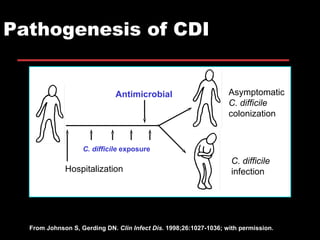
Pathogenesis of CDI Asymptomatic  C. difficile  colonization C. difficile  exposure Antimicrobial C. difficile  infection Hospitalization From Johnson S, Gerding DN.  Clin Infect Dis.  1998;26:1027-1036; with permission.
Pathogenesis Changing Epidemiology Increasing morbidity and mortality noted beginning in 2000 Outbreaks  in US and Canada (over 200 deaths) Was this due to poor infection control, emergence of antibiotic resistance, or something else? A new, hypervirulent strain was detected
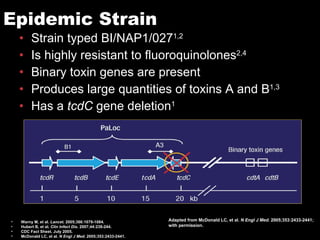
Epidemic Strain Strain typed BI/NAP1/027 1,2 Is highly resistant to fluoroquinolones 2,4 Binary toxin genes are present Produces large quantities of toxins A and B 1,3 Has a  tcdC  gene deletion 1 Warny M, et al.  Lancet . 2005;366:1079-1084. Hubert B, et al.  Clin Infect Dis . 2007;44:238-244. CDC Fact Sheet. July 2005.  McDonald LC, et al.  N Engl J Med . 2005;353:2433-2441. Adapted from McDonald LC, et al.  N Engl J Med.  2005;353:2433-2441; with permission.
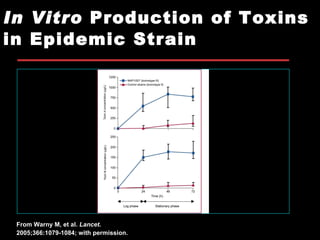
In Vitro  Production of Toxins  in Epidemic Strain From Warny M, et al.  Lancet .  2005;366:1079-1084; with permission.
Not So Fast 2 recent papers questioned whether this strain is more virulent NAP-1 strain was detected around 25% of time in their hospital (BID in Boston) but was not associated with increased severity of disease (non-epidemic setting) 1 18 and 39 bp deletion containing strains were not associated with increased severity of CDI at the Mayo Clinic 2 Age >65 and  prior NH stay implicated 1. Cloud, J. et al. 2009. Cl Gastro and Hept. 7:868-873 2. Verdoorn, B. P. et al. Diag Micro and ID. 10.1016/j.diagmicrobio.2009.0815
Should You Treat the Patient or Treat the Strain? Routine diagnostics laboratory tests do not provide strain type Routine tests not always reliable Always treat the patient based on symptoms, history, risk factors and markers of severe disease
Symptoms of CDI Asymptomatic colonization Diarrhea mild    moderate    severe Abdominal pain and distension Fever Pseudomembranous colitis Toxic megacolon Perforated colon    sepsis    death
Markers of Severe Disease Leukocytosis Prominent feature of severe disease Rapidly elevating WBC Up to >100 K Albumin (<2.5) Creatinine (2xbaseline) Serum lactate (>5.0  colectomy) Hypertension and hypotension Pseudomembranous colitis Toxic megacolon Severe distension and abdominal pain
Laboratory Diagnosis of CDI Laboratory  Diagnosis Enzyme Immunoassay (EIA) Glutamate  Dehydrogenase (GDH) Cell Culture  Neutralization  Assay (CCNA) Toxigenic Culture  (Culture and CCNA) Molecular Based (PCR Or LAMP) Stool Culture
Specimen and Testing Guidelines Only test loose or liquid stool Test within 2 hours or keep refrigerated for up to 2 days Limit testing to 1 test/patient/week Do not perform a test for cure Do not perform tests on asymptomatic patients Test outpatients with diarrhea
“Plate Sin With Gold and it Goes Untarnished”
Cell Culture Neutralization Assay Performance Revisited * Compared to toxigenic culture.  +  Compared to clinical case definition and multiple test methods. Slide provided by Dr. Karen Carroll Study Method Sensitivity (%) Specificity (%) Eastwood, et al. JCM 2009; 47:3211 In house Vero cell assay* 86.4 99.2 Barbut, et al. JCM 2009;47:1276 In house MRC-5 cells* 75.8 100 Stamper, et al JCM 2009;47:373 TechLab TOX-B test* 67.2 99.1 Peterson, et al. CID 2007;45:1152 In house MRC-5 cells + 76.7 97.1
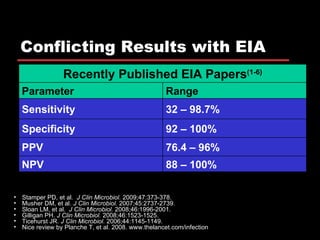
Conflicting Results with EIA Stamper PD, et al.  J Clin Microbiol.  2009;47:373-378. Musher DM, et al.  J Clin Microbiol.  2007;45:2737-2739. Sloan LM, et al.  J Clin Microbiol.  2008;46:1996-2001. Gilligan PH.  J Clin Microbiol.  2008;46:1523-1525. Ticehurst JR.  J Clin Microbiol.  2006;44:1145-1149. Nice review by Planche T, et al. 2008. www.thelancet.com/infection Recently Published EIA Papers (1-6) Parameter Range Sensitivity 32  –  98.7% Specificity 92  –  100% PPV 76.4  –  96% NPV 88  –  100%
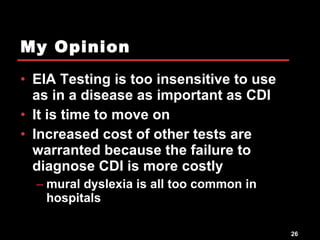
My Opinion EIA Testing is too insensitive to use as in a disease as important as CDI It is time to move on Increased cost of other tests are warranted because the failure to diagnose CDI is more costly mural dyslexia is all too common in hospitals
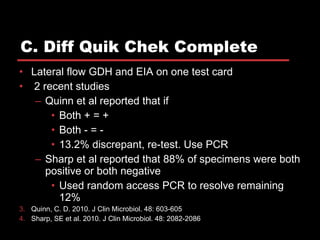
C. Diff Quik Chek Complete Lateral flow GDH and EIA on one test card 2 recent studies Quinn et al reported that if Both + = + Both - = - 13.2% discrepant, re-test. Use PCR Sharp et al reported that 88% of specimens were both positive or both negative Used random access PCR to resolve remaining 12% Quinn, C. D. 2010. J Clin Microbiol. 48: 603-605 Sharp, SE et al. 2010. J Clin Microbiol. 48: 2082-2086
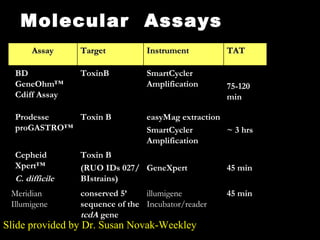
Commercially Available  Molecular  Assays Slide provided by Dr. Susan Novak-Weekley akSli Assay Target Instrument TAT BD GeneOhm ™ Cdiff Assay ToxinB SmartCycler Amplification 75-120 min Prodesse proGASTRO ™ Toxin B easyMag extraction SmartCycler Amplification ~ 3 hrs Cepheid Xpert ™  C. difficile Toxin B (RUO IDs 027/BIstrains) GeneXpert 45 min Meridian Illumigene conserved 5’ sequence of the  tcdA  gene  illumigene Incubator/reader 45 min
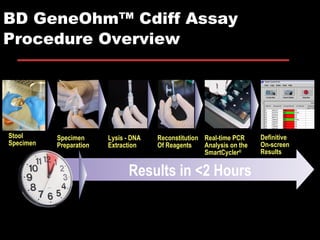
BD GeneOhm™ Cdiff Assay  Procedure Overview Definitive On-screen Results Results in <2 Hours Stool Specimen Slide courtesy BD GeneOhm lideS provide Specimen Preparation Lysis - DNA Extraction Reconstitution Of Reagents Real-time PCR Analysis on the SmartCycler ®
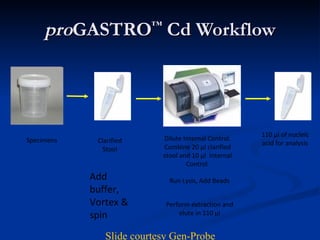
pro GASTRO ™  Cd Workflow Specimens Clarified Stool 110 µl of nucleic acid for analysis Add buffer, Vortex & spin Slide courtesy Gen-Probe Dilute Internal Control. Combine 20 µl clarified stool and 10 µl  Internal Control   Run Lysis, Add Beads Perform extraction and elute in 110 µl
pro GASTRO ™  Cd Workflow Hands-on Time =  57 min Hands-off Time = 137 min  TOTAL TIME  = 194 min Slide courtesy Gen-Probe Extracted nucleic acid Prepare controls Combine 5 µl of nucleic acid & 20 µl of Mastermix in reaction tube Insert each reaction tube in SmartCycler  Program instrument and run assay Mastermix
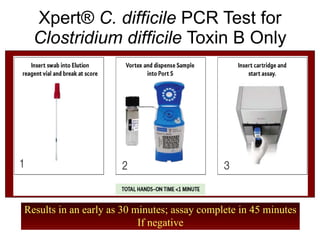
Xpert ®   C. difficile  PCR Test for  Clostridium difficile  Toxin B Only Results in an early as 30 minutes; assay complete in 45 minutes If negative
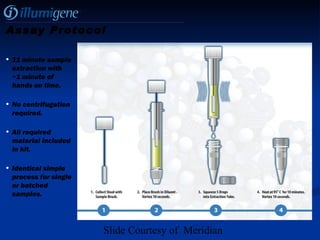
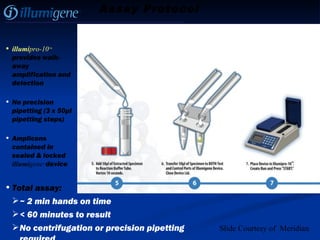
11 minute sample extraction with  ~1 minute of hands on time. No centrifugation required. All required material included in kit. Identical simple process for single or batched samples. Slide Courtesy of  Meridian Assay Protocol
illumi pro-10 ™   provides walk-away amplification and detection No precision pipetting (3 x 50 μ l pipetting steps) Amplicons contained in sealed & locked  illumi gene ™  device Total assay: ~ 2 min hands on time < 60 minutes to result No centrifugation or precision pipetting required Slide Courtesy of  Meridian Assay Protocol
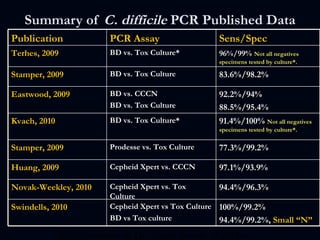
Summary of  C. difficile  PCR Published Data Slide courtesy of Dr. Susan Novak-Weekley Publication  PCR Assay Sens/Spec Terhes, 2009 BD vs. Tox Culture* 96%/99%   Not all negatives specimens tested by culture*.  Stamper, 2009 BD vs. Tox Culture  83.6%/98.2% Eastwood, 2009 BD vs. CCCN BD vs. Tox Culture 92.2%/94% 88.5%/95.4% Kvach, 2010 BD vs. Tox Culture* 91.4%/100%  Not all negatives specimens tested by culture*.  Stamper, 2009 Prodesse vs. Tox Culture 77.3%/99.2% Huang, 2009 Cepheid Xpert vs. CCCN 97.1%/93.9% Novak-Weekley, 2010 Cepheid Xpert vs. Tox Culture 94.4%/96.3% Swindells, 2010 Cepheid Xpert vs Tox Culture BD vs Tox culture 100%/99.2% 94.4%/99.2%,  Small “N”
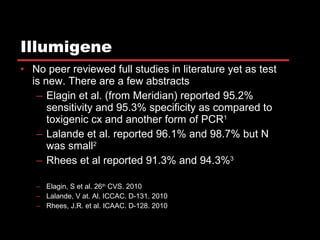
Illumigene No peer reviewed full studies in literature yet as test is new. There are a few abstracts Elagin et al. (from Meridian) reported 95.2% sensitivity and 95.3% specificity as compared to toxigenic cx and another form of PCR 1 Lalande et al. reported 96.1% and 98.7% but N was small 2 Rhees et al reported 91.3% and 94.3% 3 Elagin, S et al. 26 th  CVS. 2010 Lalande, V at. Al. ICCAC. D-131. 2010 Rhees, J.R. et al. ICAAC. D-128. 2010
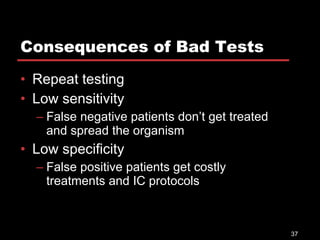
Consequences of Bad Tests Repeat testing Low sensitivity False negative patients don’t get treated and spread the organism Low specificity False positive patients get costly treatments and IC protocols
My Recommendations EIA alone is not accurate and should be discontinued (sensitivity unacceptable) 2 step tests with GDH/EIA have shown increased accuracy over EIA alone PCR works best but is significantly more expensive Cost of test is a small part of total cost Some do 2-step and confirm with PCR
Treatments Metronidazole (oral or IV) Oral vancomycin  IVIG Fidaxomicin (OPT-80) Nitazoximide Rifaximin chasers Probiotics C. difficile  non-toxigenic strains (phase 2) Monoclonal Antibodies for recurrent Disease 1 1. Lowry, I. et al. N Engl J Med 2010; 362:197-205
Bacteriotherapy Fecal Transplantation In recurrent disease, Aas et al have reported success using fresh stool Select healthy family member Mix 30-50 mg in 50-90 ml of normal saline Homogenize in a food blender Filter x 2 in coffee filter paper Administer via NG tube 1/16 patients relapsed Aas, J. et al. CID.2003. 36:580-585
Infection Control  (short course) Multi-step interdisciplinary program essential Ingredients Hand-washing with soap/warm-water  Cleaning protocols aimed at killing spores ( Precautions Antibiotic stewardship Accurate testing
Summary CDI is increasing in incidence, severity and poor outcomes No reasonable explanation for treatment failures  Community based infections are not well understood Extremely important to accurately detect all disease and aggressively treat severe disease Cost alone should not be the decision maker
Y Chromosome Testis Determining Factor (TDF) Gadgetry (MAC- locus) Channel Flipping (FLP) Catching and Throwing (BLZ-1) Self-confidence (BLZ-2) (note: unlinked to ability) Ability to remember and tell jokes (GOT-1) Sports Page (BUD-E) Addiction to death & destruction movies (MOV-E) Air Guitar (RIF) Ability to identify aircraft (DC10) Pre-adolescent fascination with Arachnid and Reptilia (MOM-4U) Spitting (P2E) Sitting on the john reading (SIT) Inability to express emotion over the  phone (ME-2) Selective hearing loss (HUH?) Total lack of recall for dates (OOPS) Gitschier, J., Science, 1993 (261) p. 679

Overview of C difficile Infections - Dr Steve Brecher - November 2010 Symposium

  • 1.
    Overview of Clostridium Difficile Infections (CDI) Stephen M. Brecher Ph.D. VA Boston HealthCare System BU School of Medicine
  • 2.
    The opinions expressedin this presentation are those of the presenter and do not necessarily represent the views of the Veterans Affairs Health- Care System
  • 3.
    Overview Historical perspectiveOrganism and key properties Changing epidemiology Mild, moderate and severe disease Laboratory diagnosis Treatment
  • 4.
    Historical Perspective Inthe 1960’s it was noted that patients on antibiotics developed diarrhea 1 “ Staphylococcal Colitis” Originally thought to be caused by S. aureus and treated with oral bacitracin Stool cultures routinely ordered for S. aureus Early 1970’s, a new explanation “ Clindamycin Colitis” Severe diarrhea, pseudomembrane colitis, and occasional deaths documented in patients on clindamycin 1. Gorbach S.L. 1999. NEJM.341: 1689-1691
  • 5.
    “ Antibiotic AssociatedPseudomembranous Colitis Due to Toxin-Producing Bacteria” 1 Bartlett and co-workers demonstrated cytotoxicity in tissue culture and enterocolitis in hamsters from stool isolates from patients with pseudomembranous colitis Isolate was Clostridium difficile Bacillus difficilis (now confirmed as C. difficile ) was cultured from healthy neonates (with difficulty, hence the name) in 1935 2 1. Bartlett, J.G. et al. 1978. NEJM. 298: 531-534 2. Hall, J.C. and O’Toole E. 1935. Am J Dis Child. 49: 390-402.
  • 6.
    Factors That Complicatedthe Discovery of CDI C. difficile is found in healthy infants who appear to be refractile to CDI Infant intestinal cells do not appear to have receptors for toxins A and B Antibiotics often cause diarrhea unrelated to C. difficile by disrupting intestinal flora which helps digest food
  • 7.
    Clostridium difficile GramPositive, anaerobic, spore-forming bacillus Vegetative cells die quickly in an aerobic environment Spores are a survival form and live for a very long time in the environment Grows on selective media in 2 days and smells like horse manure (p-cresol)
  • 8.
    Source of InfectionsSpores in the hospital, nursing home or long-term care environment associated with ill patients Large numbers of spores on beds, bed-rails, chairs, curtains, medical instruments, ceiling, etc. Airborne transmission 1 Asymptomatic carriers in those same environments Low risk compared to patients with active disease Unknown in community based infections, but food has been implicated 2 1. Best, E.L. et al. 2010. CID. 50. 1450-1457 2. Jhung,M.A. et al. 2008. Emerg Infect Dis. 14: 1039-1045
  • 9.
    Risk Factors forInfection Antibiotics (some more than others) Hospitalization or long-term care facility Increasing age (>65,>>80) Co-morbidity Surgery ? Proton-pump inhibitors Community Associated Cases Peri-partum Close contact of CDI case Food
  • 10.
    Role of AntibioticsAll antibiotics (including metronidazoloe and vancomycin) are associated with CDI High Risk Group Clindamycin Cephalosporins/Penicillins/Beta-Lactams Fluoroquinolones Alteration of normal colonic flora thought to favor growth of C. difficile Antibiotics do not know they are supposed to kill/inhibit only the “bad guys” May not be a factor in community CDI
  • 11.
    Incidence in TheUnited States CDI is not a reportable disease so exact number of cases and deaths remain unknown Based on discharge diagnoses, CDI cases have tripled over the last 5 years Deaths in the UK are around 9,000/year
  • 12.
    Pathogenesis Toxigenic strainsproduce 2 large protein exotoxins that are associated with virulence Toxins A and B Mutants strains that do not make toxins A and B are not virulent Some strains make a third toxin known as Binary Toxin By itself, not pathogenic May act synergistically with toxins A and B in severe colitis More common in animal strains
  • 13.
    Pathogenesis of CDIAsymptomatic C. difficile colonization C. difficile exposure Antimicrobial C. difficile infection Hospitalization From Johnson S, Gerding DN. Clin Infect Dis. 1998;26:1027-1036; with permission.
  • 14.
    Pathogenesis Changing EpidemiologyIncreasing morbidity and mortality noted beginning in 2000 Outbreaks in US and Canada (over 200 deaths) Was this due to poor infection control, emergence of antibiotic resistance, or something else? A new, hypervirulent strain was detected
  • 15.
    Epidemic Strain Straintyped BI/NAP1/027 1,2 Is highly resistant to fluoroquinolones 2,4 Binary toxin genes are present Produces large quantities of toxins A and B 1,3 Has a tcdC gene deletion 1 Warny M, et al. Lancet . 2005;366:1079-1084. Hubert B, et al. Clin Infect Dis . 2007;44:238-244. CDC Fact Sheet. July 2005. McDonald LC, et al. N Engl J Med . 2005;353:2433-2441. Adapted from McDonald LC, et al. N Engl J Med. 2005;353:2433-2441; with permission.
  • 16.
    In Vitro Production of Toxins in Epidemic Strain From Warny M, et al. Lancet . 2005;366:1079-1084; with permission.
  • 17.
    Not So Fast2 recent papers questioned whether this strain is more virulent NAP-1 strain was detected around 25% of time in their hospital (BID in Boston) but was not associated with increased severity of disease (non-epidemic setting) 1 18 and 39 bp deletion containing strains were not associated with increased severity of CDI at the Mayo Clinic 2 Age >65 and prior NH stay implicated 1. Cloud, J. et al. 2009. Cl Gastro and Hept. 7:868-873 2. Verdoorn, B. P. et al. Diag Micro and ID. 10.1016/j.diagmicrobio.2009.0815
  • 18.
    Should You Treatthe Patient or Treat the Strain? Routine diagnostics laboratory tests do not provide strain type Routine tests not always reliable Always treat the patient based on symptoms, history, risk factors and markers of severe disease
  • 19.
    Symptoms of CDIAsymptomatic colonization Diarrhea mild  moderate  severe Abdominal pain and distension Fever Pseudomembranous colitis Toxic megacolon Perforated colon  sepsis  death
  • 20.
    Markers of SevereDisease Leukocytosis Prominent feature of severe disease Rapidly elevating WBC Up to >100 K Albumin (<2.5) Creatinine (2xbaseline) Serum lactate (>5.0  colectomy) Hypertension and hypotension Pseudomembranous colitis Toxic megacolon Severe distension and abdominal pain
  • 21.
    Laboratory Diagnosis ofCDI Laboratory Diagnosis Enzyme Immunoassay (EIA) Glutamate Dehydrogenase (GDH) Cell Culture Neutralization Assay (CCNA) Toxigenic Culture (Culture and CCNA) Molecular Based (PCR Or LAMP) Stool Culture
  • 22.
    Specimen and TestingGuidelines Only test loose or liquid stool Test within 2 hours or keep refrigerated for up to 2 days Limit testing to 1 test/patient/week Do not perform a test for cure Do not perform tests on asymptomatic patients Test outpatients with diarrhea
  • 23.
    “Plate Sin WithGold and it Goes Untarnished”
  • 24.
    Cell Culture NeutralizationAssay Performance Revisited * Compared to toxigenic culture. + Compared to clinical case definition and multiple test methods. Slide provided by Dr. Karen Carroll Study Method Sensitivity (%) Specificity (%) Eastwood, et al. JCM 2009; 47:3211 In house Vero cell assay* 86.4 99.2 Barbut, et al. JCM 2009;47:1276 In house MRC-5 cells* 75.8 100 Stamper, et al JCM 2009;47:373 TechLab TOX-B test* 67.2 99.1 Peterson, et al. CID 2007;45:1152 In house MRC-5 cells + 76.7 97.1
  • 25.
    Conflicting Results withEIA Stamper PD, et al. J Clin Microbiol. 2009;47:373-378. Musher DM, et al. J Clin Microbiol. 2007;45:2737-2739. Sloan LM, et al. J Clin Microbiol. 2008;46:1996-2001. Gilligan PH. J Clin Microbiol. 2008;46:1523-1525. Ticehurst JR. J Clin Microbiol. 2006;44:1145-1149. Nice review by Planche T, et al. 2008. www.thelancet.com/infection Recently Published EIA Papers (1-6) Parameter Range Sensitivity 32 – 98.7% Specificity 92 – 100% PPV 76.4 – 96% NPV 88 – 100%
  • 26.
    My Opinion EIATesting is too insensitive to use as in a disease as important as CDI It is time to move on Increased cost of other tests are warranted because the failure to diagnose CDI is more costly mural dyslexia is all too common in hospitals
  • 27.
    C. Diff QuikChek Complete Lateral flow GDH and EIA on one test card 2 recent studies Quinn et al reported that if Both + = + Both - = - 13.2% discrepant, re-test. Use PCR Sharp et al reported that 88% of specimens were both positive or both negative Used random access PCR to resolve remaining 12% Quinn, C. D. 2010. J Clin Microbiol. 48: 603-605 Sharp, SE et al. 2010. J Clin Microbiol. 48: 2082-2086
  • 28.
    Commercially Available Molecular Assays Slide provided by Dr. Susan Novak-Weekley akSli Assay Target Instrument TAT BD GeneOhm ™ Cdiff Assay ToxinB SmartCycler Amplification 75-120 min Prodesse proGASTRO ™ Toxin B easyMag extraction SmartCycler Amplification ~ 3 hrs Cepheid Xpert ™ C. difficile Toxin B (RUO IDs 027/BIstrains) GeneXpert 45 min Meridian Illumigene conserved 5’ sequence of the tcdA gene illumigene Incubator/reader 45 min
  • 29.
    BD GeneOhm™ CdiffAssay Procedure Overview Definitive On-screen Results Results in <2 Hours Stool Specimen Slide courtesy BD GeneOhm lideS provide Specimen Preparation Lysis - DNA Extraction Reconstitution Of Reagents Real-time PCR Analysis on the SmartCycler ®
  • 30.
    pro GASTRO ™ Cd Workflow Specimens Clarified Stool 110 µl of nucleic acid for analysis Add buffer, Vortex & spin Slide courtesy Gen-Probe Dilute Internal Control. Combine 20 µl clarified stool and 10 µl Internal Control Run Lysis, Add Beads Perform extraction and elute in 110 µl
  • 31.
    pro GASTRO ™ Cd Workflow Hands-on Time = 57 min Hands-off Time = 137 min TOTAL TIME = 194 min Slide courtesy Gen-Probe Extracted nucleic acid Prepare controls Combine 5 µl of nucleic acid & 20 µl of Mastermix in reaction tube Insert each reaction tube in SmartCycler Program instrument and run assay Mastermix
  • 32.
    Xpert ® C. difficile PCR Test for Clostridium difficile Toxin B Only Results in an early as 30 minutes; assay complete in 45 minutes If negative
  • 33.
    11 minute sampleextraction with ~1 minute of hands on time. No centrifugation required. All required material included in kit. Identical simple process for single or batched samples. Slide Courtesy of Meridian Assay Protocol
  • 34.
    illumi pro-10 ™ provides walk-away amplification and detection No precision pipetting (3 x 50 μ l pipetting steps) Amplicons contained in sealed & locked illumi gene ™ device Total assay: ~ 2 min hands on time < 60 minutes to result No centrifugation or precision pipetting required Slide Courtesy of Meridian Assay Protocol
  • 35.
    Summary of C. difficile PCR Published Data Slide courtesy of Dr. Susan Novak-Weekley Publication PCR Assay Sens/Spec Terhes, 2009 BD vs. Tox Culture* 96%/99% Not all negatives specimens tested by culture*. Stamper, 2009 BD vs. Tox Culture 83.6%/98.2% Eastwood, 2009 BD vs. CCCN BD vs. Tox Culture 92.2%/94% 88.5%/95.4% Kvach, 2010 BD vs. Tox Culture* 91.4%/100% Not all negatives specimens tested by culture*. Stamper, 2009 Prodesse vs. Tox Culture 77.3%/99.2% Huang, 2009 Cepheid Xpert vs. CCCN 97.1%/93.9% Novak-Weekley, 2010 Cepheid Xpert vs. Tox Culture 94.4%/96.3% Swindells, 2010 Cepheid Xpert vs Tox Culture BD vs Tox culture 100%/99.2% 94.4%/99.2%, Small “N”
  • 36.
    Illumigene No peerreviewed full studies in literature yet as test is new. There are a few abstracts Elagin et al. (from Meridian) reported 95.2% sensitivity and 95.3% specificity as compared to toxigenic cx and another form of PCR 1 Lalande et al. reported 96.1% and 98.7% but N was small 2 Rhees et al reported 91.3% and 94.3% 3 Elagin, S et al. 26 th CVS. 2010 Lalande, V at. Al. ICCAC. D-131. 2010 Rhees, J.R. et al. ICAAC. D-128. 2010
  • 37.
    Consequences of BadTests Repeat testing Low sensitivity False negative patients don’t get treated and spread the organism Low specificity False positive patients get costly treatments and IC protocols
  • 38.
    My Recommendations EIAalone is not accurate and should be discontinued (sensitivity unacceptable) 2 step tests with GDH/EIA have shown increased accuracy over EIA alone PCR works best but is significantly more expensive Cost of test is a small part of total cost Some do 2-step and confirm with PCR
  • 39.
    Treatments Metronidazole (oralor IV) Oral vancomycin IVIG Fidaxomicin (OPT-80) Nitazoximide Rifaximin chasers Probiotics C. difficile non-toxigenic strains (phase 2) Monoclonal Antibodies for recurrent Disease 1 1. Lowry, I. et al. N Engl J Med 2010; 362:197-205
  • 40.
    Bacteriotherapy Fecal TransplantationIn recurrent disease, Aas et al have reported success using fresh stool Select healthy family member Mix 30-50 mg in 50-90 ml of normal saline Homogenize in a food blender Filter x 2 in coffee filter paper Administer via NG tube 1/16 patients relapsed Aas, J. et al. CID.2003. 36:580-585
  • 41.
    Infection Control (short course) Multi-step interdisciplinary program essential Ingredients Hand-washing with soap/warm-water Cleaning protocols aimed at killing spores ( Precautions Antibiotic stewardship Accurate testing
  • 42.
    Summary CDI isincreasing in incidence, severity and poor outcomes No reasonable explanation for treatment failures Community based infections are not well understood Extremely important to accurately detect all disease and aggressively treat severe disease Cost alone should not be the decision maker
  • 43.
    Y Chromosome TestisDetermining Factor (TDF) Gadgetry (MAC- locus) Channel Flipping (FLP) Catching and Throwing (BLZ-1) Self-confidence (BLZ-2) (note: unlinked to ability) Ability to remember and tell jokes (GOT-1) Sports Page (BUD-E) Addiction to death & destruction movies (MOV-E) Air Guitar (RIF) Ability to identify aircraft (DC10) Pre-adolescent fascination with Arachnid and Reptilia (MOM-4U) Spitting (P2E) Sitting on the john reading (SIT) Inability to express emotion over the phone (ME-2) Selective hearing loss (HUH?) Total lack of recall for dates (OOPS) Gitschier, J., Science, 1993 (261) p. 679

Editor's Notes

  • #14 Slide Originally, it was thought that the administration of antimicrobial therapy following asymptomatic colonization resulted in C. difficile -associated diarrhea. However, later findings suggested that patients who are colonized with C. difficile are at a reduced risk of developing active infection. 1 Those data led to the revised hypothesis of C. difficile pathogenesis, as shown in this slide. After hospitalization or admission to a long-term healthcare facility, patients are at an increased risk of exposure to C. difficile. The administration of antimicrobials or other agents that may alter the colonic flora (eg, chemotherapy) render the patient susceptible and lead to the development of C. difficile disease, asymptomatic C. difficile colonization, or nothing. The incubation period after exposure in a susceptible patient is less than 1 week. 1 Do not exclude the diagnosis of C. difficile in patients who have received other agents that can potentially alter the colonic flora. (This is the exception; the vast majority of patients with CDI will have received antimicrobials.) Johnson S, Gerding DN. Clostridium difficile -associated diarrhea. Clin Infect Dis. 1998;26:1027-1036.
  • #16 Slide The CDC has reported a new strain of C. difficile . 3 Various methods of classification exist for the epidemic strain. The epidemic strain is characterized as toxinotype III, North American pulsed-field gel electrophoresis (PFGE) type 1, and polymerase chain reaction (PCR)-ribotype 027 (NAP1/027). 1 In Quebec, the strain is classified as Pulsovar A and was determined to be identical to NAP1. 2 This new strain produces both toxin A and toxin B and they are not “missed” by laboratories that use toxin A immunoassays. This strain has caused multiple recent outbreaks of C. difficile infection across the United States and in Montreal, Canada, and the United Kingdom. Other features of the new strain include high-level resistance to fluoroquinolones, which may be related to increased virulence. 2,4 The epidemic strain also produces binary toxin. However, the significance of binary toxin is unknown at this time. This strain appears to produce greater amounts of toxins A and B and has a deletion in the tcdC gene, which potentially downregulates toxin production. 1 This slide shows the polymorphisms and deletions in the tcdC variants that have been identified in toxinotype III strains (the tcdC protein may downregulate the production of toxins A and B), which may result in a decreased ability to regulate toxin production, causing dramatically increased amounts of toxins A and B. This association requires further verification. 4-6 Warny M, et al. Toxin production by an emerging strain of Clostridium difficile associated with outbreaks of severe disease in North America and Europe. Lancet . 2005;366:1079-1084. Hubert B, et al. A portrait of the geographic dissemination of the Clostridium difficile North American pulsed-field type 1 strain and the epidemiology of C. difficile -associated disease in Quebec. Clin Infect Dis. 2007;44:238-244. CDC. Frequently asked questions about a new strain of Clostridium difficile. Fact Sheet, July 2005. McDonald LC, et al. An epidemic, toxin gene-variant strain of Clostridium difficile . N Engl J Med. 2005;353:2433-2441. Spigaglia P, Mastrantonio P. Molecular analysis of the pathogenicity locus and polymorphism in the putative negative regulator of toxin production (TcdC) among Clostridium difficile clinical isolates. J Clin Microbiol . 2002;40:3470-3475. Rupnik M, et al. Revised nomenclature of Clostridium difficile toxins and associated genes. J Med Microbiol. 2005;54:113-117.
  • #17 Slide The figure depicts the in vitro production of toxins A and B by C. difficile isolates of toxinotype 0 (red line) and toxinotype III (blue line). These data are based on observations published recently by Warny and colleagues using isolates from 124 patients with CDAD in Quebec, Canada. Additional isolates from recent outbreaks were obtained from the US Centers for Disease Control and Prevention, Montreal, and the United Kingdom. As shown, the peak concentration of toxin A was 16 times higher in the toxinotype III strain than in type 0 strains, and the concentration of toxin B was 23 times higher. Furthermore, control strains (type 0) produced toxin during the stationary phase, whereas type III strains produced toxin during the log and stationary phases. 1 Warny M, et al. Toxin production by an emerging strain of Clostridium difficile associated with outbreaks of severe disease in North America and Europe. Lancet . 2005;366:1079-1084.
  • #36 Swindell et al paper Xpert = 19 Pos, BDGO = 18 Pos