Rev. 3 
July 2009 
Application Solutions Case Study 
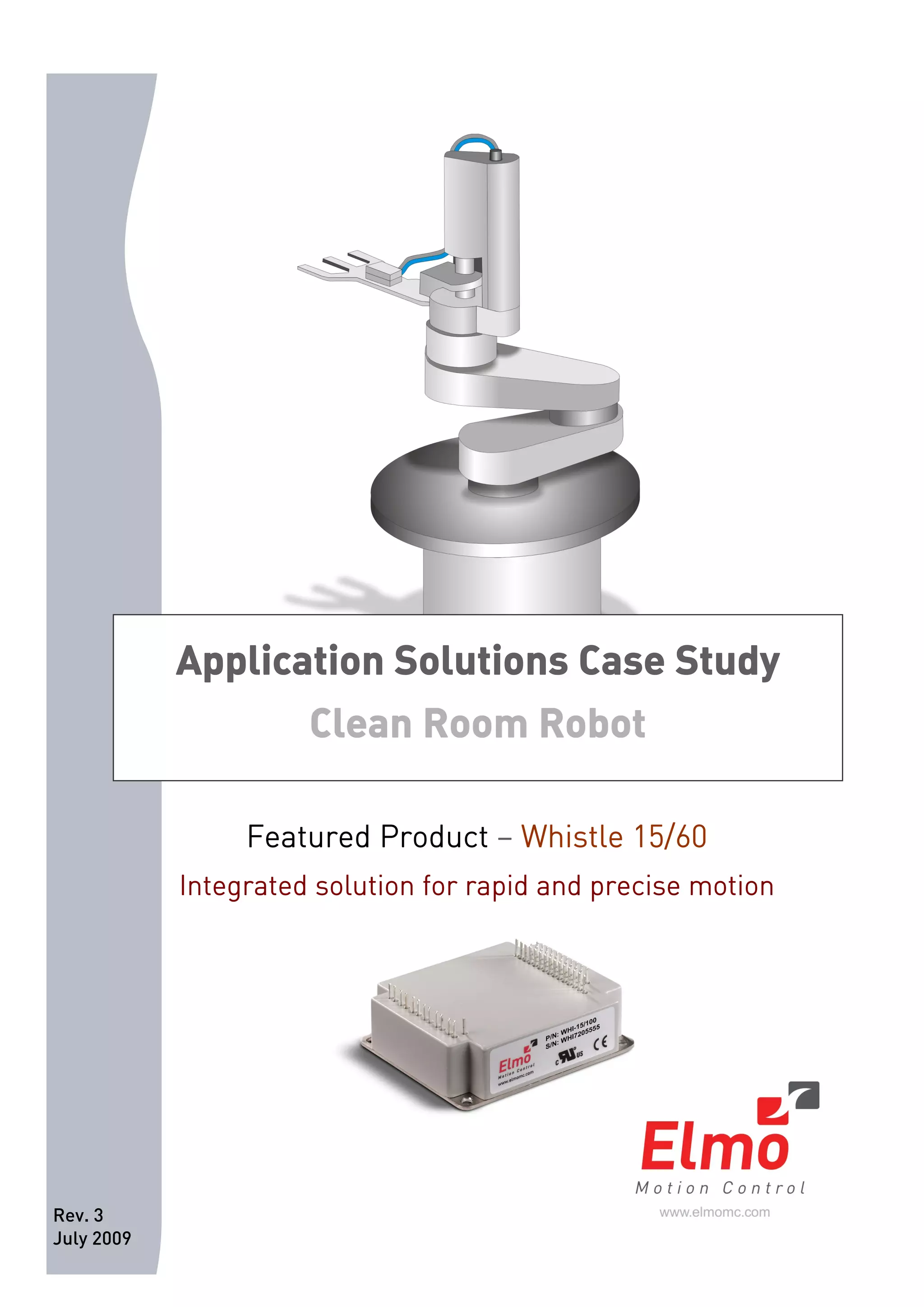
Clean Room Robot 
Featured Product – Whistle 15/60 
Integrated solution for rapid and precise motion
2 
The Requirement: Small Size, High Power 
Elmo's Whistle drives are intelligent, high power and compact 
drives. This case study shows how one of our customers, a large 
automation and robotics company, used them for a clean room 
robot application This paper will interest you if you would like to: 
• Get up to 3.3 kW peak power using a matchbox sized servo 
drive. 
• Place your drive almost anywhere on your machine. 
• Minimize your development time, resulting in short time-to-market. 
Clean Room Robot – Four Axes in a Limited 
Space 
Our customer was requested to build a robot that transfers LCD 
panels in a clean room. The application presented several 
challenges: 
• Smooth, fast movement – requires a drive that supplies 
enough power and has great motion control abilities. 
• Small size – as described below, much of the available space 
is taken by other parts of the system. 
• Good connectivity – the smart drive enabled quick and easy 
customization. 
• High reliability – clean rooms are expensive, so downtime is 
not tolerated. 
Machine Description 
The product in which Elmo’s Whistle drives have been integrated 
is an advanced robot that moves items very rapidly and places 
them with great precision. The robot is integrated into the 
workflow of automated machinery where LCD (Liquid Crystal 
Display) flat panels are manufactured in a clean room 
environment. The small LCD screens are used in a wide variety of 
products, such as smart mobile phones, PDAs( personal digital 
assistant) and Game Boys, etc. 
The advanced robot is produced by a large semiconductor 
company that specializes in automatic production machinery for 
clean rooms. 
During production, the LCD flat panels go through several 
processes that are carried out by different parts of the automatic 
clean room machinery. The robot transfers the LCD screens and 
“feeds” them into the machine. 
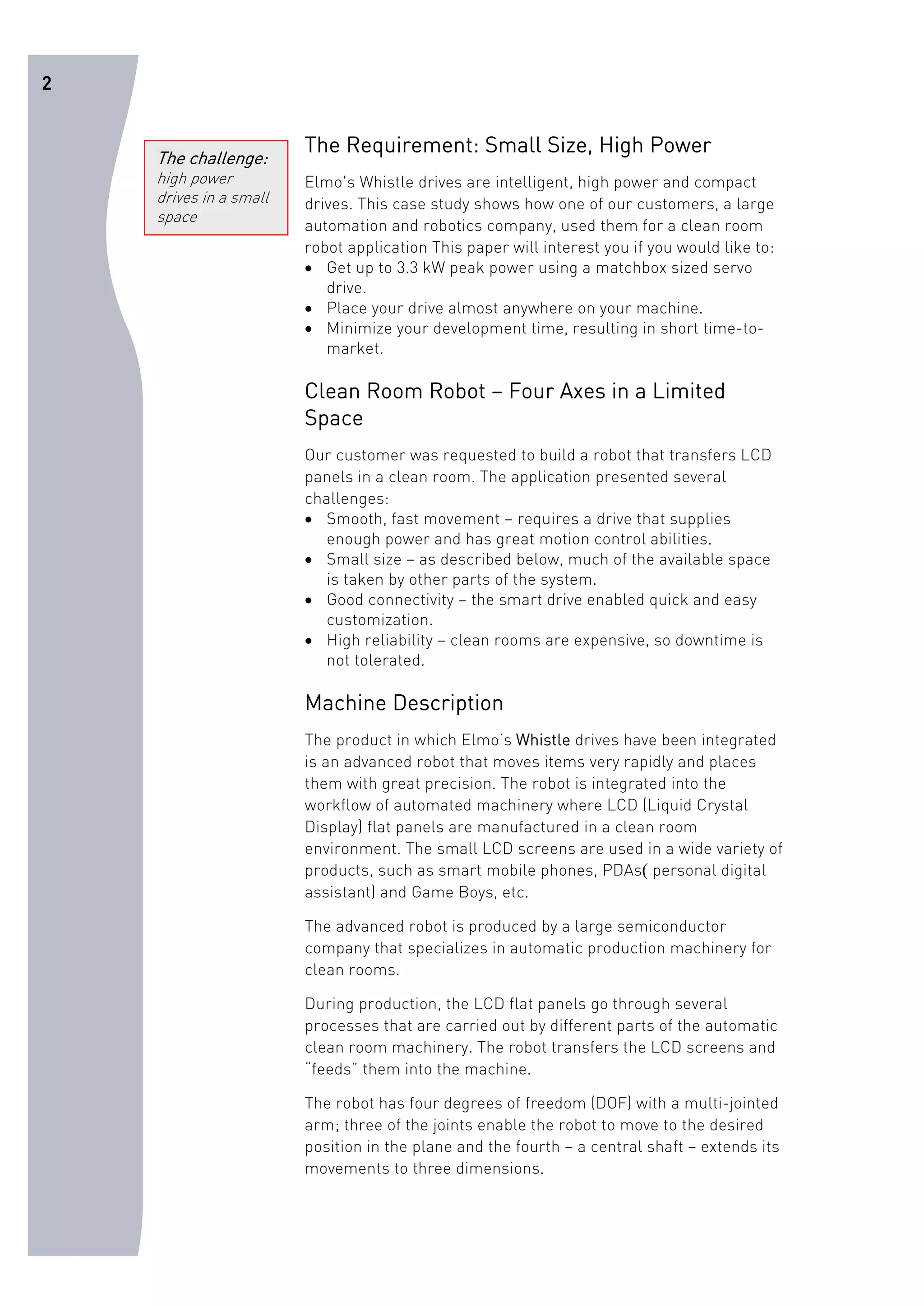
The robot has four degrees of freedom (DOF) with a multi-jointed 
arm; three of the joints enable the robot to move to the desired 
position in the plane and the fourth – a central shaft – extends its 
movements to three dimensions. 
The challenge: 
high power 
drives in a small 
space
3 
Precision, accuracy and speed are essential features that are 
required in this application. 
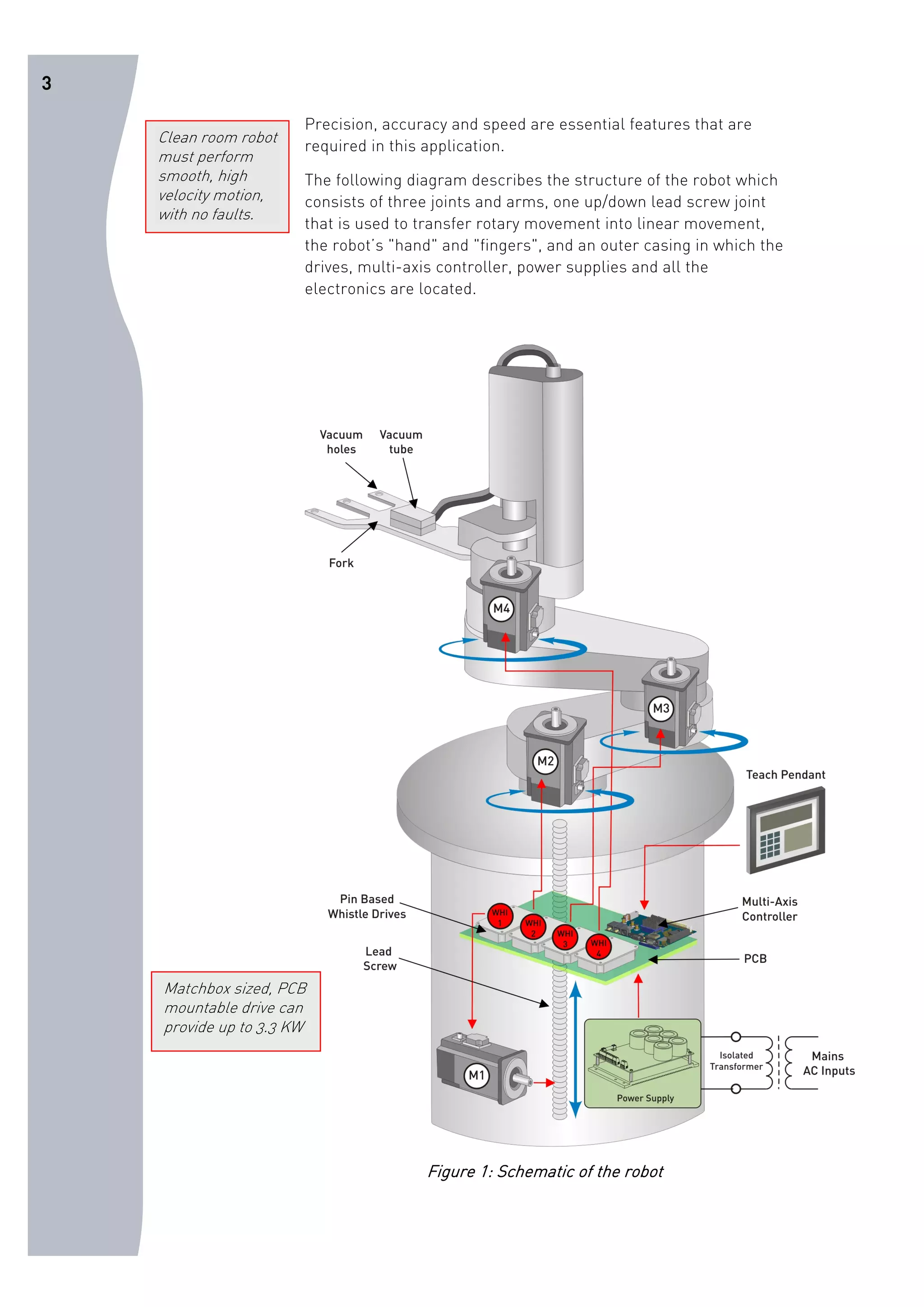
The following diagram describes the structure of the robot which 
consists of three joints and arms, one up/down lead screw joint 
that is used to transfer rotary movement into linear movement, 
the robot’s "hand" and "fingers", and an outer casing in which the 
drives, multi-axis controller, power supplies and all the 
electronics are located. 
Figure 1: Schematic of the robot 
Clean room robot 
must perform 
smooth, high 
velocity motion, 
with no faults. 
Matchbox sized, PCB 
mountable drive can 
provide up to 3.3 KW
4 
Challenges 
The robotics team had a number of design challenges, some of 
which are inherent in the requirements and some that arose 
during implementation. 
• Limited space: The size of the robot’s casing is fixed and 
cannot be altered, since it is part of a large clean room 
machine. Therefore, compact drives with a small footprint are 
essential in the application’s solution. 
• Accuracy and fast movement define the final throughput of the 
machine. 
• Reliable drives with a minimal failure rate and high 
MTBF(Mean time between failures) 
• The robot works as part of a machine that runs continuously 
for 24 hours a day, seven days per week. Any downtime in the 
process is very costly for the customer. 
• Integration of the drives as part of a multi-axis motion control 
system must be easy and simple. This significantly reduces 
the time and cost of R&D. 
• The robot requires three digital outputs: (1) Alarm, (2) Servo 
On/Off and (3) Brake. 
Elmo's Solution: PCB-mounted Drives 
The robot has a flat “hand” that is attached to the end point of the 
last joint of the arm. It consists of three broad, flat “fingers” and 
each "finger" has a small vacuum hole that enables it to hold a 
single LCD flat screen and transfer it safely into the station. The 
robot’s function is to slide the hand underneath three LCD 
screens that are ready to undergo the next stage in the 
production process, and transfer them from a rack into the next 
station in a fast, smooth and accurate manner. 
Four pin-based Whistle drives are integrated into a single PCB 
(Printed Circuit Board) designed by the customer. A centralized, 
multi-axis controller is integrated on the same PCB and it sends 
Pulse and Direction commands to the drives. A teach pendant is 
used to communicate with the multi-axis controller via an RS-232 
communication channel. At the beginning, the user "teaches" the 
robot how to move to the desired end points in space by 
programming and sending commands from the teach pendant to 
the multi-axis controller. The multi-axis controller calculates 
separately the motion trajectories required for each axis. When 
these trajectories are synchronized and coordinated, they enable 
the robot to automatically move to any position in the space.
5 
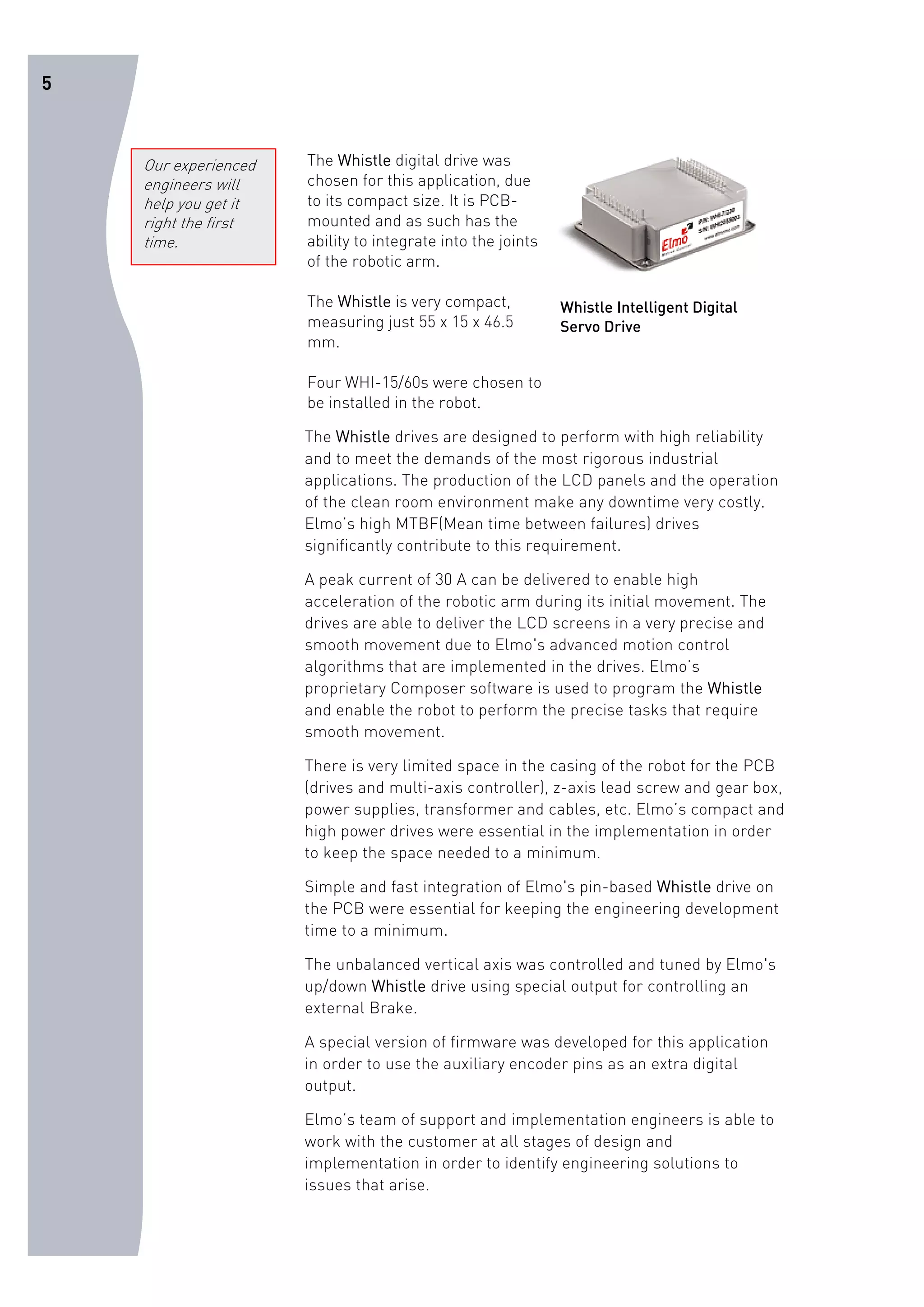
The Whistle digital drive was 
chosen for this application, due 
to its compact size. It is PCB-mounted 
and as such has the 
ability to integrate into the joints 
of the robotic arm. 
The Whistle is very compact, 
measuring just 55 x 15 x 46.5 
mm. 
Four WHI-15/60s were chosen to 
be installed in the robot. 
Whistle Intelligent Digital 
Servo Drive 
The Whistle drives are designed to perform with high reliability 
and to meet the demands of the most rigorous industrial 
applications. The production of the LCD panels and the operation 
of the clean room environment make any downtime very costly. 
Elmo’s high MTBF(Mean time between failures) drives 
significantly contribute to this requirement. 
A peak current of 30 A can be delivered to enable high 
acceleration of the robotic arm during its initial movement. The 
drives are able to deliver the LCD screens in a very precise and 
smooth movement due to Elmo's advanced motion control 
algorithms that are implemented in the drives. Elmo’s 
proprietary Composer software is used to program the Whistle 
and enable the robot to perform the precise tasks that require 
smooth movement. 
There is very limited space in the casing of the robot for the PCB 
(drives and multi-axis controller), z-axis lead screw and gear box, 
power supplies, transformer and cables, etc. Elmo’s compact and 
high power drives were essential in the implementation in order 
to keep the space needed to a minimum. 
Simple and fast integration of Elmo's pin-based Whistle drive on 
the PCB were essential for keeping the engineering development 
time to a minimum. 
The unbalanced vertical axis was controlled and tuned by Elmo's 
up/down Whistle drive using special output for controlling an 
external Brake. 
A special version of firmware was developed for this application 
in order to use the auxiliary encoder pins as an extra digital 
output. 
Elmo’s team of support and implementation engineers is able to 
work with the customer at all stages of design and 
implementation in order to identify engineering solutions to 
issues that arise. 
Our experienced 
engineers will 
help you get it 
right the first 
time.
6 
Why Elmo 
• Compact, pin-based, PCB-mounted products that have a small 
footprint. 
• High power density and intelligence within a small package. 
• Dedication of support engineers to the successful 
implementation of solutions. 
• Fast, precise and smooth motion control. 
• High reliability in demanding industrial environments. 
• Ease of integration into industrial robotics. 
• Standard communication protocols. 
For more information on Elmo: 
Elmo Motion Control Ltd. 
64 Gisin St., P.O. Box 463 
Petach Tikva 49103 
Israel 
Tel: +972 (3) 929-2300 
Fax: +972 (3) 929-2322 
info-il@elmomc.com 
Elmo Motion Control Inc. 
42 Technology Way, Nashua 
NH 03060 
USA 
Tel: +1 (603) 821-9979 
Fax: +1 (603) 821-9943 
info-us@elmomc.com 
Elmo Motion Control GmbH 
Steinkirchring 1 
D-78056, Villingen- 
Schwenningen 
Germany 
Tel: +49 (0) 7720-85 77 60 
Fax: +49 (0) 7720-85 77 70 
info-de@elmomc.com 
Elmo Motion Control Asia APAC 
#810, Tower Bldg, 769-10 
Jayang-dong, Gwangjin-gu, 
Seoul 
South Korea 
Tel: (82)-2-456-3183 
Fax: (82)-2-456-3186 
info-asia@elmomc.com 
www.elmomc.com

Motion control application for clean room robot

  • 1.
    Rev. 3 July2009 Application Solutions Case Study Clean Room Robot Featured Product – Whistle 15/60 Integrated solution for rapid and precise motion
  • 2.
    2 The Requirement:Small Size, High Power Elmo's Whistle drives are intelligent, high power and compact drives. This case study shows how one of our customers, a large automation and robotics company, used them for a clean room robot application This paper will interest you if you would like to: • Get up to 3.3 kW peak power using a matchbox sized servo drive. • Place your drive almost anywhere on your machine. • Minimize your development time, resulting in short time-to-market. Clean Room Robot – Four Axes in a Limited Space Our customer was requested to build a robot that transfers LCD panels in a clean room. The application presented several challenges: • Smooth, fast movement – requires a drive that supplies enough power and has great motion control abilities. • Small size – as described below, much of the available space is taken by other parts of the system. • Good connectivity – the smart drive enabled quick and easy customization. • High reliability – clean rooms are expensive, so downtime is not tolerated. Machine Description The product in which Elmo’s Whistle drives have been integrated is an advanced robot that moves items very rapidly and places them with great precision. The robot is integrated into the workflow of automated machinery where LCD (Liquid Crystal Display) flat panels are manufactured in a clean room environment. The small LCD screens are used in a wide variety of products, such as smart mobile phones, PDAs( personal digital assistant) and Game Boys, etc. The advanced robot is produced by a large semiconductor company that specializes in automatic production machinery for clean rooms. During production, the LCD flat panels go through several processes that are carried out by different parts of the automatic clean room machinery. The robot transfers the LCD screens and “feeds” them into the machine. The robot has four degrees of freedom (DOF) with a multi-jointed arm; three of the joints enable the robot to move to the desired position in the plane and the fourth – a central shaft – extends its movements to three dimensions. The challenge: high power drives in a small space
  • 3.
    3 Precision, accuracyand speed are essential features that are required in this application. The following diagram describes the structure of the robot which consists of three joints and arms, one up/down lead screw joint that is used to transfer rotary movement into linear movement, the robot’s "hand" and "fingers", and an outer casing in which the drives, multi-axis controller, power supplies and all the electronics are located. Figure 1: Schematic of the robot Clean room robot must perform smooth, high velocity motion, with no faults. Matchbox sized, PCB mountable drive can provide up to 3.3 KW
  • 4.
    4 Challenges Therobotics team had a number of design challenges, some of which are inherent in the requirements and some that arose during implementation. • Limited space: The size of the robot’s casing is fixed and cannot be altered, since it is part of a large clean room machine. Therefore, compact drives with a small footprint are essential in the application’s solution. • Accuracy and fast movement define the final throughput of the machine. • Reliable drives with a minimal failure rate and high MTBF(Mean time between failures) • The robot works as part of a machine that runs continuously for 24 hours a day, seven days per week. Any downtime in the process is very costly for the customer. • Integration of the drives as part of a multi-axis motion control system must be easy and simple. This significantly reduces the time and cost of R&D. • The robot requires three digital outputs: (1) Alarm, (2) Servo On/Off and (3) Brake. Elmo's Solution: PCB-mounted Drives The robot has a flat “hand” that is attached to the end point of the last joint of the arm. It consists of three broad, flat “fingers” and each "finger" has a small vacuum hole that enables it to hold a single LCD flat screen and transfer it safely into the station. The robot’s function is to slide the hand underneath three LCD screens that are ready to undergo the next stage in the production process, and transfer them from a rack into the next station in a fast, smooth and accurate manner. Four pin-based Whistle drives are integrated into a single PCB (Printed Circuit Board) designed by the customer. A centralized, multi-axis controller is integrated on the same PCB and it sends Pulse and Direction commands to the drives. A teach pendant is used to communicate with the multi-axis controller via an RS-232 communication channel. At the beginning, the user "teaches" the robot how to move to the desired end points in space by programming and sending commands from the teach pendant to the multi-axis controller. The multi-axis controller calculates separately the motion trajectories required for each axis. When these trajectories are synchronized and coordinated, they enable the robot to automatically move to any position in the space.
  • 5.
    5 The Whistledigital drive was chosen for this application, due to its compact size. It is PCB-mounted and as such has the ability to integrate into the joints of the robotic arm. The Whistle is very compact, measuring just 55 x 15 x 46.5 mm. Four WHI-15/60s were chosen to be installed in the robot. Whistle Intelligent Digital Servo Drive The Whistle drives are designed to perform with high reliability and to meet the demands of the most rigorous industrial applications. The production of the LCD panels and the operation of the clean room environment make any downtime very costly. Elmo’s high MTBF(Mean time between failures) drives significantly contribute to this requirement. A peak current of 30 A can be delivered to enable high acceleration of the robotic arm during its initial movement. The drives are able to deliver the LCD screens in a very precise and smooth movement due to Elmo's advanced motion control algorithms that are implemented in the drives. Elmo’s proprietary Composer software is used to program the Whistle and enable the robot to perform the precise tasks that require smooth movement. There is very limited space in the casing of the robot for the PCB (drives and multi-axis controller), z-axis lead screw and gear box, power supplies, transformer and cables, etc. Elmo’s compact and high power drives were essential in the implementation in order to keep the space needed to a minimum. Simple and fast integration of Elmo's pin-based Whistle drive on the PCB were essential for keeping the engineering development time to a minimum. The unbalanced vertical axis was controlled and tuned by Elmo's up/down Whistle drive using special output for controlling an external Brake. A special version of firmware was developed for this application in order to use the auxiliary encoder pins as an extra digital output. Elmo’s team of support and implementation engineers is able to work with the customer at all stages of design and implementation in order to identify engineering solutions to issues that arise. Our experienced engineers will help you get it right the first time.
  • 6.
    6 Why Elmo • Compact, pin-based, PCB-mounted products that have a small footprint. • High power density and intelligence within a small package. • Dedication of support engineers to the successful implementation of solutions. • Fast, precise and smooth motion control. • High reliability in demanding industrial environments. • Ease of integration into industrial robotics. • Standard communication protocols. For more information on Elmo: Elmo Motion Control Ltd. 64 Gisin St., P.O. Box 463 Petach Tikva 49103 Israel Tel: +972 (3) 929-2300 Fax: +972 (3) 929-2322 info-il@elmomc.com Elmo Motion Control Inc. 42 Technology Way, Nashua NH 03060 USA Tel: +1 (603) 821-9979 Fax: +1 (603) 821-9943 info-us@elmomc.com Elmo Motion Control GmbH Steinkirchring 1 D-78056, Villingen- Schwenningen Germany Tel: +49 (0) 7720-85 77 60 Fax: +49 (0) 7720-85 77 70 info-de@elmomc.com Elmo Motion Control Asia APAC #810, Tower Bldg, 769-10 Jayang-dong, Gwangjin-gu, Seoul South Korea Tel: (82)-2-456-3183 Fax: (82)-2-456-3186 info-asia@elmomc.com www.elmomc.com