
LONG TALK LISTENING IN PAPER
TOEFL TEST
NARGIS, M.HUM
In long conversation, you hear conversation
between two speakers, when you hear it, you
must able to summarize the main ideas. You
must also be asked to recall important details.
each conversation last from thirty to ninety
seconds.
The topic in Long Talk
• The conversations are often about some
aspect of school life (how difficult a class is,
• how to write a research paper, how to register
for a course).
• The conversations can also be about topics
currently in the news in the United States
(desalination of the water, supply, recycling of
used products, damage from a storm or some
other type of natural phenomenon).
The introductory comments
These comments tell you which talk refer
to and provide some information about
the conversations/talks. They also tell
you how many questions in your test
book to preview at one time. Moreover,
they give you a general ideas of what to
expect as you listen and is usually asked
in the first question in the long talk.
The questions
• Type questions
• Topic question
• Question about setting
(time and location)
Questions about the
speakers
• Sample questions
• What are the speakers
discussing ?
• When/ where did the
conversation take
place?
• Who are the speakers ?
• What are the probable
relationship between
the speakers ?
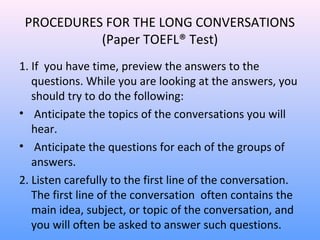
PROCEDURES FOR THE LONG CONVERSATIONS
(Paper TOEFL® Test)
1. If you have time, preview the answers to the
questions. While you are looking at the answers, you
should try to do the following:
• Anticipate the topics of the conversations you will
hear.
• Anticipate the questions for each of the groups of
answers.
2. Listen carefully to the first line of the conversation.
The first line of the conversation often contains the
main idea, subject, or topic of the conversation, and
you will often be asked to answer such questions.
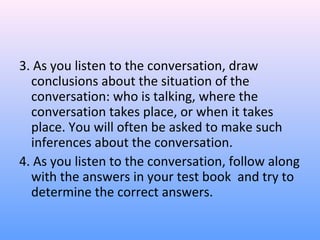
3. As you listen to the conversation, draw
conclusions about the situation of the
conversation: who is talking, where the
conversation takes place, or when it takes
place. You will often be asked to make such
inferences about the conversation.
4. As you listen to the conversation, follow along
with the answers in your test book and try to
determine the correct answers.
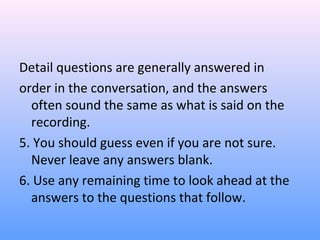
Detail questions are generally answered in
order in the conversation, and the answers
often sound the same as what is said on the
recording.
5. You should guess even if you are not sure.
Never leave any answers blank.
6. Use any remaining time to look ahead at the
answers to the questions that follow.
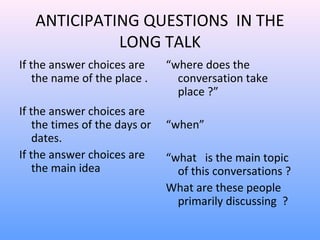
ANTICIPATING QUESTIONS IN THE
LONG TALK
If the answer choices are
the name of the place .
If the answer choices are
the times of the days or
dates.
If the answer choices are
the main idea
“where does the
conversation take
place ?”
“when”
“what is the main topic
of this conversations ?
What are these people
primarily discussing ?
DRAW CONCLUSIONS ABOUT WHO,
WHAT, WHEN, WHERE
• As you listen to each long conversation, you
should be trying to set the situation in your mind.
You should be thinking the following thoughts:
• Who is talking ?
• what is the man/woman’s occupation ?
• What is one speaker’s attitude toward the other
speaker ?
• What is the source of information for the
conversation ?
LISTEN FOR ANSWERS IN ORDER
There are two possible methods to use while
you listen to a long conversation:
1. You can just listen to the conversation (and
ignore the answers)
• Some students prefer to just listen to the
conversation while it is being spoken, and if
that method works well for you, then that is
what you should do.
2. You can follow along with the answers while
you listen.
• Other students find that they can answer
more questions correctly if they read along
with the answers while the conversation is
being spoken. Because the detail questions
are answered in order, it is possible to read
along while you listen to the conversation on
the recording.
Example from the Paper TOEFL® Test
On the recording, you hear:
(narrator) Questions 1 through 4. Listen to a conversation between a
professor and a student.
• (man) : Hello, Professor Denton. Are you free for a moment?
Could I have a word with you ?
• (woman) : Come on in, Michael. Of course I have some time. These
are my office hours, and this is the right time for you to come and ask
questions. Now, how can I help you ?
• (man) : Well, I have a quick question for you about the
homework
Assignment for tomorrow. I thought the assignment was to answer the
first three questions at the top of page 67
Example from the Paper TOEFL® Test
(man) : in the text, but when I looked,
there weren't any questions there. I'm
confused.
• (woman) : The assignment was to answer the
first three questions at the top of page 76, not
67.
• (man) : Oh, now I understand. I'm glad I
came in to check. Thanks for your help.
• (woman) : No problem. See you tomorrow.
• Questions:
1. On the recording, you hear:
(narrator) Who is the man ?
In your test book, you read:
• (A) A professor
• (B) An office worker
• (C) Professor Denton's assistant
• (D) A student
2. On the recording, you hear:
• (narrator) When does the man come to see
Professor Denton?
• In your test book, you read:
• (A) During regular class hours
• (B) Just before class time
• (C) As soon as class is finished
• (D) During office hours
3. On the recording, you hear:
• (narrator) Why does the man come to see
Professor Denton ?
• In your test book, you read:
• (A) To turn in an assignment
• (B) To ask a question
• (C) To pick up a completed test
• (D) To explain why he did not attend class
Next..
4. On the recording, you hear:
• (narrator) What incorrect information did the
man have?
• In your test book, you read:
• (A) The date the assignment was due
• (B) The page number of the assignment
• (C) The length of the assignment
• (D) The numbers of the assignment questions
Example from the Paper TOEFL®
Test
• Questions 31 through 34 based on the
following conversation.
• Example
• Man : Did you see that TV program
last night about the sky diver whose
parachutes Didn’t open after he had jumped
from his plane.
• Woman : No I didn’t. Did he die ?
• Man : No, it’s really unbelievable
how he could survive such a free fall, much
less live to tell about it on television.
• Woman : What happened ?
• Man : Neither of his parachutes
opened as he plummeted to the ground.
When they Found him, they thought he was
dead. Doctors said he’d never walk again, but
he proved them wrong.
• Woman : How long he recuperating ?
• Man : He spent 18 months in the
hospital: while his broken bones were
mending. He was sooner discharged that he
jumped out of a plane again.
• Woman : Gee, some people sure do the crazy
thing.
Questions
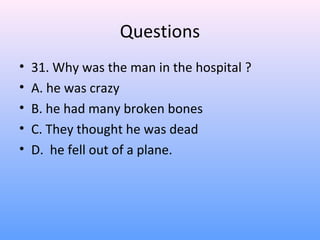
• 31. Why was the man in the hospital ?
• A. he was crazy
• B. he had many broken bones
• C. They thought he was dead
• D. he fell out of a plane.
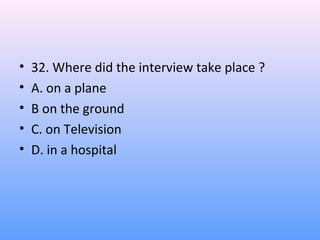
• 32. Where did the interview take place ?
• A. on a plane
• B on the ground
• C. on Television
• D. in a hospital
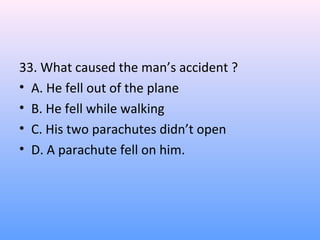
33. What caused the man’s accident ?
• A. He fell out of the plane
• B. He fell while walking
• C. His two parachutes didn’t open
• D. A parachute fell on him.
34. What caused the man’s accident ?
• A. He fell out of the plane
• B. He fell while walking
• C. His two parachutes didn’t open
D. A parachute fell on him.
Reference books
Deborah Philips (2001) Complete Course for
the TOEFL Test. Preparation for Computer and
paper test. Longman
ELI-GMU JAKARTA TOEFL TWO. knowledge is
power. (2015)

Sesi 9 long talk listening

  • 1.
    LONG TALK LISTENINGIN PAPER TOEFL TEST NARGIS, M.HUM
  • 2.
    In long conversation,you hear conversation between two speakers, when you hear it, you must able to summarize the main ideas. You must also be asked to recall important details. each conversation last from thirty to ninety seconds.
  • 3.
    The topic inLong Talk • The conversations are often about some aspect of school life (how difficult a class is, • how to write a research paper, how to register for a course). • The conversations can also be about topics currently in the news in the United States (desalination of the water, supply, recycling of used products, damage from a storm or some other type of natural phenomenon).
  • 4.
    The introductory comments Thesecomments tell you which talk refer to and provide some information about the conversations/talks. They also tell you how many questions in your test book to preview at one time. Moreover, they give you a general ideas of what to expect as you listen and is usually asked in the first question in the long talk.
  • 5.
    The questions • Typequestions • Topic question • Question about setting (time and location) Questions about the speakers • Sample questions • What are the speakers discussing ? • When/ where did the conversation take place? • Who are the speakers ? • What are the probable relationship between the speakers ?
  • 6.
    PROCEDURES FOR THELONG CONVERSATIONS (Paper TOEFL® Test) 1. If you have time, preview the answers to the questions. While you are looking at the answers, you should try to do the following: • Anticipate the topics of the conversations you will hear. • Anticipate the questions for each of the groups of answers. 2. Listen carefully to the first line of the conversation. The first line of the conversation often contains the main idea, subject, or topic of the conversation, and you will often be asked to answer such questions.
  • 7.
    3. As youlisten to the conversation, draw conclusions about the situation of the conversation: who is talking, where the conversation takes place, or when it takes place. You will often be asked to make such inferences about the conversation. 4. As you listen to the conversation, follow along with the answers in your test book and try to determine the correct answers.
  • 8.
    Detail questions aregenerally answered in order in the conversation, and the answers often sound the same as what is said on the recording. 5. You should guess even if you are not sure. Never leave any answers blank. 6. Use any remaining time to look ahead at the answers to the questions that follow.
  • 9.
    ANTICIPATING QUESTIONS INTHE LONG TALK If the answer choices are the name of the place . If the answer choices are the times of the days or dates. If the answer choices are the main idea “where does the conversation take place ?” “when” “what is the main topic of this conversations ? What are these people primarily discussing ?
  • 10.
    DRAW CONCLUSIONS ABOUTWHO, WHAT, WHEN, WHERE • As you listen to each long conversation, you should be trying to set the situation in your mind. You should be thinking the following thoughts: • Who is talking ? • what is the man/woman’s occupation ? • What is one speaker’s attitude toward the other speaker ? • What is the source of information for the conversation ?
  • 11.
    LISTEN FOR ANSWERSIN ORDER There are two possible methods to use while you listen to a long conversation: 1. You can just listen to the conversation (and ignore the answers) • Some students prefer to just listen to the conversation while it is being spoken, and if that method works well for you, then that is what you should do.
  • 12.
    2. You canfollow along with the answers while you listen. • Other students find that they can answer more questions correctly if they read along with the answers while the conversation is being spoken. Because the detail questions are answered in order, it is possible to read along while you listen to the conversation on the recording.
  • 13.
    Example from thePaper TOEFL® Test On the recording, you hear: (narrator) Questions 1 through 4. Listen to a conversation between a professor and a student. • (man) : Hello, Professor Denton. Are you free for a moment? Could I have a word with you ? • (woman) : Come on in, Michael. Of course I have some time. These are my office hours, and this is the right time for you to come and ask questions. Now, how can I help you ? • (man) : Well, I have a quick question for you about the homework Assignment for tomorrow. I thought the assignment was to answer the first three questions at the top of page 67
  • 14.
    Example from thePaper TOEFL® Test (man) : in the text, but when I looked, there weren't any questions there. I'm confused. • (woman) : The assignment was to answer the first three questions at the top of page 76, not 67. • (man) : Oh, now I understand. I'm glad I came in to check. Thanks for your help. • (woman) : No problem. See you tomorrow.
  • 15.
    • Questions: 1. Onthe recording, you hear: (narrator) Who is the man ? In your test book, you read: • (A) A professor • (B) An office worker • (C) Professor Denton's assistant • (D) A student
  • 16.
    2. On therecording, you hear: • (narrator) When does the man come to see Professor Denton? • In your test book, you read: • (A) During regular class hours • (B) Just before class time • (C) As soon as class is finished • (D) During office hours
  • 17.
    3. On therecording, you hear: • (narrator) Why does the man come to see Professor Denton ? • In your test book, you read: • (A) To turn in an assignment • (B) To ask a question • (C) To pick up a completed test • (D) To explain why he did not attend class
  • 18.
    Next.. 4. On therecording, you hear: • (narrator) What incorrect information did the man have? • In your test book, you read: • (A) The date the assignment was due • (B) The page number of the assignment • (C) The length of the assignment • (D) The numbers of the assignment questions
  • 19.
    Example from thePaper TOEFL® Test • Questions 31 through 34 based on the following conversation. • Example • Man : Did you see that TV program last night about the sky diver whose parachutes Didn’t open after he had jumped from his plane. • Woman : No I didn’t. Did he die ?
  • 20.
    • Man :No, it’s really unbelievable how he could survive such a free fall, much less live to tell about it on television. • Woman : What happened ? • Man : Neither of his parachutes opened as he plummeted to the ground. When they Found him, they thought he was dead. Doctors said he’d never walk again, but he proved them wrong.
  • 21.
    • Woman :How long he recuperating ? • Man : He spent 18 months in the hospital: while his broken bones were mending. He was sooner discharged that he jumped out of a plane again. • Woman : Gee, some people sure do the crazy thing.
  • 22.
    Questions • 31. Whywas the man in the hospital ? • A. he was crazy • B. he had many broken bones • C. They thought he was dead • D. he fell out of a plane.
  • 23.
    • 32. Wheredid the interview take place ? • A. on a plane • B on the ground • C. on Television • D. in a hospital
  • 24.
    33. What causedthe man’s accident ? • A. He fell out of the plane • B. He fell while walking • C. His two parachutes didn’t open • D. A parachute fell on him.
  • 25.
    34. What causedthe man’s accident ? • A. He fell out of the plane • B. He fell while walking • C. His two parachutes didn’t open D. A parachute fell on him.
  • 26.
    Reference books Deborah Philips(2001) Complete Course for the TOEFL Test. Preparation for Computer and paper test. Longman ELI-GMU JAKARTA TOEFL TWO. knowledge is power. (2015)